Java and XML
Copyright © 2000 O'Reilly & Associates, Inc. All rights reserved. Printed in the United States of America.
Published by O'Reilly & Associates, Inc., 101 Morris Street, Sebastopol, CA 95472. The Java™ Series is a trademark of O'Reilly & Associates, Inc. Java™ and all Java-based trademarks and logos are trademarks or registered trademarks of Sun Microsystems, Inc., in the United States and other countries. O'Reilly & Associates, Inc. is independent of Sun Microsystems. The O'Reilly logo is a registered trademark of O'Reilly & Associates, Inc. Many of the designations used by manufacturers and sellers to distinguish their products are claimed as trademarks. Where those designations appear in this book, and O'Reilly & Associates, Inc. was aware of a trademark claim, the designations have been printed in caps or initial caps. The association between the image of a Tupperware SHAPE-O® and Java™ and XML is a trademark of O'Reilly & Associates, Inc. SHAPE-O® is a registered trademark of Dart Industries Inc. (Tupperware Worldwide) and is used with permission.
While every precaution has been taken in the preparation of this book, the publisher assumes no responsibility for errors or omissions, or for damages resulting from the use of the information contained herein.
Preface
...
5
Organization
...
6
Who Should Read This Book?
...
8
Software and Versions
...
8
Conventions Used in This Book
...
9
Comments and Questions
...
9
Acknowledgments
...
10
Chapter 1. Introduction
...
11
What Is It?
...
12
How Do I Use It?
...
19
Why Should I Use It?
...
21
What’s Next?
...
33
Chapter 2. Creating XML
...
33
An XML Document
...
34
An XML Document
...
35
The Content
...
36
What’s Next?
...
43
Chapter 3. Parsing XML
...
43
Getting Prepared
...
43
SAX Readers
...
45
Content Handlers
...
49
Error Handlers
...
64
Error Handlers
...
70
"Gotcha!"
...
76
What’s Next?
...
79
Chapter 4. Constraining XML
...
79
Why Constrain XML Data?
...
79
Document Type Definitions
...
82
XML Schema
...
94
What’s Next?
...
106
Chapter 5. Validating XML
...
106
Configuring the Parser
...
106
Output of XML Validation
...
110
The DTDHandler Interface
...
114
"Gotcha!"
...
116
What’s Next?
...
118
Chapter 6. Transforming XML
...
118
The Components
...
120
The Syntax
...
123
What’s Next?
...
140
Chapter 7. Traversing XML
...
140
Getting the Output
...
141
Getting the Input
...
143
The Document Object Model (DOM)
...
144
"Gotcha!"
...
158
What’s Next?
...
160
Chapter 8. JDOM
...
160
Parsers and the Java API for XML Parsing
...
161
JDOM: Another API?
...
164
What’s in a Name?
...
164
Getting a Document
...
166
Using a Document
...
169
Outputting a Document
...
177
What’s Next?
...
184
Chapter 9. Web Publishing Frameworks
...
184
Selecting a Framework
...
185
Installation
...
187
Using a Publishing Framework
...
193
XSP
...
204
Cocoon 2.0 and Beyond
...
217
What’s Next?
...
219
Chapter 10. XML-RPC
...
219
RPC Versus RMI
...
220
Saying Hello
...
222
Putting the Load on the Server
...
232
The Real World
...
246
What’s Next?
...
249
Chapter 11. XML for Configurations
...
249
EJB Deployment Descriptors
...
250
Creating an XML Configuration File
...
252
Reading an XML Configuration File
...
257
The Real World
...
265
What’s Next?
...
273
Chapter 12. Creating XML with Java
...
273
Modifying the Data
...
282
XML from Scratch
...
287
The Real World
...
288
What’s Next?
...
295
Chapter 13. Business-to-Business
...
295
The Foobar Public Library
...
296
mytechbooks.com
...
304
Push Versus Pull
...
311
The Real World
...
322
What’s Next?
...
322
Chapter 14. XML Schema
...
323
To DTD or Not To DTD
...
323
Java Parallels
...
325
What’s Next?
...
332
Appendix A. API Reference
...
332
A.1 SAX 2.0
...
332
A.2 DOM Level 2
...
343
A.3 JAXP 1.0
...
349
A.4 JDOM 1.0
...
351
Appendix B. SAX 2.0 Features and Properties
...
358
B.1 Core Features
...
358
Preface
XML, XML, XML, XML. You can see it on hats and t-shirts, read about it on the cover of every technical magazine on the planet, and hear it on the radio or the occasional Gregorian chant album. . . . Well, maybe it hasn't gone quite that far yet, but don't be surprised if it does. XML, the
Extensible Markup Language, has seemed to take over every aspect of technical life, particularly in the Java™ community. An application is no longer considered an enterprise-level product if XML isn't being used somewhere. Legacy systems are being accessed at a rate never before seen, and companies are saving millions and even billions of dollars on system integration, all because of three little letters. Java developers wake up with fever sweats wondering how they are going to absorb yet another technology, and the task seems even more daunting when embarked upon; the road to XML mastery is lined with acronyms: XML, XSL, XPath, RDF, XML Schema, DTD, PI, XSLT, XSP, JAXP™, SAX, DOM, and more. And there isn't a development manager in the world who doesn't want his or her team learning about XML today!
When XML became a formal specification at the World Wide Web Consortium in early 1998, relatively few were running in the streets claiming that the biggest thing since Java itself (arguably bigger!) had just made its way onto the technology stage. Barely two years later, XML and a barrage of related technologies for manipulating and constraining XML have become the mainstay of data representation for Java systems. XML promises to bring to a data format what Java brought to a programming language: complete portability. In fact, it is only with XML that the promise of Java is realized; Java's portability has been seriously compromised as proprietary data formats have been used for years, enabling an application to run on multiple platforms, but not across businesses in a standardized way. XML promises to fill this gap in complete interoperability for Java programs by removing these proprietary data formats and allowing systems to communicate using a standard means of data representation.
This is a book about XML, but it is geared specifically towards Java developers. While both XML and Java are powerful tools in their own right, it is their marriage that this book is concerned with, and that gives XML its true power. We will cover the various XML vocabularies, look at creating, constraining, and transforming XML, and examine all of the APIs for handling XML from Java code. Additionally, we cover the hot topics that have made XML such a popular solution for dynamic content, messaging, e-business, and data stores. Through it all, we take a very narrow view: that of the developer who has to put these tools to work. A candid look at the tools XML provides is given, and if something is not useful (even if it is popular!), we will address it and move on. If a particular facet of XML is a hidden gem, we will extract the value of the item and put it to use. Java and XML is meant to serve as a handbook to help you, and is neither a reference nor a book geared towards marketing XML.
Finally, the back half of this book is filled with working, practical code. Although available for download, the purpose of this code is to walk you through creating several XML applications, and you are encouraged to follow along with the examples rather than skimming the code. We introduce a new API for manipulating XML from Java as well, and complete coverage and examples are included. This book is for you, the Java developer, and it is about the real world; it is not a theoretical or fanciful flight through what is "cool" in the industry. We abandon buzzwords when possible, and define them clearly when not. All of the code and concepts within this book have been entered by hand into an editor, prodded and tested, and are intended to aid you on the path to
Organization
This book is structured in a very particular way: the first half of the book (Chapter 1 through
Chapter 7) focuses on getting you grounded in XML and the core Java APIs for handling XML.
Although these chapters are not glamorous, they should be read in order, and at least skimmed even if you are familiar with XML. We cover the basics, from creating XML to transforming it. Chapter 8 serves as a halfway point in the book, covering an exciting new API for handling XML within Java, JDOM. This chapter is a must-read, as the API is being publicly released as this book goes to production, and this is the reference for JDOM 1.0 (as I wrote the API with Jason Hunter
specifically for solving problems in using Java and XML!). The remainder of the book, Chapter 9
through Chapter 14, focuses on specific XML topics that continually are brought up at conferences and tutorials I am involved with, and seeks to get you neck-deep in using XML in your applications, now! Finally, there are two appendixes to wrap up the book. Here's a summary of the contents:
Chapter 1
We look at what all the hype is about, examine the XML alphabet soup, and spend time discussing why XML is so important to the present and future of enterprise development.
Chapter 2
We start looking at XML by building an XML document from the ground up. Examination of the major XML constructs, such as elements, attributes, entities, and processing
instructions is included.
Chapter 3
The Simple API for XML (SAX), our first Java API for handling XML, is introduced and covered in this chapter. The parsing lifecycle is detailed, and the events that can be reported by SAX and used by developers are demonstrated.
Chapter 4
In this chapter, we look at the two ways to impose constraints on XML documents:
Document Type Definitions (DTDs) and XML Schema. We will dissect the differences and analyze when one should be used over the other.
Chapter 5
Complementing Chapter 4, this chapter looks at how to use the SAX skills previously learned to enforce validation constraints, as well as how to react when constraints are not met by XML documents.
Chapter 6
In this chapter, the Extensible Stylesheet Language (XSL) and the other critical components for transforming XML from one format into another are introduced. We cover the various methods available for converting XML into other textual formats, and look at using formatting objects to convert XML into binary formats.
Continuing to look at transforming XML documents, we discuss XSL transformation processors and how they can be used to convert XML into other formats. We also examine the Document Object Model (DOM) and how it can be used for handling XML data.
Chapter 8
We begin by looking at the Java API for XML Parsing ( JAXP), and discuss the importance of vendor-independence when using XML. I then introduce the JDOM API, discuss the motivation behind its development, and detail its use, comparing it to SAX and DOM.
Chapter 9
This chapter looks at what a web publishing framework is, why it matters to you, and how to choose a good one. We then cover the Apache Cocoon framework, taking an in-depth look at its feature set and how it can be used to serve highly dynamic content over the Web.
Chapter 10
In this chapter, we cover Remote Procedure Calls (RPC), their relevance in distributed computing as compared to RMI, and how XML makes RPC a viable solution for some problems. We then look at using XML-RPC Java libraries and building XML-RPC clients and servers.
Chapter 11
In this chapter, we look at using configuration data in an XML format and why that format is so important to cross-platform applications, particularly as it relates to distributed systems.
Chapter 12
Although this topic is covered in part in other chapters, here we look at the process of generating and mutating XML from Java and how to perform these modifications from server-side components such as Java servlets, and outline concerns when mutating XML.
Chapter 13
This chapter details a "case study" of creating inter- and intra-business communication channels using XML as a portable data format. Using multiple languages, we build several application components for different companies that all interact with each other using XML.
Chapter 14
We revisit XML Schema here, looking at why the XML Schema specification has garnered so much attention and how reality measures up to the promise of the XML Schema concept, and examining why Java and XML Schema are such complementary technologies.
Appendix A
Appendix B
This appendix details the features and properties available to SAX 2.0 parser implementations.
Who Should Read This Book?
This entire book is based on the premise that XML is quickly becoming an essential part of Java programming. The chapters are written to instruct you in the use of XML and Java, and other than in the introduction, they do not focus on if you should use XML. I believe that if you are a Java developer, you should use XML, without question. For this reason, if you are a Java programmer, want to be a Java programmer, manage Java programmers, or are responsible for or associated with a Java project, this book is for you. If you want to advance, want to become a better developer, want to write cleaner code, want to have projects succeed on time and under budget, need to access legacy data, need to distribute system components, or just want to know what the XML hype is about, this book is for you.
I tried to make as few assumptions about you as possible; I don't believe in setting the entry point for XML so high that it is impossible to get started. However, I also believe that if you spent your money on this book, you want more than the basics. For this reason, I assumed only that you know the Java language and understand some server-side programming concepts (such as Java servlets and Enterprise JavaBeans™). If you have never coded Java before or are just getting started with the language, you may want to read through Learning Java, by Pat Niemeyer and Jonathan
Knudsen (O'Reilly & Associates), before starting this book. I do not assume that you know anything about XML, and so I start with the basics. However, I do assume that you are willing to work hard and learn quickly; for this reason, we move rapidly through the basics so that the bulk of the book can deal with advanced concepts. Material is not repeated unless appropriate, so you may need to re-read previous sections or be prepared to flip back and forth, as previously covered concepts are used in later chapters. If you want to learn XML, know some Java, and are prepared to enter some example code into your favorite editor, you should be able to get through this book without any real problem.
Software and Versions
This book covers XML 1.0 and the various XML vocabularies in their latest form as of April 2000. Because various XML specifications that are covered are not final, minor inconsistencies may be present between printed publications of this book and the current version of the specification in question.
All of the Java code used is based on the Java 1.1 platform, with the exception of the JDOM 1.0 coverage. This variance with regard to JDOM is noted in the text in Chapter 8, and addressed there. The Apache Xerces parser, Apache Xalan processor, and Apache FOP libraries were the latest stable versions available as of April 2000, and the Apache Cocoon web publishing framework used was Version 1.7.3. The XML-RPC Java libraries used were Version 1.0 beta 3. All software used is freely available and can be obtained online from http://java.sun.com, http://xml.apache.org, and
http://www.xml-rpc.com.
The source code for the examples in this book, including the com.oreilly.xml utility classes, is contained completely within the book itself. Both source and binary forms of all examples (including extensive Javadoc not necessarily included in the text) are available online from
could run as servlets, or be converted to run as servlets, can be viewed and used online at
http://www.newInstance.com.
The complete JDOM 1.0 distribution, including the specification, reference implementation, source code, API documentation, and binary release, is available for download online at
http://www.jdom.org. Additionally, a CVS tree is being set up to host the JDOM code and allow
community contribution and comment. See http://www.jdom.org for details on accessing JDOM from CVS.
Conventions Used in This Book
I use the following font conventions in this book.
Italic is used for:
• Unix pathnames, filenames, and program names
• Internet addresses, such as domain names and URLs
• New terms where they are defined Constant Width is used for:
• Command lines and options that should be typed verbatim
• Names and keywords in Java programs, including method names, variable names, and class names
• XML element names and tags, attribute names, and other XML constructs that appear as they would within an XML document
Constant Width Bold
is used for:
• Additions to code examples
• Parts of code examples that are discussed specifically in the text Comments and Questions
Please address comments and questions concerning this book to the publisher: O'Reilly & Associates, Inc.
101 Morris Street Sebastopol, CA 95472
(800) 998-9938 (in the U.S. or Canada) (707) 829-0515 (international or local) (707) 829-0104 (fax)
You can also send us messages electronically. To be put on our mailing list or to request a catalog, send email to:
To ask technical questions or comment on the book, send email to:
We have a web site for the book, where we'll list errata and any plans for future editions. You can access this page at:
http://www.oreilly.com/catalog/javaxml
For more information about this book and others, see the O'Reilly web site at:
http://www.oreilly.com
Acknowledgments
As I look at the stack of pages that comprise the manuscript of this book, it seems absurd to try and thank all the people involved in making this book in only a few paragraphs. However, as this is arguably simpler than covering the entire realm of Java and XML in just under 500 pages, I am certainly willing to attempt it; for those of you I forget, please forgive me in advance!
This book was initiated by a call on Thanksgiving weekend, 1999, from my editor, Mike Loukides, which came as I was feverishly writing another book for O'Reilly. I was a bit dubious about putting a book I was very passionate about on hold for six months, but Mike was as adept at convincing me of the importance of this book as he has been at editing my words and making them useful. As I look back, this was easily the most enjoyable and exciting thing I have ever done in my technical career, and I owe much of that experience to Mike; he guided me through a very difficult first few chapters, allowed me to vent when I had to revise the XML Schema chapter three (yes, three!) times due to revisions of the specification coming out, and was also an all-around musical guy when I needed to take a break. Without him, this would certainly not be the high-quality book we both believe it is.
Additionally, I had a supporting cast of family and friends that made the amount of time and effort needed to make this book happen possible, and even enjoyable. My mom and dad, who corrected my grammar daily for eighteen years of my life; my aunt, who was always excited for me even when she didn't know what I was talking about; Jody Durrett, Carl Henry, and Pam Merryman, who spent more time making me a good writer than I had any right to expect; Gary and Shirley
Greathouse, who always reminded me to never settle; and my grandparents, Dean and Gladys McLaughlin, who were always there in the wings supporting me.
I had an incredible group of technical reviewers, who made this book both accurate and relevant: Marc Loy, Don Weiss, George Reese (who managed to get an entire chapter added in response to his comments!), Matthew Merlo, and James Duncan Davidson. James in particular was helpful, as his willingness to correct minor errors and be brutally honest with me was instrumental in
reminding me that I am a developer before I am a writer.
I also owe an incredible debt of gratitude to Jason Hunter, author of Java Servlet Programming
(O'Reilly & Associates). This book, though started in November of 1999, experienced a rebirth in March of 2000 as Jason and I spent an entire afternoon sitting on a lawn in Santa Clara griping about the current Java API offerings for XML. The result of this discussion was twofold: first, we developed the JDOM API, covered in this book (with help and encouragement from James
Davidson at Sun Microsystems). We believe that this API will be instrumental in bringing Java and XML more in line with each other, as well as keeping the focus of using XML on the Java
hours into the night across the country about how to make JDOM and other code samples work in an intuitive way.
Most importantly, I owe everything in these pages to my wife, Leigh. Miraculously, she has
managed to not kick me out of the house over the last six months, as I have been tired, inaccessible, and extremely busy almost constantly. The few moments I had with her away from writing and my full-time consulting job have been what made everything worthwhile. I have missed her terribly, and am anxious to return to spending time with her, my three basset hounds (Charlie, Molly, and Daisy), and my labs (Seth and Moses).
And to my grandfather, Robert Earl Burden, who didn't get to see this, you are everything that I have ever wanted to be; thanks for teaching me that other people's expectations were always lower than I should be satisfied with.
Chapter 1. Introduction
XML. These three letters have brought shivers to almost every developer in the world today at some point in the last two years. While those shivers were often fear at another acronym to memorize, excitement at the promise of a new technology, or annoyance at another source of confusion for today's developer, they were shivers all the same. Surprisingly, almost every type of response was well merited with regard to XML. It is another acronym to memorize, and in fact brings with it a dizzying array of companions: XSL, XSLT, PI, DTD, XHTML, and more. It also brings with it a huge promise: what Java did for portability of code, XML claims to do for portability of data. Sun has even been touting the rather ambitious slogan "Java + XML = Portable Code + Portable Data" in recent months. And yes, XML does bring with it a significant amount of confusion. We will seek to unravel and demystify XML, without being so abstract and general as to be useless, and without diving in so deeply that this becomes just another droll specification to wade through. This is a book for you, the Java developer, who wants to understand the hype and use the tools that XML brings to the table.
Today's web application now faces a wealth of problems that were not even considered ten years ago. Systems that are distributed across thousands of miles must perform quickly and flawlessly. Data from heterogeneous systems, databases, directory services, and applications must be
transferred without a single decimal place being lost. Applications must be able to communicate not only with other business components, but other business systems altogether, often across companies as well as technologies. Clients are no longer limited to thick clients, but can be web browsers that support HTML, mobile phones that support the Wireless Application Protocol (WAP), or handheld organizers with entirely different markup languages. Data, and the transformation of that data, has become the crucial centerpiece of every application being developed today.
XML offers a way for programmers to meet all of these requirements. In addition, Java developers have an arsenal of APIs that enable them to use XML and its many companions without ever leaving a Java Integrated Development Environment (IDE). If this sounds a little too good to be true, keep reading. You will walk through the pitfalls of the various Java APIs as well as look at some of the bleeding-edge developments in the XML specification and the Java APIs for XML. Through it all, we will take a developer's view. This is not a book about why you should use XML, but rather how you should use it. If there are offerings in the specification that are not of much use, details of why will be clearly given and we will move on; if something is of great value, we'll spend some extra time on it. Throughout, we will focus on using XML as a tool, not using it as a
1.1 What Is It?
XML is the Extensible Markup Language . Like its predecessor SGML, XML is a meta-language used to define other languages. However, XML is much simpler and more straightforward than SGML. XML is a markup language that specifies neither the tag set nor the grammar for that language. The tag set for a markup language defines the markup tags that have meaning to a language parser. For example, HTML has a strict set of tags that are allowed. You may use the tag <TABLE> but not the tag <CHAIR>. While the first tag has a specific meaning to an application using the data, and is used to signify the start of a table in HTML, the second tag has no specific meaning, and although most browsers will ignore it, unexpected things can happen when it appears. That is because when HTML was defined, the tag set of the language was defined with it. With each new version of HTML, new tags are defined. However, if a tag is not defined, it may not be used as part of the markup language without generating an error when the document is parsed. The grammar of a markup language defines the correct use of the language's tags. Again, let's use HTML as an example. When using the <TABLE> tag, several attributes may be included, such as the width, the background color, and the alignment. However, you cannot define the TYPE of the table because the grammar of HTML does not allow it.
XML, by defining neither the tags nor the grammar, is completely extensible; thus its name. If you choose to use the tag <TABLE> and then nest within that tag several <CHAIR> tags, you may do so. If you wish to define a TYPE attribute for the <CHAIR> tag, you may do that also. You could even use tags named after your children or co-workers if you so desired! To demonstrate, let's take a look at the XML file shown in Example 1.1.
Example 1.1. A Sample XML File <?xml version="1.0"?>
<dining-room>
<table type="round" wood="maple">
<manufacturer>The Wood Shop</manufacturer> <price>$1999.99</price>
</table>
<chair wood="maple">
<quantity>2</quantity>
<quality>excellent</quality> <cushion included="true"> <color>blue</color> </cushion>
</chair>
<chair wood="oak">
<quantity>3</quantity> <quality>average</quality> </chair>
</dining-room>
Although this flexibility is one of XML's strongest points, it also creates one of its greatest
weaknesses: because XML documents can be processed in so many different ways and for so many different purposes, there are a large number of XML-related standards to handle translation and specification of data. These additional acronyms, and their constant pairing with XML itself, often confuse what XML is and what it is not. More often than not, when you hear "XML," the speaker is not referring specifically to the Extensible Markup Language, but to all or part of the suite of XML tools. Although sometimes these will be referred to separately, be aware that "XML" does not just mean XML; more often it means "XML and all the great ways there are to manipulate and use it." With those preliminaries out of the way, we are ready to define some of the most common XML acronyms and give short descriptions of each. These will be fundamental to everything else in the book, so keep this chapter marked for reference. These descriptions should start to help you understand how the XML suite of tools fits together, what XML is, and what it isn't. Discussion of publishing engines, applications, and tools for XML is avoided; these are discussed later when we talk about specific XML topics. Rather, this section only refers to specifications and
recommendations in various stages of consideration. Most of these are initiatives of the W3C, the World Wide Web Consortium. This group defines standards for the XML community that help provide a common base of knowledge for this technology, much as Sun provides standards for Java and related APIs. For more on the W3C, visit http://www.w3.org on the Web.
1.1.1 XML
XML, of course, is the root of all these three- and four-letter acronyms. It defines the core language itself and provides a metadata-type framework. XML by itself is of limited value; it defines only that framework. However, all of the various technologies that rest upon XML provide developers and content managers unprecedented flexibility in data management and transmission. XML is currently a completed W3C Recommendation, meaning it is final and will not change until another version is released. For the complete XML 1.0 Specification, see http://www.w3.org/TR/REC-xml/. As this specification is tough to read through for even the XML-savvy, an excellent annotated version of the specification is available at http://www.xml.com.
As we will spend lots of time going into detail on this subject in future chapters, there are only two basic concepts you need to understand about XML documents right now. The first is that any XML document must be well-formed to be of any use and to be parsed correctly. A well-formed
document is one that has every tag closed that is opened, has no tags nested out of order, and is syntactically correct in regard to the specification. You may be wondering: didn't we say that XML has no syntax rules? Not exactly; we said that it did not have any grammatical rules. While the document can define its own tags and attributes, it still must conform to a general set of principles. These principles are then used by XML-aware applications and parsers to make sense of the document and perform some action with the data, such as finding the price of a chair or creating a PDF file from the data within a document. We will discuss these details in greater depth in Chapter 2.
The second basic concept concerning XML documents is that they can be, but are not required to be, valid. A valid document is one that conforms to its document type definition (DTD), which we'll talk about in a moment. Simply put, a DTD defines the grammar and tag set for a specific XML formatting. If a document specifies a DTD and follows that DTD's rules, it is said to be a valid XML document. XML documents can also be constrained by a schema, a new way of dictating XML format that will replace DTDs. When a document conforms to a schema, it can be said to be
1.1.1.1 PI
A PI in an XML document is a processing instruction . A processing instruction tells an application to perform some specific task. While PIs are a small portion of the XML specification, they are important enough to warrant a section in our discussion of XML acronyms. A PI is distinguished from other XML data because it represents a command to either the XML parser or a program that would use the XML document. For example, in our sample XML document in Example 1.1, the first line, which indicates the version of XML, is a processing instruction. It indicates to the parser what version of XML is being used. Processing instructions are of the form <?target
instructions?>. Any PI that has the target XML is part of the XML standard set of PIs that parsers should recognize, often called XML instructions, but PIs can also specify information to be used by applications that may be wrapping the parsing behavior; in this case, the wrapping application might have a keyword (such as "cocoon") that could be used as the PI's target.
Processing instructions become extremely important when XML data is used in XML-aware applications. As a more salient example, consider the application that might process our sample XML file and then create advertisements for a furniture store based on what stock is available and listed in the XML document. A processing instruction could let the application know that some furniture is on a "want" list and must be routed to another application, such as an application that sends requests for more inventory, and should not be included in the advertisement, or other
application-specific instructions. An XML parser will see PIs with external targets and pass them on unchanged to the external application.
1.1.1.2 DTD
A DTD is a document type definition. A DTD establishes a set of constraints for an XML document (or a set of documents). DTD is not a specification on its own, but is defined as part of the XML specification. Within an XML document, a document type declaration can both include markup constraints and refer to an external document with markup constraints. The sum of these two sets of constraints is the document type definition. A DTD defines the way an XML document should be constructed. Consider the XML document in Example 1.1 again. Although we were able to create our own tags, this document is useless to another application, or even another human, who does not understand what our tags mean. Although some common sense can help in determining what the tags mean, there are still ambiguities. Can the <quantity> tag tell us how many chairs are in stock? Can a wood attribute be specified within a <chair> tag? These questions must be answered for the XML document to be properly validated by an XML parser. A document is considered valid when it follows the constraints that the DTD lays out for the formatting of XML data. This is particularly important when trying to transfer data between applications, as there must be an agreed-upon formatting and syntax for different systems to understand each other.
1.1.2 Namespaces
Namespaces is one of the few XML-related concepts that has not been converted into an acronym. It even has a name that describes its purpose! A namespace is a mapping between an element prefix
and a URI. This mapping is used for handling namespace collisions and defining data structures that allow parsers to handle collisions. As an example of a possible namespace collision, consider an XML document that might include a <price> tag for a chair, between a <chair> and </chair> tag. However, we also include in the chair definition a <cushion> tag, which might also have a <price> tag. Also consider that the document may reference another XML document for copyright information. Both documents could reasonably have <date> or possibly <company> tags.
Conflicting tags such as these result in ambiguity as to which tag means what. This ambiguity creates significant problems for an XML parser. Should the <price> tag be interpreted differently depending on which element is it within? Or did the content author make a mistake in using it in two contexts? Without additional namespace information, it is impossible to decide if this was an error in the XML document construction, and if not, how to use the data within the conflicting tags. The XML namespace Recommendation defines a mechanism to qualify these names. This
mechanism uses URIs to perform this task, although this is a little beyond what we need to know right now. In qualifying both the correct usage and placement of tags like the <price> tag in our example, an XML document is not forced to use rather foolish naming such as <chair-price> and <cushion-price>. Instead, a namespace is associated with a prefix to an XML element, and results in tags such as <chair:price> and <cushion:price>. An XML parser can then distinguish
between these two namespaces without having to use entirely different element names. Namespaces are most often used within XML documents, but are also used in schemas and XSL stylesheets, as well as other XML-related specifications. The Recommendation for namespaces can be found at
http://www.w3.org/TR/REC-xml-names.
1.1.3 XSL and XSLT
XSL is the Extensible Stylesheet Language. XSL transforms and translates XML data from one XML format into another. Consider, for example, that the same XML document may need to be displayed in HTML, PDF, and Postscript form. Without XSL, the XML document would have to be manually duplicated, and then converted into each of these three formats. Instead, XSL provides a mechanism of defining stylesheets to accomplish these types of tasks. Rather than having to change the data because of a different representation, XSL provides a complete separation of data, or content, and presentation. If an XML document needs to be mapped to another representation, then XSL is an excellent solution. It provides a method comparable to writing a Java program to
translate data into a PDF or HTML document, but supplies a standard interface to accomplish the task.
To perform the translation, an XSL document can contain formatting objects . These formatting objects are specific named tags that can be replaced with appropriate content for the target document type. A common formatting object might define a tag that some processor uses in the transformation of an XML document into PDF; in this case, the tag would be replaced by PDF-specific information. Formatting objects are PDF-specific XSL instructions, and although we will lightly discuss them, they are largely beyond the scope of this book. Instead, we will focus more on XSLT, a completely text-based transformation process. Through the process of XSLT (Extensible
Example 1.2. Another Sample XML File <?xml version="1.0"?>
<?xml-stylesheet href="hello.xsl" type="text/xsl"?>
<!-- Here is a sample XML file -->
<page>
<title>Test Page</title> <content>
<paragraph>What you see is what you get!</paragraph> </content>
</page>
This document defines itself as XML version 1.0, and then defines the location of a corresponding XSL stylesheet, hello.xsl. This is similar to the way in which DTDs are used; just as a DTD can be referenced in XML to define how the data can be structured, an XSL file can be referenced to determine how the data is presented and displayed. Example 1.3 looks at the XSL stylesheet that is referred to.
Example 1.3. The Stylesheet for Example 1.2
<xsl:stylesheet xmlns:xsl="http://www.w3.org/1999/XSL/Transform" >
<xsl:template match="page"> <html>
<head> <title>
<xsl:value-of select="title"/> </title>
</head>
<body bgcolor="#ffffff"> <xsl:apply-templates/> </body>
</html>
</xsl:template>
<xsl:template match="paragraph"> <p align="center">
<i>
<xsl:apply-templates/> </i>
</p>
</xsl:template>
</xsl:stylesheet>
This stylesheet is designed to convert our basic XML document and its data into HTML suitable for a web browser. While most of these details are things we will discuss later, concentrate on the <xsl:template match="[element name]"> tags. Any time this type of tag occurs, the element at the matching tag, for example, paragraph, is replaced by the contents of the XSL stylesheet, which in this case results in a <p> tag with italicized font encoding. What results from the transformation of the XML document by the XSL stylesheet is shown in Example 1.4.
Example 1.4. HTML Result from Examples Example 1.2 and Example 1.3 <html>
<body bgcolor="#ffffff"> <p align="center"> <i>
What you see is what you get! </i>
</p> </body> </html>
Don't worry about understanding all of the specifics of XSL and XSLT yet; just realize that using XML and XSL, highly flexible document formats can result from the same set of underlying XML data. We will spend more time on XSL in Chapter 6. XSL is currently a W3C Working Draft. The Recommendations related to XSL may be viewed online at http://www.w3.org/Style/XSL.
1.1.4 XPath
XPath (XML Path Language) is a specification in its own right, but is used heavily by XSLT. The XPath specification defines how a specific item within an XML document can be located. This is accomplished through referencing specific nodes in the XML document; here, node refers to any piece of XML data, including elements, attributes, or textual data. In the XPath specification, an XML document is considered a tree of these nodes, where each node can be accessed by specifying the location in the tree at which it is located. We won't get into details about using XPath until we discuss XSL and XSLT more, but expect to use it anytime you must obtain a reference to a specific piece of data within an XML document. To let you know what to expect, here is a sample XPath expression:
*[not(self::JavaXML:Title)]
This particular expression evaluates to all child elements of the current element, where the child's name is not JavaXML:Title. For this document fragment:
<JavaXML:Book>
<JavaXML:Title>Java and XML</JavaXML:Title>
<JavaXML:Content>
<!-- Chapters go here --> </JavaXML:Content>
<JavaXML:Copyright>&OReillyCopyright;</JavaXML:Copyright> </JavaXML:Book>
evaluating the expression when the current node is the JavaXML:Book element would yield the JavaXML:Content and JavaXML:Copyright elements. The complete XPath specification is online
at http://www.w3.org/TR/xpath.
1.1.5 XML Schema
XML Schema is designed to replace and amplify DTDs. XML Schema offers an XML-centric means to constrain XML documents. Though we have only looked briefly at DTDs so far, they have some rather critical limitations: they have no knowledge of hierarchy, they have difficulty handling namespace conflicts, and they have no means of specifying allowed relationships between XML documents. This is understandable, as the members of the working group who wrote the
The most significant fact about XML Schema is that it brings DTDs back into line with XML itself. That may sound confusing; consider, though, that every acronym we have talked about uses XML documents to define its purpose. XSL stylesheets, namespaces, and the rest all use XML to define specific uses and properties of XML. But a DTD is entirely different. A DTD does not look like XML, it does not share XML's hierarchical structure, and it does not even represent data in the same way. This makes the DTD a bit of an oddball in the XML world, and because DTDs currently define how XML documents must be constructed, this has been causing some confusion. XML Schema corrects this problem by returning to using XML itself to define XML. We have been talking about "defining data about data" a lot, and XML Schema does this as well. The XML Schema specification moves XML a lot closer to having all of its constructs in the same language, rather than having DTDs as an aberration that has to be dealt with.
Wisely, the W3C and XML contributors realized that to refine DTD would be somewhat of a wasted effort. Instead, XML Schema is being developed to replace DTD, allowing these
contributors to correct problems that DTD could not handle, as well as add enhancements in line with the various ways in which XML is currently being used. To learn more about this important W3C draft, visit http://www.w3.org/TR/xmlschema-1/ and http://www.w3.org/TR/xmlschema-2/. A helpful primer on XML Schema is located at http://www.w3.org/TR/xmlschema-0/.
1.1.6 XQL
XQL is a query language designed to allow XML document formats to easily represent database queries. Although not yet formally adopted by the W3C, XQL's popularity and usefulness will almost certainly make it the de facto method for specifying access to data stored in a database from an XML document. The structure of a query is defined using XPath concepts, and the result set is defined using standard XML with XQL-specific tags. For example, the following XQL expression would search through the books table and return all records where the title contains "Java"; for each record, the author records (from the authors table) would be displayed:
//book[title contains "Java"] ( .//authors )
The result set from this query might look like the following: <xql:result>
<book>
<author name="Richard Monson-Haefel" location="Minnesota" /> </book>
<book>
<author name="Jason Hunter" location="California" />
<author name="William Crawford" location="Massachusetts" /> </book>
</xql:result>
There will most likely be quite a bit of change as the specification matures and is hopefully adopted by the W3C, but XQL is a technology worth keeping an eye on. The current proposal for XQL is at
http://metalab.unc.edu/xql/xql-proposal.html. This proposal made its way to the W3C in January of
2000, and current requirements for the XML Query language can be found at
http://www.w3.org/TR/xmlquery-req.
1.1.7 And All the Rest . . .
on handling XML within Java. There are quite a few more, and they are listed here with the URLs for the appropriate recommendations or working drafts:
• Resource Description Framework (RDF): http://www.w3.org/TR/PR-rdf-schema/
• XML Link Language (XLL)
• XLink: http://www.w3.org/TR/xlink/
• XPointer: http://www.w3.org/TR/xptr/
• XHTML: http://www.w3.org/TR/xhtml-basic/
This list will probably be outdated by the time you read this chapter, as more XML-based ideas are being examined and proposed every day. Just because these are not given significant time or space in this book, it should not make you think they are somehow less important; they are just not as critical to our discussions on manipulating XML data within Java. A complete understanding and mastery of XML certainly would require these specifications to be absorbed as well as those we have discussed in more detail. We still are likely to run across some of the specifications we have listed here; when that occurs, a definition and discussion will be provided in the text to help you understand what we are talking about.
.2 How Do I Use It?
All of the great ideas XML has brought to us are not much use without some tools to use these ideas within our familiar programming environments. Luckily, XML has been paired with Java since its inception, and Java boasts the most complete set of APIs available to allow use of XML directly within Java code. While C, C++, and Perl are quickly catching up, Java continues to set the standard on how to use XML from applications. There are two basic stages that occur in an XML document's lifecycle from an application point of view, as shown in Figure 1.1. First, the document is parsed, and then the data within it is manipulated.
Figure 1.1. The application view of an XML document lifecycle
As Java developers, we are fortunate to have simple ways to handle these tasks and more.
1.2.1 SAX
SAX is the Simple API for XML. It provides an event-based framework for parsing XML data, which is the process of reading through the document and breaking down the data into usable parts; at each step of the way, SAX defines events that can occur. For example, SAX defines an
endElement( ). Implementing this interface allows complete control over these portions of the XML parsing process. There is a similar interface for handling errors and lexical constructs. A set of errors and warnings is defined, allowing handling of the various situations that can occur in XML parsing, such as an invalid document, or one that is not well-formed. Behavior can be added to customize the parsing process, resulting in very application-specific tasks being available for definition, all with a standard interface into XML documents. For the SAX API documentation and other information on SAX, visit http://www.megginson.com/SAX.
Before continuing, it is important to clear up a common misconception about SAX. SAX is often mistaken for an XML parser. We even discuss SAX here as providing a means to parse XML data. However, SAX provides a framework for parsers to use, and defines events within the parsing process to monitor. A parser must be supplied to SAX to perform any XML parsing. This has resulted in many excellent parsers being made available in Java, such as Sun's Project X, the Apache Software Foundation's Xerces, Oracle's XML Parser, and IBM's XML4J. These can all be plugged into the SAX APIs and result in parsed XML data. SAX APIs provide the means to parse a document, not the XML parser itself.
1.2.2 DOM
DOM is an API for the Document Object Model. While SAX only provides access to the data within an XML document, DOM is designed to provide a means of manipulating that data. DOM provides a representation of an XML document as a tree. Because a tree is an age-old data
representation, traversal and manipulation of tree structures are easy to accomplish in programming languages, Java being no exception. DOM also reads an entire XML document into memory, storing all the data in nodes, so the entire document is very fast to access; it is all in memory for the length of its existence in the DOM tree. Each node represents a piece of the data pulled from the original document.
There is a significant drawback to DOM, however. Because DOM reads an entire document into memory, resources can become very heavily taxed, often slowing down or even crippling an application. The larger and more complex the document, the more pronounced this performance degradation becomes. Keep in mind that while DOM is a good, prevalent means of manipulating XML data, it is not the only means of accomplishing this task. We will spend time using DOM, and we will also write code that manipulates data straight from SAX. Your application requirements will most likely define which solution is correct for your specific development project. To read the DOM recommendations at W3C, go to http://www.w3.org/DOM in your web browser.
1.2.3 JAXP
JAXP is Sun's Java API for XML Parsing. A relatively new addition to the XML developer's arsenal, it attempts to provide cohesiveness to the SAX and DOM APIs. While it does not compete with or replace either of these APIs, it does add some convenience methods to try to make the XML APIs easier to use for Java developers. It conforms to the SAX and DOM specifications, as well as adhering to the namespace Recommendation we discussed earlier. JAXP does not redefine SAX or DOM behavior, but ensures that all XML-conformant parsers can be accessed within Java
applications through a standard pluggability layer.
are expected to have integrated JAXP support as well. For the complete JAXP specification, go to
http://java.sun.com/xml .
These three APIs make up the Java developers toolkit for handling XML. While this is not a formal designation, these three APIs do provide us the mechanism to get XML data and manipulate it, all within normal Java code. These APIs will be our workhorses throughout the book, and we will learn to use every aspect of the classes that each provides.
1.3 Why Should I Use It?
So now you've managed to sort through the alphabet soup of XML-related technologies. You even have realized that there may be more to XML than just another way to build a presentation layer. But you aren't quite sure where XML fits in with the applications you are building at work. You aren't positive that you could convince your boss to let you spend time learning more about XML, because you don't know how it could help make a better application. You even are thinking about trying to evaluate some tools to use XML, but you aren't sure where to start.
If this is the situation you find yourself in, excited about a new technology but confused as to where to go next, then read on! In this section, we begin to cast XML in the light of real-world
applications, and give you a reason to use XML in your applications today. We will first look at how XML is being used today in applications, and we'll give you the information to convince that boss of yours that "everybody's doing it." Next we will take a look at support for XML and related technologies, all in light of Java applications. In Java, there is a wealth of available parsers,
transformers, publishing engines, and frameworks designed specifically for XML. Finally, we will spend some time looking at where XML is going and try to anticipate how it will affect applications six months and a year from now. This is the information to use to convince your boss's boss that XML can not only keep you even with your competitors, but give your company the leading edge in your industry, and help get you that next promotion!
1.3.1 Java and XML: A Perfect Match
Even if you have been convinced that XML is a great technology, and that it is taking the world by storm, we have yet to mention why this book is about Java and XML, rather than just XML alone. Java is, in fact, the ideal counterpart for XML, and the reason can be summed up in a single phrase: Java is portable code, and XML is portable data. Taken separately, both technologies are wonderful, but have limitations. Java requires the developer to dream up formats for network data and formats for presentation, and to use technologies like JavaServer Pages™ (JSP) that do not provide a real separation of content and presentation layers. XML is simply metadata, and without programs like parsers and XSL processors, is essentially "vapor-ware." However, Java and XML matched together fill in the gaps in the application development picture.
1.3.2 XML Today
Many developers and technology-driven companies are under the impression that while XML is certainly a hot topic, and has reached "buzzword" status, it is not yet ready for the mission-critical applications that companies rely on so heavily. Nothing could be further from the truth. XML and the related technologies we have been discussing have gained a firmer place in the application space in a shorter amount of time than even Java was able to achieve when it was announced several years ago. In fact, XML is possibly the only announcement in the development world to rival the impact of the Java platform. It is fortunate for us as developers that these are complementary technologies rather than competing ones. With Java and XML, portability of applications and data is at an all-time high, and is being used heavily, right now, as you read this chapter.
1.3.2.1 XML for presentation
The most popular use for XML is to create a separation of content and presentation. In this
situation, we are defining application content as the data that needs to be displayed to a client, and application presentation as the formatting of that data. For example, a user's name and address in an administrative section of an ordering system would be content, while the HTML-formatted page with images and company branding would be the presentation. The primary distinction is that content is universal for an application, and no matter what type of client-specific formatting must occur, the same content is valid; however, presentation is specific to the type of client (web browser, Internet-ready phone, Java application) and that client's capabilities (HTML 4.0, the Wireless Markup Language, Java™ Swing) to view data. XML is being used to represent the content in this situation, while XSL and XSLT are used to provide a presentation suitable for the client.
One of the most significant challenges that applications face today, particularly web applications, is the variety of clients that might need to use the application. Ten years ago, users were almost always thick clients with software installed on their desktop computer to use an application; three years ago, application clients were almost always Internet web browsers that understood HTML. Clients today use web browsers on a multitude of operating system platforms, wireless mobile phones with Wireless Markup Language (WML) support, and handheld organizers that support a subset of HTML. This variety of client types often results in an application having numerous versions, one for each type of client it supports, and still not supporting all client variations.
Although an application may not need to support a wireless phone, certainly there are advantages to allowing employees or customers the service if they have the equipment; and while a handheld organizer may not allow a user to perform all the operations that a web browser might, frequent travelers who could manage their accounts online would certainly be more likely to continue to use a service that a company provides. The shift from lots of functionality being offered to specific types of clients to a standard set of functionality being offered to an enormous variety of client types has left many companies and application developers scratching their heads. XML can resolve this confusion.
Although we said earlier that XML is not a presentation technology, it can be used to generate a presentation layer. If there doesn't seem to be much of a difference between the two, consider this: HTML is a presentation technology. It is a markup language designed specifically to allow
manipulated with APIs and tools due to the strict structure a DTD or schema can impose. This makes it very non-presentation-oriented. However, it can be used for presentation with its companion technologies, XSL and XSLT. XSL allows definition of presentation and formatting constructs and instructions on how to apply these constructs to the data within an XML document. And through XSLT, the original XML can be displayed to a client in a variety of ways, including very complex HTML. Still, the core XML document remains separate from any presentation-specific information and can just as easily be transformed into an entirely different style of presentation, such as a Swing user interface, with no change to the underlying content.
Perhaps the most powerful component offered by XML and XSL for presentation is the ability to specify multiple stylesheets to an XML document, or to impose XSL stylesheets on an XML document externally. This adds another layer of flexibility to presentation, as not only can the same XML document be used for multiple presentations, but the publishing framework performing transformation can determine what type of client is requesting the XML document and select the correct stylesheet to apply based on that information. While there is no standard way of performing this process, and no standard set of codes for various client types, an XML publishing framework can provide ways to accomplish this dynamic transformation. The process of specifying multiple XSL stylesheets within an XML document is not vendor-specific, so the only framework details your XML document should have to worry about may be an additional processing instruction or two. Because these are simply ignored if not supported by an application, the XML documents used remain completely portable and 100% standard XML.
1.3.2.2 XML for communication
In addition to these useful transformation capabilities, the same XML document and its data content can be used to transfer information between applications. This communication is easily achievable because the XML data is not tied to any type of client, or even to being used by a client. It also provides a very simple data representation easily transmissible over a network. It is this
communication aspect of XML that is probably the most overlooked and undervalued feature of XML documents and data representations.
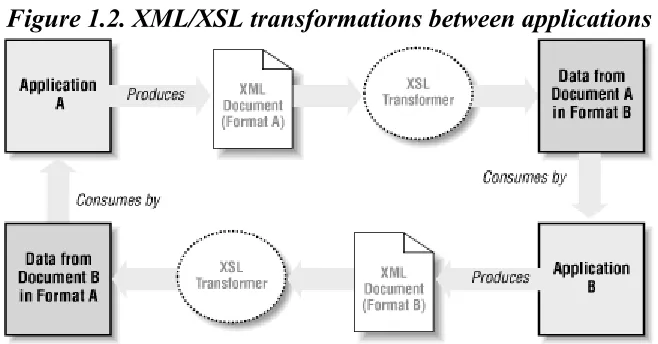
To understand the importance of XML for communications, you must first widen your concept of an application client. While talking about presentation, we made the common assumption that a client is a user that views a portion of an application. However, this is a fairly narrow assumption in today's applications, and we will now discard it. Instead, consider that a client is anything (yes, anything!) that accesses data or services within an application. Clients can be users with computers or mobile devices, other applications, data storage systems like databases or directory services, and even, at times, the application itself making callbacks. When the view of a client is widened like this, you will begin to see the impact that XML can have.
information, so the new XML document is transformed back into the format used by the original application, although it now contains different data! This scenario is a very common one.
Figure 1.2. XML/XSL transformations between applications
This repeated process of transforming a document, and always generating a new XML result, is what makes XML such a powerful tool for communication. The same set of rules can be used at every step, always starting with XML, applying one or more XSL stylesheets over one or more transformations, and resulting in XML that is still usable with the same tools that initially created the original document.
Also consider that XML is a purely textual representation of data. Because text is such a lightweight and easily serialized data representation, XML provides a fast means of transmitting data across a network. Although some binary data formats can be transmitted very efficiently, textual network transmissions will typically average out as a faster means of communication.
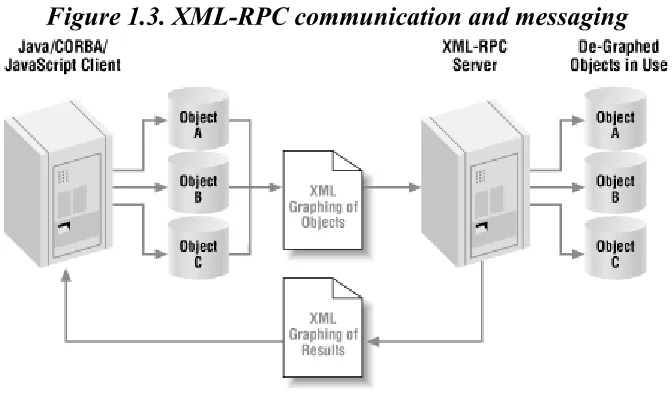
1.3.2.3 XML-RPC
One specification concerned with using XML for communication is XML-RPC. XML-RPC is concerned with communication not between applications, but between components within an application, or to a shared set of services functioning across applications. RPC stands for Remote Procedure Calls, one of the primary predecessors of Remote Method Invocation (RMI). RPC is used for making procedural calls over a network, and receiving a response, also over the network. Note that this is significantly different than RMI, which actually allows a client to invoke methods on an object via stubs and skeletons loaded over the network. The primary difference is that RPC calls generate a remote response, and the response is returned over the network; the client never interacts directly with a remote object, but instead uses the RPC interfaces to request a method invocation. RMI allows a client to directly interact with a remote object, and no "proxying" of requests takes place. For a more complete discussion on exactly what XML-RPC is, you should visit
http://www.xml-rpc.com.
generated, and again, can easily be "graphed" into XML and returned to the client (see Figure 1.3). We will look at XML-RPC in detail in Chapter 10.
Figure 1.3. XML-RPC communication and messaging
1.3.2.4 Business-to-business
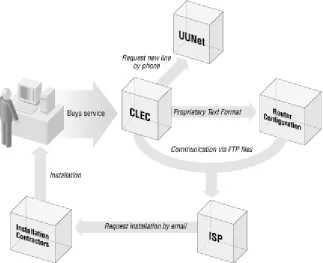
The last use of XML for communication is really not a different use or specification than those we have already talked about; however, the rise of the phrase " business-to-business" commerce and communication bears mentioning. Business-to business-communication generally refers to communication not just between differing applications, but across companies and sometimes industries. In these cases, XML is truly performing a significant service only available to extremely large companies in the past; it is allowing communication between closed systems. Consider a small- to medium-sized competitive local exchange carrier (CLEC), or a telecommunications company. When a network line, such as a DSL or T1, is sold to a customer, a variety of things must happen (see Figure 1.4). The provider of the line, such as UUNet, must be informed of the request for a new line. A router must be configured by the CLEC and the setup of the router must be coordinated with the Internet service provider. Then an installation must occur, which may involve another company if this process is outsourced. This relatively common and simple sale of a network line already involves three companies! Add to this the technical service group for the manufacturer of the router, the phone company for the customer's other communication services, and the Internic to register a domain, and the process becomes significant.
This rather intimidating process can be made extremely simple with the use of XML (as shown in
Figure 1.5). Imagine that the initial request for a line is input into a system that converts the request into an XML document. This document is then transformed, via XSL, into a format that can be sent to the line provider, UUNet in our example. UUNet then adds line-specific information,
transforming the request into yet another XML document, which is returned to the CLEC. This new document is passed on to the installation company with additional information about where the client is located. Upon installation, notes detailing whether or not the installation was successful are added to the document, which is transformed again via XSL, and passed back to the original CLEC application. The beauty of this solution is that instead of multiple systems, each using vendor-specific formatting, the same set of XML APIs can be used at every step, allowing a standard interface for the XML data across applications, systems, and even businesses.
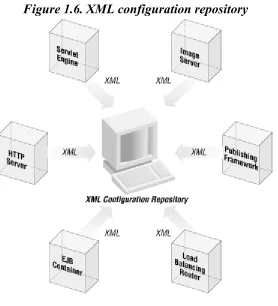
1.3.2.5 XML for configuration
One last significant use of XML in applications and Java technologies today is at the application server level. The Enterprise JavaBeans (EJB) 1.1 specification requires that deployment descriptors for Enterprise JavaBeans, which define the behavior and other information about EJBs, be XML based. This is a replacement for the previously used serialized deployment descriptors. In the EJB realm, this is a welcome change, as it removes vendor specificity from deployment descriptors. By requiring deployment descriptors to conform to a predefined DTD, vendors can all use the same XML deployment descriptors, increasing EJB portability.
XML is also used for configuration of the servlet API, version 2.2. An XML file, which specifies the connector parameters to use, the servlet contexts to start up, and other engine-specific details, configures the servlet engine itself. XML configuration files are also used to configure individual servlets, allowing initial arguments, servlet aliasing, and URL matching to be accomplished for specific servlet contexts.
Although both the EJB 1.1 specification and the Tomcat servlet engine are fairly new to the Java world, their inclusion of XML as core to their configuration is indicative of Sun's intention to continue to use XML for these purposes. As XML parsers become increasingly common and marketable, XML-based configuration files are expected to increase across all server vendors and types, including non-Java-based servers, such as HTTP and database servers.
1.3.3 Support for XML
In the middle to late months of 1999, support for XML has blossomed, particularly for the Java platform. XML parsers, XSLT processors, publishing frameworks, XML editors and IDEs, and a wealth of related tools have become available and are even now becoming stable and extremely fast. Although the subject of this book is the Java APIs for directly manipulating XML, the parsers, processors, and other components are certainly a part of the overall process of using XML, so a reference on available components is included. Because the XML technology is changing so rapidly, and companies are devoting more time and energy to the platform than ever before, no versions are listed here; they would almost certainly be long out of date by the time this book gets into your hands. In addition, it is possible, even likely, that many more tools will be available than are listed here by the time you read this. You should consult your vendors to see if they have XML support or tools if you do not see them listed here.
1.3.3.1 Parsers
One of the most important layers to an XML-aware application is the XML parser. This component handles the extremely important task of taking a raw XML document as input and making sense of the document; it will ensure that the document is well-formed, and if a DTD or schema is
referenced, it may be able to ensure that the document is valid. What results from an XML
document being parsed is typically a data structure, in our case a Java-based one, that can easily be manipulated and handled by other XML tools or Java APIs. We will not detail these data structures now, as they are discussed in great depth in later chapters. For now, just realize that the parser is one of the core building blocks to using XML data.
may not conform to finer points of the XML specification in order to squeeze out additional speed. You must decide on the proper balance between the two factors based on your application's needs. In addition, some XML parsers are validating, which means they offer the option to validate your XML with a DTD, and some are not. Make sure you use a validating parser if that capability is needed in your applications.
Here's a list of the most commonly used XML parsers. The list does not show whether a parser is validating or not, as there are current efforts to add validation to several of the parsers that do not yet offer it. No overall ranking is given or suggested here, but there is a wealth of information on the web pages for each parser:
• Apache Xerces: http://xml.apache.org
• IBM XML4J: http://alphaworks.ibm.com/tech/xml4j
• James Clark's XP: http://www.jclark.com/xml/xp
• OpenXML: http://www.openxml.org
• Oracle XML Parser: http://technet.oracle.com/tech/xml
• Sun Microsystems Project X: http://java.sun.com/products/xml
• Tim Bray's Lark and Larval: http://www.textuality.com/Lark
• The W3C has stated that they intend to release an open source schema validating parser. The Microsoft parser has been intentionally left out of this list; from all appearances, Microsoft does not now or in the future intend to conform to W3C standards. Instead, Microsoft seems to be developing their own flavor of XML. We have seen this before . . . be careful if you are forced to use Microsoft's parser, MSXML.
1.3.3.2 Processors
After an XML document is parsed, it is almost always transformed. This transformation, as we have discussed, is accomplished through XSLT. Similar to parsing, there are a wide variety of options for this component of the XML process. Again, the two primary considerations are speed of
transformation and conformity to XSL and XSLT specifications. At the time of this writing, XSL has just become a full W3C Recommendation, so the level of support for all XSL constructs and options is in great flux. The web site for each processor is the most informative location for determining conformance and fo