
TITLE: Oral modified release morphine for breathlessness in chronic heart failure: a randomised placebo-controlled trial.
Authors:
Miriam J Johnson, Wolfson Palliative Care Research Centre, University of Hull, Hull, HU6 7RX, UK* Sarah Cockayne, York Trials Unit, University of York, UK, YO10 5DD
David C Currow, IMPACCT, Faculty of Health, University of Technology Sydney, Ultimo, NSW. Australia 2007 and Wolfson Palliative Care Research Centre, University of Hull, HU6 7RX, UK Kerry Bell, York Trials Unit, University of York, UK, YO10 5DD
Kate Hicks, York Trials Unit, University of York, UK, YO10 5DD
Caroline Fairhurst, York Trials Unit, University of York, UK, YO10 5DD
Rhian Gabe, Hull York Medical School and York Trials Unit, University of York, UK, YO10 5DD David Torgerson, York Trials Unit, University of York, UK, YO10 5DD
Laura Jefferson, Department of Health Sciences, University of York, UK, YO10 5DD
Stephen Oxberry, Calderdale & Huddersfield Foundation Trust, Huddersfield Royal Infirmary, Huddersfield HD3 3EA
Justin Ghosh, Department of Cardiology, Scarborough Hospital, Scarborough, UK
Karen J Hogg, Department of Cardiology, Glasgow Royal Infirmary, Glasgow, UK, G4 0SF; The University of Glasgow
Jeremy Murphy Department of Cardiology, Darlington Memorial Hospital, Darlington, UK
Victoria Allgar, Hull York Medical School and Department of Health Sciences, University of York, UK, YO10 5DD
John GF Cleland, Robertson Centre for Biostatistics & Clinical Trials, Institute of Health & Well-being, University of Glasgow, Glasgow, UK. G12 8QQ
Andrew L Clark, Hull York Medical School, Castle Hill Hospital, Cottingham, HU16 5JQ, UK
*Corresponding author: [email protected], Director, Wolfson Palliative Care Research Centre, University of Hull, Hull, HU6 7RX. Tel: 01482 463309; e-mail: [email protected]
Words: 3,186
ABSTRACT
and cost-effectiveness of 12 weeks’ morphine therapy for the relief of chronic breathlessness in people with chronic heart failure compared with placebo.
Methods: Parallel-group, double-blind, randomised, placebo-controlled, phase III trial of 20mg daily oral modified-release morphine conducted in 13 sites in England and Scotland; hospital/community cardiology or palliative care out-patients. The primary analysis compared between-group numerical rating scale average breathlessness at week 4 using a covariance pattern linear mixed model. Secondary outcomes included treatment-emergent harms (worse, or new).
Results: The trial closed early, randomising 45 participants (average age 72 [range 39 to 89] years; 84% men; 98% New York Heart Association class III). For the primary analysis, the adjusted mean difference was 0.26 (95% CI -0.86 to 1.37) in favour of placebo. All other breathlessness measures improved in both groups (week 4 change-from-baseline), but by more in those assigned to morphine. Neither group was excessively drowsy at baseline or week 4. There were no between-group differences in quality of life (Kansas) or cognition (Montreal) at any time point. There was no exercise-related desaturation and no change between baseline and week 4 in either group. There was no change in vital signs at week 4. The natriuretic peptide measures fell in both groups, but by more in the morphine group (morphine 2169 [1092, 3851] pg/mL vs placebo 2851 [1694, 5437]) pg/ mL. There was no excess serious adverse events in the morphine group. Treatment-emergent harms during the first week were more common in the morphine group; all apart from one were ≤ grade 2.
Conclusions: We could not answer our primary objectives due to inadequate power. However, we provide novel placebo-controlled medium-term benefit and safety data useful for clinical practice and future trial design. Morphine should only be prescribed in this population when other measures are unhelpful, and with early management of side-effects.
INTRODUCTION
Although modern medical therapy is successful in improving morbidity and mortality in patients with chronic heart failure, for some, breathlessness persists1 despite optimal pharmacological therapy.
Persisting breathlessness is associated with poorer physical and mental quality of life,2 impaired
activities of daily living,3 increased unplanned hospital attendance4 and admissions,5 and higher
mortality.3 Although, non-pharmacological and pharmacological interventions can reduce its impact,
its importance to patients is often neglected in guidelines and clinical trials.6-8
The perception of breathlessness is processed in brain areas9 rich in opioid receptors.10 Endogenous
opioids reduce breathlessness whereas the opioid antagonist, naloxone, increases exertion-induced breathlessness by blocking the effects of endogenous opioids on the brain.11;12 In people with chronic
breathlessness due to a range of causes, but mainly chronic obstructive pulmonary disease, regular, low dose, modified-release morphine is safe and effective in the short term (7 days).7;13 However, the
evidence is less clear in people with chronic heart failure.14;15 Preliminary data suggest that people
with chronic heart failure may benefit from morphine given for 3 months. 16 Despite the lack of
definitive data, morphine is used in clinical practice although there is wide variation in willingness to prescribe, dosing and quality of monitoring. Potential problems are: i) patients may be denied a helpful medication (due to unfounded17 fears about harms and addiction);18 ii) they may have a
poorly monitored, suboptimal regime; and iii) there may be no net benefit in the longer term (although there is no evidence of tachyphylaxis to date).
We therefore designed BreatheMOR-HF to determine whether morphine therapy given for up to 12 weeks is superior to placebo for the relief of chronic breathlessness in ambulatory patients with chronic heart failure who remained symptomatic despite guideline-recommended medical therapy. The trial closed early due to poor recruitment, but collected important medium term placebo-controlled data especially on toxicity and safety, which we report here.
METHODS
Trial design
BreatheMOR-HF was a 12 week, parallel group, double-blind, randomised, placebo-controlled, fixed dosed, multi-site, phase III trial of 20mg daily oral modified-release morphine measuring
breathlessness intensity in ambulatory patients with symptomatic chronic heart failure. Participants and setting
Patients from 13 centres in England and Scotland attending hospital/community cardiology or palliative care clinics or hospices, were screened by research nurses in conjunction with the patients’ usual clinical team. Eligible participants: i) were aged ≥18 years; ii) had New York Heart Association (NYHA) class III/IV symptoms; iii) had either left ventricular systolic dysfunction defined as left ventricular ejection fraction <40%; orleft ventricular ejection fraction >40% and left ventricular hypertrophy, left atrial dilation or abnormal diastolic function; iv) had N-terminal-pro-B-type
≥two weeks; vi) had a glomerular filtration rate ≥30mls/min(/1.73m2) within two weeks; and vii)
scored ≥grade 2 on the modified Medical Research Council (mMRC) breathlessness scale. Optimal medical management for people with reduced left ventricular function was defined as a maximally tolerated dose of an inhibitor of the renin-angiotensin system and a beta adrenoceptor antagonist and a mineralocorticoid receptor antagonist. People with preserved left ventricular function were required only to receive diuretics and treatment for ventricular rate control for atrial fibrillation. Patients unable to provide written informed consent or complete study questionnaires, had co-existing relevant neoplasia, had used opioids regularly within the last month at a daily dose ≥ study dose, or had a documented contra-indication to morphine were excluded.
Randomisation
Random allocations (1:1; stratified block randomisation by centre; randomly permuted block sizes of 2 and 4; investigators blinded to block size) were centrally generated by an online secure service (sealed envelope™) following eligibility data entry of consented participants by a site researcher. Approvals
The protocol, amendments and trial documentation were approved by the North West-Liverpool Central Research Ethics Committee (ref 14/NW/0277; 01/07/2014). Medicines and Healthcare products Regulatory Agency approval was received (11/09/2014). NHS site approvals were obtained and the trial was registered (ISRCTN41349358) prior to recruitment.
Intervention and comparator
Participants were allocated to capsules of 10mg modified-release morphine (MST® CONTINUS® [https://www.medicines.org.uk/emc/product/7666/smpc]) or placebo that were identical in appearance, taste and smell. Capsules were to be taken orally twice daily.
Blinding
Participants, research team members and clinicians were blind to treatment allocation. Site pharmacists received the capsules un-blinded with a tear-off strip to allow blinding at the time of dispensing. To prevent un-blinding due to constipation, a laxative (100mg docusate) capsule was given twice daily to patients assigned to morphine and an identical placebo to those assigned to the placebo-control group.
Procedures
Participants’ demographic and clinical details were recorded at baseline prior to randomisation. Serum urea, electrolytes and creatinine were measured within 2 weeks of randomisation. Renal clearance was assessed using estimated glomerular filtration rate or calculated (Cockroft and Gault).19 The Charlson Comorbidity Score20 and modified-Medical Research Council breathlessness
scale21 were also recorded at baseline.
At the end of 12 weeks, participants could choose whether to take open-label morphine following the same regimen as the trial but prescribed and monitored by their usual-care clinician. The trial was closed early, due to slow recruitment, in May 2018; the last participant completed follow-up in August 2018.
Outcomes
The primary outcome measure was the average numerical rating scale breathlessness intensity score over the previous 24 hours22 assessed at 4 weeks. Table 1 details primary and secondary outcomes.
Sample size
Based on our previous data,15 a 1 point difference on the breathlessness scale was chosen to
demonstrate a minimum clinically important difference. In order to detect this difference between the groups at 4 weeks with 90% power at 5% significance, (and assuming a standard deviation of 2.55, giving a medium effect size of 0.4) 138 patients were required in each group. Allowing for 20% attrition, we needed 346 patients (173 to each group).
Statistical analysis
Analyses were conducted in Stata v13 (StataCorp. 2013. Stata Statistical Software: Release 13. College Station, TX: StataCorp LP) on an intention-to-treat basis. Statistical tests were two-sided at the 5% significance level. Baseline data are summarised overall and by trial arm both by
randomisation, and separately for participants providing data to the primary end point. No statistical comparisons between treatment groups were undertaken on baseline data.
The primary analysis compared the NRS average breathlessness at week 4 between the morphine and placebo groups using a covariance pattern linear mixed model. The outcomes were numerical rating scale at each post-randomisation time point (≤week 12), nested within patients. Scores at baseline, trial arm, time point, and a time-by-trial arm interaction were included as fixed-effects with participant and site as random-effects. An independent covariance structure for the repeated measurements was used as this provided the smallest Akaike’s information criterion.23
The adjusted mean difference, with its associated 95% confidence interval and p-value, between the two groups for the week 4 time point was extracted from the model.
The secondary outcomes of the Australian-modified Karnofsky Performance Scale, Kansas City Cardiomyopathy Questionnaire-12 and Karolinska Sleepiness Scale were similarly analysed. The Epworth Sleep Scale, Montreal Cognitive Assessment, 6-Minute Walk Test and activPAL™ were analysed using mixed-effect linear regression to compare the scores at week 4 adjusting for baseline score, and site as a random effect (i.e. repeated measures per participant not required to be
included).
RESULTS
Thirteen sites opened to recruitment and 7 randomised at least one participant. The first participant was randomised in June 2016 and recruitment closed in May 2017, by which time 45 patients had been recruited and randomised (21 to morphine; 24 to placebo).
Altogether, 386 patients were screened between December 2015 and May 2017 (median 27 per site, range 0 to 55), of whom 287 (74%) were ineligible, 53 (14%) declined, and one (0.3%) was eligible but the trial closed prior to their randomisation. The most common reasons for ineligibility were absence of NYHA functional class III or IV (n=59) and natriuretic peptide plasma concentrations below the inclusion criteria (n=34) (
Figure 1
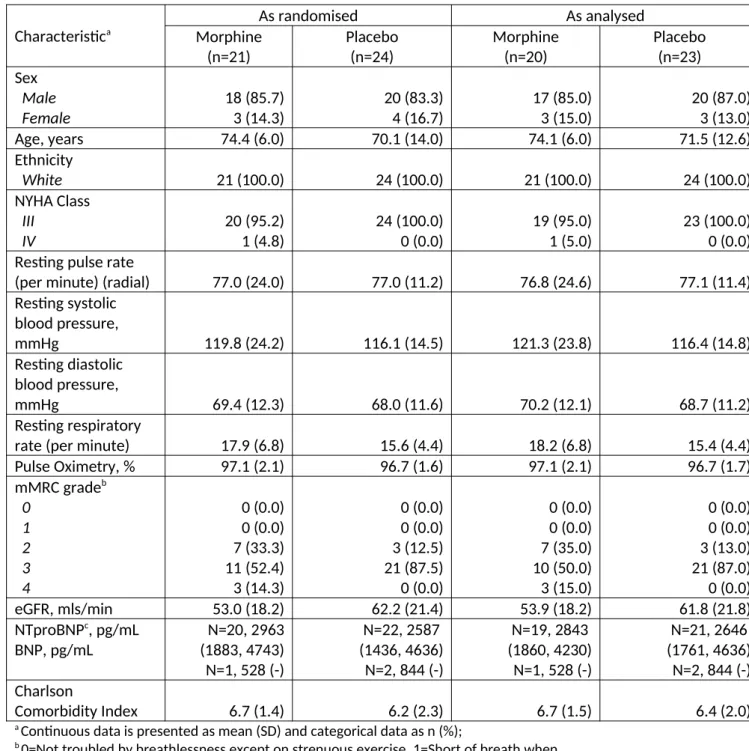
).The average age of randomised participants was 72 years (range 39 to 89) and 84% were men (Table 2.) All but one had NYHA class III symptoms and 78% had mMRC breathlessness grade 3 or 4.
Baseline characteristics were generally well balanced but those assigned to placebo had more severe breathlessness on the mMRC scale (Table 2).
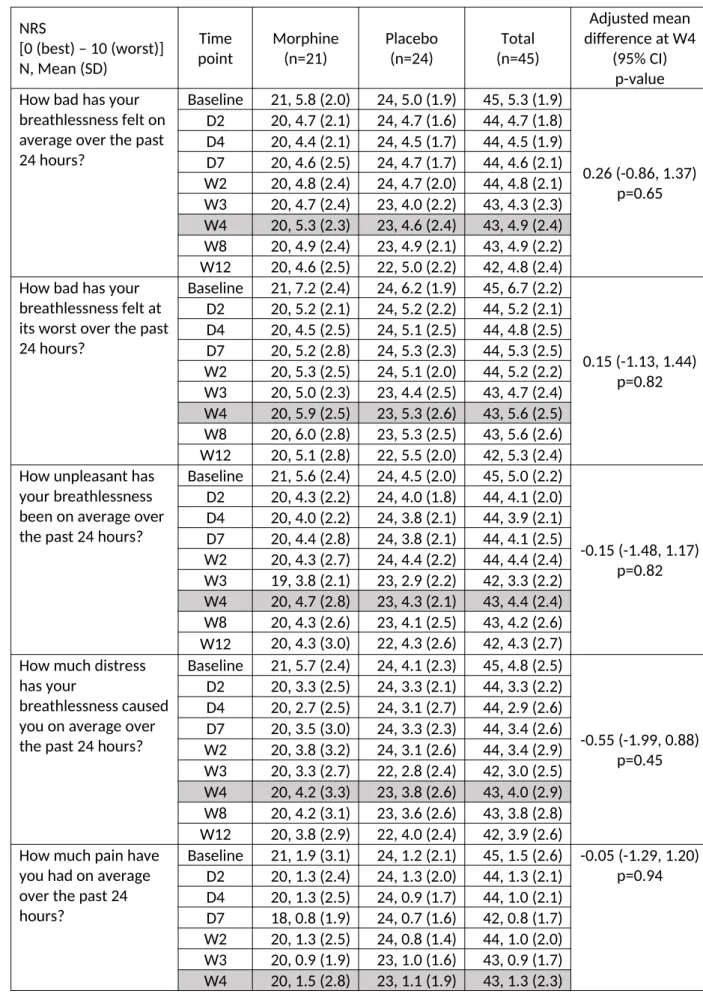
For the primary end-point, the raw mean (standard deviation) scores were 5.3 (2.3) for those assigned to morphine (n=20), and 4.6 (2.4) for those assigned to placebo (n=23) (Table 3). The adjusted mean difference was 0.26 (95% CI -0.86 to 1.37, p=0.65) in favour of the placebo group (Figure 2). No adjusted mean difference of 1 point or more (clinically important difference) was observed at 4 weeks between the groups for any NRS item.
From baseline to week 4, breathlessness measures, notably unpleasantness of, and distress due to, breathlessness improved in both groups (Table 3). The improvement was greater in those assigned to morphine compared to placebo in all but average intensity. All breathlessness scores increased further during subsequent weeks in those assigned to morphine but not in those assigned to placebo. Subjective global impression of change ratings are presented in Supplementary Table 1.
The median Australian-modified Karnofsky Performance Status was 70 for both groups across all time points (Table 4; secondary outcomes). Neither group was excessively sleepy or drowsy at baseline or week 4. There were no between-group differences in quality of life (Kansas) or cognition (Montreal) at any time point. At week 4, there was a raw mean difference of 1113 steps per day favouring the placebo group (activPAL) but of 7.4m in the walk test favouring the morphine group. There was no exercise-related desaturation and no change between baseline and week 4 in either group. There was no change in vital signs at week 4. The natriuretic peptide measures fell in both groups, but by more in the morphine group (Supplementary Table 2).
outcome data. Participants were asked to take two capsules a day for 84 days; total 168 tablets. Estimates of the proportion of tablets taken ranged from 39% to 51% in those assigned to morphine and 64% to 83% in those assigned to placebo, depending on an assumption that none or all the pills were taken if bottles were not returned.
There were 12 serious adverse events in the morphine group and 15 in the placebo group (Supplementary Table 4a). One death occurred in the placebo group. One morphine group participant had a marked cognitive decline from baseline at week 4 (25 to 14 MoCA points) which coincided with a decline in renal function. The patient fully recovered after stopping morphine. Non-serious adverse-events (Supplementary Table 4b) were more common in those assigned to
morphine (32 events) compared to placebo (22 events), although the excess was mainly due to one individual assigned to morphine who had nine non-serious events
After randomisation, up to and including week 4, 18 (86%) participants assigned to morphine and 13 (54%) to placebo reported at least one harm of grade 1 or more, and 10 (48%) and 1 (4.2%),
respectively, of grade 2 or more (Supplementary Table 5a – up to week 4; Supplementary Table 5b – weeks 8 and 12). Constipation, nausea and vomiting were more common in those assigned to morphine rather than placebo throughout the trial, but were mainly mild (grade 1). Study laxative/placebo was not taken by a substantial number of participants. Treatment emergent adverse events during the first week were three times more common in the morphine group and were more common in participants with eGFR <54 mls/min (the mean value) (Table 5), but all apart from one were grade 2 or less. Most presented by day 4 (see Supplementary Figure 1). Harms by grade, treatment group and time point to week 4 are presented in Supplementary Table
Health service use and EQ-5D-5L measures at baseline and follow-up are presented in Supplementary Tables 6a and 6b.
DISCUSSION
Main findings/results of the study
The BreatheMOR-HF trial is the first to provide placebo-controlled data for medium-duration modified-release, steady state, low dose, oral morphine for people with persistent breathlessness despite guideline-recommended treatments for chronic heart failure. The trial failed to enrol the planned number of participants but provides valuable insights into the potential rate and severity of morphine-related harm; particularly pertinent given the recent license extension to chronic
breathlessness (including that due to heart failure) for a sustained release oral morphine preparation (Kapanol™) by the Therapeutic Goods Administration in Australia. Constipation, nausea and
vomiting, albeit mainly mild, were more common in the morphine group, as was study drug withdrawal. This highlights the need for early skilful management of morphine-related side-effects and careful clinical decision-making regarding prescription of morphine for chronic breathlessness given the persisting lack of robust evidence of benefit in this patient population.
Strengths and limitations
particularly the natriuretic peptide threshold, ii) the Research Ethics Committee requirement that participants avoided driving for the first week (despite no evidence base25), and iii) delays in opening
recruitment sites. Suboptimal adherence to, and withdrawal from, study drug weakened our findings. Numbers are too small for a per protocol analysis, but inclusion of data from those who stopped study drug may have diluted benefit experienced by those who tolerated morphine.
The major strength is the double-blind, placebo-controlled design and trial duration. Data quality and completion rates (apart from physical activity and exercise tolerance) were very high, with minimal full study withdrawal. In addition, our study recruited the targeted population with advanced disease.
What this study adds
Although participants had advanced disease, there were no excess serious adverse events in the morphine group. We found no respiratory depression consistent with a recent systematic review and meta-analysis.17;18
The reports of (mainly mild) constipation, nausea and vomiting in the morphine group are similar to other published reports of low dose morphine for breathlessness14;15;26;27 but are nonetheless
important. In this study protocol, anti-emetics were not co-prescribed from study drug initiation in the same way as laxatives, but given in response to emergent nausea. It is possible that patients with heart failure and renal dysfunction may be susceptible to nausea as blood brain barrier permeability is increased, at least in acute kidney injury,28 and initial co-prescription might be useful.
Recommendations for management of morphine-related side-effects are available but may be unfamiliar to non-palliative care or non-pain specialists.29
Impaired cognition is cited as a particular fear of morphine treatment by both patients and
clinicians,30 but we found no excess sleepiness or cognitive impairment in the morphine group apart
from one patient with deterioration in renal function. We saw a reduction in daily steps with morphine but no increase in daytime sleepiness. The walk distance increased further in the
morphine group, but there was a high proportion of missing data making interpretation difficult. The lack of desaturation on exertion is reassuring and consistent with previous findings.17
In the morphine group all breathlessness measures, apart from week 4 average breathlessness, had greater improvement from baseline than the placebo group. Improvements in all breathlessness measures were sustained or improved further by week 8 and 12 in the morphine group and reached clinically important differences. Further improvement beyond week 4 was not seen in the placebo group in any breathlessness measure and none reached clinical significance. At baseline, the breathlessness scores were on average worse in the morphine group than control by around a clinically important difference (1 point) for each measure and so may represent a group more likely to respond to morphine.31 However, such findings can only be interpreted as a preliminary signal of
benefit.
Morphine should only be prescribed in people with heart failure when other measures have not helped, and only with early recourse to management of potential side-effects. Fears of serious harm are unsubstantiated.
The observed pattern of improvement in breathlessness measures in the morphine group suggests that an adequately sized trial would be useful. Lessons learnt from recruitment and attrition challenges should be incorporated in a new study. A dose titration step should be included and an initiation side-effect management plan put in place. The eligibility criterion relating to natriuretic peptide should be removed, but included as a secondary outcome in view of the observation that levels reduced by more in the morphine group; a finding seen in previous work and the significance of which is unknown.14 The extensive trials unit support required to navigate the complex
governance required to open multiple recruitment sites needs to be planned for.
The observed standard deviation of the primary outcome measure was lower than the anticipated 2.55 in each group at all time-points; the correlation between the baseline and week 4 measures of the primary endpoint was 0.67. A recalculated sample size of 150 patients would provide 80% power to detect the same planned difference, assuming a standard deviation of 2.55, 5% significance level, a conservative correlation of 0.65 between the baseline and week 4 measures, and 20% attrition.
CONCLUSIONS
We were unable to answer our primary objectives due to inadequate power. However, we provide novel preliminary placebo-controlled data relating to the benefit and safety of medium-term oral modified-release morphine which will help inform clinical practice and the design of a future trial. Author contributions
Concept and design: MJ, DCC, ALC; Protocol authors; MJJ, DCC, JC, ALC, RG, KH, JM, SO, GR, DT, VA, SC; Trial conduct and data management: SC, KB, LJ, KH; Data collection: KH, SO, JG, MJJ, ALC; Data analysis: CF, RG, VA; data interpretation: All; revisions of manuscript for intellectual content and approved final version: All.
Acknowledgements.
The authors would like to thank the participants for taking part in the trial; the Principal Investigators (PI) and research nurses at each site for recruiting participants and completing the trial
documentation; Prof G Richardson for health economic advice; members of the trial steering committee Dr J McMurray (independent Chair), Dr M Bennett, Dr J Warwick, Dr O Agbaje, and Doreen Edgar (Patient Public Involvement representative) and members of the data monitoring and ethics committee Dr M Fallon (Independent Chair) Dr A Crook and Dr R Gardner for their advice, overseeing the study and reviewing adverse event data. The BreatheMOR-HF PIs include: Dr C Boos, Dr A Clark, Dr J Cooke, Dr M Denvir, Dr Gale, Dr B Gordon, Dr K Hogg, Dr S Jenkins, Dr J Murphy, Dr S Oxberry, Dr P Sheridan, Dr H Thomas and Dr A Thorns.
Declaration of conflicts of interest.
DCC has received an unrestricted research grant from Mundipharma, is an unpaid member of an advisory board for Helsinn Pharmaceuticals and has consulted Mayne Pharma and received intellectual property payments from them. MJJ has received consulting payments from Mayne Pharma. No authors have any conflicting interests with the content of this manuscript.
Funding
This work was supported by the British Heart Foundation [grant number CS/13/2/30584]. Data management and sharing.
Figure 1: CONSORT flow diagram of participant through the BreatheMOR-HF trial
Table 1: Overview of primary and secondary outcomes
Primary outcome Average breathlessness over the previous 24 hours (Baseline, D2, D4, D7, W2, W3, W4 [primary time point], W8 and W12)
o 0-10 (11 point) NRS22
o 0 = none to 10 = worst imaginable Other
breathlessness assessments
Intensity of worst breathlessness over the previous 24 hours; Distress due to
breathlessness over the previous 24 hours; Unpleasantness of breathlessness over the previous 24 hours (Baseline, D2, D4, D7, W2, W3, W4, W8 and W12)
o 0-10 (11 point) NRS22
o 0 = none to 10 = worst imaginable Global impression of change (W4)32
o Subjective measure of response to treatment
o Participants asked if their breathlessness has changed and by how much using a verbal rating scale
Related symptoms Average pain over previous 24 hours (Baseline, D2, D4, D7, W2, W3, W4, W8 and W12) o 0-10 (11 point) NRS33
o 0 = no pain to 10 = worst imaginable pain Epworth Sleepiness Scale (ESS; Baseline and W4)34
o Screening tool for sleep-disordered breathing
o Specifically distinguishes reports of daytime dozing behaviour from fatigue and drowsiness/sleepiness
o Scores between 0 to 24
o Higher scores indicate excessive sleepiness (11-12 mild; 13-16 moderate; >16 severe)
Functional and performance status
6 minute walk test (6MWT; Baseline and W4)35
o Recorded distance walked in metres, and O2 saturation at rest and post test Physical activity monitoring (activPAL™ step count; Baseline and W4)36
o activPAL™ worn for 7 days at baseline prior to randomisation and for 7 days prior to week 4
o Discriminates between sedentary, upright and stepping activities o Average daily step count documented
Montreal Cognitive Assessment (MoCA; Baseline and W4. Shortened telephone-based MoCA administered at D4 and D7)37
o 30-item questionnaire assessing cognitive function
o Scores between 0 and 30; ≥ 26 implies no cognitive impairment (telephone version scored 0 to 16)
o Items that could be administered by phone assessed on days 4 and 7 New York Heart Association class (NYHA; Baseline, W4 and W12)38
o Four classes based on symptoms (I, II, III, IV) o Class IV denotes worst symptom status
Australia-modified Karnofsky Performance Status (AKPS; Baseline, W4 and W12)39
o Validated variant of Karnofsky Performance Status
perform activities of daily living; higher scores imply better function
Quality of life Kansas City Cardiomyopathy Questionnaire-short form (KCCQ-12; Baseline, W4 and W12)40
o 12-item, self-administered instrument quantifying physical function, symptoms (frequency, severity and recent change), social function, self-efficacy and knowledge, and quality of life
o Combined single, overall summary score between 0 and 100
o Higher scores indicate better functioning, fewer symptoms, and better disease-specific quality of life
Harms* Opioid-relevant symptoms during each assessment using criteria established by the National Cancer Institute (version 4.03) and graded accordingly (Baseline, D2, D4, D7, W2, W3, W4, W8 and W12)41
o Constipation o Confusion o Nausea o Vomiting
o Memory impairment o Cognitive impairment
Karolinska Sleepiness Scale (KSS; Baseline, D2, D4, D7, W2, W3 and W4)42
o 9-point Likert scale of the patient’s level of drowsiness (1=very alert to 9=very sleepy)
Health economic assessment
EuroQoL EQ-5D-5L (Baseline, W4, W8 and W12)43
o self-administered, validated measure of health status
o 5 dimensions: mobility, self-care, usual activities, pain/discomfort, and anxiety/depression
o 5 level (level 1= no problems, level 2 = slight problems, level 3 = moderate problems, level 4 = severe problems, 5 = unable [or extreme]) and a visual analogue self-rating scale
Health service use (Baseline, W4, W8 and W12)
o Participants recall specified service use over the past 4 weeks Clinical
assessments
Standard examination (Baseline and W4) o resting pulse rate, and blood pressure, o resting respiratory rate
o pulse oximetry
N-terminal proBNP (B-type Natriuretic Peptide) measurement (Baseline and W4) o For sites with access to this test as part of clinical practice
Dose of “as required” immediate release opioid for breathlessness (W4 and W12) o Patient diary: if, when, and the dose of any “as required” dose of immediate
release opioid solution taken for breathlessness.
Table 2: Baseline characteristics by randomised group, as randomised and as included in the primary outcome analysis
Characteristica
As randomised As analysed
Morphine (n=21) Placebo (n=24) Morphine (n=20) Placebo (n=23) Sex Male Female 18 (85.7) 3 (14.3) 20 (83.3) 4 (16.7) 17 (85.0) 3 (15.0) 20 (87.0) 3 (13.0)
Age, years 74.4 (6.0) 70.1 (14.0) 74.1 (6.0) 71.5 (12.6)
Ethnicity
White 21 (100.0) 24 (100.0) 21 (100.0) 24 (100.0)
NYHA Class III IV 20 (95.2) 1 (4.8) 24 (100.0) 0 (0.0) 19 (95.0) 1 (5.0) 23 (100.0) 0 (0.0) Resting pulse rate
(per minute) (radial) 77.0 (24.0) 77.0 (11.2) 76.8 (24.6) 77.1 (11.4) Resting systolic
blood pressure,
mmHg 119.8 (24.2) 116.1 (14.5) 121.3 (23.8) 116.4 (14.8)
Resting diastolic blood pressure,
mmHg 69.4 (12.3) 68.0 (11.6) 70.2 (12.1) 68.7 (11.2)
Resting respiratory
rate (per minute) 17.9 (6.8) 15.6 (4.4) 18.2 (6.8) 15.4 (4.4)
Pulse Oximetry, % 97.1 (2.1) 96.7 (1.6) 97.1 (2.1) 96.7 (1.7)
mMRC gradeb
0 1 2 3 4 0 (0.0) 0 (0.0) 7 (33.3) 11 (52.4) 3 (14.3) 0 (0.0) 0 (0.0) 3 (12.5) 21 (87.5) 0 (0.0) 0 (0.0) 0 (0.0) 7 (35.0) 10 (50.0) 3 (15.0) 0 (0.0) 0 (0.0) 3 (13.0) 21 (87.0) 0 (0.0)
eGFR, mls/min 53.0 (18.2) 62.2 (21.4) 53.9 (18.2) 61.8 (21.8)
NTproBNPc, pg/mL
BNP, pg/mL
N=20, 2963 (1883, 4743) N=1, 528 (-)
N=22, 2587 (1436, 4636) N=2, 844 (-)
N=19, 2843 (1860, 4230) N=1, 528 (-)
N=21, 2646 (1761, 4636) N=2, 844 (-) Charlson
Comorbidity Index 6.7 (1.4) 6.2 (2.3) 6.7 (1.5) 6.4 (2.0)
a Continuous data is presented as mean (SD) and categorical data as n (%);
b 0=Not troubled by breathlessness except on strenuous exercise, 1=Short of breath when
hurrying or walking up a slight hill, 2=Walks slower than contemporaries on the level because of breathlessness, or has to stop for breath when walking at own pace, 3=Stops for breath after about 100m or after a few minutes on the level, 4=Too breathless to leave the house, or breathless when dressing or undressing;
Table 3: Raw NRS summary scores for breathlessness by randomised group and time point, with adjusted mean difference between the groups at primary time point of 4 weeks.
NRS
[0 (best) – 10 (worst)] N, Mean (SD)
Time point Morphine (n=21) Placebo (n=24) Total (n=45) Adjusted mean difference at W4
(95% CI) p-value How bad has your
breathlessness felt on average over the past 24 hours?
Baseline 21, 5.8 (2.0) 24, 5.0 (1.9) 45, 5.3 (1.9)
0.26 (-0.86, 1.37) p=0.65 D2 20, 4.7 (2.1) 24, 4.7 (1.6) 44, 4.7 (1.8)
D4 20, 4.4 (2.1) 24, 4.5 (1.7) 44, 4.5 (1.9) D7 20, 4.6 (2.5) 24, 4.7 (1.7) 44, 4.6 (2.1) W2 20, 4.8 (2.4) 24, 4.7 (2.0) 44, 4.8 (2.1) W3 20, 4.7 (2.4) 23, 4.0 (2.2) 43, 4.3 (2.3) W4 20, 5.3 (2.3) 23, 4.6 (2.4) 43, 4.9 (2.4) W8 20, 4.9 (2.4) 23, 4.9 (2.1) 43, 4.9 (2.2) W12 20, 4.6 (2.5) 22, 5.0 (2.2) 42, 4.8 (2.4) How bad has your
breathlessness felt at its worst over the past 24 hours?
Baseline 21, 7.2 (2.4) 24, 6.2 (1.9) 45, 6.7 (2.2)
0.15 (-1.13, 1.44) p=0.82 D2 20, 5.2 (2.1) 24, 5.2 (2.2) 44, 5.2 (2.1)
D4 20, 4.5 (2.5) 24, 5.1 (2.5) 44, 4.8 (2.5) D7 20, 5.2 (2.8) 24, 5.3 (2.3) 44, 5.3 (2.5) W2 20, 5.3 (2.5) 24, 5.1 (2.0) 44, 5.2 (2.2) W3 20, 5.0 (2.3) 23, 4.4 (2.5) 43, 4.7 (2.4) W4 20, 5.9 (2.5) 23, 5.3 (2.6) 43, 5.6 (2.5) W8 20, 6.0 (2.8) 23, 5.3 (2.5) 43, 5.6 (2.6) W12 20, 5.1 (2.8) 22, 5.5 (2.0) 42, 5.3 (2.4) How unpleasant has
your breathlessness been on average over the past 24 hours?
Baseline 21, 5.6 (2.4) 24, 4.5 (2.0) 45, 5.0 (2.2)
-0.15 (-1.48, 1.17) p=0.82 D2 20, 4.3 (2.2) 24, 4.0 (1.8) 44, 4.1 (2.0)
D4 20, 4.0 (2.2) 24, 3.8 (2.1) 44, 3.9 (2.1) D7 20, 4.4 (2.8) 24, 3.8 (2.1) 44, 4.1 (2.5) W2 20, 4.3 (2.7) 24, 4.4 (2.2) 44, 4.4 (2.4) W3 19, 3.8 (2.1) 23, 2.9 (2.2) 42, 3.3 (2.2) W4 20, 4.7 (2.8) 23, 4.3 (2.1) 43, 4.4 (2.4) W8 20, 4.3 (2.6) 23, 4.1 (2.5) 43, 4.2 (2.6) W12 20, 4.3 (3.0) 22, 4.3 (2.6) 42, 4.3 (2.7) How much distress
has your
breathlessness caused you on average over the past 24 hours?
Baseline 21, 5.7 (2.4) 24, 4.1 (2.3) 45, 4.8 (2.5)
-0.55 (-1.99, 0.88) p=0.45 D2 20, 3.3 (2.5) 24, 3.3 (2.1) 44, 3.3 (2.2)
D4 20, 2.7 (2.5) 24, 3.1 (2.7) 44, 2.9 (2.6) D7 20, 3.5 (3.0) 24, 3.3 (2.3) 44, 3.4 (2.6) W2 20, 3.8 (3.2) 24, 3.1 (2.6) 44, 3.4 (2.9) W3 20, 3.3 (2.7) 22, 2.8 (2.4) 42, 3.0 (2.5) W4 20, 4.2 (3.3) 23, 3.8 (2.6) 43, 4.0 (2.9) W8 20, 4.2 (3.1) 23, 3.6 (2.6) 43, 3.8 (2.8) W12 20, 3.8 (2.9) 22, 4.0 (2.4) 42, 3.9 (2.6) How much pain have
you had on average over the past 24 hours?
Baseline 21, 1.9 (3.1) 24, 1.2 (2.1) 45, 1.5 (2.6) -0.05 (-1.29, 1.20) p=0.94 D2 20, 1.3 (2.4) 24, 1.3 (2.0) 44, 1.3 (2.1)
Table 4: Other secondary outcome scores by randomised group and time point Outcome Morphine (n=21) Placebo (n=24) Total (n=45) Adjusted mean difference at W4 (95% CI) p-value Australia - Modified Karnofsky Performance Status, [10 (comatose) -100 (normal)]
Baseline 21 70 (60, 80) 24 70 (60, 70) 45 70 (60, 70)
-2.1 (-7.0, 2.8) p=0.40 Week 4 20 70 (60, 75) 22 70 (70, 70) 42 70 (70, 70)
Week 12 22 70 (60, 80) 20 70 (60, 80) 42 70 (60, 80) Cardiomyopathy Questionnaire (Kansas City), [1 (extremely limited) – 100 (not limited)]
Baseline 21 36.6 (14.7) 24 40.2 (11.9) 45 38.5 (13.2) -2.7 (-9.7, 4.3)
p=0.44 Week 4 20 37.2 (16.0) 22 44.1 (12.9) 42 40.8 (14.7)
Week 12 20 42.2 (22.0) 22 42.3 (17.7) 42 42.2 (19.6) Epworth Sleepiness Scale, [0-24; higher score = greater sleepiness]
Baseline 21 9.6 (4.1) 24 9.5 (4.8) 45 9.6 (4.5) 1.3
(-0.8, 3.5) p=0.23
Week 4 20 10.6 (5.2) 22 9.4 (4.3) 42 10.0 (4.8)
Karolinska Sleepiness Scale, [1=very alert - 9=very sleepy]
Baseline 21 3.0 (1.5) 24 3.3 (1.6) 45 3.2 (1.5)
0.3 (-0.5, 1.2)
p=0.45
Day 2 20 3.8 (1.7) 24 3.4 (1.2) 44 3.6 (1.4)
Day 4 20 3.8 (1.9) 24 3.8 (1.9) 44 3.8 (1.8)
Day 7 20 4.6 (2.5) 24 3.5 (1.7) 44 4.0 (2.2)
Week 2 20 3.2 (1.4) 24 3.5 (1.9) 44 3.4 (1.7)
Week 3 20 3.1 (1.4) 23 3.2 (1.8) 43 3.1 (1.6)
Week 4 20 3.3 (1.5) 23 3.0 (1.6) 43 3.2 (1.5)
Montreal Cognitive Assessment, [0-30 (0-16 phone version); lower scores = greater cognitive impairment]
Baseline 21 25.1 (1.9) 24 25.4 (3.1) 45 25.2 (2.6)
-0.5 (-2.2, 1.1)
p=0.53 Day 4 (phone version) 19 14.1 (1.3) 21 14.3 (1.9) 40 14.2 (1.6)
Day 7 (phone version) 18 14.2 (1.1) 23 14.7 (1.3) 41 14.5 (1.2)
Week 4 20 26.2 (3.3) 21 26.8 (2.3) 41 26.5 (2.8)
Six minute walk test, Distance walked (metres)
Baseline 18 153 (105,
273)
24 179 (133, 255)
42 160 (120,
270) 18.7
(-48.8, 86.3) p=0.59
Week 4 13 169 (120,
250)
17 165 (90, 270)
30 167 (104, 270)
O2 saturation at rest (%)
Baseline 18 97 (96, 99) 24 97 (95, 98) 42 97 (96, 98) -0.7 (-1.8, 0.4)
p=0.23 Week 4 13 96 (95, 98) 16 97 (96, 98) 29 97 (95, 98)
O2 saturation at end (%)
Baseline 18 98 (97, 98) 24 97 (96, 99) 42 98 (97, 99) -0.2 (-1.3, 0.9)
p=0.74 Week 4 13 97 (96, 98) 16 97 (96, 99) 29 97 (96, 98)
activPAL™, Average steps per day
Baseline 20 2503 (976,
3700)
22 2207 (473, 3183)
42 2315 (589, 3445)
-728.2 (-1438.5, -17.8)
p=0.05
2975) (1744, 3143)
Table 5: Number of participants experiencing a treatment-emergent harm within the first week of follow-up, stratified by median baseline eGFR of 54 mls/min:
Grade ≤2 Grade ≥3
Morphine Placebo Morphine Placebo
eGFR≤54 (n=14)
eGFR>54 (n=7)
eGFR≤54 (n=9)
eGFR>54 (n=15)
eGFR≤54 (n=14)
eGFR>54 (n=7)
eGFR≤54 (n=9)
eGFR>54 (n=15) Confusion 0 (0.0) 1 (14.3) 0 (0.0) 1 (6.7) 0 (0.0) 0 (0.0) 0 (0.0) 0 (0.0) Constipation 9 (64.3) 5 (71.4) 0 (0.0) 2 (13.3) 0 (0.0) 0 (0.0) 0 (0.0) 0 (0.0) Vomiting 5 (35.7) 1 (14.3) 1 (11.1) 0 (0.0) 0 (0.0) 0 (0.0) 0 (0.0) 0 (0.0) Nausea 9 (64.3) 3 (42.9) 1 (11.1) 2 (13.3) 0 (0.0) 0 (0.0) 0 (0.0) 0 (0.0) Memory
impairment 1 (7.1) 1 (14.3) 0 (0.0) 1 (6.7) 0 (0.0) 0 (0.0) 0 (0.0) 0 (0.0) Cognitive
disturbance 0 (0.0) 0 (0.0) 0 (0.0) 0 (0.0) 1 (7.1) 0 (0.0) 0 (0.0) 0 (0.0) At least one 11 (78.6) 6 (85.7) 1 (11.1) 5 (33.3) 1 (7.1) 0 (0.0) 0 (0.0) 0 (0.0)
Supplementary Table 1: Global Impression of Change relating to breathlessness, at week 4 (valid data provided by 41 participants)
Global Impression of Change
Morphine (n=20)
Placebo (n=21)
Total (n=41) Is your breathing
Worse 1 (5.0) 1 (4.8) 2 (4.9)
About the same 13 (65.0) 9 (42.9) 22 (53.7)
Better 6 (30.0) 11 (52.4) 17 (41.5)
If better…
If your breathing is better, how much better is your breathing?
N=6 N=11 N=17
Almost the same, hardly any better at all
0 (0.0) 0 (0.0) 0 (0.0)
A little better 3 (50.0) 4 (36.4) 7 (41.2)
Somewhat better 1 (16.7) 2 (18.2) 3 (17.7)
Moderately better 0 (0.0) 2 (18.2) 2 (11.7)
A good deal better 2 (33.3) 2 (18.2) 4 (23.5)
A great deal better 0 (0.0) 1 (9.1) 1 (5.9)
A very great deal better
0 (0.0) 0 (0.0) 0 (0.0)
If your breathing is worse, how much worse is your breathing?
N=1 N=1 N=2
Almost the same, hardly any worse at all
0 (0.0) 0 (0.0) 0 (0.0)
Moderately worse 0 (0.0) 0 (0.0) 0 (0.0)
A good deal worse 1 (100.0) 0 (0.0) 1 (50.0)
A great deal worse 0 (0.0) 0 (0.0) 0 (0.0)
A very great deal worse
Supplementary Table 2: Clinical assessments and NYHA class at week 4 by randomised group
Characteristic Morphine
(n=21)
Placebo (n=24)
Total (n=45) NYHA Class
II III IV Missing
1 (4.8) 18 (85.7) 1 (4.8) 1 (4.8)
1 (4.2) 21 (87.5) 0 (0.0) 2 (8.3)
2 (4.4) 39 (86.7) 1 (2.2) 3 (6.7) Resting pulse rate
(per minute) (radial) 69.5 (11.8) 72.1 (9.6) 70.9 (10.6)
Resting systolic blood pressure,
mmHg 109.4 (16.4) 111.5 (19.3) 110.5 (17.8)
Resting diastolic blood pressure,
mmHg 62.9 (9.0) 65.4 (12.0) 64.2 (10.6)
Resting respiratory
rate (per minute) 16.6 (6.0) 15.3 (3.4) 15.9 (4.8)
Pulse Oximetry, % 96.3 (2.1) 97.0 (2.0) 96.7 (2.0)
NTproBNPc, pg/mL 2169 (1092, 3851) 2851 (1694, 5437) 2598 (1092, 4982)
Supplementary Table 3
Data on study drug use is described here, including estimates of number of pills taken as determined by number unused and returned. The cases where pills were dispensed but the bottles not returned were managed in two ways, assuming: i) that all the pills in that batch were taken; and ii) that none were taken.
The first dose was taken a median of 1 day after randomisation in the morphine group (range 0 to 7), and 0.5 days in the placebo group (range 0 to 5). Most first doses were taken in the afternoon (morphine group, n=18, 90.0%; placebo group, n=21, 87.5%).
It was intended for participants to take two IMP capsules a day for 84 days, a total of 168 tablets. Estimates of the proportion of tablets taken range from 39% to 51% in the morphine group, and 64% to 83% in the placebo group, depending on whether it is assumed that no or all the pills were taken in cases where bottles were not returned (Supplementary Table 5).
Supplementary Table 3: Study drug use by randomised group
Morphine/Placebo Docusate/Placebo Morphine (n=21) Placebo (n=24) Morphine (n=21) Placebo (n=24) Dispensed at, n (%):
Baseline Week 4 Week 8 21 (100.0) 13 (61.9) 9 (42.9) 24 (100.0) 22 (91.7) 17 (70.8) 21 (100.0) 13 (61.9) 9 (42.9) 24 (100.0) 22 (91.7) 17 (70.8) Total number dispensed
Mean (SD)
Median (min, max)
114.7 (51.6) 112 (56, 168)
147.0 (36.2) 168 (56, 168)
114.7 (51.6) 112 (56, 168)
147.0 (36.2) 168 (56, 168) Assume all pills taken if return pill count missing
Total number returned Mean (SD)
Median (min, max)
29.8 (24.6) 37 (0, 91)
17.9 (22.1) 6 (0, 64)
41.8 (39.5) 39 (0, 168)
32.1 (41.1) 12.5 (0, 168) Percentage taken of
drugs taken that were dispensed
Mean (SD)
Median (min, max)
59.6 (36.3) 67.0 (0, 100)
82.6 (26.4) 96.4 (5.4, 100)
52.4 (36.3) 44.0 (0, 100)
73.2 (34.1) 90.9 (0, 100) Total used out of
number intended (n=168)
Mean (SD)
Median (min, max)
50.5 (42.0) 44.6 (0, 100)
76.9 (31.3) 96.1 (1.8, 100)
43.4 (40.4) 33.3 (0, 100)
68.4 (36.2) 86.6 (0, 100) Assume no pills taken if return pill count missing
Total number returned Mean (SD)
Median (min, max)
48.4 (30.6) 46 (0, 118)
38.9 (42.1) 32.5 (0, 168)
55.1 (41.0) 46 (0, 168)
53.1 (51.8) 43.5 (0, 168) Percentage taken of
drugs taken that were dispensed
Mean (SD)
Median (min, max)
48.5 (30.1) 35.7 (0, 100)
69.4 (32.8) 79.5 (0, 100)
44.5 (31.4) 33.3 (0, 100)
number intended (n=168)
Mean (SD)
Median (min, max)
39.4 (33.8) 33.3 (0, 100)
64.4 (34.8) 69.6 (0, 100)
35.5 (33.9) 29.8 (0, 100)
Supplementary Tables 4a and 4b
Supplementary Table 4a: Serious adverse events
Serious adverse events Morphine
(n=21)
Placebo (n=24)
Total (n=45)
Number of events 12 15 27
Number of participants with ≥1 event,
n (%)a 7 (33.3) 10 (41.7) 17 (37.8)
Number of events/participant, n (%)b
1 2 3 4 3 (42.9) 3 (42.9) 1 (14.3) 0 (0.0) 8 (80.0) 0 (0.0) 1 (10.0) 1 (10.0) 11 (64.7) 3 (17.7) 2 (11.8) 1 (5.9) Type of event, n (%)c
Death
Life-threatening Disability/incapacity Hospitalisation
Prolonged hospital stay Congenital anomaly Otherd 0 (0.0) 0 (0.0) 0 (0.0) 10 (83.3) 0 (0.0) 0 (0.0) 2 (16.7) 1 (6.7) 0 (0.0) 0 (0.0) 14 (93.3) 0 (0.0) 0 (0.0) 0 (0.0) 1 (3.7) 0 (0.0) 0 (0.0) 24 (88.9) 0 (0.0) 0 (0.0) 2 (7.4) Severity, n (%)c
Mild Moderate Severe Missing 0 (0.0) 7 (58.3) 2 (16.7) 3 (25.0) 3 (20.0) 1 (6.7) 6 (40.0) 5 (33.3) 3 (11.1) 8 (29.6) 8 (29.6) 8 (29.6) Relatedness to morphine, n (%)c
Not related
Unlikely to be related Possibly related Probably related Definitely related 8 (66.7) 1 (8.3) 2 (16.7) 1 (8.3) 0 (0.0) 12 (80.0) 2 (13.3) 0 (0.0) 1 (6.7) 0 (0.0) 20 (74.1) 3 (11.1) 2 (7.4) 2 (7.4) 0 (0.0) Relatedness to docusate, n (%)c
Not related
Unlikely to be related Possibly related Probably related Definitely related 10 (83.3) 2 (16.7) 0 (0.0) 0 (0.0) 0 (0.0) 14 (93.3) 1 (6.7) 0 (0.0) 0 (0.0) 0 (0.0) 24 (88.9) 3 (11.1) 0 (0.0) 0 (0.0) 0 (0.0) Expectedness, n (%)e
Expected Not expectedf
2 (66.7) 1 (33.3) 1 (100.0) 0 (0.0) 3 (75.0) 1 (25.0)
a percentage out of number of randomised participants; b percentages out of number of participants with at
least one event; c percentage out of number of events; d cognitive decline (n=1); slight deterioration in
mental health state (n=1); e only if event possibly, probably or definitely related to morphine, percentage
out of number of these events; f this event was reported to the MHRA as a SUSAR and the participants
allocation was unblinded to the treating clinician (marked cognitive decline noted whilst performing MoCA outcome at week 4 time point).
than one event (range 1 to 9). Nineteen events were deemed to be at least possibly related to the IMP (16 (50%) in the morphine group, and 3 (14%) in the placebo group), of which only one was unexpected (participant reported dry month of mild intensity). The most commonly reported events were nausea (6 occurrences for 5 morphine participants, and 1 occurrence for 1 placebo
participant), cognitive disturbance (5 occurrences for 3 morphine participants), and lung infection (1 occurrence for 1 morphine participant, and 4 occurrences for 4 placebo participants).
Supplementary Table 4b: Non-serious adverse events Non-serious adverse events Morphine
(n=21)
Placebo (n=24)
Total (n=45)
Number of events 32 22 54
Number of participants with ≥1 event, n (%)a
14 (66.7) 12 (50.0) 26 (57.8)
Number of events/participant, n (%)b 1 2 3 4 5 … 9 7 (50.0) 3 (21.4) 2 (14.3) 1 (7.1) 0 (0.0) 0 (0.0) 1 (7.1) 6 (50.0) 4 (33.3) 1 (8.3) 0 (0.0) 1 (8.3) 0 (0.0) 0 (0.0) 13 (50.0) 7 (26.9) 3 (11.5) 1 (3.9) 1 (3.9) 0 (0.0) 1 (3.9) Severity, n (%)c
Mild Moderate Severe Missing 14 (43.8) 17 (53.1) 1 (3.1) 0 (0.0) 11 (50.0) 8 (36.4) 1 (4.6) 2 (9.1) 25 (46.3) 25 (46.3) 2 (3.7) 2 (3.7) Relatedness to IMP, n (%)c
Not related
Unlikely to be related Possibly related Probably related Definitely related 11 (34.3) 5 (15.6) 9 (28.1) 5 (15.6) 2 (6.3) 12 (54.6) 7 (31.8) 3 (13.6) 0 (0.0) 0 (0.0) 23 (42.6) 12 (22.2) 12 (22.2) 5 (9.3) 2 (3.7) Relatedness to NIMP, n (%)c
Not related
Unlikely to be related Possibly related Probably related Definitely related 23 (71.9) 5 (15.6) 4 (12.5) 0 (0.0) 0 (0.0) 15 (68.2) 5 (22.7) 2 (9.1) 0 (0.0) 0 (0.0) 38 (70.4) 10 (18.5) 6 (11.1) 0 (0.0) 0 (0.0) Expectedness for IMP, n (%)
Expected Not expected Missing 19 (59.4) 12 (37.5) 1 (3.1) 5 (22.7) 15 (68.2) 2 (9.1) 24 (44.4) 27 (50.0) 3 (5.6) Expectedness for NIMP, n (%)
Expected Not expected Missing 8 (25.0) 18 (56.2) 6 (18.8) 3 (13.6) 17 (77.3) 2 (9.1) 11 (20.4) 35 (64.8) 8 (14.8)
a percentage out of number of randomised participants; b percentages out of number of participants with at
Supplementary Table 5a: Harms by grade, treatment group and time point, up to week 4 Harm
symptom grade
Baseline Day 2 Day 4 Day 7 Week 2 Week 3 Week 4
Morphin e
Placebo Morphine Placebo Morphin e
Placebo Morphine Placebo Morphin e
Placebo Morphin e
Placebo Morphine Placebo
Confusion
0 20 (95.2) 22 (91.7) 19 (95.0) 23 (95.8) 19 (95.0) 24 (100) 19 (95.0) 22 (91.7) 18 (90.0) 22 (91.7) 20 (100) 21 (91.3) 18 (90.0) 21 (91.3)
1 1 (4.8) 2 (8.3) 1 (5.0) 1 (4.2) 0 (0.0) 0 (0.0) 0 (0.0) 2 (8.3) 2 (10.0) 2 (8.3) 0 (0.0) 2 (8.7) 2 (10.0) 2 (8.7)
2+ 0 (0.0) 0 (0.0) 0 (0.0) 0 (0.0) 1 (5.0) 0 (0.0) 1 (5.0) 0 (0.0) 0 (0.0) 0 (0.0) 0 (0.0) 0 (0.0) 0 (0.0) 0 (0.0)
Constipation
0 18 (85.7) 19 (79.2) 13 (65.0) 22 (91.7) 10 (50.0) 22 (91.7) 7 (35.0) 22 (91.7) 14 (70.0) 22 (91.7) 15 (75.0) 22 (95.7) 14 (70.0) 21 (91.3)
1 3 (14.3) 5 (20.8) 7 (35.0) 2 (8.3) 7 (35.0) 2 (8.3) 9 (45.0) 2 (8.3) 6 (30.0) 2 (8.3) 4 (20.0) 1 (4.3) 6 (30.0) 2 (8.7)
2+ 0 (0.0) 0 (0.0) 0 (0.0) 0 (0.0) 3 (15.0) 0 (0.0) 4 (20.0) 0 (0.0) 0 (0.0) 0 (0.0) 1 (5.0) 0 (0.0) 0 (0.0) 0 (0.0)
Vomiting
0 21 (100) 24 (100) 18 (90.0) 24 (100) 17 (85.0) 24 (100) 16 (80.0) 23 (95.8) 19 (95.0) 24 (100) 18 (90.0) 23 (100) 17 (85.0) 22 (95.7)
1 0 (0.0) 0 (0.0) 2 (10.0) 0 (0.0) 3 (15.0) 0 (0.0) 3 (15.0) 1 (4.2) 1 (5.0) 0 (0.0) 2 (10.0) 0 (0.0) 2 (10.0) 1 (4.3)
2+ 0 (0.0) 0 (0.0) 0 (0.0) 0 (0.0) 0 (0.0) 0 (0.0) 1 (5.0) 0 (0.0) 0 (0.0) 0 (0.0) 0 (0.0) 0 (0.0) 1 (5.0) 0 (0.0)
Nausea
0 20 (95.2) 23 (95.8) 14 (70.0) 23 (95.8) 12 (60.0) 21 (87.5) 14 (70.0) 21 (87.5) 13 (65.0) 23 (95.8) 16 (80.0) 22 (95.7) 16 (80.0) 18 (78.3)
1 1 (4.8) 1 (4.2) 5 (25.0) 1 (4.2) 7 (35.0) 2 (8.3) 4 (20.0) 3 (12.5) 7 (35.0) 1 (4.2) 3 (15.0) 1 (4.3) 3 (15.0) 5 (21.7)
2+ 0 (0.0) 0 (0.0) 1 (5.0) 0 (0.0) 1 (5.0) 1 (4.2) 2 (10.0) 0 (0.0) 0 (0.0) 0 (0.0) 1 (5.0) 0 (0.0) 1 (5.0) 0 (0.0)
Memory impairment
0 19 (90.5) 18 (75.0) 18 (94.7) 22 (91.7) 19 (95.0) 23 (95.8) 20 (100) 21 (87.5) 19 (95.0) 22 (91.7) 19 (95.0) 21 (91.3) 17 (85.0) 20 (87.0)
1 2 (9.5) 6 (25.0) 1 (5.3) 2 (8.3) 1 (5.0) 1 (4.2) 0 (0.0) 3 (12.5) 1 (5.0) 2 (8.3) 1 (5.0) 2 (8.7) 3 (15.0) 3 (13.0)
2+ 0 (0.0) 0 (0.0) 0 (0.0) 0 (0.0) 0 (0.0) 0 (0.0) 0 (0.0) 0 (0.0) 0 (0.0) 0 (0.0) 0 (0.0) 0 (0.0) 0 (0.0) 0 (0.0)
Cognitive disturbance
0 19 (90.5) 23 (95.8) 20 (100) 23 (95.8) 20 (100) 24 (100) 19 (95.0) 24 (100) 18 (90.0) 23 (95.8) 19 (100) 23 (100) 18 (90.0) 22 (95.7)
1 2 (9.5) 1 (4.2) 0 (0.0) 1 (4.2) 0 (0.0) 0 (0.0) 0 (0.0) 0 (0.0) 1 (5.0) 1 (4.2) 0 (0.0) 0 (0.0) 2 (10.0) 1 (4.3)
Supplementary Table 5b: Harms by grade, treatment group and time point, weeks 8 and 12
Harm symptom grade Week 8 Week 12
Morphine Placebo Morphine Placebo
Confusion
0 16 (80.0) 21 (91.3) 17 (85.0) 19 (86.4)
1 3 (15.0) 1 (4.3) 1 (5.0) 3 (13.6)
2+ 1 (5.0) 1 (4.3) 2 (10.0) 0 (0.0)
Constipation
0 15 (75.0) 22 (95.7) 15 (75.0) 17 (77.3)
1 5 (25.0) 1 (4.3) 4 (20.0) 5 (22.7)
2+ 0 (0.0) 0 (0.0) 1 (5.0) 0 (0.0)
Vomiting
0 18 (90.0) 23 (100.0) 17 (85.0) 21 (95.5)
1 2 (10.0) 0 (0.0) 2 (10.0) 1 (4.5)
2+ 0 (0.0) 0 (0.0) 1 (5.0) 0 (0.0)
Nausea
0 16 (80.0) 20 (87.0) 12 (60.0) 20 (90.9)
1 3 (15.0) 1 (4.3) 5 (25.0) 1 (4.5)
2+ 1 (5.0) 2 (8.7) 3 (15.0) 1 (4.5)
Memory impairment
0 17 (85.0) 19 (82.6) 16 (80.0) 18 (85.7)
1 2 (10.0) 2 (8.7) 2 (10.0) 3 (14.3)
2+ 1 (5.0) 2 (8.7) 2 (10.0) 0 (0.0)
Cognitive disturbance
0 19 (95.0) 22 (95.7) 18 (90.0) 19 (86.4)
1 0 (0.0) 0 (0.0) 0 (0.0) 3 (13.6)
Supplementary Tables 6a and 6b
Supplementary Table 6a: EQ-5D-5L, and health service use during previous 4 weeks, at baseline and week 4 by randomised group
EQ-5D-5L, and health service use during previous 4 weeks
Morphine Placebo Total
Baseline N=21 N=24 N=45
EQ-5D-5L index value, Mean (SD) Median (min, max)
0.59 (0.15) 0.63 (0.23, 0.77)
0.61 (0.20) 0.65 (0.04, 0.81)
0.60 (0.17) 0.64 (0.04, 0.81) EQ-5D-5L VAS, Mean (SD)
Median (min, max)
51.7 (18.1) 50 (5, 85)
55.1 (13.7) 54 (30, 90)
53.5 (15.8) 50 (5, 90)
Overnight stays in hospital, n (%) 0 (0.0) 2 (8.3) 2 (4.4)
Total number of nights, Mean (SD) Median (min, max)
- 5.0 (5.7)
5 (1, 9)
5.0 (5.7) 5 (1, 9)
Outpatient appointment, n (%) 12 (57.1) 14 (58.3) 26 (57.8)
Total number of visits, Mean (SD) Median (min, max)
1.6 (0.9) 1 (1, 3)
1.6 (1.2) 1 (1, 5)
1.6 (1.0) 1 (1, 5)
Contact with GP, n (%) 12 (57.1) 7 (29.2) 19 (42.2)
Total number of contacts, Mean (SD) Median (min, max)
1.1 (0.3) 1 (1, 2)
1.1 (0.4) 1 (1, 2)
1.1 (0.3) 1 (1, 2) Number at surgery, Mean (SD)
Median (min, max)
1.0 (0.4) 1 (0, 2)
1.1 (0.4) 1 (1, 2)
1.1 (0.4) 1 (0, 2) Number at home, Mean (SD)
Median (min, max)
0.1 (0.3) 0 (0, 1)
0.0 (0.0) 0 (0, 0)
0.05 (0.2) 0 (0, 1) Number via telephone, Mean (SD)
Median (min, max)
0.0 (0.0) 0 (0, 0)
0.0 (0.0) 0 (0, 0)
0.0 (0.0) 0 (0, 0)
Treatment at A&E department, n (%) 0 (0.0) 3 (12.5) 3 (6.7)
Total number of visits, Mean (SD) Median (min, max)
- 1.0 (0.0)
1 (1, 1)
1.0 (0.0) 1 (1, 1)
Contact with a nurse, n (%) 10 (47.6) 11 (45.8) 21 (46.7)
Total number of contacts, Mean (SD) Median (min, max)
1.7 (0.9) 1 (1, 3)
2.1 (1.2) 2 (1, 4)
1.9 (1.1) 1 (1, 4) Number at surgery, Mean (SD)
Median (min, max)
1.0 (1.1) 1 (0, 3)
1.1 (1.1) 1 (0, 4)
1.0 (1.1) 1 (0, 4) Number at home, Mean (SD)
Median (min, max)
0.3 (0.5) 0 (0, 1)
0.9 (1.2) 1 (0, 4)
0.6 (1.0) 0 (0, 4) Number via telephone, Mean (SD)
Median (min, max)
0.4 (1.0) 0 (0, 3)
0.1 (0.3) 0 (0, 1)
0.2 (0.7) 0 (0, 3)
Week 4 N=20 N=24 N=45
EQ-5D-5L index value, Mean (SD) Medan (min, max)
0.64 (0.17) 0.67 (0.16, 0.88)
0.64 (0.22) 0.68 (-0.13, 0.91)
0.64 (0.19) 0.68 (-0.13, 0.91) EQ-5D-5L VAS, Mean (SD)
Median (min, max)
50.2 (20.7) 50 (20, 90)
58.0 (17.8) 60 (20, 85)
54.3 (19.4) 55 (20, 90)
Overnight stays in hospital, n (%) 3 (15.0) 2 (8.3) 5 (11.4)
Total number of nights, Mean (SD) Median (min, max)
4.7 (3.5) 5 (1, 8)
5.5 (6.4) 6 (1, 10)
5.0 (4.1) 5 (1, 10)
Outpatient appointment, n (%) 6 (30.0) 4 (16.7) 10 (22.7)
Total number of visits, Mean (SD) Median (min, max)
1.7 (0.8) 2 (1, 3)
2.0 (1.4) 2 (1, 4)
1.8 (1.0) 2 (1, 4)
Total number of contacts, Mean (SD) Median (min, max)
1.3 (0.6) 1 (1, 3)
1.1 (0.3) 1 (1, 2)
1.2 (0.5) 1 (1, 3) Number at surgery, Mean (SD)
Median (min, max)
0.9 (0.6) 1 (0, 2)
1.0 (0.0) 1 (1, 1)
1.0 (0.5) 1 (0, 2) Number at home, Mean (SD)
Median (min, max)
0.0 (0.0) 0 (0, 0)
0.0 (0.0) 0 (0, 0)
0.0 (0.0) 0 (0, 0) Number via telephone, Mean (SD)
Median (min, max)
0.4 (0.7) 0 (0, 2)
0.1 (0.3) 0 (0, 1)
0.3 (0.5) 0 (0, 2)
Treatment at A&E department, n (%) 3 (15.0) 3 (12.5) 6 (13.6)
Total number of visits, Mean (SD) Median (min, max)
1.3 (0.6) 1 (1, 2)
1.0 (0.0) 1 (1, 1)
1.2 (0.4) 1 (1, 2)
Contact with a nurse, n (%) 7 (35.0) 10 (41.7) 17 (38.6)
Total number of contacts, Mean (SD) Median (min, max)
2.3 (2.0) 1 (1, 6)
1.8 (1.1) 1 (1, 4)
2.0 (1.5) 1 (1, 6) Number at surgery, Mean (SD)
Median (min, max)
1.1 (1.5) 1 (0, 4)
1.3 (1.1) 1 (0, 3)
1.2 (1.2) 1 (0, 4) Number at home, Mean (SD)
Median (min, max)
1.1 (2.2) 0 (0, 6)
0.4 (1.3) 0 (0, 4)
0.7 (1.7) 0 (0, 6) Number via telephone, Mean (SD)
Median (min, max)
0.0 (0.0) 0 (0, 0)
0.0 (0.0) 0 (0, 0)
0.0 (0.0) 0 (0, 0)
Supplementary Table 6b: EQ-5D-5L, and health service use during previous 4 weeks, at weeks 8 and 12 by randomised group
EQ-5D-5L, and health service use during previous 4 weeks
Morphine Placebo Total
Week 8 N=20 N=23 N=43
EQ-5D-5L index value, Mean (SD) Median (min, max)
0.68 (0.20) 0.72 (0.24, 1.00)
0.58 (0.34) 0.66 (-0.51, 1.00)
0.63 (0.29) 0.68 (-0.51, 1.00) EQ-5D-5L VAS, Mean (SD)
Median (min, max)
56.5 (20.4) 52.5 (10, 95)
54.3 (21.0) 60 (0, 90)
55.3 (20.5) 55 (0, 95)
Overnight stays in hospital, n (%) 1 (5.0) 5 (21.7) 6 (14.0)
Total number of nights, Mean (SD) Median (min, max)
11.0 (-) 11 (11, 11)
10.0 (10.3) 7 (1, 26)
10.2 (9.2) 9 (1, 26)
Outpatient appointment, n (%) 5 (25.0) 7 (30.4) 12 (27.9)
Total number of visits, Mean (SD) Median (min, max)
1.2 (0.4) 1 (1, 2)
1.9 (1.1) 2 (1, 4)
1.6 (0.9) 1 (1, 4)
Contact with GP, n (%) 8 (40.0) 8 (34.8) 16 (37.2)
Total number of contacts, Mean (SD)
Median (min, max)
1.8 (0.9) 1.5 (1, 3)
1.4 (0.7) 1 (1, 3)
1.6 (0.8) 1 (1, 3) Number at surgery, Mean (SD)
Median (min, max)
1.3 (0.7) 1 (0, 2)
1.3 (0.9) 1 (0, 3)
1.3 (0.8) 1 (0, 3) Number at home, Mean (SD)
Median (min, max)
0.0 (0.0) 0 (0, 0)
0.1 (0.4) 0 (0, 1)
0.1 (0.3) 0 (0, 1) Number via telephone, Mean (SD)
Median (min, max)
0.5 (1.1) 0 (0, 3)
0.0 (0.0) 0 (0, 0)
0.3 (0.8) 0 (0, 3)
EQ-5D-5L, and health service use during previous 4 weeks
Morphine Placebo Total
Total number of visits, Mean (SD) Median (min, max)
1.0 (-) 1 (1, 1)
1.0 (0.0) 1 (1, 1)
1.0 (0.0) 1 (1, 1)
Contact with a nurse, n (%) 6 (30.0) 7 (30.4) 13 (30.2)
Total number of contacts, Mean (SD)
Median (min, max)
3.2 (1.2) 3 (2, 5)
1.3 (0.5) 1 (1, 2)
2.2 (1.3) 2 (1, 5) Number at surgery, Mean (SD)
Median (min, max)
1.7 (0.8) 1.5 (1, 3)
0.9 (0.7) 1 (0, 2)
1.2 (0.8) 1 (0, 3) Number at home, Mean (SD)
Median (min, max)
0.8 (1.0) 0.5 (0, 2)
0.3 (0.5) 0 (0, 1)
0.6 (0.8) 0 (0, 2) Number via telephone, Mean (SD)
Median (min, max)
0.7 (1.0) 0 (0, 2)
0.2 (0.4) 0 (0, 1)
0.4 (0.8) 0 (0, 2)
Week 12 N=20 N=22 N=42
EQ-5D-5L index value, Mean (SD) Median (min, max)
0.58 (0.21) 0.63 (0.04, 0.88)
0.66 (0.17) 0.67 (0.08, 0.84)
0.62 (0.19) 0.66 (0.04, 0.88) EQ-5D-5L VAS, Mean (SD)
Median (min, max)
55.9 (18.6) 50 (10, 92)
59.8 (15.6) 60 (25, 90)
57.9 (17.0) 60 (10, 92)
Overnight stays in hospital, n (%) 3 (15.0) 3 (13.6) 6 (14.3)
Total number of nights, Mean (SD) Median (min, max)
12.0 (6.1) 15 (5, 16)
4.0 (3.0) 4 (1, 7)
8.0 (6.1) 6 (1, 16)
Outpatient appointment, n (%) 12 (60.0) 6 (27.3) 18 (42.9)
Total number of visits, Mean (SD) Median (min, max)
1.6 (1.1) 1 (1, 4)
1.2 (0.4) 1 (1, 2)
1.4 (0.9) 1 (1, 4)
Contact with GP, n (%) 14 (70.0) 6 (27.3) 20 (47.6)
Total number of contacts, Mean (SD)
Median (min, max)
1.4 (0.9) 1 (1, 4)
1.7 (0.5) 2 (1, 2)
1.5 (0.9) 1 (1, 4) Number at surgery, Mean (SD)
Median (min, max)
1.1 (0.8) 1 (0, 3)
1.5 (0.5) 1.5 (1, 2)
1.3 (0.7) 1 (0, 3) Number at home, Mean (SD)
Median (min, max)
0.1 (0.3) 0 (0, 1)
0.0 (0.0) 0 (0, 0)
0.1 (0.2) 0 (0, 1) Number via telephone, Mean (SD)
Median (min, max)
0.4 (0.7) 0 (0, 2)
0.2 (0.4) 0 (0, 1)
0.3 (0.6) 0 (0, 2)
Treatment at A&E department, n (%)
4 (20.0) 4 (18.2) 8 (19.1)
Total number of visits, Mean (SD) Median (min, max)
1.0 (0.0) 1 (1, 1)
1.0 (0.0) 1 (1, 1)
1.0 (0.0) 1 (1, 1)
Contact with a nurse, n (%) 5 (25.0) 9 (40.9) 14 (33.3)
Total number of contacts, Mean (SD)
Median (min, max)
1.8 (0.8) 2.0 (1, 3)
2.1 (2.3) 1.0 (1, 8)
2.0 (1.9) 1 (1, 8) Number at surgery, Mean (SD)
Median (min, max)
0.8 (0.4) 1 (0, 1)
0.8 (0.7) 1 (0, 2)
0.8 (0.6) 1 (0, 2) Number at home, Mean (SD)
Median (min, max)
0.8 (1.0) 0.5 (0, 2)
1.1 (2.6) 0 (0, 8)
1.0 (2.2) 0 (0, 8) Number via telephone, Mean (SD)
Median (min, max)
0.0 (0.0) 0 (0, 0)
0.2 (0.7) 0 (0, 2)
Supplementary Figure 1.
40
60
8
0
1
00
B
a
se
lin
e
e
G
F
R
(
m
ls
/m
in
)
2
3
4
5
6
7
Follow-up in days
Placebo
Morphine
Reference List
(1) Nordgren L, Sorensen S. Symptoms experienced in the last six months of life in patients with end-stage heart failure. Eur J Cardiovasc Nurs 2003; 2(3):213-217.
(2) Currow DC, Dal GE, Ferreira D, Johnson MJ, McCaffrey N, Ekstrom M. Chronic breathlessness associated with poorer physical and mental health-related quality of life (SF-12) across all adult age groups. Thorax 2017.
(3) Smith AK, Currow DC, Abernethy AP, Johnson MJ, Miao Y, Boscardin WJ et al. Prevalence and Outcomes of Breathlessness in Older Adults: A National Population Study. J Am Geriatr Soc 2016; 64(10):2035-2041.
(4) Hutchinson A, Pickering A, Williams P, Bland JM, Johnson MJ. Breathlessness and
presentation to the emergency department: a survey and clinical record review. BMC Pulm Med 2017; 17(1):53.
(5) Parshall MB. Adult emergency visits for chronic cardiorespiratory disease: does dyspnea matter? Nurs Res 1999; 48(2):62-70.
(6) Farquhar MC, Prevost A, McCrone P, Brafman-Price B, Bentley A, Higginson IJ et al. Is a specialist breathlessness service more effective and cost-effective for patients with advanced cancer and their carers than standard care? Findings of a mixed-method randomised controlled trial. BMC Med 2014; 12(1):194.
(7) Ekstrom M, Bajwah S, Bland JM, Currow DC, Hussain JA, Johnson MJ. One Evidence Base; Three Stories: Do Opioids Relieve Chronic Breathlessness? Thorax 2017; in press.
(8) Higginson IJ, Bausewein C, Reilly CC, Gao W, Gysels M, Dzingina M et al. An integrated palliative and respiratory care service for patients with advanced disease and refractory breathlessness: a randomised controlled trial. Lancet Respir Med 2014; 2(12):979-987. (9) von Leupoldt A., Sommer T, Kegat S, Baumann HJ, Klose H, Dahme B et al. Dyspnea and pain
share emotion-related brain network. Neuroimage 2009; 48(1):200-206.
(10) Baumgartner U, Buchholz HG, Bellosevich A, Magerl W, Siessmeier T, Rolke R et al. High opiate receptor binding potential in the human lateral pain system. Neuroimage 2006; 30(3):692-699.
(11) Gifford AH, Mahler DA, Waterman LA, Ward J, Kraemer WJ, Kupchak BR et al.
Neuromodulatory effect of endogenous opioids on the intensity and unpleasantness of breathlessness during resistive load breathing in COPD. COPD 2011; 8(3):160-166. (12) Mahler DA, Murray JA, Waterman LA, Ward J, Kraemer WJ, Zhang X et al. Endogenous
opioids modify dyspnoea during treadmill exercise in patients with COPD. Eur Respir J 2009; 33(4):771-777.
(14) Johnson MJ, McDonagh TA, Harkness A, McKay SE, Dargie HJ. Morphine for the relief of breathlessness in patients with chronic heart failure-a pilot study. Eur J Heart Fail 2002; 4(6):753-756.
(15) Oxberry SG, Torgerson DJ, Bland JM, Clark AL, Cleland JG, Johnson MJ. Short-term opioids for breathlessness in stable chronic heart failure: a randomized controlled trial. Eur J Heart Fail 2011; 13(9):1006-1012.
(16) Oxberry SG, Bland JM, Clark AL, Cleland JG, Johnson MJ. Repeat dose opioids may be effective for breathlessness in chronic heart failure if given for long enough. J Palliat Med 2013; 16(3):250-255.
(17) Verberkt CA, van den Beuken-van Everdingen MHJ, Schols JMGA, Datla S, Dirksen CD, Johnson MJ et al. Respiratory adverse effects of opioids for breathlessness: a systematic review and meta-analysis. Eur Respir J 2017; 50(5).
(18) Rocker GM, Young J, Horton R. Using opioids to treat dyspnea in advanced COPD: A survey of Canadian clinicians. Chest (accessible at chestnet.org). 2008.
Ref Type: Abstract
(19) Cockcroft DW, Gault MH. Prediction of creatinine clearance from serum creatinine. Nephron 1976; 16(1):31-41.
(20) Charlson M, Szatrowski TP, Peterson J, Gold J. Validation of a combined comorbidity index. J Clin Epidemiol 1994; 47(11):1245-1251.
(21) Stenton C. The MRC breathlessness scale. Occup Med (Lond) 2008; 58(3):226-227.
(22) Gift AG, Narsavage G. Validity of the numeric rating scale as a measure of dyspnea. Am J Crit Care 1998; 7(3):200-204.
(23) Akaike H. A new look at the statistical model identification. IEEE Transactions on Automatic Control 1974; 19(6):716-723.
(24) Rennie D. CONSORT revised--improving the reporting of randomized trials. JAMA 2001; 285(15):2006-2007.
(25) Ferreira DH, Boland JW, Phillips JL, Lam L, Currow DC. The impact of therapeutic opioid agonists on driving-related psychomotor skills assessed by a driving simulator or an on-road driving task: A systematic review. Palliat Med 2018; 32(4):786-803.
(26) Abernethy AP, Currow DC, Frith P, Fazekas BS, McHugh A, Bui C. Randomised, double blind, placebo controlled crossover trial of sustained release morphine for the management of refractory dyspnoea. BMJ 2003; 327(7414):523-528.
(27) Currow DC, McDonald C, Oaten S, Kenny B, Allcroft P, Frith P et al. Once-daily opioids for chronic dyspnea: a dose increment and pharmacovigilance study. J Pain Symptom Manage 2011; 42(3):388-399.
(29) Cherny N, Ripamonti C, Pereira J, Davis C, Fallon M, McQuay H et al. Strategies to manage the adverse effects of oral morphine: an evidence-based report. J Clin Oncol 2001; 19(9):2542-2554.
(30) Jacobsen R, Liubarskiene Z, Moldrup C, Christrup L, Sjogren P, Samsanaviciene J. Barriers to cancer pain management: a review of empirical research. Medicina (Kaunas ) 2009;
45(6):427-433.
(31) Johnson MJ, Bland JM, Oxberry SG, Abernethy AP, Currow DC. Opioids for chronic refractory breathlessness: patient predictors of beneficial response. Eur Respir J 2013; 42(3):758-766. (32) Jaeschke R, Singer J, Guyatt GH. Measurement of health status. Ascertaining the minimal
clinically important difference. Control Clin Trials 1989; 10(4):407-415.
(33) Breivik H, Borchgrevink PC, Allen SM, Rosseland LA, Romundstad L, Hals EK et al. Assessment of pain. Br J Anaesth 2008; 101(1):17-24.
(34) Johns MW. A new method for measuring daytime sleepiness: the Epworth sleepiness scale. Sleep 1991; 14(6):540-545.
(35) Ingle L, Shelton RJ, Rigby AS, Nabb S, Clark AL, Cleland JG. The reproducibility and sensitivity of the 6-min walk test in elderly patients with chronic heart failure. Eur Heart J 2005; 26(17):1742-1751.
(36) Grant PM, Ryan CG, Tigbe WW, Granat MH. The validation of a novel activity monitor in the measurement of posture and motion during everyday activities. Br J Sports Med 2006; 40(12):992-997.
(37) Gallagher R, Sullivan A, Burke R, Hales S, Gillies G, Cameron J et al. Mild cognitive
impairment, screening, and patient perceptions in heart failure patients. J Card Fail 2013; 19(9):641-646.
(38) The Criteria Committee of the New York Heart Association. Nomenclature and Criteria for Diagnosis of Diseases of the Heart and Great Vessels. 6th ed. Boston, Mass: Little, Brown & Co; 1994.
(39) Abernethy AP, Shelby-James T, Fazekas BS, Woods D, Currow DC. The Australia-modified Karnofsky Performance Status (AKPS) scale: a revised scale for contemporary palliative care clinical practice [ISRCTN81117481]. BMC Palliat Care 2005; 4:7.
(40) Jones P, Gosch K, Yi L, Reid K, Tang F, Chan P et al. The KCCQ-12: A Short Version of the Kansas City Cardiomyopathy Questionnaire. Circ Cardiovasc Qual Outcomes 2013; 6:A248. (41) National Institute for Health, National Cancer Institute. Common Terminology Criteria for
Adverse Events Version 4.03. 1-6-2010. US Department of Health and Human Services. 21-7-2018.
Ref Type: Report
![Table 4: Other secondary outcome scores by randomised group and time point Outcome Morphine(n=21) Placebo(n=24) Total (n=45) Adjusted meandifference atW4 (95% CI) p-value Australia - Modified Karnofsky Performance Status, [10 (comatose) -100 (normal)]](https://thumb-us.123doks.com/thumbv2/123dok_us/1860857.142941/17.892.95.807.89.1122/secondary-randomised-adjusted-meandifference-australia-modified-karnofsky-performance.webp)
