Semantics in Service-Oriented Architectures
A.B. Vrijkorte
August, 2006
Thesis for a Master of Science degree in Business Information Technology, Architecture from the University of Twente, Enschede, The Netherlands
Graduation Committee
dr. L. Ferreira Pires University of Twente, Enschede dr. A.B.J.M. Wijnhoven University of Twente, Enschede dr. ir. H.J.M. Bastiaansen TNO ICT, Groningen
I have suffered a great deal from writers who have quoted this or that sentence of mine either out of its context or in juxtaposition to some incongruous matter which quite distorted my meaning, or destroyed it altogether.
Alfred North Whitehead English mathematician & philosopher (1861 – 1947)
Preface
This thesis is the result of an assignment carried out for TNO ICT as part of a Master of Science degree program. I hope to have written a readable, enjoyable and in-depth report on the current state of the art in semantic service-oriented architectures.
I’d like to use this opportunity to thank my supervisors at TNO and at the university of Twente. Thanks go out to Harrie Bastiaansen, Wiltfried Pathuis, Luís Ferreira Pires and Fons Wijnhoven for their insightful advice and their commitment to this project. Furthermore I’d like to thank all the people who proofread earlier versions of this report.
Support of friends and family, and my colleagues at TNO, provided me with the motivation necessary to complete this project. I’d like to express my gratitude towards them.
Executive Summary
In rapidly changing markets it is of primary importance for organizations to be able to cooperate in a flexible manner with diverse external partners. In such a joint venture it is readily required to integrate business processes and their associated IT support.
Unfortunately, in practice it often turns out that integrating applica-tions and processes is time consuming, error-prone and expensive. As a consequence the realized synergy advantages are limited. An impor-tant cause for this problem is that business-to-business (B2B) application-integration is a manual task. On one hand some improvement may be realized by using a more structured way of working. On the other hand it is attractive to investigate possibilities for enabling automatic integration of applications and processes.
Proponents of the service-oriented architecture (SoA) forsee a future in which IT support is flexible. In this future IT functions are fulfilled by components that offer their services in a centralized directory. When an application needs a specific service, the available services in the registry are searched. The most appropriate service is found and the application can automatically make use of it.
Web-service technology is generally presented as a means for realiz-ing the service-oriented architecture. Well known web-service techniques for describing (WSDL) and finding (UDDI) services however have an im-portant shortcoming. These techniques namely describe services on a su-perficial,syntactic, level. From the syntactic description of a service it is not possible to unambiguously deduce what will happen in the real world when the service is used. Description of the semantic aspect of service provisioning is required to live up to the SoA promise.
Semantic web-service methods acknowledge this requirement and strive to enable architectures which are flexible and can be automatically com-posed. Currently however it is unknown which requirements should apply to methods for semantic web services and how these methods should be evaluated.
This report discusses the aspects that play a role in service provision-ing. An important result is the summarization of important concerns in service provisioning and the resulting requirements on semantic web ser-vice methods in chapter 6. Based on this framework we derive require-ments that methods for semantic web services should meet.
time it is unlikely that organizations can build a service-oriented architec-ture in which components are fully automatically connected to each other. Organizations can however make first steps toward a more semantic description of their services. Our recommendation is that organizations develop a data model of their business domain. Organizations can then describe their services in terms of this standardized domain. Taking these steps will initially facilitate a more structured approach to business pro-cess integration and in the long term it should clear the path towards par-tial automatic composition of architectures.
Contents
Contents vii
I
Introduction
1
1 Research Design 3
1.1 Motivation . . . 3
1.2 Objectives . . . 4
1.3 Approach . . . 4
1.4 Research Questions . . . 4
1.5 Structure . . . 6
2 Case Description 7 2.1 Current Situation . . . 7
2.2 Future vision . . . 9
3 The Service Concept 11 3.1 Characteristics of Services . . . 11
3.2 Managing Services . . . 12
II Service-oriented Architecture
15
4 Service-Oriented Architectures 17 4.1 Motivation . . . 174.2 Layering . . . 18
4.3 The Service Concept in Service-Oriented Architecture . . . . 19
5 The Web Services Platform Architecture 21 5.1 Description and Basic Operations Layer . . . 21
Message Exchange . . . 22
Interface Description . . . 22
Service Publication & Discovery . . . 23
5.2 Composition . . . 23
5.3 Management . . . 24
WS-Policy . . . 24
WSLA . . . 25
CONTENTS
III Semantic Aspects
27
6 A Framework for Semantic Web Services 29
6.1 The Semantic Web . . . 29
6.2 Aspects of Service Provisioning . . . 30
The Structure Viewpoint . . . 30
The Process Viewpoint . . . 32
6.3 Realization Concerns . . . 33
Business Service Level . . . 33
Communication Level . . . 33
Delivery Level . . . 34
6.4 Requirements on Semantic Web Service Methods . . . 34
6.5 Validation of Requirements . . . 35
Validation Approaches . . . 35
Scenarios . . . 36
Tracing . . . 37
7 Ontologies 39 7.1 Definition . . . 39
7.2 Conceptual framework . . . 40
Requirements . . . 41
7.3 Types of Knowledge Representation Languages . . . 41
First-Order Logic . . . 42
Semantic Networks . . . 42
Frame-based logics . . . 43
Description Logics . . . 44
Rule-Based Logics . . . 45
Conclusion . . . 45
7.4 Building Ontologies . . . 47
Tools . . . 48
Standard Ontologies . . . 48
7.5 Heterogeneity in ontologies . . . 49
8 Discovery 51 8.1 Preciseness of Service Descriptions . . . 51
8.2 Keyword-Based Discovery . . . 52
8.3 Description Logics-Based Discovery . . . 52
8.4 Rule Logic-Based Discovery . . . 53
IV Evaluation and Conclusions
55
9 Evaluation of Existing Methods 57 9.1 OWL-S . . . 579.2 WSMO . . . 59
9.3 SWSF . . . 60
9.4 Evaluation and Comparison . . . 61
10 Conclusions and Recommendations 63
10.1 Findings . . . 63
10.2 Recommendations . . . 64
Realizable Goals . . . 64
Future Goals . . . 65
Bibliography 67
List of Abbreviations 73
OWL Description Logic Discovery 75
List of Figures 78
Part I
1
Research Design
Information systems architecture is a broad and active research topic in which many developments take place. A current direction in IT ture research is the Service-oriented Architecture (SoA). In this architec-tural style, software components work together in a loosely coupled way. The components offer their functionality through so called services that are made public to other components and external parties. Service descrip-tions can be retrieved from a centralized directory so that any component or third-party can locate a service and make use of it. In this way IT sup-port is flexible and can be easily reconfigured when needs change. Rapid business processes integration between partners then becomes a possibil-ity.
1.1
Motivation
Web services are seen as the main technology for realizing service oriented architectures, offering support for many of the ideas in that architecture. However, realizing dynamic coupling of components through a directory is still problematic. The essential problem is that it is unclear how services in a service-oriented architecture can be described in an unambiguous way. Communication about services is currently done on the basis of syntac-tic interface descriptions. This kind of descriptions provides no meaning behind the terms used and therefore the effects of using the described ser-vice are unclear. Those who wish to make use of a serser-vice have to guess for the semantic aspects. As a consequence, locating services and integrating business processes is a manual, error prone, slow and expensive activity.
This problem is especially relevant in the telecom industry. In the in-ternet service provider market competition is fierce and there is a very high pressure to lower costs. Providers purchase connectivity from tele-com operators and they want to be able to quickly engage in a business-to-business relationship without having to go through a lengthy and ex-pensive integration process. Similarly, telecom operators want to be able to offer their services to new customers. It is therefore in their best inter-est to enable a fast business-to-business integration process. Ideally orga-nizing the IT support should not be a limiting factor for building flexible business-to-business relations.
1. RESEARCHDESIGN
become possible that no human support for the process is necessary and that intelligent software agents can forge business integration relations automatically. In the scientific literature several methods are proposed that claim to enable web services with semantic support, so called seman-tic web services.
1.2
Objectives
In this project we want to evaluate existing methods for building semantic web services. To do this we build a conceptual framework for semantic web services and we derive requirements from this framework. With these requirements we can assess the suitability of the proposed methods for realizing semantic web services. Furthermore we can see which problems surrounding semantic web services have been solved and which problems are still open for further research.
1.3
Approach
Our approach in this report was to first identify the need for service-oriented architectures. We did this by presenting a motivating case study from the telecom world. This case study illustrates the challenges that the service-oriented architecture was designed to address.
We characterized the service concept and then introduced the service-oriented architecture vision. We set out to clarify the motivation, ideas and concepts behind this architectural style. After that we investigated the web services platform architecture that is meant to be a realization of the service-oriented architecture. We evaluated the platform against the service-oriented architecture promises.
We determined that current web service technology ignores the seman-tic aspects of service provisioning. This led us to develop a framework that identifies the concepts that surround service provisioning. Based on this framework we developed requirements for methods that strive to enable semantic services.
The final phase in the research was to evaluate semantic web service methods with respect to the conceptual framework. The result of this anal-ysis provides us with insight about what currently can be done and what open issues still exist in semantic web service research.
1.4
Research Questions
The research has been conducted in four phases. In the first phase we needed to clarify the ideas and concepts of the service oriented architec-ture. The following research questions are associated with these goals:
1. What are the benefits of the service-oriented architecture?
a) What is the motivation for the service oriented architecture?
b) What are the promises of the service oriented architecture?
Research Questions
In answering this research question we came up with a conceptual model of the service-oriented architecture. In the second phase of the research we investigated how service-oriented architectures are currently realized.
2. How are service oriented architectures currently realized?
a) What technologies are available for realizing the service-oriented architecture?
b) How do these technologies relate to the conceptual model of the service-oriented architecture?
c) Are all concepts of the service-oriented architecture supported by current technology?
Answering these questions has given us insight in the capabilities and limitations of current technology.
In the third phase we investigated more closely the semantic aspects of service oriented architectures. This aspect is not included in cur-rent technologies and it is unclear what support for the semantic as-pect should look like. This led us to the following research questions:
3. How can the semantic aspects of services be represented?
a) Why is it necessary to represent the semantic aspects of ser-vices?
b) What does a conceptual architecture for combining semantics and web services look like?
c) What technologies exist to support semantic web services?
With the answers to these questions we established a framework that identifies the critical concepts and issues that surround semantic ser-vice provisioning. The final step was to assess currently available methods.
4. How do current methods for semantic web services compare to the framework?
a) What methods are available that claim to support semantic web services?
b) Can the methods be used in practice?
c) What gaps still exist in the methods?
d) What parts of the semantic service oriented architecture can be realized with current technology?
1. RESEARCHDESIGN
1.5
Structure
This report consists of four parts. The first part of the report consists of three introductory chapters in which we detail the background for the research. In this first chapter we detail the research objectives and ap-proach. In chapter 2 we introduce a case description situated in the tele-com world that illustrates the context in which a semantically enabled service-oriented architecture is highly desirable. In chapter 3 we provide background on the service concept in a business administration context.
In the second part of the report we investigate the service-oriented ar-chitecture, its motivation and its promises. In chapter 4 we discuss the service-oriented architecture by means of a layered conceptual model. In chapter 5 we treat web services technology and compare it to the layered model of the service-oriented architecture. In this chapter the current state of technology is determined and gaps between the service-oriented architecture vision and current practice are identified.
The third part of the report is about the semantic aspects of service pro-visioning which are ignored in current web service technologies. In chap-ter 6 we provide an overview of these aspects and derive requirements for methods that strive to enable semantic services. Two large topics are discussed separately: in chapter 7 we investigate the central concept of on-tologies in more detail, and in chapter 8 the subject of semantic discovery of services is treated.
In the fourth and final part of our report we evaluate proposed meth-ods and present our conclusions. In chapter 9 we evaluate methmeth-ods that are proposed in the scientific literature for realizing semantic services. In chapter 10 we summarize the findings of this report, provide advice for organizations that want to take steps toward enabling semantic services, and we make recommendations for further research.
2
Case Description
In this report we use a case study from the telecom world to illustrate the need for flexible IT integration. In this chapter we first discuss the way that internet connectivity services are currently provisioned. We then identify the real challenges that currently face the telecom world. We dis-cuss the expected future developments and how the industry should cope with those. We signal a gap between the IT support that is required and what is offered by current technology.
Our case is centered around the way broadband connectivity is offered and managed by large telecom operators. The service we describe has many interesting aspects such as context dependence and significant non-functional characteristics. Part of this case was inspired on the case de-scription found in [Duke et al., 2005].
2.1
Current Situation
In the internet connectivity market, internet service providers (ISPs) offer internet connectivity to customers who are also the end users of the
2. CASEDESCRIPTION
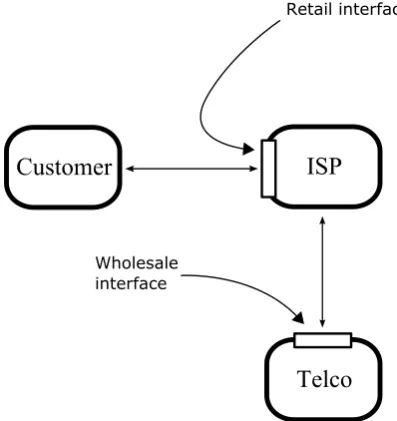
nection. The customer orders the service through a retail interface pro-vided by the ISP. The internet service providers offer diverse additional services on top of the internet connection, such as e.g. e-mail, but they usually do not provide the actual connectivity to the customer. Instead, they order the connection from a telecom operator company (Telco). The commercial relationships between the involved parties are depicted in fig-ure 2.1.
The interaction between the telecom operator and the ISP is a business-to-business relation. This relation is supported by enterprise application integration software. The telecom operator uses this software to offer a wholesale interface through which the ISP can order and cease connections for customers. This wholesale interface is the focus of this case study.
The wholesale interface offers a service to the internet service provider, namely to offer connectivity between an end-user of the internet connec-tion and the ISP. The connectivity may be realized in many ways, depend-ing on the location of the end-user. In some areas a high speed glass fiber connection can be offered but in other areas DSL connections may be avail-able. Wireless connections might be offered in sparsely populated areas. There might also be areas where no service is offered at all. The role of the telecom operator is to offer connectivity to the internet service provider at the data link layer of the internet protocol stack. In some areas multi-ple connection types are offered and each of these is offered with different characteristics and against a different price. The telecom operator can of-fer multiple variants that difof-fer in the guaranteed connection speed and availability. If a customer selects a different variant then the price is ad-justed accordingly. For scoping reasons we assume that the services are offered exclusively in the Netherlands.
In the telecom world connectivity services are commonly described on three levels: the technical, operations and support level.
Technical On this level the precise details of the connection are described
that together determine the quality of service. There are many frame-works that describe the quality of service of an IP connection, such as those defined by ITU/ETSI and IETF [Gozdecki et al., 2003]. For sim-plicity we consider only a limited number of quality of service param-eters. These are bit rate of transferring (which defines the through-put of a connection), delay experienced by packets, jitter (variations in IP packet delay) and the packet loss rate.
Operations The operations level describes the processes that are required
for fulfillment (providing ordering for connections), assurance (pro-cesses for monitoring and maintaining service quality) and billing. These processes are described by the eTOM (Enhanced Telecom Op-erations Map) framework [Milham, 2004]. This standard prescribes which business processes need to be organized to support the provi-sion of telecom services. The standard does not prescribe the busi-ness processes themselves.
Support On this level we find descriptions of the availability of the
ser-vice, the expected mean time between failures and the time required
Future vision
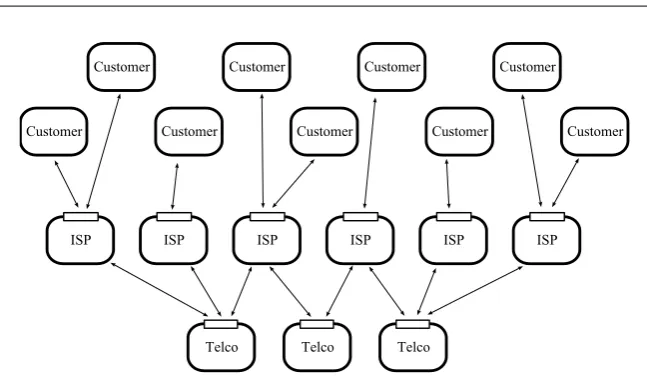
Figure 2.2: Future situation in the telecom world.
to repair faults. Furthermore this level describes the availability of the support desk.
The epBOM (eTOM public B2B Business Operations Map) standard by the TeleManagement forum specifies which operations should be supported by wholesale B2B interfaces in order to fulfill the eTOM framework. Accord-ing to the epBOM framework, required processes include processes for ful-fillment, assurance and billing. For simplicity and understandability we consider only a limited subset of these operations. In this case study, the wholesale management interface offers methods to order a new line, to cease a line and to report trouble. The interface is accessible by ISP’s as a web service, supported by telecom operators.
2.2
Future vision
In figure 2.1 we identified only one ISP and only one telecom operator. In reality there are many ISPs and multiple telecom operators. We expect that in the future the number of ISPs will increase as will the number of competing telecom operators. As a consequence, competition in the mar-ket will be fierce. This will force each ISP to obtain connectivity at the lowest possible cost. As a result ISPs will want to be able to switch be-tween telecom operators quickly and cheaply. Currently the process that is performed to enable the interaction between the ISP and the telecom operator through the wholesale interface is difficult and time consuming. This is because different systems at the ISP and the telecom operator need to be manually integrated. According to [Duke et al., 2005], up to 50% of IT costs in the telecom industry are attributable to integration activities.
2. CASEDESCRIPTION
telecom operator. All this should happen automatically. The service de-scription obtained from the directory includes enough information to au-tomatically build the required B2B connections so that all management operations can be performed.
This vision for the future coincides with the service-oriented architec-ture vision which we discuss in chapter 4. Even though a lot of material on service oriented architectures exists, realizing the sketched ideal situa-tion is not a solved problem. The important unsolved problem is that the semantic information which is necessary for business-to-business integra-tion is lacking. The goal of this report is finding out if and how the service oriented vision can be realized by taking into account semantic aspects.
3
The Service Concept
In this report we are interested in describing the semantic aspects of ser-vice provisioning. Therefore we need to know what a serser-vice is and how services are typically provisioned.
The wordservicehas multiple meanings. In the context of marketing research it has a different meaning than it has in the context of informa-tion systems research. In this report we build a bridge between the two worlds. In this chapter we discuss the service concept from a marketing angle. The information systems view on services is presented in section 4.3. We first characterize the service concept and then provide background on how services are managed.
3.1
Characteristics of Services
In the field of marketing there are many definitions of what a service is. There is currently no consensus which makes it very to give an exact def-inition. It is however possible to provide a workable characterization of the service concept. Often a service is described as “an activity or bene-fit that one party can offer to another that is essentially intangible and does not result in the ownership of anything. Its production may or may not be tied to a physical product” [Kotler and Armstrong, 2005]. Lovelock [Lovelock, 1992] additionally describes a service as being intangible and perishable, meaning that unused capacity at the time of production trans-lates to lost economic opportunity.
This last point is illustrated by the example of an airline company: if at the time of a flight some seats are unoccupied then the airline company loses money. It is not possible to stock services.
Furthermore services are non-transportable and heterogeneous, mean-ing that the service is specific to one customer and that it is hard to mass-produce a service. Finally, services tend to be labor intensive, sensitive to demand fluctuations and are likely to involve a high degree of customer interaction. Due to these characteristics it is hard to achieve economics of scale with services. Examples of services include cleaning, medical care, entertainment, consulting and education.
3. THE SERVICECONCEPT
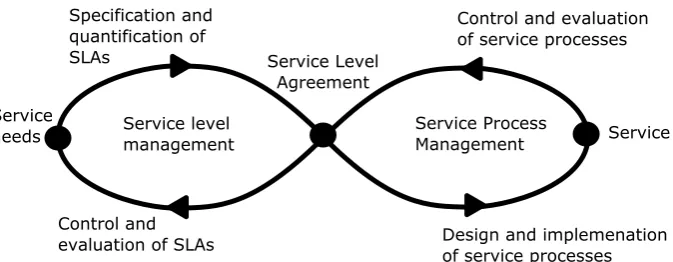
Figure 3.1: The service level lemniscate.
As mentioned in [Baida et al., 2003], a service is often offered as a col-lection of related services, sometimes called the ‘service flower’. The pri-mary service process is often supported by a number of support processes. For example, in the telecom world it is common to offer a service for report-ing and rectifyreport-ing failures as part of a connectivity service. Furthermore [Baida et al., 2003] observes that frequently a service is really an aggrega-tion of simpler services. Providers add value by tuning different services into a coherent valuable package for a customer. This type of aggrega-tion is called bundling. For example, in the telecom world we see that an account with an internet service provider often consists of an internet con-nectivity service, an e-mail service and sometimes even a phone service.
3.2
Managing Services
According to [Parasuraman et al., 1984] customers estimate the service quality by comparing performance with expectations. If the performance is according to expectations then the service will be considered to be of high quality. Therefore it is essential that a customer of a service knows what quality of service he can expect. In practice, especially in the IT world, Service Level Agreements (SLA) are used to manage service quality by defining the expectations. In an SLA the supplier and the customer of a service negotiate the properties of the service that is to be delivered. The expectations about the service performance are accurately defined in the SLA. This can prevent conflicts between supplier and customer later on since both parties agree on the service performance that is to be expected beforehand. [Thiadens, 2005]
An SLA is realized according to the service management lemniscate (see figure 3.1) [Trienekens et al., 2004]. As can be seen in the figure, there is a gap between the needs of the customer and what a supplier is prepared to deliver. In a continuous process the required service level is agreed upon and evaluated.
A service can be considered to consist of a service pit and a service shell [Trienekens et al., 2004]. The service pit is formed by the core (IT) object that is delivered to the customer, e.g. access to a network infrastructure. The service shell comprises the supporting processes and agreements of a
Managing Services
service. An example is the support provided by a helpdesk or a guaranteed level of data security. We consider the service pit to be made up of the essential criteria of the service and the service shell comprises the support criteria. A service level agreement specifies the characteristics of both service pit and shell.
Part II
4
Service-Oriented Architectures
In this chapter we introduce the service-oriented architecture vision. First we discuss the motivation behind the service-oriented architecture. Then we discuss the components of the service-oriented architecture using a lay-ered structure. Finally we elaborate on what is meant with a service in a service oriented architecture and we contrast this with the service concept in the marketing field.
4.1
Motivation
In the past business to business relations between companies were often forged for many years. Integrating business processes and information support took a lot of time, but since relationships were stable this was not too much of a problem. Nowadays, however, business environments change quickly thereby forcing companies to adapt rapidly to changing cir-cumstances. Information technology should therefore be flexible to support quickly changing demands. A common vision in the scientific literature is that the software that supports businesses needs to be built up from dis-crete parts of functionality. It should be possible to reuse these parts and to reconfigure then in order to adapt to changing environments. This vision is propagated by the component-based development approach.
4. SERVICE-ORIENTEDARCHITECTURES
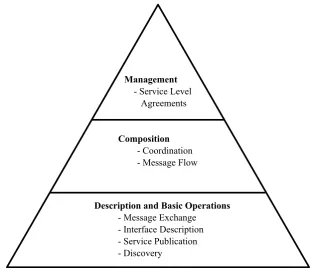
Figure 4.1: The service-oriented architecture pyramid.
4.2
Layering
The service-oriented architecture reuses the design philosophy of compo-nents-based development, namely that functionality should be split up over components that are loosely coupled. But while component-based de-velopment is mainly a software dede-velopment methodology, service-oriented architecture can be placed in a broader perspective, namely as an entire information system architecture for organizations. As was discussed in [Orlowska et al., 2003], the SoA concept can be visualized as a pyramid. At the bottom layer, the basic operations layer, basic components (called ser-vices) offer discrete parts of functionality. The SoA architecture provides a mechanism for the publication and discovery of these services, thereby offering a solution for the scalability problem that plagues component-oriented approaches. At the second layer, the composition layer, we find technology that supports the aggregation of multiple basic services into composite services. In this layer technology support is necessary for coor-dination, monitoring of performance and quality of service. The top layer of the pyramid is the management layer, which prescribes that organiza-tions should think about service level agreements, assurance and support for the information systems architecture. This pyramid structure is de-picted in figure 4.1.
Service-oriented architectures should eventually enable a distributed computing infrastructure across the internet so that organizations can col-laborate and integrate applications. Organizations will offer all of their
The Service Concept in Service-Oriented Architecture
value adding activities to the public via the internet and when specific IT support is needed for performing a business process, the required services can be found quickly in a centralized registry. This registry can be shared between a number of companies that operate in the same industry sector. Discovery of services is a crucial aspect in service-oriented architectures. The availability of services will be dynamic and it should be possible to switch quickly and without problems between suppliers that offer a spe-cific service. When this infrastructure is in place, IT support for the ac-tivities of organizations will be flexible and easily adjustable to changing circumstances.
The service-oriented architecture is only a vision of which web services are meant to be a concrete realization. Since the service-oriented architec-ture relies on universally accepted web service standards like XML, WSDL and SOAP, the interoperability problem that plagues component-based de-velopment should be eliminated. In chapter 5 we discuss web service tech-nology in more detail and we investigate to what extent it can be used to realize the service-oriented architecture vision that we sketch here.
4.3
The Service Concept in Service-Oriented Architecture
In the context of a service-oriented architecture, a service is essentially a component that offers its functionality to external components through an interface that is described in a standardized way. The coupling between services is done through a registry of available interfaces, often called a directory [Stojanovic and Dahanayake, 2005]. In the directory a user can search for an interface that will meet his or her goals. The directory should also be searchable by individual components in order to support loose cou-pling.
A service in this sense (a software component that offers an interface) is different from the concept of a service in marketing (an intangible benefit offered by one party to another, see chapter 3). In general a service in the context of a service-oriented architecture is not necessarily a service in the marketing sense of the word. In this report however we take the position thatapplication servicesin a service oriented architecture realize a higher levelbusiness service.
We think that this two-layer approach to services (the economic per-spective combined with the computational perper-spective) is very useful. It requires components in a service-oriented architecture to offer an economic value to users. Thinking about services in this way makes it possible to make intelligent investment decisions about service development based on expected returns. Additionally, using this definition, it makes sense to offer services to an on-line market and to external parties. Finally, con-sidering the economic benefit of a service can be a good starting point to decide what services to offer.
4. SERVICE-ORIENTEDARCHITECTURES
keyword returns on internet search engines. A gray area is occupied by semi-manufactured products such as database look-up components that are only useful as part of a larger whole.
5
The Web Services Platform
Architecture
In this chapter we investigate web service technology. We first detail the general concepts of web service technology. Then we discuss for each of the layers in the service-oriented pyramid (see chapter 4) how the activities at that level are supported by web services technology.
Web services can be seen as an implementation of the service-oriented architecture vision. Services are offered by components that can be im-plemented in conventional programming languages such as Java or .NET. Web service technology guarantees that components developed using any technology on any infrastructure can communicate with any other com-ponent that offers a web service description. The services are described in a standardized way and these descriptions are published in a central-ized directory of services. Parties that want to use the service, retrieve the description from the directory and can then interpret that description to make calls to the service. The activity of finding and making use of a service is called binding. Parties can also offer services that are composed of other services. The description of such a composition is called choreog-raphy.
Web services technology is described in numerous standards. These standards are generally based on XML technology. For many of the com-ponents from the service-oriented architecture pyramid (section 4.2) a web service standard is available. In the web service architecture we find, among others, standards for message exchange, description of service in-terfaces, discovery of services and the composition of services. This chapter is structured according to the layers of the service-oriented pyramid. We discuss what standard support exists for each of these layers.
5.1
Description and Basic Operations Layer
5. THE WEBSERVICESPLATFORMARCHITECTURE
Message Exchange
The message exchange layer of the web services stack is provided in the form of the SOAP protocol. A SOAP message is an XML document that consists of a header and a body. The body describes the actual message that is passed to the web service, and header elements can be used for many purposes such as additional routing information or security require-ments. The header information is also passed on to the called web service. SOAP messages are transmitted between so called SOAP nodes. A mes-sage may pass any number of SOAP nodes and the SOAP nodes may in-spect or alter the message headers. It is possible to specify that it is nec-essary for SOAP nodes to understand and process a header. In that case if a SOAP node does not understand the header, a fault condition occurs and an error message is sent back to the node that generated the SOAP message.
SOAP messages can be bound to any transport protocol. Examples are HTTP or SMTP (e-mail). HTTP transport, however, is the most commonly used. The SOAP standard intentionally does not prescribe an interaction protocol between the caller and the application service. Other web service standards, such as WSDL and BPEL, can be used to define the allowed message exchange patterns. [Weerawarana et al., 2005].
Interface Description
The set of operations that an application service offers is called the inter-face of the service. The WSDL standard (Web Service Description Lan-guage) is used to describe this interface. WSDL uses the concepts of type, message, portType, binding and service [Weerawarana et al., 2005]. For many of these concepts WSDL uses an extensibility mechanism, based on XML namespaces, so that new technologies can be used with a WSDL de-scription.
In the types part of a WSDL document, data structures are declared that can be used later to define parts of messages. These structures can be defined in any schema language, but XML Schema [Fallside, 2001] is the de facto standard.
In the message part of the WSDL description, the structure of the mes-sages that are exchanged between the web service and the caller is speci-fied. A message consists of one or more parts of a specific type which are either built-in XML Schema types, or types described in the types section. The portType part describes the input and output messages (if any) of the operations of the web service. Web services can use a request-response or a one-way interaction pattern. Theoretically WSDL makes it possi-ble for the service to initiate the conversation but it is not supported by available implementations due to practical difficulties that arise when this form of interaction is implemented (e.g. it is unclear where to the message should be sent) [Weerawarana et al., 2005].
The binding part of the interface specification describes precisely how the messages are exchanged, using which protocol and using what layout. The de facto standard is to use SOAP over HTTP transport. The recom-mendeddocumentoperation style entails that the content of the messages
Composition
are directly inserted in the SOAP body. There is also an RPCstyle that is supposed to make it easier to directly map methods defined in object oriented programming languages to SOAP messages.
Finally the service part describes the location where the web service can be found. For a SOAP web service this is specified in the form of a URL. The interface description in WSDL format only offers a description of the syntactic properties of an interface (the format of the incoming and outgoing messages), the semantics of the interface cannot be described in the WSDL language.
Service Publication & Discovery
Discovery for web services is provided by the UDDI (Universal Descrip-tion, Discovery and Integration) standard. The UDDI standard is meant to facilitate the operation of a central registry or directory of web ser-vices. The UDDI uses a data model that stores information about service providers and services. A lot of basic information is stored about the ser-vice providers, such as names, descriptions, addresses, telephone numbers, etc. This information might even be stored in multiple languages. For services, a plain text description field is provided and one or more bind-ingTemplates point at the WSDL document necessary to call the service. Searching a UDDI directory can be done with a keyword-based search.
Recent versions of UDDI include support for digital signatures. With these digital signatures it is possible to verify the identity of the publisher of the service. This way the results from an UDDI query are more trust-worthy. Furthermore, UDDI offers a subscription API for notifying clients when new services become available. [Weerawarana et al., 2005]
5.2
Composition
On the higher layers of the Service-oriented Architecture we find the need to support aggregation of services into composite services. WS-BPEL (Busi-ness Process Execution Language for Web Services) strives to model pro-cesses of web service executions. Individual web service calls are the steps in the process. The entire process description can be published as a web service to offer transparent web service aggregation. BPEL is meant to be interpreted and executed by machines so that long running processes can be executed automatically.
BPEL models business process logic in a procedural way. This means that all steps that have to be carried out by the interpreter are explicitly spelled out. Interaction with web services is specified by commands that receive and send messages. The language offers support for branching, loops, variables and calculations. Parallelism is supported as well, allow-ing business processes of arbitrary complexity to be modeled. Typically BPEL processes are bound to specific web services at deployment time. It is however possible to specify that the web services to be used are de-termined at runtime. This can be realized, for example, by querying a directory web service at the start of the process.
5. THE WEBSERVICESPLATFORMARCHITECTURE
in the process and all the messages that are to be sent. This way an exe-cutable BPEL process offers a glass box representation of service behavior. An abstract process is a projection of a BPEL process that only models the interaction with certain external parties. This interaction is defined in terms of the message exchanges that take place. Sharing this information with third parties may be necessary so they know what message exchange patterns are to be expected between the web services. Abstract process de-scriptions allow sharing of only the interaction information while keeping the actual business process details confidential, thereby providing a black box representation of service behavior. [Weerawarana et al., 2005]
5.3
Management
The management layer of the service-oriented pyramid contains tasks that (mainly) entail the arrangement and enforcement of service level agree-ments. In section 3.2 Service level agreements are briefly introduced. In this section we discuss what web service standards exist in this area.
For our treatment of the available technologies it is important to realize that an SLA primarily defines a set of metrics that need to be measured periodically. Furthermore an SLA includes a set of parameters that spec-ify algorithms for determining the performance of the service given the input metrics. For each parameter, acceptable values and deviations are specified. Finally SLAs specify the involved parties and the consequences of violating the expectations raised in the agreement.
Important success factors for service level agreements are that the specification of the service contains only a limited number of measuring points that capture the essence of the service. The pricing for the ser-vice should be transparent and clear to all parties. A final requirement for a good SLA is that it contains a penalty clause that specifies the sanc-tions that are applied to a party that does not comply with the agreement [Thiadens, 2005].
For determining the service level parameters one can use an industry standard framework. In [Gozdecki et al., 2003] a number of these frame-works in the context of IP netframe-works and their related parameters are dis-cussed. Additionally they identify a number of relevant intrinsic parame-ters that apply to all such networks.
According to [Keller and Ludwig, 2003] SLAs are often specified in nat-ural language and therefore they are also monitored manually. Big cus-tomers of an organization will want to negotiate a specific SLA for their purposes, and sometimes they want to specify custom measurement meth-ods for assessing service performance. In contrast it is also possible for the supplying organization to define a standardized portfolio of services and associated SLAs. It is desirable however to automate the monitoring of SLAs, this requires a standardized way of specifying SLAs.
WS-Policy
In the current web services platform architecture there is no comprehen-sive standardized support for monitoring and enforcing the quality criteria
Management
specified in an SLA. There is, however, the WS-Policy web service stan-dard which aims to support non-functional capabilities and requirements for web services [Weerawarana et al., 2005]. We briefly describe this stan-dard here.
A policy specification contains a list of policy containers that each rep-resent a valid policy alternative. Each of these alternatives is described by a list of assertions that must hold about a service. The subject of the assertions is free form, and only presence or absence of an attribute can be described. For example, we can express in the language that the secu-rity should be guaranteed by performing the RSA algorithm. We can not specify that at least 128 bit encryption should be used, but we can specify that exactly 128 bit security is to be used. Similarly we can not specify a minimum up-time or a maximum delay of a connection. Other complicated constructs, such as if-then-else constructs or assertions that are only valid on certain dates or times are not available. This all seems too limiting as many current SLAs require this level of complexity for specifying min-imum response times, availability during peak hours, etc. Furthermore, the WS-Policy standard offers no support for semantics. The policy de-scriptions can be interpreted only if the meaning of the subject (encryption in our example) are defined externally. In its current form the WS-Policy standard is not really sufficient to describe the quality criteria of web ser-vices.
WSLA
WSLA is an XML based language for electronically representing service level agreements [Keller and Ludwig, 2003]. WSLA strives to model in an unambiguous way the SLA parameters, the way of measuring performance and the consequences of violation of the SLA. A WSLA document contains a description of the involved parties, which have a direct interest in the SLA, such as the supplier and the customer. It also gives the possibility to define third parties, which play a role in monitoring compliance with the SLA. Contact information is specified for all parties. A WSLA document also contains a service description section that defines the observable pa-rameters of the service. It describes the metrics that can be collected, how these can be collected and by whom. The values for the metrics can be aggregated, e.g., to obtain average values over time. Finally, the service description section contains the definitions for the SLA parameters. The obligations section specifies, using logic conditions, under which circum-stances (e.g., during what times, or under what system loads) what values for the metrics are acceptable. It also contains a section that describes what actions are taken when a violation is detected. In its current ver-sion WSLA only supports the notification of SLA violations to interested parties.
A limitation of WSLA is that there is no provision for specifying and monitoring the behavior of non-automated services such as for example a help desk.
5. THE WEBSERVICESPLATFORMARCHITECTURE
SLA, but that it will be difficult for algorithms to reason about the value of an SLA for a customer. Automatically negotiating and enforcing the terms of an SLA is out of reach with current technology.
5.4
Evaluation
With the technologies discussed in this chapter it is possible to specify a service in the context of service-oriented architectures on a syntactic level. We can specify the input and output parameters of services and we can describe composite services that are built up from smaller services. This information, however, carries little meaning for the user of a web service. A customer will have to contact the supplier of a service to find out its expected behavior or alternatively will have to interpret and guess the meaning of the service from the input and output parameters. This is a time consuming and error prone process that prevents dynamic switching of web service suppliers. The lack of semantics hinders the realization of the service-oriented architecture vision discussed in chapter 4. What is necessary is a complete and unambiguous description of a service so that it is clear to the customer what the application service does. In the next chapters we investigate how the context of a service can be described in a way that can be interpreted by machines.
Part III
6
A Framework for Semantic Web
Services
Semantic web services are web services that are described in such a way that machines can reason about their utility. In this report we investi-gate a number of methods that strive to enable such semantic services. In order to evaluate these methods we need to establish the evaluation criteria which are to be used. In this chapter we therefore discuss what aspects play a role in the semantic description of business and application services.
We first discuss the vision of the semantic web, on which much of the current work in the field of semantic service description is based. Then we introduce our own framework that identifies the important concepts in semantic service description and delivery. Based on the framework we identify a number of concerns that should be addressed by methods that strive to realize automatic, semantic service delivery. Finally we arrive at a list of concrete requirements which we can use to evaluate concrete methods.
6.1
The Semantic Web
In [Berners-Lee, 2001] the usefulness of a semantic web is discussed. The article discusses how in a semantic web information is given a well-defined meaning, thereby “enabling computers and people to work in cooperation”. The article sketches a vision where software agents are able to combine in-formation from many heterogeneous sources and draw conclusions based on the combined information. This way complicated tasks can be per-formed. The article provides the example of making appointments with a medical specialist. The agent has to consider available dates and times of multiple people, the rating of the specialist and whether or not the insur-ance company has a contract with the specialist. Berners-Lee et al. foresee that in the semantic web, web pages provide information in semantic form to be processed by computers.
6. A FRAMEWORK FORSEMANTICWEBSERVICES
promises to be able to describe the meaning of information in a computer understandable way.
6.2
Aspects of Service Provisioning
For our introduction of the service-oriented architecture in chapter 4 we utilized the pyramid structure as proposed by [Orlowska et al., 2003]. In this pyramid, and in the current web services platform architecture, the semantic aspect of service provisioning is disregarded. Without consider-ing this semantic aspect a number of tasks in the service-oriented architec-ture, such as service description and discovery seem simple. These tasks were therefore grouped in one layer, situated at the bottom of the pyramid. However in semantic web-service research, tasks like service descrip-tion and discovery are at the center of attendescrip-tion. Currently there is no scientific consensus about how discovery of services should take place or how services should be described. It is not even clear which are the impor-tant issues in semantic service-oriented architectures.
Since the subject matter of semantic web services is so complex and since it does not fit the pyramid model introduced in chapter 4, we decided to develop our own framework of this domain. Our framework provides an overview of the concepts that enable service provisioning in a semantic service-oriented architecture. Instead of splitting up the subject in layers (as was done in the service-oriented pyramid), our framework provides a holistic view of the application domain.
The framework we introduce in this section consists of a structural and a procedural viewpoint. We discuss these viewpoints separately.
The Structure Viewpoint
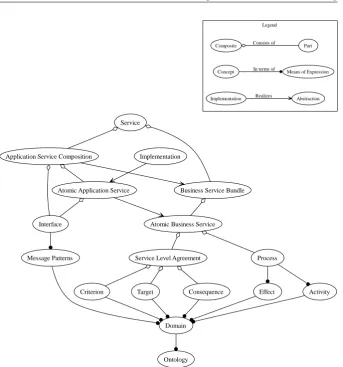
The structure viewpoint describes the field of semantic service provision-ing. In figure 6.1 this viewpoint is depicted. We discuss the the elements in the figure separately.
We consider theserviceconcept in a service-oriented architecture to be made up of two parts: a business service and an application service. The business serviceconcept represents the economic value of the service. The application service is the software component that realizes the business service.
Services can be built by bundling simpler services into a larger pack-age. Bundling services is discussed in chapter 3. In the diagram, bundling of business services is represented by thebusiness service bundleconcept. Each bundle consists of a number ofatomic business services. An atomic business service is a business service that is not made up from other busi-ness services. The bundling of busibusi-ness services is reflected in the bundling of application services (application service compositionand atomic appli-cation service).
A business service contains abusiness processthat provides the added value of the service. Business processes can be described in terms of their effectsor in terms of theactivitiesthat are carried out in the process.
Another important component of a business service is theservice level agreement. Service level agreements are used to manage expectations of
Aspects of Service Provisioning
Legend
Composite Consists of Part
Concept In terms of Means of Expression
Implementation Realizes Abstraction
Business Service Bundle
Atomic Business Service
Service Level Agreement Process Application Service Composition
Atomic Application Service
Interface
Implementation
Domain
Ontology Service
Criterion Target Consequence Message Patterns
Effect Activity
Figure 6.1: The structure viewpoint.
service performance (see chapter 3 for details). A service level agreement contains a list ofcriteriawhich are used to measure performance. The per-formance is compared to a predeterminedtarget. Theconsequencesclause of an SLA determines what happens when the agreed performance was not realized.
An application service offers aninterfacethrough which it can be used, all communication by external parties with the application service goes through the interface. The interface is defined in terms of allowedmessage exchange patterns. Animplementation in software is used to realize an atomic application service.
6. A FRAMEWORK FORSEMANTICWEBSERVICES
Provider
Requester
Registry
Formulate Request
Rank Providers
Match Request
Negotiate
Deliver
Figure 6.2: The process viewpoint.
To facilitate communication, the parties must share a common vocabu-lary about the service, this vocabuvocabu-lary can be expressed in anontology. An ontology is a means to represent knowledge in a computer understandable way. In figure 6.1 we see that ontology is the central concept in a semantic service-oriented architecture: all concepts are expressed using an ontology. Ontologies are discussed in detail in chapter 7.
The Process Viewpoint
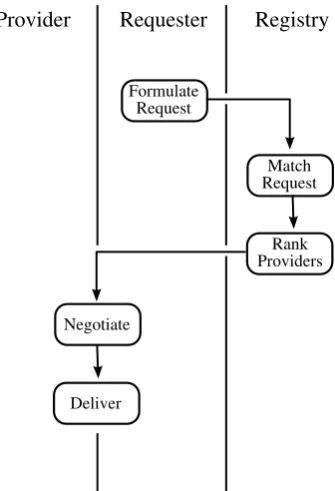
The process viewpoint is illustrated in figure 6.2. The process viewpoint of the framework describes how services can be found and executed in a semantic service-oriented architecture.
Service delivery is initiated by a requester who formulates a service request. Then, a centralized registry matches this request against service descriptions which were previously registered by providers. The service descriptions that match the service request are ranked by their relevance and returned to the requester. The requester then initiates a negotiation session with the provider to determine the exact service parameters. Fi-nally, when an agreement is reached, the service is delivered in accordance with the agreement. The subject of service discovery is treated in more de-tail in chapter 8.
Realization Concerns
6.3
Realization Concerns
From the framework introduced in section 6.2, we can derive a number of specific issues that arise in realizing semantic services. A method for semantic services should provide a means for dealing with each issue. We can group the issues in three levels: the business service level, the commu-nication level and the delivery level. Many of the terms we refer to have been introduced in figure 6.1, these terms are typeset in italics below.
Business Service Level
At the business service level we are concerned with representing the util-ity of a service. A number of concerns are relevant on this level: model-ingbusiness processes, representingservice level agreementsand specify-ingbundlingof services.
Business processesdescribe the value-adding activities that take place in the delivery of a service. Processes can be represented in two different ways: a procedural and a declarative way. The procedural way represents processes as an ordered set ofactivitiesthat are carried out in the course of the process. The declarative way describes only theeffectsof the process, not how these outcomes are realized.
Processes can be described in formal or informal ways. Formal specifi-cations have meanings that are precisely defined by mapping statements on mathematical structures, whereas informal specifications rely on the interpretative capabilities of the reader. Computers are only able to in-terpret formal specifications hence process specifications for semantic ser-vices will need to be formal.
Examples of formal procedural specifications of processes are SADT di-agrams (as described in [Congram and Epelman, 1995]) or Petri Nets (de-scribed in [van der Aalst, 2002]). Prolog, a logic programming language, is an example of a method that can be used for formally describing processes in a declarative way [McIlraith and Son, 2002].
The ideas behindservice level agreementsare introduced in section 3.2. Methods for representing service level agreements are discussed in section 5.3. A semantic web service method should provide support for negotiating and monitoring service level agreements.
Bundling refers to the fact that services can be built by aggregating simpler services into a larger package. Bundling is discussed in chapter 3. Since it is common to bundle services in order to add value, a semantic web service method should offer support for bundling.
Communication Level
At the communication level, the main issue is to represent the terminol-ogy of the applicationdomainin a machine understandable way. Further-more there is the problem ofmatchmakingbetween service requesters and providers. A final concern is how to represent allowedmessage patterns.
repre-6. A FRAMEWORK FORSEMANTICWEBSERVICES
sentation language based on logic. Since ontology representation is such a large topic, it is discussed separately in chapter 7.
The process of matchingproviders and customers of services is called discovery. A semantic web service method should provide an automatic way of locating providers who can meet a customer’s demand. This subject is treated in more detail in chapter 8.
During service delivery the provider and requester exchange messages. Semantic web service methods should provide a way of representing these message patterns. A difficult issue is that of heterogeneity in message ex-change patterns. For communication purposes, the provider and requester must be able agree on the allowed message exchanges.
Delivery Level
At the delivery level we are concerned with resolving details about the exact parameters of service invocations.
The discovery process usually does not result in an unambiguous ser-vice description that is correct and complete (see chapter 8 for details). To address this issue [Preist, 2004] proposes to include anegotiationphase af-ter the discovery phase, during which the concrete service parameaf-ters can be negotiated from an abstract description. During the negotiation phase the provider and requester agree on the exact parameters of a service and the message exchange patterns.
Since advertising concrete services is often infeasible, any semantic web service method should offer support for refining and possibly nego-tiating the exact parameters of a service.
6.4
Requirements on Semantic Web Service Methods
Based on the conclusions of sections 6.2 and 6.3, we are able to derive concrete requirements for methods that strive to enable semantic web ser-vices. In this section we present the requirements that apply to methods that strive to realize semantic service-oriented architectures.
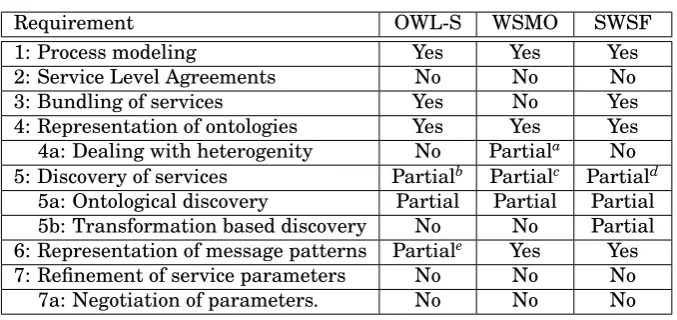
1. Business process modeling. The method should support describing processes that define the value-adding activities of the service. Pro-cesses can be represented procedurally or in a declarative manner.
2. Service level agreements. A semantic web service method should pro-vide support for negotiating and monitoring service level agreements.
3. Bundling. Since it is common to aggregate services in order to add value, a semantic web service method should offer support for creat-ing bundles of services.
4. Ontology. An ontology-based language should be used to represent the semantics underlying the service.
a) A method should be able to account for ontological heterogeneity that occurs when different organizations independently develop their own domain models (see section 7.5).
Validation of Requirements
5. Discovery. A semantic web service method should provide an auto-matic way of locating providers who can meet a requester’s demand.
a) (preferable) Matching is done on the basis of ontological descrip-tions.
b) (preferable) Matching is done on the basis of the transforma-tion(s) of the world that delivery of the service achieves.
6. Message patterns. A semantic web service method should have a way of representing message patterns and conforming to existing mes-sage exchange patterns.
7. Parameter refinement. A semantic web service method should offer support for generating concrete parameters from an abstract service description.
a) (desirable) The method offers support for automatic negotiation about parameter values between provider and requester.
6.5
Validation of Requirements
Validating requirements on software architectures is a difficult issue which has not received extensive treatment in the scientific literature. In this section we therefore discuss a number of ways in which we could validate the requirements introduced in section 6.4.
Validation Approaches
An intuitive approach to validating requirements would be to check if ful-filling the requirements will necessarily lead to a satisfying solution to the problem. The difficulty with this approach is that this method of proof is infeasible. It requires building all possible artifacts that meet the require-ments and then to check if the solutions solve the problem and fulfill the requirements. This is not a practical strategy to requirements validation since validating the requirements would entail building the solution to the problem.
We take a more practical approach: validation of individual require-ments can be done on the basis of use cases that each address a part of the problem. By checking the necessity of each requirement in section 6.4 by means of a scenario, a reasonable argument for the merit of each require-ment can be made. Even though no guarantee for the completeness of the requirements can be given, this approach does provide us with insight in the value of the requirements.
6. A FRAMEWORK FORSEMANTICWEBSERVICES
all requirements we have a reasonable indication that the method is suit-able for this purpose. The scenarios which we will use are inspired on the case description introduced in chapter 2.
Scenarios
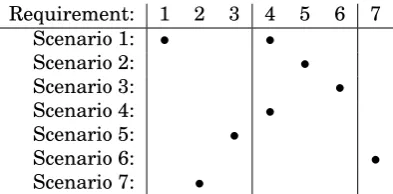
In this section we provide a number of scenarios to motivate the requiments introduced in section 6.4. For each scenario we indicate what re-quirements are necessary to fulfill the scenario.
1. An ISP wishes to purchase connectivity to connect a customer to its own network. In order to do this the ISP will need to find a service that fulfills this goal.
The ISP formulates the request for a new connection in terms of pre-and postconditions in an ontology. Then the request is sent to a party that matches supply and demand.
2. A matchmaking party compares an incoming service request with all service offers registered by the providers. The most relevant matches are determined using ontological comparison and send back to the requester.
3. In order to enable service delivery it is necessary to define what mes-sages can be exchanged between the requester and the provider. Of-ten the message exchange patterns are simple, but this scenario pro-vides an example of a more complicated exchange pattern.
When a problem occurs with the connectivity between the telecom provider and the ISP, a diagnostic procedure needs to be carried out. This procedure might consist of a number of checks that are per-formed on either end of the connection with the results reported back to the other party. A powerful method for defining these exchanges is required.
4. An ISP wants to order a connectivity service from a specific telecom operator. However the telecom operator does not use the same termi-nology as the ISP. Mediation is necessary to translate the messages of the ISP into a format that the telecom operator understands and vice versa.
5. In order to remedy failures, the telecom operator offers a fault-clearing service with each connection. Failures can be reported to this ser-vice so that they will be resolved. This serser-vice is only worthwhile in combination with a connectivity service and must be purchased simultaneously.
6. The service that the telecom provider offers depends on the location of the end user of the connection. In some areas higher connection speeds can be realized than in others. A negotiation process between the ISP and the telecom operator ensures that the desires and possi-bilities match.
Validation of Requirements
Requirement: 1 2 3 4 5 6 7
Scenario 1: • •
Scenario 2: •
Scenario 3: •
Scenario 4: •
Scenario 5: •
Scenario 6: •
Scenario 7: •
Table 6.1: Requirements traceability matrix
7. An ISP wants to order connectivity for a business customer. The busi-ness customer requires specific, measurable guarantees about avail-ability and quality of the connection. The ISP searches for telecom operators that are willing to agree to these specific requirements.
Tracing
7
Ontologies
In this chapter we investigate ontologies as a means for modeling domains. We discuss what ontologies are and why they are useful. We investigate the different approaches for representing ontologies and evaluate those for our purpose. Finally we discuss how ontologies can be built and we discuss the merits of reusing standardized ontologies.
7.1
Definition
As discussed by [Singh and Huhns, 2005], communication about services is meaningless without a common understanding of the domain. Ontolo-gies are a means to realize this shared understanding and are therefore an essential part of any semantic web service architecture. The term ontology is defined in [Guarino and Giaretta, 1995]:
[An ontology is] a representation of a conceptual system that is characterized by specific logical properties (special type of logi-cal theory containing only necessarily true formulas).
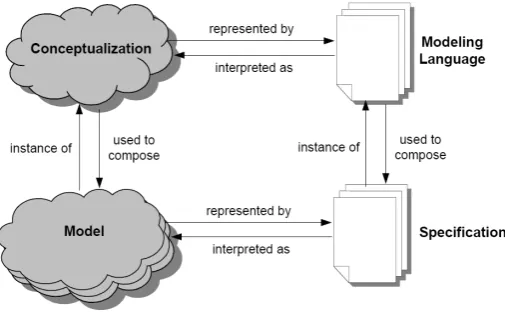
In figure 7.1, taken from [Guizzardi, 2005], the parts that make up an ontology are placed in perspective. This figure shows that a model of the world is represented by a formal specification. This specification is composed using a modeling language. Behind the modeling language are
7. ONTOLOGIES
assumptions about how knowledge about a domain should be represented: the conceptualization. The entire system is called an ontology.
7.2
Conceptual framework
In [Reichgelt, 1991] a number of the most common conceptualizations for representing knowledge are discussed. This discussion is based around a conceptual framework for knowledge representation which we introduce in this section.
According to the framework a modeling language consists of asyntactic and aninferentialaspect. The syntactic aspect covers the issue of how ex-pressions in the language are made. The inferential aspect addresses how new conclusions can be drawn from existing knowledge. The framework is further subdivided in four levels. These levels are theimplementation, logical,epistemologicaland theconceptuallevel. We discuss each of these levels here.
Implementation: on the implementation level one is concerned with
build-ing a computer program that can interpret the knowledge represen-tation language. On this level issues of data structures and algo-rithms play a role.
Logical: the logical level is concerned with the precise meaning of the
constructs in the language. Furthermore on this level we consider what kind of information can be expressed using the constructs. An example of a question on this level is: “can we express that either statementaor statementbis true?”
Epistemological: The epistemological level is concerned with the way
that knowledge is structured in the language. The choice for a cer-tain type of structure is linked with the application domain in which the language will be used.
We explain these ideas using some examples inspired on our case study. A possible choice at this level is to represent the telecom do-main as a list of unstructured facts: ‘aconnectionruns between two points’, ‘a personhas aname’,‘bob is aname’, ‘connectiony belongs to the person namedbob’.
Another possible choice is to use an object-oriented style of model-ing. Using this style connectionandpersonwould be a classes. The classes would have attributes associated with them such asnameand throughput.
The choice for a certain structure should be based on the intended application and the structure of the application domain.
Conceptual: At the conceptual level decisions are made about the
prim-itives that are included in the language. The primprim-itives that are applicable are prescribed by the choices made at the epistemological layer. For example, if at the epistemological level it is decided that a network structure is used, then at the conceptual level the required connection types and their conceptual meanings are determined.
Types of Knowledge Representation Languages
Requirements
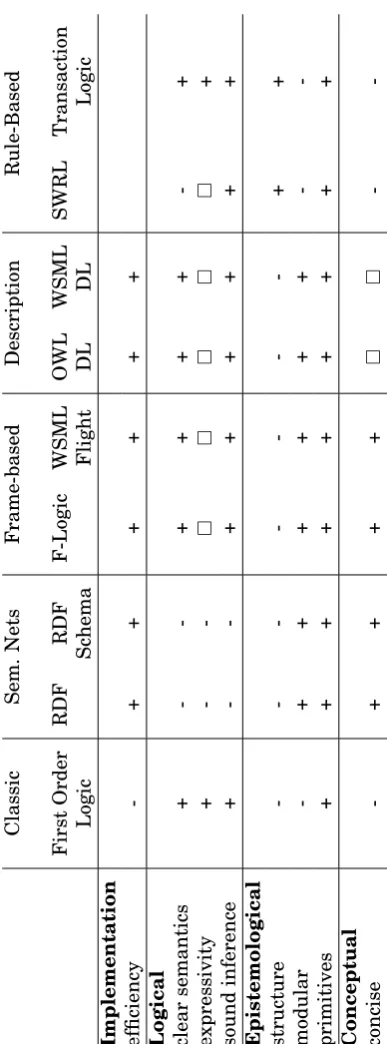
Next to the conceptual framework for knowledge representation we dis-cussed previously, [Reichgelt, 1991] also proposes a number of require-ments for modeling languages. The requirerequire-ments are organized according to the layers of the conceptual framework.
Implementation The most important requirement on knowledge
rep-resentation languages at the implementation layer, is that of efficiency. Drawing inferences should be reasonably fast and representing knowledge should be space efficient.
Logical From a logical stance, a knowledge representation language is
required to have clear semantics. This entails that all the syntactically al-lowed constructs should have a clear and unambiguous meaning. Further-more, the inference rules should be soun