TITLE PAGE
TITLE: VIRTUAL PATIENTS: DEVELOPMENT IN CANCER NURSING EDUCATION
Professor Pam Moule, EdD, MSc, BSc (Hons), RNT, RN
University of the West of England, Faculty of Health and Applied Sciences, Glenside Campus, Blackberry Hill, Stapleton, Bristol, BS16 1DD. Telephone: 0117 328 8422, Email [email protected]
Dr Katherine Pollard, PhD, MSc, PGDip(ScSci), BA, HDip(Midwifery)
University of the West of England, Faculty of Health and Applied Sciences, Glenside Campus, Blackberry Hill, Stapleton, Bristol, BS16 1DD.
Julie Armoogum, MSc, BSc (Hons), RGN
University of the West of England, Faculty of Health and Applied Sciences, Glenside Campus, Blackberry Hill, Stapleton, Bristol, BS16 1DD.
Simon Messer MSc, PGCert(HE) BSc(Hons)
University of the West of England, Faculty of Health and Applied Sciences, Glenside Campus, Blackberry Hill, Stapleton, Bristol, BS16 1DD.
ABSTRACT
Background; The number of men diagnosed with prostate cancer is increasing and
internationally there are high incidence rates. It is important that nurses and
healthcare professionals are enabled to provide appropriate care to those men
affected by prostate cancer and their families. Despite this need, there is recognition
that many professionals feel ill prepared and lack knowledge in a number of areas.
This paper presents the development of a Virtual Patient (VP) online resource to
support practitioner learning.
Aim: To develop five online VP simulation scenarios to meet the learning needs of
nurses and health-care professionals caring for men with prostate cancer.
Method: Topic areas for the VPs were taken from previous work exploring the needs
of health care professionals working with men with prostate cancer. An initial
scoping exercise involving nursing practitioners, students and a prostate cancer
charity confirmed the focus of the case study scenarios. Service users and specialist
practitioners reviewed an outline of each case study to ensure fidelity of the
simulations scenarios. Cases were entered into UChoose, a web based interactive VP player and authoring tool. The final case studies were reviewed by a sample of both registered and non-registered nurses and nursing students.
Results: The majority of respondents reported an increase in knowledge and
suggested they would recommend the resource to others. A number of positive
aspects of the resource were highlighted. Respondents also commented about areas
Conclusions: The VP case studies provided an opportunity to develop knowledge and confidence in caring for men with prostate cancer. The mode of delivery and the content was acceptable for less experienced and knowledgeable staff.
HIGHLIGHTS
Nurses indicated the need for educational support when caring for men with prostate cancer
Virtual Patient scenarios were developed using UChoose VP authoring software
A standardized process involving service users supported the development of five case studies
The majority felt completing VP increased their knowledge and confidence
Most would recommend to colleagues, found easy to use and would like more
KEYWORDS
INTRODUCTION
Each year, over 1.1 million men are diagnosed with prostate cancer worldwide (Cancer Research UK, 2014). Incidence rates are highest in Australia and New Zealand and it is the most common cancer amongst males in the UK, with 1 in 8 men developing prostate cancer at some point in their lives (Cancer Research UK, 2014). Thus, regardless of their specialty, nurses are likely to care for men who have experience of prostate cancer. Given the increasing care demands, Moule et al., (2013) completed a review of the learning needs of health care professionals working with men affected by prostate cancer for Prostate Cancer UK, a UK based charity. The review found many nurses indicated educational support needs for topics such as management of psychosocial issues, sexual issues, continence management and urinary concerns, long term effects and end of life care. As a result, Prostate Cancer UK implemented a plan to develop and provide educational resources for a range of health-care professionals, including nurses. This paper presents a study to develop and review the educational resources for nurses and healthcare professionals now available on line (prostatecanceruk.org/courses).
BACKGROUND
al., 2013). The National Health Service (NHS) Technology Enhanced Learning Strategy Paper (Department of Health, 2011) identifies the need for delivering workforce learning online and stresses that healthcare professionals should learn skills in a simulation environment as part of the managed learning process.
Simulations are activities that mimic the reality of clinical environments and are used to demonstrate procedures and enable decision making and critical thinking (Jeffries, 2005). E-simulation combines simulation with technology, and involves goal-based digital simulation via a computer screen whereby learning resources are accessed directly from the internet or downloaded as an application (Cant and Cooper, 2014).
Any technologies used in nursing education need to be engaging and innovative for the student (Moule et al., 2010). To support the design and evaluation of simulation activities in nursing, Jefferies (2005) developed a conceptual framework for
simulation activities that focuses on clear objectives, fidelity (realism) of the
learning from making mistakes. Developing on from this, VPs are increasingly being used in nurse education. Fosberg et al. (2011) investigated students’ opinions about VP use for the assessment of clinical reasoning in nursing. The majority evaluated VPs positively and found them realistic and engaging. Participants in a ‘thinking aloud study’ using VPs reflected that the virtual patients were relevant and enjoyable (Fosberg et al., 2014).
UChoose is a web based interactive VP player and authoring tool developed by the University of the West of England, Bristol (UWE). Each scenario starts with a video of an animated avatar and the learner has access to a variety of supporting
information via pop up text, such as medical notes, patients information leaflets and observations charts. There is a set of on screen options for the learner to choose from and, based on the decisions of the learner, the case branches to the next screen, with may include either a different video clip of the animated avatar, a simulated telephone call or some on screen text information. Evaluations of UChoose support the findings elsewhere in the literature demonstrating that the simulations support higher order learning and clinical decision making and that learners find them to be engaging, realistic and enjoyable to do (Messer et al., 2014; Wint et al., 2012).
METHODS
Aim
To develop five online VP simulation scenarios to meet the learning needs of nurses
The objectives were to:
i) explore and identify nurses’ needs and requirements for prostate cancer CPD
ii) use initial findings to develop five VPs, seek and incorporate clinical specialist and service user feedback
iii) review the resource against learning outcomes, perceived increases in knowledge, accessibility and ease of use
Ethical approval for the study was received by the University Ethics Committee.
Design
The mixed-methods design included two phases; 1) a scoping exercise to determine the areas of learning need, 2) resource development and review.
Phase 1.
To support the scoping phase, the initial topic areas for the VPs were drawn from a previous study (Moule et al.,2013) and included the management of psychosocial issues, sexual issues, continence management and urinary concerns, long term effects and end of life care. A questionnaire to confirm these topic areas was developed with input from service users and Prostate Cancer UK. This explored areas of perceived education need, experiences and views of online learning. In addition it invited respondents to take part in the review of the resource once developed. The questionnaires were distributed and collected (n =97) at two UK based educational events held for nurses between June and September 2013.
The development of each scenario followed the same process. Adopting Jefferies (2005) conceptual framework, clear objectives for the VP were used to guide the students’ learning and outcome achievements. Each scenario consisted of a virtual consultation between a nurse and a man with prostate cancer (with one case +/- family member). The author wrote a case study overview, and to check for fidelity (realism), the overview was reviewed by the project team, clinical nurse specialists, a medical practitioner and service users. Subsequent feedback was incorporated in the scenarios. The scenario script was then written into the UChoose software and an avatar of each patient was created. In each case learners needed to make simple decisions, where there was a correct or incorrect answer and more complex
decisions, whereby the answer required greater judgment (for example, allowing a wife to be present in a consultation - the subsequent presence or absence of the wife changed how freely the patient divulged information). At each stage the learner needed to make a decision about their actions and the case unfolded as a
consequence of their choices. As recommended by Jeffries (2005), the learner was given cues about how to progress through the case. On the introduction screen, the role of the learner was explained, for example ‘You are a health care assistant working in a busy out-patients clinic’ or ‘You are a nurse working on a surgical ward’. On following screens information was given to the learner in the format of an
During each scenario, nurses were often interrupted and had to choose to either carry on with the patient discussion or respond to the distraction. Learners could access a number of resources whilst working through the case, including patient medical notes, drug charts, nurse handover sheets, National Institute for Health and Care Excellence guidance and prostate cancer information booklets. To enable students to debrief after they had completed the case, individualised feedback was given at the end of the scenario. Feedback was related on the choices and decisions they had made during the case.
impacting on his relationship and his psychological health but were embarrassing to disclose. Learners needed to respond to his cues to elicit the necessary information. In the second case, ‘Martin Elwood’ (ME) had been experiencing urinary issues and the case focused on this alongside the role of the patient’s family. Participants were recruited from the Phase 1 scoping exercise, as well as through local contacts, Prostate Cancer UK staff and from third year undergraduate nursing students at the university. Participants completed an online survey and were asked to rate a number of statements from ‘strongly agree’ to ‘strongly disagree’ (SD=7, ME=5) which
addressed perceived changes in their knowledge of the topic, their confidence in discussing relevant issues with patients, and the importance of considering the effects of treatment for prostate cancer on the area in question. Respondents were also asked to provide qualitative comments on strong and weak aspects of each scenario, any learning which they could take back into practice, and whether or not they would recommend the resource to colleagues. They were finally asked to rate their experience of the scenarios for online learning, also from ‘strongly agree’ to ‘strongly disagree’.
RESULTS
Phase 1
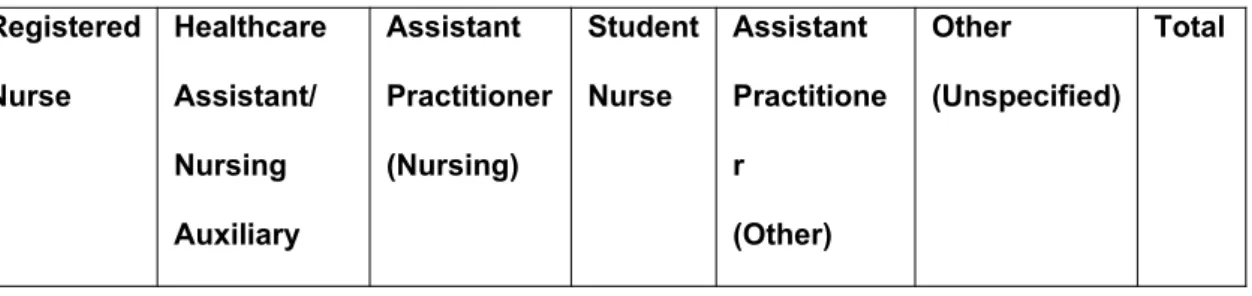
As part of the scoping exercise 97 respondents completed the questionnaire (Table 1).
Table 1. Respondents to the questionnaire by post
53 32 4 2 2 4 97
A substantial majority of the respondents agreed with the focus on the topics: sex and relationships issues, urinary symptoms and continence management,
psychological issues and end of life care (including late effects of treatment) (See Table 2). Those registered nurses responding appeared to be more positive about the five suggested topics than non-registered practitioners.
Table 2. Responses concerning the five identified topics by registration
Topic Strongly
agree
Agree Neutral Disagree Total
Psychosocial (RN)
28 (52.8%) 22(41.5%) 1 (1.9%) 2 (3.8%) 53 (100%)
Psychosocial 22 (50.0%) 16 (36.4%) 4 (9.1%) 2 (4.5%) 44 (100%)
Sexual function
/relationships (RN) 20 (37.7%)
30 (56.6%)
3 (5.7%) 0 (0%) 53 (100%)
Sexual function /relationships
10 (22.7%) 23 (52.3%) 8 (18.2%) 3 (6.8%) 44 (100%)
Continence (RN)
21 (39.6%) 28 (52.8%) 3 (5.7%) 0 (0%) 52 (98.1%)
Continence 15 (34.1%) 18 (40.9%) 7 (15.9%) 4 (9.1%) 44 (98.1%)
Late effects of
treatment (RN) 24 (45.3%) 27 (50.9%) 1 (1.9%) 1 (1.9%) 53 (100%)
Late effects of treatment
17 (38.6%) 26 (59.1%) 1 (2.3%) 0 (0%) 44 (100%)
End of life care (RN
20 (37.7%) 22 (41.5%) 7 (13.2%) 4 (7.5%) 53 (100%)
After discussion with Prostate Cancer UK, a further topic addressing diet and nutrition was included.
67 (69.1%) individuals reported having had previous experience of online learning. Of these, 56 (85.5%) reported having had at least one positive experience. Of 69 individuals who expressed an opinion about online learning, 62 (87.0%) thought that they could benefit from online learning.
Phase 2: The review for SD and ME was completed by 12 (five qualified nurses, four students, three other) and 20 (13 qualified nurses, five students, two other)
individuals respectively.
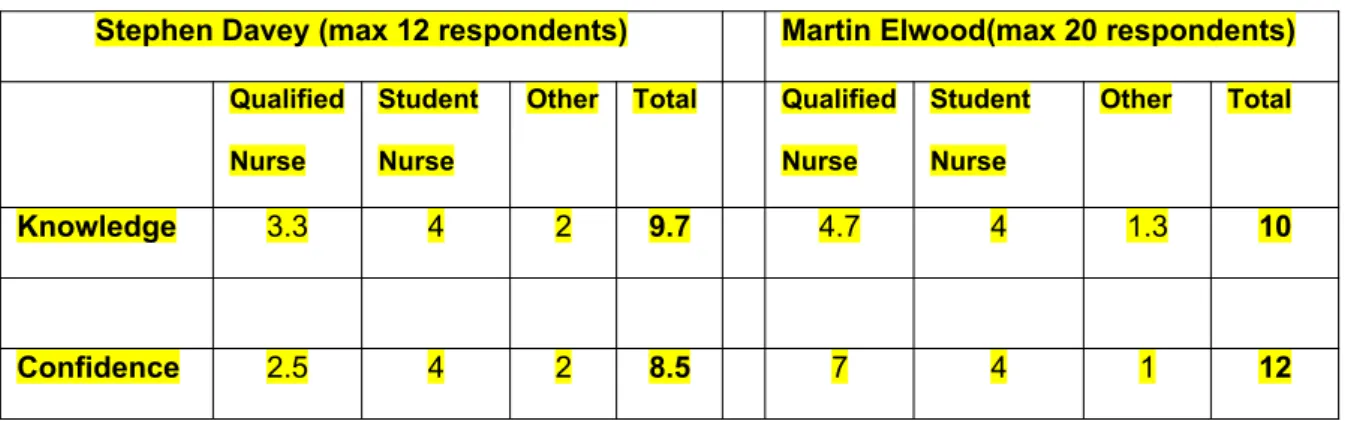
Table 3 presents summarized findings for each scenario: the sum of the number of respondents (strongly) agreeing with each statement concerning perceived change in either knowledge or confidence has been divided by the number of relevant
statements.
Table 3. Summarised findings for respondents agreeing with statements concerning
perceived change in knowledge and of confidence.
Stephen Davey (max 12 respondents) Martin Elwood(max 20 respondents)
Qualified
Nurse
Student
Nurse
Other Total Qualified
Nurse
Student
Nurse
Other Total
Knowledge 3.3 4 2 9.7 4.7 4 1.3 10
All the respondents who worked through the SD scenario thought that it had helped them to realise the importance of considering the effect of treatment for prostate cancer on sex and relationships. Fourteen of those who worked through the ME scenario were similarly positive about its impact in this respect.
Positive aspects of the two scenarios were identified as convenience, ease of use, quality of content, interactivity and effect on practice:
‘It’s quick and can be done at any time, it’s also useful to take one’s time over the questions.’
‘I liked the easy to use supporting documents provided in this case study. Reading through them made me feel well prepared for the patient visit.’
Comments about weak aspects of the VP scenarios included design of the scenario, format of the scenario, necessity for prior study/knowledge, content and learning issues:
‘Limited options, I was often left thinking, well I would say one, whilst simultaneously doing part of the other.’
Comments about what respondents would take back into practice concerned the effect on their clinical/professional practice and issues concerning their own and colleagues’ learning:
‘Always a reminder to listen to the patient and reflect on what was said or evoked in that interaction.’
‘Tell men the importance of drinking lots despite the incontinence issues.’
Eleven of the 12 respondents who worked through the SD scenario said that they would recommend it to colleagues, as did 17 of the 20 individuals who worked through the ME scenario.
DISCUSSION
When considering the findings the limitations of the study should be noted. There are some inherent limitations to a branching VP case. For example, all choice options are predetermined by the author, so the learner can only chose between the options available to them (such as a or b, when in reality they might do c). Whilst this is a limitation to the UChoose software, it should be noted that it is the same for many VP software packages. The VP scenarios were reviewed by a small number of respondents and the feedback was focused on their perceived change in
knowledge and impact in practice, rather than obtaining pre and post test data and observing practice change.
would be beneficial. Interestingly, the respondents’ held relatively positive attitudes to online learning, contrasting with the less positive findings from nurses in a previous study (Moule et al., 2013). The change in attitudes may reflect changing perceptions of the benefits of online learning amongst pressured professionals and support previous work conducted by Hajli et al. (2013). Their recent research suggested online learning had many benefits for busy professionals, in particular from the ease of access and use. In addition, online learning was perceived as relatively
inexpensive, an important factor in today’s climate when a number of professionals are funding their own professional development (Moule et al., 2013). However, these positive results may also reflect the inclusion of student nurses in the sample, who are likely to use online learning in their courses and may therefore be more familiar with, and supportive of, online learning methods.
The review findings indicated that those responding found the form of learning acceptable and useful. The majority of respondents were positive about their learning through the scenarios, the development of their knowledge about the specific topic and the effect on their confidence about discussing relevant issues with patients. This finding mirrors that of Pelayo et al., (2011) who, through a randomised controlled trial with 169 primary care physicians, found those undertaking the online learning package showed a significant increase in knowledge, perceived confidence in symptom management and communication, when compared to the half of the group receiving traditional teaching methods. In addition, the benefits of developing knowledge on how to manage sensitive issues in an online learning situation were noted. This supports the value of VPs presenting realistic cases, with high fidelity (Jeffries, 2005).
given the administration of introductory level content to a sample cohort including specialist nurses; the reflections have provided useful feedback and led to
augmentation of the resource in terms of the provision of links to additional learning materials.
It should also be noted that two respondents commented on the lack of opportunity for peer learning in the VP scenarios. Nurses have identified that some technology based learning methods can be an isolating form of learning (Wilkinson et al., 2004) and previous research (Moule et al., 2010) identified a preference for blended learning, including the benefits of online learning with an opportunity for group discussion and sharing. Foronda et al., (2014) found students gained from learning through VP use in group settings. However, It should be remembered that online simulations offer other benefits in aiding skill and theory development. The use of simulation has been shown to enable higher order learning and the development of clinical decision-making skills (Messer et al., 2014; Wint et al., 2012). Furthermore, online learning can provide an effective strategy for teaching both theory and practice (Bloomfield et al., 2010; McGuigan et al., 2008). Indeed, comments from those completing the VP scenarios suggest the respondents had identified ways in which their learning would inform their practice.
CONCLUSION
studies might usefully be developed to support wider learning and provide simulation opportunities. In particular VP simulation can provide opportunities to learn about sensitive or challenging areas and could encompass pre and post testing to review the development of knowledge. To address issues of isolation raised by respondents and capitalize on peer learning opportunities, it is suggested that the VP might be implemented as part of a blended learning approach, with the simulation forming part of a facilitated group learning situation and discussion.
REFERENCES
Botezatu. M., Hult. H., Fors. U., 2010a. Virtual patient simulation: what do students make of it? A focus group study. BMC Medical Education 10 (91), 1-8.
DOI:10.1186/1472-6920-10-91.
Bloomfield, J.,Roberts, J., While, A., 2010. The effect of computer-assisted learning versus conventional teaching methods on the acquisition and retention of
handwashing theory and skills in pre-qualification nursing students: A randomised controlled trial. International Journal of Nursing Studies 47, 287-294.
Botezatu. M., Hult. H., Mesfin Kassaye. T., Fors, U., 2010b. Virtual patient simulation for learning and assessment: Superior results in comparison with regular course exams. Medical Teacher 32 (10), 845-850.
Cancer Research UK, 2014. Cancer incidence for common cancers. ( Available online at: http://www.cancerresearchuk.org/cancer-info/cancerstats/incidence/ commoncancers/#Twenty accessed on 22/10/2015).
Cant. R. P, Cooper. S. J., (2014) Simulation in the internet age: the place of web-based simulation in nursing education. An integrative review. Nurse Education Today 34 (12), 1435-1442.
Department of Health, 2011. A Framework for Technology Enhanced Learning. Available online at:
https://www.gov.uk/government/uploads/system/uploads/attachment_data/file/ 215316/dh_131061.pdf accessed on 10/10/2014).
Ellaway. R., Candler. C., Greene. P., Smothers. V., 2006. An architectural model for MedBiquitous Virtual Patients. Technical Report. MedBiquitous, Baltimore.
Foronda. C., Gattamorta. K., Snowden. K., Bauman. E., 2014. Use of virtual clinical simulation to improve communication skills of baccalaureate nursing students: A pilot study. Nurse Education Today 934 (6), e53–534. DOI: 10.1016/j.nedt.2013.10.0.
Fosberg. E., Georg. C., Ziegert. K., Fors. U., 2011. Virtual patients for assessment of clinical reasoning in nursing — A pilot study. Nurse Education Today (31) 8, 757-762. DOI: 10.1016/j.nedt.2010.11.015.
Hajli. M., Bugshan. H., Lin. X., Featherma. M., 2013. From e-learning to social learning
– a health care study. European Journal of Training and Development 37 (9), 851-863.
Jager. F., Riemer. M., Abendroth. M., Sehner. S., Harendza. S., 2014. Virtual patients: the influence of case design and teamwork on students’ perception and
knowledge – a pilot study. BMC Medical Education 14 (1), 1-8.
DOI:10.1186/1472-6920-14-137.
Jeffries. P. R., (2005) A framework for designing, implementing and evaluating simulations used in teaching strategies in nursing. Nursing Education Perspectives 26 (2), 96-103.
Koch. L. F., 2014. The nursing educator’s role in e-learning: a literature review. Nurse Education Today 34 (11), 1382-1387. DOI: 10.1016/j.nedt.2014.04.002.
McGuigan. D, Moule. P, Lockyer. L (2008) An evaluation of an approach to e-learning in a cancer care setting. Cancer Nursing Practice 7 (4), 37-41.
Moule. P., Ward. R., Lockyer. L., 2010. Nursing and healthcare students’
experiences and use of e-learning in higher education. Journal of Advanced Nursing 66 (12), 2785–2795. DOI: 10.1111/j.1365-2648.2010.05453.x.
Moule. P., Pollard. K., Gibbard. E., Lockyer. L., Puddicombe. A., Turton. P., 2013. A review of the education and learning needs of healthcare professionals working with men affected by prostate cancer. UWE, Bristol and Prostate Cancer UK, London.
Pelayo. M., Cebrian. D., Aresoa. A., Agra. Y., Izquierdo. J., Buendia. F., 2011. Effects of on-line palliative care training on knowledge, attitude and satisfaction of primary care physicians. BMC Family Practice 12, 37.1-8. doi: 10.1186/1471-2296-12-37.
Saleh. N., 2010. The value of virtual patients in medical education. Annuals of Behavioral Science and Medical Education 16 (2), 29-31.
Wilkinson, A., Forbes, A., Bloomfield, J., Fincham Gee, C., 2004. An exploration of four web-based open and flexible learning modules in post-registration nurse education. International Journal of Nursing Studies 41, 411-424.