A Multivariate Thresholding Technique for Image
Denoising Using Multiwavelets
Erdem Bala
Department of Electrical and Computer Engineering, University of Delaware, Newark, DE 19716, USA Email:[email protected]
Ays¸in Ert ¨uz ¨un
Electrical and Electronics Engineering Department, Bo˘gazic¸i University, 34342 Bebek, Istanbul, Turkey Email:[email protected]
Received 20 January 2004; Revised 21 November 2004; Recommended for Publication by Kiyoharu Aizawa
Multiwavelets, wavelets with several scaling functions, offer simultaneous orthogonality, symmetry, and short support, which is not possible with ordinary (scalar) wavelets. These properties make multiwavelets promising for signal processing applications, such as image denoising. The common approach for image denoising is to get the multiwavelet decomposition of a noisy image and apply a common threshold to each coefficient separately. This approach does not generally give sufficient performance. In this paper, we propose a multivariate thresholding technique for image denoising with multiwavelets. The proposed technique is based on the idea of restoring the spatial dependence of the pixels of the noisy image that has undergone a multiwavelet decomposition. Coefficients with high correlation are regarded as elements of a vector and are subject to a common thresholding operation. Simulations with several multiwavelets illustrate that the proposed technique results in a better performance.
Keywords and phrases:multiwavelets, image denoising, multivariate thresholding.
1. INTRODUCTION
Multiwavelets are a relatively new addition to the wavelet the-ory, and have received considerable attention since their in-troduction [1,2,3,4,5,6,7,8,9,10,11,12,13,14]. Con-trary to ordinary wavelets, multiwavelets offer simultaneous orthogonality, symmetry, and short support. Similar to per-forming wavelet decomposition with filters, multiwavelet de-composition can be realized with filterbanks. The filter coef-ficients in this case are, however, matrices instead of scalars. Therefore, two or more input streams to the multiwavelet fil-terbank are required to perform the decomposition. Several methods have been developed for obtaining multiple input streams from a given single input stream [2,3,4,15,16,17]. One of the widely used applications of wavelet decompo-sition is the removal of additive white Gaussian noise from noisy signals [18,19]. The discrimination between the actual signal and noise is achieved by choosing an orthogonal basis, which efficiently approximates the signal with few nonzero coefficients. A signal enhancement can then be obtained by discarding components below a predetermined threshold value. Although the performance of multiwavelets has been evaluated for image compression and coding (see, e.g., [20] and the references therein), less work about denoising ap-plications of multiwavelets exists [21,22,23]. Most of the
H
G ↓2
↓2
H
G ↓2
↓2
Figure1: Implementation of multiwavelet decomposition with fil-terbanks.
This paper is organized as follows. In Section 2, the multiwavelet theory is reviewed and some information on the implementation of multiwavelet decomposition with fil-terbanks is given. In Section 3, the proposed multivariate thresholding technique for image denoising is introduced. InSection 4, simulation results are presented and finally in Section 5conclusions are drawn.
2. BACKGROUND
Multiwavelets are characterized with several scaling func-tions and associated wavelet funcfunc-tions. Let the scal-ing functions be denoted in vector form as Φ(t) =
[φ1(t),φ2(t),. . .,φL(t)]T, whereΦ(t) is called the multiscal-ing function,Tdenotes the vector transpose andφj(t) is the jth scaling function. Likewise, let the wavelets be denoted as Ψ(t) = [ψ1(t),ψ2(t),. . .,ψL(t)]T, whereψj(t) is the jth wavelet function. Then, the dilation and wavelet equations for multiwavelets take the following forms, respectively:
Φ(t)=
k
H[k]Φ(2t−k),
Ψ(t)=
k
G[k]Φ(2t−k). (1)
The lowpass filterHand the highpass filterGareL×L ma-trix filters, instead of scalars. In theory,Lcould be as large as possible, but in practice it is usually chosen to be two. Mal-lat’s pyramid algorithm [25] for single scaling and wavelet functions extends to the matrix version. The resulting two-channel, 2×2 matrix filterbank operates on two input data streams, filtering them into four output streams. Each of these streams is then downsampled by a factor of two. This procedure is illustrated inFigure 1.
Because a given signal consists of a single stream but the filterbank needs two streams, a method of mapping the data into two streams has to be developed. This mapping pro-cess is called prepropro-cessing and is performed by a prefilter [5,7,16]. The postfilter, on the other hand, maps the data from multiple streams into one stream again. In the design of prefilters, it is desirable that properties of multiwavelet bases such as orthogonality, approximation order, short support, and symmetry are preserved as far as possible. For this rea-son, research is going on for designing multiwavelet bases, called balanced multiwavelets, for which prefiltering can be avoided [26]. The type of the prefilter used in a specific ap-plication is important for the performance. Our simulations have revealed that the best image denoising results are ob-tained with the repeated row prefilter and the approximation prefilter [5].
3. THRESHOLDING WAVELET AND MULTIWAVELET COEFFICIENTS
Significant wavelet coefficients are extracted by threshold-ing as proposed by Donoho and Johnstone [18]. The two mostly used methods of thresholding are soft threshold-ing and hard thresholdthreshold-ing. In hard thresholdthreshold-ing, the co-efficients below a threshold are set to zero; those which are above the threshold remain untouched. In soft thresh-olding, the coefficients below a threshold value are set to zero as well, but coefficients above the threshold value are shrunk. The amount of shrinking is equal to the threshold value.
The universal threshold is applied to each individual multiwavelet coefficient separately in [5]. However, the indi-vidual multiwavelet coefficients are not independent because using any prefilter other than the identity prefilter produces correlated coefficients. Taking this fact into account, Downie and Silverman [17] have proposed a multivariate thresh-olding method for one-dimensional signal denoising. When multiwavelet decomposition is applied to a one-dimensional signal after prefiltering, each resultant coefficient is repre-sented by a length-Lvector. AssumingL=2, the coefficient iszj,k=z0j,kz1j,kT, where jdenotes the decomposition level, kis the coefficient index, andTis the vector transpose. The thresholding operation is applied to the whole vector coeffi -cients. Using the same approach, we have developed a mul-tivariate thresholding method for multiwavelets that is ap-plicable to image denoising. Due to the special properties of two-dimensional multiwavelet decomposition, however, a different approach should be followed. This idea is going to be elaborated in the subsequent paragraphs.
During a single level of decomposition of an image using a scalar wavelet, the two-dimensional data is replaced with four blocks. These blocks correspond to the subbands that represent either lowpass filtering or highpass filtering in each direction. The procedure for wavelet decomposition consists of consecutive operations on rows and columns of the two-dimensional data. The wavelet transform first performs one step of the transform on all rows. This process yields a ma-trix where the left side contains downsampled lowpass coef-ficients of each row, and the right side contains the highpass coefficients. Next, one step of decomposition is applied to all columns; this results in four types of coefficients.
(1) HHrepresents the diagonal features of the image and is formed by highpass filtering in both directions. (2) HLrepresents the horizontal features of the image and
is formed by lowpass filtering the rows and then high-pass filtering the columns.
(3) LHrepresents the vertical features of the image and is formed by highpass filtering the rows and then lowpass filtering the columns.
(4) LLrepresents the coefficients that will be further de-composed in the next step. It is formed by lowpass fil-tering both the rows and the columns.
LL
HL LH
HH
Figure2: Subbands corresponding to a single-level wavelet decom-position.
L1L1
L2L1
H1L1
H2L1
L1L2
L2L2
H1L2
H2L2
L1H1
L2H1
H1H1
H2H1
L1H2
L2H2
H1H2
H2H2
Figure 3: Subbands corresponding to a single-level multiwavelet decomposition.
The multiwavelet decomposition is similar to the wavelet decomposition, but has some differences. The multiwavelet filterbanks have two channels, so the decomposition will have two sets of scaling coefficients and two sets of wavelet coeffi -cients. For multiwavelets, theLandHlabels have subscripts denoting the channel to which the data corresponds. For ex-ample, the subbandL1H2represents the data from the second channel highpass filtered in the horizontal direction, and the first channel lowpass filtered in the vertical direction.
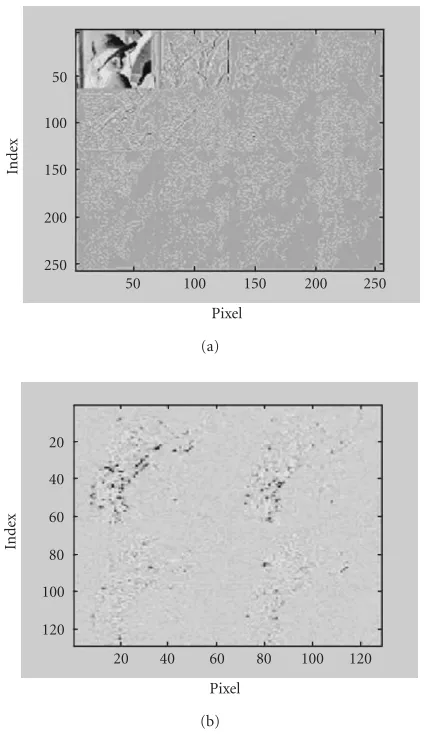
It has been shown that there exists a spatial dependence between pixels in the different subbands of a wavelet decom-position [27]. This dependence is in the form of a parent-child relationship. Each parent pixel in a deeper decompo-sition level has four children in the upper level in the form of a 2×2 block of adjacent pixels. This idea has been ex-tensively used in image coding because the statistics of the parent-child pixels are similar. If the parent coefficient has a small value, then the children would likely have small values. If the parent coefficient has a large value, the children might also have large values. This observation can also be used for a multivariate image denoising scheme for multiwavelets. If coefficients with high correlations are handled together and thresholding operation is applied to them simultaneously, we may expect to get better results. However, the parent-child relationship does not hold for multiwavelet decomposition [20]. This is due to the fact that, in a single-level decomposi-tion, each of the three subbandsLH,HL, andHHare further split into four smaller subbands. This operation destroys the parent-child relationship. The output structure of an image after a single-level multiwavelet decomposition is illustrated inFigure 3. Observations reveal that there is a large amount of similarity in each of the subbands. This suggests that the spatial dependence of the pixels could be restored. As an ex-ample, the Lena image after being exposed to a single-level
50 100
150
200
250
50 100 150 200 250
In
d
ex
Pixel (a)
20 40 60 80 100 120
20 40 60 80 100 120
In
d
ex
Pixel (b)
Figure4: The single-level multiwavelet decomposition of the Lena image: (a) the whole image; (b) theHHsubband of the image.
multiwavelet decomposition is illustrated in Figure 4a and theHHsubband of the same image consisting of four smaller subbands is illustrated inFigure 4b. The similarity between the illustrated subbands is observable from the figure.
H1H2
H2H2
H1H1
H2H1
Figure5:HHsubband corresponding to a single-level multiwavelet decomposition.
Applying the multiwavelet transform with a prefilter to a noisy image, and then collecting the coefficients in each sub-band in vectors of length four, we get vector coefficients of the form [2]
wj,k=υj,k+ρj,k, (2)
whereυis the noise-free multiwavelet coefficient vector,ρis the multiwavelet coefficient vector of the noise,wrepresents the multiwavelet coefficient vector of the corrupted signal, j is the decomposition level, andkis the coefficient index.ρj,k has a multivariate normal distributionN(0,Θj).Θjis the co-variance matrix for the noise term and depends on the reso-lution levelj. We would like to whiten the noise so that each coefficient within the vector would be distributed indepen-dently. We assume that there is no signal component in the vector. Then, the whitening operation could be achieved by multiplying the noise vector withΘ−j1/2. Ifyj,k=Θ−j1/2wj,k, then it can be easily shown that the covariance matrix ofyis the identity matrix. The squared length of the vectorycan be computed by
σj,k=yTj,kyj,k=wTj,kΘ−j1wj,k, (3)
where the superscriptTdenotes the transpose.σj,kis a posi-tive scalar value and has a Chi-squared distribution with four degrees of freedom. The analogous hard thresholding and soft thresholding rules can be applied as in (4) and (5), re-spectively:
ˆ
wj,k=wj,k·1
σj,k≥λ
, (4)
ˆ
wj,k=wj,k·max
σj,k−λ, 0 σj,k .
(5)
Similar to the procedure developed in [17], this threshold-ing technique treats the highly correlated multiwavelet co-efficients simultaneously and applies a common threshold to the vector of coefficients. The effect of correlation is compen-sated by a whitening transformation. The covariance matrix used for the transformation depends on the decomposition level and is calculated for theHH,HL, andLHsubbands sep-arately at each decomposition level. We also have to calculate the threshold valueλ. We assume that there areNidentically and independently distributedχ24random variables and the
Table1: SNRs of the denoised image which is preprocessed with approximation prefiltering.
Multiwavelet type
Univariate thresholding
Proposed method
GHM 10.8470 12.3092
CL 7.2023 12.5086
SA4 10.4630 12.6768
Table2: SNRs of the denoised image which is preprocessed with repeated row prefiltering.
Multiwavelet type
Univariate thresholding
Proposed method
GHM 10.9016 13.0763
CL 9.8595 13.2839
SA4 10.1522 12.9515
maximum of these random variables is denoted byM. The threshold value λis the infimum of all sequencesλN such that
PM≤λN−→1 asN−→ ∞. (6)
As the number of pixels go to infinity, the probabil-ity of the threshold being greater than the maximum of the noise random variables approaches to one. This guar-antees that, with high probability, a signal component ex-ists in coefficients that are larger than the threshold value. The threshold value can be found by using the cdf ofM in the limit problem (6) and solving forλ. An appropriate se-quence satisfying the relation in (6) has been shown to be λN =
2 logN+ 2 log logN[28]. Therefore, this is the value that is used for thresholding the multiwavelet coefficient vec-tors.
4. SIMULATION RESULTS
(a)
(b)
Figure6: Denoised Lena image by approximation prefiltering: (a) decomposed with the GHM multiwavelet and thresholded with the univariate scheme; (b) decomposed with the SA4 multiwavelet and thresholded with the proposed scheme.
respectively. Figures6to8illustrate some of the denoised im-ages for subjective performance comparison. Some impor-tant observations can be made from the simulation results. The objective and subjective results prove that the proposed multivariate image denoising technique performs better than the univariate denoising method. TheSNRvalues of the de-noised images with the proposed technique are higher and the quality of the images is superior. The highest SNRof 12.6768 dB with approximation prefiltering is attained with the SA4 multiwavelet and the proposed technique. Similarly, the highestSNRof 13.2839 dB with repeated row prefilter-ing is attained with the CL multiwavelet and the proposed technique. In general, results for the repeated row prefiltering method seem to be better for both multivariate and univari-ate thresholding methods. It is also observed that the mul-tiwavelets produce more satisfactory results than the ordi-nary scalar wavelets. The SNRof the denoised image with the scalar D4 wavelet is 10.0017 dB.
(a)
(b)
Figure 7: Denoised Lena image by repeated row prefiltering: (a) decomposed with the GHM multiwavelet and thresholded with the univariate scheme; (b) decomposed with the CL multiwavelet and thresholded with the proposed scheme.
5. CONCLUSIONS
A multivariate vector-based thresholding technique has been introduced for multiwavelet based image denoising applica-tions. The technique is based on the idea of restoring the spatial dependence of pixels of an image that has been sub-ject to a multiwavelet decomposition. Four of such pixels are thought as elements of a vector and a multivariate thresh-olding scheme is developed for the whole vector. Simulations are carried to evaluate the performance of the proposed tech-nique. Results prove that the new technique is well oriented for image denoising applications and produces promising re-sults both objectively and subjectively.
REFERENCES
[1] T. N. T. Goodman and S. L. Lee, “Wavelets of multiplicityr,”
Trans. Amer. Math. Soc., vol. 342, pp. 307–324, 1994. [2] M. Cotronei, L. B. Montefusco, and L. Puccio, “Multiwavelet
analysis and signal processing,” IEEE Trans. Circuits Syst. II, vol. 45, no. 8, pp. 970–985, 1998.
[3] V. Strela,Multiwavelets: theory and applications, Ph.D. thesis, Massachusetts Institute of Technology, Boston, Mass, USA, 1996.
[4] D. P. Hardin and D. Roach, “Multiwavelet prefilters I: Orthog-onal prefilters preserving approximation orderp≤2,” IEEE Trans. Circuits Syst. II, vol. 45, no. 8, pp. 1106–1112, 1998. [5] V. Strela, P. Heller, G. Strang, P. Topiwala, and C. Heil, “The
application of multiwavelet filter banks to signal and image processing,” IEEE Trans. Image Processing, vol. 8, no. 4, pp. 548–563, 1999.
[6] J. Geronimo, D. Hardin, and P. R. Massopust, “Fractal tions and wavelet expansions based on several scaling func-tions,”J. Approx. Theory, vol. 78, no. 3, pp. 373–401, 1994. [7] L. Shen, H. H. Tan, and J. Y. Tham,
“Symmetric-antisymmetric orthonormal multiwavelets and related scalar wavelets,”Appl. Comput. Harmon. Anal., vol. 8, no. 3, pp. 258– 279, 2000.
[8] C. K. Chui and J. A. Lian, “A study of orthonormal multi-wavelets,” Cat report 351, Texas A&M University, Texarkana, Tex, USA, 1995.
[9] J. Y. Tham, L. Shen, S. L. Lee, and H. H. Tan, “A general ap-proach for analysis and application of discrete multiwavelet transforms,” IEEE Trans. Signal Processing, vol. 48, no. 2, pp. 457–464, 2000.
[10] I. W. Selesnick, “Interpolating multiwavelet bases and the sampling theorem,”IEEE Trans. Signal Processing, vol. 47, no. 6, pp. 1615–1621, 1999.
[11] I. W. Selesnick, “Multiwavelet bases with extra approximation properties,” IEEE Trans. Signal Processing, vol. 46, no. 11, pp. 2898–2908, 1998.
[12] L. Shen, H. H. Tan, and J. Y. Tham, “Some properties of symmetric-antisymmetric orthonormal multiwavelets,”IEEE Trans. Signal Processing, vol. 48, no. 7, pp. 2161–2163, 2000. [13] V. Strela, “A note on construction of biorthogonal
multi-scaling functions,” inContemporary Mathematics, A. Aldroubi and E. B. Lin, Eds., vol. 216, pp. 149–157, American Mathe-matical Society, RI, USA, 1998.
[14] G. Strang and V. Strela, “Short wavelets and matrix dilation equations,” IEEE Trans. Signal Processing, vol. 43, no. 1, pp. 108–115, 1995.
[15] X. G. Xia, J. S. Geronimo, D. P. Hardin, and B. W. Suter, “De-sign of prefilters for discrete multiwavelet transforms,” IEEE Trans. Signal Processing, vol. 44, no. 1, pp. 25–35, 1996.
[16] X. G. Xia, “A new prefilter design for discrete multiwavelet transforms,” IEEE Trans. Signal Processing, vol. 46, no. 6, pp. 1558–1570, 1998.
[17] T. R. Downie and B. W. Silverman, “The discrete multiple wavelet transform and thresholding methods,” IEEE Trans. Signal Processing, vol. 46, no. 9, pp. 2558–2561, 1998. [18] D. L. Donoho and I. M. Johnstone, “Ideal spatial
adapta-tion via wavelet shrinkage,”Biometrika, vol. 81, pp. 425–455, 1994.
[19] D. L. Donoho, “De-noising by soft-thresholding,”IEEE Trans. Inform. Theory, vol. 41, no. 3, pp. 613–627, 1995.
[20] M. B. Martin and A. E. Bell, “New image compression tech-niques using multiwavelets and multiwavelet packets,” IEEE Trans. Image Processing, vol. 10, no. 4, pp. 500–511, 2001. [21] L. W. She and B. Zheng, “Multiwavelets based denoising of
SAR image,” inProc. 5th International Conference on Signal Processing, pp. 321–324, Beijing , China, August 2000. [22] W. Ling, “Orthogonal multiwavalets transform for image
de-noising,” inProc. 5th International Conference on Signal Pro-cessing, vol. 2, pp. 987–991, Beijing, China, August 2000. [23] T. D. Bui and G. Chen, “Translation-invariant denoising using
multi-wavelets,”IEEE Trans. Signal Processing, vol. 46, no. 12, pp. 3414–3420, 1998.
[24] V. Strela and A. T. Walden, “Signal and image denoising via wavelet thresholding: orthogonal, biorthogonal, scalar and multiple wavelet transforms,” inNonlinear and Nonstationary Signal Processing, W. F. Fitzgerald, R. L. Smith, A. T. Walden, and P. C. Young, Eds., pp. 395–441, Cambridge University Press, Cambridge, UK, 2001.
[25] S. Mallat,A Wavelet Tour of Signal Processing, Academic Press, San Diego, Calif, USA, 1998.
[26] I. W. Selesnick, “Balanced multiwavelet bases based on sym-metric FIR filters,” IEEE Trans. Signal Processing, vol. 48, no. 1, pp. 184–191, 2000.
[27] J. M. Shapiro, “Embedded image coding using zerotrees of wavelet coefficients,” IEEE Trans. Signal Processing, vol. 41, no. 12, pp. 3445–3462, 1993.
[28] T. R. Downie,Wavelet methods in statistics, Ph.D. dissertation, University of Bristol, Bristol, UK, 1997.
[29] J. Y. Tham, L. X. Shen, S. L. Lee, and H. H. Tan, “Good multi-filter properties: a new tool for understanding multiwavelets,” inConference for International Conference on Imaging, Science, Systems and Technology, pp. 52–59, Las Vegas, Nev, USA, July 1998.
[30] I. Daubechies, “Orthonormal bases of compactly supported wavelets,”Comm. Pure Appl. Math, vol. 41, no. 7, pp. 909–996, 1988.
Erdem Balagot the B.S and M.S. degrees in electrical engineering from Bo˘gazic¸i Uni-versity, Turkey, in 1998 and 2001, respec-tively. Between 1998 and 2001, he worked for Nortel Networks as a software design engineer in Istanbul (Turkey) and Harlow, Belfast, UK, R&D Labs. Currently, he is pur-suing the Ph.D. degree in wireless commu-nications at the University of Delaware, US. His research interests are in the general
Ays¸in Ert¨uz¨unwas born in 1959 in Salihli, Turkey. She received the B.S. degree (with honors) from Bo˘gazic¸i University, Istanbul, Turkey, the M. Eng. degree from McMas-ter University, Hamilton, Ontario, Canada and the Ph.D. degree from Bo˘gazici Univer-sity, Istanbul, Turkey, all in electrical engi-neering, in 1981, 1984, and 1989, respec-tively. Since 1988, she is with the Depart-ment of Electrical and Electronic