International Journal of Emerging Technology and Advanced Engineering
Website: www.ijetae.com (ISSN 2250-2459, ISO 9001:2008 Certified Journal, Volume 3, Issue 4, April 2013)
21
Oscillation Behaviour for the Layerd Neural Networks Based
on the Selection of Training Data by Using Rastrigin Function
Isao Taguchi
1, Yasuo Sugai
21Professor, Faculty of International Studies, Keiai University, 1--5--21, Anagawa, Inage-ku, Chiba-shi, Japan 263 2Professor, Faculty of Engineering, Chiba University, 1--33, Yayoi-cho, Inage-ku, Chiba-shi, Japan 263--8522
Abstract—This paper proposes an efficient learning method for the layered neural networks based on the selection of training data and input characteristics of an output layer unit. The multilayer neural network is widely used due to its simple structure. When learning objects are complicated, the problems, such as unsuccessful learning or a significant time required in learning, remain unsolved. The aims of this paper are to suggest solutions of these problems and to reduce the total learning time.
Focusing on the input data during the learning stage, we undertook an experiment to identify the data that makes large errors and interferes with the learning process. Our method devides the learning process into several stages.
In general, input characteristics to an output layer unit show oscillation during learning process for complicated problems.
Computational experiments suggest that the proposed method has the capability of higher learning performance and needs less learning time compared with the conventional method.
Keywords—Multi-layer Neural Network, Oscillatory Behaviour, Data Selection, Multi-stage Learning
I. INTRODUCTION
Majority of neural network research focuses on complicated networks such as pulsed neural networks [1]). However, in reality, multilayer neural networks (NNs) that are composed of sigmoid units using backpropagation (BP) are widely used because of their simple structures.
In our previous paper [2], we proposed a comprehensive learning method that features the categorization of training data based on the ease of learning prior to initiating a learning session. Multistage learning based on the dynamic adjustment of the learning rate in response to error size and input characteristics to the output layer unit (effectively utilizing amplitude diminishing conditions and desired value acquisition conditions) was applied in complex learning cases that require the use of large quantities of learning data.
Paper [4] reports the details of the effect of imposing a threshold fluctuation in terms of oscillation phenomena. However, in this study, we do not impose a threshold fluctuation. As stated in paper [2], oscillation is thought to have occurred because of the complexity of various learning parameter modifications and the learning data itself.
To analyze oscillation phenomena, we cumulatively sum the weight renewal amounts for increases and decreases in the absolute error size based on changes in weights connected to middle and output layers for each pattern, which is used as the basis for BP, and then partition the weight renewal amount in two. Two vectors can be composed from the weight renewal amounts corresponding to increases and decreases in the absolute error value. By examining the size of these vectors and movement of their angles, we can identify optimal learning cases and cases in which learning does not progress.
International Journal of Emerging Technology and Advanced Engineering
Website: www.ijetae.com (ISSN 2250-2459, ISO 9001:2008 Certified Journal, Volume 3, Issue 4, April 2013)
22 Learning using oscillation of the weight coefficient itself is relatively unknown. We also confirm whether the RMSE value can be decreased by utilizing the weight coefficients by recording all weight coefficients (the weight coefficient between the input layer and middle layer and between the middle layer and output layer) just before the final stage of learning ends (from nine repetitions before the end of learning until the end) and calculating the mean weight of the maximum and minimum values of the weight coefficients.
The remainder of this paper is composed as follows. Section 2 discusses vectors based on weight renewal amounts. Section 3 discusses computation experiments using function approximation problems as an example . We also perform experimental analysis of the movement of vectors based on variations in input characteristics to the output layer unit and evaluate weight coefficient renewal to determine if oscillation that occurs by the proposed method is effective for learning and serves to reduce learning errors. Section 4 summarizes our findings.
II. EFFICIENT LEARNING METHODS
Paper [2] discusses the dynamic adjustment of the learning coefficient in response to error, input characteristics to the output layer unit, the selection of learning data, and effective learning methods based on these properties.
2.1. Vectors Based on the Absolute Error and Weight Refresh Rate
Here vector components are expressed as the weight renewal amount for the weights between the middle layer and output layer for each pattern during learning. For each pattern during one epoch of learning, we partition weight renewal for cases in which the absolute error between the current learning step and the previous learning step increases and those in which it decreases and then add the weight coefficient variation component to both. The components of the respective vectors equal the number of weights between the middle layer and output layer. Using the summed components, an increase vector, decrease vector, and a combined vector can be composed. In this study, we examine vector movement for cases in which oscillation ceases and learning does not progress (monotonic decrease) and movement for vectors when oscillation continues.
Here the number of vector components for increases and decreases in the absolute error during learning is defined as p. i = 1 is the weight coefficient between the input layer and the middle layer.
i = 2 is the weight coefficient between the middle layer and the output layer. t is the number of learning repetitions, inc and dec represent an increase or a decrease in the absolute error, respectively. The total increase in the absolute error for each weight renewal component is given below.
={ , ,
, (1)
The vector components for weight coefficient renewal from decreases in the absolute error are given as follows.
={ , ,
, (2)
Here p is the number of weight coefficients between the input layer and middle layer. Similarly, q is the number of weight coefficients between the middle layer and output layer.
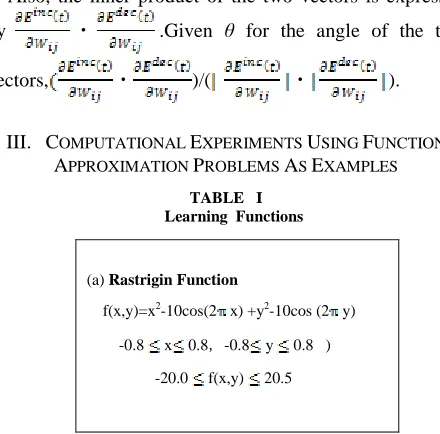
Also, the inner product of the two vectors is expressed
by ・ .Given θ for the angle of the two
vectors, ・ )/( ・ ).
[image:2.612.331.551.398.615.2]III. COMPUTATIONAL EXPERIMENTS USING FUNCTION APPROXIMATION PROBLEMS AS EXAMPLES
TABLE I Learning Functions
To demonstrate the efficacy of the multistage learning method proposed in this study, we perform computational experiments using function approximation problems as an example. These problems have been chosen, because the difficulty of learning can be configured with the selection of different functions, and experiments of unlearned data can be verified easily.
(a) Rastrigin Function
f(x,y)=x2-10cos(2 x) +y2-10cos (2 y)
International Journal of Emerging Technology and Advanced Engineering
Website: www.ijetae.com (ISSN 2250-2459, ISO 9001:2008 Certified Journal, Volume 3, Issue 4, April 2013)
23 A number of useful functions are the well-known Rastrigin function for optimization problems. These are given in Table (1).
3.1. Training Data
Table (1)(a) is shown in Figure 1. In Figure 1, adjacent training data are shown joined by a solid line. The region to learn in Table (1)(a) is given as −0.8 x, y 0.8 for the Rastrigin function. The training data sets the x, y direction stride as 0.1 and partitions the region into a 17 × 17 (289 point) grid given as training data set D.
3.2. Training Data Selection
Here we discuss the method used to select the training data in Table (1)(a) for many experiments due to the difficultyof learning. The selection of the training data in table(1)(a)can be substituted with values obtained by the partial differentiation of functions fx(x, y) or fy(x,
y) in both x and y directions.
Figure 1. An example of characteristics of the target function Next, we divide the training data into three steps (s = 3) and perform multistage learning.
uses approximately 30% of all training data. and (selected using the values of fx(x, y) or fy(x, y))
are important, because they grasp the outline of the function. The final number of data included in
was 31.1% (90 pieces). Within this data, 24 pieces fulfilled |f(x, y) 0.90, 34 fulfilled |fx(x, y) 0.3, and 34 fulfilled
|fy(x, y) 60.3. Two pieces were repeated; thus, the total
was 90 pieces.
In step 2, the final number of data included in
was 58.1% (168 pieces). Within this data, 52 pieces fulfilled |f(x, y)| 0.80, 68 pieces fulfilled |fx(x, y) 60.1,
and 68 pieces fulfilled |fy(x, y)| 60.1. Twenty pieces were
repeated; thus, the total was 168 pieces.
In in step 3, all data was used. Thus, 31.1% of all data was used in step 1, 58.1% of all data was used in step 2, and 100% of all data was used in the final step.
3.3. Experiment Settings for Methods Used in Comparison
To verify the efficacy of the proposed method, the results of computational experiments were compared with those of existing methods. The NN used for the proposed method is a three-layer feed-forward network using sigmoid elements. This is composed of two input-layer elements, nine middle-layer elements, and one output-layer element. The number of middle-layer elements was determined by preliminary experiments. All weight coefficients were renewed once per epoch in each method. The learning count for the proposed method was 2333 epochs for step one, 2333 epochs for step two, and 2334 epochs for step three for a total of 7000 epochs. The two existing methods used all training data for 7000 epochs of learning. Computations were performed on a 3.0GHz Pentium 4 PC with 2GB RAM operating on Windows XP. The basic learning coefficient for the proposed method and existing methods was η = 0.8 (standard). To evaluate the learning results, the RMSE values for the training data and average weight sets for four initial weight coefficient values were used. Weight coefficient initial values were set randomly in a range from −0.01 to 0.01.
3.4. Computational Experiment Results
International Journal of Emerging Technology and Advanced Engineering
Website: www.ijetae.com (ISSN 2250-2459, ISO 9001:2008 Certified Journal, Volume 3, Issue 4, April 2013)
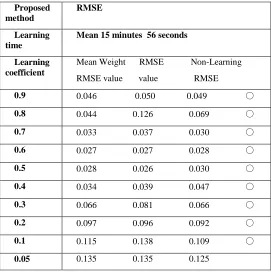
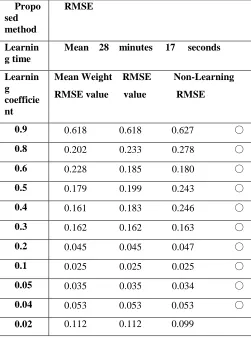
24 In Tables 2 and 3, cases in which oscillation occurred in the final step are indicated with a circle to the right of non-learning RMSE. Blank spaces indicate monotonic characteristics with no oscillation. For existing methods as well, circles indicate the presence of oscillation where they occur in the final 2334 repetitions during learning.
As shown in Table 2, when the proposed method is applied to the Rastrigin function shown in Table (1)(a), all RMSE values are below 0.1 when the learning coefficient (the standard when using the proposed method) is between 0.9 and 0.2. When the learning coefficient decreases to 0.1 or 0.05, the RMSE values increase above 0.1, but the useful range of the learning coefficient value is extremely wide.
Conversely, as shown in Table 3, learning was carried out while changing the learning coefficient in the range from 0.9 to 0.02 for the two existing methods as well. From 0.9 to 0.3, no learning occurred with the RMSE values above 0.1. From 0.2 to 0.04, the RMSE value decreased below 0.1(Mean learning time = 28 minutes 17 seconds). Conversely, when reduced to 0.02, the RMSE value increased above 0.1.
When learning using existing methods with a constant learning coefficient of 0.04, oscillation occurs in the final 2334 repetitions, and the RMSE value is 0.053. These results are shown in Table 3.
3.5. Considering the Experimental Results
[image:4.612.347.543.145.285.2]Here we consider the performance and calculation time of learning and discuss the necessity of oscillation based on the computational experiment results.
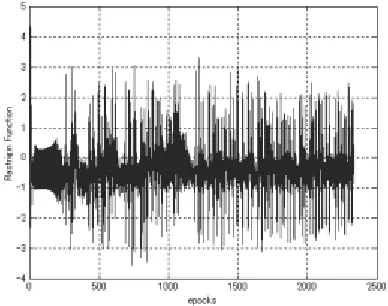
[image:4.612.75.269.488.641.2]Figure 2. Input characteristics for the proposed methods in the output layer(η=0.9).
Figure 3. Input characteristics for the proposed methods in the output layer(η=0.5)
International Journal of Emerging Technology and Advanced Engineering
Website: www.ijetae.com (ISSN 2250-2459, ISO 9001:2008 Certified Journal, Volume 3, Issue 4, April 2013)
[image:5.612.332.556.144.351.2]25 Table 2
RMSE for Proposed Methods in Learning of the Rastrigin Function
The Proposed Method and the Necessity of Oscillation
The circles in Tables 2 and 3 indicate learning in which oscillation occurred during the final step. In general learning, oscillation can be suppressed by making the learning coefficient smaller. From Tables 2 and 3, we can say that in the final learning step, the input characteristic to the output unit with the minimum RMSE value is oscillating. In Table 2 (proposed method), when the learning coefficient is 0.6, the RMSE value reaches a minimum of 0.027. Similarly, Table 3 shows the results for learning with the Rastrigin function with existing methods, in which the RMSE value reached a minimum of 0.025 when the learning coefficient was 0.1.
Figure 5. The weight renewal vector for the proposed methods. Next, we attempted a vector analysis of the oscillation wave shape based on the weight renewal value (the weight renewal value between the middle layer and the output layer) for the Rastrigin function, previously shown in Table (1)(a). For every pattern in one epoch of learning, we partitioned the weight renewal amount for cases in which the absolute error of current learning increased in relation to the previous repetition and cases in which the absolute error decreased, calculating an increase vector, decrease vector, and a combined vector. A representative relationship of the vector when oscillation ceased and learning was not comparably progressing is shown in Figure5(a). When a state in which the decrease vector is nearly equal in size to the combined vector and the increase vector having a comparatively marginal effect on the combined vector is continuously maintained, the input characteristics to the output layer unit do not have oscillation characteristics (monotonic decrease characteristics).
Proposed method
RMSE
Learning time
Mean 15 minutes 56 seconds
Learning coefficient
Mean Weight RMSE Non-Learning RMSE value value RMSE
0.9 0.046 0.050 0.049 ○
0.8 0.044 0.126 0.069 ○
0.7 0.033 0.037 0.030 ○
0.6 0.027 0.027 0.028 ○
0.5 0.028 0.026 0.030 ○
0.4 0.034 0.039 0.047 ○
0.3 0.066 0.081 0.066 ○
0.2 0.097 0.096 0.092 ○
0.1 0.115 0.138 0.109 ○
[image:5.612.43.314.161.434.2]International Journal of Emerging Technology and Advanced Engineering
Website: www.ijetae.com (ISSN 2250-2459, ISO 9001:2008 Certified Journal, Volume 3, Issue 4, April 2013)
[image:6.612.42.293.169.508.2]26 Table 3
RMSE for Traditional Methods in Learning of the Rastrigin Function
Propo sed method
RMSE
Learnin g time
Mean 28 minutes 17 seconds
Learnin g coefficie nt
Mean Weight RMSE Non-Learning
RMSE value value RMSE
0.9 0.618 0.618 0.627 ○
0.8 0.202 0.233 0.278 ○
0.6 0.228 0.185 0.180 ○
0.5 0.179 0.199 0.243 ○
0.4 0.161 0.183 0.246 ○
0.3 0.162 0.162 0.163 ○
0.2 0.045 0.045 0.047 ○
0.1 0.025 0.025 0.025 ○
0.05 0.035 0.035 0.034 ○
0.04 0.053 0.053 0.053 ○
0.02 0.112 0.112 0.099
The experiment also showed that when the sizes and angles of the increase and decrease vectors acting on the composition vector significantly vary in relation to learning repetitions, the input characteristics to the output layer unit become irregular oscillation characteristics that include noise. In terms of vectors, this is when changes such as those shown in Figure 5(b) and5(c) occur and are repeated.
In cases of monotonic decrease characteristics, variations in the increase or decrease pattern numbers have a negligible effect in regard to changes involving the number of learning repetitions.
In this study, useful oscillations occurred more easily as learning became more complex in cases in which the proposed method was used. The proposed method is effective (in terms of both error and time) for use in complex learning.
IV. CONCLUSION
This study discussed a comprehensive learning method for neural networks that categorized training data based on the ease of learning before learning, performed multistage learning based on those categories, and dynamically adjusted the learning coefficient in response to error size.
Generally, it has been thought that overshooting degrades learning by increasing learning time. Herein, we confirmed that during difficult learning, some oscillation can improve learning in comparison with monotonic decrease characteristics based on the RMSE value and the input characteristics to the output unit.
In addition, we introduced vectors based on increases and decreases in the absolute error based on the weight renewal between the middle layer and the output layer. We investigated the differences of the input characteristics to the output layer unit from vector changes (for cases with and without oscillation) and demonstrated that when vectors are actively moving (increase or decrease of vector sizes and angles are frequently changing), noisy oscillation occurs and learning progresses. Noisy oscillation is a feature of the proposed method and occurs from two modifications that make complex learning possible.
In future studies, we will actively use oscillation characteristics, extend the proposed method to evaluate effects on pattern recognition problems, and investigate further decreases in error.
REFERENCES
[1] Makoto Motoki,Seiichi Koakutsu,Hironori Hirata:``A Supervised Learning Rule Adjusting Input-Output Pulse Timing for Pulsed Neural Network'', The transactions of the Institute of Electronics, Information and Communication Engineers, Vol.J89-D- {II}, No.12, pp.726-734 (2006)
[2] Isao Taguchi and Yasuo Sugai :``An Efficient Learning Method for the Layered Neural Networks Based on the Selection of Training Data and Input Characteristics of an Output Layer Unit'', The Trans. of The Institute of Electrical engineers of Japan, Vol.129-C, No.4, pp.1208-1213, (2009)
[3] Isao Taguchi and Yasuo Sugai :``An Input Characteristic of Output Layer Units in the Layered Neural Networks and Its Application to an Efficient Learning'', Proc. of the Electronics, Information and Systems Conference, Electronics, Information and systems Society, IEE. of Japan, pp.931-934 (2004)
[4] Nobuyuki Matsui and kenichi Ishimi:``A Multilayered Neural Network Including Neurons with fluctuated Threshold'', The Trans. of The Institute of Electrical Engineers of Japan, Vol.114-C, No.11, pp.1208-1213 (1994)
International Journal of Emerging Technology and Advanced Engineering
Website: www.ijetae.com (ISSN 2250-2459, ISO 9001:2008 Certified Journal, Volume 3, Issue 4, April 2013)
27 [6] Ting Wang and Yasuo Sugai:``A Wavelet Neural Network for the
Approximation of Nonlinear multivariable Functions'', The Trans. of The Institute of Electrical engineers of Japan, Vol.120-C, No.2, pp.185-193 (2000)
[7] Yasuo Sugai,Hiroshi Horibe, and Tarou Kawase:``Forecast of Daily Maximum Electric Load by Neural Networks Using the Standard Electric Load'', The Trans. of The Institute of Electrical engineers of Japan, Vol.117-B, No.6, pp.872-879 (1997)
[8] Souichi Umehara, teru Yamazaki, and Yasuo Sugai:``A Precipitation Estimation System Based on Support Vector Machine and Neural Network'', The transactions of the Institute of Electronics, Information and Communication Engineers, Vol.J86-D-\rm{II}, No.7, pp.1090-1098 (2003)
[9] Charles K.Chui:``An Introduction to Wavelets'', Academic Press (1992)
[10] Ting Wang and Yassuo Sugai:``A Wavelet Neural Network for the Approximation of Nonlinear Multivariable Functions'', Proc.of IEEE International Conference on System, Man, and Cybernetics, \rm{III}, pp.378-383 (1999)
[11] L.K.Jones:``Constructive Approximations for Neural Networks by Sigmoidal Functions'', Proc. IEEE, Vol.78, No.10, pp.(1990) [12] Mehdi Bahiraei, Seyed Mostafa Hosseinalipour, Kaveh Zabihi, and
Ehsan Taheran: ``Using Neural Network for Determination of Viscosity in Water-TiO2 Nanofluid'', Advances in Mechanical Engineering, Article ID 742680, Volume 2012 , , 10 pages, (2012) [13] Eden Bojorquez,1 Juan Bojorquez,2 Sonia E. Ruiz,2 and Alfredo
Reyes-Salazar1: ``Prediction of Inelastic Response Spectra Using Artificial Neural Networks'', Mathematical Problems in Engineering, Article ID 937480, Volume 2012 , 15 pages, (2012)
[14] Neng-Sheng Pai, Her-Terng Yau, Tzu-Hsiang Hung, and Chin-Pao Hung: ``Application of CMAC Neural Network to Solar Energy Heliostat Field Fault Diagnosis'', International Journal of Photoenergy, Article ID 938162, 8 pages Volume 2013, 8 pages, (2013)
Author Bibliography
Isao Taguchi received the D.Eng. course of urban environmental systems, graduate school of engineering, Chiba university, Japan , in 2011.
I am a professor, course of Faculty of international studies, Keiai university, in 2005. My research area are the neural networks, information science, information education, and their applications. I am a member of IEEJ.