R E S E A R C H
Open Access
Scrambling-based speech encryption via
compressed sensing
Li Zeng
1*, Xiongwei Zhang
1, Liang Chen
2, Zhangjun Fan
2and Yonggang Wang
2Abstract
Conventional speech scramblers have three disadvantages, including heavy communication overhead, signal features underexploitation, and low attack resistance. In this study, we propose a scrambling-based speech encryption scheme via compressed sensing (CS). Distinguished from conventional scramblers, the above problems are solved in a unified framework by utilizing the advantages of CS. The presented encryption idea is general and easily applies to speech communication systems. Compared with the state-of-the-art methods, the proposed scheme provides lower residual intelligibility and greater cryptanalytic efforts. Meanwhile, it ensures desirable channel usage and notable resistibility to hostile attack. Extensive experimental results also confirm the effectiveness of the proposed scheme.
Keywords:Speech encryption, Scrambling, Compressed sensing, Residual intelligibility, Keyspace
1. Introduction
Encryption, dating back to BC, is essential for informa-tion security in modern society [1]. Informainforma-tion espio-nages, including illegal surveillance and wiretapping, have emerged due to the wide applications of speech communication in national defense, economy and trade, scientific research, and social affairs. With security an ever more vital requisite of communications systems, speech encryption has attracted substantial acceptance as an effective means of enhancing protection in both military and civilian applications.
Two main categories of technologies have been devel-oped for this purpose. The first one is content protection through encryption, e.g., speech scrambler [2-9]. Proper decryption of the data requires a key or the so-called scrambling matrix. The second one is digital watermark-ing, which aims at embedding messages into the multi-media data [10]. Intuitively, the time domain sample scrambling method is thus far the most attractive and desired, because it simply takes a segment of time do-main sample values and directly scrambles them into a different segment of samples. In this article, we focus on the scrambling-based encryption.
Earlier speech scramblers disorder the original signal using specific sequence or matrix, such as pseudoran-dom sequence, Fibonacci transform [2], Hadamard matrix [3,4], and so on. The main disadvantage shared by these methods is that the decryption key is invariable. Since the performance of computer hardware has in-credibly been improved, these methods could easily be deciphered. To alleviate this problem, researchers pro-posed to employ new key schedules, such as stochastic matrix [5] and Latin square [6], to improve the strength of security [7,8]. However, the improved algorithms also result in heavy transmission load due to their disability of compressing the original signal. Consequently, the speech compression methods are integrated into the process of encryption, e.g., G.729 mixed excitation linear prediction (MELP) and AMR [9]. Indeed, the combin-ation of compression and scrambling leads to less costly encrypted data. But the parametric coding algorithms are of low robustness in the presence of noise or other hostile attacks. Besides, the performances of such algo-rithms depend heavily upon the encryption operator, and the character of speech itself is not well utilized. More recently, researches in nonlinear process have shown that the chaotic signal is very suitable for secure communications. However, chaotic system is sensitive to disturbance and requires strict self-synchronization, which limits its practical applications [11,12].
* Correspondence:[email protected] 1
College of Command Information Systems, PLA University of Science and Technology, Nanjing, China
Full list of author information is available at the end of the article
According to Del Re et al. [13], the degree of security (deciphering difficulty) provided by a speech encryption system is related to (1) residual intelligibility (the amount of intelligibility left over in the encrypted signal) and (2) keyspace (the number of keys available for encryption). In general, the lower a scrambling system’s residual intelligi-bility and the bigger its keyspace, the higher its degree of security. After the propose of the stochastic approach [14], the keyspace of a scrambler is commonly measured by the number of encryption operators, namely the scrambling matrix [3,4,6,13].
To summarize, a channel-saving and anti-attack speech scrambler is a major issue to be addressed. In the mean-time, it should attain residual intelligibility as low as pos-sible and provide keyspace as large as pospos-sible to increase the cryptogram immunity to cryptanalysis. Despite the improvements achieved by the aforementioned works, few investigations manage to simultaneously address these problems. In light of this consideration, we apply com-pressed sensing (CS) [15-17] to speech encryption, due to its promising capability in signal compression and its not-able robustness to hostile attacks.
In this article, we tackle the issue on scrambling-based speech encryption via CS by exploiting the sparsity of speech over the Karhunen–Loeve (K–L) incoherent dic-tionary [18]. Distinguished from existing schemes, we scramble the dimensional-reduced measurements instead of the original speech. The algorithm proposed in this art-icle is motivated by the following idea: if two independent signals x1and x2 are aliased and scrambled in the same
space by a stochastic matrix, the intelligibility of the original signal can be eliminated, and it is hard for the eavesdrop-pers to get any information barely from the mixture [19]. Observations show that the measurement vector of speech exhibits noise-like nature. However, the envelope of com-pressed data still retains considerable information of the original speech [20,21], we therefore alias and scramble the two measurement vectors of separated speech instead of using the envelope as ciphered data directly.
To be specific, the presented scheme contains two stages: encryption and decryption. At the encryption stage, we compress and encrypt the speech. The original signal is separated into two independent parts and sparsely represented by the corresponding K–L incoherent dic-tionaries. Next, the sparse vectors of the two parts are measured by stochastic matrices. Afterwards, these low-dimensional measurements are mixed and scrambled by the scrambling matrix, which is constructed from the null space basis (NSB) of the aligned sensing matrix using sin-gular value decomposition (SVD). At the decryption stage, the inverse operator is constructed to eliminate each aliased measurements part individually. At last, the sepa-rated speech parts are reconstructed using the orthogonal matching pursuit (OMP) [22], and assembled to recover
the speech. Experimental results demonstrate that the encrypted signal of proposed scheme has low transmis-sion cost and low residual intelligibility. It provides im-mense cryptogram immunity and exhibits notable attack resistance.
The rest of this article is outlined as follows. In Section 2, we introduce the K–L incoherent dictionary to sparsely represent speech signals. Section 3 explains the encryption idea that we seek to address, and expatiates on the detailed procedure of encryption and decryption. The residual intelligibility, encryption strength, and ro-bustness performance of the proposed scheme, together with experimental results, are presented and discussed in Section 4. Conclusions are drawn in Section 5.
2. The sparse representation of speech
Sparse representation is a critical step of CS [16], since one can obtain the dimension-reduced signal on the basis of sparse vectors. In this section, we employ a practical sparsi-fying dictionary to sparsely represent the speech signal.
The K–L expansion [18] describes a stochastic process in the form of incoherent random principle components and the corresponding deterministic orthogonal basis. Thus, the main structure of the process can be captured by a few ex-pansion terms. Assume a real second-order moment sto-chastic process {x(t),t∈[0, 1]}, its K–L expansion is
x tð Þ ¼X 1
k¼1
akφkð Þt ð1Þ
where ak= R
0 1
x(t)φk(t)dt. The orthogonal bases {φk(t)} are eigenfunctions of the signal autocorrelation Rx(t,u). They can be used to design the atoms of signal dictionary. {φk(t)} and the corresponding eigenvalues yksatisfy the Fredholm integral equation [18,23]
ykφkð Þ ¼t Z 1
0
Rxðt;uÞφkð Þu du ð2Þ
However, for a practical signal, Equation (2) is hard to solve due to the complexity of the signal autocorrelation. Since the autocorrelation of speech signal decreases rap-idly within a low delay, we approximate it by the exponen-tial function: Rx(t, u)=Rx(0)e−μ|t−u|, where μ is the attenuation coefficient. SubstitutingRx(t,u) into (2) yields
ykϕð Þ ¼t
Z 1
0
Rxðt;uÞϕð Þudu
¼Rxð Þ0 eμt
Z t
0
eμμφð Þuduþeμt
Z 1
t
eμμφð Þudu
ð3Þ
used as an eigenfunction), we obtain the orthogonal basis
φkð Þ ¼t
kπ
μ cosðkπtÞ þ sinðkπtÞ; k∈Z∖f g0 ð4Þ
After adding φ0(t)=1, the complete orthogonal K–L
dictionaryEis represented by
E¼fφ0ð Þt g⋃ φkð Þt ;k∈Z∖f g0
ð5Þ
wherek stands for the number of atoms in the diction-ary. For digital signal processing, the bases of E are sampled in the range of 0≤t≤1 by uniform sampling. Let μ* denote the optimal value of parameter μ, it is esti-mated by solving the following optimization problem:
μ ¼ arg min μ>0
Rxð Þ τ R^xð Þμ
2
2 ð6Þ
where Rxð Þ ¼τ ðn1τÞ Xnτ
i¼1x ið Þx ið þτÞ is the unbiased estimation of the autocorrelation of speech frame x∈Rn with delayτandR^xð Þ ¼τ Rxð Þ0 eμ τj j;τ¼0;1;⋯;n1.
Thus, the optimal discrete atoms areek=[ek(1),. . .,ek(i),
. . .,ek(n)]T, where
ekð Þ ¼i
kπ μ∗cos
kπði1Þ n1
þ sin kπði¼1Þ n1
i¼1;⋯;n
ð Þ ð7Þ
Then add with e0=[1, . . . ,1]T, we construct the
complete discrete speech dictionary as
D¼f ge0 ⋃fek;k∈Z∖f g0 g ð8Þ
In this case, discrete uniform sampling changes the or-thogonality of bases {φk(t)}. Though they are not math-ematically orthogonal, atoms in Dare of low coherence and subsequently,Dturns out to be an overcomplete in-coherent dictionary.
Concisely, the presented dictionary is codetermined by the sinusoidal atoms (given in (7)) and the parameterμ*. The structure of the sinusoidal atoms is based on the K–L expansion. It is the general paradigm of the diction-ary, thus can be shared by both the compression and the recovering part. On the other hand,μ* is affected by the character of each frame. It determines the detailed struc-ture of the current dictionary. Hence, withμ*, the corre-sponding dictionary can be rebuilt to recover the original speech in the recovering part.
Three types of speech frame (unvoiced, voiced, and transition sound) and their corresponding sparse vectors over the K–L incoherent dictionaries are shown in Figure 1. Here, kis set equal to the length of a speech frame.
3. Proposed encryption scheme
This section details the specification of the proposed scheme. Section 3.1 illustrates the derivation of proposed encryption scheme. The course of scrambling matrix designing is addressed in Section 3.2. Section 3.3 describes the decryption and recovering process.
3.1. CS-based scrambling
According to Candès and Wakin [17], the implication of sparsity is now clear: when a signal has a sparse expan-sion, one can discard the small coefficients without much perceptual loss. Hence, some minor but non-zero entries of the sparse vectors can be discarded before the measuring to further reduce the compression rate. In addition, they prove that, for aK-sparse signals∈Rnand a fixed basis Φ∈Rm×n with atoms selected uniformly at random, the exact reconstruction ofsfrom the measure-mentsy=Φs∈Rm (m≪n) is of overwhelming probability, as long as the number of observations obeys
m≥C⋅K⋅logn ð9Þ
for some real positive constant C. In this case, the ori-ginal speech is compressed and the compression ratio is m:n. Here, we concentrate on the issue of speech en-cryption, and the quality of reconstructed speech will be given in Section 4.
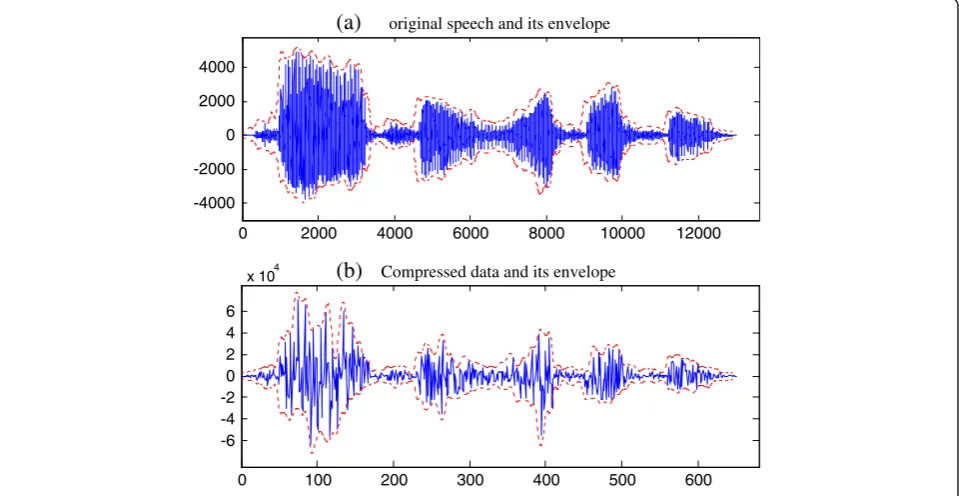
The speech has proved to be a robust signal that can be perturbed in many different ways while remaining intelli-gible [24]. As depicted in Figure 2 (the compression ratio is set as 1:20), though the measurement vector exhibits some noise-like nature (Figure 2b), it is observed that the envelopes (red, dashed line) of the original speech and the compressed signal are of high similarity. This means the CS retains considerable information within the low-dimensional measurements.
Actually, neurons in the auditory brainstem sensitive to speech envelope have been found in mammalian physiological studies [25]. The envelope extracted using the Hilbert transform reveal that the envelope is most important for speech reception, namely the words are identified according to the envelope [20]. Research on the relationship between speech envelope and audio per-ceptual comprehending is still intensely ongoing [26]. More recently, Mehmet Cenk et. al. [21] have investi-gated the perceptual features for automatic emotion rec-ognition with temporal envelopes.
Previous studies [5,7,8] have demonstrated the security of using stochastic matrix as the key. Coincidentally, the sensing matrix with respect to CS is also a stochastic matrix. It therefore can be used as the scrambling matrix to decrease the residual intelligibility of the dimensional-reduced signal. Nevertheless, we notice that the dimen-sion of the compressed signal is not in accordance with
that of the sensing matrix. In other words,y∈Rmcannot be scrambled directly by Φ∈Rm×n without dimensional variation. To solve this problem, one feasible way is to select a group of random atoms from Φ to form an m×mscrambling matrix. But the selection schedule will bring about additional communication load. As a conse-quence, based on the compressed speech sensing, we
0 100 200 300
0 100 200 300
0 100 200 300
0 100 200 300
0 100 200 300
0 100 200 300
(a)
(b)
(c)
(d)
(e)
(f)
Voiced Frame (VF) sparse vector of VF
Transition Frame (TF) sparse vector of TF
Unvoiced Frame (UF) sparse vector of UF
Figure 1Sparsity of three types of speech over K–L incoherent dictionary.The horizontal axes stand for the amplitudes of signals, the vertical axes stand for the indices of vectors.
0 2000 4000 6000 8000 10000 12000
-4000 -2000 0 2000 4000
0 100 200 300 400 500 600
-6 -4 -2 0 2 4 6
x 104
(a)
original speech and its envelope(b)
Compressed data and its envelopehave designed a new paradigm of scrambling matrix that alias and scramble two volumes of compressed data
y1
y2
together.
3.2. Design of the scrambler
As mentioned above, one can hardly get any information barely from the result if two independent signalsx1and
x2 are aliased and scrambled in the same space. As
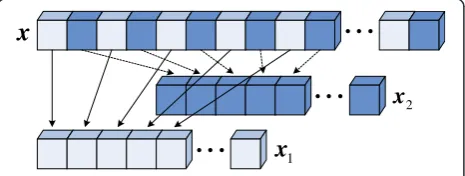
shown in Figure 3, the original speech is thereby sepa-rated into two parts. For the sake of the independency of new speech segments, we set every four consecutive frames (800 samples at sampling rate 8 kHz) as a seg-mentation piece by considering two facts: (1) the quasi-periodic property of speech endures about 50 ms; (2) the auditory tolerance to delay is about 200 ms. Each cube in Figure 3 represents such a piece.
Next, the new signals are sparsely represented over the corresponding K–L incoherent dictionaries, and then measured by different stochastic matrices to get the compressed signals individually. Since using only one fixed matrix does not always hold the restricted isometry property [17] and will result in undesirable reconstruc-tions, we randomly choose the matrices from the sto-chastic matrix dictionaryB={Φj:j=1, 2,. . .,L}.
Such matrix dictionary is constructed in advance. Dur-ing the construction process, each randomly generated stochastic matrix is tested with a group of different speech frames. If the correct reconstruction rate of this matrix is acceptable, it is chosen as a dictionary atom. In this study, we set the accepting threshold of correct re-construction rate as 80%. As a matter of fact, almost all random matrices are CS matrices [15], thus the number of atoms L in the dictionary can be set according to practical requirements.
The compressed data yi are pre-reconstructed until the final selected sensing matricesΦi, i=1, 2 ensure pre-cise reconstruction. Similarly, let αi, i=1,2 denote the normalized indices of these matrices in the dictionary and letDi,i=1,2 stand for the sparsifying matrices of the two speech parts. Then, the encrypted signal yD is obtained by aliasing and scrambling the two
low-dimensional measurement vectors with the selected matricesΦi.
yD¼f y
1;y2;Φ1;Φ2
ð Þ ð10Þ
Subsequently, one heuristic approach is to design a scrambling matrix schedule that is of high security to-gether with its inverse operator for decryption. Due to the independency of the two speech parts, their correspond-ing measurements yi=ΦiDiTxi, i=1, 2 are also incoherent. We can remove any one of them by its orthocomplement without damaging the other one. Without loss of general-ity, we takey1for the following illustrations.
Assume there exists a vector zfrom (Φ1T)⊥that is
or-thogonal to Φ1T, i.e., zTΦ1=0. Multiplying z with the
encrypted datayDyields
zTy
1¼ zTΦ1
DT
1x1¼0 ð11Þ
thus the y1part comprised inyDis eliminated. Then, we
can reconstruct x1,x2by reconstruction algorithms and
assemble them to further obtain the recovered speechx^. Since the operation objects are matrices and vectors in practice, the orthocomplement designing problem turns out to be orthogonal vector designing. Following related linear space theories [27], zcan be presented by a linear combination of the vectors in the non-trivial NSB of Φ1,
denoted as Null(Φ1). The rank of the stochastic matrix
Φ1∈Rm×n(m<n) is m. However, the dimensions ofΦ1and
the null space ofΦ1Hhave following relationship
dimNull ΦT1¼m dim ΦT1¼0 ð12Þ
According to (12), if we chooseΦito scrambley1andy2
directly, the two measurement parts cannot be separated for decryption since Null(Φ1) does not exist. To ensure
the inverse operation, we construct a non-full row rank
matrix ΦD1 ¼ ΦΦ1 1
∈R2mn. The dimension of Φ
1
D is m.
By employing the conclusion drawn from [27], we have
dim Φ1D
þ dim Null Φ1D H
h i
¼2m ð13Þ
Then,
dim Null Φ1D H
h i
¼2m dim Φ1D
¼m ð14Þ
This ensures the existence of null space of Φ1D and it
can be constructed by SVD: for a matrix Φ1D ∈ R2m×n
with rank(Φ1D)=m, it can be decomposed as
Φ1D¼U X
VH ð15Þ
Then themleft singular vectors {um+1,um+1,. . .,u2m} that correspond to the non-zero singular values are
1
x
2
x
x
• • •
• • • • • •
orthonormal basis of the conjugate transpose matrix (Φ1D)H, that is
Null Φ1D H
¼Spanfumþ1;umþ1;. . .;u2mg ð16Þ
where U∈R2m×2m and V∈Rm×m are unitary matrices.
Here
Σ
¼Σ
100 0
, where
Σ
1=diag(σ1, σ2, . . ., σm),andσiare the eigenvalues of (Φ1D)HΦ1D.
With (16), we obtain the NSB of (Φ1D)H: N∈R2m×m,
denoted as N¼ NN1 2
with property N1=−N2. N1, N2
are full rank matrices and therefore have inverse matri-ces, as proved in Appendix. In this case, the matrix Φ1D
provides available NSB. In other words, if we use the NSB matrix to construct a scrambling matrix for the
aligned measurements yy1 2
, the inverse operator for
decryption is available.
For this consideration, the scrambling matrix is
designed as S¼ αN1I1 N1 2 α2I
∈R2m2m to alias and
dis-order the measurements y1, y2. Here, αi are the corre-sponding normalized indices of Φi in the dictionary B, so that every frame of encrypted signal is aliased in dif-ferent proportion to enhance the encryption complexity. The identity matrixI∈Rm×m is used to adapt the
dimen-sions of S and y1
y2
. The final encrypted signal yD is
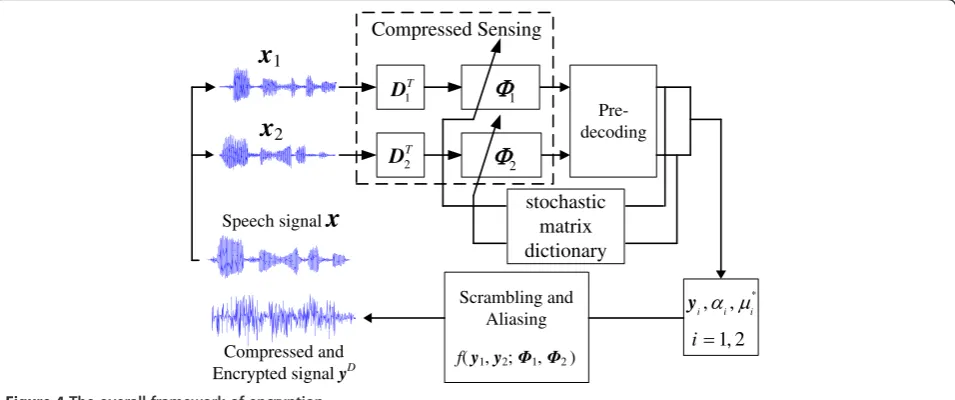
given in (17). Every compressed partyiis scrambled and the scrambled data are aliased with each other. The whole process of encryption is shown in Figure 4.
yD¼ α1I N1
N1 2 α2I
y1
y2 ¼
α1y1þN1y2
N1
2 y1þα2y2
ð17Þ
For communication, the encrypted data yD, the dic-tionary parameters μi∗, and the indices αi of sensing matrix are transmitted to the decryption end. Then the decryption operator can be constructed byΦi. As such, the stochastic matrix dictionary B is also the key book shared by both the encryption and the decryption parts. This key book will never be exposed in the channel. In practice, it is irregularly updated and the number of its atomsL can adaptively be set to meet the requirements of the system.
3.3. Decryption
Figure 5 depicts the decryption procedure. We get Φ1
with the index α1 from the transmitted data, and
con-struct the matrix S'=[N2−1 −α2I1] withΦ1D by SVD. The
y1part is removed as follows.
S0⋅yD¼ N1
2 α2I1
y1þN1y2
α1y1þN11y2
¼ N1
2 N1α22I
y2
¼t∈Rm1
ð18Þ
As mentioned above, N1 andN2are full rank matrices.
With the inverse matrixN2−1, we can gety2by multiplying
the y1—removed data t with the matrix (N2−1N1 −α22I)−1.
Analogously,y1is decrypted as
y1¼ α1α2IN1N21 1
α2I N1
½ yD ð19Þ
When the measurement vectors yi and the dictionary parameters μi∗ are derived, the two speech parts can be recovered using OMP algorithm [22]. Finally, by assembling
x
1x
2Speech signal
x
1 T
D
2 T
D
Pre-decoding
stochastic matrix dictionary
1
2
Compressed Sensing
*
, ,
1, 2
i i i
i
y
Scrambling and Aliasing
f(y1,y2; 1, 2) Compressed and
Encrypted signalyD
the two reconstructed parts, we obtain the recovered speech^x.
In theory, without the key book B, it is very hard for the eavesdroppers to decipher the encrypted signal even though they have cryptanalyzed the encryption mechan-ism. The strength of security is discussed in the follow-ing section.
4. Experimental results and discussions
In this section, the performances of the proposed en-cryption scheme are evaluated from three perspectives: (1) the residual intelligibility of the encrypted signal; (2) the strength of security; (3) resistance to hostile attacks. We test over 20,000 frames of speech coming from sev-eral speakers with unlike characteristics (gender, age, pitch, regional accent). These test signals are taken ran-domly from TIMIT database and are sampled at 8kHz with length 25ms, that is, 200 samples per frame. In Sec-tion 4.1, residual intelligibility test results and discus-sions are presented. Section 4.2 analyzes the strength of security, and a possible deciphering technique is consid-ered. Section 4.3 verifies the robustness of the proposed scheme in two conditions: in the presence of noise and low-pass filtering (LPF).
4.1. Residual intelligibility
The amount of intelligibility left over in the encrypted signal is measured by the envelope relevance between the original speech and the processed signal, given as
ρ¼ <E0;Ep>
E0
k k2⋅ Ep 2
1
2
ð20Þ
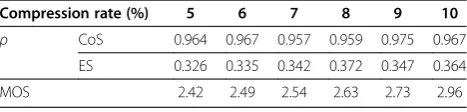
whereEoand Epdenote the envelopes of original speech and the processed signal, respectively. Naturally, we interpolate the vector ofEpto reach the same dimension as Eo due to the operation of inner production in (20). We test two kinds of processed signal: the compressed signal (CoS) and the encrypted signal (ES).
According to the experimental statistics, when the com-pression rate (m/n) is above 5%, the salient information of speech can be captured, and acceptable reconstruction
quality is derived with the K–L incoherent dictionary. On the other hand, though reconstruction quality improves with the increasing of compression rate, it is of no signifi-cance for signal compression with a high compression rate. Therefore, the average residual intelligibilities are per-formed at compression rates ranged from 5 to 10%.
As seen in Table 1, despite of the noise-like nature, the low-dimensional measurements still retain considerable information of the original speech. The envelope rele-vance between the aliased, scrambled signal, and the ori-ginal speech exhibits a dramatic decrease in terms of residual intelligibility. In the meantime, it is noticed that the compression rates and the residual intelligibility are not remarkably related, which means one can choose the compression ratio adaptively without increasing the re-sidual intelligibility. In addition, as a subjective method for predicting the quality of narrow-band speech, the mean opinion score (MOS) recommended by ITU-T P.862 [28] is adopted to evaluate the perceptual quality of the recovered speech, and the results are also pre-sented in Table 1 to illustrate the relationship between speech quality and compression rate.
4.2. Strength of security
Following Shannon’s landmark article [14], the majority of literatures on key generation may roughly be categor-ized into four basic approaches: information theory ap-proach, system theory apap-proach, complexity theory approach, and stochastic approach. Considering the key schedule, our encryption scheme belongs to the stochas-tic approach, and its security is generally measured by the scale of the keyspace. Thus, the keyspace of pro-posed scheme is analyzed in two cases to evaluate its strength of security.
ConstructN
by SVD
Recovered ˆ speech x
Pick from
Dictionary
i B
1 Eliminate
part y
2
Eliminate part y
i
2 Reconstruct
ˆ x
1
Reconstruct ˆ x
i
y
2,
21
,
1y
D
y i
Figure 5The overall framework of decryption.
Table 1 Residual intelligibilities of processed signals at different compression rates and the corresponding MOS scores of the recovered speech
Compression rate (%) 5 6 7 8 9 10
ρ CoS 0.964 0.967 0.957 0.959 0.975 0.967
ES 0.326 0.335 0.342 0.372 0.347 0.364
First, we consider the optimal case, in which the scrambling mechanism is thoroughly unknown to the unauthorized listener, including the key schedule, the struc-tures of the scrambling matrix, and the sparsifying dictio-nary. Consequently, the essential approaches for decryption is given by
yD
SðunknownÞg→
yi
ΦiðunknownÞg→
si
DiðunknownÞg→^xi→^x
ð21Þ
In this case, all of the above three unknown matrices can be regarded as the key since one cannot obtain the original information without any one of them. Mean-while, the extreme low residual intelligibility and the noise-like nature of the encrypted signal have hampered the statistical analysis methods [29]. Therefore, the most feasible way is to search for the key, and its complexity is directly decided by the scale of keyspace. Given the dimensions of S, Φi, and Di, their keyspace sizes are
O10ð2mÞ2, O(10mn
), and O(10mn), respectively. These
are also the computational complexity for the searching process.
In the second case, we assume that an eavesdropper has a complete knowledge of the system, and has the ne-cessary hardware to synchronize and isolate the frames. In other words, he knows that the scrambling matrix S can be constructed with Φi and the sparsifying matrix Di can simply be rebuilt for its characteristic structure. Hence, the security of the system is assumed to reside entirely with the selection of a key Φi. For the eaves-dropper, the only task is to find the key. Since the ran-domness ofΦi, the keyspace size isO(10mn). In practical situations, the speech frames is of length n=180–220 and if we choose the compression rate as 5%, the length of compressed signal ism=9–11. Therefore, the order of magnitude of the keyspace is about 102000.
Table 2 compares the keyspace sizes and the compression ratios of the proposed scheme and some prior scramblers, which employ representative key schedules, including Hadamard matrix [4], Latin Square [6], dimensional-variable matrix [7], and chaos system [12]. As seen in Table 2, the proposed scheme provides larger keyspace and requires lower communication overhead.
Now let us consider a possible deciphering technique by dictionary learning regardless of deciphering delay. A cryptanalyst trying to break the system may be in pos-session of large amounts of encrypted signal except the
key book, since it is held by both the encryption and de-cryption parts and never transmitted through the chan-nel. He knows the complete specification of the system (scrambling mechanism, structure of sparsifying diction-ary); he would like to deduce the key without consider-ing the real-time requirement.
In mathematical language, thejth encryption operation is represented by
yD j
ð Þ¼Sð Þj y j ð Þ
1
yð Þj 2 " #
ð22Þ
By wiretapping, the cryptanalyst has obtained enough
encrypted signaly(Dj). He would like to learnS^
j ð Þ
fromYD,
whereYD=[y(1)D yD(2)⋯y(Dj)]. Each y
j ð Þ
1
yð Þj 2 " #
is unknown.
Un-fortunately, this is an optimization problem with no con-straint conditions and thus cannot be solved, let alone the scrambling matrixSis variable but not fixed. To say the least, even though he is able to find some fixedS^, he still cannot rebuild the sensing matrixΦ. This can be verified through Equations (15) and (16).
In fact, there would not be enough data and delay tol-erance for cryptanalysis. For instance, in secure commu-nications of military information or intelligence of espionage activities, the key information is expected to be as briefly as possible to ensure short durations. Therefore, the dictionary learning may not be a feasible approach in real cases.
4.3. Robustness performance
Since readily decipherable unintelligibility signals may also be generated in large keyspace, other factors, in-cluding bandwidth expansion, delay times, channel re-sistance (to noise, distortion, etc.), cannot be ignored in assessing security. Two types of attack are performed with the encrypted signal: (1) in the presence of additive white Gaussian noise (AWGN); (2) LPF.
Representative speech scrambling schemes are chosen to compare with the CS scheme. To be specific, the time-domain scrambling (TDS) [5] is adopted to stand for non-compressional scramblers. In parallel to it, the approximate 13 line μ-law pause code modulation (PCM) and the MELP [9] are, respectively, chosen to represent waveform coding and parametric coding, with respect to compressional scramblers.
Table 2 Comparison of keyspace size and compression ratio
Proposed Hadamard [4] Latin Square [6] ASVDS [7] Chaos [12]
Keyspace O(10n2) O(10n(n!)2 O(10120) O(n2) O(1064)
The MOS is chosen as the subjective criterion. In addition, average-subsection signal-to-noise ratio (SNRseg) [30] is adopted as the objective criterion to evaluate the quality of recovered speech, given by (23).
SNRseg¼101g 1 Nframe
X Nframe
j¼1
SNRsegj !
ð23Þ
where SNRsegj¼ Xn
i¼1
x2jð Þi xjð Þ i ^xjð Þi
2 and Nframe denotes
the total number of frames. The results are calculated and averaged for a test set of approximately 100 sentences ran-domly selected from the TIMIT database.
4.3.1. Noise resistance
AWGN is added to the encrypted signal of each scheme. The performances of the proposed and comparative schemes are compared. The compression ratio of CS is set as 1:10.
As shown in Figure 6a, it is observed that CS scheme always outperforms the comparative schemes for all degrees of contamination. As the signal-to-noise ratio (SNR) becomes higher, the superiority of CS scheme becomes more obvious and leads to a more favorable comparison; the compressional schemes, including PCM and MELP, perform worse, and these are verified by the SNRseg decrements as well (Figure 6b).
The results are mainly due to the use of stochastic matrix: it has extreme low column coherence. The stud-ies [31,32] have shown that for a noiseless signal y=Φs, if theK-sparse vectorssatisfies k ks 0<12sparkð ÞΦ , then the reconstruction ^s from the contaminated measure-ments (y+e) satisfies
s^s k k2
2≤O
e k k2
2 1Mð2K1Þ
!
ð24Þ
where spark(Φ) stands for the minimum number of col-umns of Φ that are linearly dependent, and M is the “mutual coherence”ofΦ[31], defined as
M¼ max
1≤i;j≤n;i≠j ΦT
i Φj Φi
k k2 Φj 2
ð25Þ
In a word, one can stably reconstruct the sparse vector s with error proportional to the noise level, provided that (1) the columns of the sensing matrixΦare weakly mutual correlated, and (2) the vectorsis to some extent sparse. The reason why the reconstruction error is restricted is geometric in nature: summarily, the recon-struction^s is restrained within a tiny tubular wedge that surrounds the original vectors, which ensures the stabil-ity of recovering (for further details please refer to [31], subsection 5.3). In particular, the method of convex
-5 0 5 10 15 20 25 30
0 0.5 1 1.5 2 2.5 3
3.5 CS
TDS PCM MELP
MOS Decrements
(a)
SNR (dB)
-5 0 5 10 15 20 25 30
0 2 4 6 8 10
CS TDS PCM MELP
SNRseg Decrements (dB)
SNR (dB)
(b)
relaxation can identify a sparse signal in AWGN [33], and more sophisticated stable recovery schemes and boundaries have been investigated [34].
Technically speaking, the waveform coding scheme has no noise-resistant precaution and thus is vulnerable to noise. In terms of the parametric coding scheme, the noise will bring in errors to the feature parameters such as pitch period and voiced/unvoiced judgment. Once such parameters are contaminated, undesirable recon-struct distortion happens. For reasons given above, the noise resistance of the proposed scheme is better than the counterparts.
4.3.2. LPF
In terms of LPF, the decrements of MOS and SNRseg between speeches reconstructed from the filtered and the original encrypted data are compared. Also, the compression ratio of CS is set as 1:10.
As seen in Figure 7, CS scheme slightly outperforms the comparative schemes when the cutoff frequency ranges from 2400 to 2600 Hz. It gradually performs bet-ter along with the increasing of cutoff frequency and exhibits obvious competitive advantages. The TDS scheme ranks in the second place and the PCM scheme shows the worst performance.
The encrypted signal obtained from CS has dramatic-ally removed the speech characters by aliasing and
scrambling, thus it is of the best resistance to LPF. On the contrary, the TDS scheme still retains some speech structures, which makes its performances inferior to the CS scheme. The TDS scheme outperforms the other two comparative ones due to its robustness to time domain perturbations [24]. As for PCM and MELP schemes, their encoding signals have no spectral structures. All parts of the signal share the similar importance and therefore are vulnerable to this type of attack. Any damages to the encrypted signal would bring about ser-ious reconstruction errors and deteriorate the auditory quality. As a consequence, these two schemes have the worst robustness to LPF.
5. Conclusions
This article presented a scrambling-based speech en-cryption algorithm via CS. A high degree of security can be achieved due to low residual intelligibility and large keyspace size. The immense complexity associated with the task of finding the scrambling matrix ensures the ef-fectiveness of encryption. It affords notable robustness to common hostile attacks, while requires lower com-municational costs and introduces only a slight (about 200ms) processing delay. Experimental results are included which demonstrate the improved performance of the scheme compared with state-of-the-art speech scramblers. As a future work, it is planned to investigate
2400 2600 2800 3000 3200 3400 3600 3800 0
0.2 0.4 0.6 0.8 1 1.2
CS TDS PCM MELP
MOS Decrements
2400 2600 2800 3000 3200 3400 3600 3800 6
8 10 12
CS TDS PCM MELP
SNRseg Decrements (dB)
(a)
(b)
Cutoff Frequency (Hz)
Cutoff Frequency (Hz)
more sophisticated speech sparse representation and re-construction algorithms to further reduce the compres-sion ratio and improve the auditory quality of the recovered speech.
Appendix
Proof of full rank property mentioned in Section 3.2 is given as follows.
As for full row rank matrixP∈Rm×n(m<n), rank(P)=m, denote its SVD as P=UΣVH, where Σ=[Σm Om×(n−m)]∈
Rm×n
, Σm=diag(σ1, σ2,. . .,σm). Here U and V are m×m,
n×n unitary matrices, respectively. σi>0 denote the square roots of non-zero eigenvalues of PHP. With the SVD ofP, we have
PHP¼V
Σ
HUH UΣ
VH¼V
Σ
2m OðnmÞðnmÞOðnmÞðnmÞ OðnmÞðnmÞ
" #
VH ð26Þ
Then forQ¼ P
P ¼U0
Σ
0
V0H∈R2mnand rank(Q)=m, QHQ
is represented as
QHQ¼PHPH P
P ¼2PHP
¼2V0
Σ
2
m OðnmÞðnmÞ OðnmÞðnmÞOðnmÞðnmÞ
" #
V0H
ð27Þ
whereU0∈R2m×2m,Σ0∈R2m×n,V0∈Rn×n.
Comparing (26) and (27), it is noticed thatV0=V,
Σ
0¼Σ
m OmðnmÞ Omn OmðnmÞ
and U0U0H=2I2m, where I2m
de-notes the 2m×2midentity matrix. In this case, if there is a properU0, the SVD ofQcan be obtained. It is verified that
U0¼ U U
U U
satisfies U0U0H=2I2m, then (27) is
re-written as
QHQ¼2V0
Σ
2m OðnmÞðnmÞOðnmÞðnmÞ OðnmÞðnmÞ
" #
V0H
¼2V0
Σ
0HΣ
0V0H ¼V0Σ
0H 2I 2mð Þ
Σ
0V0H¼ U0
Σ
0 V0HH
U0
Σ
0 V0H
ð28Þ
Thus, with the SVD ofQ=U'ΣV'H, the null space basis ofQHcan be constructed.
Null QH¼Spanu0mþ1;u0mþ2;. . .;u02m ¼ UU
¼ N1
N2
∈Rm2m ð29Þ
whereu'm+idenotes the column vector ofU'.
As the randomness of P, dim [Null(QH)]=m, namely
the NSB matrixN¼ NN1 2
is a full column rank matrix.
By elementary row operations, N can be converted to
the form NO1
without rank changing. Therefore, rank
(N1)=m, which means Ni, i=1, 2 are full rank matrices and possess inverse matrices. This completes the proof.
Abbreviations
AMR: Adaptive multi-rate; AWGN: Additive white Gaussian noise; BC: Before Christ; CoS: Compressed signal; CS: Compressed sensing; ES: Encrypted signal; K–L: Karhunen–Loeve; LPF: Low-pass filtering; MELP: Mixed excitation linear prediction; MOS: Mean opinion score; NSB: Null space basis; OMP: Orthogonal matching pursuit; PCM: Pause code modulation; SNR: Signal-to-noise ratio; SNRseg: Average-subsection signal-to-noise ratio; SVD: Singular value decomposition; TDS: Time-domain scrambling.
Competing interests
The authors declare that they have no competing interests.
Acknowledgments
This study was supported by the National Natural Science Foundation, China (61072042), the Natural Science Foundation of Jiangsu Province, China (BK2012510), and the Pre-research Foundations of PLA University of Science and Technology (20110211). The authors appreciate Professor Shou-sheng Liu and Professor Zu-ping Qian for their useful discussions and valuable suggestions from the bottom of our hearts. The authors would like to thank the anonymous reviewers for their constructive comments and questions which greatly improved the article.
Author details
1
College of Command Information Systems, PLA University of Science and Technology, Nanjing, China.2College of Communications Engineering, PLA
University of Science and Technology, Nanjing, China.
Received: 15 December 2011 Accepted: 4 December 2012 Published: 28 December 2012
References
1. JA Clark, Nature-inspired cryptography: Past, Present and Future, inCongress on Evolutionary Computation, ed. by 3rd edn. (Newport Beach, USA, 2003), pp. 1647–1654
2. L Nan, S Yanhong, Z Jiancheng, An audio scrambling method based on Fibonacci transformation. J. North China Univ. Technol.16(3), 8–11 (2004) 3. V Senk, VD Delic, VS Milosevic, A new speech scrambling concept based on
Hadamard matrices. IEEE Signal Process. Lett.4(6), 161–163 (1997) 4. SK Pal, Fast, reliable & secure digital communication using Hardmard
matrices, inProceedings of the International Conference on Computing: Theory and Applications, ed. by 1st edn. (Kolkata, India, 2007), pp. 526–532 5. H Li, Z Qin, XP Zhang, LP Shao, Ann-dimensional space audio scrambling
algorithm based on random matrix. J. Xi’an Jiaotong Univ.
44(4), 13–17 (2010)
6. M Satti, S Kak, Multilevel indexed quasi-group encryption for data and speech. IEEE Trans. Broadcast.55(2), 270–281 (2009)
7. H Li, Z Qin, Audio scrambling algorithm based on variable dimension spaces, inInternational Conference on Industrial and Information Systems, ed. by 1st edn. (West Bengal, India, 2009), pp. 316–319
9. S Antonio, M Juan Carlos, Perception-based partial encryption of
compressed speech. IEEE Trans. Speech Audio Process10(8), 637–643 (2002) 10. M Pierre, JA O’Sullivan, Information-theoretic analysis of information hiding.
IEEE Trans. Inf. Theory.49(3), 563–593 (2003)
11. H Li-Lian, Y Qi-tian, A chaos synchronization secure communication system based on output control. J. Electron. Inf. Technol.31(10), 2402–2405 (2009) 12. T Liangrui, Z Lin, Y Xue, Chaos synchronization based on observer and its
application in speech secure communication, inProceedings of IC-NIDC, ed. by 2nd edn. (Beijing, China, 2010), pp. 773–777
13. E Del Re, R Fantacci, D Maffucci, A new speech signal scrambling method for secure communications: theory, implementation, and security evaluation. IEEE J. Sel. Areas Commun.7(4), 474–480 (1989) 14. CE Shannon, Communication theory of secret systems. Bell Syst. Tech.
J.28(4), 656–715 (1949)
15. DL Donoho, Compressed sensing. IEEE Trans. Inf. Theory.52(4), 1289–1306 (2006) 16. RG Baraniuk, Lecture notes: compressive sensing. IEEE Signal Process. Mag.
24(4), 118–121 (2007)
17. EJ Candès, MB Wakin, An introduction to compressive sampling. IEEE Signal Process. Mag.25(2), 21–30 (2008)
18. W Tian-jing, Z Bao-yu, Y Zhen, A speech signal sparse representation algorithm based on adaptive overcomplete dictionary. J. Electron. Inf. Technol.33(10), 2372–2377 (2011)
19. C Zhang-hua, T Yuan-sheng, Secure communication based on network coding. J. Commun.31(8A), 188–194 (2010)
20. ZM Smith, D Bertrand, AJ Oxenham, Chimaeric sounds reveal dichotomies in auditory perception. Nature.416, 87–90 (2002)
21. S Mehmet Cenk, G Bilge, K Gunes Karabulut, Perceptual audio features for emotional detection. EURASIP J. Audio Speech Music Process16, 1–21 (2012) 22. JA Tropp, AC Gilbert, Signal recovery from random measurements via orthogonal
matching pursuit. IEEE Trans. Inf. Theory.53(12), 4655–4666 (2007) 23. J Navarro-Moreno, JC Ruiz-Molina, Nonlinear estimation using correlation
information. IEEE Trans. Signal Process.54(7), 2822–2827 (2006) 24. K Saberi, DR Perrot, Cognitive restoration of reversed speech. Nature
398, 760 (1999)
25. PX Joris, TC Yin, Envelope coding in the lateral superior olive. I. Sensitivity to interaural time differences. J. Neurophysiol.73, 1043–1062 (1995) 26. D Bendor, X Wang, The neuronal representation of pitch in primate
auditory cortex. Nature.436, 1161–1165 (2005)
27. Z Xian-da,Matrix Analysis and Applications(Tsinghua University Press, Beijing, 2004)
28. P Itu-T,862, Perceptual Evaluation of Speech Quality (PESQ), and Objective Method for End-toEnd Speech Quality Assessment of Narrowband Telephone Networks and Speech Codecs(ITU-T Recommendation, Geneva, 2001) 29. P Georgiev, F Theis, A Cichocki, Sparse component analysis and blind
source separation of underdetermined mixtures. IEEE Trans. Neural Netw.
16(4), 992–996 (2005)
30. X Tingting, Y Zhen, S Xi, Novel speech secure communication system based on information hiding and compressed sensing, inThe 4th International Conference on System and Networks Communications, ed. by, 4th edn. 2009, pp. 201–206
31. DL Donoho, E Michael, T Vladimir, Stable recovery of sparse overcomplete representations in the presence of noise. IEEE Trans. Inf. Theory.52(1), 6–18 (2006) 32. M Babaie-Zadeh, C Jutten, On the stable recovery of the sparsest
overcomplete representations in presence of noise. IEEE Trans. Signal Process.58(10), 5396–5400 (2010)
33. JA Tropp, Just relax: convex programming methods for identifying sparse signal in noise. IEEE Trans. Inf. Theory.52(3), 1030–1051 (2006)
34. Q Sun, Sparse approximation property and stable recovery of sparse signal from noisy measurements. IEEE Trans. Signal Process.59(10), 5086–5090 (2011)
doi:10.1186/1687-6180-2012-257
Cite this article as:Zenget al.:Scrambling-based speech encryption via
compressed sensing.EURASIP Journal on Advances in Signal Processing
20122012:257.
Submit your manuscript to a
journal and benefi t from:
7Convenient online submission
7Rigorous peer review
7Immediate publication on acceptance
7Open access: articles freely available online
7High visibility within the fi eld
7Retaining the copyright to your article