Intrusion-Resilience via the Bounded-Storage
Model
?Stefan Dziembowski??
Institute of Informatics, Warsaw University, Poland
and
Institute for Informatics and Telematics CNR Pisa, Italy
Abstract. We introduce a new method of achieving intrusion-resilience in the cryptographic protocols. More precisely we show how to preserve security of such protocols, even if a malicious program (e.g. a virus) was installed on a computer of an honest user (and it was later removed). The security of our protocols relies on the assumption that the amount of data that the adversary can transfer from the infected machine is limited (however, we allow the adversary to perform any efficient computation on user’s private data, before deciding on what to transfer). We focus on two cryptographic tasks, namely: session-key generation and entity authentication. Our method is based on the results from the Bounded-Storage Model.
1
Introduction
In the contemporary Internet environment, computers are often exposed to at-tacks of malicious programs, which can monitor the machines and steal the secret data. This type of software can be secretly attached to seemingly harmless pro-grams, or can be installed by worms or viruses. In order to protect against these threats a user is usually advised to use virus and spyware removal tools. These tools need to be frequently updated (as the new viruses spread out very quickly). Nevertheless, for an average PC user it is quite inevitable that his computer is from time to time infected by a malicious process (which is later removed by an appropriate tool).
This phenomenon can be particularly damaging if the user runs some crypto-graphic programs on his machine. This is because in most of cryptocrypto-graphic tasks (encryption, authentication) the user needs to posses (and store somewhere) a secret keys. If the user does not storesoutside of the machine (e.g. on a trusted
?This is an extended version of a report [Dzi05] that appeared on the eprint archive. ??Partially supported by the EU ECRYPT grant IST-2002-507932 and by the Polish
hardware that will later participate in the protocol), then it seems that there is little that can be done to preserve the security, as the malicious process can always steals(and then impersonate the honest user, or decrypt his private com-munication). If the protocol is based on a password memorized by the user then the virus can wait until the password is typed and then record the key-strokes. In this paper we propose a method for constructingintrusion-resilient crypto-graphic protocols, i.e. such protocols that remain secure even after the adversary gained access to the victim’s machine (and later lost this access). The security of our protocols is based on a novel assumption that the amount of data that the adversary is allowed to transfer from the victim’s machine is limited (however, we allow the adversary to perform any efficient computation on user’s private data, before deciding on what to transfer). In the security proofs we make use of the theory of the Bounded Storage Model (see Section 3).
1.1 Previous work
Intrusion-resilience was introduced in [IR02] (see also [DFK+03]) and can be
viewed as a combination of forward and backward security.1 A cryptosystem
is forward-secure if an exposure of a secret key at some particular time t does not affect the security of the sessions of the protocol that endedbefore t. It was studied in context of key-exchange (see e.g. [DvOW92,Kra96]), digital signatures (this research was initiated by Ross Anderson, see [And02]) and public-key en-cryption [CHK03]. A cryptosystem isbackward-secureif the exposure of a secret key at time t does not affect the security of the sessions of the protocol that startedafter t. So far this was achieved by distributing the secret key among a group of participants (e.g. in [IR02] this group consist of two players: asigner and ahome base). One has to make an assumption that the entire group is never compromised by the adversary at the same time.
Cryptosystems that remain secure even in case of a partial leakage of the secret key were already studied in the area of Exposure-Resilient Cryptography (see e.g. [Dod00]). The differences from our model are as follows: (1) they con-sider only the leakage of individual bits of the secret keys and (2) the keys in their protocols are short.
Our model can be viewed as a generalization of the model of Kelsey and Schneier [KS99]. In their model the adversary is allowed to access individual bits of the secret key (this is justified by an assumption that the access to the memory is slow). In this model they show a simple authentication protocol (the secret key is a long random string of bits; in order to verify the authenticity of the client the server asks for the values of some randomly chosen positions of the secret key). In Sect. 5.2 we show that this protocol is also secure in our model.
Independently2(but earlier) a similar model was introduced by Dagon et al.
[DLL05]. They propose a system (calledVAST) for securely storing secret data
1 There seems to be some confusion in the literature about the terminology. What is
calledforward security in [And02] is calledbackward security in [IR02,DFK+
04]. In this paper we use the terminology of [IR02].
on devices that can be subject to an intrusion e.g. by a virus. They assume that such data is encrypted by a weak (human-memorized) password (let T denote the resulting ciphertext and let π be the password). To prevent the adversary from downloading T and cracking the password (i.e. performing a dictionary attack on π) on his own machine, they design their protocols so that T is too large to be fully downloaded. In order for this to make sense they need to assume that the computing power of the virus is limited (so the virus cannot perform the password-cracking on the victim’s machine). This is in contrast to our model, where we can grant the virus a right to perform an arbitrary (polynomial-time) computation on the victim’s data. Another difference is that they assume that the adversary does not have a full access to the victim’s machine. In particular when the user is interacting with VAST the virus should not have access to the keyboard. This is because when the user enters the passwordπ to the machine the virus can learnπ by recording the key-strokes.
1.2 Our contribution
We propose a new method for constructing intrusion-resilient protocols for the session-key generation and entity authentication (the main novelty of our ap-proach is the new method of achieving backward-security; the forward-security is achieved in a fairly standard way). The assumption that we make is that the secret key is of huge size (e.g. K is of size 5 GB). More precisely, we will grant the adversary the power to break into the honest user’s machine and take full control over it. We will assume that the adversary is able to perform arbi-trary (efficient) computation on victim’s data. Clearly, during the period of the break-in one cannot hope for much security, since the adversary has a complete knowledge about the behavior of one of the honest users (and hence she can e.g. impersonate the user or steal the session key). So the intrusion-resilience is the maximum what we can hope for. We achieve it by assuming that the amount of data that the adversary can retrieve is much smaller thanK (say it is 0.5 GB). This assumption may be quite practical as in many situations transmitting un-noticeably 0.5 GB of data is hard. Observe that if the secret key is of size 1 KB then the virus can e.g. post it on some Usenet group, so that the author of the virus can download it anonymously. Clearly this is much harder if the secret is huge.
Another motivation is that protocols that are secure in our model have a high level of resiliency against side-channel analysis [KSWH00]. Recall that the side-channel attacks allow the adversary to obtain some information about the users’ secrets by observing the behavior of the implementation of the protocol. In practice the full protection against such attacks is hard, and we can only hope for minimizing the amount of leaked information. The assumptions that we make in our model guarantee that even if some information about the secrets is leaked, the protocols are still secure.
data that can be broadcasted (e.g. by a satellite). The fact that he theory of the BSM has applications here may seem surprising at the first sight, as in some sense the assumptions in the BSM are opposite to ours. However, as it turns out, these models show similarities and in fact theorems that were proven in the BSM are useful for us.
Our exposition is rather informal, as we mostly aim at introducing the model and showing its power, not at providing ready to use practical solutions for concrete problems. For the same reason we do not provide numerical examples and we do not give comparisons between security levels of different schemes presented in the paper. Nevertheless, we believe that the protocols provided here (or their variants) may find practical applications.
Finally, let us note that our results are proven in the random oracle model (see Sect. 2.4).
1.3 The contribution of [CDD+05]
The entity authentication protocol that we present in our paper was indepen-dently constructed and analyzed by Cash et al. [CDD+05]. Moreover, they
im-prove our results by constructing a session-key generation protocol without the random oracle assumption. They also provide some concrete numerical examples of the parameter values that can be used in practical implementations.
2
Preliminaries
2.1 Probability theory
Themin-entropy of a probability distributionPX is defined as
H∞(X) := min
x∈X(−log2(PX(x))).
If X is a random variable and A is an event then PX is the distribution of
X and PX|A is a conditional distribution of X given A. In this case we define
H∞(X) := H∞(PX) and H∞(X|A) := H∞(PX|A). For more on min-entropy and its relation to the standard Shannon entropy see e.g. [Cac97].
Let thestatistical distance between random variablesX andX0 distributed
over the same setX be defined as
δ(X, X0) := 1 2
X
x∈X
|P(X =x)−P(X0=x)|
We will also say thatX isδ(X, X0)-far fromX0. IfU is a random variable with
2.2 Message Authentication Codes
We will use the following (simplified) security definition of the Message Authen-tication Codes (MACs). For a more complete definition the reader may consult e.g. [Gol04].MAC is an algorithm which takes as an input a security parame-ter 1k, a random secret keyS ∈ {0,1}λ(k) (where λ is some polynomial) and
a message M ∈ {0,1}∗. It outputs an authentication tag MAC
S(M,1k)) (we will sometimes drop 1k). It issecure against an adaptive chosen-message attack if any probabilistic polynomial time (PPT) adversary (taking as input 1k) has negligible3(ink) probability of producing a valid pair (M,MAC
S(M,1k)), after seeing an arbitrary number of pairs
(M1,MACS(M1,1k)),(M2,MACS(M2,1k)). . .
(where M 6∈ {M1, M2, . . .)), even when M1, M2, . . . were adaptively chosen by the adversary.
2.3 Public-Key Encryption
A public-key encryption scheme is a triple (G,encr,decr), where G is a PPT key-generation algorithm taking as input 1k and returning as output a (private-key,public-key) pair (E, D),encris an polynomial-time algorithm taking as input 1k, a messageM ∈ {0,1}∗ and a public keyE and returning aciphertext C =
encrE(M), anddecris an algorithm taking as input a private keyDa ciphertext
C and returning a message M0 = decr
D(C). We require that always M = decrD(encrE(M)). Let E be a polynomial time adversary which is given 1k and E. Her goal is to win the following game. She produces two messagesM0
and M1 (of the same length). Then, she is given a ciphertext C=encrS(Mr), where r ∈ {0,1} is random. She has to guess r. We say that (G,encr,decr) issemantically secure [GM84] if any polynomial time adversary has chances at most negligibly (ink) better that 0.5. More on the definitions of secure public-key encryption can be found e.g. in [Gol04].
2.4 Random Oracle Model
We prove the security of our protocol in theRandom Oracle Model [BR93]. More precisely, we will model a hash functionH:{0,1}i→ {0,1}jas arandom oracle, i.e. a black box containing a random functionh:{0,1}i→ {0,1}j. We assume that every party (including the adversary) has access to this oracle, i.e. can ask it for the value ofhon any (chosen by her) arguments.
3
A functionf:N → Risnegligible (ink)if for everyc≥1 there existsk0 such that
3
Bounded Storage Model
We will use the results from the Bounded-Storage Model, introduced by Mau-rer in [Mau92]. So far, this model was studied in the context of information-theoretically secure encryption [ADR02,DM04b,Lu04,Vad04,Din05], key-agree-ment [CM97,DM04a], oblivious transfer [CCM98,Din01,DHRS04] and time-stam-ping [MSTS04]. In this model one assumes that a randomt-bit stringR(called a randomizer) is either temporarily available to the public (e.g. the signal of a deep space radio source) or broadcast by one of the legitimate parties. We assume that the memorysof the adversary is smaller thantand therefore she can store only partial information aboutR. It has been shown in [ADR02,DM04b,Lu04,Vad04] that under this assumption the legitimate parties, Alice and Bob, sharing a short secret keyY initially, can generate a very longn-bit one-time padX with
n |Y|about which the adversary has essentially no information.
More formally, Alice and Bob share a short secret initial key Y, selected uniformly at random from a key space Y, and they wish to generate a much longern-bitexpanded key X (i.e.nlog2|Y|). In a first phase, at-bit random
stringRis available to all parties, i.e., the randomizer space isR={0,1}t. Alice and Bob apply a knownkey-expansion function
f :R × Y → {0,1}n
to compute the expanded key as X =f(R, Y). Of course, the function f must be efficiently computable and based on only a very small portion of the bits of
R, so that Alice and Bob need not read the entire stringR.
The adversary EveE can store arbitrarysbits of information aboutR, i.e., she can apply an arbitrary storage function
h:R → U
for some U with the only restriction that |U| ≤ 2s. The memory size during the evaluation of h does not need to be bounded. The value stored by Eve is
U = h(R). After storing U, Eve looses the ability to accessR. All she knows aboutRisU. In order to prove as strong a result as possible, one assumes that Eve can now even learnY, although in a practical system one would of course keepY secret.
A key-expansion functionf is secure in the bounded-storage model if, with overwhelming probability4, Eve, knowingU andY, has essentially no
informa-tion aboutX. To be more precise, let us introduce a security parameterkwhich is an additional input off and of Eve. Let us assume that the length of the ran-domizer, the size of Eve’s memory and the length of the output offare functions of k, i.e.t =τ(k), s=σ(k), andn=ν(k) (with ν(k)≥k). Also, assume that the set of the initial keys is always equal to {0,1}µ(k), for some function µ.
We say that function f is (σ, τ, ν, µ)-secure in the bounded-storage model if for
4
Formally, a sequence of probabilitiesp0, p1, . . .isoverwhelmingif the functionf(k) =
any Eve (with memory at mostσ(k)) the statistical distance of the conditional probability distributionPX|U=u,Y=y from uniform distribution over theν(k)-bit strings is negligible, with overwhelming probability over valuesuandy. Above we assumed that the adversary and the function f are deterministic, but note that we would not loose any security by allowing them to be randomized.5
Several key expansion functions were proven secure in the past couple of years (see for example [ADR02,DM04b,Lu04,Vad04]). In the next section we present an example of such a function, taken from [DM04b]. We have chosen the function of [DM04b] because we believe that it is the simplest one. The reader familiar with the BSM literature can safely skip the next section.
3.1 The scheme of [DM04b].
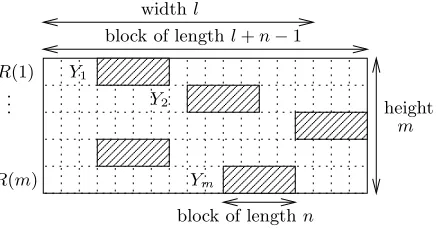
The randomizer R ∈ R= {0,1}t is interpreted as being arranged in a matrix with mrows, denotedR(1), . . . , R(m), for some m≥1 called the height of the randomizer. Each row consists ofl+n−1 bits, for somel≥1 called thewidthof the randomizer. Hencet=m(l+n−1) andRcan be viewed as anm×(l+n−1) matrix (see Fig. 1). The initial key Y = (Y1, . . . , Ym)∈ Y ={1, . . . , l}mselects one starting point within each row, and the expanded keyX = (X1, . . . , Xn) is the component-wise XOR of themblocks of lengthnbeginning at these starting pointsYi, i.e.,
X =f(R, Y),
wheref :R×Y → {0,1}nis defined as follows. Forr∈ RandY = (Y1, . . . , Y m)∈ Y,
f(R, Y) := m M
i=1
R(i, Yi), . . . , m M
i=1
R(i, Yi+n−1) !
, (1)
whereR(i, j) denotes thejth bit in theith row ofR. This is illustrated in Fig. 1. The above functionf was proven secure in [DM04b], assuming that memory of the adversary has a size that is a constant fractionc <1 of the randomizer. For the practically looking parameters this constant should be around 8%, i.e.
σ(k) :=τ(k)·0.08. See [DM04b] for details.
4
Intrusion-Resilient Session-Key Generation
Bysession-key generationwe mean a protocol that allows two parties (that share a long-term symmetric key) to agree securely on a session key even in presence of a malicious adversary that can obstruct their communication. Below, we describe what we mean byintrusion-resilient session-key generation.
5 Formally we could do it by allowing
E andfto take extra random inputsrEandrf,
resp. This does not give any extra power to the adversary, for the following reasons: (1) the inputrf is obsolete since ifE is randomized then havingrf clearly does not
change anything asE can simply chooserf herself and encode it into the description
R(1) Y1
.. .
R(m) Ym
block of lengthl+n−1
block of lengthn
height widthl
m Y2
Fig. 1.Illustration of the scheme for deriving an expandedn-bit keyX= (X1, . . . , Xn),
to be used as a one-time pad, from a short secret initial key Y = (Y1, . . . , Ym). The
randomizer Ris interpreted as am×(l+n−1) matrix with rowsR(1), . . . , R(m) of lengthl+n−1. The expanded keyXis the component-wise XOR ofmblocks of length
n, one selected from each row, where Yi is the starting point of theith block within
theith rowR(i).
4.1 An informal description of the model
First, let us fix the basic terminology. The honest users AliceAand BobB will be attacked by a (polynomially bounded) adversary Eve E. The adversary is allowed (1) to eavesdrop and to store the entire communication between Alice and Bob (2) to fabricate messages or to prevent them from arriving and (3) to (periodically) install malicious programs on the honest user’s machines (see below). Such a program will be called avirus. We assume that the honest users share a long-term secret key K generated randomly. The time is divided into sessions T1, T2, . . .(the number of sessions will be bounded). At the beginning of the session the users are allowed to get some fresh random input. At the end of each session Ti the users output a newsession key κi. (In practice, once κi is generated, the users will utilizeκi for secure communication.) For simplicity assume that each execution of the protocol is always initiated by Alice. After being installed, the virus can do the following.
1. Read all the internal data of the victim.
2. Compute an arbitrary function Γ on this data. We will model it by asking the adversary to produce a description ofΓ as a boolean circuit. The only restriction that we put onΓ is that the length of its output is limited (observe however that since Eve is polynomially-bounded the size of Γ has to be polynomial). Note also that we do not need to consider the case ofinteractive viruses (that would be allowed to engage in a interactive massage exchange with the adversary), since the circuit may contain the description of the entire state of the adversary.
3. Send the result of the computation back to the adversary.
to successfully break some test sessionTtest (of her choice), by achieving one of the following goals:
1. learnκtest,
2. convince at least one of the players to accept some κ0
test about which the adversary has some significant information, or
3. make AandB agree on different keys.
Clearly, if the adversary installs a virus on one of the users’ machines in session
Ttest then she can instruct the virus to retrieve κtest (since in a usual scenario the session keyκi is short6). Therefore, we are interested only in the adversary breaking those sessionsTtest during which no virus was installed (neither on the machine ofAnor on the one ofB).
Traditionally when considering forward security (see e.g. [Kra96]) one allows the adversary to learn all the session keys except of the challenge keyκtest. In our model this ability ofE comes from the fact that the adversary can compromise all sessions except ofTtest (we will actually allow the adversary to ,,compromise a session” that has already ended some time ago). Finally, let us remark that in this model we assume that the players can reliably erase their data (in particular, after the session Ti the players would eraseκi). Actually, we will assume that the only data that is not erased between the sessions is the secret keyK.
4.2 A more formal description of the model
We are now going to define the model more formally. Our definitions are inspired by the definitions of the security of key-exchange protocols (esp. [CK01]). For the sake of simplicity we assume that the protocol is executed just between two fixed parties, and concurrent execution of the sessions is not allowed, i.e. the users simply execute one session after another. Giving a complete definition (e.g. in the style of [CK01]) remains an open task.
Thesession-key generation scheme is a tuple (A, B, α, β, γ, δ, χ), whereα, β, γ, δ, χare some polynomials andAandBare interactive Turing machines, taking as input a security parameter 1k and a secret keyK∈ {0,1}α(k). The adversary
E is a PPT Turing Machine taking as input 1k. The execution is divided into the sessionsT1, T2, . . . , Tχ(k). The execution of eachTi looks as follows:
1. The machinesAandBreceive uniformly (and independently) chosen random inputsrA∈ {0,1}β(k) andrB ∈ {0,1}β(k)(respectively).
2. Machines start exchanging messages. The adversary can eavesdrop the mes-sages. She can also prevent some of the messages from arriving to the des-tination and fabricate new messages. At the beginning A sends a unique messagestart to B (so the adversary knows that a new session started). 3. At the end of the session the machines (privately) output an agreed key
κi ∈ {0,1}δ(k). If the traffic was not disturbed by the adversary then they have to output the same value.
6
Even if one would develop a scheme in which κi is too large to be retrieved, the
4. Now the adversary may choose tocompromise the sessionTi(each sessionTi may be compromised at most once in the entire execution of the protocol). In this case the following happens.
(a) Eve produces a description of a boolean circuit C (which models the virus) computing a functionΓ :{0,1}w→ {0,1}γ(k)(w is an arbitrary
value). Clearly we will always haveγ(k)χ(k)< α(k), since otherwise Eve could retrieve the entire secret keyK. The size ofCis arbitrary (however, it has to be polynomial in the security parameter, as the adversary is polynomially-bounded).
Note that we assume a uniform boundγ(k) on the amount of bits that the adversary is allowed to steal in each compromised session. More generally, one could give a bound on the total number of bits retrieved by the adversary in all compromised sessions.
(b) Eve learns the value ofΓ(rA, rB, K).
Observe that the functionΓ ,,has a complete view” of the internal states of the parties during the session. Thus in particular the value ofΓ(rA, rB, K) may include the encoding ofκi (if this is the wish of the adversary). Also note that our model is actually stronger than what we need in practice (as we assume thatΓ has simultaneous access to bothAandB, without restricting the amount of data that she needs to transfer between the parties, to perform the computation).
5. The adversary may decide to compromise a session (in the same way as in Point 4) even long time after the sessionTiis finished (one can imagine that the descriptions of the states of A and B at the end of Ti are deposited somewhere and the adversary may decide to access them at any later time). This may seem an artificial strengthening of the model. However, in fact it simplifies things, as it allows us to model the fact thatκimay become known to the adversary at some later point. Alternatively, we could introduce a special type of session-key-queries [CK01] that the adversary may ask to learnκi after the end ofTi.
LetC be the set of all compromised sessions. Clearly, the adversary wins if for some sessionTi 6∈ C usersA and B outputted different keys. If this is not the case then at the end of the execution the adversary decides that someTtest 6∈ C will be hertest-session. In this case her task will be to distinguish κtest from a truly random key of the same length. Of course we need to require that at least one ofAandB actually outputted some keyκtest (by blocking the message flow the adversary can clearly prevent the parties from reaching any agreement). The distinguishing game is as follows:
1. Letr∈ {0,1}be random.
2. If r = 0 then pass κtest to the adversary. Otherwise generate a random
κ0 ∈ {0,1}δ(k) and pass it to the adversary. The adversary outputs some r0∈ {0,1}. We say that shewon the distinguishing game ifr=r0.
1. the chances that in some sessionTi6∈ C machinesAandB outputted differ-ent keys are negligible (ink), and
2. the chances that E wins the distinguishing game, are at most negligibly (in
k) greater than1/2.
4.3 The protocol for intrusion-resilient session-key generation
Preliminaries Letf be (σ, τ, ν, µ)-secure in the BSM. LetMAC be a message authentication scheme secure against adaptive chosen message attack. Assume that for a security parameter 1k the length the secret key ofMAC isλ(k). Let
H :{0,1}ν(k)→ {0,1}λ(k)be a hash function (modeled as a random oracle). Let
(G,encr,decr) be a semantically secure public-key encryption scheme. In order to achieve forward-security we will use the public-key encryption in a standard way (see e.g. [DvOW92,Kra96]): Alice will (1) generate an ephemeral (public key, private key) pair7 and (2) send the public key (in an authenticated way)
to Bob, Bob will generate the session keyκand send it (encrypted with Alice’s public key) back to Alice (who can later decryptκ).8Afterwards, the ephemeral
keys are erased.
The protocol Fix some value of the security parameterk. Let R={0,1}τ(k)
and let Y ={0,1}µ(k). Assume that Alice and Bob share a random secret key K = (RA, RB)∈ R2 and hence α(k) := 2·τ(k). In each session Ti the players execute the following protocol.
1. Alice generates a randomYA∈ Y and sends it to Bob. 2. Bob generates a randomYB ∈ Y and sends it to Alice.
3. Both parties calculateS:=f(RA, YA)⊕f(RB, YB) andS0:=H(S). 4. Alice generates a public keyE and sends (E,MACS0(A:E)) to Bob.
5. Bob verifies the correctness of the authentication tag. If it is correct then he generates a randomκiand sends (encrE(κi),MACS0(encr
E(B:κi)) to Alice. He outputsκi.
6. Alice verifies the correctness of the authentication tag. If it is correct then she decryptsκi and outputs it.
7. The players erase all their internal data (including κi and random inputs), except of the long-term keyK.
The role of labels ,,A:” and ,,B:” is to prevent the adversary from bouncing the message sent by Alice in Step 4 back to her in Step 5.
7 Ephemeral key is a key that is generated just for some particular session (and it is
erased later).
8
The bound on the amount of retrieved data An important parameter that needs to be fixed is the amount of data that the virus can retrieve in each session, i.e. the value of γ(k). If the adversary compromises some sessions than at any point of the execution of the scheme, then she knows the value of some function ˜
hofK. We can think about ˜has changing dynamically after each session. After execution ofisessions the length of the output of ˜his at most the sum of
• i·γ(k) (since she could have compromised at mostisessions do far), and • i·λ(k) (since she could have learnedikeys of theMAC scheme9)
Since the maximal number of sessions isχ(k) we know that the output of ˜his of a length at most
χ(k)·(γ(k) +λ(k)).
Therefore if we want this value to be at mostσ(k) we have to set
γ(k) :=σ(k)/χ(k)−λ(k). (2)
This ensures that the information that Eve has aboutKis at mostσ(k) bits.
4.4 The security of the protocol
We prove the following.
Theorem 1. The protocol in Sect. 4.3 is intrusion resilient.
Proof (sketch).Fix some uncompromised sessionTi. Let us first consider the case when the adversary wants to break it by disrupting (by stealing and substituting messages) the communication. LetSAandSBbe the values ofScomputed byA andB(resp.) in Step 3. If the execution of the protocol was not disturbed by the adversary then we haveSA=SB. By the security off in the BSM, the adversary has almost no information about the valuesSAandSB (i.e. their distribution is negligibly far from uniform from her point of view). Note that this holds even if she was disrupting the communication between the parties. The only thing that the adversary could possibly do is to forceSA andSB to be such that they are not equal, but they are not independent either. For example by modifying the messageYA (sent in Step 1) she could makeSA⊕SB to be equal to some value
S⊕ chosen by her.10
This is why, before usingS, we hash it (in Step 3):S0 :=H(S). Let S0
A :=
H(SA) and letSB0 :=H(SB). Clearly the chances ofE of guessingSA orSB are
9 We have to add it because the definition of the security ofMAC does not imply the
secrecy of all the bits of the key.
10Consider for example the scheme from Sect. 3.1. Write
YA= (Y1, . . . , Ym). Suppose
the adversary stored the first row (RA(1)) ofRA (she should have enough memory
to do it) and she modified YA = (Y1, . . . , Ym) (sent is Step 1) only on the first
component (Y1). LetYA0 be the result of this modification. Clearly almost always
fA(RA, YA)6=fA(RA, YA0); however,fA(RA, YA)⊕fA(RA, YA0) (and henceSA⊕SB)
negligible. This is because the distributions ofSAandSBare negligibly far from a uniform distribution over{0,1}ν(k)and we assumed thatν(k)≥k. Therefore
(since we model the hash function as a random oracle) we can assume that (except with negligible probability) from the point of view ofE the distributions of the valuesS0
AandSB0 are entirely uniform. Moreover, one of the following has to hold (except with negligible probability):
1. S0
A=S0B, or 2. S0
AandSB0 are independent.
Assume that the first case holds. Then, the adversary is not able to fabricate messages in Steps 4 and 5, without breaking the MAC. The security ofκifollows now from the security of the encryption scheme (if the adversary could distin-guishκi from a random key, then she could clearly break the semantic security of (G,encr,decr)).
In the second case, the parties easily discover that the adversary was interfer-ing with their communication. This is because if the adversary wants to prevent them from discovering this, then she needs to create (in Steps 4 and 5) valid pairs (message,MAC), without having any information about the secret keys. Again, she cannot do it without breaking theMAC.
Now suppose that the adversary wants to distinguishκi from a random key, after the session is completed. If she compromises some future sessionTjthen she can of course recover the keyS0 used in sessionT
i(if she storedYAandYBfrom
Ti). However, now it is too late (as the keyS0 is used only for authentication). Therefore, the security of κi again follows from the semantic security of the
encryption scheme. ut
4.5 An alternative protocol
In this section we show another variant of the protocol from Sect. 4.3. The main difference is that instead of using a BSM-secure key derivation function
f, we will use a function ˜f : R × Y → {0,1}k that is not BSM-secure, but still works for our purposes. Again, let k be a security parameter and suppose that the randomizer R is a random element from R = {0,1}τ(k). Let Y :=
(Y1, . . . , Yk)∈ {1, . . . , τ(k)}k|Y1<· · ·< Yk . ThusY can be viewed as a set of allk-element subsets of{1, . . . , τ(k)}. First, define
ϕ((R1, . . . , Rτ(k)),(Y1, . . . , Yk)) := (RY1, . . . , RYk).
LetH be a hash function. We set
˜
f(R, Y) :=H(ϕ(R, Y)).
In other words: we just pick random positions of the secret key, concatenate them and hash the result. Of course usually ˜f is not secure in the BSM as the hash functions belong to the complexity-theoretic world. However, if we model
view of the adversary, unless she managed to guess the value ofϕ(R, Y). So, if we want to use ˜f instead of f in the protocol from Sect. 4.3, then we have to show that the probability of any adversary of guessingϕ(R, Y) correctly, is negligible (for the appropriate choice of the parameters), even when the adversary is given
h(R) andY (for someh:{0,1}τ(k)→ {0,1}σ(k)chosen by her). If we model the
adversary’s guess as a functiong we can formalize this requirement as follows.
Lemma 1. Supposeσ(k) = (1−δ)τ(k)−k, for an arbitraryδ >0. For arbitrary functionsh:{0,1}τ(k)→ {0,1}σ(k)andg:{0,1}σ(k)→ {0,1}k we have that
P(ϕ(R, Y) =g(h(R), Y)) (3)
is negligible.
For the proof we need two other lemmas. The first lemma (proven in [CM97], see Lemma 3) is quite simple. It roughly states that the knowledge ofsbits of a random stringR reduces its min-entropy by arounds, with a high probability.
Lemma 2 ([CM97]). LetR be a random variable uniformly distributed over {0,1}t. Leth:{0,1}t→ {0,1}s be an arbitrary function. Then, with probability at least1−2k the variable h(R) takes a valueusuch that
H∞(R|h(R) =u)≥t−s−k.
The second lemma (proven in [NZ96], see Lemma 11) is more complicated. Infor-mally speaking, it states that ifR∈ {0,1}tis a random string with min-entropy
δ·tandY ∈ Y is chosen uniformly at random, thenϕ(R, Y)∈ {0,1}k has (with high probability) a min-entropy close toδ0k, whereδ0 is some constant.
Lemma 3 ([NZ96]).LetPRbe a probability distribution over{0,1}twith min-entropy δt. SupposeR is chosen according toPR. Then, with probability at least 1− (over the choice ofy =Y) the distribution of Pϕ(R,y) is-far from some
distribution PX0 whose min-entropy is δ0k where δ0 := cδ/log(δ−1) and :=
max(2−ck,2−cδ0
l)for some constantc.
Actually, the lemma that is proven in [NZ96] is stronger, as it does not require
Y to be entirely uniform (see [NZ96] for details). We are now ready for the proof of Lemma 1.
Proof (of Lemma 1). To simplify the notation we sets :=σ(k) and t:=τ(k). First, observe that by Lemma 2 we have that (except with a negligible probability 2−k) the variableh(R) takes a valueusuch that
H∞(R|h(R) =u)≥t−s−k=δt. (4)
So, suppose that suchuwas selected. We are now going to apply Lemma 3. Thus set δ0 = cδ/(logδ−1) and = max2−ck,2−cδ0
that with overwhelming probabilityY took a valuey such that the conditional distribution of
Pϕ(R,Y)|h(R)=u,Y=y (5) is at most-far from a distributionPX0 with min-entropyδ0t. Assume that this
indeed happened. If we want to maximize (3) we have to letgchoose an element with the maximal probability according to the distributionPϕ(R,Y)|h(R)=u,Y=y. Clearly this probability is at most 2−H∞(PX0)
+= 2−δ0
t+which is negligible in k.
5
Intrusion-Resilient Entity Authentication
In this section we informally describe a practical intrusion-resilient method for entity authentication. In order to achieve such entity authentication one could of course use the scheme from Sect. 4; however, this is an overkill and for practical applications a much simpler method suffices. The idea is as follows. We will construct anintrusion-resilient scheme that allows a userU to authenticate to a serverS. We will consideronly intrusions intoU. This corresponds to a practical situation in which the computers of the users are usually much more vulnerable for the attacks then the computer of the server.
Assume that the parties have already established a channel C between S
and U that is authentic only from the point of view of the user, i.e. U knows that (1) whatever comes through this channel is sent by U and (2) whatever is sent through it can be read only byU. Now, the user wants to authenticate to the server. This is a typical scenario on the Internet, whereCis established e.g. using SSL (and the server authenticates with a certificate). In practice usually
U authenticates to S by sending his password over C. This method is clearly not intrusion-resilient because once a virus enters the machine of U he can re-trieve the password (or record the key-strokes if the password is memorized by a human).
In this section we propose an authentication method that is intrusion-resilient (in the same sense as the protocols in the previous sections). Again, we will use the assumption that the secret key K of the user is too large to be fully downloaded. We allow the virus to perform arbitrary computations11 of the
victim’s machine.
5.1 Our protocol
Let f be a function that is (σ, τ, ν, µ)-secure in the BSM. Fix some security parameterk. The secret keyKis simply the randomizerR∈ {0,1}τ(k). The key
is stored both on the user’s machine and on the server. The protocol is as follows (all the communication is done via the channelC).
1. The server selects a randomY ∈ {0,1}µ(k)and sends it to Bob.
2. Bob replies withf(R, Y).
3. Alice verifies the correctness of Bob’s reply.
Now assume that the adversary retrieved at mostσ(k) bits ofR. More precisely, assume that the adversary knows a value h(R), wherehis a function with the range{0,1}σ(k). It is easy to see that (by the security of f) she has negligible
chances of being able to reply correctly to the challengeY. Observe that if the adversary replies (in Step 2) with some value X, and Alice rejects this answer, than the adversary learns exactly one bit of information aboutR (namely that
f(R, T)6=X), which should be added to the total number of ,,retrieved” bits (if one want to achieve the security against multiple impersonation attempts).
Note that since we assume that the server is secure (i.e. there are no intrusions to him) hence one could generate K pseudo-randomly and just store the seed on the server. For example: the seedscould be a key to the block-cipherBand one could setK:= (Bs(1), Bs(2), . . . , Bs(j)), for some appropriate parameterj (this method allows for a quick access to any part ofK).
5.2 The protocol of [KS99]
In this section we note that in the protocol from Sect. 5.1 one can use a simpler functionf than the functions secure in the BSM. Namely, the server can simply ask (in Step 1) for the values ofkrandom positions onK. Formally, the challenge in Step 1 is a randomk-element subset of the set{1, . . . , τ(k)}. The functionf
in Step 2 is replaced with ϕ(whereϕwas defined in Sect. 4.5). This is exactly the protocol of [KS99] (however in that paper it was analyzed in a weaker model where the adversary is allowed to access only the individual bits of the secret key). The security of this protocol follows from the analysis in Sect. 4.5.
6
Discussion
The main drawback of our protocols is that during the intrusion the virus can impersonate the user (and the user may not even be aware that something wrong is happening). As a partial remedy we suggest that the user could be required to split the private key into 2 halvesK1andK2, and to store each of them on a separate DVD disc. In this case the authentication process would require physical action of replacing one DVD with another (assuming that there is only one DVD drive in the machine). Note that this method does not work if we assume that the adversary is able to store large amounts of data on user’s hard-disc (as in this case she can make a local copy of the DVDs containing the key).
7
Open Problems
between the protocols based on the BSM key-expansion function and the pro-tocols based on the function ϕ (Sect. 4.5 and 5.2), as such comparison should depend on the concrete parameters that one wants to optimize (the size of the communicated data, computing time, level of security). For some choice of these parameters (long computing time, high level of security) it may be even prac-tical to use protocols that perform computations on the entire randomizer. For example in the protocol in Sect. 4.5 one could use function ˜f that simply hashes the entire randomizerRconcatenated with Y (i.e. set ˜f(R, Y) =H(R·Y)).
Another open problem is to implement other cryptographic tasks (as asym-metric encryption and signature schemes) in our model.
8
Acknowledgments
We would like to thank Krzysztof Pietrzak and Bartosz Przydatek for helpful discussions, and the anonymous referees for their comments.
References
[ADR02] Y. Aumann, Y. Z. Ding, and M. O. Rabin. Everlasting security in the bounded storage model. IEEE Transactions on Information Theory, 48(6):1668–1680, 2002.
[And02] R. Anderson. Two remarks on public key cryptology. Technical report, University of Cambridge, Computer Laboratory, 2002.
[BR93] M. Bellare and P. Rogaway. Random oracles are practical: A paradigm for designing efficient protocols. In ACM Conference on Computer and Communications Security, pages 62–73, 1993.
[Cac97] Christian Cachin. Entropy Measures and Unconditional Security in Cryp-tography. PhD thesis, ETH Zurich, 1997. Reprint as vol. 1 ofETH Series in Information Security and Cryptography, ISBN 3-89649-185-7, Hartung-Gorre Verlag, Konstanz, 1997.
[CCM98] C. Cachin, C. Crepeau, and J. Marcil. Oblivious transfer with a memory-bounded receiver. In39th Annual Symposium on Foundations of Computer Science, pages 493–502, 1998.
[CDD+
05] D. Cash, Y. Z. Ding, Y. Dodis, W. Lee, R. Lipton, and S. Walfish. Intrusion-resilient authentication and key agreement in the limited com-munication model. Manuscript, 2005.
[CHK03] R. Canetti, S. Halevi, and J. Katz. A forward-secure public-key encryption scheme. InAdvances in Cryptology - EUROCRYPT 2003, International Conference on the Theory and Applications of Cryptographic Techniques, Warsaw, Poland, May 4-8, 2003, Proceedings, volume 2656 of Lecture Notes in Computer Science, pages 255–271, 2003.
[CM97] C. Cachin and U. Maurer. Unconditional security against memory-bounded adversaries. In Burton S. Kaliski Jr., editor, CRYPTO, volume 1294 ofLecture Notes in Computer Science, pages 292–306. Springer, 1997. [DFK+
03] Y. Dodis, M. K. Franklin, J. Katz, A. Miyaji, and M. Yung. Intrusion-resilient public-key encryption. InTopics in Cryptology - CT-RSA 2003, The Cryptographers’ Track at the RSA Conference 2003, San Francisco, CA, USA, April 13-17, 2003, Proceedings, volume 2612 ofLecture Notes in Computer Science, pages 19–32, 2003.
[DFK+04] Y. Dodis, M. K. Franklin, J. Katz, A. Miyaji, and M. Yung. A generic
construction for intrusion-resilient public-key encryption. In Tatsuaki Okamoto, editor, CT-RSA, volume 2964 of Lecture Notes in Computer Science, pages 81–98. Springer, 2004.
[DHRS04] Y. Z. Ding, D. Harnik, A. Rosen, and R. Shaltiel. Constant-round oblivious transfer in the bounded storage model. In M. Naor, editor,TCC, volume 2951 ofLecture Notes in Computer Science, pages 446–472. Springer, 2004. [Din01] Y. Z. Ding. Oblivious transfer in the bounded storage model. In Joe Kilian, editor, CRYPTO, volume 2139 of Lecture Notes in Computer Science, pages 155–170. Springer, 2001.
[Din05] Y. Z. Ding. Error correction in the bounded storage model. In J. Kilian, editor, TCC, volume 3378 of Lecture Notes in Computer Science, pages 578–599. Springer, 2005.
[DLL05] D. Dagon, W. Lee, and R. J. Lipton. Protecting secret data from insider attacks. InFinancial Cryptography and Data Security, 9th International Conference, FC 2005, Roseau, The Commonwealth of Dominica, February 28 - March 3, 2005,, pages 16–30, 2005.
[DM04a] S. Dziembowski and U. Maurer. On generating the initial key in the bounded-storage model. In Jan Camenisch and Christian Cachin, editors,
Advances in Cryptology — EUROCRYPT ’04, volume 3027 of Lecture Notes in Computer Science, pages 126–137. Springer-Verlag, May 2004. [DM04b] S. Dziembowski and U. Maurer. Optimal randomizer efficiency in the
bounded-storage model. Journal of Cryptology, 17(1):5–26, January 2004. [Dod00] Y. Dodis. Exposure-Resilient Cryptography. PhD thesis, Massachussetts
Institute of Technology, August 2000.
[DvOW92] W. Diffie, P. C. van Oorschot, and M. J. Wiener. Authentication and authenticated key exchanges. Designs, Codes and Cryptography, 2(2):107– 125, 1992.
[Dzi05] S. Dziembowski. Intrusion-resilience via the bounded-storage model. Cryp-tology ePrint Archive, Report 2005/179, 2005. http://eprint.iacr.org/. [GM84] S. Goldwasser and S. Micali. Probabilistic encryption. Journal of
Com-puter and System Sciences, 28(2):270–299, 1984.
[Gol04] O. Goldreich.Foundations of Cryptography: Volume 2, Basic Applications. Cambridge University Press, New York, NY, USA, 2004.
[IR02] G. Itkis and L. Reyzin. Sibir: Signer-base intrusion-resilient signatures. InAdvances in Cryptology - CRYPTO 2002, 22nd Annual International Cryptology Conference, Santa Barbara, California, USA, August 18-22, 2002, Proceedings, volume 2442 of Lecture Notes in Computer Science, pages 499–514, 2002.
[KS99] J. Kelsey and B. Schneier. Authenticating secure tokens using slow mem-ory access. InUSENIX Workshop on Smart Card Technology, pages 101– 106. USENIX Press, 1999.
[KSWH00] J. Kelsey, B. Schneier, D. Wagner, and C. Hall. Side channel cryptanalysis of product ciphers. Journal of Computer Security, 8(2/3), 2000.
[Lu04] C.-J. Lu. Encryption against storage-bounded adversaries from on-line strong extractors. Journal of Cryptology, 17(1):27–42, January 2004. [Mau92] U. Maurer. Conditionally-perfect secrecy and a provably-secure
random-ized cipher. Journal of Cryptology, 5(1):53–66, 1992.
[MSTS04] T. Moran, R. Shaltiel, and A. Ta-Shma. Non-interactive timestamping in the bounded storage model. In Advances in Cryptology - CRYPTO 2004, 24th Annual International Cryptology Conference, Santa Barbara, California, USA, August 15-19, 2004, Proceedings, volume 3152 ofLecture Notes in Computer Science, pages 460–476, 2004.
[NZ96] N. Nisan and D. Zuckerman. Randomness is linear in space. Journal of Computer and System Sciences, 52(1):43–52, 1996.