Commitment and Oblivious Transfer in the
Bounded Storage Model with Errors
Rafael Dowsley, Felipe Lacerda and Anderson C. A. Nascimento
Abstract—The bounded storage model restricts the memory of an adversary in a cryptographic protocol, rather than restricting its computational power, making information theoretically secure protocols feasible. We present the first protocols for commitment and oblivious transfer in the bounded storage model with errors, i.e., the model where the public random sources available to the two parties are not exactly the same, but instead are only required to have a small Hamming distance between themselves. Commitment and oblivious transfer protocols were known pre-viously only for the error-free variant of the bounded storage model, which is harder to realize.
Index Terms—Bounded storage model, commitment, oblivious transfer, unconditional security, error correction.
I. INTRODUCTION
Commitment schemes are fundamental building blocks of modern cryptography. They are important in the construction of protocols such as identification protocols [2], contract signing [3], zero-knowledge proofs [4], coin flipping over the phone [5], and more generally in two- and multi-party computation protocols [6], [7]. A commitment scheme is a two-stage protocol between two parties, Alice and Bob. First they execute thecommit stage, in which Alice chooses a value
v as input and commits to it. Later, they execute the open stage, in which Alice reveals v to Bob. For the protocol to be secure, it must satisfy two conditions: thehiding property, which means that Bob cannot learn any information about v
before the open stage, and thebinding property, which means that after the commit phase, Alice cannot change v without that being detected by Bob.
Oblivious transfer (OT) is another essential primitive for two- and multi-party computation. It is a two-party protocol in which Alice inputs two strings s0 ands1, and Bob inputs a bitc. Bob’s output is the stringsc. The protocol is secure if Alice never learns the choice bitcand Bob does not learn any information about s1−c. OT is a fundamental building block
for multi-party computation and can be used to realize any secure two-party computation [8], [9].
Unconditionally secure commitment and OT are impos-sible in the setting where the parties only communicate through noiseless channels (even if quantum channels are available [10]). However, both of them are possible in the A conference version of part of this work appeared at the proceedings of ISIT 2014 [1].
Rafael Dowsley and Felipe Lacerda are with the Department of Computer Science, Aarhus University, ˚Abogade 34, 8200, Aarhus N, Denmark. Emails: [email protected], [email protected].
Anderson C. A. Nascimento is with the Institute of Technology, University of Washington Tacoma, 1900 Commerce Street, Tacoma, WA 98402-3100, USA. E-mail: [email protected].
context of computational security (in which the adversaries are restricted to be polynomial-time Turing machines), as long as computational hardness assumptions are made. Commitment can be obtained using generic assumptions such as the ex-istence of pseudorandom generator [11] or (more efficiently) assuming the hardness of various specific computational prob-lems [12], [5], [13]. OT can be obtained from dense trapdoor permutations [14] (which is conjectured to be stronger than pseudorandom generators) or assuming the hardness of many specific computational problems [15], [16], [17], [18], [19], [20], [21], [22].
Physical assumptions, such as the existence of noisy chan-nels, enable one to obtain unconditional security for com-mitment and OT protocols. In this scenario the problem was studied from both the theoretical [23], [24], [25], [26], [27], [28], [29] and the efficient protocol designing [30], [31], [32], [33] points of view.
In this paper, we consider a different setting, the so called bounded storage model(BSM) [34], in which the adversary is assumed to have bounded memory.
A. The Bounded Storage Model
The bounded storage model assumes that both parties have access to a public random string, and that a dishonest party cannot store the whole string. This string can be obtained from a natural source, from a trusted third party, or, in some cases even generated by one of the parties.
A variety of cryptographic tasks can be implemented in the bounded storage model. Cachin and Maurer [35] proposed a key agreement protocol in the bounded storage model in which the parties have a small pre-shared key, and use it to select bits from a public random source of sizen. Key agreement in this setting is always possible if the pre-shared key has size proportional to logn, as long as the adversary has bounded memory. They also proposed a protocol for key agreement by public discussion (that is, without a pre-shared key) that requires √kn (where k is the key length) samples from the random source and is thus less practical. Later, Dziembowski and Maurer [36] showed that this protocol is optimal, in the sense that one cannot have key agreement by public discussion in the bounded storage model with less thanO(√n)samples. The first OT protocol in the bounded storage model was introduced by Cachin et al. [37]. Ding [38] and Hong et al. [39] proposed improvements in a slightly different model. Ding et al. [40] obtained the first constant-round protocol.
Unfortunately the bounded storage model assumes that there exists a random source that can be reliably broadcast to all parties, without errors in the transmission, and this is hard to realize in practice.
Consider a scenario where a satellite broadcasts a very large random string to be used in protocols in the bounded storage model. In his Ph.D. thesis, Ding [43] made an analysis of the practicality of this scenario, showing that an antenna with a surface area of 10m2 can be used to receive random bits
from a geo-stationary satellite at rates up to 50 Gbps. Ding’s analysis did not consider the fact that errors are introduced in the string and that an adversary might be able to jam signal received by a legitimate party. Our goal with this work is to study two-party protocols under more realistic assumptions. B. Our contribution
In this work, we consider a more general variant of the BSM, in which errors are introduced in the public random source in arbitrary positions. This setting captures the situation in which the source is partially controlled by an adversary, and also the situation in which there are errors due to noise in the channel. It is only assumed that the fraction of errors, relative to the length of the public string, is not too large. Ding previously studied this model [44] in the context of secret key extension protocols. These protocols can be modified, at the cost of an efficiency loss, to handle the case of key agreement, when no pre-shared key exists. He defined a general paradigm for BSM randomness extraction schemes and also showed how to incorporate error correction in key agreement extension by using fuzzy extractors [45].
We give a brief introduction to the model and its notation in order to state our results. A transmission phase is executed prior to the realization of the protocols’ main part. In this phase, Alice has access to a samplex∈ {0,1}n from anαn
-sourceX (a source with min-entropy at leastαn), where0< α <1, and the Bob to ex∈ {0,1}n such thatHD(x,
e x)≤δn, whereHD(·)represents the hamming distance. We assume that an adversary (controlling either Alice or Bob) has complete control on where to insert the differences between the strings
x and xe, thus capturing both the situation where the source is noisy and the situation where an adversary controls part of the source.
We propose the first protocols for bit commitment and OT in the BSM with errors, thus extending the results of [44] to the case of two-party secure protocols. We show that the techniques introduced by [44] originally in the context of key extension give us efficient protocols for implementing OT. Our OT protocol assumes a memory bounded Bob (i.e., he is able to store at most γn bits forγ < α), but no limitation is put on Alice’s memory. It works based on an efficient linear error correcting code proposed in [46] with rateβand achieving the Zyablov bound [47]. We show that as long asβ >1−α−γthe protocol works for noise levelsδas severe as (approximately)
max
β<β<1e
(1−βe)y
2 ,
whereyis the unique value in[0,1/2]so thath(y) = 1−β/βe
andh(·)is the binary entropy function. In case a random linear
error correcting code is used an improved noise level can be tolerated
h(2δ)< α−γ.
This improvement in the resilience comes at the price of mak-ing the protocol inefficient from a computational complexity point of view, given the intractability of decoding random linear codes.
This OT protocol immediately gives us a commitment scheme. However, using OT for obtaining commitment is not a desirable solution. The communication, round and computa-tional complexities of OT protocols are usually much higher than the ones for commitment schemes. Moreover, it could be the case that commitment protocols work for different ranges of noiseδ.
We propose a direct construction of a commitment protocol that does not rely on the framework proposed by Ding [44], does not use error correcting codes at all, implements string commitment and has only one message from Bob to Alice. Again, we assume that Bob has limited memory. No limita-tions are imposed on Alice whatsoever. The protocol is very efficient and simple and works for
h(δ)< α−γ
2 .
We then show that it is possible to obtain a protocol that works for a much larger range of noise
h(δ)< α−γ
at the cost of having one additional message in each direction and by using a family of4k-universal hash functions. Finally, we show that the use of families of4k-universal hash functions can be avoided by imposing a memory bound on Alice, instead of Bob. We note that being able to implement protocols in the memory bounded by bounding any of the parties is an important matter, particularly when one of the parties is much more powerful than the other. This protocol is based on the interactive hashing protocol of [40] and also works for
h(δ)< α−γ,
but has extra rounds of communication and implements bit rather than string commitment.
The techniques we use in our results are standard in the field: extractors, error-correcting codes, typicality tests, sampling, etc. However, to the best of our knowledge, this is the first time that these techniques are combined to obtain commitment and OT protocols in the memory bounded model with errors. Moreover, the study of how much adversarial noise can be tolerated in this model and its relation to round complexity is also original, as far as we know. Interestingly, the noise levels tolerated by our protocols are different for OT and commitment schemes. This contrasts sharply with the noiseless situation where either one has every possible secure two-party computation or nothing at all.
C. Overview
protocols are introduced in Section IV and the oblivious transfer in Section V. A conference version of this work appeared at the proceedings of ISIT 2014 [1] and only covered the case of OT. In this full version a more detailed presentation of the case of OT is presented and the case of commitment is entirely new; the other sections are also extended accordingly.
II. PRELIMINARIES
We use calligraphic letters for denoting domains of random variables and other sets, upper case letters for random variables and lower case letters for realizations of the random variables. We deal solely with discrete random variables. The probability mass function of a random variableX will be denoted byPX. The set{1, . . . , n}will be written as[n]. Ifx= (x1, . . . , xn)
is a sequence and S = {s1, . . . , st} ⊆ [n], xS denotes the
sequence (xs1, . . . , xst). u ←$ U denotes that u is drawn from the uniform distribution over the set U and Ur is the uniformly-distributed r-bit random variable. y ← F$ (x) denotes the act of running the probabilistic algorithm F with input x and obtaining the output y. y ← F(x) is similarly used for deterministic algorithms.
If x and y are strings, HD(x, y) denotes their Hamming distance (that is, the number of positions in which they differ) andx⊕y their bitwise exclusive or. Letlogxdenote the log-arithm of xin base 2. The binary entropy function is denoted by h: for0≤x≤1,h(x) =−xlogx−(1−x) log(1−x). By convention, 0 log 0 = 0.H(X) denotes the entropy ofX
andI(X;Y)the mutual information betweenX andY. Thestatistical distanceis a measure of the distance between two probability distributions. Here, we state its definition for the case of discrete probabilities.
Definition 2.1 (Statistical distance): The statistical distance kPX−PYkbetween two probability mass functions
PX, PY over an alphabet X is defined as kPX−PYk= max
A⊆X
X
x∈A
PX(x)−PY(x)
.
We sayPX andPY areε-close ifkPX−PYk ≤ε.
The main entropy measure in this work is themin-entropy. Definition 2.2 (Min-entropy): Let PXY be a probability mass function over X × Y. The min-entropy of X, denoted by H∞(X), and the conditional min-entropy of X givenY, denoted by H∞(X|Y), are respectively defined as
H∞(X) = min
x∈X(−logPX(x))and
H∞(X|Y) = min
y∈Yminx∈X(−logPX|Y=y(x)).
X is called ak-source if H∞(X)≥k.
The conditional min-entropy H∞(X|Y) measures the ex-tractable private randomness from the variable X, given the correlated random variable Y possessed by an adversary. The min-entropy has the problem of being sensitive to small changes in the probability mass function and due to this fact the notion of smooth min-entropy [48] will be used (please refer to the Appendix for a longer discussion about the advan-tages of the smooth variants for cryptographic applications).
Definition 2.3 (Smooth min-entropy): Let ε > 0 and PXY
be a probability mass functions. Theε-smooth min-entropy of
X givenY is defined by
H∞ε (X|Y) = max
X0Y0:kP
X0Y0−PXYk≤ε
H∞(X0|Y0).
Intuitively, the smooth entropy is the maximum min-entropy in the neighborhood of the probability mass function. Similarly, we also define the max-entropy and its smooth version.
Definition 2.4 ((Smooth) Max-entropy): The max-entropy is defined as
H0(X) = log|{x∈X|PX(x)>0}|
and its conditional version is given by
H0(X|Y) = max
y H0(X|Y =y).
The smooth variants are defined as
H0ε(X) = min
X0:kP
X0−PXk≤ε
H0(X0)and
H0ε(X|Y) = min X0Y0:kP
X0Y0−PXYk≤ε
H0(X0|Y0).
The following inequalities are smooth min-entropy ana-logues of the chain rule for conditional Shannon entropy.
Lemma 2.5 ([48]): Letε, ε0, ε00>0andPXY Z be a tripar-tite probability mass function. Then
H∞ε+ε0(X, Y|Z)≥H∞ε (X|Y, Z) +H∞ε0(Y|Z)and
H∞ε(X, Y|Z)< H∞ε+ε0+ε00(X|Y, Z) +H0ε00(Y|Z)
+ log(1/ε0).
The notion ofmin-entropy rateand a few results regarding its preservation will be used subsequently.
Definition 2.6 (Min-entropy rate): LetX be a random vari-able with an alphabetX,Y be an arbitrary random variable, andε≥0. The min-entropy rateRε
∞(X|Y)is defined as
Rε∞(X|Y) = H
ε
∞(X|Y) log|X | .
The following lemma follows by using Lemma 3.16 in [49] as a first step and some easy extra steps to obtain an inequality in terms of the min-entropy rate alone. It says that a source with high min-entropy also has high min-entropy when conditioned on a correlated short string. This lemma is what makes the bounded storage assumption useful: it implies that a memory bounded adversary has limited information about a string sampled from the public random string.
Lemma 2.7: Let X ∈ {0,1}n such that Rε
∞(X) ≥ρ and
Y be a random variable over {0,1}φn. Fix ε0>0. Then
Rε0+
√
8ε
∞ (X|Y)≥ρ−φ−
1 + log(1/ε0)
n .
Proof:Letψ=ρ−φ−1+log(1/εn 0). By lemma 3.16 in [49] we have that if Rε
∞(X)≥ρthen Pr
y←$Y h
R
√
2ε
∞ (X|Y =y)≥ψ
i
To get the desired result, let G = {y ∈ Y|R
√
2ε
∞ (X|Y =
y) ≥ ψ} and PXY be the joint probability distribution of X and Y. Let PXY0 be the distribution that is √2ε-close to
PXY and is such that P0(X = x|Y = y) ≤ 2−ψn for any x ∈ X, y ∈ G. Let PXY00 be obtained by letting P00(X|Y =
y) = P0(X|Y =y) for y ∈ G and defining P00(X =x|Y =
y) = 2−nfor anyx∈ X,y /∈ G. AsPr [G]≥1−ε0−√2ε, it holds thatkPXY00 −PXY0 k ≤ε0+√2εand sokPXY00 −PXYk ≤
ε0 + 2√2ε. Since P00(X = x|Y = y) ≤ 2−ψn for every
x∈ X, y∈ Y, the lemma follows.
A. Averaging Samplers and Randomness Extractors
The sample-then-extract paradigm is usually employed in the bounded storage model - first some positions of the source are sampled and then an extractor is applied on these positions. Note that due to the assumption that it is infeasible to store the whole source string (the memory bound), it is not possible to apply an extractor to the complete string at once, the extractor needs to be locally computable [50]. In this context,averaging samplers [51], [52], [53] are a fundamental tool. Intuitively, averaging samplers produce samples such that the average value of any function applied to the sampled string is roughly the same as the average when taken over the original string.
Definition 2.8 (Averaging sampler): A function Samp: {0,1}r → [n]t is an (µ, ν, ε)-averaging sampler if for every
function f: [n]→[0,1] with average
Pn i=1f(i)
n ≥µ it holds
that
Pr S←$Samp(Ur)
"
1
t X
i∈S
f(i)≤µ−ν #
≤ε.
Averaging samplers enjoy several useful properties. Particu-larly important to this work is the fact that averaging samplers roughly preserve themin-entropy rate.
Lemma 2.9 ([50]): Let X ∈ {0,1}n be such that R∞(X|Y) ≥ ρ. Let τ be such that 1 ≥ ρ ≥ 3τ > 0 and Samp: {0,1}r → [n]t be an (µ, ν, ε)-averaging
sam-pler with distinct samples for µ = (ρ−2τ)/log(1/τ) and
ν =τ /log(1/τ). Then for S $
←Samp(Ur)
Rε∞0(XS|S, Y)≥ρ−3τ,
whereε0=ε+ 2−Ω(τ n).
For t < n, the uniform distribution over subsets of [n] of size t is an averaging sampler, also called the (n, t)-random subset sampler.
Lemma 2.10: Let 0< t < n. For anyµ, ν >0, the (n, t )-random subset sampler is a(µ, ν, e−tν2/2)-averaging sampler.
Proof: It is just a restatement of Lemma 5.5 in [54]. Arandomness extractoris a function that takes a string with high min-entropy as an input and outputs a string that is close (in the statistical distance sense) to a uniformly distributed string.
Definition 2.11 (Strong extractor): A function
Ext: {0,1}n × {0,1}r → {0,1}m is a (k, ε)-strong
extractor if for everyk-sourceX, we have kPExt(X,Ur),Ur−PUm,Urk ≤ε.
The following lemma specifies the parameters of an explicit strong extractor construction [53].
Lemma 2.12 ([53]): Let ρ, ψ > 0 be arbitrary constants. For everyn∈Nand everyε > e−n/2
O(log∗n)
, there is an ex-plicit construction of a(ρn, ε)-strong extractorExt: {0,1}n×
{0,1}r → {0,1}m withm= (1−ψ)ρn andr=O(logn+
log(1/ε)).
The OT protocol presented in this work uses a variant of a strong extractor called afuzzy extractor[45]. Intuitively, fuzzy extractors are noise-resilient extractors, that is, extractors such that the extracted string can be reproduced by any party with a string that is close (in the Hamming distance sense) to the original source.
Definition 2.13 (Fuzzy extractor): A pair of functions
Ext: {0,1}n × {0,1}r → {0,1}m × {0,1}q,
Rec: {0,1}n× {0,1}r× {0,1}q→ {0,1}mis an(k, ε, δ, β
)-fuzzy extractor if:
• For every κ-source X ∈ {0,1}`, (Y, Q)←Ext(X, Ur).
ThenkPY UrQ−Um×PUrQk ≤ε.
• For every x, x0 ∈ {0,1}` such that HD(x, x0)≤δ`, let
r ←$ Ur, (y, q) ← Ext(x, r). Then it should hold that Pr [Rec(x0, r, q) =y]≥1−β.
Fuzzy extractors are a special case of one-way key-agreement schemes [55], [56]. Ultimately they are equivalent to performing information reconciliation followed by privacy amplification [57]. Since there is a restriction to close strings with respect to the Hamming distance, syndrome-based fuzzy extractors can be used, as summarized in the following lemma from Ding [44].
Lemma 2.14 ([44]): Let 1 ≥ ρ, ψ > 0 and 1/4 > δ > 0 be arbitrary constants. There is a constant β, depending on
δ, such that for every sufficiently large n ∈ N, and every ε > e−n/2O(log∗n), there exists an explicit construction of a
(ρn, ε, δ,0)-fuzzy extractor (Ext,Rec), where Ext is of the formExt: {0,1}n× {0,1}r→ {0,1}m× {0,1}p with
m= (1−ψ)ρn,
r=O
logn+ log1
ε
,
p≤ 1−β (1−ψ)ρm.
Remark 2.15: The parameters β, δ refer to the error-correcting code used in the construction, specifically, a code of sizenwith rateβ that can correctδnerrors. It is known [58] that, for a givenυ with0< υ <1/2 and0≤µ≤1−h(υ), there exists a random linear code with minimum distanceυn
andβ ≥1−h(υ)−µ(i.e., it matches the Gilbert-Varshamov bound). However this construction has no known efficient decoding. We can instead use the concatenated solution in Theorem 4 of [46], which achieves the Zyablov bound [47]. The construction provides a code with linear-time encoding and decoding such that, for a given 0 < β < 1 andµ > 0, can correct δnerrors, where
δ≥ max
β<β<1e
(1−βe−µ)y
2
B. Interactive Hashing and Binary Encoding of Subsets
Interactive hashing was initially introduced in the context of computationally secure cryptography [59], but was later generalized to the information-theoretic setting, and is par-ticularly useful in the context of designing oblivious transfer [37], [40], [60], [61], [28] and commitment protocols [41] with unconditional security. In this primitive Bob inputs a string
w ∈ {0,1}m and both Alice and Bob receive as output two
stringsw0, w1∈ {0,1}msuch thatw06=w1. The correctness
requirement is that one of the two output strings, wd, should be equal to w. The security guarantee for Alice is that one of the strings should be effectively beyond the control of (a malicious) Bob. On the other hand, the security guarantee for Bob states that (a malicious) Alice should not be able to learn
d.
A variety of protocols for realizing interactive hashing have been proposed [37], [40], [62]. In this work interactive hashing is used as a black box since the security of our protocols does not depend on particular features of the interactive hashing protocol used, but only on its security properties.
Definition 2.16 (Interactive hashing): Interactive hashing is a protocol between Alice and Bob in which only Bob has an inputw∈ {0,1}m, and both parties outputw0, w1∈ {0,1}m
such thatwd=wfor somed∈ {0,1}. The protocol is called an η-uniform(t, θ)-secure interactive hashing protocol if:
1) If both parties are honest, then the random variable
W1−d is close to completely random, i.e., W1−d is η
-close to the uniform distribution on the2m−1 strings
different fromwd.
2) Alice’s view (possibly a malicious Alice) of the protocol is independent of d. Let viewIHAlice(W) be Alice’s view of the protocol when the input is the random variable
W. Then
n
viewIHAlice(W)|W =W0o=nviewIHAlice(W)|W =W1o.
3) For any T ⊂ {0,1}m such that |T | ≤ 2t, it should
hold that after the protocol execution between an honest Alice and a possibly malicious Bob,
Pr [W0, W1∈ T ]≤θ,
where the probability is over the parties’ randomness. By allowingW1−dto be distributed only closely to uniform,
this definition is weaker than the one usually given in the literature [61]. It is, however, enough to prove security of our oblivious transfer protocol. This more general definition allows for the possibility of using the constant-round protocol of Ding et al. [40] for interactive hashing.
Lemma 2.17 ([40]): Lett, mbe positive integers such that
t ≥ logm + 2. Then there exists a four-message (2−m
)-uniform (t,2−(m−t)+O(logm))-secure interactive hashing
pro-tocol.
The following lemma is a result by [62]. It is0-uniform (that is,W1−d is distributed uniformly), and achieves near-optimal
security [61], but has the disadvantage of takingm−1rounds to execute.
Lemma 2.18 ([62]): There exists a 0-uniform (t, a · 2−(m−t))-secure interactive hashing protocol for some
con-stanta >0.
A secure interactive hashing scheme guarantees that one of the outputs is random; however, in the oblivious transfer protocols, the two binary strings are not used directly, but as encodings of subsets of sequences. Thus for the protocol to succeed, both outputs need to be valid encodings of subsets of
[n] `
. The original protocol of Cachin et al. [37] for oblivious transfer used an encoding scheme that has probability of success 1/2, thus requiring that the protocol be repeated several times to guarantee correctness. Later, Ding et al. [40] proposed a “dense” encoding of subsets, ensuring that most
m-bit strings are valid encodings. More precisely, they showed the following result.
Lemma 2.19 ([40]): Let ` ≤ n, m ≥ dlog n`
e, tm = b2m/ n
`
c. Then there exists an injective mappingF: [n]`
× [tm]→[2m] with|Im(F)|>2m− n`
.
C. Miscellaneous
Universal hash functions were introduced by Carter and Wegman [63] and are very useful in cryptography.
Definition 2.20 (t-universal hash functions): A family of functionsG={g:H → L} is called afamily of t-universal hash functions if forg←$ Gand for any x1, . . . , xt∈ H, the induced distribution on(g(x1), . . . , g(xt))is uniform overLt.
For any H = {0,1}h and L = {0,1}`, there exists a t-universal family of hash functions for which the function description has size poly(h, t) bits, and the sampling and computing times are inpoly(h, t).
The following is a basic fact that follows from simple counting.
Lemma 2.21: Let0≤δ <1/2 and letx, y∈ {0,1}n such
that HD(x, y) ≤ δn and H∞(X) ≥ αn where 0 < α < 1. ThenH∞(Y)≥(α−h(δ))n.
The next lemma shows that the restrictions of two tuples to random subsets of their positions have relative Hamming distances that are close to the one between the entire tuples.
Lemma 2.22: Letx, y∈ {0,1}n,S be a random subset of
[n] of size r and consider any ν ∈ [0,1]. On one hand, if
HD(x, y) ≤ δn, then HD(xS, yS) < (δ+ν)r except with probability e−rν2/2. On the other hand, if HD(x, y) ≥ δn, thenHD(xS, yS)>(δ−ν)rexcept with probabilitye−rν2/2.
Proof: Lets begin with the first part of the Lemma. By Lemma 2.10, a random subset sampler is an (µ, ν, e−rν2/2 )-averaging sampler for anyµ, ν >0. Hence for anyf: [n]→ [0,1]with 1nPni=1f(i)≥µ
Pr
"
1 |S|
X
i∈S
f(i)≤µ−ν #
≤e−rν2/2, (1)
Let
f(i) =
(
0, if xi6=yi,
1, otherwise.
Fixµ= 1−δ. Note that |S|1 P
i∈Sf(i) = 1−
HD(xS,yS)
1 n
Pn
i=1f(i) = 1−
HD(x,y)
n ≥µ. Thus by Equation (1) e−rν2/2 ≥ Pr
"
1 |S|
X
i∈S
f(i)≤µ−ν #
= Pr
1−HD(x S, yS)
r ≤1−δ−ν
= Pr
HD(xS, yS)≥(δ+ν)r ,
which proves the first part of the Lemma.
The second part of the Lemma uses the same idea, but now the function f is
f(i) =
(
0, ifxi=yi,
1, otherwise.
Fixing µ=δit holds that |S|1 P
i∈Sf(i) =
HD(xS,yS)
r and
1 n
Pn
i=1f(i) =
HD(x,y)
n ≥µ and hence e−rν2/2 ≥ Pr
"
1 |S|
X
i∈S
f(i)≤µ−ν #
= Pr
HD(xS, yS)
r ≤δ−ν
= Pr
HD(xS, yS)≤(δ−ν)r ,
which finishes the proof of the lemma.
The following statement of the birthday paradox is standard. Lemma 2.23: Let A,B ⊂ [n], chosen independently at random, with |A|=|B|= 2√`n. Then
Pr[|A ∩ B|< `]< e−`/4.
Proof: See corollary 3 in [38].
The following useful lemma will also be needed in the subsequent sections.
Lemma 2.24 ([64]): Let0< σ <1/2. Then
σk X
i=0 k
i
≤2h(σ)k.
The following lemma by Rompel will be also useful. Lemma 2.25 ([65]): Suppose t is a positive even integer,
X1,· · · , Xu are t-wise independent random variables taking
values in the range [0,1], X = Pui=1Xi, µ = E[X], and
A >0. Then
Pr [|X−µ|> A]< O
tµ+t2 A2
t/2! .
III. SECURITYMODEL A. Bounded Storage Model
We work in a two-party scenario, where two players (Alice and Bob) engage in cryptographic protocols, more specifically commitment and oblivious transfer protocols. We assume that one of the players has an upper bound on the available memory. As usual in the cryptographic literature, we assume an adversary that can corrupt either party. We will call a corrupted partydishonest. Parties that have not been corrupted will be calledhonest.
Cryptographic protocols in the bounded storage model run a transmission phase prior to their main part. We briefly describe this phase here.
Transmission Phase:In this phase, the sender (Alice) has access to a sample x ∈ {0,1}n from an αn-source X,
where 0 < α < 1, and the receiver (Bob) to ex ∈ {0,1}n
such that HD(x,xe) ≤ δn. Note that this captures both the situation where the source is noisy and the situation where an adversary controls part of the source. In the bounded storage model normally a memory bound is imposed on both parties during this phase, but we are able to prove the security of our protocols while imposing a memory bound on only one of them (which one depends on the specific protocol). For a memory bounded Alice, she computes a randomized function
f(x)with output size at mostγnforγ < α, stores its output and discards x. Similarly, for a memory bounded Bob, he computes a randomized function fe(xe) with output size at
most γn for γ < α, stores its output and discards xe. We should mention that in all the proposed protocol the honest parties only have to store a bounded amount of information. It should also be highlighted that even if the memory bounded party gains infinite storage power after the transmission phase is over and the source is not available anymore, this does not affect the security of the protocol, i.e., it has everlasting security.
B. Secure Commitment
The main part of a commitment protocol has two phases: commitment and opening.
Commitment Phase: Alice has an input string v ∈ V (which is a realization of a random variableV) that she wants to commit to. The parties exchange messages, possibly in several rounds. Let transCP(v) denote all the communication in this phase and viewCPBob(v) Bob’s view at the end of this phase. These random variables are a function of v, the functions that the parties computed from the public random source and the parties’ local randomness.
Opening Phase: Alice sends Bob the string ev that she claims she committed to. The parties can then exchange messages in several rounds. Let transOP(
e
v) denote all the communication in this phase. In the end Bob performs a test
testviewCPBob(v),transOP(ev)
that outputs 1 if Bob accepts Alice’s commitment and 0 otherwise.
Security. A commitment protocol is called (λC, λH, λB )-secure if it satisfies the following properties:
1) λC-correct: if Alice and Bob are honest, then for every possible v, the probability that the protocol aborts is at most λC
Prhno aborts andtestviewCPBob(v),transOP(v)= 1i ≥1−λC.
2) λH-hiding: if Alice is honest then Bob’s knowledge on her committed value is at most λH,
3) λB-binding: if Bob is honest, then there are no v and
e
v6= ˆv that can be successfully open,
PrhtestviewCPBob(v),transOP(ev)= 1i≥λB
and
PrhtestviewCPBob(v),transOP(ˆv)= 1i≥λB.
C. Secure Oblivious Transfer
We use the definition of oblivious transfer presented in [40]. An oblivious transfer protocol is a protocol between two players, Alice and Bob, in which Alice inputs two strings
s0, s1 ∈ V and outputs nothing, and Bob inputs c ∈ {0,1} and outputs s ∈ {⊥, sc}. Let viewOTAlice(s0, s1;c) denote the view of an Alice that interacts with an honest Bob. Similarly, let viewOTBob(s0, s1;c) denote the view of a Bob that interacts with an honest Alice.
Intuitively, the protocol will be secure for Bob if the view of Alice does not depend on the choice bitc, and secure for Alice if Bob cannot obtain any information abouts1−c. However this
is tricky to formalize, because a malicious Bob could choose to play with a different bit, depending on the public random source and the messages exchanged before any secret is used by Alice.
In order to have more generality, the main part of the oblivious transfer protocol is divided in two phase: the setup phase, which encompass all communication before Alice first uses her secrets, and the transfer phase, which happens from that point on. Two pairs of inputs (s0, s1),(s00, s01) are called
i-consistent ifsi=s0i for i∈ {0,1}. By the end of the setup phase there should exist a random variable I, such that for any two I-consistent pairs of inputs, the resulting view of Bob is statistically close.
Security:A protocol is called(λC, λB, λA)-secure if it satisfies the following properties:
1) λC-correct: if Alice and Bob are honest, then Pr [no aborts ands=sc]≥1−λC 2) λB-secure for Bob: for any strategy used by Alice,
n
viewOTAlice(s0, s1; 0)o−nviewOTAlice(s0, s1; 1)o ≤λB
3) λA-secure for Alice: for any strategy used by Bob with input c, there exists a random variable I, defined at the end of the setup stage, such that for every two I -consistent pairs(s0, s1),(s00, s01), we have
n
viewOTBob(s0, s1;c) o
−nviewOTBob(s00, s01;c)o ≤λA
IV. COMMITMENTPROTOCOLS
In this section we present our three commitment protocols. There are tradeoffs between the range of noise that could be tolerated and the round complexity of the proposed protocols. In short, the first protocol only has one message from Bob to Alice, but tolerates less noise than the second protocol, which has more rounds. Both of these protocols impose a memory
bound on Bob, the receiver of the commitment protocol, but nothing is assumed about the memory capacity of Alice. The third protocol then deals with the complementary case in which a memory bound is assumed on Alice, the committer, but no memory bound is assumed on Bob. Note that in many scenarios one of the parties is much more powerful than the other, so it is quite useful to have commitments protocols working in both directions and just assume a memory bound on the weaker party.
A. A Simple String Commitment Protocol
Next we present a quite simple string commitment protocol that only involves one message from Bob to Alice. A memory bound on Bob is assumed. The scheme works as follows. First, both parties sample a number of bits from the public source. Alice then extracts the randomness of her sample and uses it to conceal her commitment before sending it to Bob. This guarantees the hiding condition. She also computes a hash of her sample, where the hash function is chosen by Bob. Alice sends Bob the concealed commitment along with the hash value. In the open phase, Alice sends her committed value and her sampled string. Bob then performs a number of checks for consistency. These checks enforce binding. The details of the protocol are presented below.
The security parameter is ` and k is set as k = 2√`n in order to satisfy the requirements of Lemma 2.23. Fix ε0 >0 and letρ=α−γ−1+log(1/εn 0) according to the requirements of Lemma 2.7. To satisfy the requirements of Lemma 2.9, fixτ
such that ρ3 ≥τ >0, and also fixω, ζ >0such thatρ−3τ > ω > 2h(δ+ζ) andδ+ζ < 1/2. Let kE = (ρ−3τ−ω)k
and for ψ > 0, m = (1−ψ)kE be the parameters of the strong extractor (Lemma 2.12). The message space is V = {0,1}m. It is assumed that the following functionalities, which
are possible due to the lemmas in Section II, are available to the parties:
• A family G of 2-universal hash functions g:{0,1}k → {0,1}ωk.
• A (kE, εE)-strong extractor Ext: {0,1}k × {0,1}r →
{0,1}m, for an arbitrary εE > e−k/2O(log∗k).
Remark 4.1: Note that it should hold that2h(δ)< ω+3τ < ρ < α−γ, so the protocol is only possible if2h(δ)< α−γ.
Transmission phase:
1) Alice chooses uniformlykpositions fromX. Similarly, Bob samplesk positions fromXe. We call their sets of
positions AandB, respectively.
Commit phase:
1) Alice announcesAto Bob.
2) Bob choosesg← G$ and sends its description to Alice. 3) Alice computes p ← g(xA), u ← {0$ ,1}r, and y ←
Open phase:
1) Alice sendsv0andwto Bob, which are defined asv0=v
andw=xA in the case that she is honest.
2) Let C=A ∩ B,c=|C|andwC be the restriction of w to the positions corresponding to the setC. Bob verifies whether c≥`, HD(wC,xeC)≤(δ+ζ)c, p=g(w)and
v0=Ext(w, u)⊕z. If any verification fails Bob outputs 0, otherwise he outputs1.
Theorem 4.2: The protocol is (λC, λH, λB)-secure for
λC, λH andλB negligible in `.
Proof:Correctness:It is clear that if both Alice and Bob are honest, the protocol will fail only in the case thatc < `or
HD(xC,exC)>(δ+ζ)c. By Lemma 2.23, c≥` except with probability at most e−`/4. By Lemma 2.22, HD(xC,exC) ≤ (δ+ζ)c except with probability at most e−cζ2/2, which is
negligible in ` ifc≥`.
Hiding: After the commit phase, (a possibly malicious) Bob possesses(z, p,A, u),gand the output of a functionfe(·)ofex,
where|fe(ex)| ≤γnwithγ < α. The only random variable that
can provide mutual information aboutV when conditioned on
e
X is Z, but we prove below that Z is almost uniform from Bob’s point of view, and so it works as an one-time pad and only negligible information can be leaked.
By Lemma 2.7,
Rε∞0(X|fe(Xe))≥α−γ−
1 + log(1/ε0)
n =ρ.
Since Alice chooses A randomly and this is an (µ, ν, e−kν2/2)-averaging sampler for anyµ, ν >0 according
to Lemma 2.10. By setting µ = log(1/τ)ρ−2τ , ν = log(1/τ)τ , we have by Lemma 2.9 that
R∞ε00+ε0(XA|A,fe(Xe))≥ρ−3τ,
whereε00 is a negligible function of k. It holds that
H∞ε00+ε0(XA|G(XA),A, U, G,fe(Xe))
=H∞ε00+ε0(XA|G(XA),A,fe(Xe))
≥H∞ε00+ε0(XA|A,fe(Xe))−H0(G(XA))
≥(ρ−3τ−ω)k
=kE.
Therefore, setting ε0 and εE to be negligible in `, the use of the strong extractor to obtain y (and of y to xor the message) guarantees that only negligible information about the committed message can be leaked.
Binding: The protocol is binding if, after the commit phase, Alice cannot choose between two different values to successfully open. Let σ = δ+ζ. The only way Alice can cheat is if she can come up with two strings w, w0 such that
g(w) = g(w0), HD(wC,exC) ≤ σc and HD(w0C,xeC) ≤ σc
(with c ≥ `). If this happens, it holds that either there are two strings w, w0 such that g(w) =g(w0),HD(w,exA)≤σk
and HD(w0,exA) ≤ σk; or Alice can compute w (without knowing the setBthat together withAdeterminesC) such that
HD(w,xeA)> σk andHD(wC,exC)≤σc. It is proven below that the probability that Alice succeeds in cheating decreases
exponentially with the security parameter`(or, equivalently in
k, c). First the probability that there exists two different strings
w, w0 both within Hamming distance σk from xeA and such that g(w) =g(w0)is upper bounded by
Pr
∃w, w0 s.t.
w6=w0 g(w) =g(w0)
HD(w,xeA)≤σk
HD(w0,xeA)≤σk
=
= X
w:HD(w,xe
A)≤σk
X
w06=w:HD(w0,
e
xA)≤σk
2−ωk
≤2−(ω−2h(σ))k
where Lemma 2.24 was used to obtain the inequality. By design, it holds thatω >2h(σ), therefore the probability that Alice successfully cheats by finding two strings that are at distance at most σk from exA and hash to the same value is negligible in k.
Now considering the second case, by assumption w has Hamming distance(σ+ψ)kfromxeAfor someψ >0. Since Bob is honest,Bis chosen randomly. Hence Lemma 2.22 can be applied and thus the probability that HD(wC,xeC)≤σc is smaller thane−cψ2/2.
B. Extending the Feasibility Region
While the previous protocol is simple, efficient and round optimal, it works for a rather limited range of noise: h(δ)<
(α−γ)/2. We next present a more elaborate protocol that works for a much larger range of noiseh(δ)< α−γ at the cost of increasing the rounds of communication. The memory bound is still on Bob. The idea for guaranteeing the binding property is to use two rounds of hash challenge-responses in order to guarantee the binding condition. Consider the initial set of viable strings that Alice can possibly send to Bob during the commitment phase that would pass the Hamming distance test. The first hash challenge-response round binds Alice to one specific output of the hash function, and thus restrict the set of viable strings to be polynomial in the security parameter. The second hash challenge-response round then binds Alice to one specific value for the commitment. Our solution is based on families of4k-universal hash functions. This approach has been used before in a different context [23].
The security parameter is ` and k is set as k = 2√`n in order to satisfy the requirements of Lemma 2.23. Fix ε0 >0 and letρ=α−γ−1+log(1/εn 0) according to the requirements of Lemma 2.7. To satisfy the requirements of Lemma 2.9, fix τ such that ρ3 ≥τ >0, and also fix ω1, ω2, ζ > 0 such that ρ−3τ > ω1+ω2, ω1 > h(δ+ζ), and δ+ζ <1/2. Let kE = (ρ−3τ −ω1−ω2)k and for ψ >0, m = (1−
ψ)kEbe the parameters of the strong extractor (Lemma 2.12). The message space is V = {0,1}m. It is assumed that the
following functionalities, which are possible due to the lemmas in Section II, are available to the parties:
• A family G1 of 4k-universal hash functions g1: {0,1}k → {0,1}ω1k.
• A familyG2of2-universal hash functionsg2: {0,1}k →
• A (kE, εE)-strong extractor Ext: {0,1}k × {0,1}r →
{0,1}m, for an arbitrary ε
E> e−k/2 O(log∗k)
.
Remark 4.3: Note that it should hold thath(δ)< ω1+3τ < ρ < α−γ, so the protocol is only possible ifh(δ)< α−γ.
Transmission phase:
1) Alice chooses uniformlykpositions fromX. Similarly, Bob samplesk positions fromXe. We call their sets of
positionsAandB, respectively. Commit phase:
1) Alice announces Ato Bob.
2) Bob choosesg1← G$ 1and sends its description to Alice.
3) Alice computes p1←g1(xA)and sends it to Bob. 4) Bob choosesg2
$
← G2and sends its description to Alice.
5) Alice computes p2 ← g2(xA), u← {0$ ,1}r, and y ←
Ext(xA, u). She then computes z = v⊕y and sends (z, p2, u)to Bob in order to commit to v.
Open phase:
1) Alice sendsv0andwto Bob, which are defined asv0=v
andw=xA in the case that she is honest.
2) Let C=A ∩ B,c=|C|andwC be the restriction of w
to the positions corresponding to the setC. Bob verifies whether c ≥`, HD(wC,xeC)≤ (δ+ζ)c, p1 = g1(w), p2=g2(w)andv0 =Ext(w, u)⊕z. If any verification
fails Bob outputs0, otherwise he outputs1.
Theorem 4.4: The protocol is (λC, λH, λB)-secure for
λC, λH andλB negligible in `.
Proof: Correctness:Same as in Theorem 4.2.
Hiding: Follows the same lines as in Theorem 4.2. The difference is that here kE = (ρ−3τ−ω1−ω2)k in order
to account for the entropy loss due to the output of both hash functions g1 and g2 (instead of kE = (ρ−3τ −ω) in Theorem 4.2 that accounts for the output of a single hash functiong).
Binding: The protocol is binding if, after the commit phase, Alice cannot choose between two different values to successfully open. Let σ = δ +ζ. The only way Alice can cheat is if she can come up with two different strings
w, w0 that pass all tests performed by Bob during the opening phase. Either HD(w,exA) ≤ σk and HD(w0,
e
xA) ≤ σk; or Alice can compute w (without knowing the set B that together with A determines C) such that HD(w,xeA) > σk
and HD(wC,xeC) ≤ σc. The probability that Alice succeeds in cheating in the latter case can be upper bounded as in Theorem 4.2. Below we upper bound her cheating success probability in the former case and prove that it decreases exponentially with the security parameter ` (or, equivalently ink).
Let the viable set dynamically denote the strings that Alice can possibly send to Bob with non-negligible proba-bility of successful opening. Before the first round of hash challenge-response, the viable set consists of all w such that
HD(w,xeA)≤σk. Now lets consider an arbitrary fixed value
p1for the output of the first hash. Considering thej-th viable
string before the first hash challenge-response round, defineIj
as1if thej-th viable string is mapped byg1top1; otherwise Ij = 0. And define I=P
jIj. Clearly µ=E[I]<1, as g1
is chosen from a 4k-universal family of hash functions with range of size{0,1}ω1k for ω1 > h(δ+ζ). Let p1 be called
bad if I is bigger than 8k+ 1. Using the fact that g1 is 4k -wise independent and applying Lemma 2.25 witht= 4kand
A= 2t= 8k, we get
Pr [I >8k+ 1 ] < O
tµ+t2
(2t)2 t/2!
< O
1 +t
4t
t/2!
< O2−t/2.
Then the probability that any p1 is bad is upper bounded by
O2ω1k2−t/2< O 2−k.
If the viable set is reduced to at most8k+ 1elements after the first hash challenge-response round, then the probability that some of those collide in the second hash challenge-response round is upper bounded by
(8k+ 1)22−ω2k,
which is negligible in k.
C. Alternative Bit Commitment Protocol
Next we design a bit commitment protocol where the memory bound is imposed on Alice instead of Bob. The protocol works for h(δ) < α−γ and uses (the cheaper) families of 2-universal hash functions, instead of4k-universal hash functions. The central idea is to use an interactive hashing execution to perform the bit commitment [41].
Before describing our solution, we remark that is important to obtain protocols that work for memory bounded Alice and protocols that work for memory bounded Bob. This is particularly interesting in the case of an asymmetry of power between the parties - when one of the parties is much more powerful than the other. It makes sense to impose the bound on the weak party, whenever it is the sender of the commitment (Alice) or the receiver of the commitment (Bob).
Alice has a bitvwhich she wants to commit to. The security parameter is`andkis set ask= 2√`nin order to satisfy the requirements of Lemma 2.23. Fix ε0 >0andξ >0 such that
δ+ξ <1/2, and letρ=α−γ−1+log(1/εn 0) according to the requirements of Lemma 2.7. Fix0 < ζ <1 andτ such that
ρ
3 ≥τ >0to satisfy the requirements of Lemma 2.9. Letµ= ρ−2τ
log(1/τ),ν= τ
log(1/τ) andε
00=e−`ν2/2
−2−Ω(τ n), where the last term comes from Lemma 2.9. Fixm≥`(logk+ 1) and
m−O(`)≥t≥m−ζlog(1/(ε0+ε00))according to Lemma 2.17. It is assumed that the following functionality, which is possible due to the lemmas in Section II-B, is available to the parties:
associated dense encoding of subsetsF for tuples of size
k and subsets of size`.
The following bit commitment protocol is correct and secure if h(δ+ξ)< ρ−3τ.
Transmission phase:
1) Alice chooses uniformlykpositions fromX. Similarly, Bob samplesk positions fromXe. We call their sets of
positionsAandB, respectively.
Commit phase:
1) Bob announces B to Alice. Alice computes D =A ∩ B. If |D| < `, Alice aborts. Otherwise, Alice picks a random subsetC of Dof size`.
2) Alice computes the encoding w of C (as a subset of B). Alice and Bob interactively hash w, producing two strings w0, w1. They compute the subsets C0,C1 ⊂ B
that are respectively encoded inw0, w1. If either encod-ing is invalid, they abort.
3) Alice sends p=v⊕dto Bob, where wd =w.
Open phase:
1) Alice sends v0 and x0C0 to Bob, which are defined as
v0=v andx0C0=xC in the case that she is honest. 2) Bob computes d0 = p ⊕ v0 and checks whether
HD(x0C0,xeCd0)≤(δ+ξ)`. If the verification fails Bob
outputs0, otherwise he outputs1.
Theorem 4.5: The protocol is(λC,0, λB)-secure forλCand
λB negligible in`.
Proof: Correctness: If both participants are honest, the protocol fails only in the following cases: (1) |D| < `; (2)
HD(xC,exC)>(δ+ξ)`or (3)w0orw1is an invalid encoding of a subset. By Lemma 2.23,|D| ≥`except with probability at most e−`/4. By Lemma 2.22, HD(xC,
e
xC)≤(δ+ξ)` except with probability at most e−`ξ2/2. Finally, since wd = w is
the encoding of C, one of the two outputs of the interactive hashing protocol is always a valid encoding. The other output
W1−dis2−m-close to distributed uniformly over the2−m−1
strings different from wd. Since it is a dense encoding, Lemma 2.19 implies that the probability that it is not a valid encoding is thus less than or equal to
2−m+
k `
2m−1 ≤ 2
−m+ 2`logk−m+1
≤ 2−`logk−`+ 2−`+1 ≤ 2−`+2,
for m≥`(logk+ 1).
Putting everything together this proves the correctness.
Hiding: There are two possibilities: either the protocol does not abort; or it aborts due to |D|< ` or an invalid encoding. If the protocol aborts, Alice still has not sent p = v⊕d, so Bob’s view is independent from V. On the other hand, if the protocol does not abort, thenw1−d is a valid encoding of
some set C0. Due to the properties of the interactive hashing protocol, Bob’s view is then consistent with both
1) Alice committing tov andCbeing the subset for which she knows the positions of x, and
2) Alice committing to 1−v andC0 being the subset for which she knows the positions ofx.
Hence Bob’s view is independent of V.
Binding:The strategy of the proof is to demonstrate that there is an i such XCi has high enough min-entropy from Alice’s
point of view so that she cannot guess (except with negligible probability) a stringX0Ci that is close enough to
e
XCi. Hence
she will not be able to successfully use this output of the interactive hashing during the opening phase and will thus be bounded to use the other output of the interactive hashing. By the bounded storage assumption, the bounded information
f(X) stored by Alice is such that|f(X)| ≤γnwithγ < α. Then, by Lemma 2.7,
R∞ε0(X|f(X))≥α−γ−1 + log(1/ε 0)
n =ρ.
Since Bob is honest, B is randomly chosen. Lets consider a random subset Ce of B such that |C|e = `. This is an
(µ, ν, e−`ν2/2
)-averaging sampler for any µ, ν >0 according to Lemma 2.10. By setting µ = log(1/τ)ρ−2τ , ν = τ
log(1/τ), we
have by Lemma 2.9 that
Rε∞0+ε00(XCe|B,
e
C, f(X))≥ρ−3τ,
for ε00 = e−`ν2/2
−2−Ω(τ n). For e
ε = (ε0 +ε00)1−ζ, let
BAD be the set of C’s such thate R∞(XCe|B,Ce, f(X)) is
not eε-close to (ρ−3τ)-min entropy rate. Due to the above equation the density of BAD is at most (ε0 +ε00)ζ. Then the size of the set T ⊂ {0,1}m of strings that maps (using
the dense encoding scheme) to subsets in BAD is at most (ε0+ε00)ζ2m ≤ 2t. Hence the properties of the interactive
hashing protocol guarantee that with overwhelming probability there will be ani such that
Reε
∞(XCi|B,Ci, f(X), MIH)≥ρ−3τ,
whereMIHare the messages exchanged during the interactive hashing protocol.
However, ifh(δ+ξ)< ρ−3τ and the min-entropy rate is at least ρ−3τ, then fixing 0<ε < ρˆ −3τ−h(δ+ξ), for large enough `, the probability that Alice guesses one of the strings X0Ci that would be accepted by Bob as being close
enough toXeCi is upper bounded by
2(h(δ+ξ)−ρ+3τ−ε)`ˆ ,
which is a negligible function of`.
By fixing the parameters as small as possible we have that for large enough`the protocol works for valuesα, γ, δwhich satisfyh(δ)< α−γ.
V. OBLIVIOUSTRANSFERPROTOCOL
dense encoding) to select two subsets of the positions initially sampled by Alice. Bob inputs into the interactive hashing protocol one subset for which he has also sampled the public random source in the same positions. The other subset is out of Bob’s control due to the properties of the interactive hashing protocol. Finally the positions specified by the two subsets are used as input to a fuzzy extractor in order to obtain one-time pads. Bob sends one bit indicating which input string should be xored with which one-time pad. The security for Alice is guaranteed by the fact that one of the subsets is out of Bob’s control and will have high min-entropy given his view, thus resulting in a good one-time pad. The security for Bob follows from the security of the interactive hashing. The correctness follows from the correctness of the fuzzy extractor.
The security parameter is ` andk is set as k = 2√`n in order to satisfy the requirements of Lemma 2.23. Fixε0,ε >ˆ 0 and ξ > 0 such that 1/4 > δ+ξ > 0 and let ρ = α−
γ−1+log(1/εn 0) according to the requirements of Lemma 2.7. Fix 0 < ζ < 1 and τ such that ρ3 ≥ τ > 0 to satisfy the requirements of Lemma 2.9. Let µ = log(1/τ)ρ−2τ ,ν = log(1/τ)τ andε00=e−`ν2/2−2−Ω(τ n), where the last term comes from Lemma 2.9. Fixm≥`(logk+ 1) andm−O(`)≥t≥m−
ζlog(1/(ε0+ε00))according to Lemma 2.17. Forβ depending on δ+ξ (see comments about the code rate below), let kF
and mF (the parameters of the fuzzy extractor) be such that kF =ρ+β−3τ−2mF−1−1+log(1/ˆ` ε) and0< mF < kF. The message is V = {0,1}mF`. We assume the following
functionalities are available to the parties (see the lemmas in Sections II-A and II-B), :
• A pair of functionsExt: {0,1}`×{0,1}r→ {0,1}mF`×
{0,1}q andRec:{0,1}`×{0,1}r×{0,1}q → {0,1}mF`
that constitutes an (kF`, εF, δ + ξ,0)-fuzzy extractor
where q = (1−R)`, εF is an arbitrary number with εF > e−`/2
O(log∗`)
.
• An2−m-uniform(t,2−(m−t)+O(logm))-secure interactive
hashing protocol with input domainW ={0,1}mand an
associated dense encoding of subsetsF for tuples of size
k and subsets of size`.
Recall (Remark 2.15) that there is a tradeoff between the fraction of errors δ+ξ that the fuzzy extractor can tolerate and the rate β of the code used in the construction. The construction given in Theorem 4 of [46] has linear-time encoding and decoding and achieves the Zyablov bound [47]: for given 1> β >0 andµ >0, the code has rate β and
δ+ξ≥ max
β<β<1e
(1−βe−µ)y
2 , (2)
whereyis the unique number in[0,1/2]withh(y) = 1−β/βe
and δ+ξ the amount of errors that can be corrected by the code.
Note that in order for kF to be positive, we need to have
ρ+β > 1; since ρ approaches α−γ from below in the asymptotic limit, we can obtain an upper bound forδby setting
β >1−α+γ andµ= 0in Equation (2).
Random linear codes achieve a better bound, namely, the Gilbert-Varshamov bound: for a given relative distance υand
µ > 0, a random code has (with high probability) rate β ≥
1−h(υ)−µ. Applying again the constraint that ρ+β >1 and thatρ→α−γ in the asymptotic limit, and using the fact that a code that can correctδnerrors has relative distanceυ= 2δ+1/n→2δ, this gives an upper bound forδ: we must have
h(2δ)< α−γ. However, as noted in Remark 2.15, the random linear code construction does not have efficient decoding. It is an open question whether an efficient construction can achieve better parameters than the one from [46].
Transmission phase:
• Alice chooses uniformly k positions fromX. Similarly, Bob samples k positions from Xe. We call their sets of
positionsAandB, respectively. Setup phase:
• Alice sends A to Bob. Bob computes D = A ∩ B. If |D| < `, Bob aborts. Otherwise, Bob picks a random subset C ofDof size `.
• Bob computes the encoding w of C (as a subset of A). Alice and Bob interactively hash w, producing two stringsw0, w1. They compute the subsetsC0,C1⊂Athat
are respectively encoded inw0, w1. If either encoding is
invalid, they abort. Transfer phase:
• Bob sends p=c⊕d, wherewd=w.
• For i ∈ {0,1}, Alice picks ri ← {0$ ,1}r, computes
(yi, qi) ← Ext(xCi, ri) and zi = si⊕p⊕yi, and sends
(zi, ri, qi)to Bob.
• Bob computes y0 ← Rec(xeC, rd, qd) and outputs s = y0⊕zd.
Theorem 5.1: The protocol is(λC,0, λA)-secure forλCand
λA negligible in `.
Proof: Correctness: We first analyze the probability of an abort. The protocol aborts if either |D| < `, or if one string obtained in the interactive hashing protocol is an invalid encoding of subsets of A. By Lemma 2.23, Pr[|D| < `] < e−`/4. Since wd = w is the encoding of C, one of the two
string is always a valid encoding. The other outputW1−d is
2−m-close to distributed uniformly over the 2−m−1 strings
different from wd. Since it is a dense encoding, Lemma 2.19 implies that the probability that it is not a valid encoding is thus less than or equal to
2−m+
k `
2m−1 ≤ 2
−m+ 2`logk−m+1
≤ 2−`logk−`+ 2−`+1 ≤ 2−`+2,
for m≥`(logk+ 1). If both parties are honest and there is no abort, then s = sc if and only if Rec(xe
C, r
d, qd) = yd.
By the properties of the employed fuzzy extractor, this last event happens if HD(xC,exC) ≤ (δ+ξ)`. By Lemma 2.22,
HD(xC,xeC) > (δ +ξ)` with probability at most e−ξ2`/2. Putting everything together this proves the correctness.
Bob still has not sentp=c⊕d, so Alice’s view is independent from C. On the other hand, if the protocol does not abort, then w1−d is a valid encoding of some set C0. Due to the
properties of the interactive hashing protocol, Alice’s view is then consistent with both
1) Bob choosingc andC, and 2) Bob choosing1−c andC0.
Hence Alice’s view is independent ofC.
Security for Alice:There should be an indexi(determined at the setup stage) such that for any two pairs (s0, s1),(s00, s01)
withsi=s0i, Bob’s view of the protocol executed with(s0, s1)
is close to his view of the protocol executed with (s00, s01). The proof’s strategy is to show that for i, XC1−i has high
enough min-entropy, given Bob’s view of the protocol, in such a way that Y1−i is indistinguishable from an uniform
distri-bution. Indistinguishability of Bob’s views will then follow. By the bounded storage assumption, |fe(Xe)| ≤ γn with γ < α. Then, by Lemma 2.7,
Rε∞0(X|fe(Xe))≥α−γ−
1 + log(1/ε0)
n =ρ.
Since Alice is honest, Ais randomly chosen. Lets consider a random subset Ce of A such that |C|e = `. This is an
(µ, ν, e−`ν2/2
)-averaging sampler for anyµ, ν >0 according to Lemma 2.10. By setting µ = log(1/τ)ρ−2τ , ν = τ
log(1/τ), we
have by Lemma 2.9 that
Rε∞0+ε00(XCe|A,
e
C,fe(Xe))≥ρ−3τ,
for ε00 = e−`ν2/2
−2−Ω(τ n). For e
ε = (ε0 +ε00)1−ζ, let
BAD be the set of C’s such thate R∞(XCe|A,Ce,fe(Xe)) is
not εe-close to (ρ−3τ)-min entropy rate. Due to the above equation the density of BAD is at most (ε0 +ε00)ζ. Then
the size of the set T ⊂ {0,1}m of strings that maps (using
the dense encoding scheme) to subsets in BAD is at most (ε0 +ε00)ζ2m ≤ 2t. Hence the properties of the interactive
hashing protocol guarantee that with overwhelming probability there will be an isuch that
Rεe
∞(XC1−i|A,C1−i,fe(Xe), MIH)≥ρ−3τ,
where MIH are the messages exchanged during the in-teractive hashing protocol. We now show that XC1−i has
high min-entropy even when given Zi, Yi, Qi. We can see (Zi, Yi, Qi) as a random variable over {0,1}(2mF+1−β)`.
Then, by Lemma 2.7,
Rε+ˆ
√
8eε
∞ (XC1−i|A,C1−i,fe(Xe), MIH, Zi, Yi, Qi)≥
≥ρ+β−3τ−2mF−1−1 + log(1/εˆ)
` =kF.
Thus setting ε0 andεˆto be negligible in `, the use of the (kF`, εF, δ+ξ,0)-fuzzy extractor to obtainyi that is used as an one-time pad guarantees that only negligible information about si⊕e can be leaked and that the protocol is λA-secure for Alice for negligible λA.
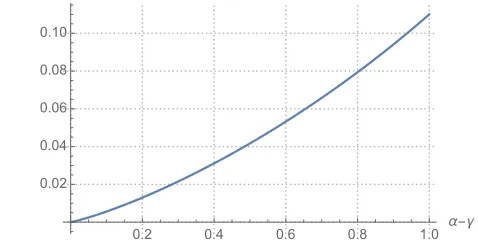
0.2 0.4 0.6 0.8 1.0 α-γ
0.05 0.10 0.15 0.20 0.25
Maximum Error Rate Supported
Fig. 1. Acceptable levels of noise as a function ofα−γfor the oblivious transfer protocol
0.2 0.4 0.6 0.8 1.0 α-γ
0.02 0.04 0.06 0.08 0.10
Maximum Error Rate Supported
Fig. 2. Acceptable levels of noise as a function of α−γ for the non-interactive commitment protocol
VI. DISCUSSION
In this section we briefly discuss the protocols we obtained in terms of their robustness against noise.
For the case of oblivious transfer, our best protocol works for levels of noise such thath(2δ)< α−γ.Puttingα= 1and
γ= 0.5 (that means, a public string that is perfectly random and the bound on the memory equal to half the length of the publicly available string), we have that oblivious transfer is possible if δ < 0.055. Figure 1 presents the maximum supported values of noise forα−γ ranging from0 to1.
Our non-interactive commitment protocol works forh(δ)<
(α−γ)/2. For α = 1 and γ = 0.5 we have that non-interactive commitments are possible in the noisy memory bounded model ifδ <0.041. Figure 2 presents the maximum supported values of noise forα−γ ranging from0 to1.
Finally, interactive commitments are possible ifh(δ)< α−
γ. For the same settings (α = 1 and γ = 0.5), this gives us a maximum noise rate of δ <0.11. Figure 3 presents the maximum supported values of noise for α−γ ranging from 0 to1.
VII. CONCLUSION