First Steps Toward a Cryptography-Aware
Language and Compiler
M. Barbosa1
, R. Noad2
, D. Page2
and N.P. Smart2 1 Departamento de Informtica,
Universidade do Minho, Campus de Gualtar,
4710-057 Braga, Portugal. [email protected]
2 Department of Computer Science, University of Bristol, Merchant Venturers Building,
Woodland Road, Bristol, BS8 1UB,
United Kingdom.
{noad, page, nigel}@cs.bris.ac.uk
Abstract. When developing secure, high-performance cryptographic soft-ware, the programmer is presented with a wide range of problems. Not only must they be conversant with pertinent scientific results, they must efficiently translate said results into a practical context. Unlike when writing normal programs, they are given little help from either the lan-guage or compiler: both are typically too general purpose to offer domain specific optimisation or analysis that would save the programmer time and reduce the potential for error. As a step toward solving this problem we present CAO, a cryptography-aware domain-specific language and as-sociated compiler system. Rather than being a panacea, we pitch CAO as a mechanism for transferring and automating the expert knowledge of cryptographers into a form which is accessible to anyone writing security conscious software.
1
Introduction
1.1 The Problem
the program into a high-quality result while allowing the program specification to exist in a form which is natural to the programmer.
However, consider the situation where one writes a program containing types the compiler knows nothing about. For example, when writing cryptographic software it is common to use finite field types which are implemented in a library, typically as a class or set of functions that encapsulate the data and operations involved. Although from a programming perspective the class or functions allow a programmer to easily manipulate finite fields, the compiler still knows nothing about them or their operational semantics. Even if we allow operator overloading to allow easy expression of the program, an example code sequence such as:
gfp a, b, c, d;
a = a + a; b = a * 2; c = a * a;
d = power( a, 2 );
suffers from a number of problems. The variables are not automatically allocated registers, or temporaries if they are non-native; we need to manually allocate them in order to minimise the space they occupy. Standard strength reduc-tion techniques cannot be applied; we must manually translate multiplicareduc-tion by small constants into an appropriate addition chain. Common sub-expression elimination cannot be performed; we must manually detect and share inter-mediate results which further complicates the minimisation use of temporary variables. The prescribed use of functions to represent operations not native to the language means analysis and transformation is harder for the compiler; it knows nothing about the meaning of the function and inter-function analysis is typically much harder then intra-function analysis.
In short, all the optimisations you would expect if the type of variables were native to the compiler are unavailable when the types are not native. The pro-gram is essentially written in a pseudo-high-level language: there are structured control flow statements but operations are otherwise at the level one would ex-pect in a low-level language. This situation presents a clear problem for the programmer in that they are again burdened with a lot of hard work. Addition-ally, optimising the program partly obfuscates the it since the result no longer describes the original algorithm, but the form required for efficient implementa-tion.
exploits them, by which time it is too late. Secondly, an attack on security will deliberately search for and pick on an operation that the programmer has not considered, rather than the bug being triggered through normal patterns of use. In this sense, they are harder to detect since they require second guessing the ability and focus of an attacker who will search every avenue to achieve their unknown goal, rather than a user who interacts with the program to achieve a pre-determined task. Finally, the problems differ in that a single security problem is catastrophic, since an attacker need only target the weakest link in the security chain to achieve their goal, while functionality problems are generally less severe: even if an error is terminal, it is possible the program will function correctly aside from the operation that cause the error.
To address the problem of solving security problems, it is obviously attrac-tive to offer a programmer automatic assistance in the same vein as the use of compiler systems to help solve functional problems by issuing error and warn-ing messages. Such a mechanical approach is less error prone and offers a more satisfactory, although clearly not perfect, level of quality assurance. This sort of approach is becoming an increasingly common method for dealing with the threat of buffer overflow attacks. Resigning themselves to the fact that human programmers will inevitable produce vulnerable programs, researchers have de-veloped systems that use compile-time [32, 39, 62] and run-time [10, 25] methods to detect and prevent attack. Investigation into many other security vulnabilities has followed, with work to detect problems through programming er-rors [8]; combined static and dynamic analysis to prevent format, race and buffer overflows [17–20]; and even for intrusion detection systems [61]. Although it is difficult to quantify how successful these methods are in the field, it is clearly advantageous to use mechanical tools to assist the programmer in addressing security vulnerabilities within a large corpus of source code.
Despite the fact that automatically providing security proofs for crypto-graphic software is some way off, the formal analysis of programs has at least started to address one area that has been overlooked elsewhere: security against side-channel attack [3, 60]. Formally proposed by Kocher et al., side-channel anal-ysis is the art of externally monitoring a device while it executes some algorithm that includes secret information. By careful profiling of time [36], power [37] or electromagnetic emissions [4, 5] and correlation of said profiles with the target algorithm, an attacker can often uncover the secret information. Although sound defence techniques have been well investigated in recent years they are typically implemented in an ad-hoc manner under sole control of the programmer: there is no way to provide assistance in diagnosing areas of the software that need protection or to actually implement said protection. Since attack and defence techniques are becoming increasingly well understood, it seems important to transfer this knowledge into automated tools that can make the programmers job easier and catch subtle but potentially catastrophic errors.
A Maintenance Perspective Given that the programmer of cryptographic software must manually optimise the performance and validate the security his programs, the final problem they encounter is one of maintenance. Even from a naive viewpoint, the problem is obvious: making even small changes might de-mand labour intensive re-optimisation and re-validation of the previously sound program. This is further complicated by the fact that in order to cope with a diverse range of targets, several synchronised versions of the same program may need to be maintained either in different source files or via some form of con-ditional compilation. For example, if the cost of addition versus multiplication is different on one machine than another, it might make sense to replace mul-tiplication by small constants with an addition chain on one machine but not the other. Furthermore, consider the case where one machine has some security enhanced architectural support, such as an execute-only-memory (XOM) [44, 43] or a split stack to prevent buffer overflow [48], but another does not. The threat model against the software will differ and demand different analysis of each program version.
1.2 Toward a Solution
To address the dual goals of being able to write programs that can be anal-ysed for security problems and compiled into a high-performance executable, we present CAO, a domain specific language (DSL) for describing cryptographic software, and an associated compiler system. The CAO language allows practi-cal description of cryptographipracti-cally interesting programs which can be analysed by the compiler that instruments a number of security conscious analysis, trans-formation and optimisation phases. The central principle behind the design of CAO is the promotion of notions central to the description of such programs to first class features in the language which are then supported by the compiler.
Unlike languages such as Magma [46] or Maple [47] which allow the de-scription of high-level mathematical constructions, we restrict our focus to the implementation of cryptography kernels such as block ciphers; hash functions; and sequences of finite field arithmetic used to implement systems such as elliptic curve cryptography (ECC). By constructing compiler tool-chains that perform analysis and instrument defence techniques on such kernels, we hope to derive similar benefits to those experienced by programmers switching from low-level assembly languages to higher-level programming languages. That is, by express-ing their programs in a more natural manner, a programmer will improve their productivity, reduce their rate of error and generally produce software of a higher quality.
We stress that CAO is not intended as a panacea or silver-bullet. It would be exceptionally hard to build an automated tool to discover new attack or defence techniques, neither is it realistic to assume that we can generate code which will always outperform a hand-written, highly optimised assembly language al-ternative. Equally, it is hard to imagine someone totally trusting the compiler output. In the same way as bugs in normal software occur, bugs in compil-ers can cause them to operate incorrectly: because of this, security conscious programmers might typically perform some final, manual validation checks and optimisation before CAO generated code is shipped. We also stress the differ-ence between secure software and compilers that address security problems, and cryptographic software. The two inhabit entirely different domains, are suscep-tible to very different classes of attack, and demand vastly different means with which to describe programs within those domains. In this respect, we view CAO as complementary to rather than competitive with languages like Fortress [6].
Fig. 1.A CAO.
elements added to the language and somewhat agnostic towards security so that the language is more generally useful.
1.3 History
The acronym CAO was originally used to describe the idea of taking C and merging it with the good bits of occam to give C And Occam. This seemed like a nice, easy to pronounce name so it stuck; also since we were interested in finite fields, the cow-field relation seemed amusing. However, like most modern languages CAO borrows things from many other sources as well: parts of it are pseudo-functional; parts of it are pseudo-HDL; some parts are even totally novel. When it was adopted to investigate issues of security the acronym CHAOS, standing for C, Haskell And Occam for Security, was suggested. This name was taken by some other project and it also hinted at the chaotic nature of the language design and compiler implementation so was rejected.
1.4 System Overview
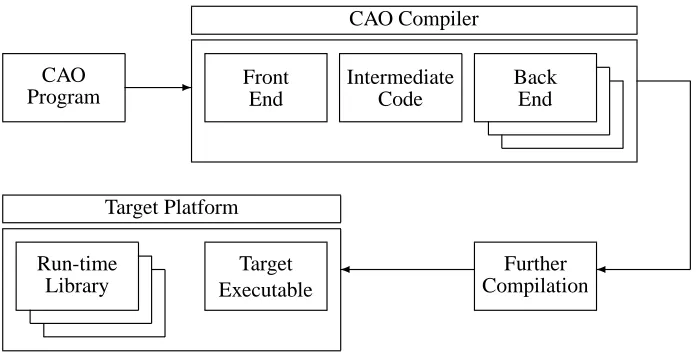
The general design of the CAO compiler is such that it translates between the CAO language and some target language which is either executed directly by the target platform or compiled further. In both cases, the executable is supported by a run-time library which manages operations on non-native types such as finite fields. The tool-chain is shown in Figure 2.
Fig. 2.A block diagram illustrating the CAO tool-chain.
CAO Program
Front End
Intermediate Code
Back End CAO Compiler
Further Compilation Target
Executable Run-time
Library
Target Platform
the user. For example, from a CAO program we might generate several target programs in C which can be linked to NTL [58], LiDIA [30] or nuMONGO [9] depending on the preference of the user. From this point of view, cryptographic libraries can be selected purely on their performance, memory footprint and feature sets rather than on how easy they are to use.
This architecture is also advantageous in the sense that by decoupling the various stages of the CAO compiler from each other, it is entirely possible to have a proprietory back-end for some commercially sensitive processor yet still benefit from the analysis and transformation phases in the front-end.
1.5 Document Overview
Listing 1.1.A CAO implementation of the double-and-add algorithm. 1 pmul ( Px : f , Py : f , d : int : { s e c r e t } ) : f , f
2 {
3 Qx : f ; 4 Qy : f ; 5 i : int ; 6
7 Qx : = 0 ; 8 Qy : = 0 ; 9
10 for ( i := s i z e o f ( d ) - 1; i >= 0; i := i - 1 ) 11 {
12 ( Qx , Qy ) : = pdbl ( Qx , Qy ); 13
14 if ( d [ i ] = = 1 )
15 {
16 ( Qx , Qy ) : = padd ( Qx , Qy , Px , Py );
17 }
18 } 19
20 r e t u r n Qx , Qy ; 21 }
Listing 1.2. A CAO implementation of point addition assuming global curve parametersA andB.
1 padd ( x1 : f , y1 : f ,
2 x2 : f , y2 : f ) : f , f : { o b s e r v a b l e := A , s a m e a s := pdbl } 3 {
4 l : f ; 5 x3 : f ; 6 y3 : f ; 7
8 l : = ( y2 - y1 ) / ( x2 - x1 ); 9 x3 := l **2 - x1 - x2 ;
10 y3 : = ( x1 - x3 ) * l - y1 ; 11
Algorithm 1: The double-and-add method for scalar point multiplication. Input: pointP, integerd
Output: pointQ=d·P Q← O
1
fori=|d]−1downto0do 2
Q←2·Q
3
if di= 1then 4
Q←Q+P
5
end 6
end 7
returnQ
8
Algorithm 2: An algorithm for point addition.
Input: curve parametersAandB, pointsP = (x1, y1) andQ= (x2, y2) with
P6=Q
Output: pointR= (x3, y3) =P+Q
λ←y2−y1
x2−x1
1
x3←λ2−x1−x2 2
y3←(x1−x3)λ−y1 3
returnx3, y3 4
2
Code Analysis
Our current implementation of the CAO compiler is typical of a research compiler in that we have concentrated on the elements which are interesting to us and hence neglected many others. Although the system is far from being ready for use in earnest, we already have a number of interesting security conscious analysis phases in development which act as an example of what is possible. Thus far, we have concentrated on public key systems, in particular ECC [12, 13]. Although this avoids issues relating to primitives such as block ciphers, we stress that this is for the purposes of exposition only: the CAO language includes several features which permit their efficient description, we simply have not focused on implementing these features yet.
Restricting ourselves to working over the field K = Fp, where pis a large
prime, our elliptic curve is defined by:
E(K) :y2=x3+Ax+B
Algorithm 3: An algorithm for point doubling. Input: curve parametersAandB, pointP= (x1, y1) Output: pointR= (x3, y3) = 2·P
λ←3x 2 1+A 2y1 1
x3←λ2−2x1 2
y3←(x1−x3)λ−y1 3
returnx3, y3 4
Listing 1.3. A CAO implementation of point doubling assuming global curve parametersA andB.
1 pdbl ( x1 : f , y1 : f ) : f , f : { o b s e r v a b l e := D , s a m e a s := padd } 2 {
3 l : f ; 4 x3 : f ; 5 y3 : f ; 6
7 l : = ( 3 * ( x1 * * 2 ) + A ) / ( 2 * y1 ); 8 x3 := l * * 2 - ( 2 * x1 );
9 y3 : = ( x1 - x3 ) * l - y1 ; 10
11 r e t u r n x3 , y3 ; 12 }
multiplication. The most basic of these is the binary or double-and-add method, described by Algorithm 1 and in CAO by Listing 1.1, which we use to illustrate our analysis phases. Note that we use affine points and slightly simplify the addition and doubling algorithms to ease discussion. Specifically, in a complete implementation we should check and resolve conditions such as performing an addition whereP =Qor where eitherP =Oor Q=O.
We begin by assuming we have defined and subsequently initialised a field type and associated curve parameters:
typedef f := gf[ 2**192 - 2**64 - 1 ];
A : f; B : f;
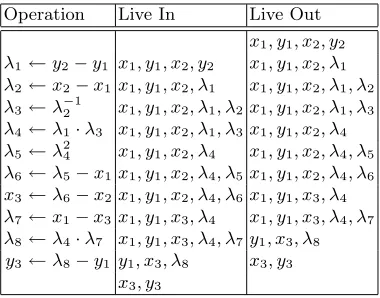
Table 1.A table describing liveness properties of temporary variables while computing an affine point addition.
Operation Live In Live Out
x1, y1, x2, y2
λ1 ←y2−y1 x1, y1, x2, y2 x1, y1, x2, λ1
λ2 ←x2−x1 x1, y1, x2, λ1 x1, y1, x2, λ1, λ2
λ3 ←λ−21 x1, y1, x2, λ1, λ2 x1, y1, x2, λ1, λ3
λ4 ←λ1·λ3 x1, y1, x2, λ1, λ3 x1, y1, x2, λ4
λ5 ←λ24 x1, y1, x2, λ4 x1, y1, x2, λ4, λ5
λ6 ←λ5−x1x1, y1, x2, λ4, λ5 x1, y1, x2, λ4, λ6
x3 ←λ6−x2x1, y1, x2, λ4, λ6 x1, y1, x3, λ4
λ7 ←x1−x3 x1, y1, x3, λ4 x1, y1, x3, λ4, λ7
λ8 ←λ4·λ7 x1, y1, x3, λ4, λ7 y1, x3, λ8
y3 ←λ8−y1 y1, x3, λ8 x3, y3
x3, y3
ECC however, this ability is not utilised. Note that usually one would defined a point structure and utilise instances of this structure rather than separate co-ordinates; although possible, we deliberately avoid this so as to minimise the amount of new syntax introduced.
2.1 A Performance Perspective
Register Allocation One of the most tedious parts of implementing sequences of operations on types not supported by the compiler is finding an allocation of temporary variables which is efficient, i.e. uses the least amount of memory. For example, when implementing Algorithm 2 we start with a list of field operations that use an unbounded number of temporaries, say λ1. . . λn, and are required
to fit them into the memory available on the target platform.
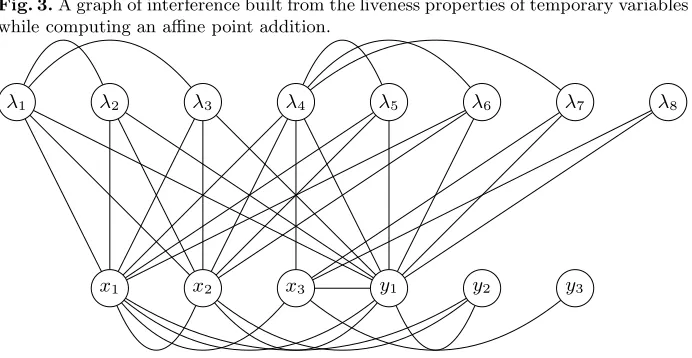
Register allocation of native types is often achieved by performing liveness analysis of the temporaries involved; constructing an interference graph which describes overlapping liveness ranges; and performing graph colouring on where the colours are register names [50, Chapter 16]. This process is illustrated by Table 1 and Figure 3 which show the calculation of liveness and interference between intermediate variables in Algorithm 2. From this, we can see that aside from the parameter and return values which are implicitly assigned their own space, we need only two temporary registers in order to compute the algorithm correctly.
Fig. 3.A graph of interference built from the liveness properties of temporary variables while computing an affine point addition.
x1 x2 x3 y1 y2 y3
λ1 λ2 λ3 λ4 λ5 λ6 λ7 λ8
Strength Reduction In a typical implementation of Algorithm 3, multiplica-tion of field elements by small constants is typically unrolled into an efficient addition chain since addition is far less costly than multiplication. In the ter-minology of compilers this is a type of strength reduction [50, Chapter 12]. For example the computation from Line 2 which computes 2x1 can be replaced by x1+x1since we know that addition is less expensive than multiplication. Clearly we apply the same technique to exponentiation.
From a purists perspective, performing this optimisation manually obfuscates the program; early optimisation like this is a poor choice since it limits both understanding of the algorithm and portability of the program which implements it. In the example above, we have made an assumption about the cost ratio between addition and multiplication and hard coded it into our implementation. If this assumption is false for some platform, we must re-evaluate the implications of our optimisation and maybe replace it with something more appropriate. Within CAO however, this potential disadvantage is eliminated since we describe a program in the most natural form and rely on automated optimisation. More precisely, since the back end of the compiler has intimate knowledge of the target architecture, or can perform experiments to find out this information, it can evaluate the least costly option and implement it automatically.
register allocator to minimise the amount of space used. For example, one might use and extend the method of Parker and Plater [54] so that a trade-off between short addition chains and low memory use is reached. Still further work might recognise and utilise multi-exponentiation as a means of reducing cost.
Common Sub-expression Elimination Intermediate results which are com-mon between different parts of the computation and can potentially be shared without re-computation should there be enough registers to accommodate them. There is no good example of this in either Algorithm 2 or Algorithm 3. However, in general if we have an operation such asx1+x1 twice in the program and the value ofx1is not altered between the two, we can compute the value just once and share the result. Clearly such an operation is a trade-off between the spaced used to store the intermediate value and the time required to recompute it.
In compiler terminology such an optimisation is termed common sub-expression elimination [50, Chapter 13] and is easily realised for types known to the com-piler.
2.2 A Security Perspective
The double-and-add algorithm described above is vulnerable to SPA-based side-channel attack where the attacker monitors the power usage of the host device while executing the point multiplication by d. Since one is composed from a different sequence of field operations than the other, the power profiles of point addition and doubling will be distinguishable. Denoting addition byAand dou-bling byD, a monitoring phase presents the attacker with a trace detailing the operations performed during execution of the algorithm. For example, by mon-itoring the execution of Algorithm 1 using the multiplier d= 10012 = 910, we get the trace:
DADDDA
Given this trace, the attacker can recover the value ofdsimply by spotting where the point additions occur: if an addition occurs then di= 1, otherwisedi = 0.
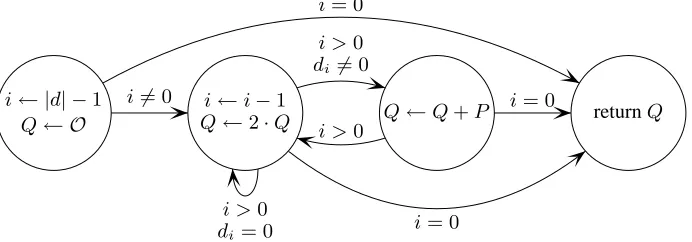
Simple Indistinguishability Tests The crux of the problem described above is that an observable operation is conditionally executed based on information that should remain secret. In the case of the double-and-add algorithm, this conditional statement is glaringly obvious and so spotting the vulnerability is simple once the programmer is aware of the issues. However, in more complex systems consisting of composite algorithms and where the secrecy of data is not as obvious, spotting such conditionals is much harder.
Fig. 4.The control flow graph of the double-and-add algorithm.
i← |d| −1
Q← O
i←i−1
Q←2·Q Q←Q+P returnQ
i6= 0
i= 0
i >0
di= 0
i >0
di 6= 0
i= 0
i >0
i= 0
an attacker. Using this extra information, the CAO compiler issues the following warning message when the program is compiled:
warning [pmul.cao:14:7-16] : branch based on secret condition if( d[i] == 1 )
^
This is essentially telling us that the branch condition has been marked as secret and hence if the executed content is observable, may be leaked.
As suggested by Coron [16], one way to avoid this problem is to employ a double-and-add-always method whereby a dummy addition is executed if the real one is not. Although this significantly reduces the performance, it acts to mask when the real addition occurs and hence leaks no information about the multiplier bit being used. More generally, if we can balance both sides of the branch in terms of observable operations, it will leak no information even if the condition is secret. An area of further work is to improve our simple indistin-guishability test to cater for this possibility. Currently we simply spot where branches based on secret information are used. If we can tell where the two sides of a branch are balanced, such a test will more accurately predict actual security problems. We leave this as an area for future work.
This can be extended to more general operations whose execution is somehow dependent on secret information. For example, some attacks against use the fact on certain processors, bitwise shift and rotate operations take different amounts of time to complete depending on the shift distance. If the distance is secret, this can leak information to the attacker; in CAO we can detect and warn against this problem at compile-time.
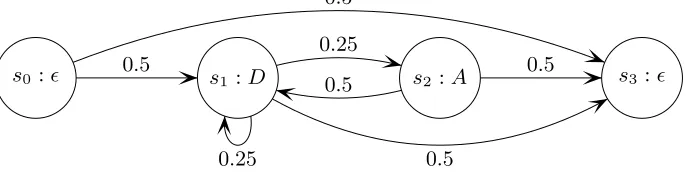
Fig. 5.A HHM description of the double-and-add algorithm. Nodes are marked with a node name si and an observable event, denotes no observable. Edges are marked with transition probabilities.
s0 : s1 :D s2 :A s3 :
0.5
0.5
0.25
0.25
0.5 0.5
0.5
research has shown that by modeling such algorithms as Hidden Markov Models (HMM), one can take the randomised side-channel information and reconstruct the original trace hence defeating the countermeasure. Oswald [52], Karlof and Wanger [34] and then Green, Noad and Smart [28] have all shown that this method is very effective in attacking systems that otherwise seem secure.
Once the HMM for a given algorithm has been constructed, the analysis is automatic: one feeds the algorithm and a number of captured randomised side-channel traces to the system and it recovers the genuine trace. Since at some point the algorithms are written as program code, it seems obvious to attempt a further step in terms of automation by constructing the HMM from the program code. In fact, this is fairly easily achieved since the HMM is essentially a distilled version of the program control flow graph with probabilities attached to the branches. The calculation of these probabilities is eased by the fact that randomisation is a first class concept in CAO but otherwise can be achieved using similar analysis phases as branch prediction would be in a conventional compiler. The observable events that occur are derived from attributes placed by the programmer: notice that the point addition and doubling implementations in Listing 1.2 and Listing 1.3 are both marked with the observableattribute to specify that they should be viewed as observable by an attacker.
in the compiler to execute the model and produce traces or execute the actual HMM itself.
Automatic Construction of Indistinguishable Operations Considering the double-and-add method for point multiplication as described above, one method of defending against the basic SPA attack is to construct the point addition and doubling formula so that they are indistinguishable from each other. This is generally achieved by splitting the more expensive point addition into two parts, each of which is identical in terms of the operations it performs to a point doubling. Put more simply, instead of recovering an operation trace such as:
DADDDA
from the SPA analysis, an attacker gets:
DDDDDDDD
from which they can get no useful information. This methodology has been successfully constructed in several vanilla ECC implementations [59, 26]. It is this basic form of analysis that we consider; we simply reorganise the formulae so they are indistinguishable rather than performing more complex manipulation of the formulae or curve representation [42, 33]. The problem with the approach is that reorganising the formulae to make them indistinguishable while minimising any overhead is still non-trivial. This is especially true when the arithmetic sequences are more complex than in ECC, as is the case in systems like XTR, or HECC. We aim to utilise standard compiler techniques to automate this process and hence to some extent automatically produce SPA resistant implementations. Put a little more formally, our starting point is a set of N functions Fi,
with 0 ≤ i ≤ N −1. Each function is a list of instructions from a finite and usually small instruction set L. For concreteness one can think of the simplest case of two functions F1 andF2 performing ECC point addition and doubling. Basic instructions will then be additions, multiplications, squarings and other operations over elements of the base field.
Let|Fi|denote the size of function Fi, andFi[j]∈Ldenote instructionj of
function Fi, with 0≤j≤ |Fi| −1. We aim to manipulate the original functions
into new versionsF0
i such that the execution trace of all of them is some multiple
of the execution trace of a pattern P. That is, runningF0
i is indistinguishable
from runningP a given number of times, or more exactly that:
|F0
i| = 0 (mod |P|) 0≤i≤N−1
F0
i[j] =P[j (mod|P|)] 0≤i≤N−1,0≤j≤ |Fi0| −1
Algorithm 4: An algorithm for Diffie-Hellman key exchange. Input: Public moduluspand primitive rootgmodulop. Output: Both players compute the shared keyk.
Agenta Agentb
x←− {0R . . . p−1} y←− {0R . . . p−1} 2
gx(modp)
−→ 3
gy (modp)
←− 4
k= (gy)x (modp) =gxy k= (gx)y (modp) =gxy 5
1
instructions within each function. We represent these dependencies as directed graphs.
The goal is to findP and matchingF0
i whose cost overhead compared to the
original programs is minimised. This problem is similar in concept to that inves-tigated by Chevallier-Mames et al. [15] who look at reordering processor level instructions to achieve a similar goal. Intuition on the hardness of this prob-lem comes from noticing similarities with well-known NP-complete optimisation problems such as the Minimum Bin Packing, Longest Common Subsequence and Nearest Codeword problems [21]. Our approach to solving this problem uses an adaptation of a generic optimisation algorithm called Threshold Accepting [24]. We do not aim to find the optimal solution, but to find a good enough approxi-mation of it that can be used in practical applications.
Notice that the the point addition and doubling implementations in List-ing 1.2 and ListList-ing 1.3 are both marked with the sameas attribute to specify that they should be paired and made indistinguishable by the compiler. Using this approach we have been able to produce results equivalent to the small hand-made solution presented by Gebotys and Gebotys in [26] for elliptic curve point addition and doubling; to construct indistinguishable squaring and multiplica-tion over a degree six extension of a finite field as used in several torus based constructions [27, 23]; and to produce indistinguishable versions of point addition and doubling over hyper-elliptic curves of genus 2 based on the explicit formulae presented by Lange in [38]. We are currently preparing a paper describing in detail our approach to generating indistinguishable operations and the results we have obtained.
Listing 1.4.A CAO implementation of Diffie-Hellman key exchange. 1 a ( ba : i n p u t chan of int ,
2 ab : o u t p u t chan of int ) : void 3 {
4 y : f ;
5 x : f : { s e c r e t }; 6 t : f ;
7 k : f : { s e c r e t }; 8
9 x := ? ; / / c o m p u t e r a n d o m x 10 t := g ** x ; / / c o m p u t e t = g ^ x 11
12 ab := t ; / / send t to b 13 y := ba ; / / read g ^ y from b 14
15 k := y ** x ; / / c o m p u t e key k 16 }
17
18 b ( ab : i n p u t chan of int ,
19 ba : o u t p u t chan of int ) : void 20 {
21 x : f ;
22 y : f : { s e c r e t }; 23 t : f ;
24 k : f : { s e c r e t }; 25
26 y := ? ; / / c o m p u t e r a n d o m y 27 t := g ** y ; / / c o m p u t e y = g ^ y 28
29 x := ab ; / / read g ^ x from a 30 ba := t ; / / send t to a 31
32 k := x ** y ; / / c o m p u t e key k 33 }
34
35 inst ( ) : void 36 {
37 ab : chan of int : 38 ba : chan of int : 39
40 par 41 {
42 a ( ab , ba ); 43 b ( ba , ab ); 44 }
Algorithm 4 and Listing 1.4 describe the basic Diffie-Hellman key exchange protocol [22] whereby two agentsaandbagree a shared keyk. The basic model for parallelism in CAO is derived from occam and hence from CSP; the imple-mentation is composed from a number of parallel processes and channels which allow them to communicate. From the implementation in CAO, we can clearly produce an executable form by mapping the processes onto the different process-ing devices involved in the protocol. However, we can also apply a fairly natural translation of the program into a CSP [55, 45] or Spi Calculus [1, 2] model that can then be verified by model checking systems. Further, we could replace our run-time support library with something similar to that of Backes et al. [11] so that automated proofs are possible by fitting into their model.
Ideally, we would want to embed the model checking software within the com-piler so that the programmer is offered a single-shot solution. That is, they need not worry about multiple phases of security analysis, the analysis is managed automatically by the compiler which either issues error messages or produces a secure executable. This transformation or analysis is not currently implemented in the compiler; we leave it as an area for future work.
3
Code Generation
Listing 1.5 shows the compiled output of the CAO source code in Listing 1.1 for ECC point multiplication while Listing 1.6 and Listing 1.7 show the compiled addition and doubling functions, all ready for linking against NTL and a driver program to form an executable. Remember that by this stage we have already warned the programmer that the source code is vulnerable the SPA attack; we present the original distinguishable versions of the addition and doubling functions for clarity, in reality we might also have transformed them to address the issued warning.
Listing 1.5.Compiled ECC point multiply. 1 void pmul ( ZZ_p & _ _ i d e n t _ a n o n 0 ,
2 ZZ_p & _ _ i d e n t _ a n o n 1 , 3 ZZ_p & Px ,
4 ZZ_p & Py ,
5 ZZ & d )
6 {
7 ZZ_p _ _ t 5 3 ; 8 ZZ_p _ _ t 5 2 ; 9 int _ _ t 4 0 ; 10 ZZ_p _ _ t 5 0 ; 11 ZZ_p _ _ t 5 1 ; 12 char _ _ t 2 0 ; 13 _ _ t 5 3 = 0 ; 14 _ _ t 5 2 = 0 ;
15 _ _ t 4 0 = N u m B i t s ( d ); 16 _ _ t 4 0 = _ _ t 4 0 - 1; 17 _ _ l a b e l 1 4 1 :
18 if ( _ _ t 4 0 < 0 )
19 goto _ _ i d e n t _ b r e a k ;
20 pdbl ( __t50 , __t51 , __t53 , _ _ t 5 2 ); 21 _ _ t 5 3 = _ _ t 5 0 ;
22 _ _ t 5 2 = _ _ t 5 1 ;
23 _ _ t 2 0 = bit ( d , _ _ t 4 0 ); 24 if ( _ _ t 2 0 ! = 1 )
25 goto _ _ l a b e l 1 4 4 ;
26 padd ( __t50 , __t51 , __t53 , __t52 , Px , Py ); 27 _ _ t 5 3 = _ _ t 5 0 ;
28 _ _ t 5 2 = _ _ t 5 1 ; 29 _ _ l a b e l 1 4 4 :
30 _ _ t 4 0 = _ _ t 4 0 - 1; 31 goto _ _ l a b e l 1 4 1 ; 32 _ _ i d e n t _ b r e a k :
Listing 1.6.Compiled ECC point addition. 1 void padd ( ZZ_p & _ _ i d e n t _ a n o n 0 ,
2 ZZ_p & _ _ i d e n t _ a n o n 1 , 3 ZZ_p & x1 ,
4 ZZ_p & y1 , 5 ZZ_p & x2 , 6 ZZ_p & y2 ) 7 {
8 ZZ_p _ _ t 5 0 ; 9 ZZ_p _ _ t 5 1 ;
10 sub ( __t50 , y2 , y1 ); 11 sub ( __t51 , x2 , x1 ); 12 inv ( __t51 , _ _ t 5 1 );
13 mul ( __t51 , __t50 , _ _ t 5 1 ); 14 sqr ( __t50 , _ _ t 5 1 );
15 sub ( __t50 , __t50 , x1 );
16 sub ( _ _ i d e n t _ a n o n 0 , __t50 , x2 ); 17 sub ( __t50 , x1 , _ _ i d e n t _ a n o n 0 ); 18 mul ( __t50 , __t50 , _ _ t 5 1 ); 19 sub ( _ _ i d e n t _ a n o n 1 , __t50 , y1 ); 20 }
Listing 1.7.Compiled ECC point doubling. 1 void pdbl ( ZZ_p & _ _ i d e n t _ a n o n 0 ,
2 ZZ_p & _ _ i d e n t _ a n o n 1 , 3 ZZ_p & x1 ,
4 ZZ_p & y1 ) 5 {
6 ZZ_p _ _ t 5 0 ; 7 ZZ_p _ _ t 5 1 ; 8 ZZ_p _ _ t 5 2 ;
9 sqr ( __t50 , x1 );
10 add ( __t51 , __t50 , _ _ t 5 0 ); 11 add ( __t50 , __t51 , _ _ t 5 0 ); 12 add ( __t50 , __t50 , A ); 13 add ( __t51 , y1 , y1 ); 14 inv ( __t52 , _ _ t 5 1 );
15 mul ( __t52 , __t50 , _ _ t 5 2 ); 16 sqr ( __t50 , _ _ t 5 2 );
17 add ( __t51 , x1 , x1 );
code for performing function call copy-back is marginal compared to the cost of a finite field multiply so this perceived lack of code quality is not actually important. However, the situation with other program types is far different. Ultimately, we would like to compile other cryptographic kernels such as the block ciphers DES and AES. In these cases, we can no longer rely on the cost of library operations to overshadow our inefficiencies since all the operations are more basic, operate on native types and hence do not use the run-time library. Addressing this issue is our next immediate goal in terms of code generation with the aim being high performance or small sized block cipher implementations from the same natural, high-level description in CAO.
4
Conclusions
Writing secure software is becoming an increasingly difficult task and yet with the rise of pervasive, networked computing, it is increasingly more important to get right. In the face of this difficulty, researchers have started to investigate and implement compiler based techniques for detecting and resolving issues such as buffer overflow vulnerabilities. Such techniques are attractive since automated program analysis and transformation can be applied to a large corpus of source code and provide a high level of quality assurance.
However, despite these advances in technology that helps to manage the com-plexity faced by programmers, until now there have been few aids for developers of cryptographic software. Since it represents a very distinct domain, this is un-fortunate given the fact that demands on performance and security are perhaps even more important than in the general setting. To this end we have introduced CAO, a language and compiler that we claim is cryptography-aware and offers a step toward solution of these problems.
References
1. M. Abadi and A.D. Gordon. A Calculus for Cryptographic Protocols: The Spi Calculus. In 4th ACM Conference on Computer and Communications Security, ACM Press, 36–47, 1997.
2. M. Abadi and A.D. Gordon. Reasoning about Cryptographic Protocols in the Spi Calculus. InConcurrency Theory (CONCUR), Springer-Verlag LNCS 1243, 59–73, 1997.
3. J. Agat. Transforming out Timing Leaks. InPrinciples of Programming Languages (POPL), 2000.
4. D. Agrawal, B. Archambeault, J.R. Rao and P. Rohatgi. The EM Side-Channel(s). InCryptographic Hardware and Embedded Systems (CHES), Springer-Verlag LNCS 2523, 29–45, 2002.
5. D. Agrawal, J.R. Rao and P. Rohatgi. Multi-channel Attacks. InCryptographic Hardware and Embedded Systems (CHES), Springer-Verlag LNCS 2779, 2–16, 2003.
7. C.S. Ananian. Reconfigurable Cryptography A Hardware Compiler for Crypto-graphic Applications. Technical Report, Massachusetts Institute of Technology (MIT), 1997.
8. K. Ashcraft and D. Engler. Using Programmer-Written Compiler Extensions to Catch Security Holes. InIEEE Symposium on Security and Privacy, 2002. 9. R.M. Avanzi. Aspects of Hyperelliptic Curves over Large Prime Fields in Software
Implementations. In Cryptographic Hardware and Embedded Systems (CHES), Springer-Verlag LNCS 3156, 148–162, 2004.
10. A. Baratloo, N. Singh and T. Tsai. Transparent Run-Time Defence Against Stack Smashing Attacks. InUSENIX Annual Technical Conference, 2000.
11. M. Backes, B. Pfitzmann and M. Waidner. A Composable Cryptographic Library with Nested Operations. InComputer and Communications Security (CCS), 2003. 12. I.F. Blake, G. Seroussi and N.P. Smart, Elliptic Curves in Cryptography,
Cam-bridge University Press, 1999.
13. I.F. Blake, G. Seroussi and N.P. Smart,Advances in Elliptic Curve Cryptography, Cambridge University Press, 2005.
14. M. Boreale. Symbolic Analysis of Cryptographic Protocols in the Spi Calculus. In
Automata, Languages and Programming (ICALP), Springer-Verlag LNCS 2076, 667–681, 2001.
15. B. Chevallier-Mames, M. Ciet and M. Joye. Low-Cost Solutions for Preventing Simple Side-Channel Analysis: Side-Channel Atomicity. InIEEE Transactions on Computers,53(6), 760–768, 2004.
16. J-S. Coron. Resistance against Differential Power Analysis for Elliptic Curve Cryp-tosystems. InCryptographic Hardware and Embedded Systems (CHES), Springer-Verlag LNCS 1717, 292–302, 1999.
17. C. Cowan, M. Barringer, S. Beattie, and G. Kroah-Hartman, M. Frantzen, and J. Lokier. FormatGuard: Automatic Protection From printf Format String Vulnera-bilities. InUSENIX Security Symposium, 2001.
18. C. Cowan, S. Beattie, J. Johansen and P. Wangle PointGuard: Protecting Pointers From Buffer Overflow Vulnerabilities. InUSENIX Security Symposium, 2003. 19. C. Cowan, S. Beattie, C. Wright, and G. Kroah-Hartman. RaceGuard: Kernel
Protection From Temporary File Race Vulnerabilities. InUSENIX Security Sym-posium, 2001.
20. C. Cowan, C. Pu, D. Maier, H. Hinton, J. Walpole, P. Bakke, S. Beattie, A. Grier, P. Wagle and Q. Zhang. StackGuard: Automatic Adaptive Detection and Prevention of Buffer-Overflow Attacks. InUSENIX Security Symposium, 1998.
21. P. Crescenzi and V. Kann. A Compendium of NP Optimization Problems. Avail-able at:http://www.nada.kth.se/$\sim$viggo/problemlist/compendium.html, 2005.
22. W. Diffie and M.E. Hellman. New Directions in Cryptography. InIEEE Transac-tions on Information Theory,22, 644–654, 1976.
23. M. van Dijk, R. Granger, D. Page, K. Rubin, A. Silverberg, M. Stam and D. Woodruff. Practical Cryptography in High Dimensional Tori. InCryptology ePrint Archive, Report 2004/352, 2004.
24. G. Dueck and T. Scheuer. Threshold Accepting: A General Purpose Optimization Algorithm Appearing Superior to Simulated Annealing. InJournal of Computa-tional Physics,90(1), 161–175, 1990.
26. C.H. Gebotys and R.J. Gebotys. Secure Elliptic Curve Implementations: An Anal-ysis of Resistance to Power-Attacks in a DSP Processor. InCryptographic Hardware and Embedded Systems (CHES), Springer-Verlag LNCS 2523, 114–128, 2002. 27. R. Granger, D. Page and M. Stam. A Comparison of CEILIDH and XTR. In
Algorithmic Number Theory Symposium (ANTS), Springer-Verlag LNCS 3076, 235–249, 2004.
28. P.J. Green, R. Noad and N.P. Smart. Further Hidden Markov Model Cryptanalysis. Submitted.
29. J.D. Guttman, J.C. Herzog, J.D. Ramsdell and B.T. Sniffen. Programming Cryp-tographic Protocols. Technical Report 0836, MITRE Corporation, 2004.
30. S. Hamdy. LiDIA: A Library for Computational Number Theory. Available from: http://www.informatik.tu-darmstadt.de/TI/LiDIA/
31. N. Heintze and J.G. Riecke. The SLam Calculus: Programming with Secrecy and Integrity. InPrinciples of Programming Languages (POPL), 1998.
32. R.W.M. Jones and P.H.J. Kelly. Backwards-compatible Bounds Checking for Ar-rays and Pointers in C Programs. InWorkshop on Automated Debugging, 13–16, Linkoping University Electronic Press, 1997.
33. M. Joye and J-J. Quisquater. Hessian Elliptic Curves and Side-Channel Attacks. In
Cryptographic Hardware and Embedded Systems (CHES), Springer-Verlag LNCS 2162, 402–410, 2001.
34. C. Karlof and D. Wagner. Hidden Markov Model Cryptanalysis. InCryptographic Hardware and Embedded Systems (CHES), Springer-Verlag LNCS 2779, 17–34, 2003.
35. D. Knuth. The Art of Computer Programming, Volume 2: Seminumerical Algo-rithms. Addison Wesley, 1999.
36. P.C. Kocher. Timing Attacks on Implementations of Diffie-Hellman, RSA, DSS, and Other Systems. InAdvances in Cryptology (CRYPTO), Springer-Verlag LNCS 1109, 104–113, 1996.
37. P.C. Kocher, J. Jaffe and B. Jun. Differential Power Analysis. In Advances in Cryptology (CRYPTO), Springer-Verlag LNCS 2139, 388–397, 1999.
38. T. Lange. Efficient Arithmetic on Genus 2 Hyperelliptic Curves over Finite Fields via Explicit Formulae. InCryptology ePrint Archive, Report 2002/121, 2002. 39. D. Larochelle and D. Evans. Statically Detecting Likely Buffer Overflow
Vulnera-bilities. InUSENIX Security Symposium, USENIX Press, 2001.
40. R.B. Lee, R.L. Rivest, M.J.B. Robshaw, Z.J. Shi and Y.L. Yin. Permutation Operations in Block Ciphers To appear in Embedded Cryptographic Hardware: Design and Security.
41. R.B. Lee, R.L. Rivest, M.J.B. Robshaw, Z.J. Shi and Y.L. Yin. On Permutation Operations in Cipher Design In International Conference on Information Tech-nology (ITCC), 569–577, 2004.
42. P-Y. Liardet and N.P. Smart. Preventing SPA/DPA in ECC Systems Using the Ja-cobi Form. InCryptographic Hardware and Embedded Systems (CHES), Springer-Verlag LNCS 2162, 391–401, 2001.
43. D. Lie. Architectural Support For Copy And Tamper-Resistant Software PhD Thesis, Stanford University, 2003.
44. D. Lie, C. Thekkath, M. Mitchell, P. Lincoln, D. Boneh, J. Mitchell and M. Horowitz. Architectural Support for Copy and Tamper Resistant Software. In
Architectural Support for Programming Languages and Operating Systems (ASP-LOS), 168–177, 2000.
46. Magma Computational Algebra System. Computational Algebra Group, Univer-sity of Sydney. Available from:http://magma.maths.usyd.edu.au/magma/ 47. Maple. Waterloo Maple Inc. Available from:http://www.maplesoft.com/ 48. J.P. McGregor, D.K. Karig, Z. Shi, and R.B. Lee. A Processor Architecture
De-fense against Buffer Overflow Attacks. InInternational Conference on Information Technology: Research and Education (ITRE), 243–250, 2003.
49. J.P. McGregor and R.B. Lee. Architectural Techniques for Accelerating Subword Permutations with Repetitions. InIEEE Transactions on Very Large Scale Inte-gration Systems,11(3), 325–335, 2003.
50. S.S. Muchnick. Advanced Compiler Design and Implementation, Morgan Kauf-mann, 1997.
51. A.C. Myers. Mostly-Static Decentralized Information Flow Control. PhD Thesis, Massachusetts Institute of Technology, 1999.
52. E. Oswald. Enhancing Simple Power-Analysis Attacks on Elliptic Curve Cryptosys-tems. InCryptographic Hardware and Embedded Systems (CHES), Springer-Verlag LNCS 2779, 82–97, 2002.
53. E. Oswald and Manfred Aigner. Randomized Addition-Subtraction Chains as a Countermeasure Against Power Attacks. InCryptographic Hardware and Embedded Systems (CHES), Springer-Verlag LNCS 2162, 39–50, 2001.
54. R. Parker and A. Plater. Addition Chains with a Bounded Number of Registers. InInformation Processing Letters,90(5), 247–252, 2004.
55. P. Ryan, S. Schneider, M. Goldsmith, G. Lowe and B. Roscoe. The Modeling and Analysis of Security Protocols. Addison-Wesley, 2000.
56. A. Sabelfeld and A.C. Myers. Language-Based Information-Flow Security. InIEEE Journal on Selected Areas in Communications,21(1), 2003.
57. Z. Shi and R.B. Lee. Bit Permutation Instructions for Accelerating Software Cryp-tography. In International Conference on Application-specific Systems, Architec-tures and Processors (ASAP), 138–148. 2000.
58. V. Shoup. NTL: A Library for doing Number Theory. Available from: http: //www.shoup.net/ntl/
59. E. Trichina and A. Bellezza. Implementation of Elliptic Curve Cryptography with Built-In Countermeasures against Side Channel Attacks. InCryptographic Hard-ware and Embedded Systems (CHES), Springer-Verlag LNCS 2523, 98–113, 2002. 60. D. Volpano and G. Smith. Eliminating Covert Flows with Minimum Typings. In
IEEE Computer Security Foundations Workshop (CSFW), 1997.
61. D. Wagner and D. Dean. Intrusion Detection via Static Analysis. InIEEE Sym-posium on Security and Privacy, 2001.
62. D. Wagner, J.S. Foster, E.A. Brewer and A. Aiken. A First Step Towards Auto-mated Detection of Buffer Overrun Vulnerabilities. InNetworking and Distributed System Security Symposium, 2000.
63. X. Yang and R.B. Lee. Fast Subword Permutation Instructions Using Omega and Flip Network Stages. InInternational Conference on Computer Design (ICCD), 15–22, 2000.
Appendix A: Language Reference
1
Comments
Annotation of code with a natural language description of functional and de-sign issues is an important part of programming. Addingcommentsto the code ensures that subtle meaning is made obvious and that readers can more easily understand design and functional decisions made by the programmer. Comments are to aid human readability only: they are discarded by the compiler and have no impact on the function or performance of the program.
CAO adopts the same syntactic method of commenting as Java and C++ . That is, one can specify block comments using:
/* comment */
whereby everything between the /*and*/markers is deemed a comment. Al-ternatively, single line comments are made easier by using the form:
// comment
which means that everything between the //marker and the end of the line is a comment.
2
Types, Constants and Symbols
Any useful CAO program will use variables and constants to represent basic data items that are being operated on. The programmer describes these objects in a way that enables the compiler to know their name and type. The type of a variable or constant is exactly that: the variety of object or, more formally, the set of values the object can take and how operations are defined on it. These notions are somewhat awkward to explain but will certainly be familiar to those who have programmed in another language such as C .
Types in CAO comprise of two main varieties:scalaror primitivetypes that describe the most basic objects in a program, andderived or constructedtypes that build more complex types from basic ones.
2.1 Scalar Types
There are several basic types in CAO :
– Thevoidtype is something of a place-holder since it represents an unknown or empty type. It doesn’t normally make sense to define variables withvoid type, but is commonly use to show that a function doesn’t return a value or take arguments.
– The boolean orbooltype, i.e. the type of object that take the values true or false, is first-class in CAO . One might view this as a specialisation of the integer type which can only take two values.
Unlike the type system in other languages where the size of a type is largely pre-determined, we allow user-defined type sizes. For example, in C one might use:
short x; int y;
to declare a 16-bit integerxand a 32-bit integery. The problem with this method, in C at least, is that on some architectures the types may be represented by a different size than on others: an inton a PIC micro-controller for example is likely to be smaller than 32-bits if the hardware can not manage native 32-bit arithmetic. CAO allows the programmer to specify the required size of such types using:
x : int[16]; y : int[32];
to declare the same 16-bit and 32-bit integer variablesxandy. This might be a little confusing for C programmers who would expect this syntax to declare an array whereas in fact we are defining the size of the basic type. In some sense it still is an array: an array of bits, the syntax being partly drawn from hardware description languages like Verilog and VHDL. Note that specifying the size of some basic types does not make sense. Specifically, one can not meaningfully change the size ofvoidorbooltypes.
There are several advantages to allowing this ability to explicitly define the size of basic types. Firstly, it allows us to be more clear about what types mean rather than simply trusting that the target architecture supports our intuition. The additional semantic information such sizes give us has the further benefits of allowing more accurate type checking and the potential for aggressive optimi-sations not possible otherwise. Secondly, the facility to have odd sizes allows us to more easily specify programs that can efficiently be compiled to both software and hardware platforms. For example, when compiling to hardware it is clearly possible to create actual 5-bit values that could save valuable silicon space com-pared with defaulting to 8-bit values. Finally, it allows us to eliminate problems of portability since there is no longer any ambiguity about what a type means, a 32-bit integer type isalwaysa 32-bit integer type.
2.2 Symbols and Scope
In the previous section, without much explanation, we introduced the syntax for variable declaration. As mentioned previously, variables represent the objects within a program that are manipulated in order to produce the required result. Before they are used in any operation, variables must be declared so that the compiler knows about their properties and hence how such operations work. Such declarations provide the name, or identifier, and type of the variable.
Variable definitions are performed within ascope and their definition is only valid within this scope. Sometimes this concept is called thevisibilityof a variable and this describes the concept fairly well: the scope of a variable is simply the part of the program where the variable can be read from or written to. For example, consider two functions fandg:
f() : void {
x : int; y : int;
... }
g() : void {
x : int; y : int;
... }
The definitions of xand y in each function are distinct – they define different variables whose scope is limited to the function each definition is within. Equally, one can use compound statements as a scope:
f() : void {
x : int; y : int;
for( x := 0; x < 10; x := x + 1 ) {
y : int;
y := x + 1; }
In this case, the definition of ywithin theforloop is valid since it is within a different scope to the first and hence causes no conflict. If it were within the same scope, the compiler would be unable to know which variable a given reference was referring to. Here, the assignment to ywithin theforloop refers to the y defined in that scope.
2.3 Attributes
C compilers have long allowed programmers to pass options to and control the compiler using thepragmadirective. Although compiler-specific behavior is usu-ally an unattractive feature, allowing the programmer to bypass the language and specify richer semantic information can be useful. To this end, CAO permits use ofattributesdirective which are used to mark types, symbols and constants with domain-specific information. This information is attached to the item in question and carried with it through the compiler transformations. The rational behind this mechanism is simple: we want the compiler to do analysis of security related programs and so knowing which variables represent, for example, secret keys is vital. In a conventional program, this information is only really known by the programmer – the compiler can not easily infer it automatically.
Since attributes are invisible to all analysis phases aside from those that look for them, one can easily construct inter-operable phases that work together to enhance the basic, security-agnostic language. Attributes are attached to a symbol by using a third section in their declaration. As a concrete example, consider the follow code fragment:
key_public : int : { public }; key_secret : int : { secret }; modulus : int : { public };
rsa_enc( x : int ) : int : { encrypt } {
return ( x ** key_public ) % modulus; }
rsa_dec( x : int ) : int : { decrypt } {
return ( x ** key_secret ) % modulus; }
their provable security properties: the compiler might be able to provethat the implementation matches the semantics dictated by such properties.
Note that this system is basically similar to that of Myers [51] as implemented in Jif, however we currently adopt a more ad-hoc approach without the formal semantics of his labeling mechanism. The semantics of attribute inheritance are that when an operation acts on a number of operands to produce a result, the attributes of the result are unioned with the attributes of the operands. That is, when we write:
f() : void {
a : int : { public }; b : int : { public }; c : int : { secret };
a := b + c; }
the attributes ofaend up being the set{ public, secret }sincebis{ public } and cis{ secret }. It is then left up to individual analysis phases to resolve any ambiguities this could present.
2.4 Type Synonyms
CAO allows the programmer to define new names for types in the same way as the typedef construct in C . The purpose of such type synonyms is two-fold. Firstly, it reduces the amount of work required by the programmer in terms of actual typing effort, which may be considerable when large compound types are constructed. The second and perhaps most important purpose is to make programs more clear and easier to read. For example it is far more instructive to see the type namedes_keythanunsigned int[64].
The mechanism for using type synonyms in CAO is somewhat cleaner than in C . To implement the example above, one would use the following statement: typedef des_key := unsigned int[64];
This upgrade of typedef from part of the actual type declaration in C to a first-class statement in CAO , makes the definition much clearer and means that the parser can be more simply designed and implemented. In addition, note that since a type synonym is an actual statement, it might generate code in the target program to, for example, initialise or register the type within the run-time library.
Using thistypedefmechanism, CAO automatically defines several type syn-onyms that are simply convenient names for often used basic types:
– Thebytetype is used to represent a byte or group of eight bits. It is therefore a synonym for using the typeint[8] : { unsigned }.
2.5 Derived Types
The basic types are augmented with a number of derived types that represent ordered collections of contained values. The first of these are the vector and matrixtypes that represent vector and matrix objects as one might see them in mathematics. These container types are used as one might expect, employing a similar syntax as basic types to denote size. For example, to declare ten by ten element matrixxand a twenty element vectory, both containing integer values, the following statements could be used:
x : matrix[10][10] of int; y : vector[20] of int;
The vector type is like an array in C , although since there are no pointers in CAO it can be viewed as a more first-class notion. The matrix type isnotlike a two-dimensional array in C since it is representation neutral. That is, there is no specification as regards row or column-wise ordering in memory, the compiler is free to decide which is most appropriate.
CAO also allows compound types called structures. Structures are just like the concept of a struct in C – they are a collection of objects of potentially different basic type which are referenced by name. Due to their syntactic size, a structure type is generally defined using a typedef. The following fragment declares a structureswith three integer members namedx,yandz:
typedef point := struct{ x : int; y : int; z : int; };
This type can then being use to define a variablev whose contents is accessed using the member selection operator:
p : point;
p.x := 0; p.y := 1; p.z := 0;
2.6 Mathematical Types
Finite fields are used extensively in cryptography and in the same way as CAO allows arbitrary precision integers as first-class types, we introduce afieldtype. The addition of the field as a native type derives similar benefit as having ar-bitrary sized integers: the compiler is able to perform optimisations that would not be possible without this knowledge.
is the one area we expect to change in a backward incompatible way: we are in the process of revising the language, see Section 6 for more details.
CAO currently restricts fields to being of the formFpe where pis the
char-acteristicof the field and e is the extension degree. Using this format, one can construct elements in simple binary and ternary extension fields, as used in ECC for example, as follows:
x : gf[2 ** 8]; y : gf[3 ** 9];
In this case, x is an element in the field F28 while y is in F39. However, one can also create more basic field types, such asgf[7], by omitting the extension degree. For large primes, it is common to use a typedefto create a new field type:
typedef f := gf[ 0xE69B959FA53FD3DE3818860FBDDD726F ];
Finally, we allow an empty field definitions: x : gf[];
At first glance, this seems pointless. However, the rational behind this construct is that often we work with a field whose size is not known until run-time. For example, maybe we generate or load a prime number, perhaps an RSA key, and work with that as a modulus: the value is not known until run-time but we know enough to compile the program. Since we are dealing with describing cryptographic kernels within some larger application, we rely on this application to initialise the field for us prior to invoking any CAO generated functions.
2.7 Constants
One problem of having such a diverse type system is that we need to be able to define constant values for each type. The integer and boolean types are no problem and follow C and C++ withtrueandfalsebeing first-class keywords to define boolean constants. CAO allows the specification of integer constants in decimal, hexadecimal and binary notation. For example, all three of the following assignments are equivalent and set the value of an integerxto the value ten: x : int;
x := 10; // decimal x := 0xA; // hexadecimal x := 0b1010; // binary
Note that since the normal inttype represents arbitrary sized integer values, constants can also be much larger than in a language like C .
since their specification is defendant on the representation. CAO currently takes the approach of defining field elements as abstract polynomials such as in this definition of the elemente:
typedef f := gf[2 ** 8]; e : f := $ ** 2 + $ + 1;
Note the use of a special symbol $ to denote the indeterminate of all poly-nomials to avoid ambiguities with actual symbols in the program. As such, in mathematical parlance we have thate∈F28 and in fact that e=x2+x+ 1.
Related to this is the potential need to allow the programmer to specify an irreducible polynomial to define a field. It is attractive to abstract this away and let the compiler select one from a list or generate a suitable one at compiler or run-time. However, there might be occasions when the programmer needs to specify one, to comply with a predetermined specification for example. The definition of such field polynomials is performed with an extension to the type definition as follows:
typedef f := gf[2 ** 8] over $ ** 8 + $ ** 4 + $ ** 3 + $ + 1; e : f := $ ** 2 + $ + 1;
In this case, we have thate∈F28 defined with the irreducible polynomialx8+ x4
+x3
+x+ 1.
2.8 Type Elasticity
The type of some expressions, constants or symbols in a CAO program will not be determined by the object themselves but by the context they are used in. Consider the following example:
a : int;
b : matrix[4][4] of int;
a := 0; b := 0;
The first assignment sets the integera to the integer value 0 while the second sets the matrix bto the zero matrix. However, in both cases the constant 0 is used with no idea of what type it is associated with. This demands the concept of type elasticity: the ability for an expression, constant or symbol to have a different type in different contexts. As far as possible, the rules that determine which type an object of elastic type eventually has are based mainly on what one would intuitively expect.
2.9 Type Qualifiers
definition. Note that one might view the type sizing mechanism as a form of qualifier since it adds information to a basic type. A more relevant example is where one wants to specify that an integer type is unsigned rather than signed so that arithmetic using variables of that type is performed correctly.
Type qualifiers come in two varieties that we termstorage modifiersandtype modifiers. A storage modifier tells the compiler where and how variable of a given type should be stored and how they are treated when linking the program. As such, they do not change the behavior of the type but do alter how it interacts with other elements of the program:
– A variable defined with a type containing anexternqualifier has its storage allocated in some other part of the program. That is, the variable is only defined so the symbol is in scope rather than to allocate space for it.
– A static type means that the defined variable is only visible within the current file.
In contrast, type modifiers change the functional properties of the type so that they mean something different when used in a given operation:
– When one needs to declare that a variable is immutable, theconstqualifier can be attached to the type. This signals to the compiler that, aside from initialisation, the variable will never change value.
– Thesignedqualifier specifies that a type is able to deal with both positive and negative values. Note that applying this qualifier is not meaningful to all types, for example a finite field type can not be signed, and that the signed-ness may impact on the size of the resulting type.
– Anunsignedqualifier has the opposite effect of asigned qualifier, forcing the type only allow positive values. It has similar constraints in terms of use as thesignedqualifier.
3
Expressions
Generally the arithmetic, bitwise and boolean operators in CAO follow those in other languages quite closely. This is not a coincidence: one of the main motivations for selecting much of the syntax has been compatibility with C so as to ease uptake.
However, there are a range of operations that are first-class in CAO but normally implemented as libraries within most other languages. By elevating these features to first-class language entities we enable analyses and transforma-tions within the CAO compiler that would be impossible to guarantee in other languages.
3.1 Extent
Precedence Operator Meaning Associativity
0 .. range left to right
1 () function call left to right 1 [] element select left to right 1 . member select left to right
2 ! boolean not right to left
2 ~ bitwise not right to left
2 ++ increment right to left
2 -- decrement right to left
2 + unary plus right to left
2 - unary minus right to left
2 sizeof size right to left 2 (type) cast right to left
3 * multiply left to right
3 / division left to right
3 % modular reduction left to right 3 ** exponentiation left to right 3 @ concatenation left to right
4 + addition left to right
4 - subtraction left to right
5 << left shift left to right 5 <| left rotate left to right 5 >> right shift left to right 5 |> right rotate left to right
6 == equals left to right
6 != not equals left to right
7 & bitwise and left to right
8 ^ bitwise xor left to right
9 | bitwise or left to right
10 && boolean and left to right 11 ^^ boolean xor left to right 12 || boolean or left to right 13 := assignment right to left
is, since assignment is aware of all types in a program, it implements the copy efficiently for the programmer. Even though this is the main use of thesizeof operator in C , it is still useful for the programmer to inspect the physical extent of variables and types in a given program. To this end, CAO retains thesizeof operator but with different semantics to C : the new operator returns the number of elements in the operand type. Hence, in the following code fragment:
x := sizeof( int[13] ); y := sizeof( int[16] );
the variablesxandyare set to 13 and 16 respectively rather than 2 which would be the number of bytes required to hold them. One might view this as thesizeof operator returning theextentof a type rather than the physical size of it.
3.2 Selection and Concatenation
In languages such as C and Java , thearray subscriptoperator is used to select a given element from an array. Ifais an array, we use the syntaxa[i]to select the elementifroma. CAO allows this operation to be applied in more contexts than array subscripting; we term the more powerful operationelement selection. If a is a vector, the element selector works as with C style arrays. If ais an integer type however, the element selector produces bit iof that value. Essentially, we can select elements from any type so long as the subscript is within range.
The element selector is also a bit more clever that the C array subscript in a couple of other ways. Firstly, we can select ranges of values so for example if we require that the variable bcontain the lowest four bits ofa we can use the rangeoperator:
b := a[3 .. 0];
This sort of operation can also be performed using theconcatenation operator which allows selected elements to be joined into composite values. We might write the same bit selection statement as:
b := a[3] @ a[2] @ a[1] @ a[0];
where the concatenation operator acts to join the parts into a whole. Note that the element selector and concatenation operators can also appear as lvalues so that:
b[3 .. 0] := 15;
assigns the value 15 to only the lowest four bits ofbleaving the rest of the value intact and
assigns the value of 1 to the lower two bits ofa, since this represents the top two bits of 6, while the lower two bits ofbare set to the value 2.
Although veering into the world of functional programming a little, the con-catenation and element selector allow natural specification of bit-related oper-ations that are commonly used in cryptography. From this richer than normal specification, the compiler can formulate the best way to implement the under-lying operation. Indeed, the fact that we can apply the element selector in such a general setting means many other operations such as mappings, shifts and rotations can be represented in a canonical form using these ideas.
3.3 Mapping
A map is a table that describes the translation of elements in a source value into a target value. The goal is to enable the compiler with enough information that permutations, such as those in DES, can be efficiently implemented from natural descriptions.
Consider a code fragment that reverse the elements in a small vectoraand stores the result in an vectorb:
b[0] := a[3]; b[1] := a[2]; b[2] := a[1]; b[3] := a[0];
We can describe this translation using a map m: m : map := { 0 to 3,
1 to 2, 2 to 1, 3 to 0 };
and apply the map to a using the map operator, which appears just like a function call – essentially the map is a function defined with a different syntax, so as to replicate our original code fragment:
b := m( a );
3.4 Rotation
Another side-effect of the element selector is that rotation is much easier to describe than in languages like C . In C , one might rotate a 32-bit integer right by four bits using the statement:
a = ( a >> 4 ) | ( a << 28 );
Although this might be the best way to implement the rotation at a machine level, it is difficult for the compiler to recognise this as a rotation and use that fact in further optimisations. To combat this, we can use element selection and concatenation to do the same job in a more descriptive way:
a := a[3 .. 0] @ a[31 .. 4];
However, even this is far from ideal since it demands the programmer knows and correctly interprets the size ofato select and place bits from the correct location. To make things easier for the programmer, CAO offers a rotation operator that looks similar to the shift operator:
a := a |> 4;
3.5 Randomisation
Random values are a native concept in CAO and can be guaranteed backing from a cryptographically strong random number generator. To assign a random value to a variable, we use almost the same syntax as with a normal assignment but replace the rvalue with therandomsymbol:
a := ?;
Conceptually, ? is a variable whose value is randomly sampled each time it is accessed, rather than an operator or function that generates the random value. As a result,?can be used anywhere in an expression a normal symbol can and the type is elastic: it matches the type expected by the context it is used in. In the example above, the type and size of ?matches the type and size ofaso that if ais a 32-bit unsigned integer,?will be a random integer in the range 0 through 232
−1.
Since?can be thought of as a random variable, we can also use it in more complex expressions:
a := ? * b;
and even perform random coin-flip style decisions: if( ? )
{ ... } else {