PORTER, RACHEL ELLIOTT. Understanding Common Core Implementation: How Educators Intuit, Interpret, and Begin to Integrate Curriculum Reform. (Under the direction of Dr. Bonnie C. Fusarelli.)
The purpose of this comparative case study was to explore the ways educators at the school-level experience a federally directed curriculum policy change and examine the contextual factors that impacted the way it was initially implemented. Application of an organizational learning (OL) lens was incorporated to help illuminate the ways educators made sense of and began to implement the new Common Core State Standards.
This study investigated the experiences and perspectives of teachers in two North Carolina elementary schools, as they initially implemented the new standards. Qualitative data was gathered through teacher surveys, faculty focus groups and interviews with each school principal and the two district Race to the Top coordinators.
Analysis of the collected data uncovered common themes between the experiences at each school, as well as varied contextual factors that impacted implementation. Themes included interpretation of the policy, the role of professional collaboration, professional and personal impacts, time and pacing, and alignment to other initiatives. Comparison to
organizational learning frameworks revealed numerous links between teacher experiences and elements of OL theory that helped explain the dynamics at hand.
Interpret, and Begin to Integrate Curriculum Reform
by Rachel Porter
A dissertation submitted to the Graduate Faculty of North Carolina State University
in partial fulfillment of the requirements for the degree of
Doctor of Philosophy
Education Research and Policy Analysis
Raleigh, North Carolina 2013
APPROVED BY:
_______________________________ ________________________________ Dr. Bonnie C. Fusarelli Dr. Lance D. Fusarelli
Committee Chair
________________________________ ________________________________
Dr. Tuere Bowles Dr. Matthew Militello
DEDICATION
BIOGRAPHY
Rachel Elliott Porter was born in Virginia but schooled in North Carolina, attending eight different public schools from first to twelfth grade. By the end of high school, Rachel knew she wanted to teach and earned a NC Teaching Fellows scholarship to attend UNC Wilmington. After receiving a BA in Elementary Education, she moved back across the state to teach fourth grade in a small mountain community. Two years later, she returned to the middle of the state with her future husband and began teaching fifth grade for Durham Public Schools.
After four years of teaching elementary school, and a season spent working part-time as an environmental educator for the state parks system, Rachel was eager to explore other avenues in the field of education. Her work with the state parks system opened up the possibilities and challenges of working with adults, and ultimately led her to pursue work in school staff development. In 2004, she began working as an Instructional Specialist with the non-profit Centers for Quality Teaching and Learning (QTL), an organization dedicated to the belief that all students deserve high quality educators.
Though she long avowed having no interest in pursuing an advanced degree, the challenge of working with teachers and school administrators led Rachel back to school, pursuing a MEd in Curriculum and Instruction from NCSU in 2009. It was during this study that she was further convinced to begin work toward a doctoral degree in the area of
ACKNOWLEDGEMENTS
TABLE OF CONTENTS
LIST OF TABLES ... ix
LIST OF FIGURES ... x
CHAPTER 1 INTRODUCTION ... 1
Background ...2
Statement of the Problem ...3
Purpose of the Study ...6
Definition of Key Terms ...6
Significance of the Study ...8
Overview of Approach ...9
Chapter Summary and Organization of the Study ...10
CHAPTER 2 LITERATURE REVIEW ... 12
Introduction ...12
School Reform Policy ...13
The federal role in school reform. ... 14
Reform in the 21st century. ... 17
Curriculum reform policy. ... 19
School reform policy implementation ... 20
School reform as systems change. ... 22
Section summary ... 33
Organizational Learning ...34
Defining organizational learning. ... 34
Organizational Learning Models. ...35
Organizational Learning Applied to Schools ...42
Chapter Summary ...47
Site Selection and Participants ...51
Procedures ...54
First round interviews ... 56
Teacher surveys ... 57
Formation of focus groups ... 59
2nd round interviews and focus groups. ... 62
Document analysis. ... 62
Data Analysis ...64
Validity and Reliability ...66
Subjectivity Statement...69
Ethical Issues ...70
Limitations of the Study ...71
Chapter Summary ...72
CHAPTER 4 FINDINGS ... 74
Introduction ...74
Participants and Context ...77
Garrel County Public Schools ... 77
Scarboro County Public Schools ... 78
Selected Schools ...80
Presentation of Findings ...83
Chapter Summary ...136
CHAPTER 5 DISCUSSION AND CONCLUSIONS ... 137
Introduction ...137
The Problem ...137
Connections to Prior Research ...140
Connections to Recent Research ...143
Discussion of Findings ...146
Limitations ...155
Implications for Policy ...155
Implications for Practice ...158
Additional Considerations ...160
Suggestions for Further Research ...161
Conclusion ...162
REFERENCES ... 165
APPENDICES ... 184
APPENDIX A Summary of Literature ... 185
APPENDIX B Teacher Survey Protocol ... 197
APPENDIX C Principal Interview Protocols ... 199
APPENDIX D RttT Coordinator Interview Protocols ... 201
APPENDIX E Focus Group Protocols ... 203
APPENDIX F List of Documents Examined... 206
APPENDIX G Informed Consent Form for Research Principals ... 207
APPENDIX H Informed Consent Form for Research Teachers – Focus Group Members .. 209
APPENDIX I Informed Consent Form for Research Teachers – Survey Respondents ... 211
APPENDIX J Informed Consent Form for Research District Coordinators ... 213
APPENDIX K Letter to Principals Inviting School Participation ... 215
LIST OF TABLES
Table 3.1. Case study methods ... 55
Table 3.2. Teacher survey response rates ... 59
Table 3.3. Focus Groups ... 61
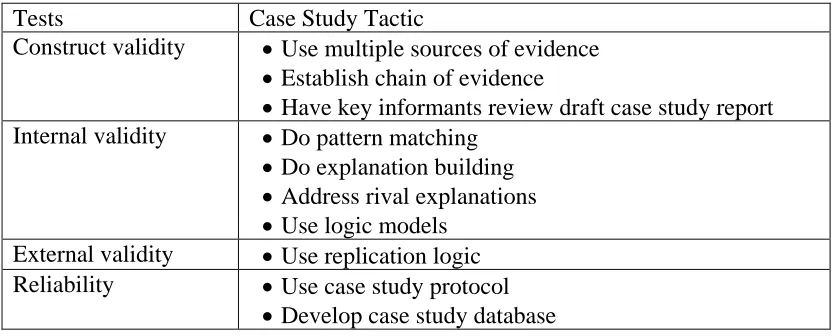
Table 3.4. Case study tactics for four design tests ... 68
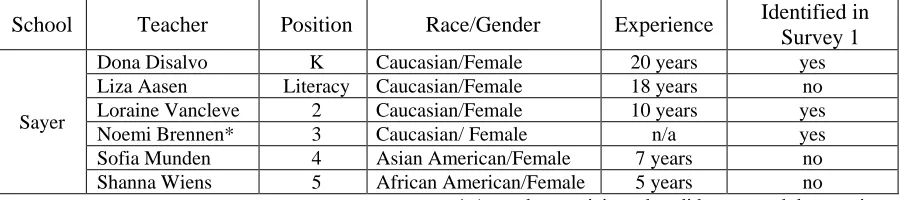
Table 4.1. Sayer focus group members ... 82
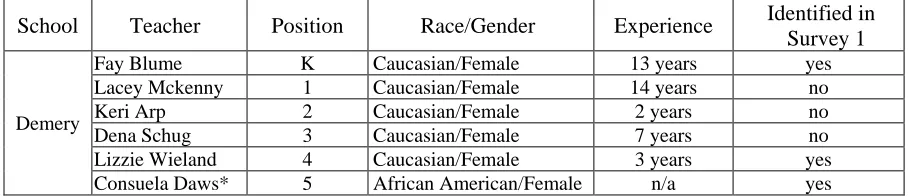
Table 4.2. Demery focus group members ... 83
Table 4.4. Survey themes indentified from surveys and explored by focus groups ... 89
Table 4.4. Implementation and comfort levels across the three faculty surveys ... 92
Table 4.5. Summary of findings in answer to research questions 1-3 ... 93
Table 4.6. Question 1 codes – Occurrence by data source ... 94
Table 4.7. Question 2 codes - Occurrence by data source ... 108
LIST OF FIGURES
Figure 1.1. Study overview ... 10
Figure 2.1. Literature review frame ... 12
Figure 2.2. Ecological process model of systems change ... 26
Figure 2.3. Single-loop and double-loop learning ... 36
Figure 2.4. Systemic inter-level change ... 37
Figure 2.5. The 4I Framework ... 40
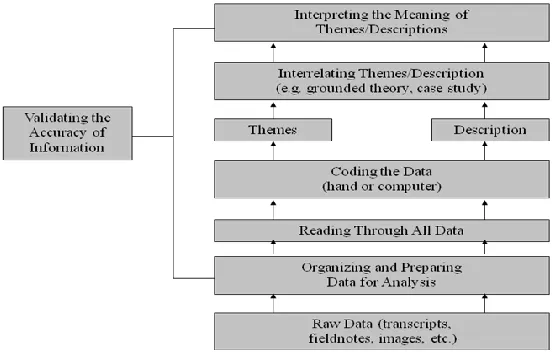
Figure 3.1. Creswell’s Data Analysis in Qualitative Research ... 66
Figure 4.1. Wordle analysis - Garrel survey 1 question 9: Challenging conditions ... 88
Figure 4.2. Wordle analysis - Potential advantages of Common Core ... 99
Figure 4.3. Wordle analysis – Sayer challenges ... 132
Figure 5.1. Funneling of Common Core State Standards policy ... 138
Introduction
In the United States, governance of public schools is the responsibility of each
individual state or territory. Given that education is not mentioned in the U.S. Constitution, it falls under the Tenth Amendment as a states’ right by default; "The powers not delegated to
the United States by the Constitution, nor prohibited by it to the States, are reserved to the States respectively, or to the people" (Tenth Amendment). Thus, for nearly two centuries, each state acted individually and independently to establish and maintain its own public schooling system. However, since its inception during the Carter administration, the federal cabinet-level Department of Education (DE) has served to “promote student achievement and preparation for global competitiveness by fostering educational excellence and ensuring equal access”(U.S. Department of Education [DE], 2010). In the second half of the twentieth
century, as federal funding for educational programs gradually increased, so did the role of the department. By 2008, DE programs served nearly 55 million Pre-K through 12th grade students (U.S. Department of Education [DE], 2010).
Over its 32 years in existence, federal DE policy has become an increasingly prominent factor in the daily operation of public schools. There is possibly no greater
evidence to this fact than the Obama administration’s Race to the Top program and its central
curriculum reform initiative, Common Core State Standards. Though not technically considered a “national curriculum,” the Common Core standards have to date been adopted
As with nearly all educational policy, implementation falls upon the educators at the school level. In the past, changes to curriculum policy in North Carolina have been funneled from state-level origin, through each school district’s administration, to building-level administrators, and then to teachers. The federally driven transition to Common Core
standards adds a significant new level to this dynamic. The purpose of this study is to explore the ways educators at the school-level experience such a dramatic policy change. An
organizational learning lens is utilized to examine the contextual factors that impact the way it is initially implemented.
Background
The Race to the Top grant initiative continues a chain of federal level education reforms stemming from the 1965 Elementary and Secondary Education Act (ESEA). Its most recent predecessor, the Bush administration’s 2001 No Child Left Behind (NCLB), ushered
in an era of accountability that tied federal funds to student outcomes as measured by Annual Yearly Progress (AYP) on state tests. No Child Left Behind ties Title 1 funds (the largest source of federal funds allocated to schools) to academic standards. The law requires:
step-by-step process for either turning those schools around or closing them. (Lohman, 2010, p. 2)
The Obama administration’s 2009 Race to the Top (RttT) initiative addresses many of
the same goals as No Child Left Behind, but in the form of a competitive grant process for American Recovery and Reinvestment Act (ARRA) funds. Whereas schools are required to adopt NCLB reforms in order to maintain base funding, they could now apply to receive the
additional funding offered through RttT. In such, the two programs work in tandem, with NCLB as a mandate and RttT as an option. However, schools that chose to apply for RttT agree to the requirements of the grant – one of which is adoption of new Common Core State Standards (CCSS). At the time of this writing, 45 states have applied for the grant – and, in doing, have agreed to adopt the new standards. It is worth noting that, as of 2013, only 21 of the original 46 applicant states had been awarded RttT funds. North Carolina is a RttT recipient and, as such, agreed to fully implement the Common Core State Standards starting in the 2012-2013 school year.
Statement of the Problem
Common Core State Standards are the first curriculum reform of their kind to emanate from the national level, be filtered through state and district levels and ultimately enacted by individual educators at each school. The shifts required to implement these new standards represent a significant learning need for educators at all levels of the system, especially for classroom teachers. School reform efforts, in general, are complex and the reasons behind their success or failure are not often clear. Research in the area of school reform shows, as will be discussed in the following chapter, that even the most widely supported efforts have historically yielded mixed outcomes.
Many of the elements included in North Carolina’s state and local RttT plans,
including standards reform, are not new concepts. Changes to assessments, curricula and standards had been part of the conversation in NC schools for many years. The most recent case in point being NC Department of Public Instruction’s Accountability and Curriculum Reform Effort (ACRE).
ACRE was launched in 2008 to redesign the K-12 curriculum around new Essential Standards based on the Revised Bloom’s Taxonomy. As state level designers became aware
of the burgeoning national effort to establish new standards for literacy and math, ACRE put Essential Standards for those two areas on hold and narrowed their focus to the remaining academics and arts – social studies, sciences, humanities, technical subjects and so on.
Common Core Standards and contributor to the NCDPI Race to the Top plan, described, “the confluence of timing was such that they chose to go ahead with the other standards” and attempted to “create coherence by folding Common Core into the plan they already had” (J.
Confrey, personal communication, December 17, 2012). This integration is officially referenced in the state Race to the Top plan: “NC will adopt the Common Core by July 31,
2010, and integrate them into our ongoing Accountability & Curriculum Reform Effort work, with its three-fold focus on improved standards, comprehensive assessment, and a next-generation state accountability model” (NC RttT Proposal, 2010, Section B1, p. 58).
Side by side, the NC Essential Standards and Common Core State Standards aim to achieve many of the same goals and their complementary nature would seem to make alignment a fairly straightforward process. However, the timelines for implementing both reforms were merged to require full implementation of all new standards within a single school-year. With this decision to roll out the K-12 Common Core State Standards for Math and English Language Arts, alongside brand new Essential Standards for all other K-12 subject levels, North Carolina embarked on a massive and unparalleled curriculum overhaul for the 2012-2013 school-year.
better understand these factors, and consequently improve the likelihood of successful implementation?
Purpose of the Study
The purpose of this study was to explore the ways educators at the school-level experience a federally directed curriculum policy change and examine the contextual factors that impact the way it was initially implemented. The following research questions framed the study:
1. How do schools respond to large-scale policy change?
2. How do teachers experience the shift to adopt Common Core State Standards? 3. How do contextual factors shape organizational learning in schools during the
initial implementation of a new policy?
Definition of Key Terms
The following terms are used throughout the study.
4I Framework – Developed by Crossan, Land and White (1999) as a structure for
understanding organizational learning as a feed-forward/feedback process in which individuals, teams and the organization as a whole function to intuit, interpret, integrate and institutionalize change.
Common Core State Standards (CCSS) – K-12 Math and English Language Arts (ELA) standards developed in 2010 by the National Governor’s Association
adopted by 46 states as part of the Race to the Top (RttT) grant application process.
No Child Left Behind (NCLB) – Bush administration reauthorization of the 1965
Elementary and Secondary Education Amendment. Mandates that schools must make changes and meet specific requirements in order to receive federal Title 1 funds.
Organizational Learning (OL) – “the deliberate use of individual, group, and
system learning to embed new thinking and practices that continuously renew and transform the organization in ways that support shared aims” (Collinson & Cook,
2007, p.8).
Race to the Top (RttT) – Obama administration initiative, enacted in 2009, as part
of the American Recovery and Reinvestment Act (ARRA). Offers federal funds to schools through a competitive grant requiring, among other things, that states adopt Common Core State Standards as part of the application process.
Systems Theory – a way of interpreting how parts and whole interact and with
and effect one another. Applied extensively to organizations as systems with “a whole consisting of two or more parts whose elements continually effect each other over time as they operate toward a common purpose” (Bierema, 2003, p.
Significance of the Study
Education reform policy is a complex issue, particularly in terms of school-level implementation. The contextual factors that impact implementation at the school level are numerous and their relationship to the success or failure of such policies is only partially understood by practitioners and policy-makers. Given that school reform efforts align with many of the themes of organizational learning (OL) theory, OL models can be beneficial tools for creating better understanding the ways educators make sense of such policies. However, the application of OL theory to public school contexts is fairly recent and not yet widely accepted, as will be further illustrated in chapter 2, and thus merits additional study.
The adoption of Common Core State Standards is the first curriculum reform effort of its kind. For North Carolina schools, the mandate to implement all new standards for every subject and for every grade level at the same time presents an unprecedented organizational learning challenge. Every educator, at all levels of the system, is affected by this shift to new standards and required to make significant changes to the ways they approach teaching and learning.
Overview of Approach
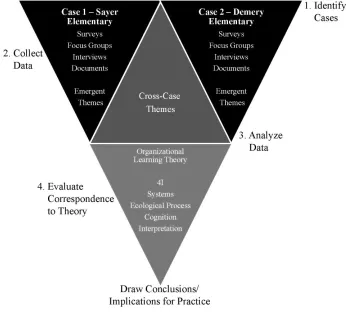
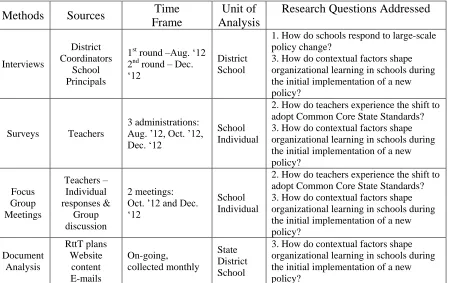
This comparative case study utilized a cross-case analysis of two North Carolina public elementary schools implementing Common Core State Standards. Data was collected during the first semester of the 2012-2013 school-year through surveys, focus groups, interviews, and document analysis. Interviews were conducted with the school principal and district Race to the Top coordinator for each of the two schools before the beginning of the school-year and again near the end of the first semester. Three online surveys (Appendix B), spread roughly six weeks apart, were given to all faculty members at both schools.
A focus group of five teachers was convened twice on each campus, once in early October and again in December. Semi-structured protocols were used for interviews [Appendices C, D] and focus group meetings [Appendix E]. Interviews and focus group meetings were recorded digitally and transcribed verbatim by the researcher. Related state, district and school documents were also collected throughout the period of the study. All collected data was compiled into a study database, and analyzed using constant and descriptive comparison to identify and confirm emergent themes.
The theoretical frame for this study is the treatment of school reform as an
organizational learning process. As such, data analysis incorporated organizational learning and systems theory to determine how emergent themes align or do not align to key
about organizational learning processes revealed by the data. The scope of the study, including data collection and analysis is presented in Figure 1.1.
Figure 1.1. Study overview
Chapter Summary and Organization of the Study
CHAPTER 2 Literature Review Introduction
The purpose of this study was to explore the ways educators at the school level experience a federally directed curriculum policy change and examine the contextual factors that impact the way it is initially implemented. Application of an organizational learning lens was intended to illuminate the complex dynamics that school leaders and policy makers must consider as they work to improve schools. This review of literature explores the related theory and research in the areas of school reform policy and organizational learning. Organization of the review is visualized in figure 2.1.
The first section reviews the literature on school reform policy in terms of federal policy implementation and the roles of educators at the school level. This section explores research on the implementation of recent school reform efforts such as No Child Left Behind and Comprehensive School Reform. It also includes research on curriculum reform which, until the advent of Common Core, has been primarily at the state level. Connections to literature on systems change as related to school reform, and an exploration of roles in school change processes are included to help delineate the complexities of such policies and their implementation.
The following section examines the literature on organizational learning as related to school change. It includes discussion of organizational learning models, including Crossan’s
4I framework, Argyris and Schön’s double-loop learning, ecological models, and a survey of existing research that applies similar frames to school change. Each section is organized to include a description of the central concept, a brief review of relevant applications and a synthesis of significant research and empirical studies.
School Reform Policy
For nearly as long as there have been schools, there have been movements to change or reform them. This long tradition emerged in the U.S. in the late 1800s with The
controversial 1983 report, A Nation at Risk. Presented as an “Open Letter to the American People,” A Nation at Risk was the culmination of research conducted by The National
Commission on Excellence in Education at the direction of then Secretary of Education T. H. Bell. Secretary Bell created the commission out of concern about "the widespread public perception that something is seriously remiss in our educational system" (National
Commission on Excellence in Education, 1983, p. 1). In the report, the commission laid out a compelling argument for dramatically reforming all levels of the public education system.
The federal role in school reform. Prior to the 1960s, the federal government’s role in public education was a small one, leaving improvement efforts primarily to the state and local levels. This shifted dramatically with the passing of the Elementary and Secondary Education Act (ESEA) in 1965, which established the Title 1 program, providing federal funds to disadvantaged student populations (Vinovskis, 2007). The conventional wisdom about school reform also shifted dramatically in the decades immediately following ESEA. In their 1985 review of the effective schools literature, Purkey and Smith argued that, while reports such as A Nation at Risk focused on what was wrong with schools, they also,
“focused public attention on schools and the need for change at precisely the time when over
a decade of research suggests means by which this change might be accomplished” (p. 352). Indeed, the burgeoning “effective schools” research highlighted determining factors such as
In the last two decades of the twentieth century, as reform efforts became the
predominant feature in the public education landscape, local, state and federal efforts became more tightly coupled, with the federal government playing an increasingly larger role. “The federal and state governments have become increasingly involved in education through mandates and the implementation of top-down command and control structures, such as higher standards, mandatory testing, and accountability all tied to a system of sanctions and rewards.” (Fusarelli & Fusarelli, 2003, p. 169). However, as Fusarelli and Fusarelli go on to point out, centralization does not equal coherence, and “even as the American system grows
more centralized, it remains fragmented by the very nature of a federal structure” (p. 174). At the federal level, updates to ESEA in the 1980s included the expansion of Title 1 to school-wide programs, and in the late 1990s generated the Comprehensive School Reform Demonstration Program (CSR or CSRD). CSR, launched in 1998, provided annual grants to high-poverty schools in order to help them, “develop and implement systematic approaches to school-wide improvement that are grounded in scientifically based research and effective practices” with the goal of enabling students to, “meet challenging state academic content and achievement standards” (U.S. Department of Education, 2004).
(p. 5). Datnow’s (2005) longitudinal study of 13 schools implementing six different CSR
models found that shifting conditions and contexts within the struggling schools made sustainability of improvements a major challenge. Data showed that, within four years of initial implementation, nearly half (six) of the 13 schools had dropped their CSR model and only two were shown to still be implementing their selected model at a high level (p. 134).
In an examination of why some of the CSR reform efforts succeeded while others failed, Finnan (2000) attributed mixed results to mismatches between reform models and school cultures:
Each of the reform models supported by CSRD had what can be called a culture of its own. The model is built on a set of assumptions; it supports certain values and
actions. The model provides a way of seeing schools and schooling. Thus the implementation process becomes an interaction between three cultures – school culture, classroom culture and the culture of the reform model. (p. 4)
Finnan’s (2000) study of 50 South Carolina schools implementing the Accelerated
Schools Project CSR model revealed that results were indeed varied and connected this to cultural alignment or lack thereof. Schools that saw success had a clear compatibility between their context and the changes presented within the model. Failure, however, was common in schools where, “such compatibility does not exist, and the reform is not
implemented as designed, if it is implemented at all” (p. 20). This lack of cohesion proved to
to principles of comprehensive reform design, initial school improvement efforts remained a relatively disjointed assemblage of programs and practices” (p. 206).
Reform in the 21st century. In 2001, ESEA was reauthorized by the Bush
administration as No Child Left Behind (NCLB). In sharp contrast to the expected reduction of federal involvement in public schools, NCLB in many ways expanded the influence of the U.S. Department of Education; “rather than trying to abandon a federal role in education
altogether, Bush wanted to close the achievement gap by mandating accountability and high standards, annual academic assessments, and consequences for schools that fail to educate disadvantaged students” (Vinovskis, 2007, p. 163). Named for its overall goal of academic
proficiency for all students, NCLB emphasized teacher quality, research-based reading instruction and academic improvement as measured by Annual Yearly Progress (AYP) on state tests.
Although NCLB created a nation-wide accountability structure, it left decisions about standards and metrics up to each individual state. Thus, implementation from state to state has been highly variable and comparisons of improvement remain difficult to quantify. “Under NCLB, each state is permitted to set its own standards and determine levels of
proficiency (in effect to set the bar), which makes nationwide comparisons difficult, given the considerable variability in state standards” (Fusarelli & Fusarelli, 2003, p. 173).
Amidst calls to “fix” NCLB, the Obama administration has proposed several changes that
have yet to be enacted by congress. In an attempt to affect change outside of ESEA, adjacent to NCLB, the Obama administration has enacted their central education initiative, a grant program dubbed Race to the Top (RttT). As an offshoot of the American Recovery and Reinvestment Act of 2009, Race to the Top has many of the same goals as NCLB, but provides funding to states through discretionary competitive grants rather than attached to mandates.
One of the other key differences between NCLB and RttT is the promotion of
national standards. Whereas NCLB allows states to determine their own student performance standards and measurements, RttT, “requires a state that receives a grant to promise to adopt
and use common K-12 standards for what students know and are able to do. These standards must be developed in a consortium with several other states and be internationally
benchmarked” (Lohman, 2010).
Common Core State Standards, developed in 2010 under the direction of the National Governors Association and the Council of State School Officers, represent the first ever national-level curriculum reform in the United States. Though the standards themselves do not represent a federal curriculum, they are attached to measures and assessments that represent sweeping changes to the curricula in the 45 states, plus DC and the U.S. Virgin Islands, that have so far adopted them. Thus, RttT and Common Core State Standards
a historic, national event” (p. 39) where the federal government is, for the first time, “imposing a logic of development that shape(s) the whole of the curriculum from kindergarten through high school” (p. 38).
Curriculum reform policy. Though unparalleled as federal-level policy, curriculum reform itself can be traced to beginnings in the early twentieth century. As early as 1902, education reformers such as John Dewey were examining the role of curriculum in learning and questioning the ways the public school system, “fixes its attention upon the importance
of the subject-matter of the curriculum as compared with the contents of the child's own experience” (p. 3). However, it was not until much later in the century that efforts to reform
public school curriculum crystallized into coordinated outcomes.
In the current education policy environment, it is easy to see the relationship between assessments, standards, and curriculum and how the former two influence the latter.
However, this has not always been the case. The first efforts at national assessment came about in the late 1960s with the National Assessment of Educational Progress (NAEP), but opposition from states and teacher unions kept results from being reported publicly. It was not until the early 1980s that policymakers began to see the reports from NAEP, and other assessments including the ACT and SAT, as valuable for measuring the effectiveness of the public school system as a whole.
education policy should be made “coherent” and organized around clear statements of what
students should be able to know and do, coupled with assessments that would determine whether or not students were attaining the standards” (McDermott & DeBray-Pelot, 2009, p.
195). In 1989, subject matter standards first gained attention at the national level when the National Council of Teachers of Mathematics released its first set of curriculum and
assessment standards (Vinovskis, 2007, p. 51). The National Council of Teachers of English followed in 1994 with their first standards for assessment of reading and writing.
Both sets of standards sought to provide cohesive guidance to educators, but as they were not widely adopted or enacted by states, teachers across the nation were left to make sense of them against incongruous state and local-level directives. Developments at the federal level, such as Bill Clinton’s “Goals 2000” and the reauthorization of ESEA as the Improving America’s Schools Act (IASA), pushed many states to finally establish their own standards. “By 2001, nearly all states had defined academic performance standards for
students and were testing students to determine their mastery of those standards”
(McDermott & DeBray-Pelot, 2009, p. 197). However, from state to state, standards and metrics varied greatly. Thus, the span of curriculum reform prior to Race to the Top stopped far short of implementing comprehensive national standards.
School reform policy implementation. “Policies, no matter how well designed, must be implemented successfully to achieve their intended effects” (Cooper, Fusarelli, & Randall,
hits the road, it deserves further scrutiny. “Amidst all the talk of education reform and
change, we need to examine more closely the issues and intricacies of policy implementation in education. After all, educational reform and change are impossible if policies are not implemented properly” (Cooper, Fusarelli, & Randall, 2004, p. 84).
As with much education policy, regardless of the level it is initiated, school reforms are enacted by teachers and administrators at the school level. It is at this level that reform policy inevitably succeeds or fails to achieve its goals. Scholars such as Smith and O’Day
(1990) agree that, “schools are the basic unit of change, and school educators (teachers and principals) are not only the agents, but also the initiators, designers, and directors of change efforts” (p. 235).
Studies of recent reform efforts, such as CSR, have consistently shown that school-level dynamics play a major role in their success or failure. In the previously discussed study of the Accelerated Schools Project, Finnan (2000) notes that, “support for school-wide
change builds on the values of trust, equity, risk taking, participation, reflection,
professionalism, experimentation, school as the center of expertise, and communication and collaboration” (p. 13).
without effective district engagement, school-by-school reform efforts are bound to disappoint” (McLaughlin & Talbert, 2003, p. 5).
Within the district context, the ways in which district leaders interpret policy is a large determinant of program success. Spillane (2000) describes this critical role using a cognitive perspective, pointing out that, a “key dimension of the implementation process concerns whether, and in what ways, implementers change their minds in response to policy” (p. 145) and that, “district leaders’ schemes for understanding instruction and its
improvement enable them to place new knowledge into some framework for interpretation, a critical component of sense-making” (p. 166-167).
The role of cognition in policy - at the district level of policy interpretation and the school level of teacher implementation - should not be underestimated. “All too frequently, policymakers assume that the goals and objectives of a policy are known to everyone, that everyone involved in implementing policy understands their roles and responsibilities, and that implementation is simply a matter of carrying out administrative mandates” (Cooper,
Fusarelli, & Randall, 2004, p. 88). This view ignores the complexities of interpretation, motivation and behavior at all levels of the educational system, dynamics which may be better understood using a systems lens.
transformations, the development of systems theory in the twentieth century has provided many helpful tools for understanding the dynamics of change processes.
Systems theory.In “Systems thinking: A new lens for old problems,” Bierema (2003) defines a system as “a whole consisting of two or more parts whose elements continually effect each other over time as they operate toward a common purpose” (p. 28) and presents
the concept in sharp contrast to previous, mechanistic, reductionist thinking. Since the 1990’s, change leaders such as Peter Senge have championed systems thinking as THE way
to conceptualize and solve issues related to change at the individual, organizational and societal level. Systems theory addresses whole and parts together as both interrelated and interdependent. Senge (1990) integrates systems theory as a cornerstone for his five identified disciplines of a learning organization, asserting that “systems thinking is a
conceptual framework, a body of knowledge and tools that has been developed over the past fifty years, to make the full patterns clearer, and to help us see how to change them
effectively” (p. 7).
Models of systems change.Theories of systems change vary widely in terms of perspective and components emphasized. Much of the literature prior to the 1990s delineated content and processes as separate elements, which is contrary to the central themes of
systems theory itself. “Content” research primarily focused on antecedents and
consequences, using large samples and statistical methods, while “Process” literature focused
challenge prior assumptions and present a synthesis through a multi-lens approach. In their analysis of strategic change, they apply 3 lenses:
Rational Lens – sequential, planned search for optimal solutions to well-defined problems based on previously defined firm objectives
Learning Lens – strategic change is seen as an iterative process that managers implement in small steps
Cognitive Lens – emphasizes the interpretive processes through which managers enact the environmental/organizational context
The authors propose that the limitations presented by each lens can be mitigated by integrating the three for a comprehensive perspective of strategic change. The assumptions and linkages underlying each perspective are reconcilable and more thoroughly understood together than when each lens is applied separately. Specifically, the learning and cognitive lenses add value to the rational lens by explaining why and how firms behave and respond to environmental shifts. When the perspectives are blended, Rajagopalan and Spreitzer (1997) recommend that each individual perspective be delineated to maintain conceptual clarity in examining cause-effect and content-process relationships.
Understanding of systems is often connected to scientific phenomena – body systems, solar systems, and ecosystems being among the most heavily used metaphors. In “An
principles of an ecological perspective to generate an Ecological Process Model of Systems Change. The authors present a case study of a policy driven systems level change through the lens of this model.
The starting point for such a design is defining the key concepts. “System” is defined
as two or more entities joined to form an organized structure, operating according to rules, for some purpose. System components include concepts, objects, agents and institutions, theory, function, resources, and client groups. Hierarchies of authority and function create order and predictability and the system achieves broader functions and objectives than any one element could on its own.
“Change” is identified as action or movement from one state of being to another, and “systems change” is defined as the process of transformation in the existing structure,
function and/or culture of the system. This level of change can be further characterized as either first-order (natural, small adaptations) or second-order (targeting the status quo to transform or reframe core elements of the system) (Peirson & Ferguson, 2011).
The ecological analogy is a core foundational element in the field of community psychology that allows phenomena to be analyzed in terms of the individual, the social and the system elements all at once. Attributed to the work of Kelly (1968), the four key principles of the ecological perspective are:
Interdependence – reciprocal connections among elements in the system
Cycling of Resources – tracking of resources as they are created, distributed, used,
Adaptation – ongoing transformations that occur within a system Succession – longitudinal lens of the progression of change
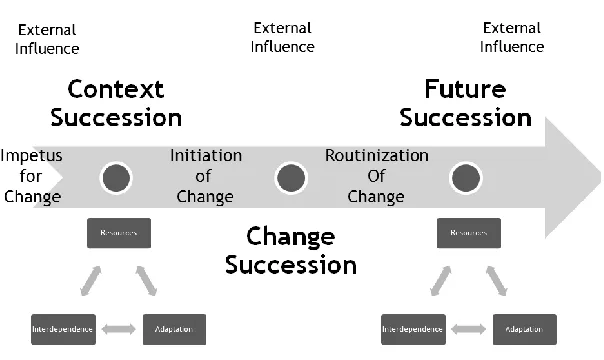
Peirson and Ferguson’s Ecological Process Model of systems change was developed
from their research on policy-driven systems change, sensitized through the concepts of Kelly’s four principles, to create a multidisciplinary framework. The complex components of
the model are presented graphically:
Figure 2.2. Ecological process model of systems change
analysis of the contextual factors that impact school reform, Fusarelli (2011) concludes that by “adopting a more holistic view of educational reform, we may indeed be able to ‘get more
bang for the buck’ and systemically improve the life chances of all children” (p. 232). Application of change models to schools. The rapid pace and growth of educational reform efforts in the last half century has resulted in change becoming the constant for schools. In Fullan and Steigelbauer’s (1991) The New Meaning of Educational Change, they argue that, “if reforms are to be successful, individuals and groups must find meaning
concerning what should change as well as how to go about it” (p. xi). The “how” of school change has been explored extensively by educational researchers over the past two decades and there has been a growing realization that, though schools are now well-practiced at experiencing change, they have by no means become skilled in the process. Central areas of concern are the depth and sustainability of change efforts, and a lack of systems thinking in the development and implementation of reform policy continues to plague even the most promising efforts.
In his examination of what was absent from the CSR program, Johnston (2002) points to a deficiency of systems thinking at the ground level; “seldom did we find evidence that
teachers routinely engaged in collective, school-wide deliberation on the range of school organizational components and instructional programs, the nature of relationships between these components and programs, or how to develop strategic interventions” (p. 222). This
and practices are ineffective. The world has changed, but the system of public education has not” (p. 271).
Fullan (1991), argues that, “neglect of the phenomenology of change – that is, how
people actually experience change as distinct from how it might have been intended – is at the heart of the spectacular lack of success of most social reforms” (p. 4). In discussion of
school change processes and reform implementation, he offers four key insights related to success:
1. active initiation and participation, 2. pressure and support,
3. changes in behavior and beliefs, and
4. the overriding problem of ownership. (p. 91)
Each of these insights points to the roles of school leaders and teachers in understanding, implementing and supporting change efforts.
Role of leadership in reform. Leadership is key in any change effort and school reform must be driven by strong school administrators who are skilled in promoting and guiding transformation. School principals have the authority to drive change at the school level and may be the only individuals at that level with the necessary perspective to make it work; “school principals are generally knowledgeable about systemic design relationships. If
functional integration of reform design and improvement model components” (Johnston,
2002, p. 222).
As middle managers (Fullan, 1991, p. 152), school administrators must interpret directives coming from above, shape the direction for their faculty and also “walk the walk” to move implementation forward. Fullan (1991) asserts that, “the principal’s actions (not what he or she says) carry the message as to whether a change is to be taken seriously” (p.
153). Borrowing from the organizational learning literature, as will be further discussed later in this review, Berson, Nemanich, Waldman, Galvin and Keller (2006) define effective school leadership as “a process of influencing and teaching others to understand why and
how certain activities and goals need to be accomplished. As such, it constitutes a process of facilitating individual and collective efforts to learn and accomplish shared goals in
organizations” (p. 579). Elaborating on this theme of principals as active facilitators, within a
systems framework, Senge (2000) describes four key competencies for school leaders: 1. Engagement – recognizing complex issues and mobilizing learning within the
system
2. Systems thinking – recognizing hidden dynamics and leverage points 3. Leading learning – modeling a learning-centered approach
4. Self-awareness – knowing their impact on the system and how it changes (p. 414-419) In a 1999 study of state education policy implementation in ten Pennsylvania
effectiveness. Qualitative data was collected from multiple case studies of Instructional Support Team (IST) programs in order to answer the question: What role, if any, do
principals play in the implementation of ISTs? The researcher also sought to determine if and how principal behaviors impacted the effectiveness and outcomes of the program (p. 346). Findings suggested that the principal’s role was significant and in alignment with the
characteristics outlined above:
When staff members were asked who has influenced the IST program at these schools, the school principal is one of the people they acknowledge. A teacher at one school says the principal “is always supportive… he always has to give the final okay as far as what’s going on in our school, and he is always pro-anything that will
benefit the kids. (p. 350)
The principals in the study viewed as being most critical to program success were also found to lead by ensuring participation in staff development, providing time for teachers to
collaborate and being actively involved in all aspects of program implementation (p. 351). Principals, as the primary school-level leaders and managers, have a significant impact on the success or failure of change efforts. However, as Senge (2000) points out, successful change “requires multiple layers of leadership roles. Formal and informal leaders,
at the classroom, school and community levels, each provide different resources to the change initiative” (p. 275). Thus, creating and supporting these layers, through engagement
is shaping systemic school reform agendas, and that school principals should occupy the pivotal position of facilitating such professional development” (Johnston, 2002, p. 226).
Role of teachers in reform. In the same way that federally driven programs must be coherently implemented at the school level, school change depends heavily on what goes on at the classroom level. Thus, teachers are the ultimate enactors of any change effort,
regardless of where it emanates. Irrespective of the ways policymakers and school leaders handle reform, when class is in session, the success or failure of the change comes down to the teacher’s actions and behaviors. However, as Fullan (1991) points out, reforms in the classroom are not just technical and dependent solely on the individual teacher, but are also social and connected to the culture and climate of the school, district and system as a whole. Thus the role of teachers in reform must be understood within a broader context, even if “the
language of reform underestimates the intricate ways in which individual and institutional lives are interwoven” (Little, 1993, p. 147).
In their qualitative study of teachers in a reforming California high school, Olsen and Sexton (2009) examined teachers’ perspectives on their role in the reform process. Over the
Data showed that teacher’s experiences were influenced by contextual elements such as tensions between and among various levels; “we think that these already-existent tensions
flared up largely because of the frustration, loss of professional autonomy, and other threat rigidity effects that the administrative climate and school reform culture engendered” (Olsen
& Sexton, 2009, p. 20). A generally negative view of reforms emanated from the fact that teachers did not feel that they were working in concert with a facilitative administration. They outline three criticisms of administration that illustrate this view:
One is that the chosen and implemented school reforms were not good ones; the later-career teachers were more likely than newer teachers to level this complaint. The second concerned the manner in which those reforms were decided and
implemented—that is, how the administration mandated restrictive changes while preaching democratic reform, teacher buy-in, and consensus building. Most teachers in our sample shared this perspective. And the third complaint was that the school administration generally had “clamped down” on teachers and students in such
draconian ways as to lower morale and anger teachers; all six teachers voiced this position. (p. 21)
Unfortunately, negative teacher perceptions of school change abound in the reform implementation literature, though bright spots can be found. If Fullan’s (1991) premise that “educational change depends on what teachers do and think – it’s as simple and as complex as that” (p. 117) is to be believed, researchers and policy makers must focus on the bright
engagement of teachers in their schools as Learning Organizations or Professional Learning Communities where they are part of a collaborative learning culture. These concepts will be explored in depth within the next section of the review.
At a basic level, successful reforms rely heavily on teachers’ decisions to accept or reject the change. Fullan (1991) suggests six issues that teachers should and do consider in this decision:
1. Does the change address an important need? 2. Is the change endorsed by administration and why? 3. Are fellow teachers likely to adopt the change?
4. Will I (how will I) contribute and collaborate to the change effort? 5. What is my role as change advocate/teacher-leader?
6. How can I negotiate the conditions of the change? (p. 137-141)
Recognizing that teachers consider these issues – and validating the ways they address them – can provide policy-makers and practitioners with valuable guidance in designing successful
change efforts.
critical to successful implementation. The following section outlines the literature on organizational learning and its application to schools as they enact school reform.
Organizational Learning
School reform policies such as the transition to Common Core State Standards represent significant organizational learning challenges for educators. Implementation requires changes in practice among individuals, teams and faculties as a whole.
Organizational learning (OL) frameworks can provide helpful tools for understanding the complex processes and dynamics of implementing reform policy. This section reviews literature surrounding the development of organizational theory, applications of specific organizational learning models and studies that have applied organizational learning to school change.
Organizations are more than collections of individuals, encompassing structures, routines, systems and cultures, all of which impact the nature of organizational learning. Levitt and March (1988) described three observations of organizational learning: (a) behavior is based on routines, and actions are based on legitimacy over logic, (b) routines are built on history rather than anticipation of future events, and (c) actions are oriented to organizational goals and aspirations for successful outcomes (p. 320). Organizational learning processes are often aimed at achieving organizational goals by changing entrenched routines. Routines and structures embedded in organizational culture are central to much of the literature on
organizational learning and are often deeply connected to how learning outcomes are measured and classified. The following section describes several models of organizational learning that emphasize key components of learning processes, context and culture.
Organizational Learning Models.
necessarily the most powerful. Double loop actions – the master programs – control the long-range effectiveness, and hence, the ultimate destiny of the system” (p. 69). The two types of
learning are illustrated in Figure 2.3.
Figure 2.3. Single-loop and double-loop learning
Fiol and Lyles (1985) expand upon the concepts of single and double loops by characterizing learning as either higher or lower level based on how routines and culture are impacted:
Lower-level Learning: Focused learning that may be mere repetition of past
behaviors-usually short term, surface, temporary, but with associations being formed. Captures only a certain element- adjustments in part of what the organization does. Single-loop. Routine level.
Higher-level Learning: The development of complex rules and associations regarding new actions. Development of an understanding of causation. Learning that affects the entire organization. Double-loop learning. Central norms, frames of reference, and assumptions changed (p. 810)
Mismatch
Double-loop
Match Governing
Variables
Actions Consequence
Higher-level or double-loop learning calls for questioning and deep reflection on current and past practices. This study will includes examination of whether and how educators engage in single and double loop learning as they implement Common Core State Standards.
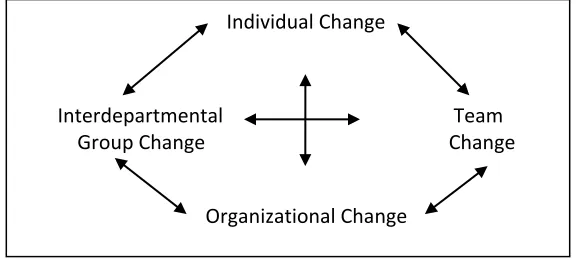
Systems thinking and organizational learning. The emphasis within organizational learning on levels, contexts and dynamics lends itself naturally to a systems perspective. In his study of the dynamics of inter-level organizational learning, Coghlan (2000) asserts that “organizational learning and change comprise individual, team, and interdepartmental group learning, and levels of aggregation work as a recursive system” (p. 67).
Figure 2.4. Systemic inter-level change
In this model, each level interacts with one another and what happens at each of the four levels impacts the other three. These dynamics are echoed in the work of other systems thinkers, such as Senge (2000), who characterizes organizational learning as, “exploring new
ideas and different ways of thinking and interacting, connecting to multiple processes and relationships outside of ourselves,” asserting that this means “redesigning not just the formal
Individual Change
Interdepartmental Team Group Change Change
structures of the organization, but the hard-to-see patterns of relationships among people and other aspects of the system” (p. 20). Given that the policies related to Common Core State Standards are being filtered through multiple levels of the education system before they are implemented at the school level, a systems lens is helpful in making sense of the complex dynamics involved.
Organizations as interpretation systems. Daft and Weick (2001) describe a
comparative model of organizations as systems that engage in four modes of interpretation: enacting, discovering, undirected viewing, and conditioned viewing. The model works on four assumptions: 1.that organizations are complex social systems that respond to
information processed from the environment, 2. that this interpretation happens at both the individual and organizational level, 3. that managers play a critical role in formulating interpretation and 4. that organizations are made up of subsystems, each with different environmental conditions (p. 285). All four of these assumptions resonate in the educational realm where schools are highly social environments in which policy is interpreted at many levels, school leaders play an important role and every classroom within every school represents a separate environment with unique conditions.
Within the Daft and Weick (2001) model, context is central. “Organizations develop
specific ways to know the environment. Interpretation processes are not random. Systematic variations occur based on organization and environmental characteristics, and the
meaning for the system and the individuals within it. “To survive, organizations must have
mechanisms to interpret ambiguous events and to provide meaning and direction for participants. Organizations are meaning systems, and this distinguishes them from lower level systems” (Daft & Weick, 2001, p. 293). Again, this characterization is appropriately
matched to the school context and the needs for such mechanisms in education policy.
Exploration and exploitation. Interpretation of, and response to, environmental
conditions is a learning process in which information is gathered, made sense of, and utilized. March (1991) divides this process into exploration and exploitation, which represent
opposing forces requiring organizations to make choices about resources. The relationship is defined thus:
The essence of exploitation is the refinement and extension of existing competencies, technologies and paradigms. Its returns are positive, proximate, and predictable. The essence of exploration is experimentation with new alternatives. Its returns are uncertain, distant, and often negative. Thus, the distance in time and space between the locus of learning and the locus for the realization of returns is generally greater in the case of exploration than in the case of exploitation, as is the uncertainty. (March, 1991, p. 85)
4I Framework. Developed by Crossan, Lane, and White (1999), the 4I framework is presented as a structure that furthers understanding of organizational learning processes by addressing learning strategies and the interactions between different levels as they experience change. They argue that organizational learning is more complex than single versus double loops. They also define the tension between exploration and exploitation as the struggle between developing new competencies and using existing knowledge. The authors organize their framework according to overlapping levels and processes:
Level Process Inputs/Outcomes
Individual Intuiting Experiences Images Metaphors Group Interpreting Language Cognitive Map Conversation/dialogue
Organization
Integrating Institutionalizing
Shared understandings Mutual adjustment Interactive systems Diagnostic systems
Routines Rules and procedures
(Crossan, Lane, and White, 1999, p. 1090) Figure 2.5. The 4I Framework
To briefly summarize the framework, 4I (1) recognizes the tension between assimilating new learning (exploration) and using what has already been learned
(exploitation); (2) examines three levels of learning and relationships amongst the levels; (3) identifies processes that link the levels; (4) links processes to strategic renewal; and (5) recognizes that organizational learning involves the interaction between cognition and action.
In Crossan and Berdrow’s (2003) “Organizational Learning and Strategic Renewal”,
the organization made the shift from physical to electronic mail delivery. This shift represented a dramatic change for the organization and provided researchers with an
interesting and instructive case study of strategic renewal. CPC managers described the shift as a four-phase process of self-definition, becoming self-sufficient, becoming competitive and preparing for the future. The four phases were a natural match to the 4I framework, the congruence of which was born out in data collected via archival analysis, observations and interviews. Data was collected and classified in bins according to the categories and levels within the 4I model and identified as converging or diverging within a matrix of 16 possible degrees of connection. The findings were organized according to each of the 4Is as well as a diagonal that tracked the dynamic flow of “feed-forward” (from individual to group to
organization) and feedback (from organization to group to individual).
The authors concluded that the actions of CPC were better understood through the use of the 4I framework and that it had proved a useful tool in connecting organizational learning and strategic renewal. One strength the authors pointed to was that it allows researchers to categorize learning in a way that minimizes positive bias. However, the authors also point out the drawback of this neutrality in that it does not account for power issues. While the case is made for the 4I framework as a useful tool in connecting organizational learning and
rapid and dramatic change.
Organizational learning applied to schools.
Before applying specific models of organizational learning to schools, one must address the question, “Are schools learning organizations?” While the idea of schools and faculties as learning communities is now commonly accepted, organizational learning theory has not been widely applied to schools. “Despite being the formal organizations universally
established to promote learning, they [public schools] have been particularly slow to examine the potentials of organizational learning” (Collinson, 2007, p. 444).
Schools differ from the types of corporate and business organizations most studied in early OD and OL research in that they are built around non-financial outcomes. However, there has been growing realization that characterization of schools as being outside the bounds of other organizations is less than productive. As Fusarelli (2002) puts it, “the view of educational organizations as loosely coupled systems or organized anarchies is not especially useful to policymakers and educational leaders because it fails to offer any guidance for school improvement or educational reform” (p. 564). Rowan (1990) expands this view, arguing that, “whereas loose coupling theorists stressed a lack of rationality in
teaching, current views argue that the work of teachers is complex and non-routine, but still subject to rational understanding” (p. 357).
In “Conditions Fostering Organizational Learning in Schools,” Leithwood, Leonard
sought to determine which factors played most heavily on the varied responses, and subsequently had the most impact on organizational learning.
Drawing upon the existing literature on OL in non-educational organizations, they present a framework of five variables: stimulus for OL, outcomes of OL, external conditions, internal school conditions, and outcomes. These variables guided the inquiry as related to the interview and survey questions given to teachers and principals included in the study. Data analysis illustrated that stimuli for OL included individual dispositions (ex: desire to do what is best for students) and external events (policies, changes in teaching assignment, etc.). External conditions influencing OL are categorized as being primarily related to district history, environment and leadership. Within the category of district environment, the factors identified as being supportive of OL were a clear and articulated vision and mission,
collaborative and harmonious culture, sense of community, school staff participation in decision-making, and policies and resources promoting learning.
Conclusions drawn from application of the five-variable framework include the declaration that OL processes vary widely and are supported to a greater degree than expected by district conditions that provide coherent and clear direction for schools. The framework provides a helpful perspective for understanding the variation among responses to educational change initiatives and their outcomes. Nonetheless, more than ten years later, more research is still needed to apply the framework to more varied situations, particularly in other countries and school systems.
In order to further explore the stimulus, process and outcomes of organizational learning for public schools, it is helpful to refer back to an earlier Leithwood study, with Jantzi and Steinbach (1995), “An Organizational Learning Perspective on School Responses to Change Initiatives.” This publication originated the five-variable framework used in the
1998 article, but more deeply explores the conditions in relation to one specific strategic change initiative. The central focus of the article is a longitudinal study of school policy implementation in British Columbia that involved substantial restructuring and produced mixed results among the six participating schools.
Events and dispositions that trigger OL were found to be both external and internal, and were significantly influenced by school mission, vision, culture. Characteristics
and initiatives. Outcomes for schools operating as learning organizations included changes in practices, new understandings, increased commitment and the development of new skills.
For schools identified by teachers as being learning organizations, OL processes were described as encompassing informal, regular conversations, experimentation with new ideas, peer observation, and personal reflection on practice. Thus, leadership and school culture supporting such processes were identified as creating the conditions most associated with OL. Also, the authors point directly to the characteristics of school leaders as being highly influential on the OL that takes place in schools.
4I applied to schools. Since its inception in 1999, only a handful of studies have applied the 4I model to organizational learning in schools. In Pan and Chen’s (2011) study of Taiwan’s Teacher Professional Development Evaluation system as a catalyst for
organizational learning, they use Crossan’s framework to help explain the behavior and
performance of the organization as well as the processes and outcomes of learning. Data from their comparative case study revealed that the program led to learning at the individual, team and organizational level. The participatory nature of the program fostered a
collaborative culture that led to institutionalization of new practices. They conclude: The research findings indicated that teacher evaluation was a catalyst for
what constitutes effective teaching and how to use evaluation to inform practices. (p. 10) In a 2007 study of classroom leadership, Strong-Rhoads applied the 4I frame to analyze the ways teachers develop leadership capacities. Findings suggested that the 4I framework was helpful in deciphering patterns of teachers experiences, highlighting “the importance of interpreting through reflection and collaboration intuition and automaticity,” and the ways, “institutions become well defined with mechanisms in place that ensure learning” (p. 143).
4I applied to policy implementation in schools. Research applying the 4I framework specifically to education policy implementation is limited. Within this literature review, for which several research databases were scoured using combinations of search terms including 4Is, schools, reform, and policy, only two studies were found. In Dalal’s 2008 dissertation study, the 4I model was used as a conceptual tool in a multiple case study of a district-level policy and its implementation at the school-level. Qualitative examination of teacher and school-leader perspectives corresponded well to the different levels and processes within 4I. Findings showed that, “grade level collaboration seemed to be a highly structured process
that appeared to match what Crossan et al. (1999) calls an institutionalized and embedded routine within the school” (p. 219).
intuiting and interpreting at the individual level and the role of evaluation and feedback at the organizational level.
Though few educational researchers have specifically applied the 4I framework to reform policy, many such asDatnow (2005) reference the central components of the model and underscore their importance in understanding policy implementation. In Datnow’s study of CSR models and their sustainability, the author concludes that, “the only schools that did
not suffer or experience conflicts in the face of these state and district demands were those that had reforms well institutionalized—these were high capacity schools by all observers’ estimations. Reforms had become taken-for-granted features of daily life at the schools, and these schools enjoyed strong reputations and protected positions in the district” (2005, p.
142). Institutionalization, being the fourth and final stage in the 4I model, is thus the goal and, as Datnow’s conclusions suggest, highly connected to the success and sustainability of
school reform efforts.
Chapter Summary
Organizational learning theory has emerged over the past two decades as a means to better understanding of school change. The preponderance of school reform efforts have created numerous opportunities to apply OL frameworks to policy implementation. Systems thinking, ecological paradigms, cognition and interpretation models and the 4I framework offer helpful tools for examining learning and change processes.
Common Core Standards represents an unprecedented national level curriculum initiative. As schools across the country move to implement the new standards, educational researchers have a unique opportunity to study how this reform is translated through the federal, state and district levels and ultimately implemented by educators at the school level. This study sought to apply OL frameworks to make sense of the shift and examine school-level experiences in terms of how educators interpreted, integrated, initially implemented and ultimately moved to institutionalize the new curriculum standards. The following chapter outlines the