Cryptanalysis of S-DES
Dr. K. S. Ooi
([email protected])
Brain Chin Vito
([email protected])
University of Sheffield Centre, Taylor’s College
1
stApril 2002
Abstract
This paper describes an effort to attack S-DES
using differential cryptanalysis and linear
cryptanalysis. S-DES is a reduced version of
the Data Encryption Standard (DES). It also includes
a discussion on the subject of cryptology and a literature
survey of useful papers regarding cryptography and
cryptanalysis. This paper is meant as a tutorial on
the fundamentals of differential cryptanalysis and
Contents
1.
Background
2.
Literature Survey
3.
S-DES
4.
Brute Force Attack of S-DES
5.
Differential Cryptanalysis of S-DES
6.
Linear Cryptanalysis of S-DES
7.
Reference
8.
Appendix
8.1
S-DES Source Code
8.2
Automated Brute Force Attack of S-DES Source Code
8.3
Automated Differential Cryptanalysis of S-DES Source Code
8.4
Automated Linear Cryptanalysis of S-DES Source Code
8.5
Brute Force Attack of S-DES Results
8.6
Differential Cryptanalysis of S-DES Results
8.7
Linear Cryptanalysis of S-DES Results
8.8
Difference Pair Table of S
08.9
Difference Pair Table of S
18.10
Difference Distribution Table of S
08.11
Difference Distribution Table of S
18.12
Differential Characteristic of S-DES
8.13
I/0 Table for S
08.14
Visualisation of Linear Approximation of S
08.15
Distribution Table for S
01.
Background
1.1 Security in the Information Age 1.2 Importance of Cipher Efficiency 1.3 Cryptology
1.4 Why Cryptanalysis?
1.1 Security in the Information Age
The beginning of the Information Age heralded a new kind of threat to governments, corporations and individuals. Cyberspace had become the new arena of information exchange and commerce.Although highly beneficial, cyberspace can become a place for new forms of old crimes.
Along with the mainstream usage of cyberspace, governments and corporations are using cyberspace as a tool for economic espionage and infrastructure attacks. Electronic commerce crime on the other hand affects corporations, threatening the recent boom that has fueled the unprecedented economic recovery. Other forms of security threat do exist, for example: identity theft, cyber stalking and cyber terrorism [RP00]. These crimes expose individuals to financial, psychological, and even physical harm.
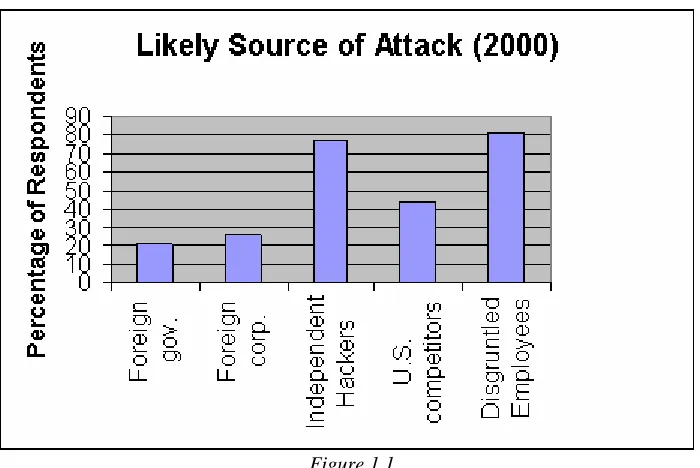
Figure 1.1 shows the sources of security threat.
Security is the main concerns of organizations participating in the information revolution. Cyber
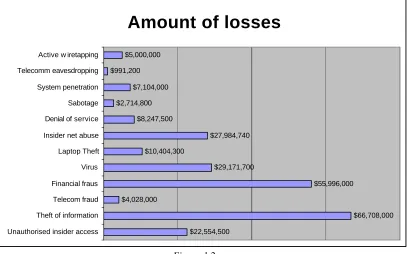
crime is very real and causes serious financial loss. Figure 1.2 shows the total amount of financial losses
caused by computer crime.
Even with billions of dollars spent on security systems, the problem of security breaches continues to rise throughout the years, encouraged by an even greater exposure of public civilians to security flaws
and widespread of malicious tools (see Figure 1.3).
Figure 1.1
Amount of losses
$22,554,500
$66,708,000 $4,028,000
$55,996,000 $29,171,700
$10,404,300
$27,984,740 $8,247,500
$2,714,800 $7,104,000 $991,200
$5,000,000
Unauthorised insider access Theft of information Telecom fraud Financial fraus Virus Laptop Theft Insider net abuse Denial of service Sabotage System penetration Telecomm eavesdropping Active w iretapping
Figure 1.2
Source: 2000 CSI/FBI Computer Crime and Security Survey(from[RP00])
0 2000 4000 6000 8000 10000
# of Incidents Reported
88 89 90 91 92 92 94 95 96 97 98 99
Year
Number of Incidents Reported
Figure 1.3
Source: CERT/CC Statistics 1998-1999(from[RP00])
Historically, cryptography played an important role in many events, mostly wars, since the ancient Greek civilization [SS00]. The importance of cryptology is even more evidential in the information age, where commerce, military powers and governments depends so much on encryption technologies to create a secure environment for information exchange in unsecured channels.
1.2 Importance of Cipher Efficiency
Owing to its wide use, it is therefore desirable to design and implement efficient cryptographic systems that are robust in various platforms. Many factors are taken into consideration when gauging efficiency, these includes gate count for hardware design, memory requirements in software implementation and cross-platform performance.
The importance of cipher efficiency is evidential in the recent selection of Rijndael as the new AES [DR00]. It is chosen because it fulfills the security requirements set by the NIST with the least cost in hardware requirements compared to the other algorithms. Messages can be rapidly encrypted and decrypted with Rijndael and the performances are equally good across platforms ranging from smart cards to 64 bit processors. It also requires a modest amount of memory and performs the best (compared to other algorithms) when implemented in hardware.
1.3 Cryptology
Cryptology is a constantly evolving science; ciphers are invented and, given time, are almost certainly breakable. Cryptanalysis is the best way to understand the subject of cryptology. Cryptographers are constantly searching for the perfect security system, a system that is both fast and hard, a system that encrypts quickly but is hard or impossible to break. Cryptanalysts are always looking for ways to break the security provided by a cryptographic system, mostly though mathematical understanding of the cipher structure.
1.4 Why Cryptanalysis?
Recent advances in cryptanalytic techniques are remarkable. It is now considered essential for every paper of a new block cipher design to include a quantitative evaluation of security against state-of the-art cryptanalysis such as linear cryptanalysis and differential cryptanalysis.
Since the 1970s, cryptanalysis effort was centered on the cracking of the Data Encryption Standard (DES), a standard adopted by the National Institute of Standards and Technology (NIST).
Recently, NIST adopted a new standard, termed the Advanced Encryption Standard (AES). NIST called for the public to submit ciphers that meet the standards set for the new AES. Most of the AES proposals submitted included results of linear cryptanalysis and differential cryptanalysis as an evaluation of the cipher strength. Most of the AES proposals stress the importance of cryptanalysis. This point is inline with the views of many cryptographers.
Bruce Schneier states that it is much more difficult to cryptanalyse a cipher than to design it [BS00]. He also mentions that cryptanalysis is the best way towards a concrete understanding of cryptographic technologies. Over 90 % of his efforts are spent on cryptanalysing when working on the proposal of the Twofish cipher. Most people have a conception that creating a good cipher system is difficult. It turns out that cryptanalysing a cipher is a much more difficult activity than creating one. To become a good cryptographer, the only route is through cryptanalysing. Only by cryptanalysing can a cryptographer really understand the inner-workings of a cryptographic system and to design systems which are stronger against attacks. This fact is clear if we observe cryptology books that are printed, while there are several good books on cryptography, there are no books, good or bad, on cryptanalysis [BS00]. This is due to the difficult nature of cryptanalysis and the fact that the only way to learn cryptanalysis is through practice. A cipher invented by someone who has shown that he can break algorithm is usually thought to be much secure. Design is easy and analysis is hard. Anyone can create an algorithm that he himself cannot break.
2.Literature Survey
2.1 Cryptology
Literatures useful for research in block cipher cryptanalysis falls into one of the following gross categories:
2.1 Cryptology
Cryptology covers both cryptography and cryptanalysis. Although cryptology literatures are not as abundant compared to those of other fields, many of the literatures in existence are well-written. It is intriguing to see how the science of keeping secrets has evolved, especially in the information age.
o Bruce Scheneir
o [BS96] is one of the most popular books on cryptography. Though not used extensively,
it provides a good introduction to the various concepts involved in cryptography and some information on cryptanalysis.
o [BS00] charts an organized pathway towards learning how to cryptanalyse.
o [BS01] provides a good explanation on why cryptography is hard and the issues which
cryptographers have to consider in designing ciphers.
o Bruce Scheneir et. al
o [BS99] proposes a new cipher as a candidate for the new AES. By reading it, we get a
grasp of the main concepts and issues involve in block cipher design. Also suggests cryptanalysis as a measure of cipher strength.
o Chan Yeob Yeun
o [CY01] provides an encyclopedic look at the design, analysis and applications of
cryptographic techniques. Good texts on number theory and abstract algebra.
o Edward Schaefer
o [SC96] describes a simplified version of DES. It has the architecture of DES but has
much lesser rounds and much lesser bits. The cipher is good for educational purposes.
o Fauzan Mirza
o [FM00] is a very good paper on block cipher and cryptanalysis. Many of the foundational
concepts required for this assignment is obtained here. A vital preliminary reading for anybody engaging in cryptanalysis.
o Howard Hayes
o [HH00] has a somewhat similar notion as [FM00] but uses a more descriptive approach.
Focuses on linear cryptanalysis and differential cryptanalysis of a given SPN cipher.
o Henning Schulzrinne
o [SH00] is a series of slides on Cryptography. Particularly, it discusses DES-like ciphers.
o Joan Daemen,Vincent Rijmen
o [DR00] describes Rijndael, the new AES. Provides good insight into many creative
cryptographic techniques that increases cipher strength.
o Joe Kilian and Philip Rogaway
o [KR01] investigates the security of Ron Rivest’s DESX construction, a cheaper
alternative to Triple DES.
o Lyndon G. Pierson
o [PL00] is an interesting paper that compares modes of operations such as CBC, CFB,
OFB and ECB.
o Kazumaro Aoki et. al.
o [AM00] proposes a new cipher called Camelia that the creators claim be used for the next
10-20 years. An elegant paper which also includes cryptanalysis to demonstrate the strength of the cipher.
o Menezes,P. van Oorschot, S. Vanstone
o [MP96] is the book that will be used for constant study and main reference throughout
this project. A bible of cryptography.
o Paul Garrett
o [PG01] is a textbook in cryptology which uses a highly mathematical path to explain
cryptologic concepts. A good reference for mathematical concepts related to cryptology.
o [SS00] is a good book that provides an introduction to cryptology and the current interests in this field. An entertaining yet informative look at the history of cryptography, classical ciphers and the effect of cryptography on society.
o Susan Landau
o [LS00] is an article on DES, the requirements of a good cryptosystem and cryptanalysis.
2.2 Linear Cryptanalysis
Linear cryptanalysis is about the approximation of an encryption algorithm with a linear equation. With the linear equation, we can then obtain key bits of the original secret key. It had been used extensively to attack DES.
o Buttyan, L. and I. Vajda.
o [BV95] shows the correspondence between searching for the best characteristic in linear
cryptanalysis and searching for the maximal weight path in a directed graph.
o Daemen et. al.
o [DG94] propose the use of correlation matrix as a natural representation to understand
and describe the mechanism of linear cryptanalysis.
o Eli Biham
o [EB94] formalizes the method described in [MM94] and show that at the structural level,
linear cryptanalysis is very similar to differential cryptanalysis. Used for further exploration into linear cryptanalysis.
o Harpes, C., G. Kramer and J. Massey.
o [HG95] provides a generalization of linear cryptanalysis and suggests that IDEA and
SAFER K-64 are secure against such generalization.
o Kaliski and Robshaw
o [KR94] surveys the use of multiple linear approximations in cryptanalysis to improve
efficiency and to reduce the amount of data required for cryptanalysis in certain circumstances.
o Mitsuru Matsui
o [MM94] is the original paper on linear cryptanalysis. This paper is of substantial
importance to the project. A must read for all cryptanalysts.
o [MM941] is an improved version of [MM94]. It discusses an experimental attack of DES
using 12 computers.
o Pascal Junod
o [PJ98] describes an implementation of Matsui’s linear cryptanalysis of DES with strong
emphasis on efficiency. An experimental undertaking.
2.3 Differential Cryptanalysis
Differential cryptanalysis is a very general tool against iterated block ciphers. It involves the examination of the input and output difference, called differential characteristics. Used to cryptanalyse many ciphers including DES.
o Anne Canteaut
o [AC97] describes the design of a Feistel cipher with at least 5 rounds that is resistance to
differential cryptanalysis.
o C. Adams
o [CA92] explores the possibility of defeating differential cryptanalysis by designing
S-boxes with equiprobable output XORs using bent functions.
o Dawson and Tavares
o [DT91] describes some design criterias for creating good S-boxes that are immune to
differential cryptanalysis. These criterias are based on information theoretic concepts.
o [EA90] is the original paper on differential cryptanalysis. Introduces differential cryptanalysis on a reduced round variant of DES. Very useful for the project
o [EA91] breaks a variety of ciphers, the fastest break being of two-pass Snefru.
o [EA92] describes the cryptanalysis of the full 16-round DES using an improved version
of [EA90].
o James Massey and Xuejia Lai
o [LM91] introduces the concept of Markov ciphers and explain it’s significance in
differential cryptanalysis. Investigates the security of iterated block ciphers and shows how to when an r-round cipher is not vulnurable to attacks.
o K. Nyberg
o [NK91] shows that there are DES-like iterated ciphers that does not yield to differential
cryptanalysis.
o Sean Murphy and M.J.B. Robshaw
o [SM00] proposes that eight round Twofish can be attacked. Investigates the role of key
dependent S-boxes in differentaial cryptanalysis.
o Youssef, A., S. Tavares.
o [YT95] is on the same line with [CA92] but proposes that the input variables be increased
and that the S-box be balanced to increase resistance towards both differential and linear cryptanalysis.
2.4 Other Methods of Cryptanalysis
Many other cryptanalytic method exists but this project focuses on linear and differential cryptanalysis. Nevertheless, the following literatures mostly describes extensions of linear or differential cryptanalysis (except Square) which are useful in this project.
o Anne Gorksa et. al.
o [AG00] describes analysis with multiple expressions and differential-linear cryptanalysis.
Also provides experimental results of an implementation of differential-linear cryptanalysis with multiple expressions applied to DES variants.
o Martin Hellman and Susan Langford
o MS94] is a paper describing the Differential-Linear cryptanalysis method, a very efficient
method against DES in terms of required texts. This method may possibly be look into in later stages of the project
o Niels Ferguson et. al.
o [NF01] is an attack on 7 and 8 round Rijndael using the Square method. Also describes a
related-key attack that can break 9 round Rijndael with 256 bit keys.
o Serge Vaudenay and Shiho Moriai
o [VM95] discusses the relations between linear and differntial cryptanalysis and presents
classes of ciphers which are resistant towards these attacks.
o Vaudenay, S.
o [VS95] is a paper describing a statistical cryptanalysis of DES, a combination and
imrovement of both linear and differential cryptanalysis. Suggests that the linearity of S-boxes are not very important.
2.5 Programming and C
C is the common standard for the implementation of ciphers. C is an extremely flexible, expressive and terse language. This flexibility can either make or break the robustness of a cipher, depending on the correctness of implementation. This in turn lies greatly on the hands of the programmer. Thoughtful programming must be employed. Efficiency is also an important consideration.
o Matthew Kwan
o [MK98] is an implementation of DES but with bit slicing. It shows how the bit-sliced
o Mark Allen Weiss
o [MW95] is a comprehensive book on C. Good reference text during the process of
coding.
o Ooi Kuan San
o [OS00] is a tutorial on using pointers in C++. Begins with a brief introduction to
computer architecture and discusses many issues such as programming practices and even operator precedency.
o [OS01] is an important tutorial for the purpose of this project as it teaches bit
manipulation, which is prerequisite knowledge for implementing ciphers.
3.S-DES
3.1 Introduction 3.2 The Keys 3.3 The Cipher
3.1. Introduction
S-DES is a reduced version of the DES algorithm. It has similar properties to DES but deals with a much smaller block and key size (operates on 8-bit message blocks with a 10-bit key). It was designed as a test block cipher for learning about modern cryptanalytic techniques such as linear cryptanalysis,
differential cryptanalysis and linear-differential cryptanalysis. It is a variant of Simplified DES [SC96].
The same key is used for encryption and decryption. Though, the schedule of addressing the key bits are altered so that the decryption is the reverse of encryption. An input block to be encrypted is
subjected to an initial permutation IP. Then, it is applied to two rounds of key-dependent computation.
Finally, it is applied to a permutation which is the inverse of the initial permutation. We shall now proceed to a detailed description of the components of S-DES.
3.1.2. The Keys
The 10 bit key is used to generate 2 different blocks of 8 bit subkeyswhere each block is used in a
particular iteration. Let us denote the 10 bit key as KEY, the 8 bit subkeys as K1and K2. The key-schedule
used to generate the subkeys is denoted as KS.
Figure 3.1 illustrates the calculation of K1 and K2 given KEY. KEY is subject to an initial permutation,
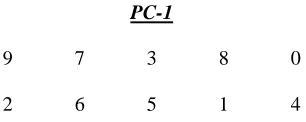
Permuted Choice 1 which is determined by the following table:
PC-1
9 7 3 8 0
2 6 5 1 4
The table has been divided into two parts. The upper part determines the bits of C0 and the bottom part
determines the bits of D0.The bits of KEY are numbered from 0 to 9. Thus, the bits of C0are bits 9, 7, 3…
of KEY and the bits of D0 are bits 2, 6, 5… of KEY.
A single left shift is then performed on both C0 and D0. The result of a single left shift of C0and D0is C1
and D1. To form K1, D1is concatenated to C1(with the with the most significant bit of C1as the most
significant bit of K1, and the most significant bit of D1 following the least significant bit of C1) and then
subjected to a permutation, Permuted Choice 2 which is determined by the following table:
3 1 7 5 0 6 4 2
Thus, the first bit of K1 is the third bit of C1D1. Notice that the bits of K1 are only 8 bits.
Figure 3.1
To form K2, C1 and D1 is subjected to two left shifts yielding C2 and D2. Then, D1is concatenated to C1
yielding C1D1. C1D1is then subjected to a permutation, Permuted Choice 2 as described above, yielding K2.
3.3 The Cipher
Enciphering
Figure 3.2 describes the computation required for enciphering. The encryption procedure can be summarized as:
C = E ( P , K ) = IP- 1( ρ2 (ρ1( IP( P ) ) )
KEY
C
oD
oPermuted
Choice 1
<<1
<<1
C
1D
1<<2
<<2
C
2D
2Permuted
Choice 2
Permuted
Choice 2
K
1Figure 3.2
The 8-bit block is subjected to an initial permutation, IP 1, which is as follows:
IP 1
7 6 4 0
2 5 1 3
The table has been divided into two parts. The upper part determines the bits of L0 and the bottom part
determines the bits of R0.The bits of INPUT are numbered from 0 to 7. Thus, the bits of L0are bits 7, 6,
After the initial permutation, L0 and R0 is then subjected to round 1. The output of round 1 is L1and R1. The
calculation is as follows:
L1 = R0
R1= L0⊕ f ( R , K1)
The key-dependant cipher function f, will be described later.
L1 and R1 is then applied to round 2, yielding L2 and and R2 as calculated below:
L2 = R1
R2= L1⊕ f ( R, K2)
The last step requires the concatenation of R2 to L2 which yields L2R2. This is then subjected to a
permutation which is the inverse of the initial permutation. After this permutation, OUTPUT is produced.
The Cipher Function f
A sketch of the calculation of f(R,K) is given in Figure 3.3
R( 4 bits )
8 bits
E
K(8 bits)
+
S
0S
1P
Figure 3.3
E denotes a function which takes in a 4 bit block input and yields a 8 bit block as output. The 8-bit output
block of E is obtained according to the following table:
E-BIT SELECTION TABLE
3 0 1 2 1 2 3 0
Thus, the first three bits of E(R) are bits 3, 0, 1 of R.
The 8 bit E(R) is then XORed with the 8 bit subkey K. The subkey K1 is used for round 1 and K2 is used for
round 2.
The result of the XORing operation is then split into two blocks, the first four bits from the most significant bit being B1 and the remaining bits being B2. B1 and B2 are then applied to S0 and S1 respectively.
S0and S1are S-Boxes which take in a 4 bit input and yield a 2 bit output.
S0
Column Number Row
No.
0 1 2 3
0 1 0 2 3
1 3 1 0 2
2 2 0 3 1
3 1 3 2 0
S1
Column Number Row
No.
0 1 2 3
0 0 3 1 2
1 3 2 0 1
2 1 0 3 2
3 2 1 3 0
We take S0 as an example to illustrate how the output block is determined. S0 takes the first bit and the last
bit of the 4-bit block and used them to represent in base 2 a number in the range of 0 to 3. For example, for a block of bits 1101, 11 are obtained and are subsequently converted to 3. This is used to determine the row, in this case, row 3.
The middle 2 bits is used to represent in base 2 a number in the range of 0 to 3. This is used to determine the column. In the case of our example block, the two bits in the middle represents column 2.
From S0 above, a number from row 3 column 2 is selected, thus yielding the number 2, which in binary is
written as 10.
The result of S0 and S1are concatenated to form a four bit block which is then applied to a permutation, P.
This function is defined by the following table:
P
1 0 3 2
The result of P will be the 4 bits returned by the function f.
Deciphering
To decipher, the same algorithm is used, but the subkeys are applied in reverse order. That is, instead of
4. Brute Force Attack
Brute force cryptanalysis, as its name suggests is the most straightforward cryptanalysis attack. Although being one of the most primitive methods of attacking a cipher is gaining increasing applicability as a result of increasing computational power.
Though simple, brute force is only practical for cryptosystems with key size of maximum 56 bits
(over 256 = 72 quadrillion tries) [MC98] . Other cryptosystems with a key size larger than 56-bits may
require a long time to crack with brute force and may not even be feasible. For example, the current AES with a 128-bit block size is almost impossible to crack by brute force with today’s general purpose computers [DR00] . The number of combinations to try is more than the grains of sands on earth, many times more than a billion for every square meter on earth [DH01].
It is feasible to attack S-DES with brute force since it only has a key size of 10 bits. To perform brute force attack, we need to have a plaintext-ciphertext pair in which we search the key space until the
appropriate plaintext, encrypted with the targeted key yields the ciphertext. Appendix 8.2 shows the code
and Appendix 8.5 shows the result of the attack.
5. Differential Cryptanalysis
5.1 Basic Concept
5.2 Difference Pairs of an S-Box 5.3 Difference Distribution Table 5.4 Differential Characteristics 5.5 Extracting the partial subkey 5.6 Conclusion
Differential cryptanalysis is a chosen plaintext/chosen ciphertext attack that was initially
developed to attack DES-like ciphers [EA93] . A chosen plaintext attack is one where the attacker is able to select inputs to a cipher and examine the output. Being one of the earlier attacks on DES, differential cryptanalysis had been studied extensively [FM00]. Many of today's ciphers are designed with
consideration to immunity against differential cryptanalysis. Nevertheless, differential cryptanalysis still provides a good understanding of the possible weakness of ciphers and techniques to overcome them.
Differential cryptanalysis involves the analysis of the effect of the plaintext pair difference on the resulting ciphertext difference. The most common difference utilized is the fixed XORed value of the plaintext pairs. By exploiting these differences, the partial subkey used in the cipher algorithm can be guessed. This guess is done statistically by using a counting procedure ( Sect. 5.5 ) for each key in which the key with the highest count is assumed to be the most probable partial subkey.
5.1 Basic Concept
Consider the following basic linear cipher function:
C = P⊕K
By taking the difference of a pair of ciphertext, we would have cancelled out the key involved, leaving us with no information about the key:
C⊕ C’ = P⊕K⊕P’ ⊕K
C⊕ C’ = P⊕ P’
This is because of the linearity of the function. The above equation simply tells us that the difference between the plaintext is the same as the difference between the ciphertext [FM00].
a plaintext pair is influenced by the key. Thus, by utilising this fact, and the knowledge that certain plaintext differences occurs with a higher probability than other differences, we can reveal information about the key [EA90] . Like linear cryptanalysis, we start by analysing the non-linear component of the cipher, the S-Box. Then, we extend the values obtained to form a complete differential characteristic sufficient to perform an attack.
5.2 Difference Pairs of an S-Box
Consider the S-Box S0 and S1 of S-DES. We denote the input to the S-Box as X and the output as
Y [HH00]. The difference pairs of an S-Box is then denoted as ( ∆X, ∆Y), where ∆X = X’ ⊕X’’. It is more
convenient if we consider all 16 values of X’ with ∆X as a constraint to the value of X’’, thus X’’ = X’ ⊕
∆X. With X’ and X’’, the value of ∆Y can then be obtained.
The table shown in Appendix 8.8 shows all the difference pairs of S0 and Appendix 8.9 shows the
difference pairs of S1.
5.3 Difference Distribution Table
The tables shown in Appendix 8.10 and Appendix 8.11 are the difference distribution tables for
S0 and S1where the row represents ∆X value, the column represents ∆Y values and the elements represents
the number of occurences given the column and row values.
Interesting things can be performed with the availability of the difference distribution table . Two of the possibilities are:
1. We can obtain the possible input and output values given their differences [EA90]
This is done by checking the corresponding value of the input and output differences in the
difference distribution table. Consider the following input and output difference ∆X=8 and ∆Y=1 of S0.
From the difference distribution table, we see that the number of occurences for this input and output difference is 2 so only two pairs can satisfy this difference. Further, we see that these pairs are duals. If the first pair is X’, X’’, then the other pair is X’’, X’.
Since ∆Y is 1, then the output pairs must be 1 and 3. Subsequently, we find that the only input
pairs that can yield 1 and 3 as output pairs and at the same time satisfy the input difference ∆X=8 is 9
and 1 respectively.
2. We can obtain the key bits involved in the S-Box using known input pairs and output differences
of the S-Box [EA90]
Given a particular input pair, we can obtain the possible key bits involved in the S-Box.
Assuming X’= 2, X’’= 8 and the S-Box considered is S0. Then, Y’=0, Y’’=2 and ∆Y = 2. We denote the
inputs to the S-Box after XOR-ing with the key as I’=X’⊕K and I’’=X’’⊕K . From [HH00], we know
that the key has no influence on the input difference value. So, ∆X = ∆I = 2 ⊕ 8 = 10.
Now that we’ve obtained ∆X= 10 and ∆Y = 2 we can proceed to obtain the key bits involved.
From the distribution table, we see that ∆X=10 and ∆Y=2 has two possibilities. This implies that there
are 2 possibilities for the key. Table 5.1 lists the keys and the corresponding X’ and X’’. Since ∆I=10,
then the pairs of I that can satisfy this difference is 7 and 13.
Given that K = X⊕I, the first possible key, 5 is obtained from:
K = I’ ⊕ X’= 7 ⊕ 2 = 5 and K= I’ ⊕ X’’ = 7 ⊕ 8 = 5
K = I’’ ⊕ X’= 13 ⊕ 2 = 15 and K = I’’ ⊕ X’’ = 13 ⊕ 8 = 15
S-Box Input Possible Keys
7 13 5 15
Table 5.1 Possible Keys for X’=2 and X’’=8
5.4 Differential Characteristics
The above example is only an introduction to the possibilities that are available to us when we analyse the difference between plaintext pairs and ciphertext pairs. We extend this knowledge to create a differential characteristic for 1 round of S-DES [HH00]. With this differential characteristic, we can obtain
the subkey, K2 used in the last round. First, we construct a differential characteristic that involves S1 in both
rounds of S-DES using the following difference pair of S0and S1:
S0: ∆X0 = 2 →∆Y0 = 2 with probability 12/16
S1: ∆X1 = 4 →∆Y1 = 2 with probability 10/16
Thus, by considering ∆X0,∆X1 and the expansion, E which me modify to E = [ 0 2 1 3 0 1 2 3 ], the input
difference to the first round is given by:
∆U1= [0 0 0 0 0 1 0 0 ]
The expansion E is only a form of “diffusion sugaring” and does not add to the non-linearity of the cipher.
The change is to make the derivation of the input difference clearer, expansion is not the main concern here.
Then, considering ∆Y0and∆Y1andthe permutation P that follows, we get the output difference for round 1:
∆V1= [ 0 1 0 0 0 1 0 1 ]
This 1-round characteristic holds with probability 12/16 × 10/16 = 15 / 32, which means that for every 32
random and uniformly distributed pairs of chosen plaintexts with difference ∆U1we expect to find about 1
pair of corresponding ciphertexts which satisfies the difference ∆V1. Pairs with plaintext that produces ∆U1
and corresponding ciphertexts that produces ∆V1 are called right pairs.
The differential characteristic can be best visualised using the figure used by Biham [EA90]. The
visualisation of the differential characteristic for round 1 is shown in Appendix 8.12.
For a N-round cipher, we need to find the differential characteristic of N-1 round [HH00] [FM00] to conceive an attack. Since S-DES is a 2-round cipher, the 1-round characteristic which we obtained is sufficient.
5.5 Extracting the partial subkey
With the differential characteristics obtained above, we can now proceed to extract subkey K2 of round 2.
We shall call the subkey that we want to extract as the target subkey [HH00]. The process to extract the subkey is described algorithmically as follows:
1. Obtain a random plaintext P’ and compute P’’ = P’ ⊕∆X.
2. For P’ and P’’
a. Encrypt both P’ and P’’ with both K1 and K2to obtain C’ and C’’. Also, obtain CI’ and
CI’’, the encrypted plaintext after one round, which is encrypted with K1 only .
b. If CI’ ⊕CI’’= ∆Y, then
i. For all possible subkey values, encrypt CI’ ⊕CI’’ with only one round, which is
ii. If the result of the encryption of 2.b.i. is equivalent to those suggested by C’ and
C’’, then we increase the count for the corresponding subkey value used.
3. Repeat 1 and 2 for another random plaintext P’. Perform this until one value of the subkey has
been counted to be substantially more than the others. This subkey value is assumed to be the correct subkey value used in the second round.
5.6 Conclusion
Using the parameters discussed, the attack is performed on S0 and S1and the results are listed in
Appendix 8.5. The attack was very successful and was able to extract the entire subkey of round 2. These subkey bits are the actual 8 bits of the S-DES 10 key bits, 2 bits are still missing. Thus, we can now try all
the 22 possibilities of the missing bits which are trivial. Also, with that subkey, the whole key can then be
derived without trying the 22 possibilities, the method to perform this is explained in [EA90].
The source code for the entirely automated differential cryptanalysis is listed in Appendix 8.3
7 Linear Cryptanalysis of S-DES
6.1 Linear Cryptanalysis Principles
6.2 Obtaining a linear equation with high probability bias 6.3 Extracting the partial subkey bits
6.4 Conclusion
6.1 Linear Cryptanalysis Principles
Linear cryptanalysis is a known-plaintext attack that is one of the most commonly used attack against block ciphers. It was invented by Mitsuru Matsui and is used initially to attack the Data Encryption Standard [MM94]. It is based on the fact that there are high probability of occurences of linear expressions consisting the plaintext bits, ciphertext bits and key bits.
The main idea behind linear cryptanalysis is to obtain an approximation to the block cipher as a whole using a linear expression. This linear expression has the form:
(1)
=
⊕
⊕
⊕
⊕
=X
i
=Y
j
=K
k
w v
u
γ β
α β γ
α 1 1 1
where X denotes plaintext bits, Y denotes ciphertext bits and K denotes the key bits. The indices
u,v and w denote fixed bit locations.
The goal is to find the linear expression which holds with the highest/biggest linear probability
bias. The linear probability bias, ε is defined as
(2)
ε
=
p
−
1
2
which is the magnitude of the bias from a probability of ½. The higher the magnitude of the bias, the higher the efficiency of the linear expression (1).
If equation (1) holds with a high probability bias, it means that the cipher used is not sufficiently random [HH00]. A cipher is considered to be random if the randomly selected value of the bits of its linear expression would cause the expression to hold with a probability of ½. Thus, the further away a linear expression is from holding with a probability of 0.5, the less random it is. Linear cryptanalysis takes advantage of this poor randomization.
Once a linear approximation with the highest bias is obtained, the attack can be mounted by recovering a subset of the key bits. This is done using Algorithm 1 as described in [MM94].
6.2 Obtaining a linear equation with high probability bias
To obtain a linear equation with high probability bias, we begin by constructing a statistical linear path between the input and output bits of each S-box. We then extend this path to the entire cipher and will finally reach a linear expression without any intermediate value[MM94].
6.2.1 Linear Approximation of S-Boxes
Block ciphers commonly use non-linear operations in its S-boxes. Though, it is possible to construct a linear approximation of S-Boxes. Techniques for this purpose are described in [RR86].
The goal is to find the linear approximation with the highest bias magnitude. Following Matsui’s notation,
Definition 6.1 For a given S-box Sa (a = identifier of the S-box), 1 ≤ α≤ p and 1 ≤ β ≤ q, we define
NSa(α,β) as the number of times out of p input patterns of Sa, such that a XORed value of the input bits
masked by α matches with an XORed value of the output bits masked by β
(3)
( )
(
)
(
)
•
=
•
≤
≤
⊕
⊕
− = − =]
[
]
)[
(
]
[
]
[
,
0
|
#
,
1 0 1 0t
t
x
S
s
s
x
p
x
x
def
a z t y s aNS
α
β
α
β
where y is the number of input bits and z is the number of output bits.
The results of this process can be enumerated in a linear approximation table, where the vertical
and the horizontal axes represents αandβrespectively. Each element of the table represents NSa ( α, β) –
(y + z). From the table, the linear approximation with the highest bias magnitude can be identified.
We shall now proceed to derive the linear approximation for S0. The table in Appendix 8.13 shows the
input to the S0and the corresponding output. We shall call this table the S0 I/O table.
The table helps us to obtain the probability for a particular value of α and β. For example:
(4)
{
(
)
}
8
,
16
0
|
#
]))
[
1
]
)[
(
(
]))
[
1
]
[
(
,
16
0
|
#
)
1
,
1
(
0 0 0 1 0 3 0 1=
=
<
≤
=
≤
<
•
=
•
=
⊕
⊕
= =Y
X
x
x
t
t
x
S
s
s
x
x
x
NS
t swhere Xi denotes the column to be considered as listed in the table in Appendix 8.13 .
The above equation means that we compare the row X0 and the row Y0to obtain the number of times where
the element of a particular row of X0 equals that of the same row of Y0.
Table 6.1 shows a portion of the distribution table of S-box S0, where the row represents α and the
column represents β and the elements shows NS0(α,β) - 8. The table in Appendix 8.15 shows the full
distribution table. Column =β
β α
1 2 3
1 0 0 0
2 0 0 -2
4 -2 2 0
5 6 2 0
6 -2 0 -2
Table 6.1
The most effective linear approximation is the one with the highest magnitude. We choose NS0(5,1) since
|NS0(5,1)-8| is one of the highest in the table.
(5)
{
(
)
}
14
,
16
0
|
#
]))
[
1
]
)[
(
(
]))
[
5
]
[
(
,
16
0
|
#
)
1
,
5
(
0 0 2 0 1 0 3 0 0=
=
⊕
<
≤
=
≤
<
•
=
•
=
⊕
⊕
= =Y
X
X
x
x
t
t
x
S
s
s
x
x
x
NS
t sThus, the linear approximation for S0is
X
2⊕
X
0=
Y
0 which holds with probability16
14
.
Appendix 8.14 shows a visualisation of the above linear approximation of S0
6.2.2 Linear Approximation of the F-Function
The linear approximation of the f-function can be obtained by taking into account the expansion E and the
permutation P. We extend our equation from the previous section to obtain:
(6)
R
0⊕
R
2⊕
f
(
R
1,
K
1)
=
K
1⊕
K
36.2.3 Linear Approximation of the entire algorithm
The entire algorithm consists of two rounds. We first apply equation (6) to the first round to get the following equation:
(7)
R
L
R
R
K
K
13 1 1 0 2 0 0 0 0 1
0
⊕
⊕
⊕
=
⊕
The equation for the second round is:
(8)
L
10⊕
L
02⊕
R
10⊕
R
12=
K
12⊕
K
32Having obtained equation (7) and (8), we can now derive a linear approximation of the entire algorithm by canceling out common terms, which is:
(9)
L
L
L
R
R
R
K
K
K
K
23 2 1 1 3 1 1 1 2 0 2 0 0 2 0 1 0 0
0
⊕
⊕
⊕
⊕
⊕
=
⊕
⊕
⊕
We use Piling-up lemma [MM94] to obtain the probability that this equation hold:
6.3 Extracting the partial subkey bits
78125
.
0
16
6
16
6
2
2
1
2
2
1
Pr
1 1 2Once a linear expression of the entire cipher had been obtained, we can deduce K1[1 3 ] ⊕ K2[1 3]
using Algorithm 1 [MM94], which is as follows:
Step 1 Let T be the number of plaintexts such that the left side of equation (9) is equal to zero.
Step 2 If T > N/ 2 (N denotes the number of plaintexts),
then guess K1[1 3 ] ⊕ K2[1 3] = 0 ( when p > 1 / 2 ) or 1 ( when p < 1/2 )
else guess K1[1 3 ] ⊕ K2[1 3] = 1 ( when p > 1 / 2 ) or 0 ( when p < 1/2 )
6.4 Conclusion
An automated linear cryptanalyser had been created and its source code is listed in Appendix 8.4.
The program is then used to attack S-DES with the above parameter instance. The result of the successful
attack is listed in Appendix 8.7 . It is clear that the increase of plaintexts also increases the success rate our
method [MM94] [HH00]. S-DES, as expected, yields to linear cryptanalysis. Since the entire process is automated, we can try several S-Box designs and use the automated cryptanalyser to obtain the best S-Box. This is done by selecting the S-Box that produces the linear approximation with the lowest probability.
7. Reference
[CA92] Adams, C. (1992), On immunity against Biham and Shamir's differential cryptanalysis.
Information Processing Letters. 41: 77-80.
[AC97] Anne Canteaut (1997), Differential cryptanalysis of Fesitel ciphers and differentially
δ-uniform mappings,Domaine de Voluceau, France.
[MP96] A. Menezes,P. van Oorschot, S. Vanstone (1996), Handbook of Applied Cryptography,
CRC Press.
[AG00] Anna Gorska et. al. (2000), New Experimental Results in Differential-Linear Cryptanalysis of
Reduced Variant of DES, Polish Academy of Sciences
[BV95] Buttyan, L. and I Vajda (1995), Searching for the best linear approximation of DES-like
cryptosystems. Electronics Letters. 31(11): 873-874.
[BS96] Bruce Schneier (1996), Applied Crytography,Second Edition, John Wiley and Sons,
[BE99] Bruce Schneier et. al. (1999), The Twofish Encryption Algorithm, John Wiley and
Sons.
[BS00] Bruce Schneier (2000), A Self-Study Course in Block-Cipher Cryptanalysis, Counterpane
Internet Security
[BS01] Bruce Schneier (2001), Why Cryptography Is Harder Than It LooKS, Counterpane
Internet Security
[HM95] C. Harpes, G. Kramer, and J. L. Massey (1995), A generalization of linear cryptanalysis
and the applicability of Matsui’s piling-up lemma, Lecture Notes in Computer Science, 921.
[CY01]Chan Yeob Yeun Design (2000), Analysis and applications of cryptographic techniques,
Department of Mathematics, Royal Holloway University of London.
[DH01]Daithi Hanluain.(2001) Got Your Number Ericsson ON: The New World of Communication, Issue
[DT91]Dawson, M. and S. Tavares (1991), An Expanded Set of S-box Design Criteria Based on Information Theory and its Relation to Differential-Like AttacKS. Advances in Cryptology -- EUROCRYPT '91. 353-367.
[DG94]Daemen, J., R. Govaerts and J. Vandewalle (1995), Correlation Matrices. Fast Software
Encryption. Lecture Notes in Computer Science (LNCS) 1008. Springer-Verlag. 275-285
[EA93] Eli Biham and Adi Shamir (1993), Differential Cryptanalysis of the Data Encryption
Standard, Springer-Verlag,Berlin,Germany.
[EA90] Eli Biham and Adi Shamir (1990), Differential Cryptanalysis of DES-like Cryptosystems.
Advances in Cryptology -- CRYPTO '90. Springer-Verlag. 2-21.
[EA91]Eli Biham and Adi Shamir (1991). Differential Cryptanalysis of Snefru, Khafre, REDOC-II, LOKI
and Lucifer. Advances in Cryptology -- CRYPTO '91. Springer-Verlag. 156-171.
[EA92]Eli Biham and Adi Shamir (1992), Differential Cryptanalysis of the Full 16-round DES. Advances
in Cryptology -- CRYPTO '92. Springer-Verlag. 487-496.
[EB94]Eli Biham (1994), On Matsui’s Linear Cryptanalysis. Technion, Israel Institute of Technology,
Israel
[EF98] Electronic Fountier Foundation (1998), Cracking DES:Secrets of Encryption Research,
Wiretap Politics Chip Design, OReilly and Associates,Inc.
[ER01] Eric Rescorla, SSL and TLS: Design and Building Secure System,Addison Wesley Professional,
U.S.A.
[SC96] Edward Schaefer (1996),A Simplified Data Encryption Standard Algorithm,Cryptologia 96
[FC94] Florent Chabaud, Serge Vaudenay (1994), LinKS between Differential and Linear
Cryptanalysis, Ecole Normale Superieure
[FM00]Fauza Mirzan (2000),Block Ciphers and Cryptanalysis, Department of Mathematics, Royal
Holloway University of London
[HG95]Harpes, C., G. Kramer and J. Massey (1995), A Generalization of Linear Cryptanalysis and the
Applicability of Matsui's Piling-up Lemma, Advances in Cryptology -- EUROCRYPT '95. 24-38.
[SH00]Henning Schulzrinne (2000),Network Security:Secret Key Cryptograph, Columbia University, New
York
[HH00] Howard M. Heys (2000), A Tutorial on Linear and Differential Cryptanalysis,Memorial University
of Newfoundland, Canada
[BJ98] Jason Bock (1998), Visual Basic 6 WIN32 API Tutorial, Wrox Publishing, 1998.
[DR00] Joan Daemen,Vincent Rijmen (2000), AES Proposal:Rijndael,http://csrc.nist.gov/encryption/aes/
Last Visited: 7th February 2001
[KR01]Joe Kilian and Philip Rogaway (2000), How to Protect DES Against Exhaustive Key Search, NEC
Research Institute U.S.A.
[JT95]Joe Kilian and Philip Rogaway (1995),A Fast Method for the Cryptanalysis of Substitution Ciphers,
[AM00]Kazumaro Aoki, et. al. (2000),Camellia: A 128-Bit Block Cipher Suitable for Multiple Platforms, NTT Coporation and Mitsubishi Electric Corporation
[KM01] Keith T. Manley (2001) Time For Java, JAVAPro, Vol. 5, No. 8, Pg. 67, August,2001
[LH01] Liam Keliher, Henk Meijer, and Stafford Tavares (2001) New Method for Upper Bounding the
Maximum Average Linear Hull Probablility for SPNs,Queen’s University at Kingston, Canada
[KR94]Kaliski, B. and M. Robshaw (1994) Linear Cryptanalysis Using Multiple Approximations.
Advances in Cryptology -- CRYPTO '94. 26-39.
[KH00] Liam Keliher, Henk Meijer, and Stafford Tavares (1999) Modelling Linear Characteristics
of Substitution-Permutation NetworKS, pg. 78-91,SAC 1999.
[PL00]Lyndon G. Pierson (2000),Comparing Cryptographic Modes of Operation using Flow
Diagrams,Sandia National Labarotaries, U.S.A.
[MC98] Matt Curtin,Justin Dolske. (1998).A Brute Force Search of DES Keyspace
http://www.interhack.net/pubs/des-key-crack/ Last Visited: 27th November 2001
[MW01] Michael Welschenbach (2001), Cryptography in C and C++, Apress Publications.
[MS01] Microsoft Developer Network (2001), Microsoft Developer Network Library, Microsoft
Corporation
[MK98] Matthew Kwan(1998) Bitslice DES, S-Boxes Implementations,
http://www.darkside.com.au/bitslice/sboxes.c. Last Visited: 28 November 2001
[MM94] Mitsuru Matsui (1994), Linear cryptanalysis method for DES cipher, EUROCRYPT
1994, no.765, pg. 386-397,
[MF99] Matthew Fischer (1999), How to implement the Data Encryption Standard, University
of Iowa
[MS94] M. Hellman and S. Langford (1994), Differential-Linear Cryptanalysis, CRYPTO
’94, no. 839, pg. 26-39.
[MW95]Mark Allen Weiss (1995) , Efficient C Programming, A practical approach, Prentice Hall, U.S.A.
[MM941]Matsui, M. (1994), The First Experimental Cryptanalysis of the Data Encryption Standard.
Advances in Cryptology -- CRYPTO '94. 1-11
[NS99] National Institute of Standards and Technology (1999), Data Encryption Standard
(DES), U.S. Department Of Commerce, U.S.A.
[NF01] Niels Ferguson et.al.(2001), Improved Cryptanalysis of Rijndael, Counterpane Internet
Security,U.S.A.
[NK91] Nyberg, K. 1991. Perfect nonlinear S-boxes. Advances in Cryptology -- EUROCRYPT '91.
378-386.
[OS00] Ooi Kuan San. (2000), Experiment with Pointers,University of Sheffield Centre, Taylor’s College,
Malaysia.
[PJ98] Pascal A. Junod (1998), Linear Cryptanalysis of DES, Eidgenssische Tenhcische Hochschule, Zurich
[PG01] Paul Garrett (2001), Making, Breaking Codes, Prentice Hall, U.S.A.
[RP00]Richard Power, (2000).Tangled Web. Que Publications.U.S.A.
[RR86] Rainier A. Rueppel (1986), “Analysis and Design of Stream Ciphers,” Spreinger Verlag.
[SS00] Simon Singh (2000), The Science of Secrecy, Fourth Estate Limited,
[LS00]Susan Landau (2000) Standing the Test of Time: The Data Encryption Standard, Sun Microsystems
[VM95] Serge Vaudenay and Shiho Moriai (1994), Comparison of the Randomness Provided by Some AES
Candidates, EUROCRYPT 1994, Springer Verlag no. 950, pg. 386-397,
[SM00] Sean Murphy,M.J.B. Robshaw (2000),Differential Cryptanalysis,Key-dependant,S-boxes, and
Twofish
[VS95]Vaudenay, S. (1995). An Experiment on DES Statistical Cryptanalysis. Ecole Normale Supérieure,
France.
[LM91]Xuejia Lai, Massey J.L (1991). Markov Ciphers and Differential Cryptanalysis. Swiss Federal
Institude of Technology, Royal Holloway University of London
[YT95]Youssef, A., S. Tavares. (1995). Resistance of Balanced S-boxes to Linear and Differential
Cryptanalysis. Information Processing Letters. 56: 249-252
8.Appendix
8.1 S-DES Source Code
/**
*S-DES Cipher
*Developer 1: Dr. K.S. Ooi ([email protected]) *Developer 2: Brain Chin Vito ([email protected])
*University of Sheffield Centre, Taylor's College *
*/
#include <stdio.h> #include <stdlib.h> #include <limits.h> #include <string.h> #define UINT unsigned int #define BYTE unsigned char #define BYTESIZE CHAR_BIT #define BLOCKSIZE BYTESIZE #define KEYSIZE 10 #define SUBKEYSIZE 8 #define SPLITKEYSIZE 5
/* ======================== general functions ================================= */
/**
* E.g. of usage:
* //printBin(" 23 is: ", 23, BYTESIZE);
* //printBin(" 217 is: ", 217, BYTESIZE);
* //printf("String 11011001 is %u\n", cbin2UINT("11011001",BYTESIZE)); *
* //printBin(" 729 is: ", 729, 10);
* //printf("String 1011011001 is %u\n", cbin2UINT("1011011001",KEYSIZE)); *
*/
void printBin(const char *str,unsigned int bInteger,unsigned int nSize){ char s[BYTESIZE*sizeof(UINT)];
UINT i;
UINT n=bInteger; for(i=0; i<nSize; i++) *(s + i)='0'; *(s+i)='\0'; i= nSize - 1;
while(n > 0){
s[i--]=(n % 2)? '1': '0'; n = n/2;
}
printf("%s%s [%+3u in decimal]\n",str,s,bInteger); }
/**
* E.g. of usage:
* //printf("String 11011001 is %u\n", cbin2UINT("11011001",BYTESIZE)); * //printf("String 1011011001 is %u\n", cbin2UINT("1011011001",KEYSIZE)); */
UINT cbin2UINT(char *s, unsigned int nSize){ int nLen = strlen(s);
UINT uResult = 0; while (--nLen >= 0) if(s[nLen] == '1')
uResult = 1 << (nSize - nLen - 1) | uResult; return uResult;
}
/* ======================== Key Scheduling ================================= */ /**
*
* Only valid for max size 10 * Shift size is two, max
* printBin(" ",cbin2UINT("10110010",BYTESIZE), BYTESIZE);
* printBin(" ",leftShift(bin2UINT("10110010",BYTESIZE),2,BYTESIZE), BYTESIZE); * printBin(" ",leftShift(bin2UINT("10110010",BYTESIZE),1,BYTESIZE), BYTESIZE); *
*/
UINT leftShift(UINT nKey, UINT nShift, UINT nSize){ UINT n = nKey >> (nSize - nShift), i, nMask=0; nKey <<= nShift;
for(i=0; i< nSize; i++) nMask |= 1 << i;
return (nKey | n) & nMask; }
/**
* printBin(" ",box_p10(cbin2UINT("1011011001",KEYSIZE)),KEYSIZE); */
UINT p10[] ={9,7,3,8,0,2,6,5,1,4}; UINT box_p10(UINT key10){
UINT uResult=0, i=0;
for(; i< KEYSIZE; i++)
if (1 << (KEYSIZE - p10[i] - 1) & key10) uResult |= 1 << (KEYSIZE - i - 1);
return uResult; }
/**
* Split Key
* printBin("",splitKey(cbin2UINT("1011011001",KEYSIZE), keyArray),5); * where keyArray is an array of 2 '5 bit' keys
*/
void splitKey(UINT p10Key10, UINT uResult[]){ /**
* 31 == 0000011111 * 992 == 1111100000 */
UINT H_SPLIT5BIT_MASK = 31, L_SPLIT5BIT_MASK = 992;
uResult[0] = (p10Key10 & L_SPLIT5BIT_MASK) >> SPLITKEYSIZE; uResult[1] = p10Key10 & H_SPLIT5BIT_MASK;
} /**
* Permutation box p8 */
UINT p8[] = {3,1,7,5,0,6,4,2}; UINT box_p8(UINT key5[]){ UINT uResult=0, uTemp, i=0; /*
* 255 = 11111111 */
UINT uMask = 255;
uTemp = key5[0] << SPLITKEYSIZE | key5[1]; uTemp &= uMask;
for(; i< SUBKEYSIZE; i++)
if (1 << (KEYSIZE - p8[i] - 1) & uTemp) uResult |= 1 << (KEYSIZE - i - 3); return uResult;
}
/**
* Key Schedule */
void keySchedule(UINT key10,UINT key8[]){ UINT key5[2]={0,0}, keyTemp, i;
keyTemp = box_p10(key10); splitKey(keyTemp, key5); for(i=0; i<2 ; i++){
key5[0] = leftShift(key5[0], i+1, SPLITKEYSIZE); key5[1] = leftShift(key5[1], i+1, SPLITKEYSIZE); key8[i]=box_p8(key5);
/* ======================== IP and IP_1 ================================= */ UINT IP[] = {7,6,4,0,2,5,1,3};
UINT IP_1[]= {3,6,4,7,2,5,1,0};
BYTE per(UINT P[], BYTE input){ BYTE bRes = 00;
int i = 8; while(--i >= 0)
if( 01 << (BLOCKSIZE - P[BLOCKSIZE - i - 1] - 1) & input ) bRes |= (01 << i);
return bRes; }
/* ======================== Round =============================== */ void split824(BYTE bInput8, BYTE bLR[]){
BYTE L_mask = 240, H_mask = 15; /** left */
bLR[0] = (bInput8 & L_mask) >> 4; /** right */
bLR[1] = bInput8 & H_mask; }
BYTE E[] = {0,1,0,0,2,3,3,2}; BYTE P4[] = {1,0,3,2};
BYTE S0[]={1,0,2,3,3,1,0,2,2,0,3,1,1,3,2,0}; BYTE S1[]={0,3,1,2,3,2,0,1,1,0,3,2,2,1,3,0}; /**
* f-function */
BYTE f(BYTE bRight, BYTE key){ BYTE bRes = 00, bTemp; BYTE sLR4[]={0,0}, r, c; int i = SUBKEYSIZE; while(--i >= 0)
if( 01 << (4 - E[SUBKEYSIZE - i - 1] - 1) & bRight ) bRes |= (01 << i);
bRes ^= key;
split824(bRes,sLR4);
c = (sLR4[0] & 6) >> 1;
r = (sLR4[0] & 8) >> 2 | (sLR4[0] & 01); sLR4[0] = S0[4*r + c] << 2;
c = (sLR4[1] & 6) >> 1;
r = (sLR4[1] & 8) >> 2 | (sLR4[1] & 01); sLR4[1] = S1[4*r + c];
bTemp = sLR4[0] | sLR4[1];
bRes = 00;
// permute using P4 i=4;
while(--i >= 0)
return bRes; }
int main(void){
UINT key8[2]={0,0};
UINT key10 = cbin2UINT("0000100000",KEYSIZE);
BYTE input8 = (BYTE) cbin2UINT("00100000",BLOCKSIZE), exInput8, i; /** left and Right */
BYTE LR[] ={00,00}; char useKey;
char userKey[]="0000000000",userText[]="0000000000";
printf("===============================S-DES===============================\n"); putchar('\n');
printf(" Do you want to use the predetermined key (y/n) ?"); scanf("%c",&useKey);
if(useKey!='y'){
printf(" Please specify key to use (10 BITS) ?"); scanf("%10s",&userKey);
key10 = cbin2UINT(userKey,KEYSIZE); }
printf(" Please specify plaintext (10 BITS) ?"); scanf("%8s",&userText);
/** display the input */
input8 = (BYTE) cbin2UINT(userText,BLOCKSIZE); printBin(" Plaintext = ", input8, BLOCKSIZE); printBin(" Key = ", key10, KEYSIZE); keySchedule(key10,key8);
putchar('\n');
printf(" =========================== Encrypt ============================ \n");
input8 = per(IP,input8); // ===> Start of the round exInput8 = input8; for(i=0; i< 2; i++){ /** =====> begin round */ split824(exInput8,LR);
input8 = (f(LR[1],(BYTE)key8[i])^LR[0]) << 4; //WAPIANG!! Sai mu sai ah.. input8 |= LR[1];
exInput8 = ((input8 & 240) >> 4) | ( (input8 & 15) << 4 ); /** =====> end of round */
}
input8 = per(IP_1,input8);
printBin(" Ciphertext = ", input8, BLOCKSIZE); putchar('\n');
printf(" ========================== Decrypt =========================== \n"); input8 = per(IP,input8);
exInput8 = input8; for(i=0; i< 2; i++){ /** =====> begin round */ split824(exInput8,LR);
input8 = (f(LR[1],(BYTE)key8[(i+1)%2])^LR[0]) << 4; input8 |= LR[1];
exInput8 = ((input8 & 240) >> 4) | ( (input8 & 15) << 4 ); /** =====> end of round */
}
input8 = per(IP_1,input8);
printBin(" Decrypted Ciphertext = ", input8, BLOCKSIZE); putchar('\n');
return EXIT_SUCCESS; }
8.2 Automated Brute Force Attack of S-DES Source Code
/**
*Automated Brute Force Attack *Designed for: S-DES
*Developer 1: Dr. K.S. Ooi ([email protected]) *Developer 2: Brain Chin Vito ([email protected])
*University of Sheffield Centre, Taylor's College */
#include <stdio.h> #include <stdlib.h> #include <limits.h> #include <string.h> #define UINT unsigned int #define BYTE unsigned char #define BYTESIZE CHAR_BIT #define BLOCKSIZE BYTESIZE #define KEYSIZE 10 #define SUBKEYSIZE 8 #define SPLITKEYSIZE 5 BYTE ctext = 0;
BYTE E[] = {0,1,0,0,2,3,3,2}; BYTE P4[] = {1,0,3,2};
BYTE S0[]={1,0,2,3,3,1,0,2,2,0,3,1,1,3,2,0}; BYTE S1[]={0,3,1,2,3,2,0,1,1,0,3,2,2,1,3,0};
/* ======================== general functions ================================= */ /**
* E.g. of usage:
* printBin(" 23 is: ", 23, BYTESIZE);
* printBin(" ",cbin2UINT("10110010",BYTESIZE), BYTESIZE); *
* printBin(" 217 is: ", 217, BYTESIZE);
* printf("String 11011001 is %u\n", cbin2UINT("11011001",BYTESIZE)); *
* printBin(" 729 is: ", 729, 10);
* printf("String 1011011001 is %u\n", cbin2UINT("1011011001",KEYSIZE)); *
*/
void printBin(const char *str,unsigned int bInteger,unsigned int nSize){ char s[BYTESIZE*sizeof(UINT)];
UINT i;
UINT n=bInteger; for(i=0; i<nSize; i++) *(s + i)='0'; *(s+i)='\0'; i= nSize - 1;
while(n > 0){
s[i--]=(n % 2)? '1': '0'; n = n/2;
}
printf("%s%s [%+3u in decimal]\n",str,s,bInteger); }
/**
* E.g. of usage:
UINT cbin2UINT(char *s, unsigned int nSize){ int nLen = strlen(s);
UINT uResult = 0; while (--nLen >= 0) if(s[nLen] == '1')
uResult = 1 << (nSize - nLen - 1) | uResult; return uResult;
}
/* ======================== Key Scheduling ================================= */ /**
*
* Only valid for max size 10 * Shift size is two, max
* printBin(" ",cbin2UINT("10110010",BYTESIZE), BYTESIZE);
* printBin(" ",leftShift(bin2UINT("10110010",BYTESIZE),2,BYTESIZE), BYTESIZE); * printBin(" ",leftShift(bin2UINT("10110010",BYTESIZE),1,BYTESIZE), BYTESIZE); *
*/
UINT leftShift(UINT nKey, UINT nShift, UINT nSize){ UINT n = nKey >> (nSize - nShift), i, nMask=0; nKey <<= nShift;
for(i=0; i< nSize; i++) nMask |= 1 << i;
return (nKey | n) & nMask; }
/**
* Permutation box p10
* printBin(" ",box_p10(cbin2UINT("1011011001",KEYSIZE)),KEYSIZE); */
UINT p10[] ={9,7,3,8,0,2,6,5,1,4}; UINT box_p10(UINT key10){
UINT uResult=0, i=0;
for(; i< KEYSIZE; i++)
if (1 << (KEYSIZE - p10[i] - 1) & key10) uResult |= 1 << (KEYSIZE - i - 1);
return uResult; }
/**
* Split Key
* printBin("",splitKey(cbin2UINT("1011011001",KEYSIZE), keyArray),5); * where keyArray is an array of 2 '5 bit' keys
*/
void splitKey(UINT p10Key10, UINT uResult[]){ /**
* 31 == 0000011111 * 992 == 1111100000 */
UINT H_SPLIT5BIT_MASK = 31, L_SPLIT5BIT_MASK = 992;
uResult[0] = (p10Key10 & L_SPLIT5BIT_MASK) >> SPLITKEYSIZE; uResult[1] = p10Key10 & H_SPLIT5BIT_MASK;
} /**
*/
UINT p8[] = {3,1,7,5,0,6,4,2}; UINT box_p8(UINT key5[]){ UINT uResult=0, uTemp, i=0; /*
* 255 = 11111111 */
UINT uMask = 255;
uTemp = key5[0] << SPLITKEYSIZE | key5[1]; uTemp &= uMask;
for(; i< SUBKEYSIZE; i++)
if (1 << (KEYSIZE - p8[i] - 1) & uTemp) uResult |= 1 << (KEYSIZE - i - 3); return uResult;
} /**
* Key Schedule */
void keySchedule(UINT key10,UINT key8[]){ UINT key5[2]={0,0}, keyTemp, i;
keyTemp = box_p10(key10); splitKey(keyTemp, key5); for(i=0; i<2 ; i++){
key5[0] = leftShift(key5[0], i+1, SPLITKEYSIZE); key5[1] = leftShift(key5[1], i+1, SPLITKEYSIZE); key8[i]=box_p8(key5);
} }
/* ======================== IP and IP_1 ================================= */ UINT IP[] = {7,6,4,0,2,5,1,3};
UINT IP_1[]= {3,6,4,7,2,5,1,0};
BYTE per(UINT P[], BYTE input){ BYTE bRes = 00;
int i = 8; while(--i >= 0)
if( 01 << (BLOCKSIZE - P[BLOCKSIZE - i - 1] - 1) & input ) bRes |= (01 << i);
return bRes; }
/* ======================== Round =============================== */ void split824(BYTE bInput8, BYTE bLR[]){
BYTE L_mask = 240, H_mask = 15; /** left */
bLR[0] = (bInput8 & L_mask) >> 4; /** right */
bLR[1] = bInput8 & H_mask; }
/**