University of South Carolina
Scholar Commons
Theses and Dissertations
8-9-2014
Synthesis, Characterization and Optical Properties
of Conjugated Boronate-Linked Materials and
Their Applications in Optical Sensing of Lewis
Bases
Min Cai
University of South Carolina - Columbia
Follow this and additional works at:https://scholarcommons.sc.edu/etd
Part of theChemistry Commons
This Open Access Dissertation is brought to you by Scholar Commons. It has been accepted for inclusion in Theses and Dissertations by an authorized administrator of Scholar Commons. For more information, please [email protected].
Recommended Citation
S
YNTHESIS,
C
HARACTERIZATION ANDO
PTICALP
ROPERTIES OFC
ONJUGATEDB
ORONATE-
LINKEDM
ATERIALS ANDT
HEIRA
PPLICATIONS INO
PTICALS
ENSING OFL
EWISB
ASESby
Min Cai
Bachelor of Science
Huazhong Normal University, 2005
Master of Science Wuhan University, 2007
Submitted in Partial Fulfillment of the Requirements
For the Degree of Doctor of Philosophy in
Chemistry
College of Arts and Sciences
University of South Carolina
2014
Accepted by:
John J. Lavigne, Major Professor
Ken D. Shimizu, Committee Member
Stephen L. Morgan, Committee Member
Guiren Wang, Committee Member
ii
iii
D
EDICATIONThis dissertation is dedicated to my family and friends. Thanks for all their help
iv
A
CKNOWLEDGEMENTSMy Ph.D. life in U.S. is like an adventure, full of happiness, tears, excitement and
anxiety. During this process, I would like to thank all my professors, lab-mates, friends
and family members. It is their unlimited love, help and encouragement that have
supported me to overcome difficulties and finish my study.
First, I would like to thank my advisor Dr. John J. Lavigne, who has given me a
lot of guidance in both of my academic and personal life. For research, he gave me
freedom to choose projects and taught me how to think independently, present data and
write papers. For teaching, he allowed me to teach undergraduate courses and be a
research mentor for undergraduates. The research and teaching experience are rewarding
for my academia development. Besides, he is so considerate and has given a lot of
support and help to me and my family.
Except Dr. John J. Lavigne, other committee members and professors have given
me guidance and support. For instance, Dr. Ken D. Shimizu, Dr. Stephen L. Morgan and
Dr. Guiren Wang, listened to my plan, proposal and dissertation defense and revised my
writing. Especially, Dr. Shimizu motivated me to think and helped me calculate binding
constant. During my last year, I had the opportunity to work for Dr. Sheryl L. Wiskur,
while I learned computational calculations from Dr. Vitaly Rassolov in USC and Dr.
Osvaldo Gutierrez in University of Pennsylvania. I would also thank Dr. Thomas A.
Bryson, allowed me to teach for him for several years, which motivate my interests in
v
It is so grateful to be a member in Lavigne group, because of the lovely group
members. Thanks to Dr. Theppawut Israsena, Dr. Kevin L. Bicker, Dr. Laura M. Lanni,
Dr. Jie Liu, Kevin Sapp, Hao Jing, and Vincenzo DiSantis, they gave me a lot of valuable
suggestions for group meetings and research. I give special thanks to my great lab-mates
and friends, Dr. Jing Sun and Dr. Xiaoning Li. The current members of Shakena Daniel,
Matthew DiCarmine, Anna Veldkamp, Dr. Kathleen O’Connell, Erin E. Gatrone, and
Tanya Hundal, are so nice and help me a lot. The undergraduate Anthony Minh Le help
me with research. I really enjoy the group parties and activities with all group members.
Other friends also deserve my thanks. During my early years in USC, Dr.
Yuewen Xu, Dr. Qingbiao Zhao, and Dr. Jing Du helped me adjust to the Ph.D. life in
U.S. Yan Zhang, Rui Tan and his wife Lanlan Meng gave me a lot of help during my last
year. Besides, I really enjoy the fun time with Dr. Jing Sun, Dr. Xiaoning Li, Chunxue
Wang, and other friends. I would also thank Dr. Yan Lin, Dr. Ying Tan, Yan Zhang and
Chunyan Yang. They were not in USC, but we shared our thoughts and happy moments.
I would like to thank my family, which is the most important part in my life. My
dad has been dead for four years because of cancer, but I love and miss him so much. I
want to thank my great mom, who has taken care of my dad for a long time. Even though
she was not in U.S., she still gave me a lot of support during my study. I am really
appreciated that my husband Wenjun Jiang has entered my life during my most difficult
time. He gives me a lot of love and encouragement. And I will thank my boy, Alex
Jiang, who is a gift that totally changes my life.
Last, I will thank the Royal Society of Chemistry. Part of Chapter 2 is reproduced
vi
A
BSTRACTOrganoboron compounds, with Lewis acidic boron centers, have been emerged as
an important class of materials, especially in the area of chemical sensors. Herein,
boranes and boronate esters in the sensing perspective were overviewed in Chapter 1.
Examples of synthesis and sensing applications of boron-containing conjugated polymers
were highlighted.
Boronate ester formation provides the advantages of facile synthesis, tunable
optical properties, enhanced stability and planar geometry. Thus, boronate esters,
especially dioxaboroles, were proposed to use as alternatives of boranes to design better
sensors for Lewis bases. Based on the previous investigation of fluorenyl bis- and poly-
dioxaboroles by our group, the binding mechanism of dioxaborole based sensors for
Lewis bases were discussed in Chapter 2. The binding between dioxaboroles and
fluoride was tunable, sensitive, reversible and cross-reactive. The selected fluorenyl
bis(dioxaborole)s were employed in cross-reactive sensor arrays for anion differentiation
in Chapter 3.
Inspired by the extensive research of donor-π-acceptor (D-π-A) boranes,
triphenylamino group was attached to borole moiety to form two families of D-π-A
boronate esters. Synthesis, characterization, structure and opto/electronic property
vii
Based on the previous work of boronate ester-linked materials in sensors, the
future directions were predicted in Chapter 6. The new fluorenyl boroles, D-π-A boroles,
viii
T
ABLE OFC
ONTENTSDEDICATION ... iii
ACKNOWLEDGEMENTS ... iv
ABSTRACT ... vi
LIST OF TABLES ... xi
LIST OF FIGURES ... xiii
CHAPTER 1OVERVIEW OF ORGANOBORON MATERIALS IN CHEMICAL SENSORS ...1
1.0INTRODUCTION ...1
1.1 CHEMICAL SENSORS ...2
1.2CONJUGATED POLYMERS...3
1.3BORANES ...6
1.4BORONATE ESTERS ...16
1.5 CROSS-REACTIVE SENSOR ARRAYS ...26
1.6CONCLUSION ...29
1.7REFERENCES ...30
CHAPTER 2SYNTHESIS,CHARACTERIZATION AND SENSING APPLICATIONS OF CONJUGATED BIS- AND POLY-DIOXABOROLES ...35
2.0INTRODUCTION ...35
2.1RESULTS AND DISCUSSION ...38
2.2CONCLUSION ...60
ix
2.4REFERENCES ...69
CHAPTER 3 BIS(DIOXABOROLE)-BASED CROSS-REACTIVE SENSOR ARRAY FOR ANION DIFFERENTIATION ...71
3.0INTRODUCTION ...71
3.1RESULTS AND DISCUSSION ...72
3.2CONCLUSION ...78
3.3EXPERIMENTAL ...78
3.4REFERENCES ...83
CHAPTER 4SYNTHESIS,CHARACTERIZATION,OPTOELECTRONIC PROPERTIES AND SENSING APPLICATIONS OF D-Π-ATRIPHENYLAMINOBOROLES ...84
4.0INTRODUCTION ...84
4.1RESULTS AND DISCUSSION ...87
4.2CONCLUSION ...107
4.3EXPERIMENTAL ...108
4.4REFERENCES ...125
CHAPTER 5SYNTHESIS,CHARACTERIZATION, AND OPTOELECTRONIC PROPERTIES OF D-Π -ATRIPHENYLAMINO DI- AND POLY-BOROLES ...127
5.0INTRODUCTION ...127
5.1RESULTS AND DISCUSSION ...128
5.2CONCLUSION ...136
5.3EXPERIMENTAL ...137
5.4REFERENCES ...142
CHAPTER 6 SUMMARY AND OUTLOOK OF BORONATE-LINKED MATERIALS IN CHEMICAL SENSORS ...144
x
6.1SUMMARY AND OUTLOOK ...145
6.2CONCLUSION ...155
6.3REFERENCES ...157
xi
L
IST OFT
ABLESTable 2.1 Calculated and experimental band gaps and optical wavelengths ...44
Table 2.2 Computed geometries and energies of molecular orbitals ...45
Table 2.3 Binding properties of bis(dioxaborole)s toward fluoride in CH2Cl2 ...47
Table 3.1 Classification accuracy for sensor array based on bis(dioxaborole) 3.1-3.3 toward anions ...78
Table 3.2 Jackknifed classification matrix for sensor array based on 3.1 and 3.2 ...80
Table 3.3 Jackknifed classification matrix for sensor array based on 3.2 and 3.3 ...80
Table 3.4 Jackknifed classification matrix for sensor array based on 3.1 and 3.3 ...80
Table 3.5 Jackknifed classification matrix for sensor array based on 3.1 ...81
Table 3.6 Jackknifed classification matrix for sensor array based on 3.2 ...81
Table 3.7 Jackknifed classification matrix for sensor array based on 3.3 ...81
Table 3.8 Jackknifed classification matrix for sensor array based on 3.1-3.3 (250-510 nm, 20 nm/scan, 14 wavelengths) ...82
Table 3.9 Jackknifed classification matrix for sensor array based on 3.1-3.3 (270-390 nm, 20 nm/scan, 7 wavelengths) ...82
Table 3.10 Jackknifed classification matrix for sensor array based on 3.1-3.3 (sensor 3.1: 290 nm, sensor 3.2: 290, 330 nm, sensor 3.3: 250, 290, 330, 370, 410, 450 nm, 9 wavelengths) ...82
Table 4.1 Computed orbitals and energies for boroles 4.1-4.7 ...97
Table 4.2 Computed and experimental band gaps and wavelengths for boroles ...98
Table 4.3 Emission wavelengths of boroles in different solvents ...100
xii
Table 4.5 Crystal data and structure refinement for 4.3 ...116
Table 4.6 Atomic coordinates ( x 104) and equivalent isotropic displacement parameters
(Å2 x 10³) for 4.3. U(eq) is defined as one third of the trace of the orthogonalized Uij tensor ...117
Table 4.7 Bond lengths [Å] and angles [°] for 4.3. ...118
Table 4.8 Anisotropic displacement parameters (Å2 x 10³) for 4.3. The anisotropic
displacement factor exponent takes the form: -2π2[h2 a*2U11 + ... +
2 h k a* b* U12] ...120
Table 4.9 Hydrogen coordinates ( x 104) and isotropic displacement parameters (Å2 x
103) for 4.3 ...122
Table 4.10 Torsion angles [°] for 4.3 ...123
Table 5.1 Computed orbitals and energies for bisborole and its fluoride complex ...131
Table 6.1 Computed orbitals and energies of borole 6.10-6.14 with modification of
phenylborole motif ...150
Table 6.2 Computed orbitals and energies of borole 6.15-6.19 with modification of
triphenylaminotetra-ol moiety ...151
Table 6.3 Hammett sigma constant and computed band gap of D-π-A
xiii
L
IST OFF
IGURESFigure 1.1 Principle and composition of chemical sensors ...2
Figure 1.2 “Molecular wire effect” of conjugated polymers ...4
Figure 1.3 Conjugated polymer-based chemical sensors in (a) side-chain and (b) main-chain approaches (black: π-conjugation system, red: recognition motif, blue: analyte, gray: π-conjugation system interrupted by analytes binding) ...5
Figure 1.4 Principle of boranes sensing Lewis bases (π refers to π-conjugated system and LB refers to Lewis base) ...7
Figure 1.5 Structure of borane used for sensing fluoride. ...8
Figure 1.6 Structures of poly(borane)s used for sensing Lewis bases ...9
Figure 1.7 D-π-A boranes of (a) linear structure, (b) U/V shaped structure, and (c) cruciform structure. ...10
Figure 1.8 Structure of linear D-π-A borane and poly(borane) for sensing fluoride ...11
Figure 1.9 Structures of metal chelated D-π-A boranes for sensing fluoride ...13
Figure 1.10 Structure of U-shaped D-π-A borane used to sense fluoride. ...14
Figure 1.11 Structure ofcruciform D-π-A borane for sensing fluoride. ...15
Figure 1.12 Formation of boronate esters from boronic acid and diol ...17
Figure 1.13 Synthesis of poly(dioxaborolane) and poly(dioxaborole) ...18
Figure 1.14 Synthesis of coordinated poly(boronate). ...20
Figure 1.15 Synthesis of COF-18 Å...21
Figure 1.16 Principle of the first fluorescent sensor for sugars based on anthrylboronic acid ...22
xiv
Figure 1.18 Structure of bis(bora)calixarene for sensing fluoride. ...24
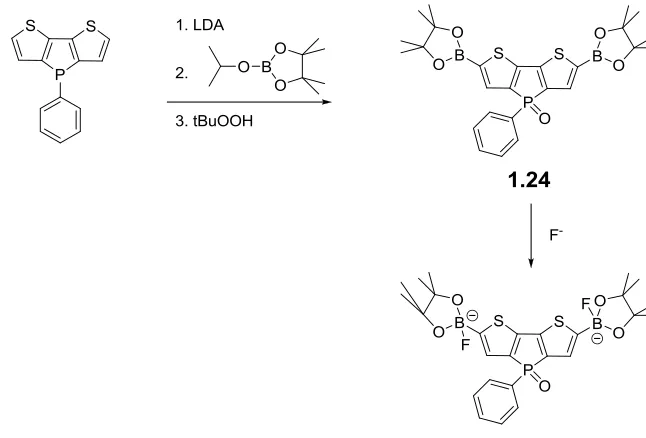
Figure 1.19 Synthesis of bis(boryl)dithienophosphole for sensing fluoride. ...25
Figure 1.20 Structures of poly(thiophene)s for differentiation of amines ...28
Figure 2.1 Schematic representation of chemosensors based on conjugated polymers
with (a) side-chain and (b) main-chain recognition motifs. Black: π-conjugation system, red: recognition motif, blue: analyte, gray: π-conjugation system interrupted by the analytes binding. (c) Molecular modeling of fluoride binding to bis(dioxaborole) by using a DFT B3LYP-6-31G* package in a computational software of Spartan 08 ...36
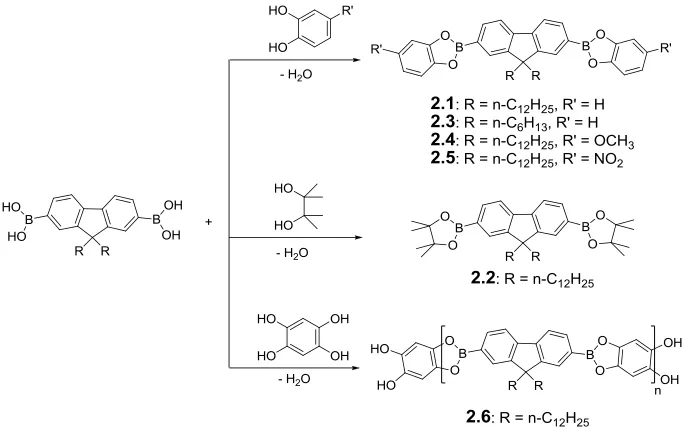
Figure 2.2 Structures of bis- and poly- dioxaboroles 2.1-2.6. ...37
Figure 2.3 Synthesis of bis- and poly- dioxaboroles by dehydration reactions ...39
Figure 2.4 (a) Absorption spectra of bis(dioxaborole)s 2.1 and 2.2 (1×10⁻⁵ M), and (b)
fluorescence spectra of bis(dioxaborole)s 2.1 and 2.2 (1×10⁻⁶ M) in the absence and presence of fluoride in CH2Cl2. ...41
Figure 2.5 (a) Absorption spectra of bis(dioxaborole)s 2.1 and 2.3 (1×10⁻⁵ M), and (b)
fluorescence spectra of bis(dioxaborole)s 2.1 and 2.3 (1×10⁻⁶ M) in the absence and presence of fluoride in CH2Cl2. ...42
Figure 2.6 (a) Absorption spectra of bis(dioxaborole)s 2.1(-H), 2.4(-OCH3) and
2.5(-NO2) (1×10⁻⁵ M), and (b) fluorescence spectra of bis(dioxaborole)s 2.1(-H), 2.4(-OCH3)
and 2.5(-NO2) (1×10⁻⁶ M) in the absence and presence of fluoride in CH2Cl2. (c) The color formation for bis(dioxaborole) 2.5(-NO2) (1×10⁻³ M) with added fluoride (2×10⁻³
M). ...43
Figure 2.7 Absorption titration of 1×10⁻⁵ M bis(dioxaborole)s (a) 2.1(-H), (b)
2.4(-OCH3), and (c) 2.5(-NO2) upon TBAF addition in CH2Cl2 ...48
Figure 2.8 Plots of the change in absorbance at the specific absorption maxima vesus the
concentration of fluoride (linear regression analysis data presented) for (a) 2.1(-H), (b)
2.4(-OCH3) and(c) 2.5(-NO2). (d) Relative response of bis(dioxaborole)s
to fluoride ...49
Figure 2.9 Mole ratio plots of 1×10⁻⁵ M bis(dioxaborole)s (a) 2.1(-H), (b) 2.4(-OCH3)
and(c) 2.5(-NO2) upon TBAF addition in CH2Cl2...50
Figure 2.10 Binding isotherms of 1×10⁻⁵ M bis(dioxaborole)s (a) 2.1(-H), (b)
xv
Figure 2.11 Fluorescence titration of 1×10⁻⁶ M bis(dioxaborole)s (a) 2.1(-H) and 2.4
(-OCH3) upon TBAF addition in CH2Cl2.. ...52
Figure 2.12 Absorption spectra of 1×10⁻⁵ M bis(dioxaborle) 2.1 and complex 2.1-F (2.1:
1×10⁻⁵ M, TBAF: 2×10⁻⁵) in CH2Cl2 in the absence and presence of 2.5×10⁻⁵ M H2O in THF.. ...53
Figure 2.131H NMR spectra (300 MHz, CDCl3) of (a) 15 mM bis(dioxaborole) 2.1, (b)
15 mM 2.1 and 30 mM fluoride with 5 wt% H2O added, (c) 15 mM 2.1 with 5 wt% H2O added, and (d) starting materials of 15 mM 9,9-didodecylfluorene-2,7-diboronic acid and 30 mM catechol with 5 wt% H2O added.. ...54
Figure 2.14 (a) Representation of fluoride-bis(dioxaborole) complexes reacting with
TMSCl. Absorption spectra of 1×10⁻⁵ M bis(dioxaborole)s (b) 2.1(-H), (c) 2.4(-OCH3)
and(d) 2.5(-NO2) in the presence of 2×10⁻⁵ M TBAF upon the addition of excess TMSCl
in CH2Cl2.. ...55
Figure 2.15 Relative change in absorbance for 1×10⁻⁵ M bis(dioxaborole)s responding to
5×10⁻⁵ M Lewis bases in CH2Cl2.. ...56
Figure 2.16 Absorption spectra of (a) saturated solution of poly(dioxaborole) 2.6, 1×10⁻⁵
M bis(dioxaborole) 2.1 and monomers of 9,9-didodecylfluorene-2,7-diboronic acid (DBA) and 1,2,4,5-tetrahydroxybenzene (THB) in CH2Cl2, (b) 1×10⁻⁵ M poly(dioxaborole) 2.6, bis(dioxaborle) 2.1 and monomers in THF, and (c) poly(dioxaborole) 2.6 at different concentrations in THF. (d) Plot of absorbance at 332 nm vesus the concentration of poly(dioxaborole) 2.6 in THF.. ...58
Figure 2.17 Absorption titration of (a) poly(dioxaborole) 2.6 (repeat unit: 5×10⁻⁵ M) and
(b) bis(dioxaborole) 2.1 (5×10⁻⁵ M) upon TBAF addition in THF. (c) Fluorescence titration of poly(dioxaborole) 2.6 (repeat unit: 5×10⁻⁶ M) upon TBAF addition in THF. Plots of the change in absorbance at the specific absorption maxima vesus the concentration of fluoride (linear regression analysis data presented) for (d) poly(dioxaborole) 2.6 and (e) bis(dioxaborole) 2.1. (f) Relative response of poly(dioxaborole) 2.6 to fluoride.. ...59
Figure 3.1 Structures of bis(dioxaborole)s used in the sensor array. ...72
Figure 3.2 Absorption spectra of sensors (10-5 M) of (a) 3.1, (b) 3.2 and (c) 3.3 sensing
anions (2×10⁻⁵ M) in chloroform ...73
Figure 3.3 (a) 2-D LDA plot of discrimination of nine anions by sensor array based on
bis(dioxaborole) 3.1-3.3. (b) Jackknifed classification matrix for sensor array. ...75
Figure 3.4 2-D LDA plot of anion discrimination by sensor array based on
xvi
Figure 3.5 2-D LDA plot of discrimination of nine anions by sensor array based on
bis(dioxaborole) (a) 3.1, (b) 3.2, and (c) 3.3 ...77
Figure 4.1 Structures of D-π-A triphenylaminoboroles 4.1-4.7 ...86
Figure 4.2 Synthesis of boroles 4.1-4.7 by condensation reactions ...87
Figure 4.3 FT-IR spectra of (a) dioxaborole 4.2, (b) diazaborole 4.7, (c) catechol and (d)
benzene 1,2-diamine ...89
Figure 4.4 1H NMR spectra of (a) free boronic acid, (b) boronic acid with added water,
(c) dioxaborole 4.2, (d) dioxaborole 4.4, (e) diazaborole 4.7 and (f)
benzene 1,2-diamine. ...90
Figure 4.5 Molecular structure of bis(dioxaborole) 4.3. All atoms are shown with 60%
probability level of displacement ellipsoids. Atoms labeled with asterisk (*) are related to their unstarred counterparts by inversion...92
Figure 4.6 Packing view of bis(dioxaborole) 4.3 of (a) phenyl-boron-phenyl π-stacking
and (b) CH-O hydrogen bonding ...93
Figure 4.7 Absorption spectra of (a) monomer 4.2, (b) dimer 4.3 and (c) timer 4.4 at
different concentration in CH2Cl2. Plots of absorbance at the absorption maxima vesus the concentration of (a) 4.2, (b) 4.3 and (c) 4.4 in CH2Cl2. ...95
Figure 4.8 Absorption spectra of boroles of (a) 4.1-4.4 and (b) 4.2, 4.5-4.7 with 1.8 × 10
-5
M boron in CH2Cl2 ...96
Figure 4.9 (a) Intramolecular charge transfer of boroles. Fluorescence spectra of boroles
of (b)-(h) 4.1-4.7 with 1.8 × 10⁻⁶ M boron in solvents of increasing polarities from hexane (blue), toluene (red), ether (green), THF (purple) to CH2Cl2 (orange) ...99
Figure 4.10 Plots of energy of 1.8 × 10⁻⁶ M borole 4.1 (red), 4.2 (blue) and 4.7 (green)
versus (a) ET(30), (b) Py and (c) Pi* value. (d) Relative response of boroles to different values ...101
Figure 4.11 Absorption spectra of borole (a) 4.1 and (b) 4.2 (1.8 × 10⁻⁵ M) and
fluorescence spectra of (c) 4.1 and (d) 4.2 (1.8 × 10⁻⁶ M) in the absence and presence of one equivalent of fluoride in CH2Cl2 ...102
Figure 4.12 Absorption titrations of borole (a) 4.2, (b) 4.3 and (c) 4.4 (boron: 1.8 × 10⁻⁵
xvii
Figure 4.13 Mole ratio plots of borole (a) 4.2, (b) 4.3 and (c) 4.4 and binding isotherms
of (d) 4.2, (e) 4.3 and (f) 4.4 (boron: 1.8 × 10⁻⁵ M) upon the addition of fluoride in CH2Cl2...105
Figure 4.14 Absorption spectra of fluoride-borole (a) 4.2 and (b) 4.4 complexes upon the
addition of excess TMSCl in CH2Cl2 (boron: 1.8 × 10⁻⁵ M, fluoride: 1.8 × 10⁻⁵ M) ...106
Figure 4.15 Degree of the absorbance response of boroles 4.2-4.4 (boron: 1.8 × 10⁻⁵ M)
upon the addition of 9×10⁻⁵ M Lewis bases in CH2Cl2 ...107
Figure 5.1 Structures of D-π-A triphenylamino bis- and poly- boroles ...128
Figure 5.2 Synthesis of boroles 5.1-5.2 ...129
Figure 5.3 (a) Absorption spectra of 2×10⁻⁵ M boroles 5.1-5.2 in CH2Cl2. (b) Absorption
spectra of bisborole 5.1 at different concentration in CH2Cl2, insert: plot of absorbance at the absorption maxima vesus the concentration of 5.1 in CH2Cl2. ...130
Figure 5.4 (a) Representation of intramolecular charge transfer of polyboroe 5.2. (b)
Fluorescence spectra of 5.2 (saturated solutions in hexane and ether, 5×10⁻⁶ M in toluene and THF, and 2×10⁻⁶ M in CH2Cl2). Plots of energy of 5.2 versus (a) ET(30), (b) Py, and (c) Pi* values...132
Figure 5.5 Absorption titrations of 2×10⁻⁵ M borole (a) 5.1 and (b) 5.2, and fluorescence
titrations of 2×10⁻⁶ M (c) 5.1 and (d) 5.2 upon the addition of fluoride in CH2Cl2. (e) Mole ratio plot, and (f) binding isotherm of 2×10⁻⁵ M bisborole 5.1 upon the addition of fluoride in CH2Cl2 ...134
Figure 5.6 Absorption spectra of fluoride-borole (a) 5.1 and (b) 5.2 complexes upon the
addition of excess TMSCl in CH2Cl2 (borole: 2×10⁻⁵ M, fluoride: 4×10⁻⁵ M). ...135
Figure 5.7 Degree of the absorbance response of borole 5.1 and 5.2 (2×10⁻⁵ M) upon the
addition of Lewis bases (10-4 M) in CH2Cl2 ...136
Figure 6.1 Structures of catechols or diamines and diboronic acids to synthesize new
boroles ...146
Figure 6.2 Synthesis of D-π-A polymer from triphenylamine diboronic
acid and THB ...147
Figure 6.3 Synthesis of D-π-A boroles ...149
Figure 6.4 Plots of computed band gap vesus Hammett sigma constant for borole (a)
6.10-6.14 and (b) 6.12, 6.15-6.19. ...153
xviii
1
C
HAPTER1
O
VERVIEW OFO
RGANOBORONM
ATERIALS INC
HEMICALS
ENSORS1.0INTRODUCTION
With regard to sensing applications in industry, medicine and the environment,
the need for better sensory materials is urgent.1-3 Efforts have been made to develop
materials, which can be easily synthesized with tuned properties and can also detect
analytes with a high selectivity and sensitivity.4 Among the π-conjugated compounds,
conjugated polymers with the recognition motif in the main-chain may provide a
possibility as better sensory materials.5-11
Organoboron compounds, with Lewis acidic boron centers, extend π-conjugation.
These compounds, including boranes and boronate esters, have emerged as an important
class of materials, especially in the area of chemical sensors.12 Among them, boranes are
relatively well-studied and used to detect Lewis bases, based on the hard Lewis acid-base
interactions.13-27 Their sensing modes can be easily tuned by charge transfer, geometric
changes, and metal chelation.17-27 Boronic acid is known to detect sugars, based on
covalent but reversible boronate ester formation.28-35 This interaction has recently been
used to detect hydrogen peroxide36 and Lewis bases37-39.
Herein, organoboron materials from the sensing perspective will be overviewed.
Before that, the background of chemical sensors, especially the optical sensors will be
2
discussed. Then, organoboron compounds of boranes and boronate esters will be
discussed in detail. Interesting examples of synthesis and sensing applications of
boron-containing conjugated polymers will be highlighted.
1.1CHEMICAL SENSORS
Chemical sensors are analytical devices that convert chemical information such as
composition and/or concentration into a physical signal.1 Sensors usually consist of two
units: recognition motifs and signal transducers. Recognition motifs bind with and/or
recognize analytes, while signal transducers transform the recognized information into an
optical, electrochemical or electric signal (Figure 1.1). Due to their simple operation,
low cost, and compact size, chemical sensors have drawn great attention from both
academic and practical usage, including industry, medicine and environmental
monitoring.2
Figure 1.1 Principle and composition of chemical sensors.
As a branch of chemical sensors, optical sensors employ transduction techniques
based on absorbance and fluorescence.3 These optical sensing methods have the good
attributes, including fast response, low cost, and high selectivity and sensitivity, making
3
recognition motif and/or transduction platform have drawn great attention. Efforts have
been made to discover better materials with the following attributes: (1) easy to
synthesize; (2) optical properties can be easily tuned; and (3) can be used to detect the
analyte with a high selectivity and sensitivity.4
1.2CONJUGATED POLYMERS
Conjugated polymers (CPs) have attributes that make them better sensing
materials in optical sensors.5,6 For instance, CPs have excellent optical properties, which
can be easily tuned by modification of their repeat units. Moreover, these optical
properties are quite sensitive to external stimuli, including solvent, temperature, and
charge changes. Thus, CPs can act as transducers in sensors, transferring a chemical
event into optical (fluorescent or colorimetric) signal with a high sensitivity.
As early as 1995, the Swager group explored the origins of highly sensitive CPs.7
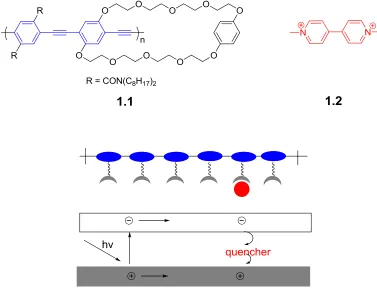
They found that the fluorescence of poly(p-phenylene ethynylene) 1.1 with a
dibenzocrown ether repeat unit could be easily quenched by the cationic paraquat 1.2.
The quenching efficiency of polymer was 65 times that of monomer. They attributed the
enhanced fluorescence quenching to the “molecular wire effect” (Figure 1.2). In CPs,
photons are excited to generate electron-hole pairs, which migrate along the main chain
of polymer. The cationic paraquat traps an electron-rich dibenzocrown ether unit by an
electrostatic interaction. Due to the fast energy migration, the fluorescence of the
4
Figure 1.2 “Molecular wire effect” of conjugated polymers.7
Based on the above features, CPs have been used as signal transducers in
chemical sensors.5,6 Within these sensors, recognition motifs can be incorporated into the
side-chains or embedded in the main-chains of polymers. In the peripheral side-chain
approach (Figure 1.3a),8 the electronic properties and/or main-chain conformation are
perturbed when a target binds to the recognition motifs, resulting in optical change.9 For
instance, the Lavigne group attached a carboxylic acid recognition unit to the side chains
of poly(thiophene) 1.3. The added diamine analytes (such as 1,2-ethylenediamine 1.4)
had an interaction with the carboxylic acid, leading to the main-chain twisting, leading to
5
cross-reactive poly(thiophene) polymers could identify structurally similar amines or
biogenic amines, creating a colorimetric sensor for food spoilage.10
Figure 1.3 Conjugated polymer-based chemical sensors in (a) side-chain and (b)
main-chain approaches (black: π-conjugation system, red: recognition motif, blue: analyte, gray: π-conjugation system interrupted by analytes binding).8
Reproduced by permission of The Royal Society of Chemistry.
In the main-chain approach (Figure 1.3b),8 the binding sites are embedded in the
polymer backbone. The binding of analytes changes the π-conjugation of the polymer
backbone. For example, the recognition motif of 2,2’-bipyridine was incorporated into
the main-chain of a phenylene-vinylene-based polymer 1.5. The metal ions analytes 1.6
that bound to 2,2’-bipyridine forced the polymer to be planar and highly ionochromic.
Thus, this polymer could be used as a promising ion-responsive material.11 Although the
side-chain approach is common, the main-chain approach has a direct impact on
6
the signal transducer would afford an enhanced signal generation, thus providing a more
sensitive sensing strategy.
1.3BORANES
Organoboron compounds, especially boranes, have recently emerged as an
important class of materials due to their interesting optical and electronic properties.12
With an empty p orbital, the electron-deficient boron center can act as a Lewis acid or
electron acceptor, which shares the electrons from neighboring π systems and extends
π-conjugation. When connected to an electron donor, a borane can form a
donor-π-acceptor system, resulting in intramolecular charge transfer. Thus, boranes have wide
applications in several areas, including chemical sensors for Lewis bases, blue emitters
and charge-transporters in organic light-emitting devices (OLEDs), non-linear optics and
two-photon emitting materials.12 Herein, sensing applications of borane-based small
molecules and polymers will be discussed in detail.
1.3.1 BORANES IN SENSORS
Boranes with a Lewis acidic boron center extend π-conjugation by interaction of
its vacant p orbital with the electrons from the neighboring π-systems, such as aryl rings.
Sensing applications of boranes are usually based on Lewis acid-base interactions
between boron centers and Lewis bases. As shown in Figure 1.4, the added Lewis base
or nucleophile coordinates with the boron and interrupts π-conjugation, resulting in a
geometric change of the boron moiety from trigonal planar to tetrahedral. The optical
7
decrease in absorbance and/or quenching of fluorescence.12b Based on this, sensors of
borane-based small molecules as well as polymers have been developed and will be
discussed below.
Figure 1.4 Principle of boranes sensing Lewis bases (π refers to π-conjugated system and
LB refers to Lewis base).12b
1.3.1.1BORANE-BASED SMALL MOLECULES
The sensing applications of boranes started with fluoride detection, which took
advantage of the well-known Lewis acid-base interactions between boron and fluoride.
The seminal work by the Yamaguchi group developed a colorimetric fluoride sensor
based on trianthrylborane.13 Tri(9-anthryl)borane 1.7 was synthesized from the
organometallic reaction between 9-anthryllithium and BF3. When fluoride was added,
the extended π-conjugation through the p orbital on boron was interrupted. Thus, the
absorption band of borane blue shifted from 470 nm to 360-410 nm. The color changed
accordingly from orange to colorless, which was visible to the naked eye. Upon the
addition of water, the resultant fluoroborate was returned to the borane, which confirmed
the binding reversibility of this system. Tri(9-anthryl)borane showed a selective binding
to fluoride with a binding constant of (2.8±0.3)×105 M-1, while it showed a smaller
binding constant for AcO- and OH- of 103 M-1 and no binding response to larger anions
8
Figure 1.5 Structure of borane used for sensing fluoride.13
1.3.1.2POLY(BORANE)S
Conjugated polymers have been emerged as important sensory materials, mostly
due to their signal amplification from the molecular wire effect.7 Incorporation of boron
centers in the main-chain, poly(borane)s have been investigated in sensing Lewis bases,
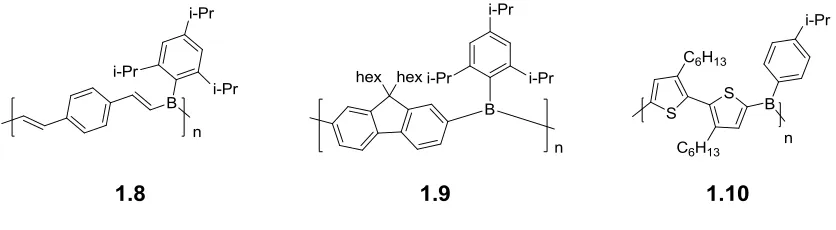
such as fluoride, cyanide and amines. The first poly(borane) 1.8 was reported by the
Chujo group to sense fluoride.14 The polymer (Figure 1.6) was synthesized by the
hydroboration polymerization of diyne. The resultant polymer in chloroform showed an
absorption maximum at 377nm, which showed a blue-shift upon the addition of fluoride.
However, the polymer did not response to large anions, including Cl-, Br- and I-,
indicative of the strong hard Lewis acid-base interaction between boron and fluoride.
The addition of 0.5 equiv. of fluoride could quench fluorescence of the blue emissive
9
Figure 1.6 Structures of poly(borane)s14-16 used for sensing Lewis bases.
Apart from fluoride, poly(borane)s can be used to detect other anions, such as
cyanide.15 For example, poly(fluorenylborane) 1.9 (Figure 1.6) was cross-reactive to
fluoride and cyanide. 15 The polymer was synthesized by an organometallic
polycondensation between fluorenyl dibromoborane and fluorenyl ditin, followed by
post-modification with an arylcopper. Upon the addition of fluoride or cyanide, the
absorption maxima of the polymer blue-shifted and the fluorescence intensity at 403 and
425 nm decreased while a new band at 475 nm developed, due to the intramolecular
charge transfer from the electron-rich borate to the electron-deficient borane.
In addition to anions, poly(borane)s can be used to detect amines.16 For example,
the thiophene functionalized poly(borane) 1.10 (Figure 1.6) was developed by the Jäkle
group.16 The polymer was synthesized by an organometallic polycondensation between
aryl boron dibromide and distannylated bithiophene. Complexation of pyridine to the
polymer gave an upfield chemical shift in the 11B NMR spectra, confirming the geometric
change of boron moiety from a trigonal planar to tetrahetral. The coordinated pyridine
was removed by the addition of B(C6F5)3, which demonstrated the reversible binding
10
polymer showed a blue-shift of the absorption maximum and fluorescence quenching.
Interestingly, sterics and electronics influenced the sensing behaviors.
1.3.2 DONOR-Π-ACCEPTOR BORANES
Boranes with electron-deficient boron centers can also act as electron acceptors.
By linking with electron donors such as amino groups, boranes can form
donor-π-acceptor (D-π-A) systems. These systems are highly polarized when excited with light,
leading to intramolecular charge transfer.12 Upon the binding of Lewis base analytes to
the boron centers, the optical properties, especially fluorescence, is changed. Thus,
D-π-A boranes have promising applications as chemical sensors for Lewis bases.
According to the relative positions of donor and acceptor, these systems have
three general structures.12 As shown in Figure 1.7, the donor and acceptor can be located
at the terminals of a π-system to form a linear or a curved U-shaped structure. The donor
and acceptor can also be at the lateral positions of a π-system to form a cruciform
structure. Due to their diverse structures, optical properties and sensing abilities of
A boranes are easily tuned. Herein, some interesting examples of sensors based on
D-π-A boranes will be highlighted.
a b c
Figure 1.7 D-π-A boranes with a (a) linear structure, (b) U-shaped structure, and (c)
cruciform structure.12
N π B
B
B
N π N
11
1.3.2.1LINEAR D-Π-A BORANES
A typical example of linear D-π-A triarylboranes was reported by the Wang
group.17 In D-π-A borane 1.11 (Figure 1.8), triarylamine acts as an electron donor and
mesitylborane acts as an electron acceptor. These groups are linked by a biphenyl group.
The donor was attached by Ullmann condensation, while the acceptor was attached by
organolithium chemistry.18 The resultant borane showed a fluorescent solvent response,
due to the intramolecular charge-transfer from the amine to the boron moiety. Upon
fluoride binding, the fluorescence of the borane was quenched. Fluoride coordination
increased the electron-density on the boron center and turned off charge-transfer. The
binding was selective to fluoride, because the bulky mesityl groups around boron blocked
large analytes, such as chloride or bromide. Similar sensors based on D-π-A boranes
were also designed by modification of linkers and electron donors. For instance,
stilbene19 or pentaphenylene20 were used as linkers. Porphyrin21 or tetrathiafulvalene22
were used as electron donors.
Figure 1.8 Structures of linear D-π-A borane17 and poly(borane)23 for sensing fluoride.
Linear D-π-A borane can also be incorporated in conjugated polymers. For
example, the Jäkle group reported D-π-A poly(borane) 1.12.23 The polymer (Figure 1.8)
12
and a fluorenyl- diboron monomer. Then, the bulky triisopropylphenyl group on boron
was post-modified for protection. The resultant polymer had a relatively high molecular
weight (Mw = 13,000). Moreover, it showed an intense emission depending on the
solvent polarity, due to intramolecular charge-transfer. The addition of small anions,
such as fluoride or cyanide, allowed the absorption maximum to be blue-shifted and the
fluorescence quenched. However, large anions such as chloride, bromide or nitrate did
not result in any optical change to the polymer.
Interestingly, the titration of cyanide showed a distinct two-step binding to the
polymer. First, one equiv of cyanide bound to borons with a higher Lewis acidity. The
absorption maximum blue-shifted from 422 nm to 405 nm, indicating a charge-transfer
with a higher energy. During this process, the fluorescence of the polymer at 459 nm was
quenched when ≤ 0.3 equiv of cyanide was added. After that, a new emmisive band
appeared at 550 nm and then blue-shifted to 510 nm, due to the charge-transfer from the
formed tetracoordinate boron to the neighboring tricoordinate boron. Second, more than
one equiv of cyanide bound to the other boron. The new absorption bands appeared in
the region from 270 to 325 nm and fluorescence at 510 nm was quenched, indicating that
the intramolecular charge-tranfer was turned off.
The Lewis-base sensing modes of D-π-A boranes can be easily tuned by
incorporation of linker chelating metals.24 For instance, the Wang group24 designed the
Pt(II)-borane complex 1.13 (Figure 1.9). The complex was synthesized from the
organometallic reaction between 2,2’-bipy lithium salt and BMes2F, then the resultant
13
enhanced, which was confirmed by electrochemical methods. The complex showed a red
color, due to the metal-to-ligand charge transfer (MLCT).
The fluoride titration showed a two-step binding to the boron sites in 1.13. The
addition of ~1 equiv of fluoride changed the color from red to orange, while the addition
of ~2.5 equiv of fluoride changed the color further to light yellow. The absorption
maxmium was accordingly blue-shifted, because fluoride binding increased the LUMO
energy of the ligand and turned off MLCT. Binding constants of K1 ≥ 109 M-1 and K2 =
106 M-1 were measured by absorption titration. Although 1.13 was not fluorescent,
complex 1.14(Figure 1.9) with one boron center changed to amine showed “turn-on”
fluorescent response to fluoride.
Figure 1.9 Structures of metal chelated D-π-A boranes24 for sensing fluoride.
1.3.2.2U-SHAPED D-Π-A BORANES
Apart from the linkers and donor-acceptor pairs, charge-transfer is also dependent
on the molecular geometry, which can be used to tune the sensing modes. For example,
the Wang group17 synthesized the U-shaped D-π-A borane 1.15 (Figure 1.10). It showed
solvatochromism by fluorescence, resulting from the intramolecular charge-transfer from
14
wavelength blue-shifted from 504 to 453 nm, while fluorescent intensity was enhanced.
The emissive color was accordingly changed from green to blue, making it an unusual
“turn-on” sensor for fluoride. This occurred because the fluoride binding to boron
interrupted the charge-transfer and activated the highly emissive amine moiety. 19F NMR
spectrum showed the binding ratio between boron and fluoride was 1:1. Fluorescent
titration indicated that the binding constant was > 4.0 × 10⁴ M-1. Large ions, such as
chloride, bromide or iodide, did not compete with the fluoride sensing. The sensor also
showed reversibility, when water was used to extract fluoride. In addition to U-shaped
D-π-A boranes, V-shaped systems25 were also developed to sense fluoride.
Figure 1.10 Structure of U-shaped D-π-A borane17 used to sense fluoride.
1.3.2.3CRUCIFORM D-Π-A BORANES
Cruciforms, possessing spatially separated molecular obitals, have recently been
developed as a new class of sensing materials. When analytes bind, either the HOMO or
LUMO of cruciforms will change, leading to a dramatic optical change, especially in
their emission properties. Pioneered by the Bunz group, cruciforms have been studied as
15
As mentioned before, nitrogen and boron are an excellent electron donor-accepter
pair. The Zhao group27 put the LUMO located boron moiety and HOMO located amine
moiety in a perpendicular position to form a cruciform-type D-π-A borane 1.16 (Figure
1.11). The borane cruciform was synthesized by a Sonogashira coupling reaction,
followed by a Suzuki coupling reaction. The resultant borane showed an emission
dependant on the solvent polarity, due to intramolecular charge-transfer from the amine
to the borane moiety. Upon the addition of fluoride, the fluorescence at 540 nm
decreased, while the fluorescence at 442 nm increased. Accordingly, the emissive color
changed from yellow to blue. The large blue-shift of the emission wavelength (up to 100
nm) was because the fluoride binding increased the LUMO energy and turned off
charge-transfer. The binding constant was calculated to be 3.27×10¹⁰ M-2. The cruciform
also showed a response to fluoride in the solid-state.
16 1.3.3 CONSIDERATIONS
Boranes, with Lewis acidic boron centers, have emerged as an important class of
optoelectronic materials. The optical and/or electronic properties of these materials can
easily be tuned by the modification of their π-systems. When attached to an
electron-donor such as an amine, boranes form D-π-A systems resulting in intramolecular
charge-transfer.12 The structures of D-π-A boranes can be altered by modification of linkers,
metal chelation, and molecular geometry, leading to intriguing optical and/or electronic
properties, including absorbance, fluorescence, phosphorescence, and/or
electrochemistry.12 These properties can be utilized to develop versatile optical sensors
for Lewis bases, based on the Lewis acid-base interactions.13-27
However, boranes are usually synthesized by organometallic chemistry, under
stringent conditions without water and oxygen and require tedious workup procedures
using column chromatography. Moreover, these materials are relatively unstable toward
water and oxidation, because of their highly electron-deficient boron centers.12 Thus,
bulky substituents, such as 2,4,6-trimethylphenyl (Mes) groups are often incorporated at
the ortho- position on arylboranes to prevent nucleophilic attack. The employed bulky
groups limit sensing to small Lewis bases, such as fluoride and cyanide. However, they
prevent access to larger Lewis bases and lower the sensing abilities. Thus, better
materials other than boranes are required to develop sensors for Lewis bases.
1.4BORONATE ESTERS
Boronic acid reacts with diols to form boronate esters.28 This reaction, with its
17
great attention in the building of boronate-linked complex materials, such as polymers
29-32
and covalent organic frameworks33,34. Compared with the previously mentioned
boranes, boronate esters have the advantages of facile synthesis, tuned optoelectronic
properties, enhanced stability and planar structures. Thus, boronate esters have been
explored as the sensory materials for detecting hydrogen peroxide36 and Lewis bases37-39.
In this section, some interesting examples of boronate-linked materials will be
highlighted. Optical sensors based on boronate esters will also be discussed.
1.4.1 BORONATE-LINKED MATERIALS
Boronic acids reacts with 1,2- or 1,3- diols to produce boronate esters (Figure
1.12).28 The resultant water is usually removed to push the reversible reaction to
completion. The formation of boronate esters has been used to assemble complex
materials, such as polymers and colavent organic frameworks, which will be discussed in
detail herein.
Figure 1.12 Formation of boronate esters from boronic acid and diol.28
1.4.1.1BORONATE-LINKED LINEAR POLYMERS
After intensively researching oligomeric boronate esters,29 the Lavigne group
incorporated the boronate ester moiety into the main-chain of a linear polymer
18
six-membered cyclic boronate ester.30 As shown in Figure 1.13, polymer 1.17 was
synthesized by a condensation reaction between fluorenyl diboronic acid and
pentaerythritol in toluene, with the removal of water by a Dean-Stark trap. It was soluble
in aprotic solvents, such as toluene, dichloromethane and hexane. Gel permeation
chromatography (GPC) determined that the polymer had an Mw of 28,000 with 58 repeat
units and was stable for days in dry dichloromethane. The polymer could be easily
modified by changing the ratio of diboronic acids and diols, reaction time, or
post-polymeriztion process. The polymer was shortened under hydrolytic conditions, while it
was self-repaired by storage under reduced pressure.
Figure 1.13 Synthesis of poly(dioxaborolane)30 and poly(dioxaborole)31.
Apart from the self-repairing poly(dioxaborolane), poly(dioxaborole) 1.18 was
also reported by the Lavigne group.31 The dioxaborole repeating unit refers to the
aromatic five-membered cyclic boronate ester. As shown in Figure 1.13, polymer 1.18
was synthesized by a facile condensation between fluorenyl diboronic acid and
1,2,4,5-tetrahydroxybenzene. After the azeotropic removal of water, the polymer was obtained
with a high yield of ~ 90% in 30 min. It was soluble in non-polar solvents, including
19
Mw of ~25,000 and PDI of 2.4. Polymers with higher molecular weights could easily be
synthesized by lengthening the reaction times. However, the resultant polymers had
limited solubility in organic solvents. Compared to the diester or the non-conjugated
poly(dioxaborolane), the conjugated poly(dioxaborole) had a red-shifted absorption and
emission wavelengths. These results indicated that there was an extended π-conjugation
through the backbone of the polymer, due to the overlap of the vacant p orbital on boron
with the lone pairs on the neighboring oxygen atoms. The effective conjugation length
was calculated to be 3-5 bridging repeat units. This polymer had potential applications as
a blue-emissive material in OLEDs.
1.4.1.2BORONATE-LINKED COORDINATION POLYMERS
Based on the coordination between boron and amine, the boronate-linked
coordination polymer 1.19 was developed by the Severin group.32 The polymer was
synthesized by a three-component one-pot reaction (Figure 1.14). Substituted phenyl
boronic acid, 1,2,4,5-tetrahydroxybenzen and 1,2-bis(4-pyridyl)ethylene were mixed in a
2:1:1 ratio and heated in benzene. After the reaction mixture was cooled down, the
dark-purple self-assembled polymer precipitated. The polymer was dissolved in hot
chloroform, but it fell apart to give the pyridyl linker and boronate diester, due to the
weak dative B-N bond. However, if it was cooled down, it went back to the precipitated
polymer, indicating the reversibility of the process. Computational studies showed that
the intense color was the result of the intramolecular charge-transfer from
20
Figure 1.14 Synthesis of coordinated poly(boronate).32
1.4.1.3COVALENT ORGANIC FRAMEWORKS
Apart from polymers, boronate ester formation can be used to build larger
systems, such as covalent organic frameworks (COFs). COFs are porous materials,
which have potential applications in gas storage, catalysis, and separation. The Yaghi33
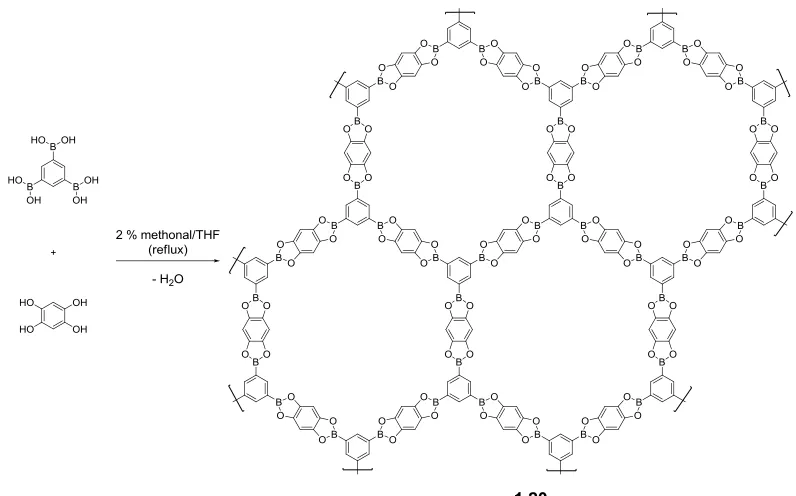
and Lavigne group34 did seminal work in the COF area. For example, the Lavigne group
synthesized COF-18Å 1.20 with pores of 18 Å diameters. The compound was obtained
by the dehydration reaction of benzene-1,3,5-triboronic acid and
1,2,4,5-tetrahydroxybenzene which were refluxed in 2 % methanol/THF for three days (Figure
1.15). After workup, the product was obtained with a yield of 85-95%. COF-18Å
showed a highly crystalline network, with thermal stable pores (> 500 °C), high surface
21
Figure 1.15 Synthesis of COF-18 Å.34
1.4.2 BORONATE ESTERS IN CHEMICAL SENSORS
Apart from use as building blocks for complex materials, the formation of
boronate esters can be applied in the sensing area. Well-known examples are to sense
sugars, using the covalent but reversible interaction between boronic acids and cis
-diols.35 Recently, boronate esters have been used to detect hydrogen peroxide, due to the
oxidative deprotection of boronates by hydrogen peroxide.36 Similar to boranes, boronate
esters are also reported to detect Lewis bases, because of the Lewis acidic boron
centers.37-39 In this section, interesting examples of boronate esters in chemical sensors
22
1.4.2.1SENSING SUGARS
The formation of boronate esters provides a sensing tool for saccharides, which
are difficult to detect in aqueous solutions.35 The first fluorescent sensor for sugars was
reported by the Czarnik group (Figure 1.16).35 Anthrylboronic acid 1.21 was emissive at
416 nm, due to the fluorescent anthracene moiety. When fructose was added, fructose
bound to the boronic acid, lowering its pKa from 8.8 to 5.9. In aqueous solution (pH =
7.4), the boronate anions were dominant The boronate anions were non-fluorescent, due
to photoinduced electron-transfer (PET) quenching. Thus, anthrylboronic acid could be
used to detect fructose by the fluorescent turn-off mechanism.
Figure 1.16 Principle of the first fluorescent sensor for sugars based on anthrylboronic
acid.35
1.4.2.2SENSING HYDROGEN PEROXIDE
Apart from sugars, boronate esters can be used to detect hydrogen peroxide,
which can be produced from peroxide explosives by UV or acid-catalyzed
23
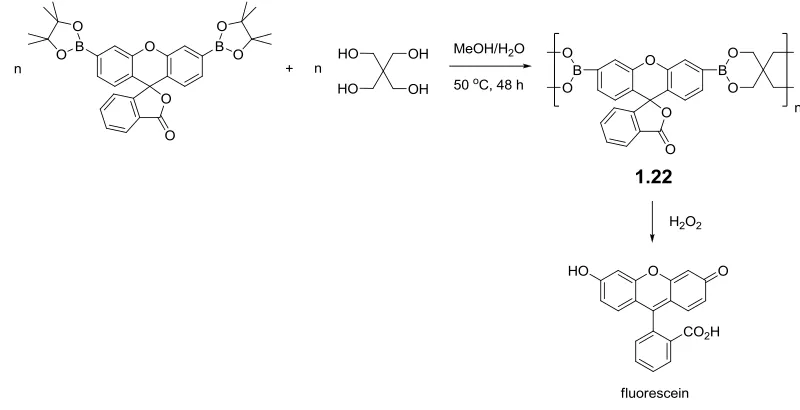
1.22 to detect vapor and liquid H2O2. The polymer was synthesized by the
transesterification polymerization between 3’,6’-bis(pinacolatoboron)fluoran and
pentaerythritol in MeOH-H2O at 50 °C for two days (Figure 1.17). After workup, the
polymer was obtained in a good yield of 75%. Molecular weight was determined to be
10,000 by GPC with a PDI of 1.5. As a thin-film, the polymer was non-fluorescent.
When exposed to 2.9 ppm of H2O2 vapor for 3.5 h, the fluorescent intensity at 510 nm
increased eight-fold, due to the oxidative deprotection of boronate ester by hydrogen
peroxide and the release of fluorescent fluorescein. The detection limit was 3 ppb after 8
h of exposure to hydrogen peroxide. In addition, the polymer could also detect 30 ppm of
H2O2 in water by the solution spot test after 3s.
Figure 1.17 Synthesis of the functionalized poly(boronate)36 used for sensing hydrogen
24
1.4.2.3SENSING LEWIS BASES
Similar to boranes, boronate esters have been reported as sensory materials for
Lewis bases. For example, the James group developed bis(bora)calixarene 1.23 (Figure
1.18) as a fluorescent fluoride sensor.37 The compound was synthesized by an
organometallic reaction between tetralithiated calixarene and dichlorophenylborane.
Calixarene was a rigid scaffold, providing the bidentate boron centers for fluoride. Thus,
the addition of fluoride quenched the fluorescence of 10-2 M bis(bora)calixarene in
chloroform. However, chloride or bromide made no significant optical change to
bis(bora)calixarene, indicating the selective binding with fluoride. The binding constant
for the fluoride complex was calculated as logK = 6.3 ± 0.4.
Figure 1.18 Structure of bis(bora)calixarene37 for sensing fluoride.
Similarly, the Baumgartner group38 developed bis(boryl)dithienophosphole 1.24
as a sensory material for fluoride. As shown in Figure 1.19, dithienophosphole was
lithiated by LDA and borated, followed by an oxidation by tert-butylhydroperoxide. The
generated phosphole showed absorption maximum at 398 nm and emission maximum at
452 nm. The addition of fluoride made the absorption and emission maximum red shift
25
significant response to phosphole, indicating the binding selectivity of fluoride.
Fluorescence titration showed the binding constants of logK1 = 4.02(8) and logK2 =
3.79(8). Fluoride at a low concentration as ppm could be detected by the fluorescent
phosphole, while fluoride as low as 10-5 M could be recognized by the naked eye, upon
the irradiation at 366 nm. A similar example can also be found in literature.39
Figure 1.19 Synthesis of bis(boryl)dithienophosphole38 for sensing fluoride.
1.4.3 CONSIDERATIONS
Boronate esters are formed between boronic acids and cis-diols.28 As early as
1992, the formation of boronate esters was used to detect sugars.35 Moreover, boronate
esters have been investigated as the building blocks to construct complex materials,
including polymers29-32 and covalent organic frameworks33,34. These materials have
26
esters are also used for hydrogen peroxide detection, using the oxidative deprotection of
boronate esters.36
As mentioned before, borane-based small molecules and polymers have been
well-studied in sensing Lewis bases.12 However, boranes suffer from disadvantages,
including complicated syntheses, instability toward water and oxidation, and crowded
structure.12 Compared to boranes, boronates can be synthesized by the catalyst-free
dehydration between boronic acids and 1,2- or 1,3- cis-diols, under mild conditions with
high yields.29-31 The optical or electronic properties can be easily tuned by modification
of the boronic acid and diol moieties. In addition, boron centers can be incorporated into
five- or six- membered heterocyclic ring to form dioxaborolane or dioxaborole, which
have enhanced stability toward air and moisture. Although a few boronate esters have
been reported to sense fluoride, the incomplete π-conjugation through boronates may
limit their sensing abilities.37-39
1.5CROSS-REACTIVE SENSOR ARRAYS
Traditional sensors use a single variable to read and analyze transduction
signals.40 For instance, the previously discussed examples of fluoride sensing by boranes
are “lock and key” type sensors. However, these sensors cannot differentiate multiple
structurally and/or chemically similar analytes or meet the demand of complex analytical
problems in environmental, industrial, biological or medical processes.41
Inspired by the nature’s use of mammalian olfactory and gustatory systems,
cross-reactive sensor arrays were developed to differentiate multiple analytes. Each sensor has
27
on one, two or multiple dimensions. These dimensions form the fingerprint patterns of
sensor arrays, which can be differentiated using statistical techniques.40
1.5.1STATISTICAL TECHNIQUES FOR PATTERN RECOGNITION
The applications of statistical techniques to deal with multivariate analysis for
pattern recognition dated back to 1971.42 Several statistical methods were commonly
used in cross-reactive sensor arrays, including principal component analysis (PCA) and
linear discriminate analysis (LDA). LDA minimizes the variation in the patterns within
each analyte group, while it maximizes the differences in the patterns between different
groups.
1.5.2SINGLE/MULTIPLE DIMENSIONAL RROSS-REACTIVE SENSOR ARRAYS
The simplest sensor arrays are based on one sensor, providing a pattern for each
target by one wavelength response. For example, the Chang group reported a
colorimetric sensor array to differentiate cations.43 This array used 47
commercially-available dyes as one sensor called New York Tongue 1: (NYT-1) to test 47 cations
including 44 metal cations. The recognition pattern of each analyte was formed by one
wavelength response at the absorption maxima of each dye. By grouping the alkali-metal
ions as one analyte, cations were identified with the accuracy of 99.4 % and quantified
with the accuracy of 96.8 % by PCA analysis.
The dimensions of sensor arrays can easily be increased using multiple
wavelength response. For example, the Lavigne group developed a sensor using
28
structurally similar diamines. The response was based on electrostatic and
hydrogen-bonding interactions between the analytes and the polymer, which were coupled to π-π
interactions between polymer chains and analyte-induced polymer aggregation. LDA
was used to classify the patterns and differentiate the diamines by multiple wavelengths
response in the entire spectra. In an organic solution,9a nine wavelengths or dimensions
were selected to identify and quantify six diamines by LDA with the accuracy over 99%.
In the aqueous solution,9c 36 wavelengths were chosen to identify and differentiate 22
biologically relevant amines by LDA with 97% accuracy. A multi-layered analysis was
further developed to enhance accuracy, categorize analytes and determine
concentration.9b
Figure 1.20 Structures of poly(thiophene)s9,44 fordifferentiation of amines.
Dimensions of cross-reactive sensor arrays can be increased further by using
multiple sensors. For instance, the Lavigne group44 used poly(thiophene) 1.26 (Figure
1.20) to sense soft metal ions in a competitive two-step approach. Metal ions were added
to precipitate the polymer, then a competitive ligand of diamine was used to re-dissolve
the assembly of metal ions and polymer. 36 wavelengths and 2 diamines were selected to
form a 72 (36×2) dimensional sensor array to distinguish seven soft metal ions with an
29 1.5.3CONSIDERATIONS
Cross-reactive sensor arrays have interactions with analytes and produces
different signals based on one, two or multiple dimensions. The generated recognition
patterns are differentiated by using statistical techniques.40 Sensor arrays have been
developed to differentiate multiple analytes, including ions43, organic small molecules9,44
or biologically relevant analytes9.
1.6CONCLUSION
In summary, chemical sensors especially optical sensors, were briefly introduced.
In those optical sensors, conjugated polymers as transduction or/and recognition motif
were also discussed. Organoboron compounds, including boranes and boronate esters
30
1.7REFERENCES
1
Hulanicki, A.; Glab, S.; Ingman, F. Chemical sensors definitions and classification.
Pure & App. Chem., 1991, 63 (9), 1247-1250.
2
Vlasov, Yu. G.; Ermolenko, Yu. E.; Legin, A. V.; Rudnitskaya, A. M.; Kolodnikov,V. V. Chemical sensors and their systems. J. Anal. Chem., 2010, 65 (9), 880–898.
3
McDonagh, C.; Burke, C. S.; MacCraith B. D. Optical chemical sensors. Chem. Rev., 2008, 108 (2), 400-422.
4
Yuan, M. J.; Li, Y. J.; Liu, H. B.; Li, Y. L. Chemical sensors based on π-conjugated organic molecules and gold nanoparticles. Sci. China Ser. B Chem., 2009, 52 (6), 715-730.
5
Liu, Y.; Ogawa, K.; Schanze K. S. Conjugated polyelectrolytes as fluorescent sensors. J.
Photochem. Photobiol. C: Photochem. Rev., 2009, 10, 173-190.
6
Thomas III, S. W.; Joly, G. D.; Swager, T. M. Chemical sensors based on amplifying fluorescent conjugated polymers. Chem. Rev., 2007, 107 (4), 1339-1386.
7
Zhou, Q.; Swager, T. M. Fluorescent chemosensors based on energy migration in conjugated polymers: the molecular wire approach to increased sensitivity. J. Am. Chem. Soc., 1995, 117(50), 12593-12602.
8 Cai, M.; Daniel, S. L.; Lavigne, J. J. Conjugated bis and poly(dioxaborole)s for optical sensing of Lewis bases based on main-chain perturbations. Chem. Commun., 2013, 49, 6504-6506. Reproduced by permission of The Royal Society of Chemistry. http://pubs.rsc.org/en/content/articlelanding/2013/CC/c3cc41189c#!divAbstract
9
Lee, K.; Povlich, L. K.; Kim, J. Recent advances in fluorescent and colorimetric conjugated polymer-based biosensors. Analyst, 2010, 135, 2179-2189.
10
(a) Nelson, T. L.; O’Sullivan C.; Greene, N. T.; Maynor, M. S.; Lavigne, J. J. Cross-reactive conjugated polymers: analyte-specific aggregative response for structurally similar diamines. J. Am. Chem. Soc., 2006, 128(17), 5640-5641. (b) Nelson, T. L.; Tran, I.; Ingallinera, T. G.; Maynor, M. S.; Lavigne, J. J. Multi-layered analyses using directed partitioning to identify and discriminate between biogenic amines. Analyst, 2007, 132, 1024-1030. (c) Maynor, M. S.; Nelson, T. L.; O’Sullivan C.; Lavigne, J. J. A food freshness sensor using the multistate response from analyte-induced aggregation of a cross-reactive poly(thiophene). Org. Lett., 2007, 9(17), 3217-3220.
11