Validation of a skinfold-based index for tracking proportional changes in lean mass
Running title: LMI for monitoring change in muscle mass
Abstract
The lean mass index (LMI) is a new empirical measure that tracks within-subject
proportional changes in body mass adjusted for changes in skinfold thickness. Objective: To compare the ability of the LMI and other skinfold-derived measures of lean mass to monitor changes in lean mass. Methods: Twenty elite rugby union players undertook full
Introduction
Physique traits are known to influence competitive success in many individual and team sports. Among adult athletic populations much of the focus on assessment of physique traits has centred on routine monitoring of body fat levels on the basis of the negative implications of excess body fat on frontal body surface area, power to weight ratio and thermoregulation 1. However in sports demanding high strength and power, absolute levels of lean or muscle mass may be more closely associated with competitive success than body fat. Data collected during the 1999 Rugby Union World Cup revealed correlations between final ranking and body size 2, with teams consisting of the larger forwards being more successful. In rowing, performance is correlated with absolute levels of fat-free mass 3. While between-subject experimental data is of interest, coaches and athletes at the elite level are more interested in monitoring within-subject longitudinal changes as they prepare for major competitions.
Several techniques are available for measurement of fat free mass (FFM) and muscle mass, including radiographic (computer tomography, magnetic resonance imaging, dual x-ray absorptiometry), metabolic (creatinine, 3-methylhistidine), nuclear (total body potassium, total body nitrogen) and bioelectrical impedance 4. Selection of the appropriate technique is based on accuracy, reliability, expense, safety, portability, invasiveness and technical expertise necessary to conduct the procedures. For reasons of timeliness and practicality the routine monitoring of body composition among athletic populations is often undertaken using anthropometric traits such as body mass and subcutaneous skinfold thicknesses. Estimates of body density, fat mass and/or FFM are then derived using one of many regression equations. However, these equations are based on a single-measurement between-subject cross-sectional comparison of anthropometric parameters and laboratory-based techniques such as
using a criterion measure. Furthermore most equations were derived from non-athletic populations 7. A major issue is the ability of these equations to track changes in physique traits of athletes in response to training and/or dietary interventions 5, 8. In particular, the ability of skinfold-based prediction equations to track changes in the lean mass of elite athletes needs to be established.
A novel approach of assessing lean mass changes in elite athletes using a simple field test of basic anthropometric measures has been proposed (SEE COMPANION PAPER). The Lean Mass Index (LMI) is an empirical measure that tracks within-subject proportional changes in body mass adjusted for changes in skinfold thickness. As such, the LMI tracks changes in body mass not associated with changes in skinfolds. The LMI could be a simple and practical measure for estimating changes in lean mass of trained athletes. The primary objective of this study was therefore to establish the reliability and validity of the LMI against the criterion four compartment (4C) model and other skinfold-based measures of fat-free mass or muscle mass.
Methods
Subjects
Twenty Super 12 rugby players (9 forwards, 11 backs) of Caucasian, Polynesian or
Melanesian ethnicity volunteered for this study. The players age (mean ± SD) was 23.2 ± 2.0 years, with a body mass of 96.0 ± 10.3 kg, a sum of seven skinfolds of 80.9 ± 23.2 mm, and a LMI of 53.1 ± 5.3 mm.kg-0.14.
Experimental Design
assess the utility of the LMI and other anthropometrically derived indexes against the criterion measures we established the mean change over the 10 weeks, the precision of the estimate, and the degree of individual response around the mean change.
To minimize within-subject biological variability, all assessments, excluding the dual energy x-ray absorptiometry (DXA) scan, were conducted on the same morning (0500 - 0900 h) when volunteers were at least 8 h post-prandial and in a euhydrated state. DXA
measurements were undertaken within 6 h of the other tests (1200 - 1400 h). To standardize hydration status, volunteers were provided with guidelines on maximizing hydration status in the 24 h prior to each assessment. Volunteers were provided with 1.0 L of a commercially available oral rehydration solution (Gastrolyte®) following their final training session on the day prior to assessments. To confirm hydration status, the specific gravity of the first void urine sample was assessed immediately using an automated refractometer (UG-1, Atago Ltd, Tokyo, Japan).
Body Composition
Practical Measures - Anthropometry
(British Indicators Ltd, Hertfordshire, United Kingdom). The majority of breadths were also measured with the large sliding caliper; biepicondylar breadths were measured with vernier calipers (Holtain Ltd, Crosswell, United Kingdom). All anthropometric equipment was calibrated prior to each assessment period, with additional checks against National Association of Testing Authorities (NATA) certified calibration weights and rods.
All measurements were made on the right side of the body using techniques previously described 9. The full anthropometric profile was undertaken in duplicate to establish within-day retest reliability. If the difference between duplicate measures exceeded 4% for skinfolds or 1% for all other parameters, a third measurement was taken but only after the full profile had been completed in duplicate. The mean of duplicate or median of triplicate
anthropometric measurements were used for all subsequent analysis.
Lean Mass Index
Detailed methods for the calculation of the LMI are provided elsewhere (SEE COMPANION PAPER). Briefly, we analyzed the relationship between changes in log-transformed mass and sum of skinfolds using repeated-measures multiple linear regression. Back-transformation yielded a function of mass and sum of skinfolds. The function tracked changes in mass controlled for changes in skinfolds. The LMI is a supplementary estimate of body composition and allows the quantification of proportional changes in lean mass.
Prediction Equations
Criterion Measures
The 4C body composition model involves the measurement of body density (BD), total body water (TBW) and bone mineral content (BMC) by hydrodensitometry, isotopic (deuterium) dilution and DXA respectively. Derivation of the 4C model is described elsewhere 13. The 4C model served as the gold standard from which changes in anthropometrically derived data were compared. The 2C model is derived from BD alone while the 3C model also
incorporates TBW in the calculation of FFM.
Total Body Water
Hydrodensitometry
Body density was determined by underwater weighing at approximately functional residual capacity, with measurement of associated respiratory gas volume by oxygen dilution immediately following each trial (while the subject remained immersed to neck level) using procedures described previously 17. A minimum of three and a maximum of eight trials were performed, with the median of three trials showing the least variability used in all subsequent calculations.
Dual-energy X-ray Absorptiometry
Total BMC was determined using a Norland XR-36 series DXA (Norland Corp., Fort Atkinson, WI), with Norland Body Composition software (v. 2.5.0) in the medium mode 18. As the BMC reported from DXA represents ashed bone, results were multiplied by a correction factor (1.0426) to obtain bone mineral mass 19. Quality control calibration procedures were undertaken according to the manufacturer’s specifications at the beginning of each testing session using calibration standards provided with the scanner. Volunteers were scanned while wearing minimal clothing, with all metallic objects removed prior to assessment.
Statistical Analysis
The LMI is intended to track proportional or percent changes in lean mass 20. The LMI and the other measures in this study were therefore log transformed for all analyses 21, because this approach converts uniform proportionality into uniform additively (an implicit
represented the scaling factor for predicting percent changes in the criterion measure from percent changes in the practical measure, and the standard error of the estimate was the prediction error. Magnitudes of correlations were interpreted qualitatively using Cohen's scale: r < 0.1, trivial; 0.1–0.3, small; 0.3–0.5, moderate, >0.5, large. Confidence limits for correlations and for the difference between correlations were derived by re-sampling 3000 times from the original data (bootstrapping). Measures of centrality and spread are shown as mean ± between-subject standard deviation (SD). The magnitude of change is expressed as percentage of the baseline score ± SD. Uncertainty in population values of statistics was expressed as 90% confidence limits (90%CL). The typical (standard) error of measurement was calculated as the measure of within-day retest reliability 21. Analyses were performed using the Statistical Analysis System (Version 8.02, SAS Institute, Cary, NC).
Results
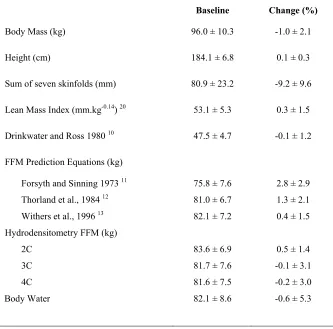
The baseline values in anthropometric measures and proportional changes in height, sum of seven skinfolds, and anthropometric measures of muscle mass and FFM are provided in Table 2. All mean changes in body composition over the 10 weeks were trivial, with the exception of a small increase in FFM calculated using the Forsyth and Sinning 11 equation, and a small decrease in the sum of seven skinfolds. Individual variation in the changes (the SD of the change scores) was either trivial or small for all measures of lean mass, with the 4C criterion measure showing the largest variation. Variation in the sum of skinfolds was of similar small magnitude, but the variation in total body water was moderate-large.
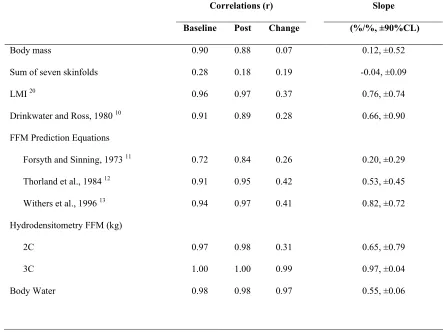
measures of lean mass and of body mass were also very high (0.85-0.98), whereas the
correlations with skinfold thickness were small. The change scores for the LMI and the other practical measures of lean mass had only small-moderate correlations with the criterion, although uncertainty in the correlations (confidence limits, ~±0.30) allowed for the true correlations to be trivial to strong. There was less uncertainty for the comparison of the LMI correlation (0.37) with that of some of the other measures, in particular the Withers et al equation (0.41; difference -0.04, confidence limits ±0.17) and the Drinkwater and Ross equation (0.28; difference 0.09, confidence limits ±0.21). The change scores for the LMI also had stronger correlations with those of the Withers et al (0.89) and Drinkwater and Ross (0.75) than with the other practical measures of lean mass (Thorland et al, 0.59; 2C FFM, 0.57; and Forsyth and Sinning, 0.31).
The standard errors of the estimate (SEE) for the prediction of change in 4C FFM by all practical measures were within the range of 2.8 to 2.9%, whereas the SEE for the predictions by changes in 3C and body water were much smaller (0.3% and 0.8% respectively). The LMI correctly identified the direction of change in 4C FFM (increased or decreased) in 70% of cases. The TBW and 3C methods were 95% and 100% accurate respectively in identifying the direction of change, while the other skinfold-based measures were within 55% to 65% accurate.
Discussion
This investigation was prompted by the need to establish a fast, convenient, and valid measure of changes in lean mass in highly trained athletes. For this purpose we compared relationships between change scores for a criterion measure of lean mass with a new practical measure of lean mass (the LMI), and an array of existing anthropometrically derived
estimates of lean mass. Professional rugby union athletes were monitored during 10 weeks of pre-season training, a period in which both changes in fat mass and fat free mass were a priority for the players. The primary finding of this investigation is that the LMI is probably as good as other skinfold-derived measures for tracking within-subject lean mass changes. Moreover, the practical measures evaluated in this study were as effective as the conventional 2C model of hydrodensitometry alone in tracking changes in lean mass. Thus, the LMI can be used to routinely monitor changes in FFM.
A number of cross-sectional between-subject validation studies have been undertaken on anthropometric methods of assessing physique traits primarily using the 2C
hydrodensitometry model as the gold standard, or more recently the 4C model. As has been observed previously 6, cross-sectional validity assessments between criterion and
Few studies have been undertaken to validate the ability of various techniques to track change in physique traits. Van Marken Lichtenbelt and associates 6 observed a strong relationship (r = 0.88) between the gold standard 4C model and skinfold derived estimates of FFM change. Because of the relatively large method error, the authors suggested skinfold estimates be employed to monitor group responses rather than that of individual athletes. Others have reported that anthropometrically derived equations may not be accurate predictors of changes in body composition 5, 8. Prediction equations currently available have not been formulated to monitor within-subject changes in physique traits. Rather they were created to offer an estimate of between-subject physique traits at a single time point. Consequently, it is not surprising that estimates from these equations correlated only moderately with the criterion measure when monitoring an individual longitudinally.
The short-term test-retest measurement error of the 4C criterion measure and the other measures of FFM were all much less than the variation in the change scores over the 10 weeks of the present investigation. The change scores therefore represented real changes within each subject rather than measurement error. Further, error of measurement arising from physique assessment did not account for the relatively modest correlations between change scores. We must conclude that there were substantial changes in criterion lean mass that were not tracked by the practical measures of lean mass.
regard this investigation as providing reasonable evidence that the LMI is comparable with the other practical measures of lean mass, and that the LMI is theoretically at least more appropriate for tracking changes in individuals. We acknowledge the LMI provides a
proportional rather than an absolute measure of change in FFM. Despite this, the LMI tracked changes in FFM as well as other anthropometry derived measures and predicted the correct direction of change better than other practical tools. The improved ability to predict the direction of change may be attributable to greater specificity of the equation to the population under investigation and/or that the LMI has been derived from the longitudinal assessment of within-subject changes in mass and skinfolds.
In summary, given that the 4C criterion measure will never be an option for routine field use, the LMI and other practical, anthropometrically derived tools may offer a convenient, fast and economical option for monitoring physique changes. However, the LMI remains a proportionality index that tracks changes in mass not accounted for by changes in skinfolds and further investigation is required to establish its utility under all conditions.
Acknowledgements
The authors would like to acknowledge the Australian Sports Commission, NSW Rugby Union, Royal North Shore Hospital (Sydney), and the University of Sydney.
References
1. Norton K, Olds T, Olive S, Craig N. Anthropometry and sports performance. In: Norton K, Olds T, editors. Anthropometrica. Sydney: University of New South Wales Press; 1996. p. 287-364.
2. Olds T. The evolution of physique in male rugby union players in the twentieth century. Journal of Sports Sciences 2001;19:253-262.
3. Yoshiga C, Kawakami Y, Fukunaga T, Okamura K, Higuchi M. Anthropometric and physiological factors predicting 2000 m rowing ergometer performance time.
Advances in Exercise and Sports Physiology 2000;6:51-57.
4. Lukaski HC. Estimation of muscle mass. In: Roche AF, Heymsfield SB, Lohman TG, editors. Human Body Composition. Champaign, IL: Human Kinetics; 1996. p. 109-128.
5. Cisar CJ, Housh TJ, Johnson GO, Thorland WG, Hughes RA. Validity of
anthropometric equations for determination of changes in body composition in adult males during training. Journal of Sports Medicine and Physical Fitness
1989;29(2):141-148.
6. van Marken Lichtenbelt WD, Hartgens F, Vollaard NB, Ebbing S, Kuipers H. Body composition changes in bodybuilders: a method comparison. Medicine and Science in Sports and Exercise 2004;36(3):490-497.
7. Lee RC, Wang Z-M, Heo M, Ross R, Janssen I, Heymsfield SB. Total-body skeletal muscle mass: development and cross-validation of anthropometric prediction models.
8. Wilmore JH, Girandola RN, Moody DL. Validity of skinfold and girth assessment for predicting alterations in body composition. Journal of Applied Physiology
1970;29(3):313-317.
9. Norton K, Whittingham N, Carter L, Kerr D, Gore C, Marfell-Jones M. Measurement techniques in anthropometry. In: Norton K, Olds T, editors. Anthropometrica.
Marrickville, NSW: Southwood Press; 1996. p. 25-75.
10. Drinkwater DT, Ross WD. Anthropometric fractionation of body mass. In: Ostyn MD, Beunen G, Simons J, editors. Kinanthropometry II. Baltimore: University Park Press; 1980. p. 178-189.
11. Forsyth HL, Sinning WE. The anthropometric estimation of body density and lean body weight of male athletes. Medicine and Science in Sports and Exercise
1973;5(3):174-180.
12. Thorland WG, Johnson GO, Tharp GD, Housh TJ, Cisar CJ. Estimation of body density in adolescent athletes. Human Biology 1984;56(3):439-448.
13. Withers B, Laforgia J, Heymsfield S, Wang Z, Pillans R. Two, three and four-compartment models of body composition analysis. In: Norton K, Olds T, editors. Anthropometrica. Sydney: University of New South Wales Press; 1996. p. 199-234.
15. Bell NA, McClure PD, Hill RJ, Davies PS. Assessment of foot-to-foot bioelectrical impedance analysis for the prediction of total body water. European Journal of Clinical Nutrition 1998;52(11):856-859.
16. Schoeller DA, Ravussin E, Schutz Y, Acheson KJ, Baertschi P, Jequier E. Energy expenditure by doubly labeled water: validation in humans and proposed calculation.
American Journal of Physiology 1986;250(5):R823-R830.
17. Van Der Ploeg GE, Gunn SM, Withers RT, Modra AC, Crockett AJ. Comparison of two hydrodensitometric methods for estimating percent body fat. Journal of Applied Physiology 2000;88:1175-1180.
18. Gotfredsen A, Baeksgaard L, Hilsted J. Body composition analysis by DEXA by using dynamically changing samarium filtration. Journal of Applied Physiology
1997;82(4):1200-1209.
19. Heymsfield SB, Lichtman S, Baumgartner RN, Wang J, Kamen Y, Aliprantis A, et al. Body composition of humans: comparison of two improved four-compartment models that differ in expense, technical complexity, and radiation exposure. American
Journal of Clinical Nutrition 1990;52(1):52-58.
20. Duthie GM, Pyne DB, Livingstone S, Hopkins WG, Hooper S. Anthropometry profiles of elite super 12 rugby players: quantifying changes in lean mass. Medicine and Science in Sports and Exercise 2005:Submitted for review.
21. Hopkins WG. Measures of reliability in sports medicine and science. Sports Medicine
Figures
Figure 1: The first panel is a two-dimension plot showing a nearly perfect relationship between the 4 compartment estimate of FFM and the LMI before and after 10 weeks of
pre-season training for 20 individual subjects. The second panel shows a moderate relationship between change scores for the 4 compartment estimate of FFM and the
LMI after 10 weeks of pre-season training for 20 individual subjects. Solid line represents the mean correlation for the change scores from baseline. The dashed line
Tables
Table 1: Estimates of muscle mass and body density and the anthropometric measurements they are derived from.
Reference Estimate Anthropometric Measures
Drinkwater and Ross 1980 10 Muscle mass Skinfold correcteda relaxed arm, chest, mid thigh and calf girths plus forearm girth
Forsyth and Sinning 1973 11 Body density Subscapula, abdominal, tricep and mid-axilla skinfolds Thorland et al., 1984 12 Body density Tricep, subscapula, mid-axilla, iliac crest, abdominal,
thigh and calf skinfolds
Withers et al., 1996 13 Body density Tricep, subscapula, bicep, supraspinale, abdominal, thigh and calf skinfolds
Table 2: Baseline values (mean ± SD) in anthropometric measures for 20 rugby union players and proportional changes (mean ± SD) after 10 weeks of intensive training.
Baseline Change (%)
Body Mass (kg) 96.0 ± 10.3 -1.0 ± 2.1 Height (cm) 184.1 ± 6.8 0.1 ± 0.3 Sum of seven skinfolds (mm) 80.9 ± 23.2 -9.2 ± 9.6 Lean Mass Index (mm.kg-0.14) 20 53.1 ± 5.3 0.3 ± 1.5 Drinkwater and Ross 1980 10 47.5 ± 4.7 -0.1 ± 1.2 FFM Prediction Equations (kg)
Forsyth and Sinning 1973 11 75.8 ± 7.6 2.8 ± 2.9 Thorland et al., 1984 12 81.0 ± 6.7 1.3 ± 2.1 Withers et al., 1996 13 82.1 ± 7.2 0.4 ± 1.5 Hydrodensitometry FFM (kg)
2C 83.6 ± 6.9 0.5 ± 1.4
3C 81.7 ± 7.6 -0.1 ± 3.1
4C 81.6 ± 7.5 -0.2 ± 3.0
Table 3: Relationships between criterion (4C) fat-free mass and other estimates of body composition for baseline, post-test and change scores. Change score correlations were
forced through the origin and the slope of the relationship represents the scaling to convert percent changes in the anthropometric measure to that of the criterion 4C
FFM.
Correlations (r) Slope
Baseline Post Change (%/%, ±90%CL)
Body mass 0.90 0.88 0.07 0.12, ±0.52 Sum of seven skinfolds 0.28 0.18 0.19 -0.04, ±0.09
LMI 20 0.96 0.97 0.37 0.76, ±0.74
Drinkwater and Ross, 1980 10 0.91 0.89 0.28 0.66, ±0.90 FFM Prediction Equations
Forsyth and Sinning, 1973 11 0.72 0.84 0.26 0.20, ±0.29 Thorland et al., 1984 12 0.91 0.95 0.42 0.53, ±0.45 Withers et al., 1996 13 0.94 0.97 0.41 0.82, ±0.72 Hydrodensitometry FFM (kg)
2C 0.97 0.98 0.31 0.65, ±0.79
3C 1.00 1.00 0.99 0.97, ±0.04