C A S E R E P O R T
Peripheral nerve
fi
eld stimulation to the
preauricular area for intractable chronic migraine:
a case report
This article was published in the following Dove Press journal: Journal of Pain Research
Yi-Fan Li1,2
Peng Mao2
Qian Zhu2
Bo-Tao Liu2
Bi-Fa Fan2
1Department of Graduate School, Beijing
University of Chinese Medicine, Beijing 100029, People’s Republic of China;
2Department of Pain, China-Japan
Friendship Hospital, Beijing 100029, People’s Republic of China
Objective:To report a successful attempt of peripheral nervefield stimulation (PNFS) in preauricular area to treat refractory chronic migraine (CM). This article focuses on novel utilization of PNFS and discusses its existing issues.
Case report: A 35-year-old woman diagnosed with CM complained about a 2-year history of severe pain at the occipitocervical and left auriculotemporal area, sometimes bilaterally, which did not benefit from conventional medical therapy. After failed attempts of occipital nerve stimulation and PNFS at the retroauricular area, we used exploratory
PNFS at the preauricular area, which to our knowledge is the first reported case in
literature, to such an area in refractory CM. The patient experienced satisfactory pain relief and obvious improvement in quality of life. And the amelioration on the severity of pain was validated by reduced scores (from 9 to 2) on the numerical rating scale. The clinical effects continued in the next 2-year follow-up after the implantation, without adverse events.
Conclusion: PNFS is a promising and safe neuromodulation therapy for refractory CM. Facial areas like preauricular region are applicable for lead implantation. Nevertheless, the underlying mechanisms are still unverified, and there is still a lack of standardized operation guides of PNFS. Large-scale randomized clinical trials should be conducted to further validate thesefindings.
Keywords:chronic migraine, neuromodulation, peripheral nervefield stimulation, occipital nerve stimulation, preauricular pain, case report
Introduction
Migraine is a common neurological disease that occurs frequently among young people, with the global morbidity around 12%. It is also ranked third in the burden
of disease according to the 2010 global survey.1About 2.5–3.0% of patients with
migraine show an increasing number of attacks per year, indicating a “chronic”
trend.2 Chronic migraine (CM) accounts for about 8% of the total number of
migraine sufferers, with a morbidity of 1–2%.3,4Research has shown that compared
with episodic migraine patients, the quality of life of the patients with CM was lower; the medical treatment frequency, higher; time of hospitalization, longer; the drug abuse, more obvious; and the economic burden, higher than patients with
paroxysmal migraine.5
The treatment for CM is dominated by prophylactic and therapeutic drugs. For
intractable CM that does not benefit from drug treatment, multiple multicenter
Correspondence: Bi-Fa Fan
China-Japan Friendship Hospital, No. 3 Ying-Hua East Street, Chaoyang District, Beijing 100029, People’s Republic of China Tel +86 150 1010 1616
Email [email protected]
Journal of Pain Research
Dove
press
open access to scientific and medical research
Open Access Full Text Article
Journal of Pain Research downloaded from https://www.dovepress.com/ by 118.70.13.36 on 24-Aug-2020
randomized controlled studies have shown that peripheral nerve electrical stimulation (occipital nerve stimulation; ONS) is effective.6–8
Peripheral nervefield stimulation (PNFS), also known as
the subcutaneous stimulation (SubQ), is a newly emerging
therapy for chronic pain in recent years.9Unlike spinal cord
stimulation (SCS) where leads are placed in the epidural space, leads of PNFS are placed into the subcutaneous tissue in the area of pain, thereby subcutaneously stimulating the peripheral nerves and their endings in the corresponding region to reach
the spinal cord through the sensory afferentfibers and achieve
analgesic effects.10
PNFS is mainly used for lower back pain, failed spinal surgery, head and face pain, and as an adjuvant therapy to SCS. For craniofacial pain, the location of the electrodes is mostly at the supraorbital, infraorbital, and occipital areas.
To the best of our knowledge, this is the first case
report of PNFS applied successfully at the anterior auri-cular area for the treatment of ONS-ineffective CM. The detailed case report follows.
Clinical material
Case report
A 35-year-old policewoman came to our pain treatment center with the complaint of a 2-year-long history of head-ache resulting from childbirth. The pain presented as per-sistent distention and pulsating pain at the occipitocervical region and left auriculotemporal area, sometimes extend-ing to the contralateral area. The pain was aggravated by menstruation and fatigue, and partly relieved by some rest. When the headache was severe, it was often accompanied by nausea and vomiting, without photophobia, phonopho-bia, or aura. The patient reported visual analog scale (VAS) scores of between 7 and 9. There was no obvious tenderness and hyperalgesia in the head and cervical para-vertebral skin. Moreover, no obvious abnormalities were seen in head CT, cervical MRI, electroencephalogram,
cervical vascular ultrasound, local cerebral blood flow
imaging and so on, so we ruled out some organic lesion causes.
Treatment process
According to clinical symptoms and examinations, we
diagnosed this case as CM without aura.11 The patient
successively took variety of drugs, such as NSAIDs
ibruprofen and celecoxib, flunarizine (maximum dose
up to 20 mg/day), zomixetam, antidepressants and so
on, which unfortunately were ineffective. Traditional Chinese medicine and acupuncture also did not bring
benefits. Selective nerve block and radiofrequency
pulse therapy at the occipital nerve, stellate ganglion, and pain point also did not achieve satisfactory clinical effects.
ONS was also performed. The lead (Pisces-Octad®
lead, Medtronic Inc., Minneapolis, MN, USA) was punctured into the skin at the posterior occipital region at level C2, and implanted into the left mastoid in
a horizontal direction. However, the patient only
reported partial relief in the occipitocervical region and no improvement in the auriculotemporal region during the trial period.
Subsequently, we decided to try PNFS therapy at the pain area based on discussions with and the per-mission of the patient. PNFS procedure: The lead was led upward along the hairline of the left ear, and then to the temporal part through the tip of the ear, which
was the patient’s pain area (also known as “pterion”).
However, the patient was dissatisfied with the
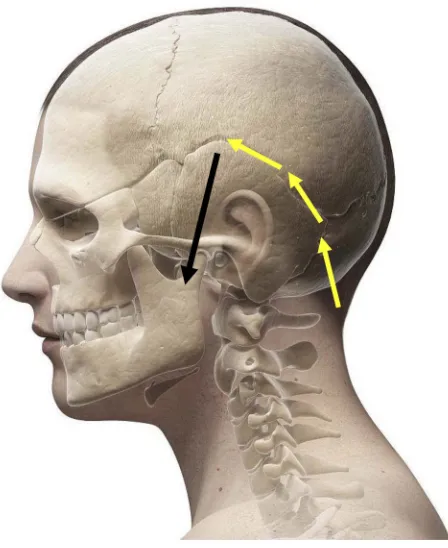
analge-sic effect of the procedure in the following 1-week trial period. Hence, we tried another time to remove the lead from the front of the left ear to the upper part
of the mandibular joint (Figures 1 and 2).
During the next 14-day trial period, a satisfactory analgesic effect was achieved. Pain in the temporal and
occipital region was significantly relieved, reflected by
VAS scores decreased by >50% (parameters: pulse
width, 330 μs; frequency, 35 Hz; current, 1.98 mA).
Ultimately after the trial, the patient decided to
undergo permanent implantation. The stimulator
(PrimeAdvanced® neurostimulator, Medtronic Inc.)
was placed in the left posterior thoracic-axillary area.
Postoperative radiographs confirmed appropriate
elec-trode placement (Figure 3).
Follow-up
We conducted follow-up evaluations at 3, 6, 12, 18, and 24 months after PNFS. The patient reported an obvious decrease on the numerical rating scale and continued to
have approximately 50% pain relief (Figure 4). Apparent
improvements on the onset, duration of the headache, and the impacts on daily life were also observed based on the feedback of the patient. The stimulation mode of IPG chan-ged from continuous stimulation to intermittent mode 6 months after the implantation. The patient only needed sti-mulation around the time of menstruation. Furthermore, only
Journal of Pain Research downloaded from https://www.dovepress.com/ by 118.70.13.36 on 24-Aug-2020
under extreme circumstances did the patient need to take the adjuvant medications such as ibuprofen. Two years
post-implantation, the baseline pain level fluctuated between 0
and 2, and the exacerbations were easily controlled.
Discussion
There is quite a lot of research reporting that
neuromo-dulation, such as with SCS and ONS, can be beneficial
for refractory CM.12–18 Furthermore, the application and
clinical effects of trigeminal nerve stimulation, transcra-nial magnetic stimulation, vagus nerve stimulation, and cerebellar stimulation, etc., are also under study and
being explored.8
Different from SCS where electrodes are placed in the epidural space, and also unlike peripheral nerve stimulation
(PNS) where electrodes are placed near a specific peripheral
nerve, PNFS therapy does not target specific nerves that
dominate the corresponding pain area. Instead, the electro-des are placed in the center of the pain region to stimulate the affected nerve in the area, including the skin sensory
afferent nerves and segmental spinal nerve branches.19
PNFS is different from SCS and PNS in terms of therapeu-tic mechanisms, clinical application, characteristherapeu-tics, key points of operation, and parameter settings.
Figure 1Schematic diagram of electrode placement: electrode implantation
tra-jectory (yellow arrow), electrodefinal position (black arrow).
Figure 2Establishment of a subcutaneous tunnel (extending the electrode along the hairline of the left ear, then leading to the temporal part through the tip of the ear).
Figure 3Postoperative radiograph: peripheral nervefield stimulation (PNFS) in the anterior auricular region showing the position of the electrode (black arrow).
Journal of Pain Research downloaded from https://www.dovepress.com/ by 118.70.13.36 on 24-Aug-2020
The mechanism of PNFS in the treatment
of CM
At present, the mechanisms of CM are still unclear. It is currently accepted that it may be related to abnormal pain regulation, central sensitization, cortical hyperactivity, and
neurogenic inflammatory response. As for the chronicity
of migraine, it is a gradual process: recurrent headaches lead to the activation of the trigeminal vascular system and the weakening of the function of the brain stem descend-ing inhibition system, resultdescend-ing in increased cortical
excit-ability, ultimately resulting in repeated episodes of pain.20
The mechanisms of PNFS treating pain are also unclear. Similar to SCS and PNS, it is believed to be
based on the “Gate theory” put forth by Melzack and
Wall,21 which suggest that by stimulating the myelinated
A fibers, the glial inhibitory interneurons (SG cells) are
stimulated, thus closing the gate and inhibiting the activity of the dorsal horn projecting neurons (T cells), and subse-quently inhibiting the transmission of nociceptive informa-tion to the high center to alleviate pain.
In addition to these effects on the segmental regulation of the spinal cord, some researchers believe that PNFS may also affect the descending pain modulation system of the upper central nervous system by stimulating the sub-cutaneous electrode, thus exerting an analgesic effect. In addition, some studies have shown that local electrical
stimulation can reduce the inflammation of the cutaneous
nervefibers, depolarizing the cell membrane, and reducing
the sensitivity of catecholamine in the blood.22–24
Moreover, the possible mechanisms for PNFS also
include influencing the excitability of the receptors and
tissues in the pain area; affecting the local blood circula-tion; regulating the level of neurotransmitters; affecting the conduction of the spinal and thalamus pathway; and
affect-ing the sympathetic efferent function.25 Although there is
no unified conclusion on the mechanisms of PNFS, most
researchers believe that PNFS may impact the endogenous enkephalin level, thus changing the threshold of nocicep-tive sensation in the target area. Therefore, further research
into its basic mechanism is needed.26,27
Perhaps one of the most important reasons for success-ful PNFS treatment for CM, in this case, is because of the
patient’s sufficient trust and active compliance during the
treatment period. Regards the underlying mechanism, it
may be that the relatively thin muscle fibers in the
tem-poral to anterior auricular area made it easier for the
electrode to stimulate the nerve branches in the superficial
fascia. The therapeutic target of PNFS is the sensory afferent nerve in the subcutaneous tissue of the pain area. It is well known that the primary neuron of neuralgia and the thermal perception of the head and face are both attributed to the trigeminal ganglion; its anatomical posi-tion is the trigeminal nerve track in front of the petrous bone tip of the temporal bone, going through the nucleus
of the trigeminal tract, andfinally projecting to the
dorsal-ventral nucleus of the dorsum thalamus. The location of our electrode is very close to the trigeminal ganglion, which may explain its mechanism of improving pain in the two regions of the temporal and occipital areas.
ONS likely yielded unsatisfactory curative effects because of the long-lasting moderate-to-severe headache
induced by the patient’s extended massage to the neck and
occipital muscle, which increased the tension of the occi-pital muscle, and inhibited the sensitivity and excitability
of the afferent nervefiber of the occipital nerve.
Clinical application of PNFS
PNFS is currently used in head and neck or occipital pain, trunk or medial axis pain, and stubborn pain in the limbs.
D’Ammando et al28 employed PNFS on 22 patients with
chronic refractory neuropathic pain and found that the clinical effect of PNFS was better on craniofacial postherpetic neuro-pathy (PHN) than on upper limb PHN; and of failed back surgery syndrome (FBSS) patients, pain in lumbosacral area achieved better analgesic effects than in perineal area.
Granville et al29used temporary bilateral sacral PNFS in the
treatment of intractable coccyx pain and achieved good results. Additionally, application of PNFS for head and neck pain or occipital region includes occipital neuralgia, neck headache, migraine, cluster headache, trigeminal neuralgia, and facial
PHN. Levi et al30used PNFS to treat facial neuropathic pain
induced by radiation therapy in a patient with laryngeal cancer
and achieved satisfactory effects. Verrills et al31treated 83
0 2 4 6 8 10
NRS
0 6 12
Time (Months) 18 24
Figure 4Numerical rating scale (NRS) scores at 0, 3, 6, 12, 18, and 24 months.
Journal of Pain Research downloaded from https://www.dovepress.com/ by 118.70.13.36 on 24-Aug-2020
patients with chronic headache by using PNFS and followed-up for 3–42 months; 60 of the 83 patients reported satisfactory clinical effects in terms of pain, analgesic usage, function, and
mood status. Upadhyay et al32reported a case of facial PHN
treated by PNFS on the supraorbital to temporal region, which
turned out to be effective. Klein et al33reported successful
PNFS in the trigeminal innervation area that resulted in excel-lent clinical outcome in a case of trigeminal neuralgia.
PNFS can be applied alone or as complementary
ther-apy with SCS. Hamm-Faber et al34 used PNFS as
com-plementary therapy with SCS on nine patients with lower back pain, and during the 4-year follow-up, the quality of life and pain intensity of these patients were improved
significantly. Ejaa et al35 randomly compared SCS and
SCS+PNFS on 52 FBSS patients, and after 12 months of follow-up, patients in the SCS+PNFS group showed super-ior results than those in the SCS group in terms of VAS, quality of life, anxiety and depression scale, and adjuvant
analgesic usage. Zhou et al36found that thoracic SCS did
not achieve satisfactory effects on type I complex regional pain syndromes patients that underwent appendectomy, whereas PNFS attained >90% analgesia.
Advantages of PNFS
Compared with SCS, PNFS can reach areas that SCS can-not, such as the cranial nerve innervation area. Compared with PNS, PNFS can target pain areas that were not
inner-vated by specific nerves. Besides, when the pain area is
local, PNFS can accurately stimulate the pain area and is
relatively easy to operate, with lesser trauma.9
Operation points of PNFS
The electrode of PNFS is placed in subcutaneous tissue. If the electrode is implanted in a too shallow location such as the dermis, it may cause burning or needling pain. Nevertheless, if the implantation is too deep, such as into deeper tissue, it may not achieve satisfactory treatment effects. If the electrode is implanted into the muscle, it
may cause discomfort and affect the patient’s motion.
Besides, an unfavorable electrode position may also cause muscle spasm. Currently, there are few studies on precautions to be taken in PNFS operation, which require
further standardized key points of operation.37,38
In addition, we found that compared with SCS and PNS, literature reports on PNFS are mainly clinical case reports, and the large sample randomized clinical trials (RCTs) and related basic mechanisms are rarely studied, which provides us with future research direction.
Conclusion
The application of PNFS is very extensive. It is a choice for intractable CM characterized by temporal pain that can achieve ideal clinical effects and is still safe. However, the current circumstances call for advanced related mechan-isms study, standardized operation guides, and large sam-ple RCTs to promote the application of PNFS.
To the best of our knowledge, this is thefirst case to
report on PNFS being successfully applied to the preauri-cular area to treat refractory CM, which was unresponsive to previous ONS treatment. We believe the details of this case report could provide a potential novel approach for the application of PNFS.
Ethics approval and coonsent to
participate
This article was permitted by the patient who provided written informed consent. The study was approved by Beijing University of Chinese Medicine and China-Japan Friendship Hospital.
Acknowledgments
the authors would like to express their gratitude to the patient. The authors would also like to thank Prof. Ji-Sheng Han (Neuroscience Research Institute, Peking University, Beijing, PLC) for his advice for the clinical application of PNFS.
Disclosure
The authors report no conflicts of interest in this work.
References
1. Vos T, Flaxman AD, Naghavi M, et al. Years lived with disability (YLDs)
for 1160 sequelae of 289 diseases and injuries 1990–2010: a systematic
analysis for the Global Burden of Disease Study 2010.Lancet.2012;380
(9859):2163–2196. doi:10.1016/S0140-6736(12)61729-2
2. Lipton RB. Tracing transformation: chronic migraine classification,
progression, and epidemiology. Neurol. 2009;72(5 Suppl):3–7.
doi:10.1212/WNL.0b013e3181974b19
3. Bigal ME, Serrano D, Buse D, Scher A, Stewart WF, Lipton RB. Acute migraine medications and evolution from episodic to chronic migraine:
a longitudinal population-based study.Headache J Head Face Pain.
2008;48(8):1157–1168. doi:10.1111/j.1526-4610.2008.01217.x
4. Manack AN, Buse DC, Lipton RB. Chronic migraine: epidemiology
and disease burden. Curr Pain Headache Rep. 2011;15(1):70–78.
doi:10.1007/s11916-010-0157-z
5. Lantériminet M, Duru G, Mudge M, Cottrell S. Quality of life impair-ment, disability and economic burden associated with chronic daily headache, focusing on chronic migraine with or without medication
overuse: a systematic review. Cephalalgia. 2011;31(7):837–850.
doi:10.1177/0333102411398400
6. Schwedt TJ. Chronic migraine.BMJ.2014;348(12):1416. doi:10.1136/bmj.
g1416
Journal of Pain Research downloaded from https://www.dovepress.com/ by 118.70.13.36 on 24-Aug-2020
7. Beran RG. Management of chronic headache.Aus Fam Physician.
2014;43(3):106.
8. Roceanu A, Antochi F, Bajenaru O. Chronic migraine–new
treat-ment options.Maedica.2014;9(4):401–404.
9. Abejón D, Krames ES. Peripheral nerve stimulation or is it peripheral
subcutaneousfield stimulation; what’s in a moniker?Neuromodulation.
2009;12(1):1–4. doi:10.1111/j.1525-1403.2009.00192.x
10. Slavin KV, Yin D, Yin H, Gomez C. Subcutaneous peripheral nerve
field stimulation for intractable pain. In:Neuromodulation.2 nd ed.
Academic Press;2018;523–528.
11. Headache Classification Committee of the International Headache
Society (IHS),The international classification of headache disorders,
3rd edition (beta version). Cephalalgia. 2013;33(9):629–808.
doi:10.1177/0333102413485658
12. Young WB. Occipital nerve stimulation for chronic migraine.Curr
Pain Headache Rep.2014;18(2):396. doi:10.1007/s11916-013-0396-x
13. Perini F, De Boni A. Peripheral neuromodulation in chronic
migraine. Neurol Sci. 2012;33(Suppl 1):S29–S31. doi:10.1007/
s10072-012-1039-4
14. Mekhail NA, Estemalik E, Azer G, Davis K, Tepper SJ. Safety and
efficacy of occipital nerves stimulation for the treatment of chronic
migraines: randomized, double-blind, controlled single-center
experience.Pain Pract.2017;17:669–677. doi:10.1111/papr.12504
15. Martelletti P, Jensen RH, Antal A, et al. Neuromodulation of chronic headaches: position statement from the European Headache Federation.
J Headache Pain.2013;14:86. doi:10.1186/1129-2377-14-86
16. De Agostino R, Federspiel B, Cesnulis E, Sandor PS. High-cervical spinal
cord stimulation for medically intractable chronic migraine.Neuromodul.
2015;18(4):289–296; discussion 296. doi:10.1111/ner.12236
17. Arcioni R, Palmisani S, Mercieri M, et al. Cervical 10 kHz spinal cord stimulation in the management of chronic, medically refractory
migraine: a prospective, open-label, exploratory study.Eur J Pain.
2016;20(1):70–78. doi:10.1002/ejp.692
18. Chichorro JG, Porreca F, Sessle B. Mechanisms of craniofacial pain.
Cephalalgia.2017;37(7):613–626. doi:10.1177/0333102417704187
19. Barolat G. Subcutaneous peripheral nerve field stimulation for
intractable pain. In: Krames E, Peckham PH, Rezai A, editors.
Neuromodulation. San Diego (CA): Elsevier;2009:1017–1020.
20. Schwedt TJ, Larsonprior L, Coalson RS, et al. Allodynia and des-cending pain modulation in migraine: a resting state functional
connectivity analysis. Pain Med. 2014;15(1):154–165.
doi:10.1111/pme.12267
21. Melzack R, Wall PD. Pain mechanisms: a new theory. Science.
1965;150(3699):971. doi:10.1126/science.150.3699.971
22. Mørch CD, Nguyen GP, Wacnik PW, Andersen OK. Mathematical
model of nervefiber activation during low back peripheral nervefield
stimulation: analysis of electrode implant depth. Neuromodulation.
2014;17:218–225. doi:10.1111/ner.12163
23. Reverberi C, Bonezzi C, Demartini L. Peripheral subcutaneous
neurostimulation in the management of neuropathic pain: five
case reports.Neuromodul. 2009;12:146–155.
doi:10.1111/j.1525-1403.2009.00201.x
24. Krutsch JP, McCeney MH, Barolat G, Al Tamimi M, Smolenski A. A case report of subcutaneous peripheral nerve stimulation for the treatment of
axial back pain associated with postlaminectomy syndrome.
Neuromodulation. 2008;11:112–115. doi:10.1111/j.1525-1403.2008.
00151.x
25. Dworkin RH, Backonja M, Rowbotham MC, et al. Advances in
neuropathic pain: diagnosis, mechanisms, and treatment
recommendations. Arch Neurol. 2003;60(11):1524–1534.
doi:10.1001/archneur.60.11.1524
26. Ellrich J, Lamp S. Peripheral nerve stimulation inhibits nociceptive
pro-cessing: an electrophysiological study in healthy volunteers.
Neuromodulation. 2005;8:225–232. doi:10.1111/j.1525-1403.2005.
00029.x
27. O’Neill CW, Liu JJ, Leibenberg E, et al. Percutaneous plasma
decompression alters cytokine expression in injured porcine
inter-vertebral discs. Spine J. 2004;4:88–98.
doi:10.1016/S1529-9430(03)00423-6
28. D’Ammando A, Messina G, Franzini A, Dones I. Peripheral nervefield
stimulation for chronic neuropathic pain: a single institution experience.
Acta Neurochir (Wien).2016;158(4):767–772.
doi:10.1007/s00701-016-2713-8
29. Granville M, Brennan P, Jacobson RE. Bilateral peripheral nervefield
stimulation for intractable coccygeal pain: a case study using dual lead
intercommunication.Cureus.2017;9(11):e1832.
30. Levi V, Messina G, Franzini A, Zanin L, Castelli N, Dones I.
Peripheral nervefield stimulation (PNFS) as a treatment opion for
intractable radiation-induced facial neuropathic pain in a laryngeal
cancer survivor: a case report. World Neurosurg. 2016;91:671.e5–
671.e7. doi:10.1016/j.wneu.2016.03.104
31. Paul Verrills MD, Bsc RR, Bruce Mitchell MD, Vivian D, Barnard A.
Peripheral nervefield stimulation for chronic headache: 60 cases and
long-term follow-up. Neuromodulation. 2014;17(1):54. doi:10.1111/
ner.12130
32. Upadhyay SP, Rana SP, Mishra S, Bhatnagar S. Successful treatment of an intractable postherpetic neuralgia (PHN) using peripheral nerve
field stimulation (PNFS).Am J Hospice Pall Care.2010;27(1):59–62.
doi:10.1177/1049909109342089
33. Klein J, Sandi-Gahun S, Schackert G, Juratli TA. Peripheral nerve
field stimulation for trigeminal neuralgia, trigeminal neuropathic
pain, and persistent idiopathic facial pain. Cephalalgia. 2016;36
(5):445. doi:10.1177/0333102415597526
34. Hamm-Faber TE, Aukes H, Gorp E, Gültuna I. Subcutaneous stimulation as an additional therapy to spinal cord stimulation for the treatment of low back pain and leg pain in failed back surgery
syndrome: four-year follow-up. Neuromodulation. 2015;18
(7):618–622. doi:10.1111/ner.2015.18.issue-7
35. Ejaa VG, Teernstra O, Aukes HJ, et al. Long-term effect of peripheral
nervefield stimulation as add-on therapy to spinal cord stimulation to
treat low back pain in failed back surgery syndrome patients: a 12-month
follow-up of a randomized controlled study.Neuromodulation.2018.
[Epub ahead of print].doi:10.1111/ner.12776
36. Zhou L, Chou H, Holder E. Abdominal wall Type-I complex regional
pain syndrome treated effectively with peripheral nervefield
stimula-tion: a case report.J Surg Case Rep.2017;2017(1):222. doi:10.1093/
jscr/rjw222
37. Mcroberts WP. Optimizing stimulation in a case of facial pain
through“cross-talk”of peripheral and central leads: a case report.
Neuromodulation.2016;19:8. doi:10.1111/ner.12443
38. Abejón D, Deer T, Verrills P. Subcutaneous stimulation: how to
assess optimal implantation depth. Neuromodulation. 2011;14
(4):343–347. doi:10.1111/j.1525-1403.2011.00357.x
Journal of Pain Research downloaded from https://www.dovepress.com/ by 118.70.13.36 on 24-Aug-2020
Journal of Pain Research
Dove
press
Publish your work in this journal
The Journal of Pain Research is an international, peer reviewed, open
access, online journal that welcomes laboratory and clinicalfindings in
thefields of pain research and the prevention and management of pain.
Original research, reviews, symposium reports, hypothesis formation and commentaries are all considered for publication. The manuscript
management system is completely online and includes a very quick and fair peer-review system, which is all easy to use. Visit http:// www.dovepress.com/testimonials.php to read real quotes from pub-lished authors.
Submit your manuscript here:https://www.dovepress.com/journal-of-pain-research-journal
Journal of Pain Research downloaded from https://www.dovepress.com/ by 118.70.13.36 on 24-Aug-2020