Type of the Paper (Article)
1
Performance Evaluation of the Physical and
2
Combustion Properties of Briquettes Produced from
3
Agro-Wastes and Wood Residues
4
Babajide Charles Falemara1*, Victoria Ibukun Joshua2, Oluwaseyi Oluwafunmi Aina1 and Rivi
5
David Nuhu3
6
1 Forestry Research Institute of Nigeria, P.M.B. 5054, Forest Hills, Jericho, Ibadan, Oyo State, Nigeria;
7
8
2 Montane Forest Research Station, Jos, Plateau State; [email protected]
9
3 Federal College of Forestry, Jos, P.M.B. 2019, Jos Plateau State, Nigeria; [email protected]
10
* Correspondence: [email protected]; +2348066714571
11
12
Abstract: This study investigated the physical and combustion properties of briquettes produced
13
from agricultural wastes (groundnut shells and corn cobs), wood residues (Anogeissus leiocarpus)
14
and admixtures of the particles at 15%, 20% and 25% starch levels (binder). A 6 x 3 factorial
15
experiments in a Completely Randomized Design (CRD) was adopted for the study. The briquettes
16
produced were analyzed for density, volatile matter, ash content, fixed carbon and specific heat of
17
combustion. The result revealed that the density ranged from 0.44g/cm3 to 0.53g/cm3, while
18
briquettes produced from groundnut shells had the highest (0.53g/cm3) significant mean density.
19
Mean volatile matter and ash content of the briquettes ranged from 24.35% to 34.95% and 3.37% to
20
4.91%. A. leiocarpus and corn cobs particles had the lowest and highest ash content respectively. The
21
briquette fixed carbon and specific heat of combustion ranged from 61.68% to 68.97% and
22
7362kca/kg to 8222kca/kg respectively. Briquette produced from A. leiocarpus particles had the
23
highest specific heat of combustion. In general, briquettes produced from A. leiocarpus particles and
24
admixture of groundnut shell and A. leiocarpus particles at 25% starch level had better quality in
25
terms of density and combustion properties and thus suitable as environmentally friendly
26
alternative energy source.
27
Keywords: Biomass; Briquette; Combustion; Density; Energy source
28
29
1. Introduction
30
An estimated 3 billion people in our current estimated 7.63 billion people in the world [1, 2] rely
31
upon wood, kerosene, biomass and coal for domestic cooking. This led to rapid deforestation and
32
loss of more than 3% of the world's forests on an annual basis. The use of wood is increasing on daily
33
basis especially in the less technologically developed countries of the world [3]. With deforestation
34
becoming a major problem in many parts of the developing world, there is increased scarcity of
35
fuelwood for household cooking. Increase in the energy demand and use in Nigeria due to rapid
36
growth in population and industry has raised concerns about the economic and environmental
37
impacts of power generation based on national energy sources. Kerosene and gas are the major
38
cooking fuel [4].
39
Environmental and ecological problems are the major issues of concern associated with
40
exploitation of these fuels. Another major challenge with these fuels is their unsustainability and
41
projected depletion over the years. The use of fuel wood in the large scale without replenishing poses
42
serious environmental consequences in many countries. Also population increase in countries like
43
Nigeria places more demands on energy to light and heat homes, to cook food, to drive transport,
44
wood for fuel energy. One of such alternative means is the use of biomass for briquette production
47
through densification and manufacture of carbonized or uncarbonised processes [6]. Biomass in the
48
form of wood and agricultural wastes constitute one of the third largest alternative source of
49
primary energy in the world aside from coal and oil [7].
50
The large quantities of agricultural residues produced in Nigeria can play a significant role in
51
meeting her energy demand. However, the abundant quantities of agricultural wastes and forest
52
residues are neither managed effectively, nor utilized efficiently in all developing countries. The
53
common practice is to burn these residues or they are left to decompose [8]. This burning itself
54
contributes to atmospheric pollution, but more than that; the burning or decomposition is a waste of
55
available energy [9]. Recycling of these biomass helps to ameliorate the accumulation of greenhouse
56
gases [10] and can be renewably converted into liquid, solid or gas states [11]. Briquetting provides a
57
value addition, sustainable and efficient utilization of the biomass residues [12].
58
The natural environment cannot continue to provide cooking fuel for the ever increasing
59
population. An alternative and sustainable fuel energy source becomes imperative. The focus of this
60
study is to examine the qualities (physical and combustion properties) of briquettes produced from
61
agricultural wastes (groundnut shells and corn cobs), wood residues (Anogeissus leiocarpus) and
62
admixtures of the particles.
63
2. Materials and Method
64
2.1. Study Site
65
The experiment was carried out in Federal College of Forestry Jos, Plateau State Nigeria. Jos is
66
located in Northern Guinea savanna is situated between latitudes 80 and 30´ and 100 10 N and
67
longitude 80 20´ and 90 30´E.
68
2.2. Materials for the briquette production
69
The materials used for the briquette production include agricultural waste from groundnut shell
70
and corn cobs; and sawdust of Anogeissus leiocarpus (Plate 1a). The choice of the agricultural wastes
71
was based on the relative abundance of the groundnut and corn crops in the northern parts which
72
are annual crops. The A. leiocarpus was chosen also based on its relative abundance in the timber
73
market.
74
2.3. Sample Preparation Procedures
75
Wood samples (planks) of A. leiocarpus species was obtained from the timber market at Katako.
76
The wood samples were processed and converted into sawdust using circular saw machine. The
77
agricultural wastes (groundnut shells and corn cobs) were sourced from surrounding farms and
78
pulverized into small particles. The particles were pre-treated in hot water at 1000C for 30 minutes to
79
remove extractives that may inhibits the binding ability of the particles and cassava starch. They were
80
thereafter sundried for 7 days so as to reduce the moisture content (Plate 1a & 1b). The particles were
81
sieved using 80µm wire mesh, so as to reduce the particles size into fine particles [13].
82
The starch binder at different levels of 15%, 20% and 25% [14, 15] was prepared with 250ml
83
boiled water, stirred and mixed with measured (Plate 1d) grams of separate particles singly and
84
combined (at a mixing proportion of 50:50). The homogenously mixed stock was poured into the
85
fabricated briquette moulder (Plate 1e) and compressed using hydraulic jack (Plate 1f). The briquettes
86
were then removed and air dried for 30days. Proximate analysis was thereafter carried out for
87
properties investigation.
88
2.4. Experimental Design
94
The experimental design for the study was 6 x 3 factorial experiments in a Completely
95
Randomized Design (CRD). The factors consist of six (6) particle types (A. leiocarpus sawdust only
96
(T1), groundnut shell only (T2), corn cobs only (T3), A. leiocarpus sawdust (T4) + Groundnut shell, A.
97
leiocarpus sawdust + Corn Cobs treatment combination (T5) and A. leiocarpus sawdust + Groundnut
98
shell + Corn Cobs treatment combination (T6) and three starch levels (15%, 20% and 25% starch
99
levels). This gave18 treatment combination replicated four times (Plates 2a, 2a, 3a-3f).
100
101
102
103
104
105
106
107
108
109
110
111
112
113
114
115
116
117
118
119
120
121
122
123
124
125
126
Plate 1. Materials used for the production of the briquette and production process. (a) Particle types and starch;
127
(b) Pre-treatment in hot water (1000C); (c) Drying of the particles; (d) Weighing of the materials (particle and
128
starch); (e) Fabricated briquette hydraulic moulder; (f) Compression, hydraulic pressing and moulding of the
129
briquette.
130
131
132
133
134
135
136
137
138
139
140
(f)
(a) (b) (c)
143
144
145
146
147
148
149
150
151
152
153
154
155
156
157
Plate 2. (a) Briquettes produced based on particle types; (b) Briquettes produced based on particle types and
158
starch levels159
160
161
162
163
164
165
166
167
168
169
170
171
172
173
174
175
176
177
178
179
180
181
182
183
184
185
186
Plate 3. Briquettes produced from different particle types. (a) Anogenssus leiocarpus briquette (T1);
187
(b) Groundnut Shell briquette (T2); (c) Corn Cobs briquette (T3); (d) Admixture of T1 + T2 briquette;
188
(e) Admixture of T1 + T3 briquette; (f) Admixture of T1 + T2 + T3 briquette.
189
2.5. Variables Assessed
190
The following parameters were determined on each of the sample briquettes [14, 16].
191
Relaxed density: The relaxed density was determined according to the weight and the volume of
192
each briquette block which depends on its shape. The volume (V=πr2h) was be based on direct
193
(a) (b) (c)
(e)
(d) (f)
G ro u n d n u t sh el l p a rt ic le A . l ei oc ar p u s p a rt ic le C o rn c o b s p a rt ic le G ro u n d n u t sh el l + A . le io ca rp u s p a rt ic les C o rn c o b s + A . l ei oc ar p u s p a rt ic les G ro u n d n u t sh el l+ C o rn co b s+ A . l ei oc ar p u s p a rt ic les
(a) (b)
15% starch level
20% starch level
25% starch level
measurement of radius and height (m) and the weight (g) using digital weigh balance. The
194
density of each briquette sample was calculated using the formula in equation 1;
195
= ( )
( ) ………...Equation 1
196
Volatile matter (%Vm): The percentage volatile matter was determined by placing the crucible
197
containing the oven dry weight (w2) in the furnace for 10 minute at 5500C to obtain weight (w3)
198
after which the volatile matter in it must have escaped. The percentage volatile matter (%Vm)
199
was calculated using the formula as shown in equation 2;
200
(%) =( ( ) – ( ) .
( )
201
………Equation 2
202
Ash content (%Ash): 2g of oven dry pulverized briquette was placed in a crucible (w2). The
203
crucible was placed in the furnace for 4 hours at 550C to obtain the ash weight (w4). Percentage
204
ash content was calculated using equation 3;
205
ℎ (%) = ( )
( ) ……….Equation 3
206
Fixed carbon (%FC): The percentage fixed carbon was calculated by subtracting the sum of
207
percentage volatile matter and percentage ash content from 100% (Equation 4).
208
(%) = 100% − (% + % ℎ) ……...Equation 4
209
Specific Heat of Combustion (Hc): The specific heat of combustion (Hc) was calculated from the
210
formula as shown in equation 5;
211
Specific Heat of Combustion (Hc) = 0.35 (147.6 x %FC) + (144 x %VM) + (%Ash)
212
…..……...Equation 5
213
2.6. Statistical Analysis
214
Analysis of variance (ANOVA) resulting from 18 treatment combinations and four replicates
215
was carried out to evaluate the performance of each of the treatments. Where significant differences
216
existed, Duncan’s Multiple Range Test (DRMT) was used for mean separation to determine the
217
magnitude of differences.
218
3. Results
219
3.1. Effect of Treatments and Starch Levels on Relaxed Density of the Briquette
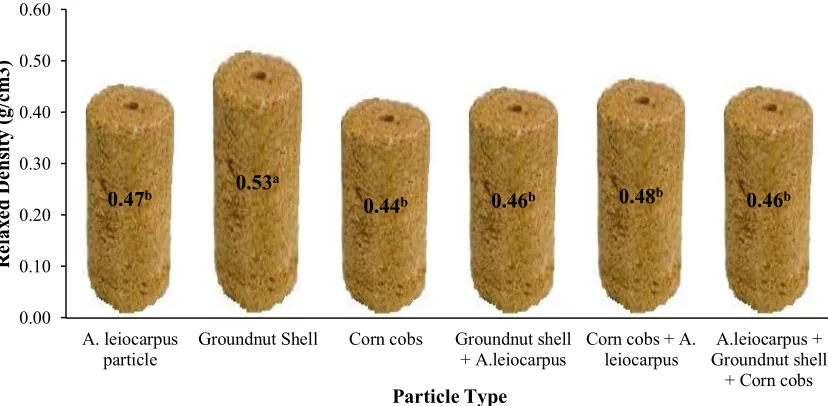
220
The relaxed density of the briquettes ranged between 0.46g/cm3 and 0.53g/cm3 (Figure 1)
221
Briquette made with groundnut shell particles had the highest relaxed density (0.53g/cm3), while
222
briquette produced with the three combinations of A. leiocarpus, groundnut shell and corn cobs
223
particles had the lowest (0.46g/cm3) mean briquette density. The statistical analysis revealed that
224
groundnut shell had significantly higher effect on the relaxed density of the briquette, while the other
225
particle treatments and treatment combinations were not significantly different from each other
226
(p≥0.05).
227
The effect of starch levels on briquette relaxed density (Figure 2) indicated that briquettes
228
produced at 20% starch level had the highest relaxed density (0.49g/cm3), while briquette produced
229
at the lowest starch level (15%) had the lowest density (0.46g/cm3). The effects of the three starch
230
levels on briquette relaxed density were not significantly different (p≥0.05) from each other, as there
231
were little variations in the relaxed density of the briquettes produced from the three starch levels.
232
233
236
Figure 1. Mean Effect of Treatments on Density (g/cm3) of Briquette
237
Means in the same bar having the same superscript are not significantly different (p≥0.05)
238
239
240
241
242
Figure 2. Mean Effect of Treatments on Density (g/cm3) of Briquette
243
Means in the same bar having the same superscript are not significantly different (p≥0.05)
244
245
3.2. Effect of particle types on combustion properties of the briquettes
246
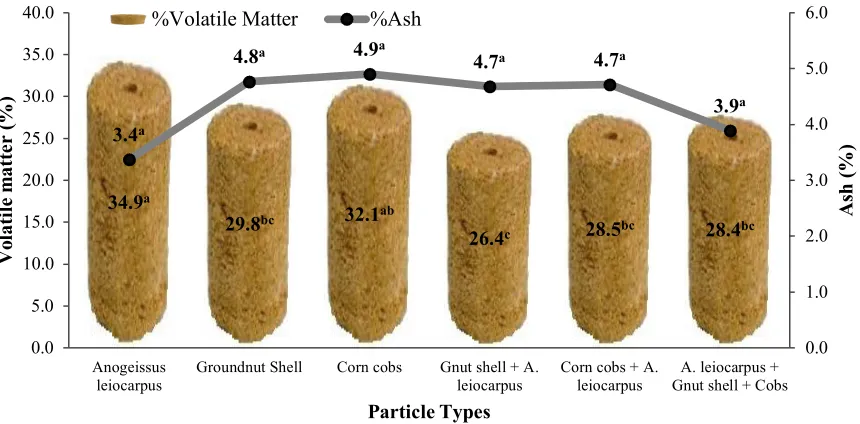
The volatile matter (Figure 3) ranged between 26.4% and 34.9%. Briquettes made with A.
247
leiocarpus and mixture of groundnut shell and A. leiocarpus had the highest (34.9%) and lowest
248
(26.4%) volatile matter respectively. The statistical analysis revealed that the effects of all particle
249
types excluding A. leiocarpus wood particle on volatile matter were not significantly different
250
(p≥0.05) from each other. The volatile matter of briquettes produced from mixture of agricultural
251
residues (A+gnut shell (26.4), A+corn cobs (28.5%) and A+G+C (28.4%) and wood particle were lower
252
than briquettes produced from unmixed/uncombined particle types (A. leiocarpus (34.9%),
253
groundnut shell (29.8%) and corn cobs (31.2%). Ash content (Figure 3) of the briquettes ranged
254
between 3.4% and 4.9%. The ash content of the briquettes were not significantly different from each
255
other, though corn cob briquette had the highest ash content (4.9%) while briquette from Anogeissus
256
0.47b 0.53
a
0.44b 0.46b 0.48b 0.46b
0.00 0.10 0.20 0.30 0.40 0.50
A. leiocarpus particle
Groundnut Shell Corn cobs Groundnut shell + A.leiocarpus
Corn cobs + A. leiocarpus
A.leiocarpus + Groundnut shell
+ Corn cobs
R
e
lax
e
d
D
e
n
si
ty
(g/
c
m
3)
Particle Type
0.46
a0.49
a0.47
a0.44 0.45 0.45 0.46 0.46 0.47 0.47 0.48 0.48 0.49 0.49 0.50
15%SL
20%SL
25%SL
R
el
ax
ed
d
en
si
ty
(g/
cm
3
)
leiocarpus particle had the lowest ash content (3.4%). Mixture of agricultural residues (gnut shell and
257
corn cobs) and wood particles had the same ash content.
258
The specific heat of combustion and fixed carbon ranged from 7362kca/kg to 8222kca/kg and
259
61.7% to 69% respectively (Figure 4). As similarly observed for volatile matter, the specific heat of
260
combustion of the briquettes produced from mixed particles (groundnut shell and A. leiocarpus
261
(7362kca/kg); corn cobs and A. leiocarpus (7561kca/kg), A. leiocarpus, groundnut shell and corn cobs
262
(7589kca/kg)) were lower than the specific heat of combustion of briquettes produced from unmixed
263
A. leiocarpus (8222kca/kg), groundnut shell (7677 kca/kg) and corn cobs (7882kca/kg) particles. On
264
the other hand, the fixed carbon of briquettes produced from mixed particles (groundnut shell and
265
A. leiocarpus (69%); corn cobs and A. leiocarpus (66.8%), A. leiocarpus, groundnut shell and corn
266
cobs (67.7%)) were higher than the fixed carbon of unmixed particle types (A. leiocarpus (61.7%),
267
groundnut shell (65.4%) and corn cobs (63%) particles). Briquette produced from mixture of
268
groundnut shell and Anogeissus leiocarpus particles had the lowest specific heat of combustion
269
(7362kca/kg) and highest fixed carbon content (69%). The specific heat of combustion and fixed
270
carbon were not significantly different from each other (p≥0.05).
271
272
273
Figure 3. Effect of particle types on percentage volatile matter (%VM) and Ash content (%) of the
274
briquette
275
Means in the same bar having the same superscript are not significantly different (p≥0.05)
276
277
34.9a
29.8bc 32.1ab
26.4c 28.5bc 28.4bc
3.4a
4.8a 4.9a
4.7a 4.7a
3.9a
0.0 1.0 2.0 3.0 4.0 5.0 6.0
0.0 5.0 10.0 15.0 20.0 25.0 30.0 35.0 40.0
Anogeissus leiocarpus
Groundnut Shell Corn cobs Gnut shell + A. leiocarpus
Corn cobs + A. leiocarpus
A. leiocarpus + Gnut shell + Cobs
A
sh
(%
)
V
o
lati
le
m
atte
r
(%
)
Particle Types
278
Figure 4. Effect of particle types on specific heat of combustion (SHC) and fixed carbon (%FC) of the
279
briquette
280
Means in the same bar having the same superscript are not significantly different (p≥0.05)
281
282
283
3.3. Effect of starch levels on combustion properties of the briquettes
284
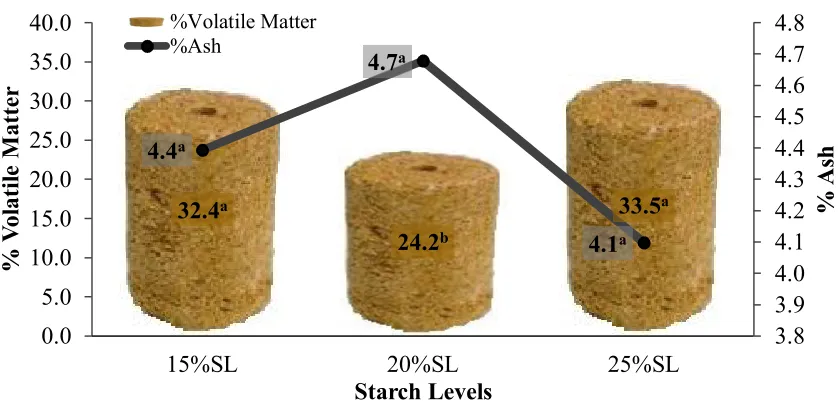
The result of findings as shown in Figures 5 and 6 revealed that briquettes produced at 20%
285
starch level had the lowest volatile matter (24.2%) and specific heat of combustion (7165Kca/kg),
286
while 25% starch level produced briquettes with the highest volatile matter (33.5%) and specific heat
287
of combustion (8051Kca/kg). On the other hand, briquettes produced at 20% starch level had the
288
highest ash content (4.7%) and fixed carbon (71.1%), while 25% starch level produced briquettes
289
having the lowest ash content (4.1%) and fixed carbon (62.4%). In addition, the volatile matter of
290
briquettes produced at 15% and 25% starch levels were not significantly different from each other as
291
similarly observed for specific heat of combustion and fixed carbon. The effects of the three starch
292
levels (15%, 20% and 25%) on ash content of the briquettes were not significantly different from each
293
other (p≥0.05). The effects of 20% starch level on fixed carbon and specific heat of combustion was
294
significantly (p≤0.05) higher and lower respectively from the other starch levels (15% and 25%).
295
296
Figure 5: Effect of Starch levels on percentage volatile matter (%VM) and Ash (%) of the briquette
297
Means in the same bar having the same superscript are not significantly different (p≥0.05)
298
8222a 7677bc 7882ab 7362bc 7561c 7589bc
61.7c
65.4abc
63.0bc
66.8ab
67.7a
58.0 60.0 62.0 64.0 66.0 68.0
6800 7000 7200 7400 7600 7800 8000 8200
Anogeissus leiocarpus
Groundnut Shell Corn cobs Gnut shell + A. leiocarpus
Corn cobs + A. leiocarpus
A. leiocarpus + Gnut shell + Cobs
F
ix
e
d
C
ar
b
o
n
(%
)
S
H
C
(K
c
a/
k
g)
Particle Types
SHC (Kca/kg) %FC
32.4
a24.2
b33.5
a4.4
a4.7
a4.1
a3.8
3.9
4.0
4.1
4.2
4.3
4.4
4.5
4.6
4.7
4.8
0.0
5.0
10.0
15.0
20.0
25.0
30.0
35.0
40.0
15%SL
20%SL
25%SL
%
A
sh
%
V
ol
at
il
e
M
at
te
r
Starch Levels
%Volatile Matter299
300
301
Figure 6: Effect of Starch levels on percentage specific heat of combustion (Kca/kg) and fixed carbon
302
(%FC) of the briquette
303
Means in the same bar having the same superscript are not significantly different (p≥0.05)
304
305
4. Discussion
306
4.1. Relaxed Density
307
The briquette produced from groundnut shell had poor compaction and agglomeration at
308
higher starch level which contributed to its higher significant effect on density (Figure 1). This
309
assertion contradicts the report of Egbewole et al. [14] on poor agglomeration of briquette at lower
310
starch levels of 10% and 15% for wood sawdust. The implication of this is that particle sizes and type
311
have great influence on density of briquettes as similarly observed by Aina et al. [17]. Quality of the
312
mixture composition and technological characteristics of the bio-raw material have a very important
313
influence on the particle agglomeration during the pressing process [18]. In collaboration with the
314
findings of Tembe et al. [15] on comparative analysis of combustion properties of briquettes from
315
groundnut shell and rice husk, the starch level had no significant effect on the briquette density. The
316
relaxed density obtained in the study is within the range of values as obtained by Ige et al. [19] and
317
Onuegbu et al. [20] who reported a relaxed density range between 0.319g/cm3 and 0.590g/cm3. In
318
addition, high density is an indication of longer burning time, as such briquettes produced from
319
groundnut shell (0.53g/cm3); admixture of corn cobs and A. leiocarpus (0.48g/cm3); and A. leoicarpus
320
(0.47g/cm3) particles will tend to burn for a longer time compare to others.
321
4.2. Volatile Matter
322
The range of values for volatile matter (24.2% and 34.95%) of briquettes produced in this study
323
(Figures 3 and 5) is lower than 43% to 49% obtained by Adegoke et al. [13] from mixed sawdust
324
briquettes of tropical hardwood species, 72.33% to 77.44% of briquettes produced from three
325
hardwood species as reported by Emerhi [21] and 68% stated by Ige et al. [18]. Adetogun et al. [22] in
326
their study on briquettes from maize cobs reported a higher volatile matter ranging between 57.82%
327
and 62.91% compared to a lower value of 31.2% and 33.5% for briquettes made from maize cob in
328
this present study (Figures 3 and 5). Conversely, Egbewole et al. [14] and Sotannde et al. [23] reported
329
a lower volatile matter for briquettes made from wood sawdust (13.89% to 19.33%) and neem-wood
330
residues (10% to 13%) respectively.
331
Volatile matter which is a mixture of short and long chain hydrocarbons, aromatic
332
7931
a7165
b8051
a63.2
b71.1
a62.4
b58.0
60.0
62.0
64.0
66.0
68.0
70.0
72.0
15%SL
20%SL
25%SL
6600
6800
7000
7200
7400
7600
7800
8000
8200
F
ix
ed
C
ar
b
on
(
%
)
Starch Level
S
H
C
(
K
ca/
k
g)
influences secondary air requirement and distribution aspects. Lower volatile matter is an indication
335
that the briquettes might not be easy to ignite, but once ignited they will burn smoothly with clean
336
flame without smoke, while high volatile matter results in high combustibility at low ash content
337
[24]. In contrast, the higher the volatile matter of a briquettes, the higher the amount of emissions
338
during burning. This implies that low volatile matter is required for good quality briquette and it
339
typically range between 20 and 35%. The volatile matter values obtained in this study is with the
340
acceptable quality values required for fuelwood.
341
4.3. Ash Content
342
The low ash content as observed in this study (Figure 3 and 5) is a reflection of the high specific
343
heat of combustion/heating value (Figures 4 and 6) which is an indication that the briquette does not
344
contain high mineral (non-combustible) matters. As posited by Sotannde et al. [23] ash content
345
normally causes an increase in the combustion remnant, thereby lowering the heating effect. The
346
briquettes produced at 25% starch level had the lowest ash content (Figure 5) thus indicating its
347
suitability in briquette production. The low ash content as observed in this study corroborates the
348
findings of Akowuah et al. [25], Adetogun et al. [22] and Sotannde et al. [23] who all reported a lower
349
ash content of 2.6%, 1.06% to 1.23% and 3.50% to 5.75% respectively. On the contrary, higher ash
350
content ranging from 19.07% to 21.72%; 10.44% to 42.33%; 18.67% to 22.06%; and 18% were reported
351
by Emerhi [21], Ogbuagu et al. [26], Ikelle and Anyigor [27], and Ige et al. [19] respectively. Lower
352
ash content is an indication of good quality briquette and generally range between 5% and 20% [28].
353
Ash is an impurity that will not burn. Higher ash content in a fuel usually leads to higher dust
354
emissions, air pollution and affects the combustion volume and efficiency of combustion [29].
355
Consequently, the lower ash content as observed in this study validates the high quality and
356
improved efficiency of the briquettes.
357
4.4. Specific heat of combustion
358
The specific heat of combustion values ranging between 7362kcal/kg and 8222kcal/kg (Figures
359
4 and 6) as obtained in this study is within the range of values (7500kcal/kg and 8000kcal/kg) as
360
similarly reported by Bamiyo [30]. However, Egbewole et al. [14] and Tembe et al. [15] in their
361
findings reported a lower specific heat of combustion ranging from 4908.52kcal/kg to 5257.66kcal/kg
362
and 3284kcal/kg to 3980kcal/kg respectively.
363
4.5. Fixed Carbon
364
Fixed carbon gives an indication of the proportion of char that remains after the devolitization
365
phase or after volatile matter is distilled off. It gives a rough estimate of the heating value of a fuel
366
and acts as the main heat generator during burning [25]. The fixed carbon as observed in this study
367
(Figures 4 and 6) is close to the high fixed carbon content of briquette obtained by Sotannde et al. [23]
368
and Egbewole et al. [14] of 85.25% and 85.95% respectively. According to Sotannde et al. [23], it is
369
expected that the high fixed carbon and its smokeless flame will enhance the heat value and
370
combustion duration of briquette. However, the fixed carbon as reported in this study is relatively
371
higher than 9.06% to 11.46% obtained by Adegoke et al. [13] 5.75% to 8.28% stated by Emerhi [21],
372
16.80% - 20.90% quantified by Adetogun et al. [22] and 15% fixed carbon estimated by Ige et al. [19].
373
A good quality and efficient fuel briquette is dependent on lower volatile matter and ash content with
374
a higher fixed carbon content [31] in collaboration with result of findings of this study.
375
5. Conclusion
376
The study examined the physical and combustion properties of briquettes produced from
377
agricultural wastes (groundnut shells and corn cobs) and wood residues (Anogeissus leiocarpus) as
378
well as homogenous combination of the particles. The study affirmed that briquettes produced from
379
25% starch level had better quality in terms of density, agglomeration, compaction and combustion
381
properties with respect to high volatile matter, low ash content, high fixed carbon and high specific
382
heat of combustion. There were little variations in the quality of the briquette produced from these
383
two particle types compared to other homogeneous and heterogeneous particle types. This study has
384
been able to confirm that agricultural wastes alongside wood waste can be utilized in producing
385
quality briquettes. As such, wood wastes from A. leiocarpus and a combination of groundnut shell
386
and A. leiocarpus particle type using 25% starch level are suitable for briquette production due to
387
better combustion performance.
388
Subsequently, the briquettes will provide better and efficient environmentally friendly
389
alternatives to other forms of energy source, help to solve agricultural and wood wastes management
390
issues, help in the restoration of already destroyed forests by proving alternative fuel wood. It could
391
also enhance market diversification, rural economic empowerment and job opportunities.
392
393
Author Contributions: The first author conceived the research idea, adopted and designed the fabricated
394
briquette moulder, wrote the original draft manuscript, analyzed the data and review and editing of the
395
manuscript. The second author participated in the investigation and production process, reviewed and edited
396
the manuscript. The third author conducted the laboratory analysis and contributed to manuscript preparation
397
and review. The fourth author sourced and fabricated the materials used for the methodology, participated in
398
the investigation and production process as well as contributed to manuscript preparation.
399
Funding: This research received no external funding.
400
Conflicts of Interest: The authors declare no conflicts of interest.
401
402
6. References
403
1. World Health Organization. Household air pollution and health. Fact Sheet 2018. Accessed on the 4th of
404
July 2018 from http://www.who.int/news-room/fact-sheets/detail/household-air-pollution-and-health
405
2. Worldometers. Current World Population. Retrieved on the 4th of July 2018 from
406
http://www.worldometers.info/world-population/?
407
3. Aremu, M.O.; Agarry, S.E. Enhanced Biogas Production from Poultry Droppings using Corn Cob and Waste
408
Paper as Co-Substrates, International Journal of Engineering Science and Technology. 2013. 5, 2, 247-253
409
4. Frank. O.O.; Akhihiero T.E. Fuel Briquettes from Water Hyacinth-Cow Dung Mixture as Alternative Energy
410
for Domestic and Agro-Industrial Applications. Journal of Energy Technologies and Policy. 2011. 3, 6, 56 –
411
61
412
5. Ismaila A.; Zakari I.Y.; Nasiru R.; Tijjani B.I.; Abdullahi I.; Garba N.N. Investigation on biomass briquettes
413
as energy source in relation to their calorific values and measurement of their total carbon and elemental
414
contents for efficient biofuel utilization. Advances in Applied Science Research. 2013. 4, 4, 303-309
415
6. International Tropical Timber Organization. Tropical Forest Update, 15, 1, 2005. International Tropical
416
Timber Organization (ITTO), Yokohama, Japan. 2005. 32pp.
417
7. Chen, L.; Xing, L.; Han, L. Renewable energy from agro-residues in China: Solid biofuels and biomass
418
briquetting technology. Renew. Sustain. Energy Rev. 2009, 13, 2689–2695.
419
8. Oladeji, J.T. Utilization of Potential of Melon Shells for Pyrolysis as Biomass Fuels. World Rural Observation.
420
2012, 4, 2, 60-64
421
9. Oladeji, J.T.; Ogunsola, A.D. Pyrolysis of Sawdust into Medium-Grade Fuels and Chemical Preservatives.
422
Proceedings of 2nd Engineering Conference of the School of Engineering; Federal Polytechnic, Offa, July
13-423
15, 2010. 64-67
424
10. Havrland, B.; Ivanova, T.; Łapczyńska-Kordon, B.; Kolarikova, M. Comparative analysis of bio-raw
425
materials and biofuels. 12th International Scientific Conference on Engineering for Rural Development –
426
Proceedings, Latvia University of Agriculture Faculty of Engineering. 2013, T. 12, 541-544.
427
11. Kambo, H.S.; Dutta, A. A comparative review of biochar and hydrochar in terms of production,
physical-428
chemical properties and applications. Renewable and Sustainable Energy Reviews. 2015, 45, 359-378. DOI:
429
10.1016/j.rser.2015.01.050
430
12. Li, Y.; Liu, H. High-pressure Densification of Wood Residues to Form an Upgraded Fuel” Biomass and
Bio-431
of briquette produced from mixed sawdust of tropical wood species. Climate Change and Forest Resources
434
Management: The Way Forward. In; Proceedings of the 2nd Biennial National Conference of the Forests
435
and Forest Products Society. 2010. 368 – 371
436
14. Egbewole, Z.T.; Alao, J.S.; Ogunsanwo, O.Y.; Sotunde, O.A; Aina K.S.; Akinyemi, O. Potential use of wood
437
production. An Alternative for energy Generation. PAT Journal. 2009. 5, 1, 181-195.
438
15. Tembe, E.T.; Adeogun, A.C.; Elaigwu, V.O. Comparative Analysis of Combustion Properties of Briquettes
439
from Groundnut shell and rice husk. 36th Annual Conference of the Forestry Association of Nigeria. 2011.
440
389 - 394
441
16. Fuwape, J. A.; Sobanke, A.O. Combustion characteristics of wood briquettes produced from sawdust
442
National Conference of Nigerian Society of Agricultural Engineering, 1998. 1- 11, 8 – 11th September, 1998.
443
17. Aina, K.S.; Baiyewu, R.A.; Ogunleye, M.B.; Adegoke, I.A.; Adesope, A.S.; Fatade, B.O. Evaluation of
444
Combustion properties of briquette produced from Cedrella odorata, Terminalia superba and Cordia
445
millenii. Climate Change and Forest Resources Management: The Way Forward. In; Proceedings of the 2nd
446
Biennial National Conference of the Forests and Forest Products Society. 2010. 395 – 400
447
18. Alexandru, M.; Tatiana, I.; Bohumil, H.; Victor P.; Vasile, V. Particularities of bio-raw material particle
448
agglomeration during solid fuel pressing process. Engineering for Rural Development. 2013. 499 - 503
449
19. Ige, A.R.; Elinge, C.M.; Hassan, L.G.; Adegoke, I.A.; Ogala, H. Effect of Binder on Physicochemical
450
Properties of Fuel Briquettes Produced from Watermelon Peels. AASCIT Journal of Energy. 2018, 5, 2,
23-451
27.
452
20. Onuegbu, T.U. Improving Fuel wood Efficiency in Rural Nigeria: A case for Briquette Technology, National
453
Magazine of the CSN. 2010, 5, 4, 35-39.
454
21. Emerhi, E.A. Physical and combustion properties of briquettes produced from sawdust of three hardwood
455
species and different organic binders. Advances in Applied Science Research. 2011. 2, 6, 236-246
456
22. Adetogun, A.C.; Ogunjobi, K.M.; Are, D.B. Combustion properties of briquettes produced from maize cob
457
of different particle sizes. Journal of Research in Forestry, Wildlife and Environmental. 2014. 6, 1, 28-38
458
23. Sotannde, O.A.; Oluyege, A.O.; Abah, G.B. Physical and combustion properties of charcoal briquettes from
459
neem wood residues. Int. Agrophysics, 2010, 24, 189-194
460
24. Maninder, R.; Singh, K.; Grover, S. Using agricultural residues as a Biomass Briquetting: An Alternative
461
source of energy. Journal of electrical and electronic Engineering. 2012, 1, 5, 11-15.
462
25. Akowuah, O.J.; Kermausuor, F.; Mitchual, J.S. Physicochemical characteristics and market potential of
463
sawdust charcoal briquette, International Journal of Energy and Environmental Engineering. 2012, 3, 20,
18-464
26.
465
26. Ogbuagu, J.; Onuegbu, T.; Ikelle I.I.; Chimezie O.; Anyigor, C. Production and analysis of the heating
466
properties of coal and Rice husk briquettes using CaSO4 as a binder. Journal of Physical Science and
467
Innovation. 2013. 1, 5, 35 – 44
468
27. Ikelle, I.I.; Anyigor, C. Comparative Thermal Analysis of the Properties of Coal and Corn Cob Briquettes.
469
IOSR Journal of Applied Chemistry (IOSR-JAC). 2014. 7, 6, I. 93-97
470
28. Garcia, R.; Pizarro, C.; Lavin, A.V.; Bueno J.L. Characterization of Spanish biomass wastes for energy use,
471
Bioresource Technol. 2012, 103, 249-258. doi:10.1016/j.biortech.2011.10.004
472
29. Katimbo, A.; Nicholas, K.; Simon, K.; Hussein, B.K.; Peter, T. Potential of densification of mango waste and
473
effect of binders on produced briquettes. Agric. Eng. Intl. CIGR Journal. 2014, 16, 4, 146-155.
474
30. Bamiyo, F. Briquette: Alternative Energy Source. 2004. File://:\Briquette.htm. Pp 1-5
475
31. Asamoah, B.; Nikiema, J.; Gebrezgabher, S.; Odonkor, E.; Njenga, M. A review on production, marketing
476
and use of fuel briquettes. Colombo, Sri Lanka: International Water Management Institute (IWMI). CGIAR
477
Research Program on Water, Land and Ecosystems (WLE). 2016, 51p. (Resource Recovery and Reuse Series
478
7). doi: 10.5337/2017.200