
Explosive Nuclear Burning in the pp-Chain Region and the
Breakout Processes
S. Kubono1,2,3a, H. Yamaguchi3, S. Hayakawa3, S.Q. Hou2, J.J. He2 1
RIKEN Nishina Center, 2-1 Hirosawa, Wako, 351-0198 Saitama, Japan 2
Institute of Modern Physics, CAS, Lanzhou, China 3
Center for Nuclear Study, University of Tokyo, 2-1 Hirosawa, Wako, 351-0198 Saitama, Japan
Abstract. The nuclear reactions in the pp-chain region and on the breakout process from the pp-chain region under very high temperature conditions are reviewed, and some possibilities for experimental investigation are discussed. The reactions discussed could play an important role typically for the primordial nucleosynthesis and supernova nucleosynthesis. Specifically, I discuss here the reactions starting from the two key nuclei, 7Be and 7Li. The 7Be(n,) reaction,
which destroys 7Be, is considered to have a large impact to the primordial 7Li problem. Our
recent estimate of the reaction rate indicates that the reaction rate can be about one order of magnitude smaller than the rate currently adopted, suggesting this channel has a minor effect for the 7Li problem. Under a proton-rich environment at high temperature like the p-process, the 7Be()11C(,p)14N pathway is expected to play a majpr role for heavy element synthesis,
comparable to the triple alpha process. These two reactions on the pathway were investigated by using low-energy, high-intensity RI beams of 7Be and 11C. The results support the theoretical prediction of heavy nucleus production at around mass 90-100 by the p-process, where the anomalously abundant p-nuclei exist. The reactions on the breakout sequence of
7Li(n,)8Li(,n)11B are also discussed which could paly a crucial role in nuetron-rich
envirnments, like in the primirdial universe as well as the early stage of the r-process. The cross sections of the first step reaction 7Li(n,)8Li seems well confirmed, but the second step reaction 8
Li(,n)11B still is not well known yet, whose status of the study is discussed.
1 The pp-Chain Region and the Breakout Process
Observation of elements is one of the keys for studying the evolution of the universe as well as various stellar phenomena. Almost all the elements were produced by nuclear reactions along the evolution of the universe. Thus, studying nucleosynthesis is a powerful tool to look back the history of the universe [1], and investigate the mechanism of the evolution.
The primordial nucleosynthesis just after the big bang is one of the key elements that support the big bang model. The nuclear reactions there took place in a neutron-rich environment under relatively high temperature conditions for the first few minutes just after the big bang, and produced primarily the nuclides in the chain region. Thus, the nuclear reactions in the
a
observation of the cosmic microwave background by WMAP[2] and the ESA Plank Mission [3] together with the optical observations [4] have revealed that there is a significant inconsistency in the 7Li abundance[5]. There still is a possibility that this problem comes from unstudied, or not well studied nuclear reactions in the pp-chain region in the primordial nucleosynthesis, although so much efforts have been made for many years in nuclear astrophysics.
The nuclear reactions in the pp-chain region also play a very important role in type II supernovae, because Fe and Ni nuclides in the core region may be dissociated to protons, neutrons and alphas, and the nucleosynthesis starts from the pp-chain region and produces heavier nuclei. Thus, the nucleosynthesis in the early epoch of type II supernovae first make the seed nuclei from the pp-chain region in the r-process and the p process [6-8].
Thus, the nuclear reactions in the chain region and on the breakout pathway from the pp-chain region control significantly the production of heavy nuclides. There are a lot of efforts made for the reaction studies in the pp-chain region at low temperatures, for instance, for the solar neutrino problems, but only a few efforts for the reactions at high temperatures, where more unstable nuclei are involved.
It should be worth noting that major efforts were made for the proton capture reactions on proton-rich unstable nuclei in the proton-rich nuclear regions for explosive hydrogen burning. However, at high temperatures in the light mass region, alpha induced reactions play a dominant role, mostly (,p) reactions that bypass the waiting points, and would accelerate the nucleosynthetic flow to heavier mass regions [9]. There are several efforts reported for these reactions, but almost none are known well yet. Another interesting point for the nucleosynthesis at high temperature in the proton-rich nuclear region is that neutron-induced reactions will also play an important role like in the p-process. Of course, it is a very challenging subject to investigate such reactions because both the projectile and the target are unstable.
1.1 7Li problem in the primordial origin
There are many astronomical observations which report that 7Li together with other nuclides 1
H, 2H, 4He, etc, may be of primordial origin, although there could be other contributions for 7Li abundance. The elemental abundance calculations by the standard big bang model reproduce all the nuclides in the pp-chain region except for 7Li [5]. There are two possibilities for this discrepancy; one possibility is due to some
uncertainties in nuclear physics, and the other is the one in the astronomical observation. Thus, this problem should be worked out by checking all possible nuclear reactions relevant thoroughly for nuclear physics side. 7Li is considered to have been produced primarily through the 3H(7Li reaction and from 7Be. Figure 1 shows a typical calculation [10] of the primordial nucleosynthesis. The main contributor for 7Li is considered to be the 7Be(n,p)7Li reaction, whereas the 7Be(n,) may
be an important destruction reaction of 7Be, which would reduce the 7Li production. Both reactions on 7Be, however, are not well investigated, especially almost none for the (n,) reaction.
Figure 1 The nuclear reactions relevant to 7Be in the
In the pp-chain region, there remain some possibilities that some unknown resonances would affect the 7Li abundance.
Another interesting reactions for the primordial nucleosynthesis are those on the possible pathway of the breakout from the pp-chain region, 7Li(n,)8Li(,n)11B [12]. These reactions also play an important role in the early stage of the r-process, as will be discussed in sec. 3 [13].
1.2 The nuclear reactions on the beakout processes under explosive burning at high temperatures
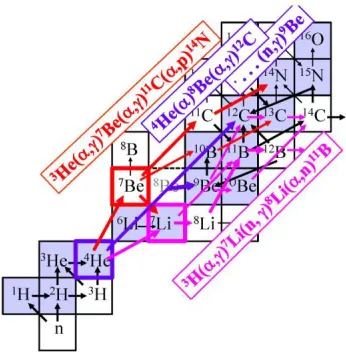
The nuclear reactions in the pp-chain region is depicted in Fig. 2 together with possible breakout processes under high temperature astronomical conditions [11,12,13]. The triple-alpha reaction is considered to be a key process for a wide temperature range in various scenarios. The 4He()8Be(n,)9B process is considered to be another important pathway in type II supernovae. In addition, the pathway, mentioned in the last subsec. 7Li(n,) 8Li(,n)11B also is important in the type II supernovae, and the possible CNO element production in the primordial universe.
Under proton-rich, high temperature conditions like in the p-process in the very early epoch of type II supernovae, nuclear reaction chains that involve proton-rich nuclei are considered to be favourable like 7
Be()11C(,p)14N, and 7Be(p)10B(p) 13C [10]. Since the nuclear reactions on the breakout
processes involve unstable nuclei, most of them were not investigated well yet. The breakout conditions actually influence very much the heavy element synthesis as we see in the next subsec. Therefore, the reaction study of these processes along the breakout processes is considered to be one of the key subjects for investigation of explosive burning in nuclear astrophysics. This paper will discuss some important reactions among them.
1.3 The p-process in type II supernovae
The p-process, proposed in 2006 [6-8], may take place at the very early epoch of type II supernovae in the ejecta near the inner core. Here, it can be proton-rich with some fraction of neutrons at very high temperatures because they are in equilibrium through the weak
interaction;
en pe, ep ne and the mass difference of proton andneutron. This process has been discussed as a possible source of p-nuclei near A=90 - 100, which have anomalously large isotopic abundances [14].
To investigate this possibility, we need to confirm this process from nuclear physics point of view, as the most nuclear reactions involved are unknown yet. It involves not only proton and alpha induced reactions, but also neutron-induced reactions in the proton-rich unstable nuclear regions. Specifically, the breakout process from the pp-chain region has a quite large influence to the production of nuclei around A ~ 90-100, as can be seen in the sensitivity test shown in Fig. 3.
The pathway going through 7Be()11C (,p)14N together with the triple alpha process seem to play a key role. Since this pathway was not known well, we studied the two reactions in the pathway in our project. A detail will be discussed in subsec. 2.3.
In addition for the
p-process, one needs to study neutron-induced stellar reactions on proton-rich nuclei, which is a distinct difference from the ordinary rp-process. But, an important point here is that the p-process has a possibility to contribute for the chemical evolution, which is different from the x-ray bursts which do not contribute to it. An interesting consequence of the neutron-induced reactions is that the waiting points of the rp-process may be discarded by the (n,p) and (n,) reactions, and the nucleosynthesis may flow up to heavier mass regions [11].
The p-process thus involves nuclear structures which are not investigated yet. The proton capture reactions may be sensitive to low-lying proton resonances of a single particle configuration. Pigmy resonances might also contribute to the (p,) reaction if they exist in this energy region, and alpha cluster resonances to the alpha-induced reactions. This possibility is supported by the cluster threshold rule [15], which says that alpha cluster states will appear with a large possibility near the alpha-thresholds. Of course, there are very few experimental studies on alpha cluster resonances in proton-rich unstable nuclear region yet. The neutron thresholds in proton-rich nuclei locate at much higher energy region, where almost no nuclear structure information are available in nuclear physics yet. The neutron-induced reactions on proton-rich unstable nuclei are very difficult to study, as discussed above. If the reactions involve proton-rich nuclei located close to the line of stability, there is a possibility to study it by a time-reverse reactions. If the proton-rich nuclei have a long half-lives, one may make a target for the study. These are, however, very limited, and mostly the proton-rich nuclei relevant are short-lived nuclei located away from the line of stability, which cannot be reached by the time reverse reactions. Currently, people are using statistical models to estimate almost all cross sections of the alpha- and neutron- induced reactions, although statistical models are known to be not precise enough in the light mass regions, and further the statistical models are not investigated so much in unstable nuclear regions. Thus, the experimental studies of the stellar reactions by alpha and neutrons should be very important and a challenge for the coming years in nuclear astrophysics. I will discuss these subjects along with our recent experimental efforts, specifically emphasizing the astrophysical reactions starting from 7Be and 7Li in the following sections.
2 Fate of
7Be
2.1 7Be(n,)4He reaction
!"#$"" $%
(a) (b)
!" % & $ %
'!
$ * $ % $& *"+ &
/ * *
< $
$
$ > $$* $ * & & " ?! * D" G J !" he BBN simulation shows that the present rate leads to an increase of 1.2% of the 7Li abundance, compared with the result using the Wagoner rate, and thus, the new rate makes the 7Li problem worse. The present estimate should be confirmed by experiment.
2.2 7Be()11C reaction
The nucleosynthetic flows through the proton-rich nuclear side in the pp-chain region are considered to affect significantly the production of heavy nuclei in the p-process [11], as discussed in subsec. 1.3. At extremely high temperatures, alpha induced reactions are expected to play a key role in the light mass regions.
Among the possible breakout pathways from the pp-chain region, the least investigated but very crucial pathway is 7Be()11C(,p)14N. The first step reaction 7Be()11C, which is considered to have the decisive role in the pathway, was studied previously by the direct method using a 7Be target [20], but it was limited up to the second resonance above the -threshold. We need to know the contributions from the high-lying resonances in 11C, which might have significant contributions at high temperatures.
In order to study the high-lying resonances, an experiment was performed [21] for 7Be+ resonant scattering with a thick-target method using a high-intensity, nearly pure 7Be beam from the CRIB facility [22,23] of the University of Tokyo, set in the RIKEN RIBF facility. The 7Be beam was about 2x10⁵ pps and 17.9 MeV. Both elastic and inelastic events were measured separately by using a E-E Si detector telescope together with
Figure 4 The cross sections of the 7Be(n,)4He reaction estimated from other reaction data together with the cross section at the thermal energy [19].
Figure 5 The reaction rates of 7Be()11C, deduced based on the
10 NaI(Tl) detectors for particle identifications.
The elastic and inelastic scattering of + 7Be were measured together with the 7Be(,p) reaction. A new resonance at 8.90 MeV, which is the third resonance above the alpha threshold, was identified for the first time, with possible spin-parity assignment of (9/2+) or 3/2+, where the R-matrix analysis did not give a unique assignment [21]. New rotational bands were identified that have a large alpha configuration.
The reaction rates estimated through this resonance are shown in Fig. 5. Here, the gamma decay width of this state was simply assumed to be a typical value, 0.1 of the Weisskopf unit. This work suggests about 10% increase of the total reaction rate of 7Be()11C due to the new third resonance above the alpha threshold in 11C. Since this reaction rate is considered to have the decisive role for breakout from the pp-chain region, this gamma width needs to be investigated experimentally.
2.3 11C(,p)14N reaction
The second reaction 11C(,p)14N on the breakout process was studied recently [24] by the direct method for the first time using a high-intensity 11C beam at very low energies. This reaction was previously studied only by the time-reverse reaction 14N(p,)11C with an activation method.
Apparently, the time reverse reaction study is not sensitive to the reactions leading to the excited states in 14N. It should be also worthwhile to confirm by the direct method the cross sections to the ground state derived previously by the activation method.
The 11C(,p)14N experiments[24] were performed at the CRIB facility [22,23]. The 11C beam at low energies were produced at the CRIB facility; 3x10⁵ pps at 10.1 MeV, and 1x10⁵ pps at 16.9 MeV with a purity better than 97 %. A new method was developed here for efficient measurement of the excitation functions of the 11C(,p)11N reaction cross sections for the low-lying excited states as well as for the ground state in 14N. We adopted a thick-target method with an extended gas target together with two position sensitive beam monitors, and position sensitive Si telescopes for the measurement of protons. By combining the TOF information, one can identify the reaction points in the target, and thus the reaction energies of the (,p) reaction. Precise excitation functions were obtained for the 11C(,p)11N reactions for the ground states and the first and second excited states [24]. The cross sections for the ground state transitions obtained agree well with the cross sections previously measured by the time-reverse reaction with the activation method [25]. The cross sections for the first and second excited states were also obtained for the first time, and our data consistently disagree with the statistical model predictions roughly by a factor of 2-5.
The R-matrix analysis identified several new resonances, and new resonance parameters for the known states in 14N. This is the first extensive, direct measurement of the stellar (,p) reaction cross sections with the proton-rich unstable nuclei, identifying each resonance and the resonance parameters. It is interesting to note that alpha cluster states enhance the reaction rates; some large peaks of the reaction cross sections are due to large alpha widths, as expected.
3 Fate of
7Li
3.1 7Li(n,)8Li reaction
Possible heavy elements synthesis in the inhomogeneous big bang model was discussed seriously late 1980s and 1990s both in theory [12] and experiment [26-33]. One of the important pathway suggested was 7Li(n,)8Li(,n)11B for the CNO element synthesis. Later, this pathway also has been identified to be important in the type II supernovae in the early stage of the r-process. The 7Li(n,)8Li reaction is the first step of this breakout process.
#* & Z! Z! $ * * * % * " J $ Z'! $\ * Z!$ not with the “new” data [26]" % &% *^ & Z!" + * “* ” & * Z! * *^& Z?!" _ * < < % Z!* $% "
* * * * < * $ & *"
3.2 8Li(,n)11B reaction
$< 7/8/11"
&*$% 118/*% `G!"
& { % 8/11""
%&$ * 11" *%$
9
1211| `!" & $
" *% & $ *
11
*"
_ %$ 8/$%$ *$
8/
$ 4 " &
* }+ 8/
$ * `Z!"#
*& *$'/
$ $ & " D * * < * * < ``!" + % " *% $ *$ D"" * $ % % $ *" + $ ${ * G" * "
Figure 6 The reaction rate of 8Li(,n)11B, deduced based
4 Summary
^
$ $< * " _ % / *
& " ^ ^ *& ++ %"
References
[1] Proc. Origin of Matter and Evolution of Galaxies 2011, eds. S. Kubono, et al., AIP Conf. Proc. 1484 (2012). Proc. Origin of Matter and Evolution of Galaxies 2011, eds. S. Jeong , et al., AIP Conf. Proc. 1594 (2013). Proc. XII International Symposium on Nuclei in the Cosmos, Cairns, 2012, eds. J. Lattanzio, et al. Proceedings of Science (NIC XII), S. Kubono, Nucl. Phys.A 693 , 221 (2001)
[2] J. Dunkley, et al., Astrophys. J., Suppl. Ser. 180, 306 (2009). [3] Plank Collaboration, 2015, arXiv:1502.01582 (2015) [4] F. Spite, M. Spite, Astron. Astrophys. 115 (1982) 357 [5] B. D. Fields, Annu. Rev. Nucl. Part. Sci. 61, 47 (2011) [6] C. Fröhlich, et al., Phys. Rev. Lett. 96, 142502 (2006) [7] J. Pruet, et al., Astrophys. J. 644, 1028 (2006)
[8] S. Wanajo,Astrophys. J. 647, 1323 (2006)
[9] R. K. Wallace and S. E. Woosley, Astrophys. J. Suppl. 45, 389 (1981) [10] S. Q. Hou, et al., Chin. Phys. Lett. 27, 082601 (2010)
[11] S. Wanajo, H.-T. Janka, and S. Kubono, Astrophys. J. 729, 46 (2011)
[12] J.H. Applegate, C. J. Hogan, and R.J. Scherrer, Phys. Rev. D 35 (1988) 1151, T. Kajino, G.J. Mathews, G. M. Fuller, Astrophys. J. 364 (1990) 7
[13] T. Sasaqui, et al., Astrophys. J. 645 (2006) 1345 [14] M. Arnould, and S. Goriely, Phys. Rep. 384 , 1 (2003)
[15] S. Kubono, et al., 10th International Conference on Clustering Aspects of Nuclear Structure and Dynamics, IOP Conf. 436, 012071 (2013)
[16] E. P. Bassi et al., Nuovo Cimento 28, 1049 (1963) [17] R. V. Wagoner, Astrophys. J., Suppl. Ser. 18, 247 (1969). [18] C. H. King, et al., Phys. Rev. C 16 (1977) 1712
[19] S.Q. Hou, J.J. He, S. Kubono, and Y.S. Chen, Pys. Rev. C 91 (2015) 055802 [20] G. Hardie, et al., Phys. Rev. C 29 (1984) 1199
[21] H. Yamaguchi, et al., Phys. Rev. C 87, 034303 (2013). [22] S. Kubono, et al., Eur. Phys. J. A 13, 217 (2002)
[23] Y. Yanagisawa, S. Kubono, et al., Nucl. Instr. Meth. A 539, 74 (2005) [24] S. Hayakawa, Ph. D. thesis of the University of Tokyo, 2012.
[25] P.D. Ingalls, et al., Phys. Rev. C 13 (1976) 524 [26] M. Wiescher, et al., Astrophys. J. 344 (1989) 464 [27] W. Imhof, et al., Phys. Rev. 14 (1959)1037 [28] Y. Nagai, et al., Astrophys. J. 381 (1991) 444 [29] M. Heil, et al., Astrophys. J. 507 (1998) 997 [30] T. Paradellis, et al., Z. Phys. A 337 (1990) 211
[31] S. Kubono, et al., Z. Phys. A 338 (1991) 459, S. Kubono, et al., Z. Phys. A 341 (1991) 121, R. Boyd, S. Kubono, et al., Nucl. Phys. A 542 (1992) 97
![Figure 1 The nuclear reactions relevant to 7Be in the primordial nucleosynthesis by the standard model [10]](https://thumb-us.123doks.com/thumbv2/123dok_us/8167992.1363229/2.482.252.425.454.622/figure-nuclear-reactions-relevant-primordial-nucleosynthesis-standard-model.webp)
![Figure 3(a) (b) early stage of the (a) The breakout reactions from the pp-chain region, important in the �p-process [11]](https://thumb-us.123doks.com/thumbv2/123dok_us/8167992.1363229/4.482.156.436.76.203/figure-early-stage-breakout-reactions-region-important-process.webp)
![Figure 5 The reaction rates of present experiment [21]. The curves (a) and (b) represent the contribution of the newly found, third resonance, assuming 9/27Be(���)11C, deduced based on the +and 3/2+, respectively](https://thumb-us.123doks.com/thumbv2/123dok_us/8167992.1363229/5.482.246.429.79.247/reaction-present-experiment-represent-contribution-resonance-assuming-respectively.webp)
![Figure 6 The reaction rate of 8Li(�,n)11B, deduced based on the present experiment [33], together with other data indicated](https://thumb-us.123doks.com/thumbv2/123dok_us/8167992.1363229/7.482.225.417.447.595/figure-reaction-rate-deduced-based-present-experiment-indicated.webp)
