
University of South Carolina
Scholar Commons
Theses and Dissertations
2017
Multi-Model Structural Analysis
Wesley Holt
University of South Carolina
Follow this and additional works at:https://scholarcommons.sc.edu/etd
Part of theCivil Engineering Commons
This Open Access Thesis is brought to you by Scholar Commons. It has been accepted for inclusion in Theses and Dissertations by an authorized administrator of Scholar Commons. For more information, please [email protected].
Recommended Citation
Multi-Model Structural Analysis
by
Wesley Holt
Bachelor of Science
Tennessee Technological University 2007
Submitted in Partial Fulfillment of the Requirements
for the Degree of Master of Science in
Civil Engineering
College of Engineering and Computing
University of South Carolina
2017
Accepted by:
Juan Caicedo, Director of Thesis
Dimitris Rizos, Reader
Paul Ziehl, Reader
c
Copyright by Wesley Holt, 2017
Acknowledgments
I would like to sincerely thank my advisor, Dr Juan Caicedo, for his guidance,
ex-pertise, and extremely valuable time. I would also like to thank my thesis committee
Abstract
The uncertainty in modeling earthquake loading is investigated through the
compar-ison of various openSEES models. A series of models is created and the responses
compared with each other as well as with a full scale shake table experiment. The
openSEES models selected for comparison include two linear models, a nonlinear
model using the Steel01 material for the entire cross section, and eight fiber models
using reinforcing steel material and various concrete materials.
The models are subjected to a series of nine simulated earthquakes, matching
the excitations applied to the shake table test. It is found that all of the models
under-predict the maximum base reactions. However, the nonlinear model using the
Steel01 material generates the most accurate response of the models tested. It is seen
that accumulated damage from each excitation affects the response of the column
during the subsequent excitations and that the effect of this accumulated damage
contributes to the total amount of uncertainty in the models.
A method of combining the responses of the different models to create a single
probabilistic output is presented and some potential real world challenges to
Table of Contents
Acknowledgments . . . iii
Abstract . . . iv
List of Tables . . . ix
List of Figures . . . x
Chapter 1 Background . . . 1
1.1 Variability in Structural Models . . . 1
1.2 Modeling Software . . . 2
1.3 Blind Test . . . 3
1.4 Related Work . . . 4
Chapter 2 Models . . . 6
2.1 General . . . 6
2.2 Model 1 . . . 8
2.3 Model 2 . . . 9
2.4 Model 3 . . . 10
2.5 Model 4 . . . 13
2.6 Concrete Materials . . . 16
2.8 Number of Integration Points . . . 19
Chapter 3 Results . . . 21
3.1 Excitation . . . 21
3.2 Linear Elastic vs Nonlinear Models . . . 22
3.3 Shear . . . 27
3.4 Moments . . . 29
3.5 Deflections . . . 31
3.6 Effect of Different Concrete Materials . . . 33
3.7 Influence of the Excitation / Damage Accumulation . . . 38
3.8 Combination of Results . . . 46
3.9 Hand Calculation Method for Baseline Reference . . . 53
Chapter 4 Conclusions and Future Work . . . 56
4.1 Modeling From a Practitioner Point of View . . . 56
4.2 Model Conclusions . . . 57
4.3 Future Work . . . 61
4.4 Application . . . 62
Bibliography . . . 65
Appendix A Excitations. . . 67
Appendix B Model 1 Output . . . 72
Appendix D Model 3 Output . . . 100
Appendix E Model 4a Output . . . 114
Appendix F Model 4b Output . . . 128
Appendix G Model 4c Output . . . 142
Appendix H Model 4d Output . . . 156
Appendix I Model 5a Output . . . 170
Appendix J Model 5b Output . . . 184
Appendix K Model 5c Output . . . 198
Appendix L Model 5d Output . . . 212
Appendix M Model 3 Moment Curvature Plots . . . 226
Appendix N Model 4a Moment Curvature Plots . . . 231
Appendix O Model 4b Moment Curvature Plots . . . 236
Appendix P Model 4c Moment Curvature Plots . . . 241
Appendix Q Model 4d Moment Curvature Plots . . . 246
Appendix R Model 5a Moment Curvature Plots . . . 251
Appendix T Model 5c Moment Curvature Plots . . . 261
Appendix U Model 5d Moment Curvature Plots . . . 266
List of Tables
Table 2.1 Model Types . . . 8
Table 2.2 Parameters used for Model 1 . . . 9
Table 2.3 Parameters used for Model 2 . . . 10
Table 2.4 Parameters used for Model 3 . . . 11
Table 2.5 Moment-Curvature Data . . . 12
Table 2.6 Parameters used for Model 4 . . . 14
Table 2.7 Model 4 and Model 5 materials . . . 14
Table 2.8 Parameters used for fiber materials in model 4 and model 5 . . . . 15
Table 2.9 Parameters used for Model 5 . . . 19
Table 2.10 Parameters used for Bond-SP01 material . . . 19
Table 3.1 Maximum Base Moment . . . 41
Table 3.2 Maximum Base Shear . . . 42
Table 3.3 Maximum Deflection . . . 45
Table 3.4 Relative weights assigned to the openSEES models . . . 49
Table 3.5 Parameters used to estimate the column response using hand methods 53 Table 3.6 Sa and Sd values for Tn = 1.15 from Figures 3.37, 3.38, and 3.39 . 54 Table 3.7 Resulting Base Reactions from EQ 1, 2, & 3 based on linear single degree of freedom model [14], [15] . . . 55
List of Figures
Figure 1.1 PEER contest predictions of maximum displacement at the top
of column verses measured response [1] . . . 4
Figure 1.2 PEER contest predictions of maximum moment at the base of the column verses measured response [1] . . . 4
Figure 2.1 Pier Cross Section Details [2] . . . 7
Figure 2.2 Comparison of maximum displacement and the number of elas-tic elements . . . 10
Figure 2.3 Moment-Curvature of Column at Different Loading Stages . . . . 12
Figure 2.4 Concrete01 (Source: OpenSees documentation) . . . 16
Figure 2.5 Concrete02 (Source: OpenSees documentation) . . . 17
Figure 2.6 Concrete03 (Source: OpenSees documentation) . . . 18
Figure 2.7 Concrete04 (Source: OpenSees documentation) . . . 18
Figure 3.1 Maximum base shear of all models . . . 23
Figure 3.2 Maximum base moment of all models . . . 24
Figure 3.3 Maximum deflection of all models . . . 25
Figure 3.4 Comparing the time domain simulations of models 1 (blue) and 2 (green) for EQ 1 . . . 25
Figure 3.5 Comparing the time domain simulations of models 1 (blue) and 2(green) for EQ 5 . . . 26
Figure 3.7 Maximum base shear of model 3 compared with the
experimen-tal results . . . 28
Figure 3.8 Maximum base moment omitting models 1 and 2 . . . 29
Figure 3.9 Maximum base moment of model 3 compared with the experi-mental results . . . 30
Figure 3.10 Maximum deflection omitting models 1 and 2 . . . 32
Figure 3.11 Maximum deflection of model 3 compared with the experimen-tal results . . . 33
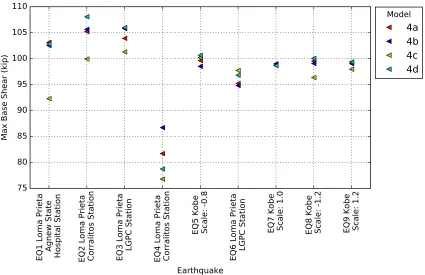
Figure 3.12 Comparing maximum base shear of models 4a, 4b, 4c, and 4d . . 34
Figure 3.13 Comparing maximum base moment of models 4a, 4b, 4c, and 4d . 35 Figure 3.14 Comparing maximum deflection of models 4a, 4b, 4c, and 4d . . . 36
Figure 3.15 Comparing maximum base shear of models 5a, 5b, 5c, and 5d . . 36
Figure 3.16 Comparing maximum base moment of models 5a, 5b, 5c, and 5d . 37 Figure 3.17 Comparing maximum deflection of models 5a, 5b, 5c, and 5d . . . 37
Figure 3.18 Moment-curvature plot of EQ2 generated from the PEER ex-periment [2] . . . 38
Figure 3.19 Moment-curvature plot of EQ3 generated from the PEER ex-periment [2] . . . 39
Figure 3.20 Moment-curvature plot of EQ4 generated from the PEER ex-periment [2] . . . 40
Figure 3.21 Moment-curvature plot of EQ5 generated from the PEER ex-periment [2] . . . 41
Figure 3.22 Moment-curvature plot of EQ2 generated from model 3 . . . 42
Figure 3.23 Moment-curvature plot of EQ3 generated from model 3 . . . 43
Figure 3.24 Moment-curvature plot of EQ4 generated from model 3 . . . 43
Figure 3.26 Moment-Curvature Plot of EQ4 generated from model 4a . . . 44
Figure 3.27 Moment-Curvature Plot of EQ5 generated from model 4a . . . 45
Figure 3.28 Comparing maximum base shear of models 4a, 4b, 4c, and 4d . . 47
Figure 3.29 Prior prediction combination of maximum base shear generated from models 4a, 4b, 4c, and 4d. Red markers indicate
experi-mental results. . . 48
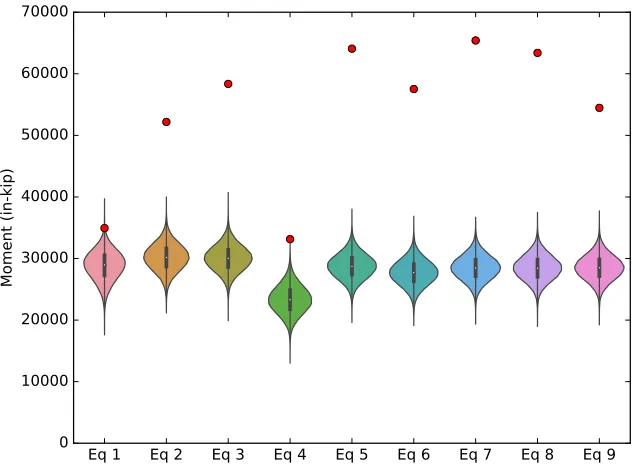
Figure 3.30 Prior prediction combination of maximum base moment gen-erated from models 4a, 4b, 4c, and 4d. Red markers indicate
experimental results. . . 49
Figure 3.31 Prior prediction combination of maximum base shear generated from models 5a, 5b, 5c, and 5d. Red markers indicate
experi-mental results. . . 50
Figure 3.32 Prior prediction combination of maximum base moment gen-erated from models 5a, 5b, 5c, and 5d. Red markers indicate
experimental results. . . 50
Figure 3.33 Prior prediction combination of maximum base shear generated from models 4a, 4b, 4c, 4d, 5a, 5b, 5c, and 5d. Red markers
indicate experimental results. . . 51
Figure 3.34 Prior prediction combination of maximum base moment gen-erated from models 4a, 4b, 4c, 4d, 5a, 5b, 5c, and 5d. Red
markers indicate experimental results. . . 51
Figure 3.35 Prior prediction combination of maximum base shear generated from models 3, 4a, 4b, 4c, 4d, 5a, 5b, 5c, and 5d. Red markers
indicate experimental results. . . 52
Figure 3.36 Prior prediction combination of maximum base moment gener-ated from models 3, 4a, 4b, 4c, 4d, 5a, 5b, 5c, and 5d. Red
markers indicate experimental results. . . 52
Figure 3.37 EQ1 pseudo-acceleration and displacement response spectra at
1% damping ratio [3] . . . 53
Figure 3.38 EQ2 pseudo-acceleration and displacement response spectra at
Figure 3.39 EQ3 pseudo-acceleration and displacement response spectra at
1% damping ratio [3] . . . 54
Figure 4.1 Maximum Base Shear omitting models 1 and 2 . . . 59
Figure 4.2 Maximum Base Moment omitting models 1 and 2 . . . 59
Figure 4.3 Maximum Column Deflection omitting models 1 and 2 . . . 60
Figure A.1 Input excitation for EQ1 [1] . . . 67
Figure A.2 Input excitation for EQ2 [1] . . . 68
Figure A.3 Input excitation for EQ3 [1] . . . 68
Figure A.4 Input excitation for EQ4 [1] . . . 69
Figure A.5 Input excitation for EQ5 [1] . . . 69
Figure A.6 Input excitation for EQ6 [1] . . . 70
Figure A.7 Input excitation for EQ7 [1] . . . 70
Figure A.8 Input excitation for EQ8 [1] . . . 71
Figure A.9 Input excitation for EQ9 [1] . . . 71
Figure B.1 Displacement response of model 1 for EQ1 . . . 72
Figure B.2 Displacement response of model 1 for EQ2 . . . 73
Figure B.3 Displacement response of model 1 for EQ3 . . . 73
Figure B.4 Displacement response of model 1 for EQ4 . . . 74
Figure B.5 Displacement response of model 1 for EQ5 . . . 74
Figure B.6 Displacement response of model 1 for EQ6 . . . 75
Figure B.7 Displacement response of model 1 for EQ7 . . . 75
Figure B.9 Displacement response of model 1 for EQ9 . . . 76
Figure B.10 Fx response of model 1 for EQ1 . . . 77
Figure B.11 Fx response of model 1 for EQ2 . . . 77
Figure B.12 Fx response of model 1 for EQ3 . . . 78
Figure B.13 Fx response of model 1 for EQ4 . . . 78
Figure B.14 Fx response of model 1 for EQ5 . . . 79
Figure B.15 Fx response of model 1 for EQ6 . . . 79
Figure B.16 Fx response of model 1 for EQ7 . . . 80
Figure B.17 Fx response of model 1 for EQ8 . . . 80
Figure B.18 Fx response of model 1 for EQ9 . . . 81
Figure B.19 Mz response of model 1 for EQ1 . . . 81
Figure B.20 Mz response of model 1 for EQ2 . . . 82
Figure B.21 Mz response of model 1 for EQ3 . . . 82
Figure B.22 Mz response of model 1 for EQ4 . . . 83
Figure B.23 Mz response of model 1 for EQ5 . . . 83
Figure B.24 Mz response of model 1 for EQ6 . . . 84
Figure B.25 Mz response of model 1 for EQ7 . . . 84
Figure B.26 Mz response of model 1 for EQ8 . . . 85
Figure B.27 Mz response of model 1 for EQ9 . . . 85
Figure C.1 Displacement response of model 2 for EQ1 . . . 86
Figure C.2 Displacement response of model 2 for EQ2 . . . 87
Figure C.4 Displacement response of model 2 for EQ4 . . . 88
Figure C.5 Displacement response of model 2 for EQ5 . . . 88
Figure C.6 Displacement response of model 2 for EQ6 . . . 89
Figure C.7 Displacement response of model 2 for EQ7 . . . 89
Figure C.8 Displacement response of model 2 for EQ8 . . . 90
Figure C.9 Displacement response of model 2 for EQ9 . . . 90
Figure C.10 Fx response of model 2 for EQ1 . . . 91
Figure C.11 Fx response of model 2 for EQ2 . . . 91
Figure C.12 Fx response of model 2 for EQ3 . . . 92
Figure C.13 Fx response of model 2 for EQ4 . . . 92
Figure C.14 Fx response of model 2 for EQ5 . . . 93
Figure C.15 Fx response of model 2 for EQ6 . . . 93
Figure C.16 Fx response of model 2 for EQ7 . . . 94
Figure C.17 Fx response of model 2 for EQ8 . . . 94
Figure C.18 Fx response of model 2 for EQ9 . . . 95
Figure C.19 Mz response of model 2 for EQ1 . . . 95
Figure C.20 Mz response of model 2 for EQ2 . . . 96
Figure C.21 Mz response of model 2 for EQ3 . . . 96
Figure C.22 Mz response of model 2 for EQ4 . . . 97
Figure C.23 Mz response of model 2 for EQ5 . . . 97
Figure C.24 Mz response of model 2 for EQ6 . . . 98
Figure C.25 Mz response of model 2 for EQ7 . . . 98
Figure C.27 Mz response of model 2 for EQ9 . . . 99
Figure D.1 Displacement response of model 3 for EQ1 . . . 100
Figure D.2 Displacement response of model 3 for EQ2 . . . 101
Figure D.3 Displacement response of model 3 for EQ3 . . . 101
Figure D.4 Displacement response of model 3 for EQ4 . . . 102
Figure D.5 Displacement response of model 3 for EQ5 . . . 102
Figure D.6 Displacement response of model 3 for EQ6 . . . 103
Figure D.7 Displacement response of model 3 for EQ7 . . . 103
Figure D.8 Displacement response of model 3 for EQ8 . . . 104
Figure D.9 Displacement response of model 3 for EQ9 . . . 104
Figure D.10 Fx response of model 3 for EQ1 . . . 105
Figure D.11 Fx response of model 3 for EQ2 . . . 105
Figure D.12 Fx response of model 3 for EQ3 . . . 106
Figure D.13 Fx response of model 3 for EQ4 . . . 106
Figure D.14 Fx response of model 3 for EQ5 . . . 107
Figure D.15 Fx response of model 3 for EQ6 . . . 107
Figure D.16 Fx response of model 3 for EQ7 . . . 108
Figure D.17 Fx response of model 3 for EQ8 . . . 108
Figure D.18 Fx response of model 3 for EQ9 . . . 109
Figure D.19 Mz response of model 3 for EQ1 . . . 109
Figure D.20 Mz response of model 3 for EQ2 . . . 110
Figure D.22 Mz response of model 3 for EQ4 . . . 111
Figure D.23 Mz response of model 3 for EQ5 . . . 111
Figure D.24 Mz response of model 3 for EQ6 . . . 112
Figure D.25 Mz response of model 3 for EQ7 . . . 112
Figure D.26 Mz response of model 3 for EQ8 . . . 113
Figure D.27 Mz response of model 3 for EQ9 . . . 113
Figure E.1 Displacement response of model 4a for EQ1 . . . 114
Figure E.2 Displacement response of model 4a for EQ2 . . . 115
Figure E.3 Displacement response of model 4a for EQ3 . . . 115
Figure E.4 Displacement response of model 4a for EQ4 . . . 116
Figure E.5 Displacement response of model 4a for EQ5 . . . 116
Figure E.6 Displacement response of model 4a for EQ6 . . . 117
Figure E.7 Displacement response of model 4a for EQ7 . . . 117
Figure E.8 Displacement response of model 4a for EQ8 . . . 118
Figure E.9 Displacement response of model 4a for EQ9 . . . 118
Figure E.10 Fx response of model 4a for EQ1 . . . 119
Figure E.11 Fx response of model 4a for EQ2 . . . 119
Figure E.12 Fx response of model 4a for EQ3 . . . 120
Figure E.13 Fx response of model 4a for EQ4 . . . 120
Figure E.14 Fx response of model 4a for EQ5 . . . 121
Figure E.15 Fx response of model 4a for EQ6 . . . 121
Figure E.17 Fx response of model 4a for EQ8 . . . 122
Figure E.18 Fx response of model 4a for EQ9 . . . 123
Figure E.19 Mz response of model 4a for EQ1 . . . 123
Figure E.20 Mz response of model 4a for EQ2 . . . 124
Figure E.21 Mz response of model 4a for EQ3 . . . 124
Figure E.22 Mz response of model 4a for EQ4 . . . 125
Figure E.23 Mz response of model 4a for EQ5 . . . 125
Figure E.24 Mz response of model 4a for EQ6 . . . 126
Figure E.25 Mz response of model 4a for EQ7 . . . 126
Figure E.26 Mz response of model 4a for EQ8 . . . 127
Figure E.27 Mz response of model 4a for EQ9 . . . 127
Figure F.1 Displacement response of model 4b for EQ1 . . . 128
Figure F.2 Displacement response of model 4b for EQ2 . . . 129
Figure F.3 Displacement response of model 4b for EQ3 . . . 129
Figure F.4 Displacement response of model 4b for EQ4 . . . 130
Figure F.5 Displacement response of model 4b for EQ5 . . . 130
Figure F.6 Displacement response of model 4b for EQ6 . . . 131
Figure F.7 Displacement response of model 4b for EQ7 . . . 131
Figure F.8 Displacement response of model 4b for EQ8 . . . 132
Figure F.9 Displacement response of model 4b for EQ9 . . . 132
Figure F.10 Fx response of model 4b for EQ1 . . . 133
Figure F.12 Fx response of model 4b for EQ3 . . . 134
Figure F.13 Fx response of model 4b for EQ4 . . . 134
Figure F.14 Fx response of model 4b for EQ5 . . . 135
Figure F.15 Fx response of model 4b for EQ6 . . . 135
Figure F.16 Fx response of model 4b for EQ7 . . . 136
Figure F.17 Fx response of model 4b for EQ8 . . . 136
Figure F.18 Fx response of model 4b for EQ9 . . . 137
Figure F.19 Mz response of model 4b for EQ1 . . . 137
Figure F.20 Mz response of model 4b for EQ2 . . . 138
Figure F.21 Mz response of model 4b for EQ3 . . . 138
Figure F.22 Mz response of model 4b for EQ4 . . . 139
Figure F.23 Mz response of model 4b for EQ5 . . . 139
Figure F.24 Mz response of model 4b for EQ6 . . . 140
Figure F.25 Mz response of model 4b for EQ7 . . . 140
Figure F.26 Mz response of model 4b for EQ8 . . . 141
Figure F.27 Mz response of model 4b for EQ9 . . . 141
Figure G.1 Displacement response of model 4c for EQ1 . . . 142
Figure G.2 Displacement response of model 4c for EQ2 . . . 143
Figure G.3 Displacement response of model 4c for EQ3 . . . 143
Figure G.4 Displacement response of model 4c for EQ4 . . . 144
Figure G.5 Displacement response of model 4c for EQ5 . . . 144
Figure G.7 Displacement response of model 4c for EQ7 . . . 145
Figure G.8 Displacement response of model 4c for EQ8 . . . 146
Figure G.9 Displacement response of model 4c for EQ9 . . . 146
Figure G.10 Fx response of model 4c for EQ1 . . . 147
Figure G.11 Fx response of model 4c for EQ2 . . . 147
Figure G.12 Fx response of model 4c for EQ3 . . . 148
Figure G.13 Fx response of model 4c for EQ4 . . . 148
Figure G.14 Fx response of model 4c for EQ5 . . . 149
Figure G.15 Fx response of model 4c for EQ6 . . . 149
Figure G.16 Fx response of model 4c for EQ7 . . . 150
Figure G.17 Fx response of model 4c for EQ8 . . . 150
Figure G.18 Fx response of model 4c for EQ9 . . . 151
Figure G.19 Mz response of model 4c for EQ1 . . . 151
Figure G.20 Mz response of model 4c for EQ2 . . . 152
Figure G.21 Mz response of model 4c for EQ3 . . . 152
Figure G.22 Mz response of model 4c for EQ4 . . . 153
Figure G.23 Mz response of model 4c for EQ5 . . . 153
Figure G.24 Mz response of model 4c for EQ6 . . . 154
Figure G.25 Mz response of model 4c for EQ7 . . . 154
Figure G.26 Mz response of model 4c for EQ8 . . . 155
Figure G.27 Mz response of model 4c for EQ9 . . . 155
Figure H.2 Displacement response of model 4d for EQ2 . . . 157
Figure H.3 Displacement response of model 4d for EQ3 . . . 157
Figure H.4 Displacement response of model 4d for EQ4 . . . 158
Figure H.5 Displacement response of model 4d for EQ5 . . . 158
Figure H.6 Displacement response of model 4d for EQ6 . . . 159
Figure H.7 Displacement response of model 4d for EQ7 . . . 159
Figure H.8 Displacement response of model 4d for EQ8 . . . 160
Figure H.9 Displacement response of model 4d for EQ9 . . . 160
Figure H.10 Fx response of model 4d for EQ1 . . . 161
Figure H.11 Fx response of model 4d for EQ2 . . . 161
Figure H.12 Fx response of model 4d for EQ3 . . . 162
Figure H.13 Fx response of model 4d for EQ4 . . . 162
Figure H.14 Fx response of model 4d for EQ5 . . . 163
Figure H.15 Fx response of model 4d for EQ6 . . . 163
Figure H.16 Fx response of model 4d for EQ7 . . . 164
Figure H.17 Fx response of model 4d for EQ8 . . . 164
Figure H.18 Fx response of model 4d for EQ9 . . . 165
Figure H.19 Mz response of model 4d for EQ1 . . . 165
Figure H.20 Mz response of model 4d for EQ2 . . . 166
Figure H.21 Mz response of model 4d for EQ3 . . . 166
Figure H.22 Mz response of model 4d for EQ4 . . . 167
Figure H.23 Mz response of model 4d for EQ5 . . . 167
Figure H.25 Mz response of model 4d for EQ7 . . . 168
Figure H.26 Mz response of model 4d for EQ8 . . . 169
Figure H.27 Mz response of model 4d for EQ9 . . . 169
Figure I.1 Displacement response of model 5a for EQ1 . . . 170
Figure I.2 Displacement response of model 5a for EQ2 . . . 171
Figure I.3 Displacement response of model 5a for EQ3 . . . 171
Figure I.4 Displacement response of model 5a for EQ4 . . . 172
Figure I.5 Displacement response of model 5a for EQ5 . . . 172
Figure I.6 Displacement response of model 5a for EQ6 . . . 173
Figure I.7 Displacement response of model 5a for EQ7 . . . 173
Figure I.8 Displacement response of model 5a for EQ8 . . . 174
Figure I.9 Displacement response of model 5a for EQ9 . . . 174
Figure I.10 Fx response of model 5a for EQ1 . . . 175
Figure I.11 Fx response of model 5a for EQ2 . . . 175
Figure I.12 Fx response of model 5a for EQ3 . . . 176
Figure I.13 Fx response of model 5a for EQ4 . . . 176
Figure I.14 Fx response of model 5a for EQ5 . . . 177
Figure I.15 Fx response of model 5a for EQ6 . . . 177
Figure I.16 Fx response of model 5a for EQ7 . . . 178
Figure I.17 Fx response of model 5a for EQ8 . . . 178
Figure I.18 Fx response of model 5a for EQ9 . . . 179
Figure I.20 Mz response of model 5a for EQ2 . . . 180
Figure I.21 Mz response of model 5a for EQ3 . . . 180
Figure I.22 Mz response of model 5a for EQ4 . . . 181
Figure I.23 Mz response of model 5a for EQ5 . . . 181
Figure I.24 Mz response of model 5a for EQ6 . . . 182
Figure I.25 Mz response of model 5a for EQ7 . . . 182
Figure I.26 Mz response of model 5a for EQ8 . . . 183
Figure I.27 Mz response of model 5a for EQ9 . . . 183
Figure J.1 Displacement response of model 5b for EQ1 . . . 184
Figure J.2 Displacement response of model 5b for EQ2 . . . 185
Figure J.3 Displacement response of model 5b for EQ3 . . . 185
Figure J.4 Displacement response of model 5b for EQ4 . . . 186
Figure J.5 Displacement response of model 5b for EQ5 . . . 186
Figure J.6 Displacement response of model 5b for EQ6 . . . 187
Figure J.7 Displacement response of model 5b for EQ7 . . . 187
Figure J.8 Displacement response of model 5b for EQ8 . . . 188
Figure J.9 Displacement response of model 5b for EQ9 . . . 188
Figure J.10 Fx response of model 5b for EQ1 . . . 189
Figure J.11 Fx response of model 5b for EQ2 . . . 189
Figure J.12 Fx response of model 5b for EQ3 . . . 190
Figure J.13 Fx response of model 5b for EQ4 . . . 190
Figure J.15 Fx response of model 5b for EQ6 . . . 191
Figure J.16 Fx response of model 5b for EQ7 . . . 192
Figure J.17 Fx response of model 5b for EQ8 . . . 192
Figure J.18 Fx response of model 5b for EQ9 . . . 193
Figure J.19 Mz response of model 5b for EQ1 . . . 193
Figure J.20 Mz response of model 5b for EQ2 . . . 194
Figure J.21 Mz response of model 5b for EQ3 . . . 194
Figure J.22 Mz response of model 5b for EQ4 . . . 195
Figure J.23 Mz response of model 5b for EQ5 . . . 195
Figure J.24 Mz response of model 5b for EQ6 . . . 196
Figure J.25 Mz response of model 5b for EQ7 . . . 196
Figure J.26 Mz response of model 5b for EQ8 . . . 197
Figure J.27 Mz response of model 5b for EQ9 . . . 197
Figure K.1 Displacement response of model 5c for EQ1 . . . 198
Figure K.2 Displacement response of model 5c for EQ2 . . . 199
Figure K.3 Displacement response of model 5c for EQ3 . . . 199
Figure K.4 Displacement response of model 5c for EQ4 . . . 200
Figure K.5 Displacement response of model 5c for EQ5 . . . 200
Figure K.6 Displacement response of model 5c for EQ6 . . . 201
Figure K.7 Displacement response of model 5c for EQ7 . . . 201
Figure K.8 Displacement response of model 5c for EQ8 . . . 202
Figure K.10 Fx response of model 5c for EQ1 . . . 203
Figure K.11 Fx response of model 5c for EQ2 . . . 203
Figure K.12 Fx response of model 5c for EQ3 . . . 204
Figure K.13 Fx response of model 5c for EQ4 . . . 204
Figure K.14 Fx response of model 5c for EQ5 . . . 205
Figure K.15 Fx response of model 5c for EQ6 . . . 205
Figure K.16 Fx response of model 5c for EQ7 . . . 206
Figure K.17 Fx response of model 5c for EQ8 . . . 206
Figure K.18 Fx response of model 5c for EQ9 . . . 207
Figure K.19 Mz response of model 5c for EQ1 . . . 207
Figure K.20 Mz response of model 5c for EQ2 . . . 208
Figure K.21 Mz response of model 5c for EQ3 . . . 208
Figure K.22 Mz response of model 5c for EQ4 . . . 209
Figure K.23 Mz response of model 5c for EQ5 . . . 209
Figure K.24 Mz response of model 5c for EQ6 . . . 210
Figure K.25 Mz response of model 5c for EQ7 . . . 210
Figure K.26 Mz response of model 5c for EQ8 . . . 211
Figure K.27 Mz response of model 5c for EQ9 . . . 211
Figure L.1 Displacement response of model 5d for EQ1 . . . 212
Figure L.2 Displacement response of model 5d for EQ2 . . . 213
Figure L.3 Displacement response of model 5d for EQ3 . . . 213
Figure L.5 Displacement response of model 5d for EQ5 . . . 214
Figure L.6 Displacement response of model 5d for EQ6 . . . 215
Figure L.7 Displacement response of model 5d for EQ7 . . . 215
Figure L.8 Displacement response of model 5d for EQ8 . . . 216
Figure L.9 Displacement response of model 5d for EQ9 . . . 216
Figure L.10 Fx response of model 5d for EQ1 . . . 217
Figure L.11 Fx response of model 5d for EQ2 . . . 217
Figure L.12 Fx response of model 5d for EQ3 . . . 218
Figure L.13 Fx response of model 5d for EQ4 . . . 218
Figure L.14 Fx response of model 5d for EQ5 . . . 219
Figure L.15 Fx response of model 5d for EQ6 . . . 219
Figure L.16 Fx response of model 5d for EQ7 . . . 220
Figure L.17 Fx response of model 5d for EQ8 . . . 220
Figure L.18 Fx response of model 5d for EQ9 . . . 221
Figure L.19 Mz response of model 5d for EQ1 . . . 221
Figure L.20 Mz response of model 5d for EQ2 . . . 222
Figure L.21 Mz response of model 5d for EQ3 . . . 222
Figure L.22 Mz response of model 5d for EQ4 . . . 223
Figure L.23 Mz response of model 5d for EQ5 . . . 223
Figure L.24 Mz response of model 5d for EQ6 . . . 224
Figure L.25 Mz response of model 5d for EQ7 . . . 224
Figure L.26 Mz response of model 5d for EQ8 . . . 225
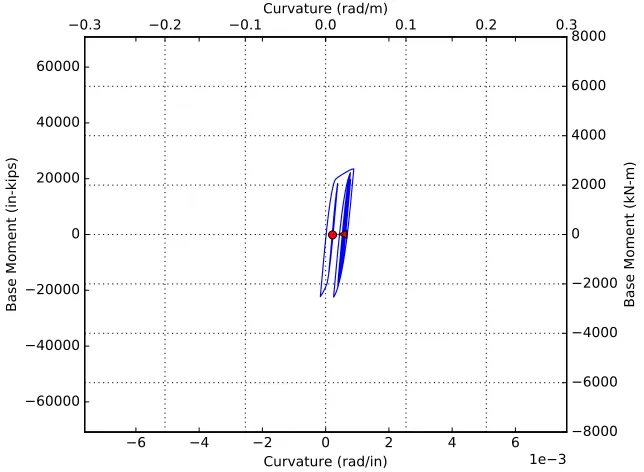
Figure M.1 Moment curvature response of model 3 for EQ1. Red circle
indicates initial point . . . 226
Figure M.2 Moment curvature response of model 3 for EQ2. Red circle
indicates initial point . . . 227
Figure M.3 Moment curvature response of model 3 for EQ3. Red circle
indicates initial point . . . 227
Figure M.4 Moment curvature response of model 3 for EQ4. Red circle
indicates initial point . . . 228
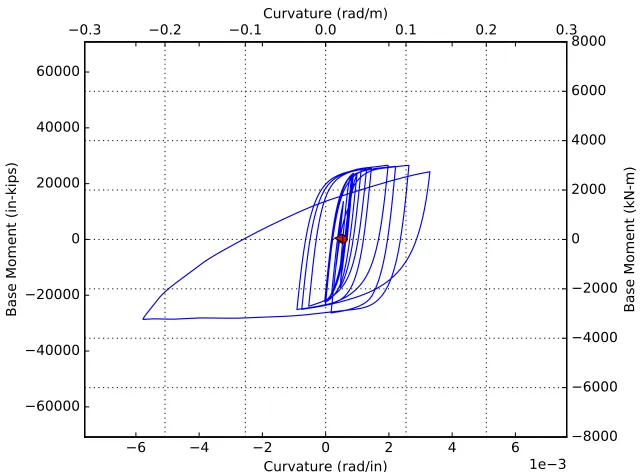
Figure M.5 Moment curvature response of model 3 for EQ5. Red circle
indicates initial point . . . 228
Figure M.6 Moment curvature response of model 3 for EQ6. Red circle
indicates initial point . . . 229
Figure M.7 Moment curvature response of model 3 for EQ7. Red circle
indicates initial point . . . 229
Figure M.8 Moment curvature response of model 3 for EQ8. Red circle
indicates initial point . . . 230
Figure M.9 Moment curvature response of model 3 for EQ9. Red circle
indicates initial point . . . 230
Figure N.1 Moment curvature response of model 4a for EQ1. Red circle
indicates initial point . . . 231
Figure N.2 Moment curvature response of model 4a for EQ2. Red circle
indicates initial point . . . 232
Figure N.3 Moment curvature response of model 4a for EQ3. Red circle
indicates initial point . . . 232
Figure N.4 Moment curvature response of model 4a for EQ4. Red circle
indicates initial point . . . 233
Figure N.5 Moment curvature response of model 4a for EQ5. Red circle
indicates initial point . . . 233
Figure N.6 Moment curvature response of model 4a for EQ6. Red circle
Figure N.7 Moment curvature response of model 4a for EQ7. Red circle
indicates initial point . . . 234
Figure N.8 Moment curvature response of model 4a for EQ8. Red circle
indicates initial point . . . 235
Figure N.9 Moment curvature response of model 4a for EQ9. Red circle
indicates initial point . . . 235
Figure O.1 Moment curvature response of model 4b for EQ1. Red circle
indicates initial point . . . 236
Figure O.2 Moment curvature response of model 4b for EQ2. Red circle
indicates initial point . . . 237
Figure O.3 Moment curvature response of model 4b for EQ3. Red circle
indicates initial point . . . 237
Figure O.4 Moment curvature response of model 4b for EQ4. Red circle
indicates initial point . . . 238
Figure O.5 Moment curvature response of model 4b for EQ5. Red circle
indicates initial point . . . 238
Figure O.6 Moment curvature response of model 4b for EQ6. Red circle
indicates initial point . . . 239
Figure O.7 Moment curvature response of model 4b for EQ7. Red circle
indicates initial point . . . 239
Figure O.8 Moment curvature response of model 4b for EQ8. Red circle
indicates initial point . . . 240
Figure O.9 Moment curvature response of model 4b for EQ9. Red circle
indicates initial point . . . 240
Figure P.1 Moment curvature response of model 4c for EQ1. Red circle
indicates initial point . . . 241
Figure P.2 Moment curvature response of model 4c for EQ2. Red circle
Figure P.3 Moment curvature response of model 4c for EQ3. Red circle
indicates initial point . . . 242
Figure P.4 Moment curvature response of model 4c for EQ4. Red circle
indicates initial point . . . 243
Figure P.5 Moment curvature response of model 4c for EQ5. Red circle
indicates initial point . . . 243
Figure P.6 Moment curvature response of model 4c for EQ6. Red circle
indicates initial point . . . 244
Figure P.7 Moment curvature response of model 4c for EQ7. Red circle
indicates initial point . . . 244
Figure P.8 Moment curvature response of model 4c for EQ8. Red circle
indicates initial point . . . 245
Figure P.9 Moment curvature response of model 4c for EQ9. Red circle
indicates initial point . . . 245
Figure Q.1 Moment curvature response of model 4d for EQ1. Red circle
indicates initial point . . . 246
Figure Q.2 Moment curvature response of model 4d for EQ2. Red circle
indicates initial point . . . 247
Figure Q.3 Moment curvature response of model 4d for EQ3. Red circle
indicates initial point . . . 247
Figure Q.4 Moment curvature response of model 4d for EQ4. Red circle
indicates initial point . . . 248
Figure Q.5 Moment curvature response of model 4d for EQ5. Red circle
indicates initial point . . . 248
Figure Q.6 Moment curvature response of model 4d for EQ6. Red circle
indicates initial point . . . 249
Figure Q.7 Moment curvature response of model 4d for EQ7. Red circle
indicates initial point . . . 249
Figure Q.8 Moment curvature response of model 4d for EQ8. Red circle
Figure Q.9 Moment curvature response of model 4d for EQ9. Red circle
indicates initial point . . . 250
Figure R.1 Moment curvature response of model 5a for EQ1. Red circle
indicates initial point . . . 251
Figure R.2 Moment curvature response of model 5a for EQ2. Red circle
indicates initial point . . . 252
Figure R.3 Moment curvature response of model 5a for EQ3. Red circle
indicates initial point . . . 252
Figure R.4 Moment curvature response of model 5a for EQ4. Red circle
indicates initial point . . . 253
Figure R.5 Moment curvature response of model 5a for EQ5. Red circle
indicates initial point . . . 253
Figure R.6 Moment curvature response of model 5a for EQ6. Red circle
indicates initial point . . . 254
Figure R.7 Moment curvature response of model 5a for EQ7. Red circle
indicates initial point . . . 254
Figure R.8 Moment curvature response of model 5a for EQ8. Red circle
indicates initial point . . . 255
Figure R.9 Moment curvature response of model 5a for EQ9. Red circle
indicates initial point . . . 255
Figure S.1 Moment curvature response of model 5b for EQ1. Red circle
indicates initial point . . . 256
Figure S.2 Moment curvature response of model 5b for EQ2. Red circle
indicates initial point . . . 257
Figure S.3 Moment curvature response of model 5b for EQ3. Red circle
indicates initial point . . . 257
Figure S.4 Moment curvature response of model 5b for EQ4. Red circle
Figure S.5 Moment curvature response of model 5b for EQ5. Red circle
indicates initial point . . . 258
Figure S.6 Moment curvature response of model 5b for EQ6. Red circle
indicates initial point . . . 259
Figure S.7 Moment curvature response of model 5b for EQ7. Red circle
indicates initial point . . . 259
Figure S.8 Moment curvature response of model 5b for EQ8. Red circle
indicates initial point . . . 260
Figure S.9 Moment curvature response of model 5b for EQ9. Red circle
indicates initial point . . . 260
Figure T.1 Moment curvature response of model 5c for EQ1. Red circle
indicates initial point . . . 261
Figure T.2 Moment curvature response of model 5c for EQ2. Red circle
indicates initial point . . . 262
Figure T.3 Moment curvature response of model 5c for EQ3. Red circle
indicates initial point . . . 262
Figure T.4 Moment curvature response of model 5c for EQ4. Red circle
indicates initial point . . . 263
Figure T.5 Moment curvature response of model 5c for EQ5. Red circle
indicates initial point . . . 263
Figure T.6 Moment curvature response of model 5c for EQ6. Red circle
indicates initial point . . . 264
Figure T.7 Moment curvature response of model 5c for EQ7. Red circle
indicates initial point . . . 264
Figure T.8 Moment curvature response of model 5c for EQ8. Red circle
indicates initial point . . . 265
Figure T.9 Moment curvature response of model 5c for EQ9. Red circle
Figure U.1 Moment curvature response of model 5d for EQ1. Red circle
indicates initial point . . . 266
Figure U.2 Moment curvature response of model 5d for EQ2. Red circle
indicates initial point . . . 267
Figure U.3 Moment curvature response of model 5d for EQ3. Red circle
indicates initial point . . . 267
Figure U.4 Moment curvature response of model 5d for EQ4. Red circle
indicates initial point . . . 268
Figure U.5 Moment curvature response of model 5d for EQ5. Red circle
indicates initial point . . . 268
Figure U.6 Moment curvature response of model 5d for EQ6. Red circle
indicates initial point . . . 269
Figure U.7 Moment curvature response of model 5d for EQ7. Red circle
indicates initial point . . . 269
Figure U.8 Moment curvature response of model 5d for EQ8. Red circle
indicates initial point . . . 270
Figure U.9 Moment curvature response of model 5d for EQ9. Red circle
indicates initial point . . . 270
Figure V.1 Moment curvature response of column from PEER experiment
(EQ1) [2] . . . 271
Figure V.2 Moment curvature response of column from PEER experiment
(EQ2) [2] . . . 272
Figure V.3 Moment curvature response of column from PEER experiment
(EQ3) [2] . . . 272
Figure V.4 Moment curvature response of column from PEER experiment
(EQ4) [2] . . . 273
Figure V.5 Moment curvature response of column from PEER experiment
(EQ5) [2] . . . 273
Figure V.6 Moment curvature response of column from PEER experiment
Figure V.7 Moment curvature response of column from PEER experiment
(EQ7) [2] . . . 274
Figure V.8 Moment curvature response of column from PEER experiment
(EQ8) [2] . . . 275
Figure V.9 Moment curvature response of column from PEER experiment
Chapter 1
Background
1.1 Variability in Structural Models
In the world of structural engineering, there are a number of different analytical tools
that an engineer could use to analyze a particular problem. These tools include:
simple hand calculations combined with engineering judgment, vigorous hand
cal-culations, open source software, and commercial software. Ideally, each method of
analyzing the same problem would generate the same results - or at least similar
results. However, often the case is that different analysis techniques present
differ-ent results. Further complicating the matter is the fact that even the same analysis
software can return different results based on how the particular problem is modeled.
This inherent variability of structural models can be described as uncertainty in the
models. The hypothesis behind this work is that a structural engineer can perform
an estimate of this uncertainty by combining the results of several models of the same
problem. The scope focuses in studying the inherent variability of different structural
models and providing information for the uncertainty quantification.
A selection of models were created and analyzed with a program called openSEES
(http://opensees.berkeley.edu/). The structure modeled was a single reinforced
con-crete column, representing a bridge pier. The details of the models are described in
Chapter 2. The column was loaded with gravity loads and a dynamic time history
loading taken from a series of recorded seismic events. The results from these models
test of the same column using the same dynamic time history loading. The results are
presented in Chapter 3. Finally, in Chapter 4, some thoughts are presented regarding
the resulting uncertainty from the point of view of a professional engineer.
1.2 Modeling Software
Most engineers today choose to use some sort of analysis software to model their
structure. A few of the commercial software packages that are available include:
RISA, RAM, STAAD, SAP2000, Etabs, and GTStrudl. Most commercial software is
similar in the fact that is has a graphical user interface and allows the engineer to see
their structure in 3-dimensions, apply loads, and analyze load combinations. These
software packages typically give results in the form of member stresses, deflections,
base reactions, and have a variety of different code checks that can be chosen from,
such as AISC and ACI. These programs are directly suited for structural engineers
to use for professional design purposes.
Other commercial analysis packages include finite element analysis software such
as ANSYS, Abaqus, and Solidworks simulation. The results generated from these
types of packages are typically limited to internal stresses and deformations/deflections
of the members. They may not be able to directly compare the member stresses to
the applicable building code (such as AISC or ACI).
In addition to commercial software packages, there are also many different types
of open-source software that can be used. These options typically have a much less
refined user interface than the commercial software options. Open source software
also typically has more limited functionality and may only be capable of a particular
type of analysis.
OpenSEES is a structural analysis program used by many engineers and
re-searchers worldwide to model the dynamic effects of earthquakes on structures. It is
in the 1990’s (http://opensees.berkeley.edu/). Over the years, many engineers have
developed different modeling techniques to attempt to create the most accurate
pre-diction of the real-world structural response of their particular problem. The result
is that there are now several ways to model the same problem that result in different
responses. A selection of these models was chosen for comparison.
With currently available design tools, it is not realistic to expect the time history
analysis to accurately predict the results from the shake table test. The behavior of
reinforced concrete subjected to these loads is simply too complex to predict with a
high level of certainty. Therefore, the objective of creating and analyzing models is
to get as close as possible and a "good" model is defined as a model that predicts a
response that is more accurate than other available models.
1.3 Blind Test
In addition to comparing the analysis results with each other, they were also compared
with a full scale test that was performed at the University of California, San Diego in
2010 and published by the Pacific Earthquake Engineering Research Center (PEER)
[2, 3]. In this experiment, a full scale reinforced concrete column was built on a
shake table and subjected to earthquake motions recorded during historic seismic
events. The data from this experiment is publicly available (NEES-2010-0987 from
https://www.designsafe-ci.org/data/browser/public/nees.public/ ).
The experiment was part of a blind contest performed by PEER [1]. In this
contest, engineers and researches from around the world were asked to predict the
response of the column. Figure 1.1 below shows the range of predictions that were
received for the maximum deflection at the top of the column. All contestants were
given the same information to model the column, yet the range of predicted maximum
deflections was very large. The range of predictions of the maximum moment at the
It is easy to see how the uncertainty in these models could pose a problem when the
engineer has to determine whether or not the column is adequate.
Figure 1.1: PEER contest predictions of maximum displacement at the top of column verses measured response [1]
Figure 1.2: PEER contest predictions of maximum moment at the base of the column verses measured response [1]
1.4 Related Work
Periera et al performed similar research using openSEES for numerical modeling and
uncertainty stemming solely from applying different material profiles was studied. A
total of 56 material combinations were analyzed in this work. It was found that the
accuracy of the models depended on the stress level in the column and that no single
model accurately predicted the response for the entire range of loading.
Similar work was also performed by Pan et al [5], [6], who investigated the effects
of bond slip on their fiber model of the same PEER column [2]. It was concluded that
including bond slip parameters made a substantial contribution toward the accuracy
Chapter 2
Models
2.1 General
The full scale test that the models were based on was performed at the Network for
Earthquake Engineering Simulation (NEES) shake table at the University of
Califor-nia, San Diego [2, 3]. In that experiment, a full scale bridge pier was built on the
shake table with a 522 kip concrete block on top of the pier to simulate the weight of
a bridge. The 522 kip block at the top of the pier was required to get realistic inertial
forces acting on the concrete pier. The pier itself had a round cross-section with a
diameter of 48". It was reinforced with eighteen #11 longitudinal bars and #5 hoops
spaced every 6 inches. See Figure 2.1 below. The pier was 24 feet tall, excluding the
foundation, which was 4 feet thick. The rebar was tied into the foundation to create
a moment connection and allow the pier to function as a simple cantilever column.
The mass of concrete at the top of the column was connected so that the center of
gravity of the mass was in line with the top of the column (24 feet above the top
of concrete of the footing). The connection between the pier and the superstructure
mass was designed so that there was no contact between the mass and the column
below 24 feet above TOC of the footing.
The researchers placed 250 gages and instruments onto the column prior to
test-ing [2]. The instrumentation included accelerometers on the foundation. This
ac-celerometer data was used as the input acceleration for the openSEES models. The
Figure 2.1: Pier Cross Section Details [2]
the maximum deflection that the column experienced during each of the simulated
earthquakes. This allowed the different models to not only be compared with each
other, but to be compared with the shake table response.
The software that was used for the computer analyses was the Open System for
Earthquake Engineering Simulation (openSEES). This is a software that was initially
developed by the University of California, Berkeley, and is now established as the
primary computational platform for the Pacific Earthquake Engineering Research
Center (PEER). It is an open-source platform that is used around the world for
modeling the nonlinear response of structural systems subjected to dynamic loading.
The typical process for creating a model with openSEES is the engineer downloads
a generic model from the community that resembles the system to be modeled (or
begins with a model used previously). The generic model is then modified to match
the desired dimensions, materials, conditions, etc. Right away, this presents a problem
because there are several different models that could be chosen for the same structure.
The different models range from simple, elastic analyses to advanced, nonlinear fiber
models and FEA models.
which is just about the simplest structure one would ever need to analyze. Yet, even
for this simple structure, there were several openSEES models that could be chosen
and configured for the column. And if the same column was simulated in each of the
different models, the resulting base reactions, deflections and internal stresses would
be substantially different. This difference was the inspiration behind this work.
To compare the differences between models, five commonly available models were
chosen. Table 2.1 shows the types of models used. Model 4 and model 5 each had
4 sub-models to compare different materials. Each model is discussed further in its
respective section. Once the different models were built, identical loads were applied
to each one. The acceleration load was obtained from the PEER experiment [2].
While the results of these models will be compared with the PEER test results
[2], it is important to note that no attempt was made to "fit" the models to the test
results. All of the models were created, run, and their results aggregated before being
compared with the PEER test results. There were no parameters that were adjusted
in attempt to improve the accuracy of the results. The intention was to create the
models as if no test results were available, as would be the case in a design scenario.
Table 2.1: Model Types
Model Type of Analysis No. of Elements Type of Cross-Section
Model 1 linear analysis single element solid cross-section
Model 2 linear analysis multiple elements solid cross-section
Model 3 nonlinear analysis single element solid cross-section
Model 4 nonlinear analysis single element fiber cross-section
Model 5 nonlinear analysis single element fiber cross-section
2.2 Model 1
Model 1 was the most basic model. It consisted of a single 24 foot tall element with a
16,211 slug mass at the top (applied in the model as 1.35 kip-s2/in to convert to the
itself along the length (0.00043 kip-s2/in). This model used the elasticBeamColumn
analysis element. This element had the limitation of a linear analysis even if the
column stress exceeded the yield stress. Table 2.2 shows the parameters used in
model 1. The primary parameter that had to be determined for this model was
the moment of inertia. A composite moment of inertia was calculated, assuming a
cracked cross-section, with all reinforcing bars intact (as opposed to selecting a state
after some bars had yielded).
Table 2.2: Parameters used for Model 1
Parameter Value
Model Name model1
Number of Elements 1
Element Type elasticBeamColumn
Fu 102 ksi
A 1810 in2
E 3320 ksi
I 97600 in4
mass 0.00043 kip-sec2
2.3 Model 2
Model 2 was similar to model 1 in most aspects except the number of elements was
increased from one to ten. This also required increasing the number of nodes from
two to eleven. This number of elements was selected after running the model with
several different numbers of elements and recording the maximum displacement in
the column. It was observed that the change in max displacement decreased as the
number of elements increased. Figure 2.2 illustrates how the maximum displacement
of the model converged once the number of elements reached approximately ten.
Table 2.3: Parameters used for Model 2
Parameter Value
Model Name model2
Number of Elements 10
Element Type elasticBeamColumn
Fu 102 ksi
A 1810 in2
E 3320 ksi
I 97600 in4
mass 0.00043 kip-sec2
0 2 4 6 8 10 12 14
Number of Elements 7.60
7.65 7.70 7.75 7.80
Maximum Displacement (in)
Figure 2.2: Comparison of maximum displacement and the number of elastic elements
2.4 Model 3
Model 3 was fundamentally different from model 1 and model 2 in that it utilized
nonlinear analysis. It also used a composite material for the cross section. The
material used was “Steel01”. This material was chosen based on the assumption that
the reinforced concrete behaves in a manner similar to steel in that it has a constant
EI value up to a point and then loses stiffness and has a reduced EI beyond that point.
was one area where an approximation had to be made. Since the column had a
circular cross section, the reinforcing bars were not all a constant distance away from
the neutral axis. Therefore, all of the reinforcing bars were not expected to yield
simultaneously. Instead, as the internal moment in the column was increased, the
steel furthest from the neutral axis would reach yielding first. Then, if the moment
continued to increase, the next set of rebars would yield, and then the next, and so
on. Unfortunately, there is not an opensees material that is designed to model this
behavior explicitly. The “Steel01” material was chosen to be relatively similar to the
actual behavior (albeit simplified). The “yield” point (point at which the slope of the
moment-curvature plot abruptly changes) was determined to be 29800 in-kips based
on a moment-curvature analysis of the column.
Table 2.4: Parameters used for Model 3
Parameter Value
Model Name model3
Number of Elements 1
Element Type nonlinearBeamColumn
Number of Integration Points 10
f’c 6 ksi
A 1810 in2
Ec 3320 ksi
I 97600 in4
Yield Moment 29800 in-kip
Yield Curvature 0.63 x 10⁻⁴
Cracked EI 324,000,000 in2
Strain-Hardening ratio 0.04
mass 0.00043 kip-sec2
The moment curvature plot was created by determining the moment and the
curvature associated with the first concrete crack, the yield of the most extreme
rebar, and then each subsequent rebar. The moment curvature plot is shown in
Figure 2.3. The yield point was selected as the point at which the outermost 8 rebar
0.0000 0.0001 0.0002 0.0003 0.0004 0.0005 0.0006 0.0007 0.0008 Curvature (rad/in)
0 5000 10000 15000 20000 25000 30000 35000 40000
Moment (in-kip)
Figure 2.3: Moment-Curvature of Column at Different Loading Stages
Table 2.5: Moment-Curvature Data
Stage phi M (in-kip)
No Load 0 0
1st Crack 0.0000075 7790
2 Rebar Yield 0.0000639 22500
4 Rebar Yield 0.0000689 23800
6 Rebar Yield 0.0000843 25100
8 Rebar Yield 0.0001090 27300
10 Rebar Yield 0.0001730 28900
12 Rebar Yield 0.0003780 30600
The initial EI slope was input using the cracked moment of inertia of the column
and the concrete modulus of elasticity. The cracked column moment of inertia was
taken as 97600 in4 and the modulus of elasticity was taken as 3320 ksi. The steel rebar
areas were transformed to their equivalent concrete area when calculating composite
modulii.
For the post yielding EI slope, a value of 0.04 x initial EI was used. The 0.04 value
was chosen by comparing the slopes on the moment curvature plot. The element used
in this model was ’nonlinearbeamcolumn’. Table 2.4 shows the parameters used in
2.5 Model 4
Model 4 also used the nonlinearBeamColumn element. However, the column was
modeled using a fiber cross section instead of a uniform cross section, as it was
in the previous models. There were still only two nodes and one element connecting
them. The fiber cross section was created using three materials. The interior concrete
(within the rebar cage), the exterior concrete (outside of the concrete cage), and the
longitudinal reinforcing steel. The fiber cross section was built using the ’patch’ and
’layer’ commands in openSEES. The cross section was built using 20 angular divisions
and 12 circumferential divisions, resulting in 240 total concrete fibers. Of these, 200
were within the rebar cage and 40 were outside the rebar cage.
The eighteen 36 mm (1.417 in) diameter longitudinal reinforcing bars were
mod-eled using a steel area of 1.58 square inches per bar. The material parameters: yield
strength, ultimate strength, initial modulus of elasticity, post strain hardening
mod-ulus of elasticity, strain at peak stress, and strain at initial strain hardening were
taken directly from the PEER report. These values were provided as 75.2 ksi, 102.4
ksi, 28.4 ksi, 0.8 ksi, 12.2 percent, and 1.1 percent, respectively [2], as shown in Table
2.8.
There were four different variants of model 4 that were analyzed: model4a,
model4b, model4c, and model4d. All of the models used the same concrete
ma-terial for the inner concrete layers. However, they used different concrete mama-terials
for the outer concrete layers (outside of the rebar cage). The materials are given in
Table 2.6: Parameters used for Model 4
Parameter Value
Model Name model4
No. of Elements 1
Element Type nonlinearBeamColumn
No. of Integration Points 6
mass 0.00043 kip-sec2
No. of Steel Fibers 18
No. of Interior Conc. Fibers (Radial Direction) 10
No. of Interior Conc. Fibers (Circumf. Direction) 20
No. of Exterior Conc. Fibers (Radial Direction) 2
No. of Exterior Conc. Fibers (Circumf. Direction) 20
Area of Steel Fibers 1.58 in 2
Table 2.7: Model 4 and Model 5 materials
Model Inner Concrete Outer Concrete Reinforcing Steel
4a concrete01 concrete01 ReinforcingSteel
4b concrete01 concrete02 ReinforcingSteel
4c concrete01 concrete03 ReinforcingSteel
4d concrete01 concrete04 ReinforcingSteel
5a concrete01 concrete01 ReinforcingSteel
5b concrete01 concrete02 ReinforcingSteel
5c concrete01 concrete03 ReinforcingSteel
Table 2.8: Parameters used for fiber materials in model 4 and model 5
Parameter concrete01 concrete02 concrete03 concrete04 reinforcingSteel
fpc -6 ksi -6 ksi -6 ksi -6 ksi n/a
epsc0 -0.0026 -0.0026 -0.0026 -0.0026 n/a
fpcu 0 0 0 n/a n/a
epsU -0.005 -0.005 -0.005 -0.005 n/a
lambda n/a 0.25 0.25 n/a n/a
ft n/a 0.580 ksi 0.580 ksi 0.580 ksi n/a
Ets n/a 733 ksi n/a n/a n/a
epst0 n/a n/a 0.00066 n/a n/a
ft0 n/a n/a 0.193 ksi n/a n/a
beta n/a n/a -1 n/a n/a
epstu n/a n/a 0.0021 n/a n/a
Ec n/a n/a n/a 3320 ksi n/a
fct n/a n/a n/a 0.0002 n/a
et n/a n/a n/a 0.1 n/a
Fy n/a n/a n/a n/a 75.2 ksi
Fu n/a n/a n/a n/a 102.2 ksi
Es n/a n/a n/a n/a 28400
Esh n/a n/a n/a n/a 800
esh n/a n/a n/a n/a 1.1
eult n/a n/a n/a n/a 12.2
2.6 Concrete Materials
The material concrete01 considers the concrete to have zero tensile strength (see
Figure 2.4).
Figure 2.4: Concrete01 (Source: OpenSees documentation)
The concrete02 and concrete03 materials include parameters for the concrete
ten-sile strength (see Figures 2.5 and 2.6). Concrete02 considers linear tension softening
(based on the work of Yassin et al [7]) while concrete03 considers nonlinear tension
softening.
The material concrete04 also considers concrete tensile strength with nonlinear
tension softening, using the Popovics concrete model [8] (see Figure 2.7).
2.7 Model 5
Model 5 was a fiber model similar to model 4 except that it included parameters for
strain penetration into the footing. The openSEES Bond-SP01 material was used to
model this strain penetration. A zero length element at the column base was created
Figure 2.5: Concrete02 (Source: OpenSees documentation)
slip of the rebar in the column in the area where the reinforcing bars have not yet
developed their full bond.
The parameters required for the Bond-SP01 material were: rebar yield strength
(Fy), rebar slip under yield stress (Sy), rebar ultimate strength (Fu), rebar slip at
ultimate strength (Su), initial hardening ratio (b), and pinching factor for the cyclic
slip vs bar response (R). The parameter values are shown in Table 2.10.
The slip at yield stress, Sy, was calculated by the following equation taken from
the opensees Bond-SP01 documentation, which is based on the work of Zhao and
Sritharan [9].
Sy = 0.1∗qa
db/4000∗F y/√f0c∗(2a+ 1) + 0.013
Figure 2.6: Concrete03 (Source: OpenSees documentation)
Figure 2.7: Concrete04 (Source: OpenSees documentation)
reinforcing steel, and f‘c is the compressive strength of the concrete. The variable ’a’
was taken as 0.4, per the CEB-FIB Model Code 90 [10]
The slip at ultimate stress was taken as 40 times the slip at yield [9], [11]. A range
for typical initial hardening ratios, b, was given in the opensees documentation as 0.3
Table 2.9: Parameters used for Model 5
Parameter Value
Model Name model5
No. of Elements 1
Element Type nonlinearBeamColumn
No. of Integration Points 6
mass 0.00043 kip-sec2
No. of Steel Fibers 18
No. of Interior Conc. Fibers (Radial Direction) 10
No. of Interior Conc. Fibers (Circumf. Direction) 20
No. of Exterior Conc. Fibers (Radial Direction) 2
No. of Exterior Conc. Fibers (Circumf. Direction) 20
Area of Steel Fibers 1.58 in 2
Table 2.10: Parameters used for Bond-SP01 material
Parameter Value
Fy 75 ksi
Fu 102 ksi
Sy 0.04 in
Su 1.6 in
b 0.4
R 0.7
pinching factors, R, was given in the opensees documentation as 0.5 - 1.0. The value
used in model 5 was 0.7.
2.8 Number of Integration Points
It should be noted that the number of integration points was not held constant among
the different concrete models. It would be ideal for this parameter to be constant, in
order to have a better direct comparison of the different models’ results. However,
these models were very sensitive to this parameter and some of them would not
converge unless a particular number of integration points was chosen.
The maximum number of integration points that the models were capable of
used. Each model was initially run with 10 integration points. If the model failed to
Chapter 3
Results
3.1 Excitation
The excitation input files for the openSEES models were obtained from
Design-Safe (https://www.designsafe-ci.org/data/browser/public/nees.public/
NEES-2010-0987). The original experiment subjected the column to ten simulated earthquakes.
The first nine were used in the openSEES models. The tenth was omitted because
the column reached failure and hit the support structure.
The earthquake time histories were taken from two historical events: the 1989
earthquake in northern California near Loma Prieta and the 1995 earthquake in
Kobe, Japan. Three different recordings of the Loma Prieta earthquake were taken
from different monitoring stations in the San Francisco area. EQ1 was taken from
the Agnew State Hospital station. The Corralitos Station record was used for EQ2
and again for EQ4. EQ3 and EQ6 were taken from the LGPC Station. Only one
recording of the Kobe earthquake was used, but different scale factors were applied to
create increasing amplitudes for the later excitations. EQ5 used the Kobe earthquake
with a -0.8 scale factor. The scale factors for EQ7, EQ8, and EQ9 were +1.0, -1.2,
and +1.2.
In the PEER experiment[2] , the same column was used for each of the earthquake
simulations with no repairs being performed between excitations. This resulted in
accumulated damage affecting the performance of the column for each subsequent
EQ4 and EQ2 as well as the results of EQ6 and EQ3 and is discussed later in this
chapter. Each of these excitation pairs used the same time history input but had
notably different responses.
The accumulated damage was accounted for in the openSEES simulations by
linking all of the excitations into a single input file and analyzing them in a single
run. Each excitation was separated by enough time to allow all motion in the column
to dissipate. The dead time between excitations was around 120-200 seconds between
each earthquake. For comparison, each excitation was around 40 seconds in duration.
While this differed from the actual experiment that spanned two days, it was not
expected that the shortened dead time between excitations would affect the models.
The following sections describe the behavior of the models in terms of the base
shear, base moment, and top deflection. The results from the PEER experiment were
taken from [1].
The complete set of outputs from the openSEES models is included in the
appen-dices. This includes the time history response of the deflection, base shear, and base
moment of the column for each earthquake and each model.
3.2 Linear Elastic vs Nonlinear Models
Figures 3.1, 3.2, and 3.3 show the maximum shear force, bending moment and
de-flection for all models. Models 1 and 2 assumed linear elastic behavior, regardless
of the stress in the column. This resulted in extremely large base shears and
mo-ments for the later earthquakes. These results were expected, as the excitations in
the experimental test were chosen to ensure that the stresses in the column exceeded
the linear stress range. The maximum deflections of the linear elastic models were
also over-predicted, though not by as much of a margin as the base reactions. Even
though the linear elastic models resulted in unrealistically high base reactions, they
maximum values expected. This is, if other models give higher results, then it could
be an indication of an error in the non-linear models.
EQ1 Loma Prieta Agnew State Hospital Station EQ2 Loma Prieta Corralitos Station EQ3 Loma Prieta LGPC Station EQ4 Loma Prieta Corralitos Station
EQ5 Kobe Scale: -0.8 EQ6 Loma Prieta LGPC Station
EQ7 Kobe Scale: 1.0 EQ8 Kobe Scale: -1.2 EQ9 Kobe Scale: 1.2
Earthquake 0 200 400 600 800 1000 1200 1400 1600 1800
Max Base Shear (kip)
Model
1
2
3
4a
4b
4c
4d
5a
5b
5c
5d
Experiment
Figure 3.1: Maximum base shear of all models
Models 1 and 2 are linear models with the same type of element but different
number of elements. Model 1 has only 1 beam element while model 2 has 10 elements.
Figure 3.4 shows the time domain response of both models for EQ1 (Loma Prieta
- Agnew State Hospital Station). As observed in this figure, the responses are very
similar, with model 1 generally resulting in higher displacements throughout the
excitation. Figure 3.5 shows the time domain response of both models for EQ5 (Kobe
- scale -0.8). As observed in this figure, the responses are also similar, but model 2
generally resulted in higher displacements, except for the peak. Interestingly, model
1 still returned a higher peak displacement. Overall, based on the metrics defined
by the blind test competition [1] it was observed that both models have very similar
behavior, indicating that increasing the discretization to 10 elements did not make a
EQ1 Loma Prieta Agnew State Hospital Station EQ2 Loma Prieta Corralitos Station EQ3 Loma Prieta LGPC Station EQ4 Loma Prieta Corralitos Station EQ5 Kobe Scale: -0.8
EQ6 Loma Prieta LGPC Station
EQ7 Kobe Scale: 1.0 EQ8 Kobe Scale: -1.2 EQ9 Kobe Scale: 1.2
Earthquake 0 100000 200000 300000 400000 500000
Max Base Moment (in-kip)
Model
1
2
3
4a
4b
4c
4d
5a
5b
5c
5d
Experiment
Figure 3.2: Maximum base moment of all models
Because of the high values of base shear, base moment and deflection from the
linear models, it is easier to compare the results of the other models with each other
if the model 1 and model 2 results are removed. Once the linear elastic models
are removed, most of the models under-predict the base reactions. There are only
three cases where the non linear models did not under-predict the base reactions:
the maximum base shear and maximum base moment resulting from EQ4 and the
maximum base moment resulting from EQ8. Of these, the base moment resulting
from EQ 8 was only over-predicted by model 3. The fiber models (4 and 5) all
under-predicted this reaction.
EQ1 Loma Prieta Agnew State Hospital Station EQ2 Loma Prieta Corralitos Station EQ3 Loma Prieta LGPC Station EQ4 Loma Prieta Corralitos Station
EQ5 Kobe Scale: -0.8
EQ6 Loma Prieta LGPC Station
EQ7 Kobe Scale: 1.0 EQ8 Kobe Scale: -1.2 EQ9 Kobe Scale: 1.2
Earthquake 0 5 10 15 20 25 30 35 40 45 Displacement (in) Model
1
2
3
4a
4b
4c
4d
5a
5b
5c
5d
Experiment
Figure 3.3: Maximum deflection of all models
0 20 40 60 80 100 120 140 160 Time (s) 3 2 1 0 1 2 3
EQ1 Displacement (in)
780 800 820 840 860 880 900 920 Time (s)
30 20 10 0 10 20 30
EQ5 Displacement (in)



![Fig ur e 3 .3 7 : E Q 1ps e udo - a c c e le r a t io n a nd dis pla c e me nt r e s po ns e s pe c t r aa t 1 %da mpingr a t io[3 ]](https://thumb-us.123doks.com/thumbv2/123dok_us/8381962.1384710/87.612.149.463.305.513/fig-udo-dis-pla-me-nt-po-mpingr.webp)
![Fig ur e 3 .3 9 : E Q 3ps e udo - a c c e le r a t io n a nd dis pla c e me nt r e s po ns e s pe c t r aa t 1 %da mpingr a t io[3 ]](https://thumb-us.123doks.com/thumbv2/123dok_us/8381962.1384710/88.612.152.462.84.289/fig-udo-dis-pla-me-nt-po-mpingr.webp)
