The Nature of Low Temperature Carburized Layer
Fazel Baniasadi1, Saeed Sovizi2, Peter Todoroff1, Pupak Amini2,
Sirous Asgari2*
1Department of Materials Science and Engineering, Virginia Polytechnic Institute
and State University, Blacksburg, USA.
2Department of Materials Science and Engineering, Sharif University of
Technology, Tehran, Iran, P.O. Box 11365-9466.
*Corresponding Author: Professor, Department of Materials Science and
Engineering, Sharif University of Technology, Tehran, Iran, PO Box 11365-9466.
Abstract
Carburizing of stainless steels at low temperatures (below 500°C) develops a high content carbon layer, known for its high hardness. X-ray Diffraction investigation indicates that carburization treatment does not impact the structure of substrate; however, introduced carbon causes expansion in the carburized layer through the increase in d-spacing. Characterization of carbon concentration and hardness profiles indicate that carbon content gradually decreases while moving further into the substrate; and the origin of the increased hardness of the expanded layer arises from the super-saturated carbon content, following the solid solution strengthening theory. An area that is not well understood is in regard to the carburized layer’s relation to the substrate and the significance in their differences. Using two grades of stainless steel, AISI 316L and PH 17-4, it was observed that the carburized layer is not a separate layer, but a higher carbon content version of the substrate.
Key Words: Low Temperature Carburizing, XRD, Optical Microscopy, Carburized Layer.
1- Introduction
Stainless steels (SSs) are used significantly in chemical, nuclear, and petrochemical industries and many heavy duty applications like in hydraulic actuators due to their high corrosion resistance [1-5]. These alloys are also used as biomaterials due to the wide variance in mechanical and electrochemical properties [2]. However, low hardness and low wear resistance reduces their feasibility for specific applications. There are quite a few methods to overcome these problems e.g. carburizing, nitriding, ion implantation, compositing the surface with hardening interstitial atoms using friction stir welding method and etc. [6-9]. One of the most recently used methods for increasing hardness and wear resistance of the material’s surface is through carburization. Carburization is the process of introducing carbon atoms into a material’s surface through diffusion by subjecting the material to a high carbon environment at elevated temperatures, which increases their surface hardness [10-13]. However, the creation of carbides from substitution atoms, such as free chromium, dilutes the matrix from chromium and prevents the formation of a protective passivation layer of 𝐶𝑟 𝑂 . It is well known that the passivation layer provides SSs well known corrosion resistance [1].
Another method for increasing hardness is quenching, however, this is not feasible for these alloys due to their high Nickel content which acts as an austenite stabilizer and prevents martensite formation [3, 14].
atoms, such as chromium, is insufficient; resulting in kinetically constrained or immobile atoms. Due to these conditions, fewer carbide or nitride precipitates are formed in comparison to the carbide formed at higher temperatures [20-26] and the content of the diffused interstitial atoms in the surface is much higher than the equilibrium state [27]. Through the introduction of these interstitial atoms in the surface, the affinity of lattice expansion is suppressed by the constant volume of substrate results in the formation of high compressive stresses, which consequentially cause an increase in fatigue resistance [28]. Many researchers have considered the carburized layer as a separate phase, often termed as the “S phase” on austenitic SSs and the “M phase” on martensitic SSs [10, 16, 22, 29]. In this study, the validity of this claim was investigated. Two types of SSs PH 17-4 as a martensitic SS and AISI 316L as an austenitic SS, were selected for low temperature gas carburization. The relationship between the carburized layer and the associated substrate was investigated with preliminary investigation of structure and microstructure.
2- Experimental Procedure
Chemical composition of AISI 316L and PH17-4 SSs are given in Table 1 and 2. The steel samples underwent low temperature gas carburization using a variation of a common gas media (38 vol % CO, 2 vol % CO2 and 60 vol % H2) at 450˚C for
18 hours[30]. Separate samples of each material were annealed at the same temperature and carburizing duration to compare with carburized samples. Finally, all of the samples were cooled to room temperature in the furnace.
Fe N Mo Ni Cr Si S P Mn C Element Balance 0.086 2.1 10.19 16.84 0.72 0.026 0.031 1.45 0.018 Weight Percent
Table 2: Chemical composition of PH 17-4 SS.
Fe O N S Ta Cu Ni Cr Si S P Mn C Element Balance 0.002 0.001 0.001 0.3 3.81 4.53 17 0.83 0.03 0.05 0.93 0.07 Weight Percent
After their duration in the furnace, XRD was performed with the EQuinox 1111 using a CuKα tube on the carburized and annealed samples. The specimens were mounted in a molding polymer and then cleaned. The specimens were cleaned with SiC 3000 grit sandpaper, then polished using a suspension solution of 50 nm alumina particles, and were then finally etched with a Kalling etchant (10 gr CuCl2,
100 mL HCl, 100 mL Methanol) for 40 seconds. Optical microscopy was then conducted to investigate the microstructure.
The hardness at each depth was calculated using a Nikon QM microhardness apparatus. At each instance, a 1N force was applied for 15 seconds using a spherical indenter with an impression to ball diameter ratio (d/D) of 0.375.
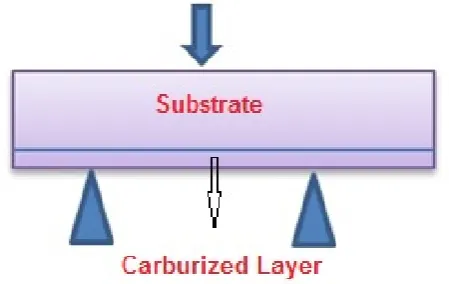
To investigate the coherency of the expanded layer, three point bending tests were performed on the carburized samples (Fig.1). Samples were subjected to 1-2% plastic deformation as indicated by their dynamic stress-strain diagrams during the bending tests. The behavior of slip lines near the interfaces were investigated via optical microscopy using Nomarski contrast.
Fig.1: Schematic figure of three points bending test.
3- Result and Discussion
3-1- XRD and AES Investigation
Fig. 2 shows XRD results of carburized layers. Vertical red lines show the angles of diffraction planes in annealed samples.
Fig.2: X-ray diffraction of low temperature carburized samples (black diagram), and identical diffracted
planes of annealed sample (vertical red lines) a) 316L SS and b) PH 17-4 SS.
Cross sectional images of carburized samples are shown in Fig.3. The featureless layer in these images is the carburized layer. For both SSs, there are no observable precipitates in the expanded layer, suggesting that the formed carbides in the process are negligible. The sample preparation processes of grinding, polishing, and etching revealed a large contrast in topography between the substrate and the carburized/extended layer. This suggests that the carburized layer is more corrosion resistant, and exhibits a higher hardness and wear resistance than the substrate.
Fig.3: Cross sectional image of carburized samples a) 316L and b) PH 17-4 SSs.
316L and 11at% for PH 17-4, but carbon content in the matrices are nearly zero, indicating the carburization did not affect the substrate. As shown in Table 1 and 2, the carbon concentration at the equilibrium condition is less than 0.015 at. % for both SSs Low temperature gas carburization increased the content of diffused carbon to nearly 860 times more than the equilibrium condition. Optical microscopy investigation supports this claim with no visible precipitate development at the given concentration of carbon.
Fig.4: In-Depth carbon concentration and hardness of carburized a) 316L and b) PH 17-4 SSs. Note: error
bars are not included for “Carbon Concentration (at%)” because due to their size of 0.01%.
hardness according to solid solution strengthening theory [33]. For both steels, the hardness is constant in the substrate below the expanded layer as supported by the similar concentration-depth and cross sectional metallographic images. This supports the claim that the carburized layer thicknesses are 31μm and 13μm for 316L and PH 17-4, respectively. Carbon concentration and hardness profiles are similar, so it can be concluded that hardness is proportional to interstitial carbon content in the layer.
3-2- Coherency of Expanded Layers
Nomarski contrast is due to differences in topography that can be attributed to variations in the corrosion and wear resistance of the material.
Fig.5: cross sectional images of carburized 316L sample with Nomarski contrast of a) grains and twins b)
Further support of this claim can be proven by analysis of slip lines as shown in Fig.5c. Slip lines are well understood to change their direction at grain boundaries due to the mis-match of slip plane orientations. It is mostly seen that these slip lines do not exhibit any change in direction while crossing into the carburized region. This proves identical structure between the substrate and the carburized region. A grain boundary extending across the substrate – carburized region interface is observed via the slip line behavior (marked in yellow lines). This grain boundary is observed due to the slip lines changing their direction. This further agrees with the assertion that there is no structural difference.
Fig.6: cross sectional images of PH 17-4 carburized sample with nomarski contrast of a) deformed
sample and b) Martensites.
Conclusion
Structures of the carburized layers were the same as both the substrates in the austenitic SS and martensitic SS, respectively. Also, low amounts of carbides were found in 316L SS that could not be verified through optical microscopy. Excessive hardness of these layers is due to the presence of supersaturated carbon content in the surface, which can be justified according to solid solution strengthening theory. Crystallographic directions, grains, or martensitic formation of carburized layers are as of their matrixes. Through static observation of the interface between substrate and the carburized layer, it was determined that no nucleation and growth occurred. In support of the solid solution strengthening theory, It was concluded that that introduction of carbon into the surface did not cause a change in the crystallographic structure.
Acknowledgment
The authors of this paper would like to acknowledge the support of Professor Seyyed Masoud Seyyed Ahmadian who provided generous access to the use of his laboratory and equipment.
References
1. Sedriks, A.J., Corrosion of stainless steel, 2. 1996.
2. Dong, H., S-phase surface engineering of Fe-Cr, Co-Cr and Ni-Cr alloys. International Materials Reviews, 2010. 55(2): p. 65-98.
3. Lo, K.H., C.H. Shek, and J. Lai, Recent developments in stainless steels. Materials Science and Engineering: R: Reports, 2009. 65(4): p. 39-104.
4. Sharifi, S., et al., Leakage fault detection in Electro-Hydraulic Servo Systems using a nonlinear representation learning approach. ISA Transactions, 2018. 73: p. 154-164.
5. Sharifi, S., et al. Multi-class fault detection in electro-hydraulic servo systems using support vector machines. in Robotics and Mechatronics (ICROM), 2016 4th International Conference on. 2016. IEEE.
6. Azhiri, R.B., et al., Measurement and evaluation of joint properties in friction stir welding of ABS sheets reinforced by nanosilica addition. Measurement, 2018. 127: p. 198-204.
7. Azhiri, R.B., et al., Analyzing of joint strength, impact energy, and angular distortion of the ABS friction stir welded joints reinforced by nanosilica addition. The International Journal of Advanced Manufacturing Technology, 2018: p. 1-14.
8. Larisch, B., U. Brusky, and H.-J. Spies, Plasma nitriding of stainless steels at low temperatures.
9. Amiri, M., M. Kazeminezhad, and A. Kokabi, Energy absorption of friction stir welded 1050 aluminum sheets through wedge tearing. Materials & Design, 2016. 93: p. 216-223.
10. Leyland, A., et al., Low temperature plasma diffusion treatment of stainless steels for improved wear resistance. Surface and Coatings Technology, 1993. 62(1): p. 608-617.
11. Suh, B.-S. and W.-J. Lee, Surface hardening of AISI 316L stainless steel using plasma carburizing.
Thin Solid Films, 1997. 295(1): p. 185-192.
12. Parrish, G., Carburizing: microstructures and properties. 1999: Asm International. 13. Nazari, A. and S. Farhad, Heat generation in lithium-ion batteries with different nominal
capacities and chemistries. Applied Thermal Engineering, 2017. 125: p. 1501-1517.
14. Vitek, J., A. Dasgupta, and S. David, Microstructural modification of austenitic stainless steels by rapid solidification. Metallurgical Transactions A, 1983. 14(9): p. 1833-1841.
15. Tsujikawa, M., et al., Surface material design of 316 stainless steel by combination of low temperature carburizing and nitriding. Surface and Coatings Technology, 2005. 200(1): p. 507-511.
16. Souza, R.M.d., et al., Structure and properties of low temperature plasma carburized austenitic stainless steels. Surface and Coatings Technology, 2009. 204(6): p. 1102-1105.
17. Williams, P.C. and S.V. Marx, Low temperature case hardening processes. 2000, Google Patents. 18. Hwang, K.-S., L.-H. Cheng, and Y.-C. Lu, Low-temperature stainless steel carburization method.
2013, Google Patents.
19. A.E. Pirbazari, P.M., B.F. Kisomi, Co/TiO2 nanoparticles: preparation, characterization and its
application for photocatalytic degradation of methylene blue. Desalin, Water Treat 2017. 63: p. 283-292.
20. Ernst, F., Y. Cao, and G. Michal, Carbides in low-temperature-carburized stainless steels. Acta Materialia, 2004. 52(6): p. 1469-1477.
21. Ernst, F., et al., Carbide precipitation in austenitic stainless steel carburized at low temperature.
Acta Materialia, 2007. 55(6): p. 1895-1906.
22. Sun, Y., Kinetics of low temperature plasma carburizing of austenitic stainless steels. Journal of Materials Processing Technology, 2005. 168(2): p. 189-194.
23. Adachi, S. and N. Ueda, Combined plasma carburizing and nitriding of sprayed AISI 316L steel coating for improved wear resistance. Surface and Coatings Technology, 2014. 259: p. 44-49. 24. Najdahmadi, A., A. Zarei-Hanzaki, and E. Farghadani, Mechanical properties enhancement in Ti–
29Nb–13Ta–4.6 Zr alloy via heat treatment with no detrimental effect on its biocompatibility.
Materials & Design (1980-2015), 2014. 54: p. 786-791.
25. Yarahmadi, M., H.M. Goudarzi, and M. Shafii, Experimental investigation into laminar forced convective heat transfer of ferrofluids under constant and oscillating magnetic field with different magnetic field arrangements and oscillation modes. Experimental Thermal and Fluid Science, 2015. 68: p. 601-611.
26. Goudarzi, H.M., M. Yarahmadi, and M.B. Shafii, Design and construction of a two-phase fluid piston engine based on the structure of fluidyne. Energy, 2017. 127: p. 660-670.
27. Cao, Y., F. Ernst, and G. Michal, Colossal carbon supersaturation in austenitic stainless steels carburized at low temperature. Acta Materialia, 2003. 51(14): p. 4171-4181.
28. Agarwal, N., et al., Enhanced fatigue resistance in 316L austenitic stainless steel due to low-temperature paraequilibrium carburization. Acta Materialia, 2007. 55(16): p. 5572-5580. 29. Christiansen, T. and M.A. Somers, Low temperature gaseous nitriding and carburising of
stainless steel. Surface Engineering, 2005. 21(5-6): p. 445-455.
31. Williamson, D., et al. Stainless Steel 2000. in Proceedings of an International Current Status Seminar on Thermochemical Surface Engineering of Stainless Steels, The Institute of Materials, London. 2001.
32. Tsujikawa, M., et al., Behavior of carbon in low temperature plasma nitriding layer of austenitic stainless steel. Surface and Coatings Technology, 2005. 193(1): p. 309-313.