Mohammad Al-Kaseem1*, Zaid Al-Assaf1, François Karabeet2
*1
Department of Analytical and Food Chemistry, Faculty of Pharmacy, Damascus University, Damascus, Syria.
2
Department of Chemistry, Faculty of Science, Damascus University, Damascus, Syria. *Corresponding author’s E-mail: [email protected]
Accepted on: 15-12-2013; Finalized on: 28-02-2014. ABSTRACT
In this study, a simple analytical method based on gas chromatography coupled with flame ionization detector (GC-FID) was developed for the determination of seven volatile nitrosamines (N-nitrosodimethylamine, N-nitrosodiethylamine, N-nitrosodi-n-propylamine, N-nitrosopyrrolidine, N-nitrosopiperidine, N-nitrosodi-n-butylamine, N-nitrosomethyethylamine) in meat. Various meat samples, including raw meat, cured meat, grilled meat, fried meat, smoked meat and canned meat products, were treated with an aqueous sodium hydroxide (NaOH) by autoclaving at 121°C for 10 min and extracted by liquid-liquid extraction with dichloromethane, then the nitrosamines were pre-concentrated using activated silica. Quantitative analyses were carried out for the analytes after the chromatographic separation on a optima-XLB Capillary Column (30 m x0.25 mm I.D.x0.25 film thickness (df). The limits of quantification (LOQs) for the seven volatile nitrosamines were in the range 0.26 to 0.6 µg/kg. The mean recoveries at the
three spiked levels were from 82% to 105.5%, with the relative standard deviations (RSDs) between 2.80% and 4.40%. The method is accurate, rapid and sensitive, and can be used for the inspection of meat products.
Keywords: GC-FID, N-nitrosamines, fast food, meat, autoclave.
INTRODUCTION
itrite is one of the very important additives in the meat production process in terms of desirable color, texture, lipid oxidation, and especially for preventing a toxin formation by Clostridium botulinum. Recent evidence has suggested that the nitrite is a bactericidal for gastrointestinal, oral and skin pathogenic bacteria when ingested and mixed with gastric acid. But significant concerns exist because nitrite may react with amines and amino acids to produce N-nitrosamines, which are known to be carcinogenic, mutagenic and teratogenic.1 These compounds are formed by the reaction of secondary amines with nitrosating agents, such as nitrates or nitrites which are commonly used in the manufacture of meat products.2 Investigations carried out at various research centers and food controlling institutions have shown that many food products are contaminated with nitroso compounds, as the result of various technological processes in which they form in slightly acidic environments by reaction of sodium nitrite and nitrogen oxide with such precursors as: proteins, peptides, amino acids and amines present in food.3 For this reason, the use of these nitrosating agents for curing meat is strictly controlled in some countries.4 Moreover, some known inhibitors of the nitrosation reaction, such as ascorbic acid, are used in the processing of several foods.5,6 N-nitrosamines are formed after cooking of meat in a complex process that is influence by a large variety of substances.7 The main precursors of N-nitrosamines are believed to be formed by reaction of nitrogen oxides (that are generated from nitrites and are also present in wood smoke) with, mainly, secondary amines present in the meat,8 although they can also occur in the environmental
tobacco smoke,9 and may be formed endogenously within the human body.10 The International Agency for Research on Cancer (IARC) classified N-nitrosodimethylamine (NDMA) and N-nitrosodiethylamine (NDEA) as most carcinogenic to humans, and N-nitrosodi-n-butylamine (NDBA), N-nitrosopiperidine (NPIP) and N-nitrosopyrrolidine (NPYR) as possibly carcinogenic to humans.11 The determination of nitrosamines in food and water samples has been carried out by different analytical methods,12 including colorimetry,13 capillary electro-chromatography,14 micellar electro-kinetic capillary chromatography,15 gas chromatography with flame ionization detection, nitrogen phosphorous detection, thermal energy detection, nitrogen chemiluminescence detection,16-19 and mass spectrometry detection,20-22 high-performance liquid chromatography with thermal energy analyzer, mass spectrometry and fluorescence detection.22-24 The extraction of the nitrosamine from the complex food matrices and the cleanup of the extract have been the critical points of the sample preparation step, and several approaches are documented in the literatures, including distillation (steam or vacuum),25-27 solvent extraction,28 solid-phase extraction,29 solid-phase micro-extraction (SPME),30 and supercritical fluid extraction.31
The purpose of the present study was to develop and validate a simple gas chromatographic method for the determination of seven volatile N-nitrosamines in meat products (fast food) in Syria using the method of sample preparation preformed in our previous work.32
Development and Validation of GC-FID Method for the Determination of Volatile
N-nitrosamines in Meat
N
MATERIALS AND METHODS
Samples
All samples of meat products (raw meat, cured meat, grilled meat, fried meat, smoked meat and canned meat) used in this research were purchased from fast food restaurants (cooked or as provided to consumers) in Damascus and Damascus countryside. The samples were crushed and mix with no addition of the fluid and then stored in −20°C before analysis.
Materials
EPA 521 nitrosamine mix standard was purchased from Supleco (USA), this solution contained seven analytes at
2000µg/mL of each: nitrosodimethylamine (NDMA),
N-nitrosomethylethylamine (NMEA), N-nitrosodiethylamine (NDEA), N nitrosopyrrolidine (NPYR), nitrosodin-propylamine (NDPA), nitrosopiperidine (NPIP) and N-nitrosodi-n-butylamine (NDBA). For sample preparation, sodium hydroxide, ethanol, octane and dichloromethane (DCM) were purchased from Sigma-Aldrich (USA). All other chemicals (ascorbic acid, anhydrous sodium sulfate and sodium chloride) used in this research were of analytical laboratory grade.
Apparatus
Pyrex tubes (20 ml) with heat-stable Teflon-lined caps were used. Glass column (30 cm × 1.5 cm), Kuderna - Danish (KD) concentrator was used for the concentration of organic solvents. Autoclave (Selecta, Spain, 4001757) and gas chromatograph equipped with a flame ionization detector controlled by computer running GC-Solution software (GC-2014, Shimadzu, Japan) and an optima-XLB Capillary Columns (0.25 mm i.d. 30 m, 0.25 µm) from (MACHEREY-NAGEL GmbH & Co) were used. CAMAG UV Lamp dual wavelength, 254/366 nm, 2x8 watt in combination (Switzerland).
Preparation of nitrosamine mix standard
A series of working standard solutions were prepared by appropriate dilution of the EPA 521 nitrosamine mix with dichloromethane and stored at –20ºC before use. From the primary stock solution 2000µg/mL of each nitrosamine, a 1/200 dilution was done to get 100µg/mL
secondary stock solution of each nitrosamine. Sequentially dilute secondary stock solution was performed to get standards titrating at 4, 10, 50, 100 ,
500, 1000 µg/L in by taking the following volumes from
secondary stock solution, 40µl, 100 µl, 500 µl, 1000 µl,
5mL, 10 mL in series of 100 mL volumetric flasks respectively, these solution kept in the absence of light. Analytical Conditions
GC analysis was carried out using GC-2014 gas chromatograph equipped with flame ionization. (GC-FID) (Shimadzo Technologies, Japan). One micro liter of the extracted sample solution was injected into optima-XLB Capillary Column (30 m x0.25 mm I.D.x0.25 film thickness
nitrosamines, the injection port and detector temperature were kept at 250 and 300°C. The oven program was as follows: 40°C, held for 3 min; ramp to 100°C at 10°C/ min, held isothermally for 1 min; ramp to 250°C at 15 °C/min, held isothermally at 250°C for 2 min. The sample was injected in splitless mode; using an
injection volume of 1 µl. Nitrogen was used as make-up
gas. The purity of all gases used was greater than 99.999%. The velocity of the helium carrier was 1 mL/min. Conditions for autoclave treatment
Conditions for autoclave treatment were adopted as our previous study (Kaseem, Assaf and Karabeet, 2013),32 half milliliter of the N-nitrosamine Mix standard containing 50 µg/L of each nitrosamine was diluted with 10 mL of 1 N aqueous sodium hydroxide and 10 mg of ascorbic acid (Inhibitor of endogenous nitrosation) in 20 mL Pyrex tubes tightly capped and autoclaved at 121°C for 10 min. After being allowed to stand at room temperature, the autoclaved solution was transferred to 50 mL separatory funnel. The tubes was rinsed twice with 5 mL of ethanol and then 10 mL of dichloromethane, and the rinsing solutions and 10 mL of 10% aqueous sodium chloride were combined with the original extract in the separatory funnel. After being shaken, the dichloromethane layer was collected, and the water layer was re-extracted with 10 ml of dichloromethane. The dichloromethane extracts were combined, dried over anhydrous sodium sulfate and concentrated to approximately 0.5 mL using KD concentrator and nitrogen gas flow. The concentrate was loaded onto a silica gel column (30 cm × 1.5 cm) (equilibrated with dichloromethane) and the column was eluted with 10 ml of dichloromethane. After the addition
of 100 µL of octane (to prevent exsiccation of the
solvent), the elute was concentrated to 1 mL using KD concentrator and nitrogen gas flow and analyzed by
GC-FID using 1 µL injection volume.
Extraction of N-nitrosamine from Meat
The method of preparation of meat samples was described in our previous work.32 Approximately one gram of meat sample was placed in the Pyrex tube into which 10 mL of sodium hydroxide 1N was poured. The tube was capped tightly and autoclaved at 121°C for 10 min; dichloromethane extract was obtained by the procedure described for the standard solution in (section 2.6). The individual extracts were analyzed by GC-FID as in the case of the standard solution (section 2.5).
RESULTS AND DISCUSSION
Method development and optimization summary
Preliminary experiments were carried out by using non polar stationary phase (dimethylpolysiloxane) like OPTIMA® 1 and low polar stationary phase (silarylene phase with ultra-low bleeding: optimized silarylene content) like OPTIMA XLB and mid polar stationary phase like Rtx-624 capillary column, and high polar stationary
separation was achieved on OPTIMA XLB column (containing 6% Cyanopropylphenyl and 94% Dimethylpolysiloxane copolymer) of 30 m length, 0.25 mm internal diameter and film thickness of 0.25µm with
Helium as carrier gas. In the diluents composition Dichloromethane was used, slight low response and some base line disturbance for nitrosamines was observed. Therefore, a slight amount of octane was added during the sample preparation. The peak shape and response of all nitrosamines were improved. Finally, satisfactory result was achieved in reasonable time with flow of Helium gas set to constant pressure mode.
Validation of the method
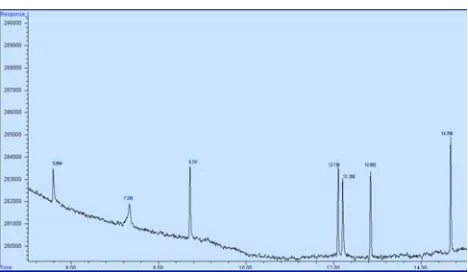
In order to judge the suitability of method for determining the nitrosodimethylamine (NDMA), N-nitrosomethylethylamine (NMEA), N-nitrosodiethylamine (NDEA), N nitrosopyrrolidine (NPYR), nitrosodin-propylamine (NDPA), nitrosopiperidine (NPIP) and N-nitrosodi-n-butylamine (NDBA) traces in meat products, the method was validated as per the ICH guideline for specificity, limit of detection, limit of quantification, linearity, accuracy, precision and robustness.33 The matrix effect was studied by comparing the slope of the aqueous standards and standard additions calibration graphs obtained for the sex different fast food samples, namely, raw meat, cured meat, smoked meat, grilled meat, fried meat and canned meat, no statistically differences were observed, and so quantification was carried out by external calibration. Calibration curves were obtained by least squares linear regression analysis for the peak area versus the analyte concentration using six concentration levels in duplicate. The method was validated to demonstrate that it is suitable for its intended purpose by the standard procedure to evaluate adequate validation characteristics.33 Retention times of selected N-nitrosamines were determined by using standard solutions of each nitrosamine. Figure 1 shows the chromatogram obtained by GC-FID of 50 ppb (part per billion) standard solution of each N-nitrosamine. Figure 2 shows the chromatogram obtained by unspiked meat sample
Specificity/ selectivity
To assess the ability of the method, Mix standard solution were prepared with known amounts of NDMA, NMEA, NDEA, NPYR, NDPA, NPIP, NDBA, and injected in to the gas chromatograph and the chromatograms were recorded. The sample (raw meat) solution was prepared as per the methodology and injected into the chromatograph (Control sample). The sample shows no peaks either due to any nitrosamines. So it reveals that the raw meat (control sample) is free from nitrosamines under investigation. Therefore the sample extract was spiked with known amount of each nitrosamine reference standard at target level (50 µg/l), and injected into the
chromatograph (Spiked sample). The relative retention time for NDMA, NMEA, NDEA, NPYR, NDPA, NPIP, NDBA, and was found 5.617, 7.344, 8.733, 12.104, 12.224,
12.853 and 14.681 respectively. The resolution between NPYR and NDPA was found to be 1.59 and between NDPA and NPIP was found to be 5.59 respectively. No interference of blank was observed corresponding to any of nitrosamines. The selectivity of the method was judged from the absence from the interfering peaks (false peaks) at the analyte elution times for blank chromatograms of different unspiked samples after irradiating them to UV light (wavelength 366 nanometer) for three hours to destroy nitrosamines if they are present .34 The original signals were wrongly positive if the signals from the samples are not remarkably diminished after the irradiation. No matrix compounds existed that might give a false positive signal to the blank samples as shown in Figure 3.
Figure 1: Chromatogram of 50 µg/L of N-nitrosamine Mix (GC-FID)
Figure 2: Chromatogram of spiked fried meat sample
Linear Range, Limit of Quantification (LOQ) and Limit of Detection (LOD)
A series of working standards at the concentrations of 4,
10, 50, 100, 500 and 1000 µg/L were prepared and
analyzed under the selected chromatographic conditions. The linear equations and the correlation coefficients for the seven N-nitrosamines are shown in Table 1. The limits of quantification with a signal-to-noise ratio of 10 for the
seven nitrosamines were from 0.26 to 0.6 ppb (µg/kg)
with limits of detection with a signal-to-noise ratio of 3 for the seven nitrosamines were from 0.077 to 0.18 ppb.
Recovery and Precision
The recovery and precision were conducted by spiking different blank meat samples including, raw meat, cured meat, smoked meat, grilled meat, fried meat, and canned
meat. At three spiking levels of 1, 5, 10 µg/L to the
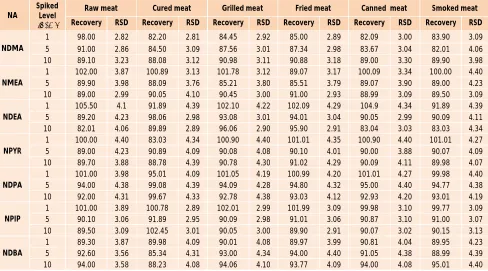
prepared samples, six replicates at each level, the mean recoveries were from 82% to 105.5% with the relative standard deviations (RSDs) from 2.8% to 4.4%.. The results are shown in Table 2 and spiked sample chromatogram is shown in Figure 2.
Table 1: Linear equations, linear ranges and correlation coefficients of seven volatile nitrosamines
N-nitrosamine RT*
GC-FID Linear equation
Linear range
µg/L
Correlation coefficients
LOQ
µg/kg
LOD
µg/kg
NDMA 5.617 y=4161.7x-9274.8 0.6-500 0.9997 0.6 0.18
NMEA 7.344 y=5816.1x-14015 0.43-500 0.9994 0.43 0.13
NDEA 8.733 y=7095.3x-13214 0.33-500 0.9996 0.33 0.1
NPYR 12.104 y=8699.3x-8839.9 0.26-500 0.9995 0.26 0.08
NDPA 12.224 y=6674.6x-3555.2 0.25-500 0.9981 0.25 0.077
NPIP 12.853 y=7992.3x-141000 0.34-500 0.9995 0.34 0.105
NDBA 14.681 y=9805.1x-16361 0.30-500 0.9998 0.309 0.093
RT* retention time (minutes), GC-FID; Gas Chromatography-Flame Ionization Detection, LOQ; limit of Quantitation, LOD; Limit of Detection
Table 2: Results of spiked recoveries for seven volatile nitrosamines in meat samples (n=6)
NA
Spiked Level
(µg/L)
Raw meat Cured meat Grilled meat Fried meat Canned meat Smoked meat
Recovery RSD Recovery RSD Recovery RSD Recovery RSD Recovery RSD Recovery RSD
NDMA
1 98.00 2.82 82.20 2.81 84.45 2.92 85.00 2.89 82.09 3.00 83.90 3.09
5 91.00 2.86 84.50 3.09 87.56 3.01 87.34 2.98 83.67 3.04 82.01 4.06
10 89.10 3.23 88.08 3.12 90.98 3.11 90.88 3.18 89.00 3.30 89.90 3.98
NMEA
1 102.00 3.87 100.89 3.13 101.78 3.12 89.07 3.17 100.09 3.34 100.00 4.40
5 89.90 3.98 88.09 3.76 85.21 3.80 85.51 3.79 89.07 3.90 89.00 4.23
10 89.00 2.99 90.05 4.10 90.45 3.00 91.00 2.93 88.99 3.09 89.50 3.09
NDEA
1 105.50 4.1 91.89 4.39 102.10 4.22 102.09 4.29 104.9 4.34 91.89 4.39
5 89.20 4.23 98.06 2.98 93.08 3.01 94.01 3.04 90.05 2.99 90.09 4.11
10 82.01 4.06 89.89 2.89 96.06 2.90 95.90 2.91 83.04 3.03 83.03 4.34
NPYR
1 100.00 4.40 83.03 4.34 100.90 4.40 101.01 4.35 100.90 4.40 101.01 4.27
5 89.00 4.23 90.89 4.09 90.08 4.08 90.10 4.01 90.00 3.88 90.07 4.09
10 89.70 3.88 88.78 4.39 90.78 4.30 91.02 4.29 90.09 4.11 89.98 4.07
NDPA
1 101.00 3.98 95.01 4.09 101.05 4.19 100.99 4.20 101.01 4.27 99.98 4.40
5 94.00 4.38 99.08 4.39 94.09 4.28 94.80 4.32 95.00 4.40 94.77 4.38
10 92.00 4.31 99.67 4.33 92.78 4.38 93.03 4.12 92.93 4.20 93.01 4.19
NPIP
1 101.00 3.89 100.78 2.89 102.01 2.99 101.99 3.09 99.98 3.10 99.77 3.09
5 90.10 3.06 91.89 2.95 90.09 2.98 91.01 3.06 90.87 3.10 91.00 3.07
10 89.50 3.09 102.45 3.01 90.05 3.00 89.90 2.91 90.07 3.02 90.15 3.13
NDBA
1 89.30 3.87 89.98 4.09 90.01 4.08 89.97 3.99 90.81 4.04 89.95 4.23
5 92.60 3.56 85.34 4.31 93.00 4.34 94.00 4.40 91.05 4.38 88.99 4.39
10 94.00 3.58 88.23 4.08 94.06 4.10 93.77 4.09 94.00 4.08 95.01 4.40
NA; nitrosamine, Recovery and RSD are expressed as (%)
CONCLUSION
In this study, seven nitrosamines were separated and analyzed successfully using GC-FID after extraction under autoclave conditions. The developed gas chromatographic method has to evaluate reliable and economical result for the simultaneous determination of
REFERENCES
1. Byun MW, Ahn HJ, Kim JH, Lee JW, Yook HS and Han SB, Determination of Volatile N-Nitrosamines in Irradiated Fermented Sausage by Gas Chromatography Coupled to a Thermal Energy Analyzer, Journal of Chromatography A, Vol. 1054, No. 1-2, 2004, pp. 403- 407.
2. Campillo N, Viñas P, Martínez-Castillo N,Hernández-Córdoba, Determination of Volatile Nitrosamines in Meat Products by Microwave-Assisted Extraction and Dispersive Liquid-Liquid Micro-Extraction Coupled to Gas Chromatography-Mass Spectrometry, Journal of Chromatography A, Vol. 1218, No. 14, 2011, pp. 1815-1821.
3. Rywotycki R, Meat nitrosamine contamination level depending on animal breeding factors, Meat Science,Vol. 65,2003, pp. 669–676
4. Honikel KO, The Use and Control of Nitrate and Ni- trite for the Processing of Meat Products, Meat Science, Vol. 78, No. 1-2, 2008, pp. 68-76.
5. Scanlan RA, Encyclopedia of Food and Nutrition, Elsevier, 2003, pp. 4142-4147.
6. Robles H, Encyclopedia of Toxicology, Elsevier, 2005, pp. 249–250.
7. Sanchez BJ, Ballesteros E and Gallego M, Automatic Screening Method for the Pre-Concentration and Determination of N-Nitrosamines in Water, Talanta, Vol. 73, No. 3, 2007, pp. 498-504.
8. Yurchenko S and Molder U, Volatile N-Nitrosamines in various fish products, Food Chemistry, Vol. 96, 2006, pp. 325-333.
9. Lin WG, Wei F, Gu FN, Dong X, Gao L, Zhuang TT, Yue MB and Zhu JH, Adsorption of Nitrosamines by Mesoporous Zeolite, Journal of Colloid and Interface Science, Vol. 348, No. 2, 2010, pp. 621-627.
10. Tricker AR and Preussmann R, Carcinogenic N-nitrosamines in the diet: occurrence, formation, mechanisms and carcinogenic potential. Mutation Research, Vol. 259, 1991, pp. 277–289.
11. IARC Monographs on the Evaluation of Carcinogenic Risks to Humans, Monographs Programme Finds Smoke- less Tobacco Is Carcinogenic to Humans, International Agency for Research on Cancer, 2004.
12. Yurchenko S and U. Molder, The Occurrence of Volatile N-Nitrosamines in Estonian Meat Products, Food Chemistry, Vol. 100, No. 4, 2007, pp. 1713-1721.
13. Qiang M, Wei XH, Chao W, Hua B, Cheng X.G, Ning S, Yan XL and Bing WJ, Determination of Ten Volatile Nitrosamines in Cosmetics by Gas Chromatography Tandem Mass Spectrometry, Chinese Journal of Analytical Chemistry, Vol. 39, No. 8, 2011, pp. 1201- 1207.
14. Matyska MT, Pesek JJ and Yang L, Screening method for Determining the Presence of N-Nitrosodiethanolamine in Cosmetics by Open-Tubular Capillary Electrochromatography, Journal of Chromatography A, Vol. 887, No. 1-2, 2000, pp. 487-503.
15. Filho PJS, Valcarcel M, Rios A, Zanin KD, Caramoa EB, Determination of nitrosamines in preserved sausages by
solid-phase extraction-micellar electro-kinetic chromatography. Journal of Chromatography A, Vol. 985, 2003, pp. 503–512.
16. Grebel JE and Suffet HI, Nitrogen-Phosphorus Detection and Nitrogen Chemiluminescence Detection of Volatile Nitrosamines in Water Matrices: Optimization and Performance Comparison, Journal of Chromatography A, Vol. 1175, No. 1, 2007, pp. 141-144.
17. Ozel MZ, Gongus F, Yagci S, Hamilton JF and Lewis AC, Determination of Volatile Nitrosamines in Various Meat Products Using Comprehensive Gas Chromatography-Nitrogen Chemiluminescence Detection, Food and Chemical Toxicology, Vol. 48, No. 11, 2010, pp. 3268-3273.
18. Hfiger B and Niessner R, Determination of N-Nitrosomethylaniline and Methylaniline in the Gas Phase, Microchimica Acta, Vol. 122, No. 1-2, 1996, pp. 35-44.
19. Incavo JA and Schafer MA, Simplified Method for the Determination of N-Nitrosamines in Rubber Vulcanizates, Analytica Chimica Acta, Vol. 557, No. 1-2, 2006, pp. 256-261.
20. Tsikas D, Methods of Quantitative Analysis of the Nitric Oxide Metabolites Nitrite and Nitrate in Human Biological Fluids, Free Radical Research, Vol. 39, No. 8, 2005, pp. 797-815
21. Dallinga JW, Pachen DM, Lousberg AH, Van Geel JA, Houben GM, Stockburgger RW, Maanen JM and Kleinjans JC, Volatile N-Nitrosamines in Gastric Juice of Patients with Various Conditions of the Gastrointestinal Tract Determined by Gas Chromatography- Mass Spectrometry and Related to Intragastic pH and Nitrate and Nitrite Levels, Cancer Letters, Vol. 124, No. 2, 1998, pp. 119-125.
22. Xia Y, McGuffey JE, Bhattacharyya S, Sellergren B, Yilmaz E andWang L, Analysis of the Tobacco-Specific Nitrosamine 4-(Methylnitrosamino)-1-(3-Pyridyl)-1- Butanol in Urine by Extraction on a Molecularly Imprinted Polymer Column and Liquid Chromatography/ Atmospheric Pressure Ionization Tandem Mass Spectrometry, Analytical Chemistry, Vol. 77, No. 23, 2005, pp. 7639-7645.
23. Bellec G, Cauvin MC, Calve KL, Dreano Y, Gouerou H, Menez JF and Berthou F, Analysis of N-Nitrosamines by High-Performance Liquid Chromatography with Post-Column Photohydrolysis and Colorimetric Detection, Journal of Chromatography A, Vol. 727, No. 1, 1996, pp. 83-92.
24. Komarova NV and Velikanov AA, Determination of Volatile N-Nitrosamines in Food by High-Performance Liquid Chromatography with Fluorescence Detection, Journal of Analytical Chemistry, Vol. 56, No. 4, 2001, pp. 359-363.
25. Association of Official Analytical Chemists, N-Nitrosamines (Volatile) in Fried Bacon. Mineral Oil Vacuum Distillation— Thermal Energy Analyzer Method, No. 982.22, Official Methods of Analysis, 15th Edition, 1990.
26. E. L. Greenfield, W. J. Smith and A. J. Malanovski, Mineral Oil Vacuum Distillation for Nitrosamines in Fried Bacon, with Thermal Energy Analyser, Journal of the Association Official Analytical Chemists, Vol. 65, No. 6, 1982, pp. 1319-1332.
for Determining Low Levels of Volatile Nitrosamines in Meat Products, Journal of Agricultural and Food Chemistry, Vol. 19, No. 5, 1971, pp. 937-940.
28. Nawrocki J and Andrzejewski J, Nitrosamines and Water, Journal of Hazardous Materials, Vol. 189, No. 12, 2011, pp. 1-18. h005
29. Raoul S, Gremaud E, Biaudet H and Tureski R, Rapid Solid-Phase Extraction Method for the Detection of Volatile Nitrosamines in Food, Journal of Agricultural and Food Chemistry, Vol. 45, No. 12, 1997, pp. 4706-4713.
30. Ventanas S, Martín D, Estévez M and Ruiz J, Analysis of Volatile Nitrosamines from a Model System Using SPME-DED at Different Temperatures and Times of Extraction, Food Chemistry, Vol. 99, No. 4, 2006, pp. 842- 850.
31. Fiddler W and Pensabene JW, Supercritical Fluid Extraction of Volatile N-Nitrosamines in Fried Bacon and
Its Drippings: Method Comparison, Journal of AOAC International, Vol. 79, No. 4, 1996, pp. 895-901.
32. Al-kaseem M, Assaf Z, Karabeet F, Rapid and Simple Extraction Method for Volatile N-Nitrosamines in Meat Products. Pharmacology & Pharmacy,Vol. 4, 2013, pp.611-618.
33. International Conference on Harmonization, Validation of Analytical Procedure, Text and Methodology Q2 (R1), 2005 IFPMA, Geneva, Switzerland.
34. BS ISO 29941, Condoms — Determination of nitrosamines migrating from natural rubber latex condoms International Standards, 2010, section 9, confirmation of the detected nitrosamines.