A MATHEMATICAL APPROACH TO COPY
DETECTION BY USING RADON TRANSFORM
Dr. Shikha Srivastava
Department of Mathematics, GLA University, Mathura (UP), India
ABSTRACT
Media hashing is one of the novel technology of multimedia processing and is an alternative approach to many
applications previously accomplished with watermarking. Media hashing is basically employed to perform copy
detection and content authentication of digital images. One of the major disadvantage of the existing media
hashing technologies is their limited resistance to geometric attacks specially rotation. In this paper, we have
proposed media hashing technique based on radon transform and statistical features, which is robust to many of
image processing attacks including rotation. In the proposed algorithm, the input image is firstly normalized by
using image resizing, Gaussian filtering, color space conversion from RGB image to YCbCr. Preprocessed
image is then divided into 64 equal size matrix where Radon transform is then applied to each of the
sub-matrix to produce the Radon coefficients. Average value of radon coefficients of each of the sub-sub-matrix is
calculated and combined to form the final matrix. Average values are once again calculated row-wise from the
final matrix to produce a column vector. The column vector is used to calculate four statistical features, Mean,
Standard Deviation, Kurtosis & Skewness which forms the feature vector, which is used for image identification.
Many experiments have conducted to compare the proposed technique with various reported techniques and the
results shows that proposed technique is robust to normal digital operations apart from giving excellent result
against rotation.
Keywords: Copy detection, Media hashing, Radon transform, Statistical Features, Watermarking.
I. INTRODUCTION
Due to the popularity of digital technology, more and more digital images are being created and stored every day. In other words, advent of Internet and multimedia technology has a significant impact on the creation, replication and distribution of digital images [1]. Creation of duplicate copies will have effect on multiple dimensions. On one hand, one cannot determine if an image already exists in database without examining all the stored copies. On the other hand, duplication of copies give rise to the problem of copy detection. The unauthorized duplication and forgery techniques for multimedia content have always been ahead of image forensic techniques [2]. Protecting the copyright of an image is a matter of great concern and thus finding the illegal copies have become an important issue for digital rights management [3]. To verify that image is an original one and not a modified copy of image authentication techniques are in place [4].
Copy detection techniques does not depend on any signatures. Here the content itself is used to verify its originality [6]. Recent studies of copy detection are focusing towards an shorter version of copy detection, which is termed as image hashing [7]. In image hashing, the features which are unique to image are extracted and are used for image identification [8]. Theoretically, image hashes should be able to discriminate between the robustness and discrimination properties for identification. In addition, the method should be robust to different image processing attacks. The rest of the paper is arranged is as follows: Section 2 gives an overview of the literature in the area of image hashing. Section 3 gives an insight of proposed image hashing technique. Section 4 presents the obtained experimental and Section 5 summarizes the results obtained.
II. REVIEW OF LITERATURE
Lot of researchers has implemented many algorithms related to various aspects of image hashing. Few of the notable algorithms are given as follows:
Tang et. al. [13] proposed a robust image hashing method based on ring partition and invariant vector distance. Tang et. al. [20] proposed another hashing method based on ring based entropies. The authors claim that their mechanism outperforms similar techniques specially in terms of time complexity. Longjiang et. al. [9] proposed a robust approach based on the sign bit of the DCT. Tang et. al. [10] used a mechanism based on a dictionary, which represents the characteristics of various image blocks. Tang et. al. [7] proposed a hashing-based image copy detection method based on dominant DCT coefficients which have been proven to perform well in classification and in detecting image copies. The proposed mechanism exhibits low collision probability which means that slightly different images will generate different hashes.
Venkatesan et. al. [14] proposed novel image indexing technique in which after wavelet decomposition of the image, each sub-band is randomly tiled into small rectangles. The resulting hash is statistically independent on a key K which is variable in nature. Wu et. al. [15] proposed a hash algorithm based on radon and wavelet transform. The proposed mechanism is discriminable to content changes. Lefebvre et. al. [16] presents a high compression and collision resistant algorithm named as RASH based on Radon transform. Xudong et. al. [17] is similar to [19] where Harris detector is used to select the most stable key-points which are less vulnerable to image processing attacks, after applying SIFT.
Tang et. al. [18] proposed a robust hashing method in which after preprocessing, Non negative matrix factorization(NMF)is applied to the secondary image to produce a coefficient matrix, which is coarsely quantized and randomly scrambled to produce the final hash. The algorithm exhibits a low collision probability. Qin et. al. [12] proposed a hash algorithm in which the pre-processed image is converted to a secondary image by rotation projection. The proposed mechanism is claimed to be robust against basic image processing operations. The advantage of DFT-based techniques is that they are resilient to content-preserving modifications such as moderate geometric and filtering distortions [11]. DFT-based techniques are resistant to common content-preserving manipulations while maintaining low collision probability [13].
features. Many experiments were conducted to evaluate the performance of the proposed hashing technique on various parameters. The results proved that the proposed technique outperforms many of the similar hashing algorithms.
III. PROPOSED IMAGE HASHING
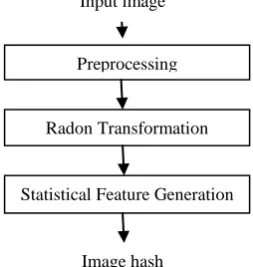
Basic steps of the proposed image hashing are shown in fig 1. The first step is the preprocessing step in which the input image is converted to the normalized image. In the second step Radon transformation is applied to generate a row vector which is used for final hash generation. In the final step, four statistical features are chosen for hash generation.
Fig. 1 Basic block diagram of proposed technique
3.1Preprocessing
In this step the input image is normalized by means of image resizing, Gaussian filtering and color space conversion. Image resizing is used to resize the original image to a standard size of 512x512; 3x3 Gaussian filtering is done to filter out the effects of any kind of minor image processing operations. Input RGB image is converted to YCbCr image and only Y component is taken for hash generation.
3.2 Radon Transformation
Radon transform is the projection of the image intensity along a radial line oriented at a specific angle. In medical image processing, when a bundle of X-rays goes through an organ, its attenuation depends on composition of organ, distance and direction or angle of projection [21]. This set of projections is called Radon transform. Radon transform is widely used in areas ranging from seismic analysis to medical images processing. The radon transform of an image f(x,y) denoted as g(r, θ) is defined as its line integral along a line inclined at an angle θ from the y-axis and at a distance r from the origin [22] is given in fig 2.
Fig. 2 The projection of an image at angle θ.
Image hash Preprocessing
Statistical Feature Generation Radon Transformation
Mathematically, it can be written as:
The radon transform has excellent properties with respect to translation, rotation and scaling. The properties related to each of them are as follows:
Translation: If the image is shifted by (x0,y0) in the spatial domain, then RT will be translated along r as follows:
(2)
Rotation: If the image is rotated by angle ψ, then the corresponding RT will be shifted by the same angle.
Scaling: If the input image f(x,y) is scaled by a factor ψ then it will cause the RT to be scaled as follows:
The radon transform is resistant to almost all types of geometric transform except shifting, shearing etc. In our experiments, it returns better results against rotation apart from giving acceptable values for all other attacks.
After applying the Radon transform, we get a Radon matrix in which each column corresponds to Radon transform for one of the angles for different radial co-ordinates. In this paper, Radon transform is applied to the input image by varying degrees from 0° to 179° i.e. with an increment of 1°. After applying the radon transformation, we get a two-dimensional matrix which is minimized by removing the zero rows.
3.3Statistical Feature Generation
To capture the effect content of the entire image, four statistical features mean, variance, skewness and kurtosis are chosen. These statistical features are calculated for every image by using the row generated after applying Radon transformation.
where f(1) is mean, f(2) is standard deviation, f(3) is skewness and f(4) is kurtosis.
3.4Similarity Metric
Hamming distance is used to measure the similarity between a pair of hashes. Let H1 and H2 be the two image
hashes, then hamming distance is defined as follows:
If D is not bigger than a predefined threshold T, the images of the corresponding hashes are visually identical. Otherwise, they are different images.
IV. EXPERIMENTAL RESULTS
produce a 64 radon matrix of size of 95x180. Column-wise average value is calculated for each of the radon matrix to produce a row vector of size 1x180. The row vectors of the entire image are combined to form a matrix of size 64x180. Lastly row-wise averaging is done on 64x180 matrix to produced a column vector of size 64x1. Finally four statistical features are calculated on the basis of the column vector to produce a feature vector of size 1x4, which is later used for image analysis and identification.
4.1Performance evaluation
Standard images were used for our experiments such as Baboon, House, Lena, Girl etc. as shown in Fig 3.
Fig. 3 Few of the standard benchmark images used.
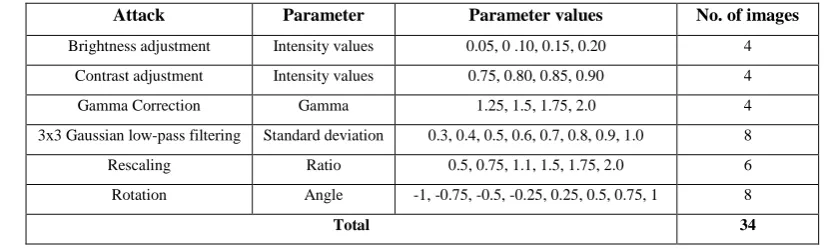
Each of the original image is used to create 34 different versions by modifying the original image with the number of image processing operations like brightness adjustment, contrast adjustment, gamma correction, Gaussian low-pass filtering, rescaling and rotation. MATLAB are used for the creation of duplicate copies by using attack parameters as shown in Table 1.
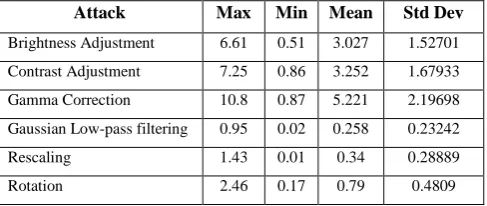
After generating the duplicate copies hashes are extracted from all the images including the original image and hamming distance is calculated between the original image and its copies. Table 2 presents the maximum, minimum, mean and standard deviation of hamming distance under different operation. It is observed that all the mean values are under 6 and maximum distances of all the attacks are less than 11. To demonstrate the discrimination, we have taken 36 different images of varying sizes from 225x225 to 2144x1424, which are accumulated from different databases. We have calculated hash differences by comparing each of the image with the remaining images in the dataset. In nutshell, proceeding in that way we have calculated 630 hash differences for 36 different images. The maximum, minimum, mean and standard deviation of hash difference for discrimination is 28.61, 0.75, 9.81, 5.06 respectively.
Table 1. Generation of duplicate copies of original images
Attack Parameter Parameter values No. of images
Brightness adjustment Intensity values 0.05, 0 .10, 0.15, 0.20 4
Contrast adjustment Intensity values 0.75, 0.80, 0.85, 0.90 4
Gamma Correction Gamma 1.25, 1.5, 1.75, 2.0 4
3x3 Gaussian low-pass filtering Standard deviation 0.3, 0.4, 0.5, 0.6, 0.7, 0.8, 0.9, 1.0 8
Rescaling Ratio 0.5, 0.75, 1.1, 1.5, 1.75, 2.0 6
Rotation Angle -1, -0.75, -0.5, -0.25, 0.25, 0.5, 0.75, 1 8
It is quite evident over here that the mean value of discrimination is 9.81 which is almost more than 1.5 times greater than the highest mean of robustness. Also the maximum value of discrimination is 28.61 which is almost 3 times larger than the maximum value of robustness. It is important here to specify that robustness hash values corresponds to duplicate copies of similar images whereas discrimination hash values corresponds totally different images. Theoretically we are looking for small robustness value and larger discrimination value. Our proposed hashing gives good experimental results, keeping in view the concept of robustness and discrimination.
Table 2. Maximum, Minimum, Mean and Standard Deviation
of hamming distance of similar images under different attack
Attack Max Min Mean Std Dev
Brightness Adjustment 6.61 0.51 3.027 1.52701
Contrast Adjustment 7.25 0.86 3.252 1.67933
Gamma Correction 10.8 0.87 5.221 2.19698
Gaussian Low-pass filtering 0.95 0.02 0.258 0.23242
Rescaling 1.43 0.01 0.34 0.28889
Rotation 2.46 0.17 0.79 0.4809
We have also calculated maximum, minimum, mean and standard deviation of difference of hash values between the original image and its duplicate copies, image-wise by considering all but one of the attacks i.e the difference values are calculated by considering all the attacks except one of the attacks. As we have used six different attacks, such a analysis gives six different maximum, minimum, mean & standard deviation values for all the images. Also we calculate maximum, minimum, mean and standard deviation values by considering all the attacks “image-wise”. It is important here to specify that, we get a column based values calculated on the basis of all attacks and all but one of the attacks. Mean square error (MSE) is then calculated between the column of mean value, calculated on the basis of all the attacks and 6 other column mean values, calculated on the basis of leaving one of the 6 attacks.
Table 3 gives the MSE values for different attacks for the proposed technique along with the MSE values for the other two state-of-the-art techniques used for comparison. The acronym used in Table 3 like BA indicates that MSE values are calculated by considering all the attacks except brightness adjustment. Similarly CA indicates MSE values calculated on the basis of all the attacks except contrast adjustment and so on. The calculated MSE values are having different range of values for different techniques. In order to make fair comparison among them, they are normalized in a range of 0 to 1. Normalized MSE values of the proposed approach along with few other implemented approaches [11,18] is given in Table 4. For rotation (RO), the normalized values for proposed, [11] & [18] are 0.209, 1.0 & 1.0 respectively. It is quite evident from the these values that the proposed technique gives excellent results for rotation apart from giving comparable results for all other attacks.
Table 3. MSE values for all but one of the attack
Technique BA CA GC GLPF RE RO
[11] 0.218491349 0.410404 0.337672 0.335741 0.280234 6.294716
[18] 4.532009484 2.472332 3.343883 2.68926 3.074638 9.667785
BA: Brightness adjustment; CA: Contrast adjustment; GC: Gaussian correction; GLPF: Gaussian low-pass filtering; RE: Rescaling; RO: Rotation
Table 4. Normalized MSE values for all but one of the attack
Technique BA CA GC GLPF RE RO
[11] 0 0.031584 0.019614 0.019296 0.010161 1
[18] 0.286247114 0 0.121125 0.030148 0.083707 1
Proposed 0 0.098038 1 0.718501 0.202519 0.209386
BA: Brightness adjustment; CA:Contrast adjustment; GC: Gaussian correction; GLPF: Gaussian low-pass filtering; RE: Rescaling; RO: Rotation
V.CONCLUSION
In this paper, robust image hashing technique is proposed based on radon transform and statistical features. Proposed hashing firstly calculates Radon transform for the entire image along different directions by using different sub-matrices which are generated from the preprocessed image. Averaging of the Radon coefficients are done twice before generating the final column vector which is use for feature generation. Finally four statistical features; mean, standard deviation, skewness and kurtosis are calculated from the column vector to produce the image hash which is used for image identification. Experiments validate the performances of the proposed hashing against number of normal digital operations apart from rotation. Future work will be done to address the limitation of Radon transform.
REFERENCES
[1] Muhammad Ali Qureshi, Mohamed Deriche, “A bibliography of pixel-based blind image forgery detection,” Signal Processing : Image Communication 39 (2015), 46-74.
[2] S. Lian, D. Kanellopoulos, “Recent advances in multimedia information systems security,” Informatica – An International Journal of Computing and Informatics, 33 (2009) 3-24.
[3] Xiaobing Kang, Shengmin Wei, “An efficient approach to still image copy detection based on SVD and block partition for digital forensics,” IEEE International Conference on Intelligent Computing and Intelligent Systems (ICIS), 2009, pp. 457-461.
[4] Sebastiano Battiato, Giovanni Maria Farinella, Enrico Messina, Giovanni Puglisi, “Robust image alignment for tampering detection,” IEEE Transactions on Information Technology Forensics and Security, Vol. 7, No. 4, 2012, pp. 1105-1117.
[5] C. Rey, J.-L. Dugelay, “A survey of watermarking algorithms for image authentication,” EURASIP Journal on Applied Signal Processing 2002, (1) 2002, 613-621.
[6] Jen-Hao Hsiao, Chu-Song Chen, Lee-Feng Chien, Ming-Syan Chen, “A new approach to image copy detection based on extended feature sets,” IEEE Transactions on Image Processing, Vol. 16, No. 8, 2007, pp. 2069-2079.
[8] Zhenjun Tang, Xianquan Zhang, Xuan Dai, Jianzhong Yang, Tianxiu Wu, “Robust image hash function using local color features,” International Journal of Electronics and Communications(AEU) 67 (2013)717-722.
[9] Longjiang Yu, Shenghe Sun, “Image robust hashing based on DCT sign,” Proceedings of the 2006 International Conference Intelligent Information Hiding and Multimedia Signal Processing (IH-MSP’-06). [10] Zhenjun Tang, Shuozhong Wang, Xinpeng Zhang, “Lexicographical framework for image hashing with
implementation based on DCT and NMF,” Multimedia Tools Appl., January 2010.
[11] Ashwin Swaminathan, “Robust and secure image hashing,” IEEE Transactions on Information Forensics and Security, Vol. 1, No. 2, June 2006, pp. 215-230.
[12] C. Qin, C. Chang, “Robust image hashing using non-uniform sampling in discrete fourier domain,” Digital Signal Processing, 2013, 23, (2), pp. 578-585.
[13] Zhenjun Tang, Xianquan Zhang, Xianxian Li, Shichao Zhang, “Robust image hashing with ring partition and invariant vector distance,” IEEE Transactions on Information Forensics and Security, Vol. 11, No. 1, January 2016, pp. 200-214.
[14] R. Venkatesan, S.-M. Koon, M. H. Jakubowski, P. Moulin, “Robust image hashing,” in Pro. IEEE Int. Conf. Image Processing, Canada, Sep. 2000, vol. 3, pp.664-666.
[15] Di Wu, Xuebing Zhou, Xiamu Niu, “A novel image hash algorithm resistant to print-scan,” Signal Processing 89 (2009) 2415-2424.
[16] Frederic Lefebvre, Benoit Macq, Jean-Didier Legat, “RASH: RAdon Soft Hash algorithm,” 2002 11th European Signal Processing Conference, Sept. 2002, pp. 1-4.
[17] Xudong Lv, Z. Jane Wang, “Perceptual image hashing based on shape contexts and local feature points,” IEEE Transactions on Information Forensics and Security, Vol. 7, No. 3, June 2012 pp. 1081-1093. [18] Zhenjun Tang, Shuozhog Wang, Xinpeng Zhang, Weimin Wei, Shengjun Su, “Robust image hashing for
tamper detection using non-negative matrix factorization,” Journal of Ubiquitous Convergence and Technology, Vol. 2, No.1, May 2008, pp. 18-26.
[19] Zhenjun Tang, Liyan Huang, Yumin Dai, Fan Yang, “Robust image hashing based on multiple histograms,” International Journal of Digital Content Technology and its Applications(JDCTA), Vol.6, No. 23, December 2013, pp. 39-47.
[20] Zhenjun Tang, Xianquan Zhang, Liyan Huang, Yumin Dai, “Robust image hashing using ring-based entropies,” Signal Processing 93 (2013) 2061-2069.
[21] Frederic Lefebvre, Benoit Macq, Jean-Didier Legat, “RASH: RAdon Soft Hash algorithm,” 2002 11th European Signal Processing Conference, Sept. 2002, pp. 1-4.