136 | P a g e
ON ONLINE BEHAVIORAL BASED FRIEND
RECOMMENDATION FRAMEWORKUSING SECRET
SHARING SCHEME
Ketaki Handi
1, Sujata Jadhav
2, Manprit Kaur Kochhar
3,
Sreelakshmi Hari
4 1,2,3,4Department of Computer Engineering, Pune University, Maharashtra (INDIA)
ABSTRACT
Social network sites (SNS’s) have connected millions of users creating the social revolution. The popular social
networking sites are facebook, Twitter, MySpace, Orkut, LinkedIn, Google plus etc. which are actually online
social networking (OSN) sites. a novel friend recommendation framework (FRF) based on the behavior of users
on particular SNS’s. The proposed method is consisted of the following stages: measuring the frequency of the
activities done by the users and updating the dataset according to the activities, applying FP-Growth algorithm
to classify the user behavior with some criteria, then apply multilayer thresholding for friend recommendation.
The popularity of public cloud services, the concern of confidentiality is recognized as the problem even for
personal individual users. Secret sharing data management approaches for multiple clouds to maintain
confidentiality that involvesa secret sharing scheme have been proposed.
Keywords: Cloud computing, Recommendation Framework, Security, Social Networking Sites.
I. INTRODUCTION
Cloud computing has rapidly grown to be a platform of network-based computing. Public clouds have
advantages in initial cost and availability. However, there are problems concerning confidentiality, such as
improper use of data, because a third party's service provider manages data not only business user but also
personal users. We focus on a storage service, which is a major cloud service. We have proposed a concrete data
management approach. This approach uses secret sharing scheme. With our approach, confidential data are
distributed to multiple cloud services using secret sharing scheme. In this paper, the proposed approach is
implemented by using an actual cloud service as a CSP, and the performance is evaluated.
The popularity of online social networking sites is getting higher day by day because of the friendliness
introduced in the sites and technological advancement.Friend recommendation is an important recommender
application in social media. Major social websites such as Twitter and Facebook are all capable of
recommending friends to individuals. However, most of these websites use simple friend recommendation
algorithms such as similarity, popularity, or “friend‟s friends are friends”, which are intuitive but consider few
of the characteristics of the social network. A recommendation system generally interacts with its user in most
possible friendly way and recommends doing something in its users favor. Recommendation systems for SNS‟s
137 | P a g e
Facebook, Twitter, Flickr, LinkedIn, MySpace, Google Plus etc. In the social networking sites, a social entity oruser makes connections with other known or unknown social entities, namely friends or partners, and share their
news and views through the profound facilities of the sites. Friends could be offline or real-life friends,
classmates, neighbors, colleagues, family members, relatives or anyone having a profile in the OSN sites.
Recommending people on social networking sites is worth studying because it is different from traditional
recommendations of books, movies, restaurants, etc. due to the social implications of “friending”. With the ever
increasing web crimes and identity theft, people are becoming more and more careful in sharing their personal
information. Hence, unless a user can trust the system with their data, the system cannot stand and it will be
valueless. Exploitation of social network data is the fragmentation of the population of social network users into
numerous proprietary and closed social networks. This issue is compounded by the fact that each new game or
media application tends to build its own social network around it rather than building upon the rich data
available about existing social relationships. In this paper, we have defined users‟ online behavior in perspective of mining and proposed a connection or friend recommendation framework for online SNS‟s using the concept of user‟s online behavior towards the other users.
II.SYSTEM ARCHITECTURE
Fig1. System architecture
2 (a). Social Networking:
The popularity of online social networking sites is getting higher day by day because of the friendliness
introduced in the sites and technological advancement. Use of these sites has developed social traditions and
behavior in its users [1].
Nowadays, recommendation system has gained its popularity to the researchers‟ because of its versatile notion
of integrating different research areas. Researchers from psychology, human computer interaction, computer
vision, data mining etc. are keeping their attention on this research area. A recommendation system generally
138 | P a g e
2 (b). Friend Recommendation Framework:
In this section, we proposed a novel friend recommendation framework based on the user‟s online behavior defined in the previous section. The framework isconsidered for a graph as the popular SNS‟s are architecture as
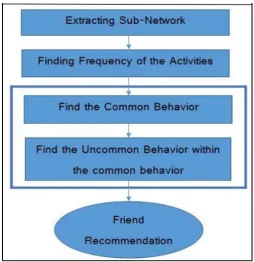
graph based network. There are five step sequencing in the framework: extracting sub-network, finding
frequency of the activities, find the common behavior, find the uncommonbehavior within the common behavior
and finally friend recommendation.
Extracting Sub-Network
SNS‟s are very large entity and has large-scale databases.Day by day the size of the network is increasing and as
the people are joining, there is huge number of information overload happens on these sites. For experiment of
our proposed system, we take the whole network of a random individual. After getting the whole network of a
client for who are going to suggest friends, we extract the sub network of „x‟ no of people from the visualized
graph.
Fig 2: Proposed friend recommendation framework.
Finding Frequency of Activities:
Activities are the main base of social networking sites. The behavior of a particular user depends on the type of
activities he/she does on the SNS. The definition of behavior also describes the related or considered activities
actually define the behavior of that user. There are huge number of activities on SNS‟s nowadays and increasing day by day because of technological advancement and user‟s involvement from different spheres of life. For our
proposed method we can consider different set of activities like types of songs user like, types of videos user
often watches, types of online social games user take part etc. for each type of activities there will be many
139 | P a g e
song activity.From all the activities we find out the entity with maximum frequency. We make the networkscrutinized by using this frequency where the maximum frequency related activities are there. So all activities
come down to the number of activities, where the every categorized activity contains one activity with the
maximum frequency. After this step only the activities with maximum frequencies will be selected.
Find the Behavior
To find the desired user behavior (common and uncommon) we use FP-growth algorithm in our modified
dataset. FP-growth algorithm gives us the pattern from the dataset. Among this pattern the desired behavior will
be found. Growth works in a divide and conquers way. It requires two scans on our model database.
FP-Growth algorithm first computes a list of frequent items sorted by frequency in descending order (F-List) during
its first database scan. In its second scan, the database is compressed into a FP-tree. Then FP-Growth starts to
mine the FP-tree for each item whose support is larger than Į by recursively building its conditional FP-tree. The
algorithm performs mining recursively on FP-tree. The problem of finding frequent item sets is converted to
searching and constructing trees recursively. Thus, applying FP Growth algorithm in our dataset we find the
behaviors patterns. From the acquired pattern we find out the common behavior by using the maximum number
of frequency for any pattern with the single activities of the user behavior. Naturally single activities will give
the highest frequencyvalue. After finding the common behavior our next step is to find the uncommon behavior.
If we recommend friend only using the common behavior it will just like the natural recommendation process
using only one feature like “fof” (friend of friend). So for more integrity we use uncommon behavior. This
uncommon activity is different from the natural uncommon process. We actually find out the less no
offrequency of other two activities from the user behavior containing the common user behavior. We call it
uncommon because it appears less among the user whose have similar interest early. Actually this behavior can
be considered as their unique behavior. Therefore, multilayer thresholding is done to find out the uncommon
behaviors.
Friend Recommendation
In this final step we recommend the users with the user behavior found in previous steps. We can take any
random user from any other sub network and recommend them as friend. So many friends or connections could
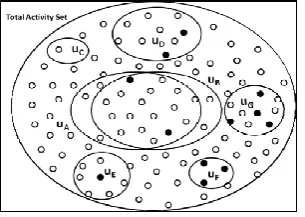
be recommended to a particular user in any social network. The Fig-4 describes the recommendation framework
more precisely. The total activity set is defined by the large circle here the inscribed circles define the different
users and the activities they have performed in a particular timestamp.
Fig 3: Behavior Analysis for friend recommendation forseveral users. (Black dots specifies the
least frequentlyperformed activities and white dots specifies most frequentlyperformed
140 | P a g e
Each user could have least frequently and most frequently performed activities which are denoted as black andwhite dots in the figure, respectively. Some users could have only most frequently done activities (i.e. uC), some
could have only least frequently done activities (i.e. uF) or both (i.e. uA, uB, uD, uE, uG). Now, the uA and uB
have many common activities as the sets overlaps and have two least frequently performed activities which is
the commonly uncommon behavior that we have define in section III. Based on these activities these two users
could be recommended to be friend to each other.
2 (c). Multiple clouds using secret sharing scheme
In the evaluation, a particular popular public storage service is used as a public cloud service because it is
familiar and discloses its API to service developers [16]. Ideally, performance should be evaluated with many
varieties ofcloud services, but here, one service is used with multiple accounts in order to clarify the basic
characteristics because the effect on internet communication should be estimated first rather than the difference
of various kinds of CSPs. Here, we use multiple accounts of the public cloud service as multiple CSPs.
Evaluation with various services is future work.
Evaluation Environment
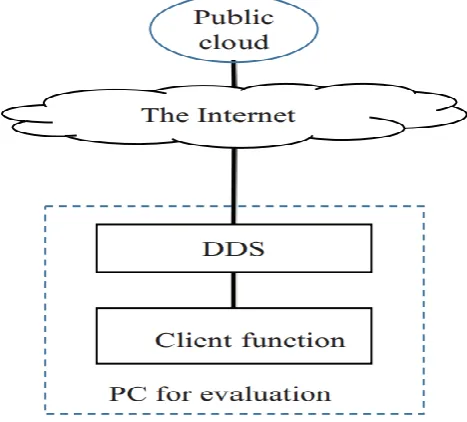
The configuration of the evaluation environment is depicted in Fig. 2. A PC for evaluation (Core i7, 2.8GHz)
was connected through LAN (100 Mbps). A broadband connection for The Internet was used to communicate
with the public cloud service as storage service. All programs were written in JAVA. AES was used as the
encryption algorithm. The PC has functions of both client and DDS.
Fig 4. Evaluation Environment
Here, A fast (k, L, n) threshold secret sharing ramp scheme using XOR, proposed by, was used for secret share
generation. The communication with the public storage service was performed by using disclosed API by the
public storage service.
141 | P a g e
Here, all measured point values are the value averaged by measuring 5 times. The results of evaluating pureprocessing performance where the parameters of the secret sharing scheme were fixed to k=3, L=2, n=5 in Fig.
3. Here, the secret data sizes were 1 and 10 MB. In Fig.4, process times of AES encryption/distribution
comparing to process time of AES decryption/restoring are depicted except communication time to public cloud
service. As shown in Fig.4, secret sharing process takes more time than AESprocess. Secret sharing process
time is almost twice as long compared to AES process time, even in the case of encryption/distribution and
decryption/restoration.
As shown in Fig.3, upload and download time with single account (no secret shearing) and the case that the
secret sharing scheme were fixed to k = 3, L = 2, n = 5 were evaluated. In this case, multiple accesses (multiple
accounts) perform in parallel. The upload uses 5 (n=5) accounts simultaneously, and the download uses 3 (k=3)
accountssimultaneously. Both upload time and download time are nearly the same, though communication
channels are varied. This is because communication speed of each channel is much lower than communication
band and process time.
Basic Component Structure
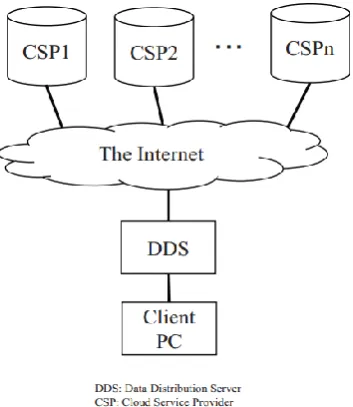
Figure 5 illustrates the basic logical component structure. We use multiple public clouds without adding extra
sharing storages within an organization guaranteeing data security because we assume also easy personal usage.
A client PC encrypts the secret data using a key. Usersthen transmit the encrypted data to the DDS (Data
Distribution Server). The key is stored a client PC. The DDS applies the (k, L, n) secret sharing scheme to the
encrypted data and transmits the generated share to each CSP. Furthermore, DDS generates a hash value to
prevent falsification. Detailed processes are describes below.
Data Management Process
The encryption/distribution and decryption/restoration with the secret sharing scheme are described.
oEncryption and Distribution
1. A client who wants to store secret data M encrypts M with a key K and generates the encrypted data S. Then,
the client discards M.
2. The client transmits S to the DDS. A secure protocol like SSL is necessary if the network is not trustable.
3. The DDS creates n shares DSj from S using the (k, L, n) secret sharing scheme.
4. The DDS generates hash values HDj from each DSj.
5. The DDS send hash value information and the identification information of shares to a client‟s storage. 6. The DDS distributes generated shares to multiple CSPs‟ storages.
Decryption and Restoration
1. A client who uploaded S in the encryption and distribution procedure uploads HDj and identification
information to the DDS.
2. The DDS selects arbitrary k cloud services out of n CSPs and requests the shares to each CSP, then, the DDS
142 | P a g e
Fig 5. Assumed Basic Logical Component Structure
3. The DDS verify the received shares by using the hash values HDi, which are uploaded in Step 1. If the
received DSi fails verification, the DS requests another share to another CSP.
4. The DDS restores S by applying the (k, L, n) secret sharing scheme.
5. A client receives S from the DDS.
6. The client decrypts S by using the key K and get original secret data M.
III.
ALGORITHMS:
The following algorithms are used for friend recommendation and for security:
3 (a).FP-GROWTH:
To find the desired user behavior (common and uncommon) we use FP-growth algorithm in our modified
dataset. FP-growth algorithm gives us the pattern from the dataset. FP-Growth works in a divide and conquers
way. It requires two scans on our model database.
FP-Growth algorithm first computes a list of frequent items sorted by frequency in descending order (F-List)
during its first database scan.
In its second scan, the database is compressed into a FP-tree.
Then FP-Growth starts to mine the FP-tree for each item whose support is larger than α by recursively
building its conditional FP-tree.
The algorithm performs mining recursively on FP-tree. The problem of finding frequent item sets is
converted to searching and constructing trees recursively.
Thus, applying FP Growth algorithm in our dataset we find the behaviors patterns. From the acquired pattern we
find out the common behavior by using the maximum number of frequency for any pattern with the single
activities of the user behavior. Naturally single activities will give the highest frequency value.
3 (b). AES:
AES is based on a design principle known as a substitution-permutation network, combination of both
substitution and permutation, and is fast in software and hardware. Unlike its predecessor DES[20], AES does
143 | P a g e
128, 192, or 256 bits. By contrast, the Rijindael specification per se is specified with the block and key sizes thatmay be any multiple of 32bits, both with a minimum of 128 and a maximum of 256bits. Most AES calculations
are done in a special finite field.
1. Key Expansion-
Round keys are derived from the cipher key using Rijindael‟s key schedule. AES requires a separate 128 bit
round key block for each round plus one more.
2. InitialRound-
addRoundKey-
Each byte of the state is combined with a block of the round key using bitwise xor.
3. Rounds-
Sub Bytes-
A non-linear substitution step where each byte is replaced with another according to a lookup table.
Shift Rows-
A transposition step where the last three rows of the state are shifted cyclically a certain number of steps.
MixColumns-
A mixing operation which operates on the columns of the state, combining the four bytes in each column.
AddRoundKey.
4. Final Round(no MixColumns)
SubBytes ShiftRows AddRoundKey
3 (c). DES:
DES relies on encryption techniques of confusion and diffusion.[20] Confusion means that each character of the
cipher text should depend on several parts of the key. Diffusion means that a small change in the plaintext
should reflect a big change in the cipher text, and similarly, a small change in the cipher text, should reflect a
big change in the plain text. Confusion is accomplished through substitution, whereas diffusion is accomplished
through permutation of the plaintext and the key. The algorithm includes initial permutation, sixteen identical
iterations, 32-bit swap, and inverse initial permutation.[18] There is a key expansion function which produces
different iteration keys that are used in each of sixteen iterations from the initial key.
The iteration function consists of the following operations:
• expansion permutation- in which the right half of the input block (Ri-1) is permuted and extended from 32 bit
to 48 bit length,
• logical XOR function- which is applied to the extended right half of the input block and the iteration key for
that iteration,
• substitution- which includes substitution function applied to the result of previous function which substitutes
bits and reduces the size from 48 bit to 32 bit,
144 | P a g e
DES has a set of look up tables known as S-boxes and P-boxes, for substitution and transposition ofplaintext,respectively. Substitution algorithm uses eight S-box tables. Each of them gives 4-bit output for 6-bit input.
Every S-box consists from four different 4-bit substitution algorithms. The most significant and the least
significant bit from the input 6-bit value determines which of thefour algorithms will be used and the middle
4-bit value is replaced with the value from the table. After sixteeniterations and inverse initial permutation a 64-4-bit
cipher text block is created. Iteration keys are created from 56-bit initial key. There are sixteen different 48-bit
iteration keys. A permutation is applied to a 64-bit key that was entered by a user. This permutation also
eliminates every eighth bit. Then there are sixteen iterations in which a 56-bit value is divided into two halves of
equal size then for each half a circular left shift is done, followed by a permutation that selects 24 bit from each
half. That is how a 48-bit iteration key is created. The result after rotation is input for next iteration.
IV. MATHEMATICAL MODEL:
Let S be the whole system consist of:
S = { U, w, z, d, Q, F}.
Where,
5. U is the set of number of users.
U = {u1,u2,…..un}.
6. Q is a set of query generated from user.
Q = {q1,q2,……qn}
7. F is the feedback of users.
F = {f1,f2,……fn}.
8. Let w is the set of activities.
w = [w1,w2,……wW]
wherewi is the ith activity and W is the total number of activities.
9. Let z is the set of life styles
z = [z1,z2,……,zZ]
Where zi is the ith life style and Z is the total number of life styles.
10. Let d is the set of life document.
d = [d1,d2,……, dn]
where di is the ith life document and n is the total number of users.
p(
i|dk)=Let p( i|dk) is the probability of the activity Ѡiin a certain life document dk.
Let is the probability of how much the activity Ѡicontributes to the life style .
Let is the probability of the life style embedded in the life document
V. CONCLUSION
We have proposed a novel friend or connection recommendation framework which could be used in any social
145 | P a g e
user‟s online behavior definition as well as an approach to use the online behavior to recommend friend. Theapplications of this framework is huge and this approach could be used to recommend friend, community or
group, online games matches with the users behavior or interest and many more. The FP Growth algorithm
could be modified to determine a new recommendation system having more accuracy. Different data mining
rules could be applied to simplify the model dataset and find the required connection. Our future work is to
work with different data mining algorithms and large scale datasets from Facebook, Twitter, and MySpace etc.
We experimentally evaluated the performance of a proposed data management approach for multiple clouds that
use secret sharing schemes by implementing the prototype. An actual particular public cloud service was used as
a CSP in the prototype. The result shows that the performance wasfeasible for use and that the secret sharing
processing time was much less than communication time. We will evaluate the performance with various kinds
of CSPs in the future.
VI. REFERENCES
[1]. Friend Recommendation Framework for SocialNetworking Sites using User‟s Online BehaviorMd. Mehedi
Hasan1, Noor HussainShaon 2, Ahmed Al Marouf 3, Md. Kamrul Hasan4, Hasan Mahmud5, and
Md.Mohiuddin Khan6.
[2] S. Catanese, P. D. Meo, E. Ferrara, G. Fiumara, “Analyzing the Facebook Friendship Graph”, 1st
International Workshop on Mining the Future Internet, MIFI, 2010.
[3] L. Jin, Y. Chen, T. Wang, P. Hui, A. V. Visalakos, “Understanding User Behavior in Online Social
Networks: A Survey”, IEEE CommunicationMagazine, September 2013, pp. 144-150.
[4] X. Xie, “Potential Friend Recommendation in Online Social Network”, IEEE/ACM International Conference
on Green Computing and Communications, 2010.
[5] Y. Zheng, Y. Chen, X. Xie, W. Ma, “GeoLife2.0: A Location-Based Social Networking Service”, 10th
International Conference on Mobile Data Management: Systems, Services and Middleware (MDM), 18-20
May, 2009, pp. 357-358.
[6] A. A. Marouf, R. Ajwad, M. T. R. Kyser, “Community Recommendation Approach for Social Networking
Sites based on Mining Rules”, 2nd International Conference on Electrical Engineering
and Information & Communication Technology (iCEEiCT 2015), 21-23 May, 2015.
[7]. Performance Evaluation on Data Management Approach for Multiple Clouds Using Secret Sharing Scheme
Atsushi KANAI, Shigeaki TANIMOTO and Hiroyuki SATO
[8]. J. Chen, W. Geyer, C. Dugan, M. Muller, and I. Guy, “Make new friends but keep the old: Recommending
people on social networking sites,” in ACM CHI‟09, New York, NY, USA, April 2009.
[9]. S. Wan, Y. Lan, J. Guo, C. Fan, and X. Cheng, “Informational friendship recommendation in social media,”
in ACM SIGIR‟13, Dublin, Ireland, pp. 1045–1048, July 2013.
[10]. R. J. Rummel, The Conflict Helix: Principles and Practices of Interpersonal, Social, and International
Conflict and Cooperation. New Brunswick, N.J, 1991.
[11]. M. Weber, The Nature of Social Action. Cambridge University Press, 1991.
[12]. H. Ma, H. Yang, M. R. Lyu, and I. King, “SOREC: Social recommendation using probabilistic matrix
146 | P a g e
[13]. S. D. Roy, T. Mei, W. Zeng, and S. Li, “Socialtransfer: Cross-domain transfer learning from socialstreams for media applications,” in ACM MM‟12, Nara, Japan, pp. 649–658, October 2012.
[14]. N. Li and G. Chen, “Multi-layered friendship modeling for locationbased mobile social networks,” in
IEEE MobiQuitous‟09, Toronto, Canada, pp. 1–10, July 2009.
[15] X. Xie, “Potential friend recommendation in online social networking,” in IEEE/ACM CPSCom‟10,
Hangzhou, China, pp. 831–835, December2010.
[16]. V. Cardellini, V. Valerio, V. Grassi, S. Iannucci, F. Presti, “A New Approach to QoS Driven Service
Selection in Service Oriented Architectures,” Proc. of The 6th IEEE International Symposium on Service
Oriented System Engineering SOSE, pp. 102-113, 2011.
[17]. G. R. Blakley, “Security of ramp schemes,” Crypto‟84, pp. 242-268,1984.
[18]. Pranav M, Archana K Rajan.“DES security enhancement with dynamic permutation”. [19]. Zarko S. Stanisavljevic “Data Encryption Standard Visual Representation.”