Western University Western University
Scholarship@Western
Scholarship@Western
Electronic Thesis and Dissertation Repository
12-12-2013 12:00 AM
A Modular Approach to the Development of Interactive
A Modular Approach to the Development of Interactive
Augmented Reality Applications.
Augmented Reality Applications.
Nelson J. Andre
The University of Western Ontario
Supervisor
Dr. Michael James Katchabaw The University of Western Ontario Graduate Program in Computer Science
A thesis submitted in partial fulfillment of the requirements for the degree in Master of Science © Nelson J. Andre 2013
Follow this and additional works at: https://ir.lib.uwo.ca/etd
Part of the Graphics and Human Computer Interfaces Commons, and the Software Engineering Commons
Recommended Citation Recommended Citation
Andre, Nelson J., "A Modular Approach to the Development of Interactive Augmented Reality Applications." (2013). Electronic Thesis and Dissertation Repository. 1800.
https://ir.lib.uwo.ca/etd/1800
This Dissertation/Thesis is brought to you for free and open access by Scholarship@Western. It has been accepted for inclusion in Electronic Thesis and Dissertation Repository by an authorized administrator of
(Thesis format: Monograph)
by
Nelson Andre
Graduate Program in Computer Science
A thesis submitted in partial fulfillment
of the requirements for the degree of
Masters of Science
The School of Graduate and Postdoctoral Studies
The University of Western Ontario
London, Ontario, Canada
c
Abstract
Augmented reality (AR) technologies are becoming increasingly popular as a result of the increase in the power of mobile computing devices. Emerging AR applications have the potential to have an enormous impact on industries such as education, healthcare, research, training and entertainment. There are currently a number of augmented reality toolkits and libraries available for the development of these applications; however, there is currently no standard tool for development. In this thesis we propose a modular approach to the organization and development of AR systems in order to enable the creation novel AR experiences. We also investigate the incorporation of the framework that resulted from our approach into game engines to enable the creation and visualization of immersive virtual reality experiences. We address issues in the development process of AR systems and provide a solution for reducing the time, cost and barrier of entry for development while simultaneously providing a framework in which researchers can test and apply advanced augmented reality technologies.
Keywords: Augmented Reality, Mixed Reality, Virtual Reality, Computer Vision, Image Processing, Game Engines
Abstract ii
List of Figures v
1 Introduction 2
1.1 Problem Statement . . . 3
1.2 Research Questions . . . 3
1.3 Contributions . . . 4
1.4 Roadmap . . . 4
2 Related Work 5 2.1 Visual Tracking Methods . . . 5
2.2 Simultaneous Localization and Mapping . . . 6
2.3 Natural User Interfaces . . . 7
2.4 Existing Toolkits and Frameworks . . . 8
2.4.1 Augmented Reality Authoring Tools . . . 9
2.5 Displays . . . 10
2.5.1 Handheld Displays . . . 10
2.5.2 Head Mounted Displays . . . 10
2.5.3 Surround Screen Projection Based Displays . . . 10
2.6 Photorealistic Rendering . . . 11
2.6.1 Lighting and Shadows . . . 11
2.6.2 Accounting for Captured Image Artefacts . . . 12
2.7 Diminished Reality . . . 13
2.8 Summary . . . 13
3 Approach and Solution 14 3.1 Navigational Augmented-Virtual Reality Framework . . . 14
3.2 Providing an Interface Between Layers . . . 15
3.2.1 Trackable Detection Interface . . . 16
3.2.2 Feature Point Mapping Interface . . . 17
3.2.3 Image Processing Interface . . . 17
3.3 Video Capture Input . . . 18
3.4 Rendering Layer Manager . . . 19
3.5 World State Manager . . . 20
3.5.2 Egocentric Pose Determination . . . 21
3.5.3 Trackable Groups . . . 22
3.6 System Architecture . . . 23
3.7 Graphics Engine Integration . . . 24
3.8 Summary . . . 26
4 Evaluation and Validation 28 4.1 Description of Previous Framework . . . 28
4.1.1 Physical Setup . . . 29
4.1.2 Software Architecture . . . 29
4.2 Development with NAVR . . . 30
4.2.1 Defining Rendering Layers . . . 31
4.2.2 Creating Virtual Environments . . . 32
4.2.3 Interaction Between Trackable Groups . . . 33
4.2.4 Image Effects for Photorealistic Rendering . . . 34
4.3 Summary . . . 34
5 Discussion 36 5.1 Disadvantages of Our Approach . . . 38
6 Conclusion 39 6.1 Contributions . . . 39
6.2 Future Work . . . 39
6.3 Final Comments . . . 40
Bibliography 40
Curriculum Vitae 45
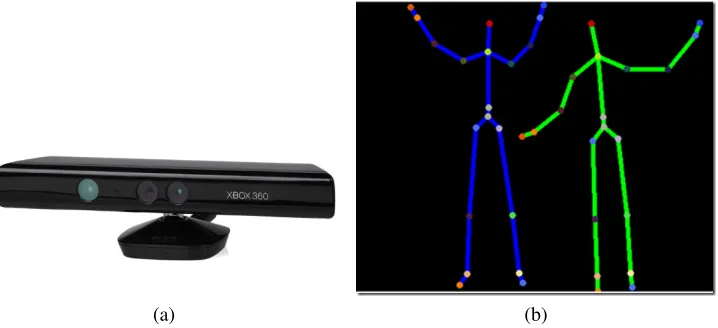
1.1 Reality-virtuality continuum [18] . . . 3 2.1 Microsoft KinectTM(a) is a natural user interface device used for tracking
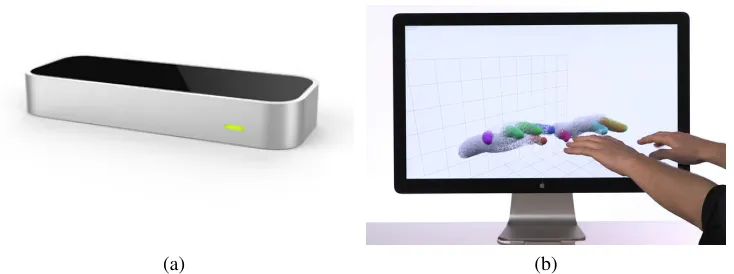
skele-tal pose in real-time (b). . . 7 2.2 Leap MotionTM(a) is a natural user interface device that tracks hand and finger
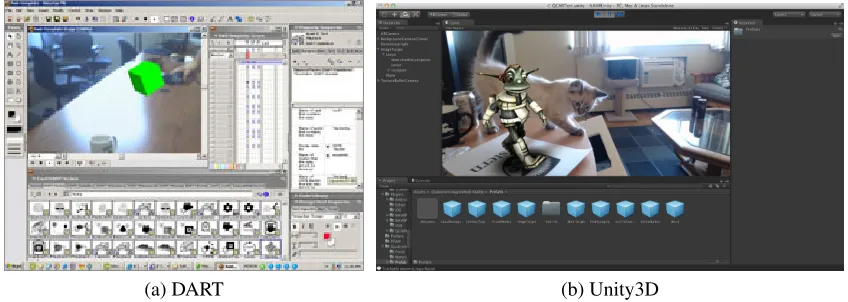
positions (b). . . 8 2.3 Augmented reality authoring tools can be used to extend existing conent
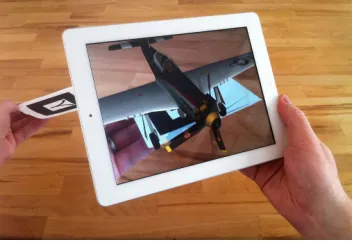
cre-ation software. . . 9 2.4 Apple iPadTMdevice augmenting a fiducial marker with a virtual object. . . 10 2.5 Head mounted displays are commonly used in immersive augmented reality
systems. . . 11 2.6 Adding shadows to virtual objects and an example of lighting acquisition
pro-cedure using a diffuse sphere (circled in green). . . 12 2.7 Virtual hamburger model generated in AR with simulated noise [9]. . . 13 2.8 Diminished reality example, images from left to right: original, augmentation
over existing object, diminished image, augmentation over diminished image. [25] . . . 13 3.1 NAVR Framework Layer Diagram . . . 16 3.2 Camera input is captured and processed and an interface is provided to modules
within the NAVR framework. . . 18 3.3 Rendering Manager entity relationship diagram. . . 19 3.4 An example of how rendering layers are used to determine the systems
classi-fication on the Reality-Virtuality Continuum. . . 20 3.5 World State Manager entity relationship diagram. . . 20 3.6 Egocentric pose estimation using module providing an interface to the Paralell
Tracking and Mapping implementation by Klein et al. [14] . . . 22 3.7 Related trackables objects are classified into trackable groups that relate reated
physical bodies. In this example there are two trackable groups, a cereal box and a table. . . 23 3.8 Representing trackables as game objects within Unity3D and assigning virtual
objects. Single marker target (Left), multi marker target (Middle), planar image target (Right). . . 25 3.9 Interface to NAVR within Unity3D for creating for creating single trackable
marker in Unity3D. . . 25 3.10 By extending the NAVR framework, we provide an interface for defining,
1 3.11 Visualizing trackables within a graphical engine allows for organization of
aug-mentable objects in the real world in relation to virtual objects. . . 27 4.1 The VUZIX iWear 920VR head mounted display. . . 29 4.2 Virtual scenes rendered in previous framework developed by Garcia [11]. . . . 29 4.3 Physical space in which fiducial markers were setup in order to create a
prede-fined multi-marker system. . . 30 4.4 Comparison of layer diagrams representing software architecture of previous
system vs NAVR framework. . . 31 4.5 Rendering layers are created by the image processing modules within NAVR
and by the rendering of virtual objects in the application. . . 32 4.6 Street environment created using the NAVR framework in Unity3D (a) and
then a rendering layer defined by a skin classification module was overlaid (b) to create an immersive experience. . . 33 4.7 An interaction event is triggered when trackable groups come within a
thresh-old distance. . . 34 4.8 Comparison of augmented objects rendered with and without image effects.
Introduction
The rise in the availability of powerful camera equipped mobile devices is paving the way for visual Augmented Reality (AR) technologies. The field of AR revolves around overlaying virtual objects or information over ones field of view in real time [3]. Milgram and Kishino [18] have proposed that all realities lie at a point along the Virtuality Continuum (VC), ranging from completely real to completely virtual environments. A subclass of virtual reality, known as Mixed reality (MR), refers to the merging of real and virtual worlds [18], in which both real and virtual objects can coexist and interact in realtime.
Another concept explored by Milgram and Kishino [18] is the Extent of the World Knowl-edge (EWK) scale, which can range from completely unmodelled to completely modelled en-vironments. It is not necessary to have a completely accurate description of the real world, but instead a simple approximation that will allow for augmentation of objects of interest to a specific application [10]. Once a language is developed for defining knowledge of objects within the real world, augmentation can occur and a virtual environment can be created. The knowledge of one’s physical surroundings can be used in different ways to create environments and hence differen user experiences in the same real world environments can exist. By having an approximate representation of the structure of a real world environment, this can enable the development of complex augmented relaity simulations and allow for relationships between features within the real world and the virtual to be clearly defined.
The main focus of research in augmented reality technology is the techniques used for the tracking and localization of trackable objects within a scene. Information about a scene must firstbe obtained to allow for mixed reality environments to be created and thus reliable tracking is important. Many augmented reality systems use mechanisms for combining object recognition, fiduciary marker tracking, and other localization methods to create hybrid AR systems. In this thesis we discuss the evolution of tracking techniques in Section 2.1 and how they can be used to create AR experiences.
1.1. ProblemStatement 3
Figure 1.1: Reality-virtuality continuum [18]
In fully immersive virtual reality environments, applications often make use of a head-mounted display (HMD) that allows users to experience a more natural field of view. The display hardware used in the setup for an augmented reality system can greatly impact the de-gree of immersion experienced. Wearable technologies like Google GlassTMand Oculus Rift
TMserve as a more natural way of experiencing a virtual world and interacting with information.
However, providing a virtual interface on mobile devices has the benefit of being a convenient and portable means of display. We will further discuss the different types of available displays used in AR applications in Section 2.4.
1.1
Problem Statement
Currently, there is no standard tool for the development of augmented reality applications. There are numerous toolkits and libraries available for tracking objects in AR environments, however a comprehensive system for using these tools in the creation of AR environments does not exist. A flexible framework for creating portable cross-platform AR applications is needed to enable the development of dynamic experiences. Augmented reality technology currently has many applications in entertainment, education, healthcare and training [12] and such tools would be helpful in allowing developers to create realiable believable systems with minimal knowledge of computer vision.
1.2
Research Questions
In this thesis we will address the following research questions:
2. Can we address the first question while at the same time making it easier to deploy and use AR applications?
3. How do we accomplish the above while maintaining or improving the quality of the AR experience being created?
By answering these questions we hope to allow developers and researchers to create and use virtual reality applications at a lower develop cost, time and barrier of entry.
1.3
Contributions
In this thesis, we have developed a high level approach for the creation of mixed reality envi-ronments. We have provided a modular interface for linking computer vision and augmented reality libraries with 3D graphical and physics engines in order to facilitate the creation of interactive, realistic mixed reality environments. This interface is to be extendable, highly configurable and cross platform allowing for augmented reality setups and feature databases to be shared across virtual reality applications. We have developed an approach that allows developers to incorporate existing commercial toolkits as well as open source solutions in or-der to create augmented reality experiences. As well, we provide an interface that allows for the integration of this framework into game engines enabling the creation and organization of immersive virtual reality experiences.
1.4
Roadmap
Chapter 2
Related Work
2.1
Visual Tracking Methods
One of the main topics of study in research in augmented reality is tracking [32] because it provides some knowledge of the orientations of objects within a physical environment and allows for augmentation of these trackables. Tracking techniques can generally be grouped into visionbased, sensor-based and hybrid techniques. The majority of this thesis will focus on techniques for vision based tracking, which can be used for determining camera pose rela-tive to real world objects. In computer vision, most available techniques are divided into two classes, feature based and model-based [22]. Feature-based methods focus on the tracking of 2D features such as geometrical primitives, object contours, and regions of interest. Model based approaches explicitly use a 3D CAD model of tracked objects and can provide a ro-bust solution. Relative camera pose can then be calculated by projecting the 3D coordinates of the features into the observed 2D image coordinates and minimizing the distance to their corresponding 2D features [30].
Computer vision techniques for efficiently calculating camera pose in real time from arti-ficial markers is a common approach to tracking virtual objects. The ARToolKit library was one of the first development kits to describe this approach[13], while other research at the time focused on line finding [27] and minimizing marker error. Square markers were the domi-nant technique studied in the early 2000s and several techniques for marker tracking have been published and source code has been made freely available.
In feature-based tracking, camera pose is determined from naturally occurring scene fea-tures such as points, lines, edges or texfea-tures [31]. After camera pose had been calculated from known visual features, additional natural features can be acquired then subsequently used to update the pose calculation. This allows for robust tracking even when original fiducial mark-ers are no longer in view. Other techniques use an explicit model of tracked objects such as
a CAD model or 2D template of the object based on distinguishable features. Modelbased trackers generally create their models based on lines or edges in the model. Edges are used most frequently because they are the most efficient to find and the most robust to changes in lighting. Vachettit et al. [29] combined edge information and feature points to let the tracker handle both textured and untextured objects which resulted in a system with increased track-ing stability. Similarly, Presigout and Marchand proposed a model-based hybrid monocular vision system [23], combining edge extraction and texture analysis to obtain a more robust and accurate pose computation.
In many augmented reality applications, hybrid-tracking techniques are used in the de-velopment of a robust tracking solution. Azuma et al [4] have proposed the dede-velopment of outdoor AR systems, requiring the use of a tracking system based on GPS as well as inertial and computer vision sensing mechanisms. Since then there has been a consensus among the augmented reality community to combine both inertial and computer vision technologies. Vi-sion based tracking approaches have low jitter and no drift, but they are slow and outliers may occur. As well, sudden changes in motion and direction lead to tracking failure with a large recovery time. Inertial based tracking methods are fast and robust and can be used for motion prediction when rapid changes occur. This is especially useful in mobile devices as object pose position can be recovered based on accelerometer and gyroscope data [15]. Support for a hy-brid based pose tracking system and concepts of sensor fusion are explored in our approach in Section 3.5.2.
2.2
Simultaneous Localization and Mapping
Simultaneous Localization and Mapping (SLAM) is an important problem that is widely stud-ied in the robotics community. This problem is based on the question of whether it is possible for a mobile robot to be placed in an undefined location and dynamically build a representa-tion of this environment while concurrently estimating its morepresenta-tion. Research in vision based SLAM often concentrates on reconstruction problems from small image sets, and makes up a field known as Structure from Motion (SFM). These algorithms generally work on longer im-age sequences and can produce a reconstruction of the camera trajectory and scene structure. To obtain globally consistent estimates over a sequence, local motion estimates from frame-to frame matching are refined by a technique known as bundle adjustment. These methods are suited for automatic analysis of short image sequences obtained from arbitrary sources but do not scale to consistent localization over long sequences in time.
2.3. NaturalUserInterfaces 7
presented by Davison [7]. The quadratic computational complexities of EKF-SLAM make it beneficial for smaller maps of reliable features to be used instead of mapping an entire scene. Klein and Murray have presented a method for estimating camera pose in an unknown scene that is designed to be suitable specifically for tracking a hand held camera in small workspaces [14]. In their approach, which they refer to as PTAM, they split tracking and mapping into two separate tasks processed in parallel. One task deals with the robust tracking of erratic handheld motion, while the other provides a three dimensional map of features from observed frames. This allows for the use of processor intensive bundle adjustment operations that are not suitable for use in real time calculations and must be performed on a lower priority thread. This results in a system that can produce detailed maps with thousands of landmarks that can be tracked in real time.
2.3
Natural User Interfaces
Interaction of users with virtual environments can be enhanced through the use of natural user interface (NUI) devices such as the Microsoft KinectTM, Leap MotionTMand other hardware
devices (Figure 2.1). These devices provide information on the pose of a users body parts, which can then be calculated in relation to the device. If the devices pose relative to the user is known then it can be used in virtual environments to allow for real time interaction with virtual objects. Hybrid user interfaces that make use of multiple forms NUI devices can be combined in a manner such that the techniques will complement each other. By doing so, you can provide a more robust mechanism of interaction with the virtual world.
(a) (b)
(a) (b)
Figure 2.2: Leap Motion TM(a) is a natural user interface device that tracks hand and finger positions (b).
2.4
Existing Toolkits and Frameworks
Several tools for creating augmented reality applications are currently available for use. These tools contain libraries, toolkits and SDKs that are used for AR application development. They contain methods for tracking objects and may often provide their own graphical interface. There are several open source augmented reality libraries available that are based on the OpenCV libraries. An example of such library is the ALVAR toolkit developed by VTT [2] that contains methods for marker and natural feature based tracking. Many augmented reality toolkits also use additional libraries for lower levels tasks and mathematical operations, such as Eigen or LAPACK for linear algebra which may be optimized for certain processors and make use of hardware acceleration. Most currently available AR technologies support iOS and Android devices, however there is currently no standard library for use in mobile AR applications. OpenCV is rapidly becoming the accepted standard for computer vision application develop-ment and it can be used rapdily expandable AR frameworks.
In the past, AR applications relied on fiducial marker tracking, however due to advance-ments in computer vision research and hardware, AR applications are tending to rely on mark-erless technologies based on tracking and mapping of natural features, allowing for virtual con-tent creation to be performed dynamically [16]. Currently the most popularly used computer vision libraries provide support for SLAM methods in order to augment a users environment without the use of predefined trackables. Some of these libraries include Metaio [21] and Vu-foria by Qualcomm TM[26]. These libraries all contain some form of SLAM implementation
2.4. ExistingToolkits andFrameworks 9
2.4.1
Augmented Reality Authoring Tools
There are many systems, which allow for content authoring in augmented reality that will ex-tend existing 3D modeling software. For example, DART (The Designers Augmented Reality Tooklit) [17] was introduced in 2003 and provided an interface for creating augmented real-ity environments at a higher level (Figure 2.2). This software is based on top of Macromedia Director, which was popular at the time and allowed for a large number of designers to create VR experiences and applications with a low barrier of entry. It advertised itself as having the ability to create rapid content creation for experience testing and design early on in augmented reality creation process.
Currently, many toolkits provide multiple ways for developers to use their software within applications. Generally, these kits provide an API for using their SDK within a development environment. The majority of toolkits now support some sort of interface with the popular game engine Unity3D. This allows for rapid development of high quality augmented reality applications with a low development barrier for developers. For example, the Vuforia SDK of-fers complete support for Unity3D integration, allowing for rapid cross-platform develoment. By integrating augmented reality toolkits within existing editors and graphical engines, de-velopers can easily and quickly create AR applications with minimal development time and cost.
(a) DART (b) Unity3D
2.5
Displays
2.5.1
Handheld Displays
As the inclusion of cameras in handheld devices is becoming ubiquitous, they are becoming an increasingly popular platform for augmented reality applications. Handheld displays have the ability to experience applications without needing an extra device and allows for a platform which users are comfortable using. Handheld displays are often used as a means to engage audiences in content in the form of advertising, education and training.
Figure 2.4: Apple iPadTMdevice augmenting a fiducial marker with a virtual object.
2.5.2
Head Mounted Displays
Using augmented reality technologies in combination with a head mounted display (HMD) can provide a fully immersive mixed reality experience. The availability of low cost displays has brought upon the possibility of using these devices in everyday applications. The Oculus RiftTM(Figure 2.5) has received a large amount of support from the gaming community due to its ability to provide a high feeling of immersion with a high-resolution screen with a large field of view. The amount of support for the development of augmented reality applications with this hardware is lacking. Applications have been demonstrated which use a camera attached to a head mounted display to augment the virtual world. This idea is also seen in Google Glass
TMwhere information is overlaid on objects in the virtual world.
2.5.3
Surround Screen Projection Based Displays
2.6. PhotorealisticRendering 11
(a) Oculus RiftTM
Figure 2.5: Head mounted displays are commonly used in immersive augmented reality sys-tems.
been in development since 1991. There are many notable designs of the CAVE displays and advancements in visual acuity are constantly increasing.
2.6
Photorealistic Rendering
An important aspect of creating immersive and believable virtual environments is defining how to augment objects in a way that the virtual objects seem like they belong in the real world. The type of visualization technique generally depends on the purpose of the application and in some cases it may be better for the augmented objects to have non-photorealistic rendering. This type of rendering is useful in cases in which the application wants the object to contrast from the backgorund, and can be more effective at conveying information [8]. However, techniques relating to photorealistic rendering, attempt to render the virtual object in such a way that they are indistinguisable from virtual objects. In the following sections we will describe some of these techniques and how they can increase the feeling of realism of virtual objects.
2.6.1
Lighting and Shadows
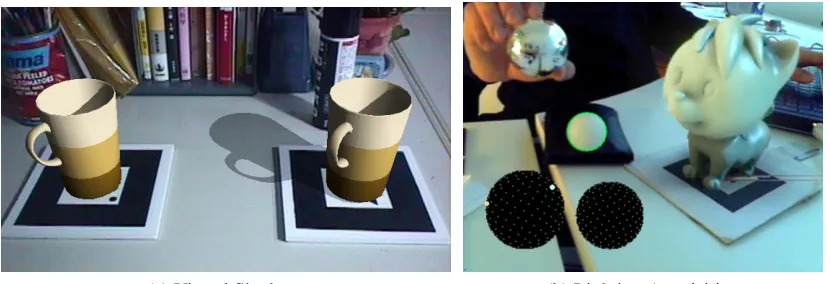
In order to have a virtual object seem indistinguishable form the real world objects, it should be lit and shaded correctly and cast accurate shadows in correspondence with the real world [28]. Without the use of shadows, virtual objects lack depth cues, causing the virtual objects to appear as if it is floating on top of a real surface. Sugano has determined that shadows of a virtual object provide two effects in AR environments, presence and spatial cues.
(a) Virtual Shadows (b) Lighting Acquisition
Figure 2.6: Adding shadows to virtual objects and an example of lighting acquisition procedure using a diffuse sphere (circled in green).
Virtual lights can imitate natural lights of the scene in such a way that the virtual objects seem to be illuminated naturally.
Users can define virtual lights manually or it is also possible for measurements to be carried out using special devices such as photometers or computer vision methods. Aittala has pro-posed a method of detecting lighting conditions using a white object [1], after which an inverse lighting method can be used to determine the light source (Figure 2.6). Other approaches have been used to improve the realism of lighting in augmented reality, including tracing [24] as well as detecting light sources and illumination with a sphere mirror [20].
2.6.2
Accounting for Captured Image Artefacts
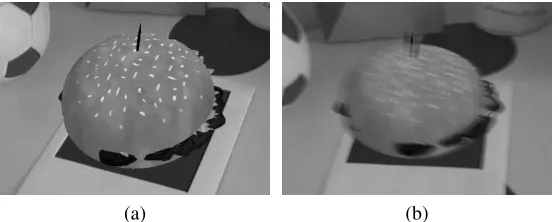
It is necessary for virtual objects to appear similar in quality and appearance to achieve be-lievability. A system must adapt the focus and motion blur of an augmented object to that of the virtual imagery. Many AR applications can also compensate for noise, lens distortion or other capture properties of the input image. Most commonly, AR applications render virtual objects sharp and in focus, which looks unnatural when combined with a fuzzy image. Adapt-ing the augmented objects to have the properties of the captured image requires the detection of the attributes of the captured image and rending the augmented layer appropriately with this knowledge.
2.7. DiminishedReality 13
(a) (b)
Figure 2.7: Virtual hamburger model generated in AR with simulated noise [9]. of the effects of a motion blur rendering method is seen in Figure 2.7.
2.7
Diminished Reality
In augmented reality systems, existing objects often disturb the feeling of augmentation. For example, if a fiducial marker is used for pose tracking, it may seem unnatural to the scene. Using image processing techniques, these can be virtually removed from the input image in a process refered to as diminished reality [25].
Figure 2.8: Diminished reality example, images from left to right: original, augmentation over existing object, diminished image, augmentation over diminished image. [25]
2.8
Summary
Approach and Solution
In our approach we describe a framework for the organization and development of an aug-mented reality system. Our framework aims to decrease the development time of visual based augmented reality systems by providing a simple cross-platform interface for application devel-opment. It allows for visual features to be organized, grouped and stored within an application, a task that is necessary for the augmentation of real world objects. Our framework supports the hybridization of numerous tracking methods, and provides a context for storing the knowledge of a user’s physical environment.
We also provide a structure for which we can interface with contextual information de-rived from existing augmented reality toolkits. This allows us to provide a representation of trackables and features within our framework that can be used by applications to define virtual environments. In the following sections we describe the structure of the framework developed and how it interfaces with these toolkits as well as providing an open source platform for the development of extended functionality within the framework. By doing so we aim to reduce the development time, cost and barrier to entry while simultaneously providing a platform for which researchers can test and apply new augmented reality technologies.
3.1
Navigational Augmented-Virtual Reality Framework
The framework we describe in this thesis is intended to allow for the development a broad range of AR applications. For example, it could be used to simplify the development of a simple ap-plication that may place a virtual character on a trackable marker, or it could also be extended to create a fully immersive virtual reality training simulation. This framework organizes infor-mation to provide a general representation of the real world, such that a developer can define how a user will navigate and interact within the defined virtual environment. The Navigational Augmented-Virtual Reality (NAVR) framework described in this thesis provides a context for
3.2. Providing anInterfaceBetweenLayers 15
the physical state of the real world as well as tools that support the processing of visual input to be rendered within augmented reality applications. This framework accomplishes this by pro-viding an interface to multiple toolkits and modules, which contain functionality useful for the creation of AR applications. In developing and publishing this framework we hope to extend the lifecycle of AR applications by providing an adaptable development environment, which can incorporate advancements in AR related technologies.
Many of the modules that NAVR provides an interface with perform similar tasks and thus it is necessary to provide a layer of abstraction to translate and contextualize the information provdided by each module. This is beneficial for developers because it allows for experimen-tatino with several toolkits and tracking strategieis within a minimal effect on the development of the application itself. For example, a user may know that they wish to use planar image targets as trackables within their augmented relaity appilcation. However, there are several toolkits and methods that exist for this task, which may have varying platform support and may also lose support in the future. In this case, a developer would define a generic trackable target within the NAVR framework and could swap the method used to perform this tracking supporting changes in the development lifecycle of the AR software.
Another benefit of this system is the ability to combine functionalities of augmented reality modules. For instance, a developer may wish to incorporate a SLAM implementation to map out a users environment, but they may also wish to also include support for trackable detec-tion. By using our framework, the developer would be able to experiment with several SLAM implementations in combination with trackable detection to determine which suited the needs of their application.
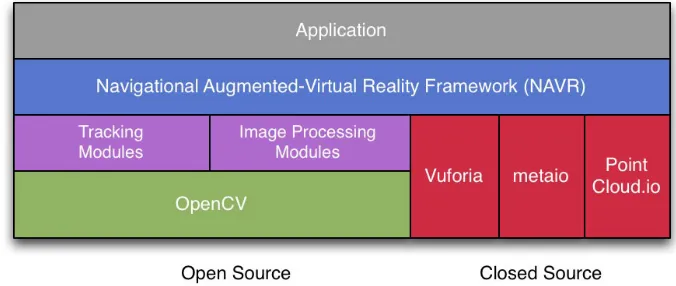
Developers can build AR applications based on the interface provided by the NAVR frame-work layer (Figure 3.1). This frameframe-work contains bindings and interfaces for both open source and closed source modules, which can be selectively incorporated within the application layer. Details of how NAVR interfaces with these modules and contextualizes the information they provide is described in Section 3.2.
3.2
Providing an Interface Between Layers
system relies upon the detection of trackables within a scene as well as processing a video capture input for rendering in an application.
Figure 3.1: NAVR Framework Layer Diagram
In our framework the functionalities of these modules can be classified as one of the fol-lowing:
• Trackable Detection
• Feature Point Mapping
• Input Frame Processing
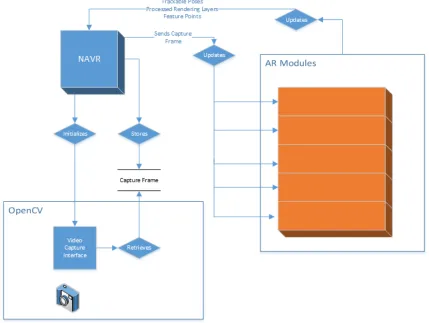
For each module that is included in the NAVR framework, an interface must be provided to allow the user to activate and initialize each module. In the following sections (3.2.1, 3.2.2,3.2.3) we describe the interface for translating the information that each of these mod-ules provide. We also explain how this information is stored and contextualized for use by AR applications. Another function of this framework is updating each active module with each new captured frame. The NAVR framework must provide an interface that translates the cap-tured video frame to the appropriate a format compatible with the module. A more detailed description for the interface for video captured input is provided in Section 3.3.
3.2.1
Trackable Detection Interface
3.2. Providing anInterfaceBetweenLayers 17
Additionally, the parameters specific to that trackable must be set by the application such as physical size, tracking error thresholds and classifier information.
The application must also specify a trackable group identifier, which is used to provide a reference to a virtual object or state. For instance, an application may create a trackable group called ”Hero”. The application layer would then need to define a virtual hero character object in their application and specify that they wish for this object to be displayed on screen relative to this trackable group.
Each trackable also has its own unique identifier generated by the NAVR framework at runtime. This identifier is used to link the trackable object in NAVR to the representation within the module performing trackable detection. The properties of trackables and trackable groups will be discussed further in Section 3.5.3.
Each detected trackable provides knowledge of 3D points and their corresponding view coordinates within the world. If a trackable is found the framework will update a feature map representation within framework with the feature points derived from the trackable pose. It will also store the corresponding normalized view coordinates within the current frame. The reason for this is that the framework can use correspondences stored in the feature map to determine a camera pose estimate for calculation of a users egocentric pose (Section 3.5.2).
3.2.2
Feature Point Mapping Interface
The framework stores a point cloud map that contains information on the states of all tracked features within a users environment. Modules that support an implementation of SLAM will provide an interface that will update the point cloud with mapped features. It is important for each feature point to have a unique identifier as well as a label that specifies the module being used to detect the feature as well as other properties, such as an error value representing the confidence of detection. The features that are tracked by SLAM are representative of the surrounding static environment of a user and can be used to determine their egocentric motion relative to a defined origin point. Information on how the egocentric pose is calculated as well as defining the origin point of a scene is described in Section 3.5.2.
3.2.3
Image Processing Interface
variety of formats by the application layer for display. More information on how these modules are developed and their output is managed is described in Section 3.4.
3.3
Video Capture Input
The NAVR framework stores and processes video capture input via the interface provided by OpenCV. On each updated input frame, NAVR triggers an update of all active modules within teh framework. It is important to note that each module handles the processing of captured input frames independently an possibly in a separate thread. Some modules may process the input frame in realtime on the update call from the AR application, but they may also add the input frame to a processing cue to be processed or discarded in a separate thread. This technique is heavily used in modules that have support for SLAM implementations in which expensive operations like bundle adjustment are used. In this case, these operations can be run in paralell on a low priority thread to avoid performance issues within the application.
3.4. RenderingLayerManager 19
3.4
Rendering Layer Manager
The rendering layer manager provides an interface for the application to access the output of the image processing modules that are being used. The application can access these images in a format compatible with their application, and the application can choose to display the rendering layers stored as necessary. The manner in which the application chooses to display the rendering layers defines the classification of the system on the Reality-Virtuality continuum (Figure 3.4) described by Milgram and Kishino [18].
Figure 3.3: Rendering Manager entity relationship diagram.
(a) Real Environment (b) Augmented Reality (c) Augmented Virtuality (d) Virtual Environment
Figure 3.4: An example of how rendering layers are used to determine the systems classifica-tion on the Reality-Virtuality Continuum.
3.5
World State Manager
In AR applications, it is necessary to obtain knowledge of the state of surrounding augmentable objects in a user’s physical environment. The NAVR framework manages information regard-ing the orientations and states of trackables and feature points within a users field of view. In the following sections, we discuss how the framework stores trackables such that they can be accessed by the application layer (Section 3.5.3), as well as organizing all known features into a point cloud that can be used to provide an estimate of structure for virtualization. We also discuss how the egocentric pose can be estimated by using correspondences between points stored in the point cloud and their respective positions in the viewport (Section 3.5.2).
3.5. WorldStateManager 21
3.5.1
Feature Point Cloud Map
The states and pose of all known features contributed from by trackables and mapping proce-dures are stored within the framework. From this a point cloud of mapped features is created and used to infer the physical structure of a users scene. A feature contains information on its estimated world position, the last time it was tracked, and the confidence value of its current position. Also, if a feature point is currently being tracked in an input frame, the normalized screen coordinates are stored. This feature point map contains information from trackables as well as mapping procedures.
This map can be defined by a mapping procedure implemented in a module, but this module must provide an interface that allows the NAVR library to interpret the information provided. With access to the current map data being used by the application, a virtual environment can be built to augment the associated physical surroundings. This allows for an application to create a mixed reality experience in which virtual objects and characters can interact with real world structures based on information received from various modules.
3.5.2
Egocentric Pose Determination
In this section we describe how the framework can be used to determine the three dimensional location of a user with respect to a defined origin. By providing the ability for users to navigate through the virtual environment the framework allows for the interaction with fully immersive virtual worlds.
In order for the camera pose to be calculated from the feature point correspondences stored within the framework (Section 3.5.1) it is first necessary for the intrinsic parameters to be determined using a calibration procedure. An interface to OpenCVs calibration methods is provided by the NAVR framework and can be used. Alternatively, modules could be used in order to provide an alternate calibration method and would be able to update the intrinsic parameter representation stored in the framework.
Figure 3.6: Egocentric pose estimation using module providing an interface to the Paralell Tracking and Mapping implementation by Klein et al. [14]
3.5.3
Trackable Groups
An important concept introduced in this thesis is the organization of trackables into trackable groups. The groups are composed of trackables that are anchored to the same physical object in the real world. For example, if our real world was a living room, then one group could represent the walls, floors, light switches and everything that would move together relative to the user. Another defined group would be the furniture in the room, books, and any other dynamic objects that would move as individual groups. The virtual scene is composed of numerous trackable groups that serve as the basis for interaction with the virtual world. By defining a trackable group we make it easier for the application layer to assign multiple trackables to a virtual object and query its pose relative the user.
Trackable groups are composed of a variety of different trackables which are used to gather information about the pose of the entire group. The calculated pose is determined by the detection of a single trackable within the group. For example, a cereal box could be defined as a trackable group with each side definining a child trackable within that group. More trackables associated with a group allows for a more reliable and robust pose detection of a group, however The more trackables in the group, the more likely it is that an estimate of the pose can be determined.
3.6. SystemArchitecture 23
Figure 3.7: Related trackables objects are classified into trackable groups that relate reated physical bodies. In this example there are two trackable groups, a cereal box and a table. allows for the determined world position of a trackable group to be based on the most reliable trackable pose information. Conditional hierarchies can be defined, in which the estimated pose of certain trackable is used preferentially under certain conditions set by the user. This is used by the application to selectively use trackables that are most reliable in various lighting conditions or hardware setups.
In some immersive virtual reality applications developers may choose to segment out real objects such as users hands or objects that the user wishes to interact with and have visible within the virtual world. As well, in augmented reality setups it is also possible to define areas which act as windows to the virtual world. This is commonly referred to as diminished reality. In our approach, reality segmentation regions are anchored to trackable groups. Segmenta-tion regions are used by an image processing module to determine which regions should be segmented out into separate rendering layers (See Section 3.4). In this implementation only rectangular shapes are only supported; however, trackable groups could be extended to use vector-shape based segmentation regions in the future.
3.6
System Architecture
and display setups. This framework was developed in C++ and is based on the open source computer vision library, OpenCV. Input from capture devices is stored in an OpenCV image format, however wrappers and support for other image formats are provided. In the following section (3.7) we will describe how the framework can be incorporated into graphical engines to provide an interface for creating virtual environments.
3.7
Graphics Engine Integration
This section details an example of how this framework can be incorporated as a plugin into a graphical engine, providing an intuitive interface for development. The framework currently provides support for integration into the Unity3D game engine. This engine was chosen be-cause of its cross-platform support, large developer community base and its overall popular-ity. It is currently standard for commercial augmented reality toolkits to provide support for Unity3D; however, there is currently little support for open source augmented reality toolkits.
In order to use the NAVR framework within this game engine a plugin had to be developed to interact with the NAVR libraries. The Unity3D Engine is built on Mono 2.6, an open source implementation of the .NET framework. Programmers may use C# to write scripts to assign behaviours to game objects. In order to integrate the NAVR framework it was necessary to write a C# wrapper within Unity3D to integrate with the NAVR plugin which has a C++interface. It is our hope that by providing this framework we will be able to help developers integrate open source computer vision libraries and AR tools into game engines.
Within the Unity3D game engine the base class for all entities in a scene is the Game Object. A developer will attach scripts to game objects to provide functionality. Trackable groups are stored as game objects within the scene and their properties and parameters can be set in the editor. Child trackables can also be attached to other trackables and this configuration can be done within the Unity Editor (Figure 3.6). If these trackables are defined within the scene they will be initialized within the NAVR framework at runtime.
A user interface is provided by extending the Unity Editor, allowing for modification of trackable parameters within the NAVR framework. Being able to provide a 3D visual repre-sentation of trackables and features allows developers to effectively organize and link virtual objects to real world objects, allowing for augmentation of the users physical environment. As well, game objects can react to changes in pose as well as states of trackable groups. This al-lows developers to build scripts and behaviours based on information queried form the NAVR framework to create immersive AR environments.
3.7. GraphicsEngineIntegration 25
Figure 3.8: Representing trackables as game objects within Unity3D and assigning virtual objects. Single marker target (Left), multi marker target (Middle), planar image target (Right).
Figure 3.10: By extending the NAVR framework, we provide an interface for defining, training and visualizing planar image targets within Unity3D editor.
markers can be seen in which a user specifies the module to be used for detection and the rel-evant parameters. The current implementation of allows for detection and training of planar image targets. The module that is being used in Figure 3.8 is the ALVAR augmented reality toolkit. ALVAR provides functions that are can be used to train image recognition classifiers for planar image target tracking. Our interface allows for developers to perform training from directly within the editor. This lets developers configure image training and detection parame-ters within an editor, whereas alternatively they would have previously needed to be performed programmatically.
The ability to visualize feature points and trackables that are to be used within the frame-work can allow developers to place virtual objects directly in the scene that the user will be navigating through. These viewpoints could potentially be mapped out prior to development using a complex SLAM implementation or they could be inferred from a trackable setup (As seen in Figure 3.9).
3.8
Summary
3.8. Summary 27
Figure 3.11: Visualizing trackables within a graphical engine allows for organization of aug-mentable objects in the real world in relation to virtual objects.
Evaluation and Validation
In this Chapter, we first describe the system that was previously used for creating navigational augmented reality systems that was the inspiration for this research. We will describe the hardware used in this system as well as the software architecture. The NAVR framework described in this thesis is designed to be completely compatible with ALVAR, the augmented reality libraries used in the previous system, as well as the formats of the 3D models and environments that were created. In Section 4.2 we describe the outline the development process with NAVR and its benefits versus the original system. We also compare it to development with other commercial SDKs and outline the advantages and disadvantages of developing with our framework.
4.1
Description of Previous Framework
The previous framework developed by Garcia [11] used a head mounted display for presenting virtual environments to the user. This system was designed for use as a potential rehabilitative tool and there was a requirement for it to be completely wearable, allowing for navigation throughout the virtual environment. The main hardware considerations were the weight of the system, as well as processing power and connectivity of the devices. The system used a lightweight portable computer that could be placed within a backpack to provide minimal hindrance to the user. This device also needed to have significant 3D graphical and computation processing power. The aim of this system was to develop a system that could be used to provide a high sense of immersion with low equipment cost. This system used the VUZIX iWear 920VRTM, a head mounted display with an attached camera (Figure 4.1), allowing for users to
4.1. Description ofPreviousFramework 29
Figure 4.1: The VUZIX iWear 920VR head mounted display.
Figure 4.2: Virtual scenes rendered in previous framework developed by Garcia [11].
4.1.1
Physical Setup
This setup relied on a physical space with a predefined fiducial marker system that defined a point cloud in the virtual world. In order to setup the environment a room that measured 6.68mx4.92mwas enclosed with four white vinyl walls, which were then covered with printed markers (Figure 4.3). These black and white markers were chosen because they were ideal for detection in varying light sources due to their high contrast. This setup consisted of markers of varying sizes to support detection from various distances. Markers were placed in such a manner that at least one marker could be seen from all viewpoints within the room. Overall a total of 110 fiduciary markers were used. The setup of this room required precise measurement and this required a large amount of time to accurately determine the coordinates of each fiducial marker.
4.1.2
Software Architecture
Figure 4.3: Physical space in which fiducial markers were setup in order to create a predefined multi-marker system.
module built with OpenCV that performed skin segmentation. The result of this segmentation was overlaid over the 3D graphical layer. In this framework users were able to interact with real objects within the virtual world by the strategic use of rendering layers. The development time and cost of this system was high due to the lack of graphical engine and scene management tools.
4.2
Development with NAVR
The creation of the NAVR framework was inspired by the need to quickly create a navigational virtual reality system in which immersive virtual environments could be explored. The original framework required the development of a graphical engine, augmented reality integration, and system for defining behaviours of virtual objects. The physical setup of the scenes was also quite time consuming and took weeks to setup and accurately measure the coordinates of each of the fiducial markers placed within the room. With our framework we address the develop-ment issues of the previous framework and provide a novel way of organizing the developdevelop-ment of augmented reality applications.
4.2. Development withNAVR 31
within those modules it wishes to use. Then it must update the NAVR framework at a suitable timestep determined by their application. After each update frame the application can query the NAVR framework to retrieve the states and poses of all of defined trackables. The developer can then use this information within their game or simulation to provide augmentation of the real world by defining virtual objects.
(a) Previous Framework (b) NAVR Framework
Figure 4.4: Comparison of layer diagrams representing software architecture of previous sys-tem vs NAVR framework.
As seen in Section 3.7, providing a graphical user interface for the configuration of track-ables and scene features, allows for quick and intuitive definition of tracktrack-ables within a physical scene. This allows the developer to visualize the relation of the markers in the real world to virtual objects while developing the AR application. In the previous framework it became difficult to decide the distance a wall or an obstacle should have been placed in the original framework due to the inability to visualize this information. By using a game engine to design these simulations one is able to experiment with the placement of objects. As well, it is much simpler in terms of development to create behaviours and events within a game engine because game engines are designed for the purpose of creating highly interactive and responsive virtual worlds.
4.2.1
Defining Rendering Layers
the system. For example, in a standard augmented setup, the application would display the captured input frame in the background. The application would need to define which trackables and are present are to be searched for. It will then send the frame capture information to NAVR which will then in turn use the specified AR modules to calculate and store the pose of each trackable within the input frame.
Figure 4.5: Rendering layers are created by the image processing modules within NAVR and by the rendering of virtual objects in the application.
As a result of the modular design of the NAVR framework, developers can choose which image-processing module the application uses and can then access the resulting rendering layer within the application being developed. For each rendering layer the developer must select a depth value within the graphical engine that will determine the order in which the rendering layer will be displayed within the scene. By providing this interface for development we are able to experiment with several variations of image processing algorithms. In the previous framework Garcia [11] used a skin classification algorithm that was used to overlay a users hands over a virtual world in the system. By doing this, the problem of unnatural occulusion of virtual objects was overcome by placing the hand rendering layer in front of the virtual objects within the scene.
4.2.2
Creating Virtual Environments
4.2. Development withNAVR 33
able to add more advanced characters states, and behaviours to the virtual worlds that we cre-ated. When developing with our framework, developers can assign scripts in the game engines, which can respond to changes in state of trackable groups. Game developers can choose a development environment which they are already familiar with to create their applications and can use existing assets and environments. This drastically decreases development time and allows for more complex simulations to be created.
Figure 4.6: Street environment created using the NAVR framework in Unity3D (a) and then a rendering layer defined by a skin classification module was overlaid (b) to create an immersive experience.
A rendering of one of the virtual environments created by Garcia [11] can be seen in Figure 4.2. Development of the 3D models and rendering code took months of development time. In the new system using NAVR the time necessary to create a similar fully functional application could be decreased to just days. We created the environment scene in Figure 4.6 in approxi-mately an hour by using the our the interface for NAVR created within Unity, as described in Section 3.7 with a predefined multi-marker setup.
4.2.3
Interaction Between Trackable Groups
the trackables within the group and the modules being used to perform the tracking while still having the behaviour associated with the group itself.
Figure 4.7: An interaction event is triggered when trackable groups come within a threshold distance.
4.2.4
Image E
ff
ects for Photorealistic Rendering
Creating realistic environments is key in the construction believable virtual reality experiences. In Section 2.5 we discussedd techniques for photorealistic rendering. Producing these effects was quite difficult in the previous system due to the lack of built in support since the software was not built upon a rendering engine. Most game engines provide support for image effects that can be used to merge real and virtual world objects. These effects can easily be integrated and help to increase the photorealism of augmented objects withi nthe scene, as can be seen in Figure 4.8. In this example, we enabled real-time lighting and shadows, and shadows were cast onto a plane defined below the character. By providing shadowing effects we enhanced the perception of the characters depth within the scene. We also used a noise and grain filter effect to account for the image artefacts that were present within the camera input source. As well, we applied a focusing blur, such that objects within the periphery of the field of view were blurred.
4.3
Summary
4.3. Summary 35
(a) (b)
Figure 4.8: Comparison of augmented objects rendered with and without image effects. Ap-plied effects include shadows, noise and grain, and a focusing blur.
Discussion
The development of our framework was intended to address the shortcomings of the previous system as well as other similarly structured AR applications. In this section we discuss some of the development issues faced when developing AR systems and our approach for addressing them. These issues include:
• Development time and cost
• Physical setup time and cost
• Tracking stability
• Game engine integration
– Graphical quality
– Physics support
• Portability
– Ability to deploy on mobile devices
• Cross platform support
• Software extensibility
It is important to note that many of these issues are not addressed by the system directly, but instead by providing an interface for enabling the incorporation of AR systems into game en-gines. In Section 3.7 we described how we integrated the NAVR framework into the Unity3D engine. By doing so we have reduced development time for future AR systems. The overall quality of the system was enhanced due to the provided support for rendering environments
37 and other graphical effects. These engines also contain support for complex physics simula-tions which enables realistic environments and simulasimula-tions to be created. They also allow for developers to incorporate realistic characters, behaviours and animations. By doing so we can increase the overall feeling of immersion by simulating realistic interactions with characters within games such as in [5].
One issue of the system that we wanted to address was the issue of portability in order to provide support for a system that allows for navigation through an environment. Previously we used a laptop that was carried by users as they walked through our virtual environment. We developed the new system to be cross platform in order to potentially allow for mobile devices running on Android or iOS platforms to be used.
The previous system used a large multi-marker system to create a point cloud for egocen-tric pose calculation. It is advantageous to reduce the number of markers used in the system to reduce setup cost and time. To address this issue we incorporated support for SLAM im-plementations enabling for AR systems to be created that can track natural features in addition to trackable markers. We also added interfaces for sensor fusion to make use of gyroscope, magnetomer, accelerometer and geospatial data to be incorporated into AR systems. Through the use of filters and marker-less technologies we were able to also address the issue of tracking stability by implementing pose recovery mechanisms.
In this thesis we have described how our modular framework can be used for the integra-tion AR technologies into software applicaintegra-tions. By allowing for developers to apply new and emerging tracking methods we can potentially enable AR applications to adapt to rapid changes in technology therefore enhancing the extensibility of software developed with this framework. One of the main benefits of providing a framework that interfaces with augmented reality li-braries is that developers can focus on creating virtual experiences that are not necessarily tied to a specific toolkit. As a result, the developer does not need to worry about updating the com-puter vision toolkits used and can experiment with different configurations that suit the needs of the application. For instance, some SLAM implementations are ideal in small workspaces whereas others may be better equipped to deal with larger environments.
versions.
Future development of the NAVR framework will allow for the inclusion of modules that allow for more advanced AR functionalities that are currently only included in commercial toolkits. By providing an open source solution, our framework can support variations of popu-lar tracking methods as well as the ability to efficiently hybridize augmented reality techniques. The development of virtual reality experiences within game engines seems to be a logical relationship. By using augmented reality libraries within game engines it enables developers to visualize and define how virtual characters and environments will interact with the real world. It is clear that game engines will play a pivotal role in the development of augmented and virtual applications due to their popularity and the support of emerging augmented reality toolkits.
5.1
Disadvantages of Our Approach
Chapter 6
Conclusion
6.1
Contributions
In this thesis we described our approach for creating a framework for the development of aug-mented reality applications. Our approach addressed how the creation of a modular system could improve the ability of developers to harness and adapt to augmented reality related soft-ware technologies. Our proposed framework provides a means for reducing the cost and time involved in the development of these systems, thereby making them easier to deploy.
One of the most useful features of our proposed framework is the ability for developers to create software that allows for a user to navigate freely through immersive environments. By providing an interface to dynamic feature mapping implementations we allow augmented re-ality applications to be created that are indepedent of a predefined physical environment. Also described in this thesis is the ability to incorporate and provide an interface for our framework within game engines. As virtual reality technologies become increasingly popular the integra-tion of computer vision and gaming technology will become an important area of research. We hope that our framework will be an important tool for demonstrating how these technologies can be combined to create novel applications.
6.2
Future Work
In order to provide a quantitative analysis of the effectiveness of this framework it will be necessary to evaluate the development cycle of AR applications using our framework. We will need to provide a comparison of applications developed with and without our approach. From this we can provide an analysis of how well the research questions proposed in Section 1.2. It will need to assess the factors that we earlier discussed such as development time, cost and also
lifetime of the software itself. It will be necessary to provide some sort of measure of the ability for applications using our approach to adapt to changes in technology and the availability of AR toolkits versus those using a standard approach to the development of AR applications. Some of the benefits of this approach could be tested with simple user testing; however, factors such as long term flexibility of this framework will need to be tested over an extended period of time.
Future developments will focus on the ability for developers of AR technologies to create modules that can interface with our framework. By allowing developers of AR applications to quickly add and modify existing modules within our framework we will be able to enable the development of virtual reality experiences. It will also be necessary to provide a more complete interface for the storage of features within our framework. It will be necessary to provide a means for the storeage of the features within a database for sharing and retrieving throughout applications. It will also be necessary to further investigate the integration of sensor fusion methods within our system to allow for the use of geospatial data and motion data to be applid to the egocentric motion model of users.
6.3
Final Comments
Bibliography
[1] Miika Aittala. Inverse lighting and photorealistic rendering for augmented reality. The
visual computer, 26(6-8):669–678, 2010.
[2] Antti Ajanki, Mark Billinghurst, Hannes Gamper, Toni J¨arvenp¨a¨a, Melih Kandemir, Samuel Kaski, Markus Koskela, Mikko Kurimo, Jorma Laaksonen, Kai Puolam¨aki, et al. An augmented reality interface to contextual information. Virtual reality, 15(2-3):161– 173, 2011.
[3] Ronald Azuma, Yohan Baillot, Reinhold Behringer, Steven Feiner, Simon Julier, and Blair MacIntyre. Recent advances in augmented reality. Computer Graphics and
Appli-cations, IEEE, 21(6):34–47, 2001.
[4] Ronald T Azuma, Bruce R Hoff, Howard E Neely III, Ronald Sarfaty, Michael J Daily, Gary Bishop, Vern Chi, Greg Welch, Ulrich Neumann, Suya You, et al. Making aug-mented reality work outdoors requires hybrid tracking. InProceedings of the First
Inter-national Workshop on Augmented Reality, volume 1. Citeseer, 1998.
[5] Christine Bailey and Michael Katchabaw. An emergent framework for realistic psychoso-cial behaviour in non player characters. InProceedings of the 2008 Conference on Future
Play: Research, Play, Share, pages 17–24. ACM, 2008.
[6] Carolina Cruz-Neira, Daniel J Sandin, and Thomas A DeFanti. Surround-screen projection-based virtual reality: the design and implementation of the cave. In
Proceed-ings of the 20th annual conference on Computer graphics and interactive techniques,
pages 135–142. ACM, 1993.
[7] Andrew J Davison, Ian D Reid, Nicholas D Molton, and Olivier Stasse. Monoslam: Real-time single camera slam. Pattern Analysis and Machine Intelligence, IEEE Transactions on, 29(6):1052–1067, 2007.
[8] Jan Fischer, Dirk Bartz, and Wolfgang Straber. Stylized augmented reality for improved immersion. InVirtual Reality, 2005. Proceedings. VR 2005. IEEE, pages 195–202. IEEE, 2005.
[9] Jan Fischer, Dirk Bartz, and Wolfgang Straßer. Enhanced visual realism by incorporating camera image effects. InProceedings of the 5th IEEE and ACM International Symposium
on Mixed and Augmented Reality, pages 205–208. IEEE Computer Society, 2006.
[10] Russell Freeman, Anthony Steed, and Bin Zhou. Rapid scene modelling, registration and specification for mixed reality systems. InProceedings of the ACM symposium on Virtual
reality software and technology, pages 147–150. ACM, 2005.
[11] Andres Ayala Garcia. Interactive augmented reality as a support tool for Parkinson’s Disease rehabilitation programs. Master’s thesis, The University of Western Ontario, London, ON, 2012.
[12] Charles E Hughes, Christopher B Stapleton, Darin E Hughes, and Eileen M Smith. Mixed reality in education, entertainment, and training. Computer Graphics and Applications, IEEE, 25(6):24–30, 2005.
[13] Hirokazu Kato and Mark Billinghurst. Marker tracking and hmd calibration for a video-based augmented reality conferencing system. In Augmented Reality, 1999.(IWAR’99)
Proceedings. 2nd IEEE and ACM International Workshop on, pages 85–94. IEEE, 1999.
[14] Georg Klein and David Murray. Parallel tracking and mapping for small ar workspaces.
InProceedings of the 2007 6th IEEE and ACM International Symposium on Mixed and
Augmented Reality, ISMAR ’07, pages 1–10, Washington, DC, USA, 2007. IEEE
Com-puter Society.
[15] Peter Lang, Albert Kusej, Axel Pinz, and Georg Brasseur. Inertial tracking for mobile augmented reality. InInstrumentation and Measurement Technology Conference, 2002.
IMTC/2002. Proceedings of the 19th IEEE, volume 2, pages 1583–1587. IEEE, 2002.
[16] Tobias Langlotz, Stefan Mooslechner, Stefanie Zollmann, Claus Degendorfer, Gerhard Reitmayr, and Dieter Schmalstieg. Sketching up the world: in situ authoring for mobile augmented reality. 16(6):623–630, 2012.
[17] Blair Macintyre, Maribeth G, Steven Dow, and Jay David Bolter. Dart: A toolkit for rapid design exploration of augmented reality experiences. InIn ACM Symp. on User Interface
![Figure 1.1: Reality-virtuality continuum [18]](https://thumb-us.123doks.com/thumbv2/123dok_us/7788273.1289375/9.612.161.471.76.170/figure-reality-virtuality-continuum.webp)