DIFFRACTION OF NORMAL SHOCK WAVE FOR
MONOATOMIC, CO
2
, SF
6
Gases Both For Small And
Large Bends
R.S. Srivastava
Formerly of the Defence Science Centre, New Delhi, (India)
ABSTRACT
Lighthill considered the diffraction of Normal Shock Wave past a small bend of angle . Following Lighthill,
Srivastava obtained the vorticity distribution over the diffracted shock for several Mach numbers of the shock
wave. Sakurai and Takayama extended the theory of Lighthill for larger bends. Srivastava predicted the
vorticity distribution over diffracted shock for
=1.4 (
being the ratio of specific heats) from both the theories(Lighthill, Sakurai and Takayama) for two Mach numbers of the shock wave 1.80 and 1.95. In the present
paper, curvature and vorticity distribution over the diffracted shock has been obtained both from Lighthill’s
theory and Sakurai and Takayama’s theory for monoatomic, CO2, SF6 gases for Mach number of the shock
wave M=1.36. In addition, Mach reflection effects have also been determined for these gases.
Keywords
:
Curvature, Diffraction, Mach Reflection, Singular Perturbation, Vorticity
I.
INTRODUCTION
Lighthill [1] considered the diffraction of a normal shock wave past a small bend and gave curvature results for different Mach numbers of the shock wave. Using this theory, vorticity distribution over diffracted shock have been obtained by Srivastava [2]. Sakurai and Takayama [3] extended the theory to higher angle of bend using singular perturbation technique. Srivastava [4] used the theory of Lighthill [1] and Sakurai and Takayama’s theory [3] and predicted vorticity distribution over diffracted shock for
1
.
4
(
being the ratio of specific heats) and for two Mach Numbers of the shock wave. In the present paper, vorticity distribution both from Lighthill’s theory [1] and Sakurai and Takayama’s theory [3] have been obtained for monoatomic, CO2, SF6gases for M=1.36. This is essentially in continuation to the work presented in the paper [4]. In order to achieve this, expressions for general value of
from the paper [6] have been used in which the values of
for different gases have been substituted. For smaller bends and
5
/
3
, for curvature and vorticity distribution reference may be made to Srivastava [5] and [6] respectively.We have further considered Mach reflection effects for concave corners for monoatomic gas, CO2 and SF6 both
Shock wave vortex interaction has been a subject of great interest and important contributions have appeared in literature. For instance, reference may be made to Skews [7, 8], Takayama and Inoue [10] and Sun and Takayama [11]. However, in this paper, new results connecting the curvature and vorticity of the diffracted shock have been presented.
A. Sasoh, K. Takayama and T. Saito [12] have conducted experiments and numerical simulation concerning the curvature of the diffracted shock for a shock Mach number equal to 1.15 and angle of bend =150 (They have used in place of ). They have also presented results connecting triple point angle χ and the angle both experimentally and theoretically.
II. MATHEMATICAL FORMULA
Using the theory as elucidated in Eq. (1-10) of [6] we obtain the vorticity distribution over the diffracted shock and develop some more details in this section. As observed in the paper [6], the disturbance behind the diffracted shock is enclosed by the diffracted shock, the Mach circle and wall surface.
We now present the equations for curvature and vorticity over the diffracted shock. Following reference [1] the equation of the straight portion of the shock in (x,y) coordinates is
k
a
q
U
x
1 1 where, 1 1 1
p
a
,U
is the shock velocity,q
1,p
1,
1are flow velocity, pressure, densitybehind the shock before diffraction.
We assume the equation of the diffracted shock in (x, y) coordinate system to be:
y
f
k
x
where
f
y
is small.If
is the curvature of the diffracted shock then, using the relationx
k
f
y
, we have:)
(
y
f
(1)The perturbed velocities over the diffracted shock is given by:
1
1
2 2 1
M
M
y
f
y
y
f
U
a
u
(2)
y
f
v
(3)Where
M
is the Mach number of the shock wave0
a
U
,a
0, is the speed of sound in still air, The Vorticity
of the fluid particle from (2) and (3) is given by:
1
1
2
1
v
2
1
2 2 1
M
M
y
f
k
y
k
U
a
y
u
x
(4)
1
1
1
1
1
)
(
1 2 1 2 0 1 2 0 1 2 3 1
x
x
x
x
k
x
x
D
x
BC
y
f
(5)From (4) and (5) we have:
1
1
1
1
1
1
1
2
1
1
1
)
(
2
1
2 2 1 2 1 2 0 1 2 0 1 2 3 1 1 2 2 1
M
M
x
x
x
x
k
x
x
D
x
BC
k
y
k
U
a
M
M
y
f
k
y
k
U
a
(6) Where:
1
1
1 2 1 1
x
x
k
y
,
k
1
k
2,
(7)In (4) and (5) all quantities are functions of M except
x
1.x
1 runs from 1 to
on the diffracted shock in the transformed plane.The wall is given by y=0 so that from (7)
y
/
k
0
on the wall. At the intersection of unit circle and shock wave,y
k
so that at this pointy
/
k
1
. For this to be truex
1
from (7). Equation (5) gives curvature and equation (6) gives the vorticity over the diffracted shock. This is in relation to Lighthill’s theory [1]. Sakurai and Takayama [3] have extended the work of Lighthill [1] to higher order by considering second order terms through singular perturbation technique. Sakurai and Takayama [3] assumed y on the diffracted shock and computed correspondingy
from their extended theory and then computedx
1. The relationship betweeny
and
x
1 is same as (7) in which y is replaced byy
andx
1 byx
1. The newy
andx
1 are used to calculate curvature and vorticity from (5) and (6) respectively. This gives the result for larger
. The modified results of Sakurai and Takayama [3] which are required for calculation of curvature and vorticity have been used here. In these equations y is the coordinate on the diffracted shock
is the strained variable and other variables are connected within themselves.III. NUMERICAL RESULTS
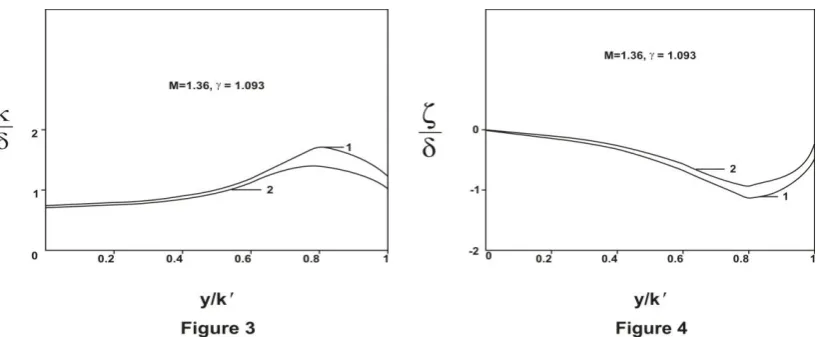
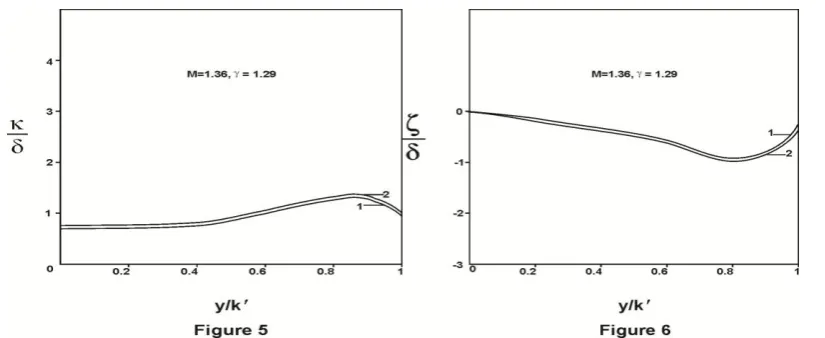
The calculations have been carried out for the combinations M=1.36,
5
/
3
,
M=1.36,
1
.
093
,
it is negative, the motion of the particles are moving anticlockwise. The vorticity of the particle increases from the wall and assumes maximum velocity, then decreases and assumes the value zero at
y
/
k
1
i.e., at the point of intersection of Mach circle and shock beyond which the flow is uniform (refer Fig. 2, 4, 6). Physically the results are consistent.We have experimental and theoretical results available for M=1.5 and
15
ofrom reference [12] for the curvature of diffracted shock. The theoretical and experimental results tally. These results appear in Figure 3 of the paper. As the vorticity results are derived from curvature results one may possibly expect that the theoretical results may be in agreement with experimental results (not available at present) in the case of vorticity as well.Figure 1: Curvature of the diffracted shock (Curve 1-Srivastava Reference (5), Curve 2-Sakurai
and Takayama’s Theory)
Figure 2: Vorticity distribution over the diffracted shock (Curve 1-Srivastava Reference (6),
Curve 2-Sakurai and Takayama’s Theory)
Figure 3: Curvature of the diffracted shock (
Curve 1-Lighthill’s Theory, Curve 2-Sakurai and
Takayama’s Theory)
Figure-5: Curvature of the diffracted shock
( Curve1- Lighthill’s Theory,Curve 2- Sakurai and
Takayama’s Theory.
Figure 6: Vorticity distribution over the diffracted shock (
Curve 1- Lighthill’s Theory, Curve 2-
Sakurai and Takayama’s Theory)
IV. MACH REFLECTION
In this section we now present new results for Mach Reflection. If
is the triple point angle and
is the angle of concave bend then following Sandeman [13] and Sandeman et al [14], Sakurai and Takayama [3] for larger bends represented geometrically the relation:
k
M
k
r
1 2 2
tan
(8)In Lighthill’s theory [1] for concave bends we obtain the relation as:
k
M
k
1 2
1
tan
(9)
versus from equation (8) and (9) have been plotted in Fig. 7 for M1=1.36 and
5
/
3
In Fig. 8this has been carried out for M=1.36,
1
.
093
.
Further in Fig. 9 this has been worked out for M=1.36,.
29
.
1
In each of the cases Lighthill’s theory [1] gives lower
than Sakurai and Takayama’s theory [3] for different values of .Figure-7, 8, 9: Graph of
versus
for M=1.36 and
respectively Curve 1-
Lighthill, Curve 2-Sakurai and Takayama)
V.
CONCLUSION
This paper gives a new idea by connecting curvature of the shock wave with the vorticity distribution of a particle over the diffracted shock and will be useful for further research on this subject. The importance of this subject has been illustrated in several references given in the paper. The results obtained from the new theory can possibly be applicable in noise reduction.
REFERENCES
[1]. Lighthill, M.J., The diffraction of blast 1. Proc. R. Soc. A, 198, 454-470 (1949).
[2]. Srivastava, R.S., A note on the vorticity distribution over a normal diffracted shock. In Liang S.M. (ed) Proc. of the fifth International Workshop on Shock Waves/Vortex Interaction, pp 136-138, Kaohsiung Grand Hotel, Kaohsiung, Taiwan, (2003).
[3]. Sakurai A. and Takayama F., Analytical solution of a flow field for weak Mach reflection over a plane surface Shock waves. Vol.14, 225-230 (2005).
[4]. Srivastava, R.S. On the vorticity distribution over a normal diffracted shock both for small and large bends. Shock Waves Vol 23, Issue 5, 525-528(2013)
[5]. Srivastava, R.S. Diffraction of a plane Straight Shock Wave British Aeronautical Research Council C.P. No. 603 (1963).
[6]. Srivastava, R.S. Diffraction of normal shock for monoatomic gases. Shock Waves 21, 29-33 (2011). [7]. Srivastava, R.S. Interaction of Shock Waves Kluwer, Dordrecht (1994).
[8]. Skews B.W. The shape of a diffracting shock wave J. Fluid Mec 29, 297-304, 1967.
[9]. Skews B. W. The perturbed region behind a diffracting shock wave J. Fluid Mech 29, 705-719, 1967. [10]. Takayama K., Inoue O. Shock wave diffraction over a 90 degree sharp corner, Shock waves, 1,301-312,
1991.
[12]. Sasoh, A., Takayama, K., and Saito, T. A weak shock wave reflection over wedges Shock Waves 2, 277-281 (1992).
[13]. Sandeman, R.J. A simple physical theory of weak Mach reflection over plane surfaces Shock Waves 10, 103-112 (2000).