Vector boson tagged jets and jet substructure
IvanVitev1,
1Los Alamos National Laboratory, Theoretical Division, Mail Stop B283
Los Alamos, NM 87545, USA
Abstract.In these proceedings, we report on recent results related to vector boson-tagged jet production in heavy ion collisions and the related modification of jet substructure, such as jet shapes and jet momentum sharing distributions. Z0-tagging andγ-tagging of jets provides new opportunities to study parton shower formation and propagation in the quark-gluon plasma and has been argued to provide tight constrains on the energy loss of reconstructed jets. We present theoretical predictions for isolated photon-tagged and electroweak boson-tagged jet production in Pb+Pb collisions at √sNN = 5.02 TeV at
the LHC, addressing the modification of their transverse momentum and transverse mo-mentum imbalance distributions. Comparison to recent ATLAS and CMS experimental measurements is performed that can shed light on the medium-induced radiative correc-tions and energy dissipation due to collisional processes of predominantly quark-initiated jets. The modification of parton splitting functions in the QGP further implies that the substructure of jets in heavy ion collisions may differ significantly from the correspond-ing substructure in proton-proton collisions. Two such observables and the implication of tagging on their evaluation is also discussed.
1 Introduction
In ultrarelativistic collisions of heavy nuclei a new deconfined state of matter, the quark-gluon plasma (QGP), is expected to be formed. The attenuation of the production rate of high transverse momentum particles in nucleus-nucleus (A+A) relative to the binary collision-scaled proton-proton (p+p) reac-tions has been proposed a long time ago as a signature of its formation [1]. The quenching of hadrons opposite a direct photon was studied [2] shortly after – a precursor of the modern tagged reconstructed jet observables [3, 4]. The production of a vector boson in association with jets is a powerful channel to probe the fundamental properties of Quantum Chromodynamics (QCD). Vector boson-tagged jets are also very well suited to studying the effects of the QGP. The tagging bosons escape the region of the hot dense medium unaffected and can be used to constrain the energy of the away-side parton shower. Previous studies of vector boson tagged jet production in heavy ion collisions have been performed in the framework of perturbative QCD [5, 6]. A Boltzmann transport model [7], an event generator JEWEL [8] and a hybrid strong/weak coupling model [9] have also been used. On the ex-perimental side, isolatedγ-tagged andZ0-tagged jets results in Pb+Pb collisions at √s
NN =5.02 TeV
have become available at the LHC from the ATLAS and CMS collaborations [10–12]. These new measurements call for improved theoretical calculations [13] to interpret the experimental data.
Vector-boson tagged jet cross section modification cannot be understood in isolation. The emer-gence of in-medium parton branching, qualitatively different from the one which determines the jet properties ine++e−,e−+p, andp+pcollisions, also implies non-trivial modification of jet substruc-ture observables. These include jet shapes, jet fragmentation functions and jet momentum sharing distributions. In these proceedings we also report on calculation of two of the above [14, 15] in a theoretical framework that uses the same fundamental input – the in-medium splitting functions.
2 Vector boson tagged jets
Let us now turn to the new theoretical results on V+jet modification at the LHC.
2.1 Proton collisions
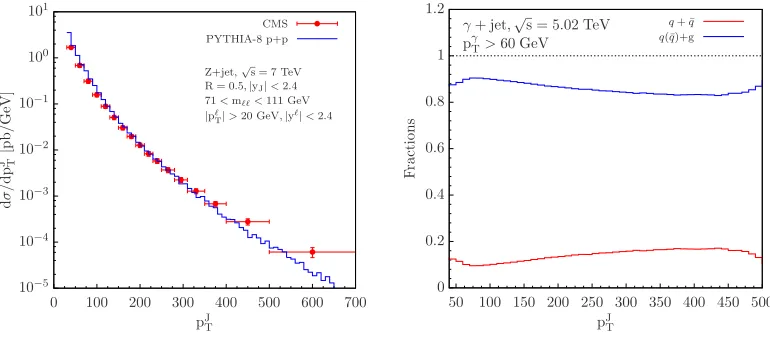
Before we proceed to heavy ion collisions, it is important to validate the perturbative calculations in the simpler proton-proton reactions. We use Pythia 8 [16], which is a popular high energy phe-nomenology event generator. It utilizes leading-order perturbative QCD matrix elements+parton shower, combined with the Lund string model for hadronization an can can describe well the main properties of a p+p event structure. This is shown in the left panel of figure 1 in comparison toZ0+jet measurements made by the CMS collaboration at √s =7 TeV [17]. We also find good agreement withγ-tagged jet measurements, see [18].
10−5
10−4
10−3
10−2
10−1
100
101
0 100 200 300 400 500 600 700
Z+jet,√s = 7 TeV
R = 0.5,|yJ|<2.4
71<mℓℓ<111 GeV
|pℓ
T|>20 GeV,|yℓ|<2.4
d
σ/
dp
J T
[p
b
/
G
eV
]
pJ T
CMS PYTHIA-8 p+p
0 0.2 0.4 0.6 0.8 1 1.2
50 100 150 200 250 300 350 400 450 500
γ+ jet,√s = 5.02 TeV pγT>60 GeV
F
rac
ti
on
s
pJ T
q+ ¯q q(¯q)+g
Figure 1. Left panel: Pythia 8 simulations are compared to CMS measurements ofZ0+jet production in p+p collisions at the LHC at √s = 7 TeV. Results are shown differentially versus the jet pJT. Right panel: the fractional contributions of different subprocesses to isolated-γ+jet production cross sections in p+p collisions at
√s
=5.02.
At leading order two dominant channel for V+jet are implemented in Pythia, namelyq+q¯→V+g
andq(¯q)+g→V+q(¯q). We have checked that theg+g→V+gchannel contribution to the cross
section is negligible. The utility of vector boson tagging beyond constraining the recoil jet energy is that it can be used for flavor selection. We have shown this in the right panel of figure 1 on the example of photon-tagged jets at √s =5.1 TeV. Results indicate thatγtagging orZ0 tagging preferentially
selects quark jets and at highpT the sample has∼80% purity. The accumulated statistics allows us
to use the fully differentialdσ/dpV
Vector-boson tagged jet cross section modification cannot be understood in isolation. The emer-gence of in-medium parton branching, qualitatively different from the one which determines the jet properties ine++e−,e−+p, andp+pcollisions, also implies non-trivial modification of jet substruc-ture observables. These include jet shapes, jet fragmentation functions and jet momentum sharing distributions. In these proceedings we also report on calculation of two of the above [14, 15] in a theoretical framework that uses the same fundamental input – the in-medium splitting functions.
2 Vector boson tagged jets
Let us now turn to the new theoretical results on V+jet modification at the LHC.
2.1 Proton collisions
Before we proceed to heavy ion collisions, it is important to validate the perturbative calculations in the simpler proton-proton reactions. We use Pythia 8 [16], which is a popular high energy phe-nomenology event generator. It utilizes leading-order perturbative QCD matrix elements+parton shower, combined with the Lund string model for hadronization an can can describe well the main properties of a p+p event structure. This is shown in the left panel of figure 1 in comparison toZ0+jet measurements made by the CMS collaboration at √s = 7 TeV [17]. We also find good agreement withγ-tagged jet measurements, see [18].
10−5
10−4
10−3
10−2
10−1
100
101
0 100 200 300 400 500 600 700
Z+jet,√s = 7 TeV
R = 0.5,|yJ|<2.4
71<mℓℓ<111 GeV
|pℓ
T|>20 GeV,|yℓ|<2.4
d σ/ dp J T [p b / G eV ] pJ T CMS PYTHIA-8 p+p 0 0.2 0.4 0.6 0.8 1 1.2
50 100 150 200 250 300 350 400 450 500
γ+ jet,√s = 5.02 TeV pγT>60 GeV
F rac ti on s pJ T
q+ ¯q q(¯q)+g
Figure 1. Left panel: Pythia 8 simulations are compared to CMS measurements ofZ0+jet production in p+p collisions at the LHC at √s = 7 TeV. Results are shown differentially versus the jetpTJ. Right panel: the fractional contributions of different subprocesses to isolated-γ+jet production cross sections in p+p collisions at
√s
=5.02.
At leading order two dominant channel for V+jet are implemented in Pythia, namelyq+q¯→V+g
andq(¯q)+g→V+q(¯q). We have checked that theg+g→V+gchannel contribution to the cross
section is negligible. The utility of vector boson tagging beyond constraining the recoil jet energy is that it can be used for flavor selection. We have shown this in the right panel of figure 1 on the example of photon-tagged jets at √s =5.1 TeV. Results indicate thatγtagging orZ0tagging preferentially
selects quark jets and at highpT the sample has∼80% purity. The accumulated statistics allows us
to use the fully differentialdσ/dpV
TdpTJ to high transverse momenta of the jet and the vector boson.
2.2 Heavy ion collisions collisions
0 0.2 0.4 0.6 0.8 1 1.2 1.4 1.6 1.8
0 0.5 1 1.5 2
γ+ jet
√
s = 5.02 TeV
0−10%
1 σγ
d σJ γ dx J γ
xJγ
ATLAS p+p prel.
ATLAS Pb+Pb prel. 0−10%
PYTHIA-8 p+p Rad. and Coll. E-loss g=2.0 Rad. and Coll. E-loss g=2.2
0 0.2 0.4 0.6 0.8 1 1.2 1.4 1.6 1.8
0 0.5 1 1.5 2
γ+ jet
√
s = 5.02 TeV
0−10%
1 σγ
d σJ γ dx J γ
xJγ
CMS p+p prel.
CMS Pb+Pb prel. 0−10%
PYTHIA-8 p+p Rad. and Coll. E-loss g=2.0 Rad. and Coll. E-loss g=2.2
Figure 2.Left panel: The isolated photon-tagged jet asymmetry distributions are shown and compared to ATLAS data in central Pb+Pb collisions at the LHC [12]. The transverse momenta for the isolated photon and the jet are pγ
T >60 GeV andpTJ >30 GeV, respectively. The jet radius parameter isR=0.4. Right panel: same comparison
but for CMS data [11] with jet radiusR=0.3.
We start from the baseline p+p cross sections obtained from Pythia. However, in heavy ion col-lisions we take into account the reaction geometry, the hydrodynamic expansion of the QGP and radiative and collisional energy losses. At an impact parameter|b⊥|we evaluate the cross sections as
dσAA(|b⊥|) dpV
TdpTJ
=
d2s⊥T
A
s⊥−b⊥2
TA
s⊥+b⊥
2 q,g
1
0 d
Pq,g(;s⊥,|b⊥|) 1−floss
q,g(R;s⊥,|b⊥|)
×dσ
NN q,g
pV
T,pJT/{1−fqloss,g (R;s⊥,|b⊥|)}
dpJ TdpVT
. (1)
Here hard production follows the binary collision density∝ TA(s⊥−b⊥/2)TA(s⊥+b⊥/2) and we
use an optical Glauber model with inelastic nucleon-nucleon scattering cross sectionsσin = 70 mb at √sNN =5.02 TeV. In equation 1Pq,g() is the probability that a fractionof the parent parton is redistributed through medium-induced multiple gluon emission. We employ the soft gluon emission limit of the of the SCETG[19, 20] splitting functions [21, 22] used to predict inclusive light hadron attenuation in heavy ion collisions [23, 24]. We note that the spectrum coincides with the original energy loss derivation of [25]. Of course, only the fraction of the energy that is redistributed outside of the jet cone leads to jet cross section suppression. We evaluate this fraction as follows
floss
q,g (R; rad+coll)=1−
R
0 dr
E
ωmin
dωdN
g
q,g(ω,r) dωdr
Rmax
0 dr
E
0 dω dNg
q,g(ω,r) dωdr
. (2)
gluons
∆Ecoll
q,g(tot.)=
Ntot.partons
q,g
i=1
∞
zi
d∆Ecoll
i
d∆z d∆z, ∆Ecollq,g(tot.)=
ωmin
0 dω
Rmax
0 drω dNg
q,g(ω,r) dωdr . (3)
To lowest leading order in perturbative QCD, the transverse momentum of the vector boson is balanced by the transverse momentum of the jet,pV
T = pJT. Higher order processes and the
develop-ment of parton showers introduce deviations from this equality. The exact differential distribution of dσ/dpV
TdpTJ is also affected by the jet reconstruction algorithm, jet radius choice, experimental cuts,
and detector resolution. Nevertheless, the quenching and shift of this distribution to smaller values of pJ
T are currently the best proxies for jet energy loss. To study these effects one introduces the
trans-verse momentum imbalance xJV =pJT/pVT. distribution can be obtained from the double differential distribution of V+jet cross section
dσ
dxJV = pJ,max
T
pJ,min
T dpJ
T
pJ T
x2 JV
dσ(pV
T =pTJ/xJV,pTJ)
dpV TdpJT
, (4)
wherepJ,min
T andpTJ,maxare matched to the desired cuts of the experimental measurements.
In figure 2 we plot the normalized momentum imbalance distributions for theγ+jet final state in p+p and Pb+Pb collisions at the LHC. Comparison of the calculations to the ATLAS measure-ments [12] are shown in the left panel. Comparison of the calculations to the CMS measuremeasure-ments [11] are shown in the right panel. The black dashed histogram shows Pythia 8 simulations for the the xJZdistribution in p+p collisions. The black solid points represent the ATLAS and CMS results in the elementary nucleon-nucleon collisions. It can be seen that the xJZ distribution from Pythia 8 simulation is narrower than the one measured by the experiments. Part of the reason is that ex-perimental measurements are not unfolded for detector resolution effects. This can be seen on the example ofZ0+jet momentum imbalance by CMS in Ref. for the p+p reference [10]. We applied the same smearing functions that experiment applies to Monte Carlo simulations, to our differential pT distributions for p+p and Pb+Pb collisions. We got broader xJZdistributions and better agreement between the curves to the data points in both p+p and Pb+Pb collisions. In figure 2 we also give results of our theoretical calculations in Pb+Pb collisions. The green and magenta histograms corre-spond to jet-medium coupling strengthsg =2.0 andg =2.2, respectively, values that have worked
well in describing the light inclusive hadron [23, 24] and jet suppression data [18] at the LHC. Our results include both medium-induced radiative energy loss and the parton showers energy dissipation of through collisional processes in the QGP. We see the downshift of xJV, which quantitatively agrees with measurements in terms of the difference between p+p and Pb+Pb collisions.
Another often studied observable sensitive to nuclear modification effects in V+jet systems is IAA. It is defined as ratio of the differential cross section for tagged jets in A+A collisions to the binary collision scaled p+p result. We present IAA in isolated γ+jet production at the LHC in 0−30% Pb+Pb collisions in figure 3. By comparing to CMS experimental data, we find that our theoretical results agree with data for a wide kinematic range. In eachpγ
Twindow, the jet energy loss effects are
shown in four cases and coded with different colors - two different jet-medium coupling strengths and simulations where collisional energy loss effects are either included or excluded. Figure 3 illustrates that there is kinematic sensitivity of IAA and the largest suppression is observed along the diagonal region of the transverse momenta of the triggerγand the recoil jet. The reason for this behavior in
pγ
T ≈pTJ arises from the steeper falling cross section in that region. The cross section is suppressed in
the regionpJ
T >pγTand is. enhanced forpJT <pγT. This is characteristic of in-medium tagged-jets as
gluons
∆Ecoll
q,g(tot.)=
Ntot.partons
q,g i=1 ∞ zi d∆Ecoll i
d∆z d∆z, ∆Eqcoll,g(tot.)=
ωmin
0 dω
Rmax
0 drω dNg
q,g(ω,r) dωdr . (3)
To lowest leading order in perturbative QCD, the transverse momentum of the vector boson is balanced by the transverse momentum of the jet,pV
T =pJT. Higher order processes and the
develop-ment of parton showers introduce deviations from this equality. The exact differential distribution of dσ/dpV
TdpTJ is also affected by the jet reconstruction algorithm, jet radius choice, experimental cuts,
and detector resolution. Nevertheless, the quenching and shift of this distribution to smaller values of pJ
T are currently the best proxies for jet energy loss. To study these effects one introduces the
trans-verse momentum imbalance xJV =pJT/pVT. distribution can be obtained from the double differential distribution of V+jet cross section
dσ
dxJV = pJ,max
T
pJ,min
T dpJ T pJ T x2 JV
dσ(pV
T =pTJ/xJV,pTJ)
dpV TdpJT
, (4)
wherepJ,min
T andpTJ,maxare matched to the desired cuts of the experimental measurements.
In figure 2 we plot the normalized momentum imbalance distributions for theγ+jet final state in p+p and Pb+Pb collisions at the LHC. Comparison of the calculations to the ATLAS measure-ments [12] are shown in the left panel. Comparison of the calculations to the CMS measuremeasure-ments [11] are shown in the right panel. The black dashed histogram shows Pythia 8 simulations for the the xJZdistribution in p+p collisions. The black solid points represent the ATLAS and CMS results in the elementary nucleon-nucleon collisions. It can be seen that the xJZ distribution from Pythia 8 simulation is narrower than the one measured by the experiments. Part of the reason is that ex-perimental measurements are not unfolded for detector resolution effects. This can be seen on the example ofZ0+jet momentum imbalance by CMS in Ref. for the p+p reference [10]. We applied the same smearing functions that experiment applies to Monte Carlo simulations, to our differential pT distributions for p+p and Pb+Pb collisions. We got broader xJZdistributions and better agreement between the curves to the data points in both p+p and Pb+Pb collisions. In figure 2 we also give results of our theoretical calculations in Pb+Pb collisions. The green and magenta histograms corre-spond to jet-medium coupling strengthsg =2.0 andg =2.2, respectively, values that have worked
well in describing the light inclusive hadron [23, 24] and jet suppression data [18] at the LHC. Our results include both medium-induced radiative energy loss and the parton showers energy dissipation of through collisional processes in the QGP. We see the downshift of xJV, which quantitatively agrees with measurements in terms of the difference between p+p and Pb+Pb collisions.
Another often studied observable sensitive to nuclear modification effects in V+jet systems is IAA. It is defined as ratio of the differential cross section for tagged jets in A+A collisions to the binary collision scaled p+p result. We present IAA in isolated γ+jet production at the LHC in 0−30% Pb+Pb collisions in figure 3. By comparing to CMS experimental data, we find that our theoretical results agree with data for a wide kinematic range. In eachpγ
T window, the jet energy loss effects are
shown in four cases and coded with different colors - two different jet-medium coupling strengths and simulations where collisional energy loss effects are either included or excluded. Figure 3 illustrates that there is kinematic sensitivity of IAA and the largest suppression is observed along the diagonal region of the transverse momenta of the triggerγand the recoil jet. The reason for this behavior in
pγ
T ≈pTJ arises from the steeper falling cross section in that region. The cross section is suppressed in
the regionpJ
T >pγT and is. enhanced forpJT < pγT. This is characteristic of in-medium tagged-jets as
discussed in previous works [5, 6].
0 0.5 1 1.5 2
50 100 150 200 250
γ+ jet,√s = 5.02 TeV R = 0.3,|yJ|<1.6,|yγ|<1.44
40<pγ T<50 GeV
50 100 150 200 250 50<pγ
T<60 GeV
50 100 150 200 250 60<pγ
T<80 GeV
50 100 150 200 250 80<pγ
T<100 GeV
IAA
pJ T(GeV) CMS prel. 0-30%
pJ T(GeV) Rad. E-loss g=2.0 Rad. and Coll. E-loss g=2.0 Rad. E-loss g=2.2 Rad. and Coll. E-loss g=2.2
pJ
T(GeV) pJT(GeV)
Figure 3. Theoretical results for IAAcompared to CMS data with several different transverse momentum cuts. Shown are four different scenarios for energy loss effects with and without collisional energy loss and with couplings between the jet and the mediumg=2.0 andg=2.2
Table 1.Theoretical predictions for the difference of the average xJZbetween p+p and Pb+Pb 0−30% central collisions. The center of mass energy is chosen to be√s=5.02 TeV, the transverse momentum cut for the
recoil jet ispJ
T>30 GeV, and data is from CMS [10].
∆xJZ pZ
T(GeV) 40−50 50−60 60−80 80−120
CMS [10] 0.061±0.059 0.123±0.051 0.124±0.052 0.068±0.042
Rad.+Coll.g=2.0 0.022 0.050 0.075 0.086
Rad.+Coll.g=2.2 0.024 0.058 0.093 0.119
To better quantify the shift toward smaller values of the xJVdistribution, we introduce the mean value of xJVand the difference between proton and heavy ion collisions
xJV=
dxJVxJVdxJVdσ dxJVdxJVdσ
, ∆xJV=xJVpp− xJVPbPb. (5)
The calculated downshifts of the xJVdistribution is consistent with the experimental data [10] within the measurement uncertainties for differentpZT cuts. More importantly, when the downshift is recast into energy loss of the jet recoiling against theZ0boson, we find that this experimentally determined jet energy loss corresponds within 15% accuracy to the theoretically computed energy redistributed out of the jet cone due to in-medium interactions of the parton shower
3 Jet substructure
We now turn to the question of jet substructure in heavy ion collisions.
3.1 Momentum sharing distributions
Cambridge/Aachen algorithm and goe through the branching history, dropping the soft branch until
zcut <min(pT1,pT2)/(pT1+pT2) ≡zg. One can also demand that the angular separation between the
two branches is greater than an angular scale∆,∆<∆R12 ≡rg. By selecting the groomed jet radius rg, one gains access to the momentum sharing distribution p(zg) at different splitting angles, and can study the angular distributionρzg. We evaluate
pi(zg)=
kR
k∆ dk⊥Pi(zg,k⊥) 1/2
zcut dx kR
k∆ dk⊥Pi(x,k⊥)
where k∆=ωx(1−x) tan
∆
2, kR=ωx(1−x) tan
R
2. (6)
The symmetrized splitting functions arePi(x,k⊥) =j,l
Pi→j,l(x,k⊥)+Pi→j,l(1−x,k⊥)
and in the presence of a QGP,Pi→jl(x,k⊥)=Pvi→acjl(x,k⊥)+Pimed→jl(x,k⊥). The medium-induced component were calculated using soft-collinear effective theory with Glauber gluon interactions (SCETG) [19–22].
Analytic and numerical considerations show that forx<1/2 in Eq. (6) medium-induced compo-nent goes as 1/x2 [21]. We thus expect that the momentum sharing distribution will be enhanced at
smallzgand suppressed nearzg=1/2. Numerical results [15] are shown in the left panel of figure 4
and compared to preliminary CMS data. The parameters for the groomed soft-dropped jets areβ=0,
zcut =0.1 and∆R12 >0.1. We estimate the theoretical uncertainty by varying the jet-medium cou-plingg=2.0±0.2. Analogous calculations in the soft gluon emission limit have also been presented
[28, 29]. The finalized CMS data [30] changed significantly and is now in excellent agreement with the theoretical predictions of [15]. This signifies the need for reliable pQCD theory to interpret heavy ion data and motivates further studies, such as the groomed jet radius distribution. The anticipated modification is shown in the right panel of figure 4 for several different pT bins. The peak of this distribution reflects the medium enhancement of large-angle splitting for hard branching processes.
zg
RAA(zg) RAA(rg)
rg
Figure 4. Left panel: theoretical calculations compared to preliminary CMS data for the ratio of momentum sharing distributions of inclusive anti-kTR=0.4 jets in central Pb+Pb and p+p collisions at √sNN=5.02 TeV. Purple and red bands correspond to calculations with and without the implementation of collisional energy loss. Right panel: the groomed jet radius modification of inclusive jets in proton-proton and central lead-lead collisions at√sNN=5.02 TeV. We show results for fourpTbins with 60 GeV<pT <80 GeV , 100 GeV<pT<120 GeV,
140 GeV<pT <160 GeV and 250 GeV<pT<300 GeV.
3.2 Jet shapes
Cambridge/Aachen algorithm and goe through the branching history, dropping the soft branch until
zcut <min(pT1,pT2)/(pT1+pT2) ≡zg. One can also demand that the angular separation between the
two branches is greater than an angular scale∆,∆<∆R12 ≡rg. By selecting the groomed jet radius rg, one gains access to the momentum sharing distribution p(zg) at different splitting angles, and can study the angular distributionρzg. We evaluate
pi(zg)=
kR
k∆ dk⊥Pi(zg,k⊥) 1/2
zcut dx kR
k∆ dk⊥Pi(x,k⊥)
where k∆=ωx(1−x) tan
∆
2, kR=ωx(1−x) tan
R
2. (6)
The symmetrized splitting functions arePi(x,k⊥)=j,l
Pi→j,l(x,k⊥)+Pi→j,l(1−x,k⊥)
and in the presence of a QGP,Pi→jl(x,k⊥)=Pvi→acjl(x,k⊥)+Pimed→jl(x,k⊥). The medium-induced component were calculated using soft-collinear effective theory with Glauber gluon interactions (SCETG) [19–22].
Analytic and numerical considerations show that forx<1/2 in Eq. (6) medium-induced compo-nent goes as 1/x2 [21]. We thus expect that the momentum sharing distribution will be enhanced at
smallzgand suppressed nearzg=1/2. Numerical results [15] are shown in the left panel of figure 4
and compared to preliminary CMS data. The parameters for the groomed soft-dropped jets areβ=0,
zcut =0.1 and∆R12 > 0.1. We estimate the theoretical uncertainty by varying the jet-medium cou-plingg=2.0±0.2. Analogous calculations in the soft gluon emission limit have also been presented
[28, 29]. The finalized CMS data [30] changed significantly and is now in excellent agreement with the theoretical predictions of [15]. This signifies the need for reliable pQCD theory to interpret heavy ion data and motivates further studies, such as the groomed jet radius distribution. The anticipated modification is shown in the right panel of figure 4 for several different pT bins. The peak of this distribution reflects the medium enhancement of large-angle splitting for hard branching processes.
zg
RAA(zg) RAA(rg)
rg
Figure 4. Left panel: theoretical calculations compared to preliminary CMS data for the ratio of momentum sharing distributions of inclusive anti-kT R=0.4 jets in central Pb+Pb and p+p collisions at √sNN=5.02 TeV. Purple and red bands correspond to calculations with and without the implementation of collisional energy loss. Right panel: the groomed jet radius modification of inclusive jets in proton-proton and central lead-lead collisions at√sNN=5.02 TeV. We show results for fourpTbins with 60 GeV<pT<80 GeV , 100 GeV<pT<120 GeV,
140 GeV<pT <160 GeV and 250 GeV<pT<300 GeV.
3.2 Jet shapes
A complementary observable, in fact the first one that has been quantitatively studied in relation to inclusive jet modification in heavy ion collisions [31], is the jet shape. The jet shape [32] describes
the transverse energy profile inside a jet of sizeR, reconstructed using a jet algorithm. The integral jet shape, defined as the fraction of the transverse energyET of the jet within a subcone of sizer, reads
ΨJ(r)=
i,dinˆ<rEiT
i,dinˆ<REiT
, where dinˆ =
(ηi−ηjet)2+(φi−φjet)2 (7)
In heavy ion collisions, the differential jet shapeρ(r)= drdΨ(r) is more sensitive to in-medium modi-fication, which can be presented asMρ(r)=ρAA(r)/ρpp(r).
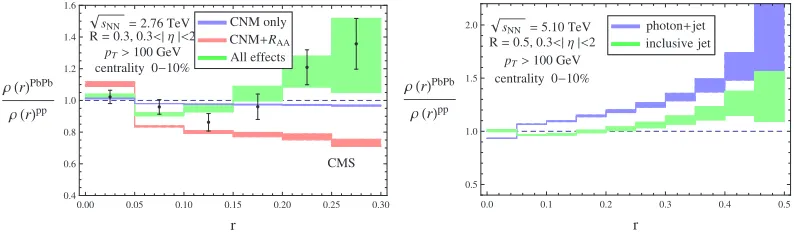
A robust theory of jets in high energy nuclear collisions should describe, within its regions of applicability, the modification of the jet shapes in addition to the attenuation of the inclusive and dijet cross sections [33]. We have taken the opportunity to address this key issue in [14], building upon an improved description ofρpp(r) [34] in the framework of SCET [35]. Our results are shown
in figure 5, where we impose cuts on the jet transverse momentum pT > 100 GeV and
pseudo-rapidity 0.3 < |η| < 2.0 of jets. We take the coupling between the jet and the QGP to be g = 2 and the theoretical uncertainty is estimated by varying the jet energy scales 1
2µjR < µ < 2µjR in the
calculations. Several contributions to the jet shape modification are shown. The blue band corresponds to the initial state cold nuclear matter effects. The effect of quenching is added in the red band, which enhances the fraction of quark jets that are narrower than the gluon jets. The green band correspond to the full calculation the green band is the full calculation and adds the event-by-event broadening. It is evident that the jet shape modification is highly nontrivial and we find that it compares well to the data from CMS [36] with jet radiusR=0.3.
We also present predictions for the modification of jet shapes in Pb+Pb collisions at √sNN ≈ 5.1 TeV, focusing on the differences between inclusive jets and tagged jets. The results are given in the right panel of figure 5. WhileMρ(r) for jet shapes at √sNN ≈5.10 TeV is similar to the one at
√s
NN = 2.76 TeV, the modification ofγ-tagged jet shapes is more pronounced. Photon-tagged jet
shapes also exhibit a different modification pattern. Since photon tagging selects primarily quark jets, see previous section, the quenching does not play a significant role and the enhancement toward the periphery of jets is more pronounced. Other examples of jet shape calculations include [37, 38].
CMS sNN �2.76 TeV
R�0.3, 0.3�Η�2 pT�100 GeV centrality 0�10�
0.00 0.05 0.10 0.15 0.20 0.25 0.30 0.4
0.6 0.8 1.0 1.2 1.4 1.6
r
ΡrPbPb
Ρrpp
All effects CNM�RAA
CNM only sNN �5.10 TeV
R�0.5, 0.3�Η�2 pT�100 GeV centrality 0�10�
0.0 0.1 0.2 0.3 0.4 0.5
0.5 1.0 1.5 2.0
r
ΡrPbPb
Ρrpp
inclusive jet photon�jet
Figure 5. Left panel: the modification of differential jet shapes of inclusive jets in Pb+Pb central collisions
4 Conclusions
To summarize, in these proceedings we reported results on vector boson-tagged jet production [13] and jet substructure [14, 15] in heavy ion collisions. We presented a new study ofγ-tagged orZ0 -tagged jets in Pb+Pb reactions at the LHC a center-of-mass energy per nucleon pair of 5.02 TeV. Good description of the mean momentum imbalance shift∆xJV and the tagged jet nuclear modi-fication factor IAAcan be achieved in a framework that accounts for the QGP-induced radiative and collisional dissipation of the parton shower energy outside of the jet cone. At the heart of such quench-ing effects for reconstructed jets is the in-medium parton branchquench-ing – qualitatively and quantitatively different from the standard Altarelli-Parisi splittings in the vacuum. New techniques, such as the study of the subjet momentum sharing distributions, have recently emerged and can probe precisely this parton dynamics. We also presented the first calculation of this subjet momentum sharing dis-tribution in heavy ion collisions. The validation of the theoretical predictions by recent experimental measurements complements our earlier results on the modification of the jet shape and corroborates the perturbative picture of parton shower modification in the medium. Finally, we found that the modification ofγ-tagged andZ0-tagged jet substructure can differ substantially from the correspond-ing substructure modification of inclusive jets. Future experimental results for such observables can significantly enhance our understanding of in-medium QCD dynamics.
References
[1] X.N. Wang, M. Gyulassy, Phys. Rev. Lett.68, 1480 (1992),hep-ph/9605213 [2] X.N. Wang, Z. Huang, I. Sarcevic, Phys. Rev. Lett.77, 231 (1996),hep-ph/9605213 [3] D.K. Srivastava, C. Gale, T.C. Awes, Phys. Rev.C67, 054904 (2003),nucl-th/0212081 [4] R.B. Neufeld, I. Vitev, B.W. Zhang, Phys. Rev.C83, 034902 (2011),1006.2389
[5] W. Dai, I. Vitev, B.W. Zhang, Phys. Rev. Lett.110, 142001 (2013),1207.5177 [6] R.B. Neufeld, I. Vitev, Phys. Rev. Lett.108, 242001 (2012),1202.5556 [7] X.N. Wang, Y. Zhu, Phys. Rev. Lett.111, 062301 (2013),1302.5874
[8] R. Kunnawalkam Elayavalli, K.C. Zapp, Eur. Phys. J.C76, 695 (2016),1608.03099
[9] J. Casalderrey-Solana, D.C. Gulhan, J.G. Milhano, D. Pablos, K. Rajagopal (2015), 1508.00815
[10] A.M. Sirunyan et al. (CMS), Phys. Rev. Lett.119, 082301 (2017),1702.01060 [11] Collaboration (CMS), Analisys note (2016)
[12] Collaboration (ATLAS), Analysis note (2016)
[13] Z.B. Kang, I. Vitev, H. Xing, Phys. Rev.C96, 014912 (2017),1702.07276 [14] Y.T. Chien, I. Vitev, JHEP05, 023 (2016),1509.07257
[15] Y.T. Chien, I. Vitev, Phys. Rev. Lett.119, 112301 (2017),1608.07283
[16] T. Sjostrand, S. Mrenna, P.Z. Skands, Comput.Phys.Commun.178, 852 (2008),0710.3820 [17] V. Khachatryan et al. (CMS), Phys. Rev.D91, 052008 (2015),1408.3104
[18] Z.B. Kang, F. Ringer, I. Vitev, Phys. Lett.B769, 242 (2017),1701.05839 [19] A. Idilbi, A. Majumder, Phys.Rev.D80, 054022 (2009),0808.1087 [20] G. Ovanesyan, I. Vitev, JHEP1106, 080 (2011),1103.1074 [21] G. Ovanesyan, I. Vitev, Phys.Lett.B706, 371 (2012),1109.5619
[22] M. Fickinger, G. Ovanesyan, I. Vitev, JHEP1307, 059 (2013),1304.3497
4 Conclusions
To summarize, in these proceedings we reported results on vector boson-tagged jet production [13] and jet substructure [14, 15] in heavy ion collisions. We presented a new study ofγ-tagged orZ0 -tagged jets in Pb+Pb reactions at the LHC a center-of-mass energy per nucleon pair of 5.02 TeV. Good description of the mean momentum imbalance shift∆xJVand the tagged jet nuclear modi-fication factor IAAcan be achieved in a framework that accounts for the QGP-induced radiative and collisional dissipation of the parton shower energy outside of the jet cone. At the heart of such quench-ing effects for reconstructed jets is the in-medium parton branchquench-ing – qualitatively and quantitatively different from the standard Altarelli-Parisi splittings in the vacuum. New techniques, such as the study of the subjet momentum sharing distributions, have recently emerged and can probe precisely this parton dynamics. We also presented the first calculation of this subjet momentum sharing dis-tribution in heavy ion collisions. The validation of the theoretical predictions by recent experimental measurements complements our earlier results on the modification of the jet shape and corroborates the perturbative picture of parton shower modification in the medium. Finally, we found that the modification ofγ-tagged andZ0-tagged jet substructure can differ substantially from the correspond-ing substructure modification of inclusive jets. Future experimental results for such observables can significantly enhance our understanding of in-medium QCD dynamics.
References
[1] X.N. Wang, M. Gyulassy, Phys. Rev. Lett.68, 1480 (1992),hep-ph/9605213 [2] X.N. Wang, Z. Huang, I. Sarcevic, Phys. Rev. Lett.77, 231 (1996),hep-ph/9605213 [3] D.K. Srivastava, C. Gale, T.C. Awes, Phys. Rev.C67, 054904 (2003),nucl-th/0212081 [4] R.B. Neufeld, I. Vitev, B.W. Zhang, Phys. Rev.C83, 034902 (2011),1006.2389
[5] W. Dai, I. Vitev, B.W. Zhang, Phys. Rev. Lett.110, 142001 (2013),1207.5177 [6] R.B. Neufeld, I. Vitev, Phys. Rev. Lett.108, 242001 (2012),1202.5556 [7] X.N. Wang, Y. Zhu, Phys. Rev. Lett.111, 062301 (2013),1302.5874
[8] R. Kunnawalkam Elayavalli, K.C. Zapp, Eur. Phys. J.C76, 695 (2016),1608.03099
[9] J. Casalderrey-Solana, D.C. Gulhan, J.G. Milhano, D. Pablos, K. Rajagopal (2015), 1508.00815
[10] A.M. Sirunyan et al. (CMS), Phys. Rev. Lett.119, 082301 (2017),1702.01060 [11] Collaboration (CMS), Analisys note (2016)
[12] Collaboration (ATLAS), Analysis note (2016)
[13] Z.B. Kang, I. Vitev, H. Xing, Phys. Rev.C96, 014912 (2017),1702.07276 [14] Y.T. Chien, I. Vitev, JHEP05, 023 (2016),1509.07257
[15] Y.T. Chien, I. Vitev, Phys. Rev. Lett.119, 112301 (2017),1608.07283
[16] T. Sjostrand, S. Mrenna, P.Z. Skands, Comput.Phys.Commun.178, 852 (2008),0710.3820 [17] V. Khachatryan et al. (CMS), Phys. Rev.D91, 052008 (2015),1408.3104
[18] Z.B. Kang, F. Ringer, I. Vitev, Phys. Lett.B769, 242 (2017),1701.05839 [19] A. Idilbi, A. Majumder, Phys.Rev.D80, 054022 (2009),0808.1087 [20] G. Ovanesyan, I. Vitev, JHEP1106, 080 (2011),1103.1074 [21] G. Ovanesyan, I. Vitev, Phys.Lett.B706, 371 (2012),1109.5619
[22] M. Fickinger, G. Ovanesyan, I. Vitev, JHEP1307, 059 (2013),1304.3497
[23] Z.B. Kang, R. Lashof-Regas, G. Ovanesyan, P. Saad, I. Vitev, Phys. Rev. Lett. 114, 092002 (2015),1405.2612
[24] Y.T. Chien, A. Emerman, Z.B. Kang, G. Ovanesyan, I. Vitev, Phys. Rev.D93, 074030 (2016), 1509.02936
[25] M. Gyulassy, P. Levai, I. Vitev, Phys. Rev. Lett.85, 5535 (2000),nucl-th/0005032 [26] A.J. Larkoski, S. Marzani, G. Soyez, J. Thaler, JHEP05, 146 (2014),1402.2657 [27] M. Dasgupta, A. Fregoso, S. Marzani, G.P. Salam, JHEP09, 029 (2013),1307.0007 [28] Y. Mehtar-Tani, K. Tywoniuk, JHEP04, 125 (2017),1610.08930
[29] N.B. Chang, S. Cao, G.Y. Qin (2017),1707.03767 [30] A.M. Sirunyan et al. (CMS) (2017),1708.09429
[31] I. Vitev, S. Wicks, B.W. Zhang, JHEP0811, 093 (2008),0810.2807
[32] S.D. Ellis, Z. Kunszt, D.E. Soper, Phys.Rev.Lett.69, 3615 (1992),hep-ph/9208249 [33] Y. He, I. Vitev, B.W. Zhang, Phys.Lett.B713, 224 (2012),1105.2566
[34] Y.T. Chien, I. Vitev, JHEP12, 061 (2014),1405.4293
[35] C.W. Bauer, S. Fleming, D. Pirjol, I.W. Stewart, Phys.Rev. D63, 114020 (2001),
hep-ph/0011336
![Figure 2. Left panel: The isolated photon-tagged jet asymmetry distributions are shown and compared to ATLASdata in central Pb+Pb collisions at the LHC [12]](https://thumb-us.123doks.com/thumbv2/123dok_us/8061381.1343599/3.482.46.438.109.284/figure-isolated-asymmetry-distributions-compared-atlasdata-central-collisions.webp)