1
A Robot's Response Acceleration using the Metric
Dimension
Problem
E. M. Badr1 and Khalid Aloufi2
1Scientific Computing Department, Faculty of Computers & Artificial Intelligence, Benha University, Benha, Egypt. [email protected]
2College of Computer Science & Engineering Taibah University Saudi Arabia [email protected]
Abstract
Consider a robot that is navigating in a space modeled by a graph, and that wants to
know its current location. It can send a signal to determine how far it is from each
landmark among a set of fixed landmarks. We study the problem of computing the
minimum required number of landmarks, and where they should be placed so that the
robot can always determine its location. Since the problem is an NP-complete
problem, the robot's responses to the actions are slow. To accelerate this response, we
can use the parallel version of this problem. In this work, we introduce a new parallel
implementation for determining the metric dimension of a given graph. We run the
proposed algorithm on a symmetric multi-processing (SMP) cluster using C
programming language and the Message Passing Interface (MPI) library. Finally, we
run our implementation on four categories of graphs (the tracks in which the robot
moves): a cycle graph Cn, a path graph Pn, a triangular snake graph k and a ladder
graph Ln. Preliminary computational results indicate that the metric dimension
problem is an NP-complete problem and prove the ability of the proposed algorithm
to achieve a speedup of 6 for 8 processors.
Keywords - Parallel Processing; MPI cluster; metric dimension; resolving set; NP-complete.
2 1. Introduction
The metric dimension of a graph has demonstrated to be useful and has many
applications such as Robotic Navigation [1], [2], Chemistry [3], [4] and
Combinatorial Search and Optimization [5].
Consider a robot that is navigating a space modeled by a graph and that wants
to know its current location. It can send a signal to determine how far it is from each
landmark among a set of fixed landmarks. We study the problem of computing the
minimum required number of landmarks and where they should be placed so that the
robot can always determine its location. The problem is an NP-complete problem [6],
which means that the robot's responses to the actions are slow. To accelerate this
response, we can use the parallel version of this problem.
For a definition of the metric dimension, let G be a connected graph and d(u, v)
be the distance between the vertices u and v. A subset of vertices W = {w1,… , wk}is
called a resolving set for G if for every two distinct vertices u, v V (G) there is a
vertex wi W such that d(u, wi) d(v, wi). The metric dimension md(G) of G is the
minimum cardinality of a resolving set for G. Harary and Melter [6] and Slater [7]
independently defined the metric dimension problem. The metric dimension problem
is known as the locating number or rigidity problem and as Harary’s problem.
There are three reasons to study this problem. First, very little is known about
the time complexity of this problem. Second, the serial implementation of this
problem takes significant time to get the final result (e.g., 994 seconds for graph G
with 20 vertices). Third, we hope to accelerate the robot's responses to the actions.
Gerey and Johnson [8] showed that finding the metric dimension of a given graph is
an NP-complete problem. Recently, Josep Diaz et al. [9] proved that the metric
dimension of planar graphs with bounded degree is NP-complete. In addition, they
introduced a polynomial-time algorithm for finding the metric dimension of
outerplanar graphs.
E. M. Badr and K. Aloufi [10] proposed an exponential algorithm for finding
the metric dimension of a given graph, which has a time complexity of O(n2 x 2n). They also introduced the results of computer calculations that found the metric
dimension of various classes of networks by using an approximate algorithm, namely,
3
for special graphs, namely, mirror graphs, square graphs, Tortoise graphs, Z-(Pn)
graphs and middle graphs.
Integer linear programming is an efficient approach for determining the metric
dimension of graphs with big orders. We can see how to formulate graph problems for
mathematical models in [12]. Chartrand et al. [13] introduced the metric dimension
problem as an integer programming problem. James Daniel Currie and Ortrud R.
Oellermann [14] proposed another efficient mathematical model as an integer
programming problem.
There are two approaches for distributing the serial code into more than one
processor. One is the row distribution scheme and the other is the column distribution
scheme. Badr et al. [15] used the row distribution scheme and presented a
well-designed, quite valuable implementation for eight loosely coupled processors
(interconnected with Fast Ethernet and the Scalable Coherent Interface (SCI)),
targeting and achieving significant speedup (up to five) when solving small random
dense linear programming problems.
Figure 1 shows how the different signals determine the robot's location.
Suppose the robot moves on the path graph (straight line) and there is a landmark
vertex (v4) that sends different signals (the distances are 3, 2, 1, and 0 between v1, v2,
v3, and v4 and the landmark vertex v4, respectively) to the robot to determine its location.
In this paper, we introduce a new parallel implementation for determining the
metric dimension of a given graph. We run the proposed algorithm on a symmetric
multi-processing (SMP) cluster using C programming language and the Message
Passing Interface (MPI) library. Finally, we run our implementation on four
categories of graphs (the tracks in which the robot moves): a cycle graph Cn, a path
graph Pn, a triangular snake graph k and a ladder graph Ln. Preliminary
computational results ensure that the metric dimension problem is an NP-complete
problem and prove the ability of the proposed algorithm to achieve a speedup of 6 for
4
2. A serial exponential algorithm for finding the metric dimension of a graph In this section, we introduce some definitions of graphs (the tracks in which
the robot moves).
Definition 1 [16]:
A triangular snake (or k -snake) is a connected graph in which all blocks are
triangles and the block-cut-point graph is a path.
Definition 2: The ladder graph Ln is defined by Ln = Pn x K2, where Pn is a path with n
vertices, x denotes the Cartesian product and K2 is a complete graph with two vertices. The main aim of this section is to introduce an algorithm that gives a metric
dimension for a given graph G. The time complexity of this algorithm is exponential
and is O(n2x2n) [10]. Recall that Gerey and Johnson [6] showed that determining the
metric dimension of an arbitrary graph is an NP-complete problem. Recently, Josep
Diaz et al. [9] proved that the metric dimension of planar graphs with bounded degree
is NP-complete. In addition, they introduced a polynomial-time algorithm for finding
the metric dimension of outerplanar graphs.
The parameters of Algorithm 1 are the following:
A[i][j]: the adjacency matrix of graph G,
S[i]: all of subsets of V(G) (power set with n vertices),
D[i][j]: the distance matrix of a graph G,
E[i][j]: the distance matrix that corresponds to the subset S[i],
Cardinality: the order of subset S[i], and
MetricDimension: the metric dimension of graph G.
The main function of the proposed algorithm (Algorithm1) includes four procedures, Floyd –Warshall, Initialization, Get-Next-Subset and Check-Subset, as follows:
Algorithm 1: A serial algorithm for finding the metric dimension of a given graph
Input: An adjacency matrix A[n][n] of an n-vertex simple connected graph G. Output: A metric dimension of G.
Begin
1: Call Procedure1 (Floyd -Warshall’s algorithm) 2: Call Procedure 2 (Initialization)
3:while Not Done do
4:Call Procedure 3 (Get-Next-Subset) 5:for i = n to 1 do
5
8: E[i][,j] D[i][,j] 9: end
10: end 11:end
12:Call Procedure 4 (Check-Subset)
13:if(E[i][:] or E[j][:])and(metric_dimension> cardinality)then 14: MetricDimension = cardinality;
15:end
16:End /* Begin
The Floyd -Warshall procedure determines the distance matrix of a graph G. It is
known that the Floyd -Warshall algorithm has the time complexity of O (n3) because it has three inner loops.
Procedure 1: Floyd -Warshall algorithm for finding the distance matrix of a graph 1: for i =1 to n do
2: for j = 1 to n do 3: A(i,j) inf; 4: A(i,i) 0; 5: end
6: end 7: D A
8: minn inf;
9: for k = 1 to n do 10: for i =1 to n do 11: for j =1 to n do 12: x D[i][j]
13: y D[i][k] + D[k][j] 14: if x < y then
15: minn x; 16: else
17: minn y; 18: end
19: D[i][j] minn; 20: end
21: end 22: end
The Initialization procedure initializes the initial subset of V(G) as array S[j] = 0 and
the distance matrix E[i][j] = 0, which corresponds to the subset S[i]. We outline the
initialization procedure that considers the empty subgraph as the first subset as
follows.
Procedure 2: Initialization 1: for i = n to 1 do 2: S[i] 0
3: for j= n to 1 do
6 5: end
6: end
7: cardinality 0
8: MetricDimension 0 9: Done false
The Get-Next-Subset procedure generates all subsets S[i] of V(G) using the binary
counting representation method.
Procedure 3: Get-Next-Subset 1: j n + 1
2: repeat
3: j j – 1
4: until (( S[j] = 0) or ( j = 0) 5: if j 0 then
6: S[j] 1
7: MAX j
8: for i = MAX +1 to n do 9: S[i] 0
10: end 11: else
12: Done True 13: end if
The Check-Subset procedure verifies whether the current subset S[i] is a resolving set
or not. A precise description of this process is the following.
Procedure 4: Check-Subset
1: for i = 1 to n-1 d
2: for j= i+1 to 1 do
3: if E[i][:] = E[j][:] then 4: break
5: end
6: end 7: if ( E[i][:] = E[j][:] ) then
8: break 9: end
10: cardinality = non-zero elements of S[i]
11: end
3. A parallel algorithm for finding the metric dimension of a graph
In this section, we introduce a new parallel algorithm that determines the metric
7
generates 2n/NPRS subsets, where NPRS is the number of processors and n is the order of graph G.
Algorithm 2: MPI Parallel algorithm for finding the metric dimension of a graph Begin
1-/* All processors read the adjacency matrix A[ ] [ ] */ for 1 ≤ i ≤ n do
for 1 ≤ j ≤ do
Read A[i][j]
end
end
2-/*All processors initialize S[] and E[] [ ]*/ for 1 ≤ i ≤ n do
Set S[i]=0 end
for 1 ≤ j ≤ n do
for 1 ≤ k ≤ n do
Set E[j][k]=0
end
end
3-/* Each processor generates q=2n/NPRS subsets */ for 0 ≤ i ≤ NPRS do
Each processor generates q subsets only. end
4-/* Each processor constructs E[][] for every S[][] */ for i = n to 1 do
for j = n to 1 do
if S[j] = 1 then
E[i][,j] = D[i][,j] end
end end
5-/* Each processor checks their subsets */ for i = n to 1 do
for j= i+1 to 1 do
if E[i][:] = E[j][:] then
break end
end
if ( E[i][:] = E[j][:] ) then
break end
local_cardinality=non-zero elements of S[][] end
6-/* Each processor determines the local metric dimension */ if (E[i][:] or E[j][:])and(metric_dimension>cardinality)then
8 end
7-/*Each processor sends local-MetricDimension to the processor 0 */ Send Local-MetricDimension to the processor 0
8-/* Proc 0 receives the Local-MetricDimension from the all */ ▪ Receive Local-MetricDimension from the all processors. ▪ Search the minimum value among Local-MetricDimension
and assign in MetricDimension.
▪ Print MetricDimension
End /* Begin
4. COMPUTATIONAL RESULTS
We run the proposed algorithm implementation on a symmetric multi-processing
(SMP) cluster using C programming language and the Message Passing Interface
(MPI) library. We run the numerical experiments on the computer cluster of the
Faculty of Science [17] at Cairo University. It is a homogeneous PC cluster that
consists of 9 nodes, including one master and eight slaves. Each slave node has an
Intel(R) core (TM)2 Duo CPU E7400 @ 2.80 GHz and 4 Gb of DDR2 RAM and the
master node has an Intel(R) core(TM)2 Quad CPU Q6700 @ 2.66 GHz and 4 Gb of
DDR2 RAM. The interconnection among the processors uses Fast Ethernet and the
Scalable Coherent Interface (SCI).
We have run our implementation on four categories of graphs (the tracks in
which the robot moves): a cycle graph Cn, a path graph Pn, a triangular snake graph
k
and ladder graph Ln.
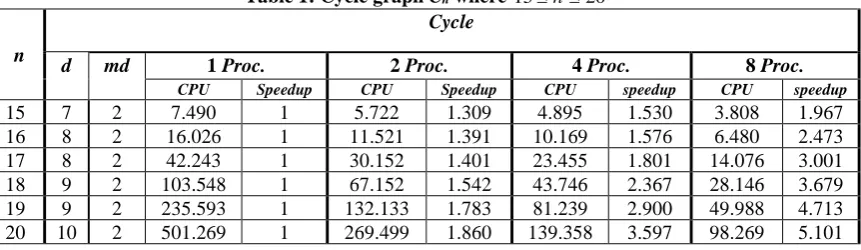
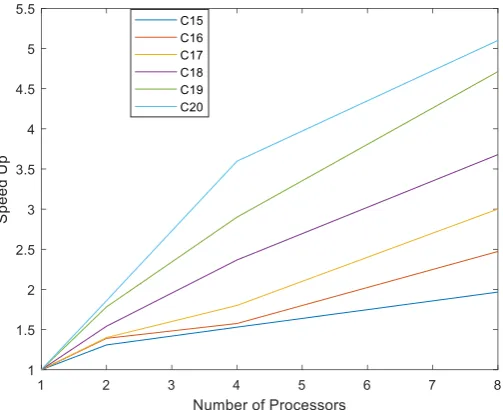
From Table 1, we note that the order of the cycle graph starts with fifteen vertices
because if we use a smaller problem size, we cannot get a good speedup because the
communication time is greater than the computation time.
First, it is understandable that for 1 CPU, since a separate source code was
developed, the communication time does not exist because the master does not send
anything to a worker. It does all the computation work on its own. It had to be done
using this pattern to get accurate results and the reason was that the same computer
architecture should be used. If the code for 1 CPU was executed on machine with a
newer CPU, the times should be quite different. As a result, this should be executed
9
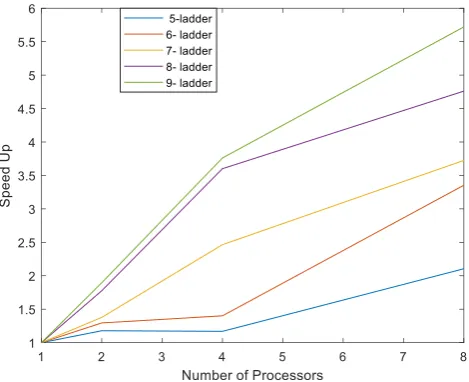
Looking at Table 4, comparing the times for 1 CPU and the times for 8 CPUs,
we can assess the time differences and how many times faster the results are with
parallelization. To be more specific, with 8 CPUs and the ladder graph with 20
vertices, we can achieve a speedup of 5.721 times (timecpu[1] / timecpu[8]).
4. Conclusion:
We introduced a new parallel implementation for determining the metric
dimension of a given graph. We run the proposed algorithm on a symmetric
multi-processing (SMP) cluster using C programming language and the Message Passing
Interface (MPI) library. Finally, we run our implementation on four categories of
graphs (the tracks in which the robot moves): a cycle graph Cn, a path graph Pn, a
triangular snake graph k and a ladder graph Ln. Preliminary computational results
indicated that the metric dimension problem is an NP-complete problem and proved
the ability of the proposed algorithm to achieve a speedup of 6 for 8 processors.
Table 1: Cycle graph Cn where 15 n 20
n
Cycle
d md 1 Proc. 2 Proc. 4 Proc. 8 Proc.
CPU Speedup CPU Speedup CPU speedup CPU speedup
15 7 2 7.490 1 5.722 1.309 4.895 1.530 3.808 1.967
16 8 2 16.026 1 11.521 1.391 10.169 1.576 6.480 2.473
17 8 2 42.243 1 30.152 1.401 23.455 1.801 14.076 3.001
18 9 2 103.548 1 67.152 1.542 43.746 2.367 28.146 3.679
19 9 2 235.593 1 132.133 1.783 81.239 2.900 49.988 4.713
20 10 2 501.269 1 269.499 1.860 139.358 3.597 98.269 5.101
Table 2: Path graph Pn where 15 n 20
n
Path
d md 1 Proc. 2 Proc. 4 Proc. 8 Proc.
CPU speedup CPU speedup CPU speedup CPU speedup
15 14 1 7.451 1 5.611 1.328 4.789 1.556 3.729 1.998
16 15 1 18.248 1 13.025 1.401 11.498 1.587 7.037 2.593
17 16 1 43.470 1 27.203 1.598 23.497 1.850 13.513 3.217
18 17 1 105.984 1 63.388 1.672 28.112 2.561 28.112 3.770
19 18 1 241.557 1 141.344 1.709 80.761 2.991 53.395 4.524
10
Table 3: k -snakes graph where 5 k 10
k
k
-snakes graph
d md 1 Proc. 2 Proc. 4 Proc. 8 Proc.
CPU speedup CPU speedup CPU speedup CPU speedup
5 5 2 0.207 1 0.1992 1.039 0.192 1.078 0.189 1.098
6 6 2 1.195 1 1.087 1.099 1.034 1.156 0.598 1.998
7 7 2 6.005 1 4.725 1.271 4.259 1.410 1.870 3.211
8 8 2 31.784 1 21.375 1.487 18.214 1.745 8.756 3.630
9 9 2 167.522 1 104.636 1.601 58.248 2.876 36.697 4.565
10 10 2 994.015 1 529.013 1.879 262.342 3.789 177.503 5.600
Table 4: Ladder graph Ln where 5 n 9
k
Ladder graph
d md 1 Proc. 2 Proc. 4 Proc. 8 Proc.
CPU speedup CPU speedup CPU speedup CPU speedup
5 6 2 0.629 1 0.534 1.178 0.538 1.169 0.299 2.105
6 7 2 3.717 1 2.870 1.295 2.653 1.401 1.082 3.354
7 8 2 19.964 1 14.488 1.378 8.099 2.465 5.359 3.725
8 9 2 107.231 1 60.378 1.776 29.778 3.601 22.523 4.761
9 10 2 651.142 1 343.429 1.896 173.130 3.761 113.816 5.721
0 1
2 3
v1 v2 v3 v4
Figure 1: how the different signals determine the robot's location
11
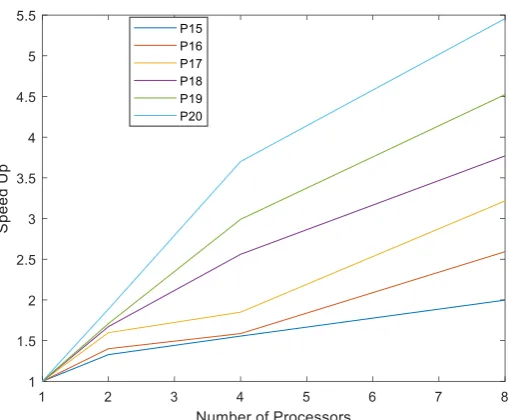
Figure 3: Algorithm 2 on a path graph with different sizes (P15, P16, P17, P18, P19, and P20)
12
Figure 5: Algorithm 2 on a ladder graph with different sizes (L5, L6, L7, L8, and L9)
References:
[1] S. Khuller, B. Raghavachari and A. Rosenfeld, Landmarks in graphs, Disc. Appl.
Math. 70 (1996) 217–229.
[2] B. Shanmukha, B. Sooryanarayana and K. S. Harinath, Metric dimension of
wheels, Far East J. Appl. Math. 8 (3) (2002) 217–229.
[3] G. Chartrand, D. Erwin, G. L. Johns and P. Zhang, Boundary vertices in graphs,
Discrete Math. 263 (2003) 25-34.
[4] C. Poisson and P. Zhang, The metric dimension of unicyclic graphs, J. Comb.
Math Comb. Comput. 40 (2002) 17–32.
[5] A. Seb¨o and E. Tannier, On metric generators of graphs, Math. Oper. Res. 29 (2)
(2004) 383–393.
[6] Harary, F., Melter, R.A.: The metric dimension of a graph. Ars Combinatoria 2,
191–195 (1976)
[7] Slater, P.: Leaves of trees. Congressus Numerantium 14, 549–559 (1975)
[8] M.R. Garey, D.S. Johnson, Computers and Intractability: A Guide to the Theory
of NP-Completeness. Freeman, 1979.
[9] Josep Diaz, Olli Pottonen, Maria Serna, and Erik Jan van Leeuwen, On the
Complexity of Metric Dimension, ESA 2012: 419-430
[10] E. M. Badr and K. Aloufi, Polynomial, Exponential and Approximate
13
[11] E. M. Badr, A. Elrokh and B. Mohamed, On the metric dimension of Some
Families of cyclic graphs, IT MUST Conference 29-30 April 2019, 6 October Giza,
Egypt.
[12] Elsayed M. Badr, Mahmoud I. Moussa (2019), An upper bound of radio k
-coloring problem and its integer linear programming model, March 2019, Wireless
Networks
[13] G. Chartrand, L. Eroha, M. Johnson and O. Oellermann, Resolvability in graphs
and the metric dimension of a graph. Discrete Applied Mathematics, 105:99-113,
2000.
[14] James Daniel Currie and Ortrud R. Oellermann, The Metric Dimension and
Metric Independence of a Graph, Journal of Combinatorial Mathematics and
Combinatorial Computing · January 2011.
[15] E.S. Badr, M. Moussa, K. Paparrizos, N. Samaras, and A. Sifaleras, Some
computational results on MPI parallel implementation of dense simplex method,
World Academy of Science, Engineering and Technology (WASET), 23, 2008,778–
781.
[16] A. Rosa (1967), Cyclic steiner Triple Systems and Labelings of Triangular
Cacti, Scientia, 5, 87-95.
[17] Sweilam NH, Moharram HM, Sameh Ahmed. On the parallel iterative finite difference algorithm for 2-D Poisson’s equation with MPI cluster. In: The 8th international conference on INFOrmatics and systems (INFOS2012), IEEE Explorer; 2012.
[18] E. S. Badr, K. Paparrizos, N. Samaras, and A. Sifaleras (2005), On the Basis
Inverse of the Exterior Point Simplex Algorithm, in Proc. of the 17th National
Conference of Hellenic Operational Research Society (HELORS), 16-18 June,
Rio, Greece, pp. 677-687.
[19] E. S. Badr, K. Paparrizos, N. Samaras, and A. Sifaleras (2005), On the Basis
Inverse of the Exterior Point Simplex Algorithm, in Proc. of the 17th National
Conference of Hellenic Operational Research Society (HELORS), 16-18 June, Rio,
Greece, pp. 677-687.
[20] E.S. Badr, K. Paparrizos, Baloukas Thanasis and G. Varkas (2006), Some
14
18th National Conference of Hellenic Operational Research Society (HELORS),