407 |
P a g e
EFFECT OF SELECTED MULTI LAYERED FABRICS
CONSTRUCTION ELEMENTS ON THERMAL
RESISTANCE OF DUVETS
Ebtehal. A-E. Mohammed
1, Ossama E. EldinHalawa
2, E.M.Abou-Taleb
31,2,3
Weaving & Knitting Dept., Faculty of Applied Arts,Helwan University, Egypt.
ABSTRACT
Multi-layered duvets fabrics are characterized by its light weight and the ability to provide warmth. There are
many types of duvets that suit different seasons and climates. The degree of warmth achieved by the duvet and
which is directly connected to the thermo physiological comfort characteristics of fabrics is rated through the
TOG (thermal overall grade).The aim of this paper was to study the fabric construction elements that affect the
overall warmth of the multilayered duvets. Accordingly, nine samples were produced for studying thermal
resistance, wherethe warp and weft yarns of all samples were made of cotton fibers. In addition, weft yarns,
used for wadded, were Polyester, Polypropylene, and Acrylic. Moreover, the ratio of the number of
waddedwefts to the number of face and back weft yarns were 33.3%, 50%, and 60%. The study showedthat the
thermal resistance is influenced by specific density and the morphology of wadded wefts.
Key Words: Comfort, Thermo Physiological Comfort, TOG, Duvet, Multi Layered Fabric
I. INTRODUCTION
Interior textiles are defined as a type of textiles used in several applications; such as tapestries, wall coverings,
tablecloths, carpets, rugs, floor coverings, upholstery fabrics, bed sheets, duvets, window blinds and curtains to
towels and mattresses.When selecting fabrics for interior application, the decision should involve not only
aesthetic aspects but also the fabric structure and composition. Principally multi layered fabrics which used for
interior textiles such as duvets and mattresses.Where multi-layered fabrics consist of different layers of the
fabrics which have the ability to complement and maximize the essential comfort properties [1].Duvets are the
most Multi-layered Fabrics using for warming due to existence a lot of materials achieved warming with light
weight.As a result of industrial development in Bedding Fabrics, there is a possibility for manufacturing Duvets
with different degrees of warming According to the climate conditions surrounding us[2].
1.1 Thermal Performance of multi layered fabrics
Thermo physiological comfort characteristics of fabrics used in the manufacturing of inner and outer layer
fabrics[3]. Manufacturers rate the performance of their duvets in tog (thermal overall grade), Tog is a unit of
thermal resistance used to measure the power of insulation of a fabric, garment, quilt, etc. Where the thermal
408 |
P a g e
and comparing this with the performance of a known material under the same conditions a measurementof thermal insulation[4]. This enables the purchaser to select a duvet appropriate to the season: the higher the tog
rating, the warmer the duvet.
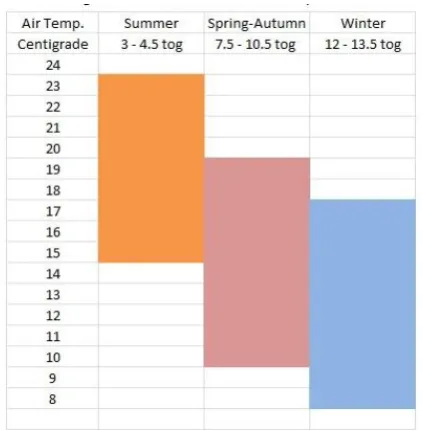
A few manufacturers have marketed combined duvet sets, one of approximately 4.5 tog and one of
approximately 9.5 tog. The light-weight one is for summer and the medium one for autumn; snapped together,
14 togs is designed for winter[2].
The tog-value of an article is equal to ten times the temperature difference between its two faces, in degrees
celsius, when the flow of heat across it is equal to one watt/ .The TOG system for describing the thermal
insulation properties of textile products originated at the Shirley Institute in the 1960’s and the Shirley Tog
meter was devised for measuring insulation values. Today the system is universally used and is particularly
familiar in connection with rating of duvets[4]
Figure (1) Tog Values of Duvets versus Temperature
1.2 Thermal Insulation Materials
Natural fibers have lower thermal conductivity than synthetic fibres in the dry state but they absorb around
8-13%moisture and such a high moisture content increase their thermal conductivity on the lower side[5].
Category of fibers which provide thermal insulation entraps as much air as possible and has low
compressibility. High resilience and high bulk. Among synthetic fibres, Polyester and Polypropylene have
thermal conductivity on the lower side. Main factors that govern thermal insulation value of fabric are the
thickness which determines the degree of insulation provided by the clothing, the construction – open
structure has lower thermal insulation due to high convective losses, and the bulk density which influences
409 |
P a g e
1.4 Experimental work
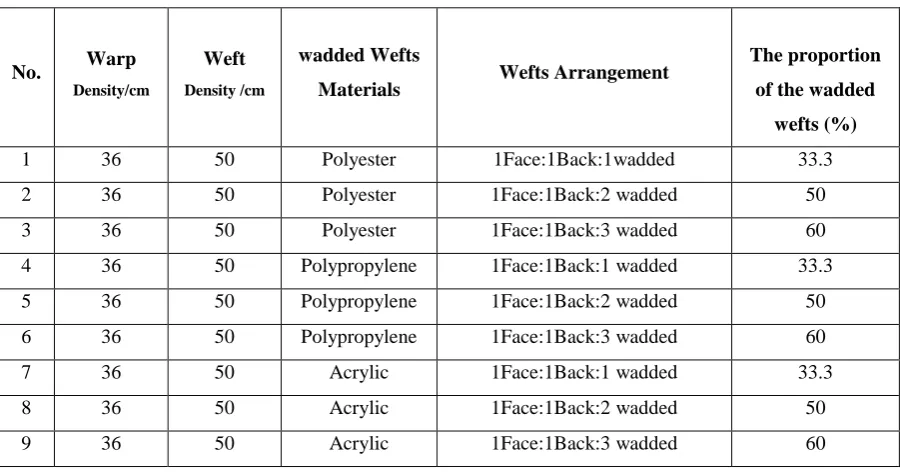
In this study 9 samples were studied for thermal insulation. The warp and weft yarns of all samples were made
of cotton fibers. In addition, weft yarns, used for wadded, were Polyester, Polypropylene, and Acrylic.
Moreover, the ratio of the number of wadded weftsto the number of face and back weft yarns were 33.3%, 50%,
and 60%. The complete specification of samples under study is tabulated in table (1).
Table (1): Samples specifications
No. Warp
Density/cm
Weft
Density /cm
wadded Wefts
Materials Wefts Arrangement
The proportion
of the wadded
wefts (%)
1 36 50 Polyester 1Face:1Back:1wadded 33.3
2 36 50 Polyester 1Face:1Back:2 wadded 50
3 36 50 Polyester 1Face:1Back:3 wadded 60
4 36 50 Polypropylene 1Face:1Back:1 wadded 33.3
5 36 50 Polypropylene 1Face:1Back:2 wadded 50
6 36 50 Polypropylene 1Face:1Back:3 wadded 60
7 36 50 Acrylic 1Face:1Back:1 wadded 33.3
8 36 50 Acrylic 1Face:1Back:2 wadded 50
9 36 50 Acrylic 1Face:1Back:3 wadded 60
II. STRUCTURES WEAVING USED
2.1 First design (Samples1, 4 and7)
The following structures are used to produce the research samples number (1, 4 and 7) whereas the arrangement
of wefts for these samples is (1 face weft: 1 back weft: 1 wadded weft), that means the proportion of the
wadding wefts is 33.3% of the produced samples wefts. Plain double weave with stitching for Face and Back
layers is used as shown in figures (2), (3) and (4) figure (5) simulation and figure (6) card design.
Figure (2): first colour
Figure (3): second colour
Figure (4): third
410 |
P a g e
Figure (5): simulation
Figure (6): card design
2.2 Second design (samples2, 5, and 8)
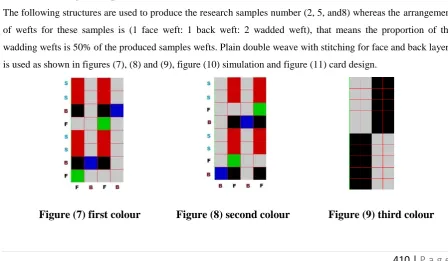
The following structures are used to produce the research samples number (2, 5, and8) whereas the arrangement
of wefts for these samples is (1 face weft: 1 back weft: 2 wadded weft), that means the proportion of the
wadding wefts is 50% of the produced samples wefts. Plain double weave with stitching for face and back layers
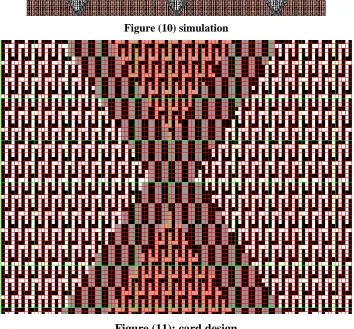
is used as shown in figures (7), (8) and (9), figure (10) simulation and figure (11) card design.
411 |
P a g e
Figure (10) simulation
Figure (11): card design
2.3 Third design (Samples3, 6, and9)
The following structures are used to produce the research samples number (3, 6, and 9) whereas the arrangement
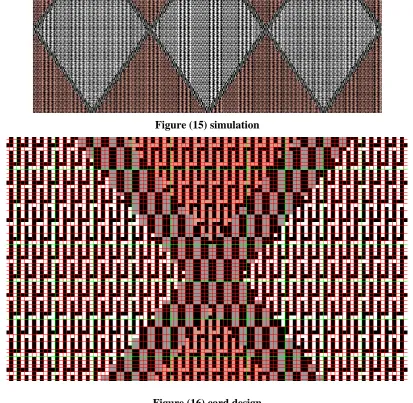
of wefts for these samples is (1 face weft: 1 back weft: 3 wadded weft), that means the proportion of the
wadding wefts is 60% of the produced samples wefts. Plain double weave with stitching for face and back layers
412 |
P a g e
Figure (12) first colour Figure (13) second colour Figure (14) third colour
Figure (15) simulation
413 |
P a g e
Samples were tested for fabric weight[8], fabric thickness[9],fabric air permeability[10], and fabric thermalresistance[11].
A permeates apparatus (skin model), was used to measure fabric thermal resistance according to
(ISO11092:2014) standard measurement of thermal and water vapour resistance.
III. RESULTS AND DISCUSSION
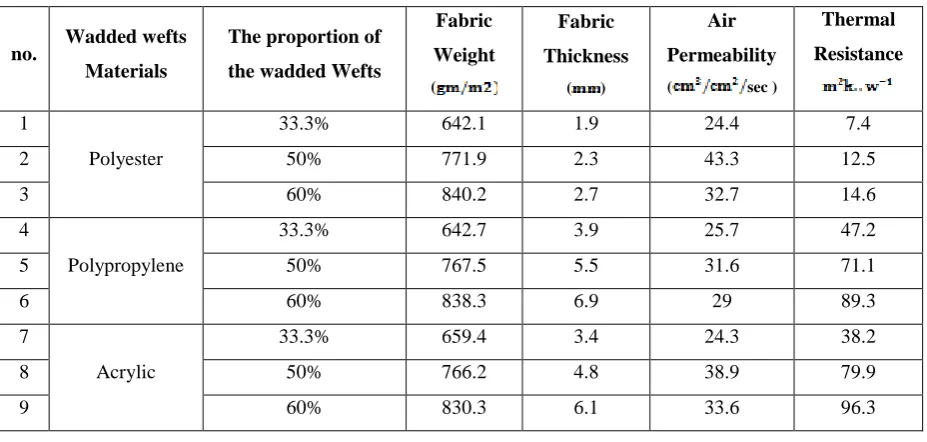
The results of tests are listed in the table (2).
Table (2) the tests results
no. Wadded wefts
Materials
The proportion of
the wadded Wefts
Fabric Weight ( Fabric Thickness ( ) Air Permeability
( sec )
Thermal
Resistance
1
Polyester
33.3% 642.1 1.9 24.4 7.4
2 50% 771.9 2.3 43.3 12.5
3 60% 840.2 2.7 32.7 14.6
4
Polypropylene
33.3% 642.7 3.9 25.7 47.2
5 50% 767.5 5.5 31.6 71.1
6 60% 838.3 6.9 29 89.3
7
Acrylic
33.3% 659.4 3.4 24.3 38.2
8 50% 766.2 4.8 38.9 79.9
9 60% 830.3 6.1 33.6 96.3
Moreover, all results were grouped according to wadded wefts materials, whereas the warp and weft materials
were cotton.
3.1 The effect of wadded wefts on fabric weight
414 |
P a g e
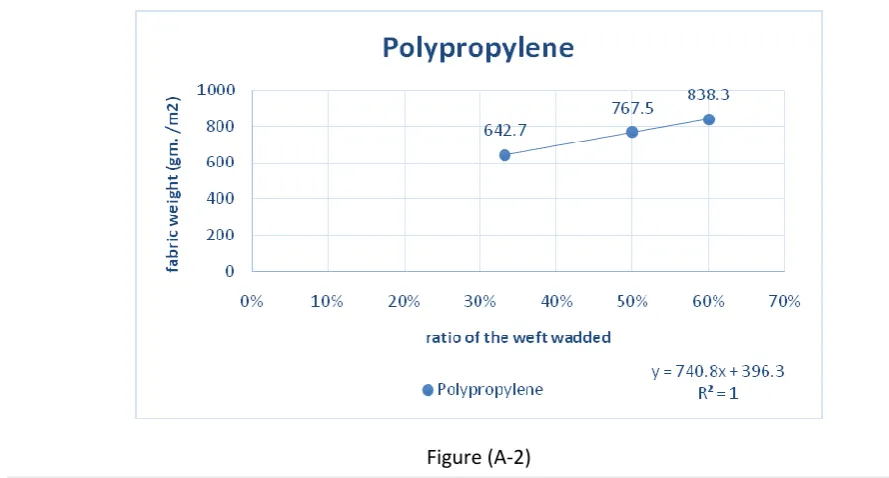
Regression equations obtained from statistical analysis of the weight test results, as shown in annexure (A), figs.(A-1), (A-2) and (A-3) showed that there was a strong correlation coefficient between wadded weft ratios and
fabric weight.
As mentioned above, and from table (2) and fig. (17). the ratio of wadded wefts (60%) recorded the highest
weight values for all materials. Moreover, there was a positive relationship between the ratio of the wadded
wefts and the fabric weight. In addition, the variance of wadded wefts materials affected sample weights. This
can be explained by the specific density (gm/ ) of tested samples which translates into a direct proportional
relation between specific density and weight as specific density = . And as Polyester fiber has a greater
specific density (1.23-1.38 gm/ ), when compared to Acrylic (1.16-1.18 gm/ and Polypropylene
(0.9-0.91 gm/ respectively, therefore Polyester scored a higher weight.
3.2 The effect of wadded wefts on fabric thickness
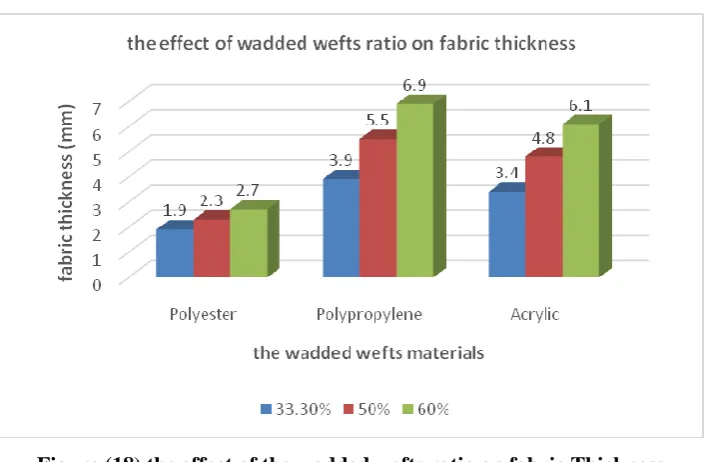
Figure (18) the effect of the wadded wefts ratio on fabric Thickness
Statistical analysis of thickness test results, as shown in annexure (A), figs. (A-4), (A-5) and (A-6), proved that
there was a strong correlation coefficient between wadded wefts ratios and fabric thickness.
In addition, it was illustrated from table (2) and fig. (18) that the ratio of the wadded wefts (60%) recorded the
highest thickness values among all materials.
Results have also shown that there was a positive relationship between the ratio of the wadded wefts and the
fabric thickness. On the other hand, the different types of wadded wefts materials affected the thickness of
samples. This could be explained by reviewing the specific density ( gm/ ) of each material. As
mentioned earlier, specific density of Polypropylene was (0.9-0.91 gm/cm3) which is the lowest specific density
415 |
P a g e
The results show that Polypropylene scored the highest fabric thickness. The reason for that can be explained byreviewing the specific density value for Polypropylene which is the lowest when compared to the other two
samples. The relation between sample thickness and specific density can be explained by reviewing the law
governing specific density which is weight divided by volume, where volume = length*width*height. Assuming
length and width are equal for all sample the difference will be in sample height which in turn is a direct
indication for thickness. Consequently the smallest specific density of Polypropylene led to highest thickness
among all samples.
3.3 The effect of wadded wefts on Air Permeability
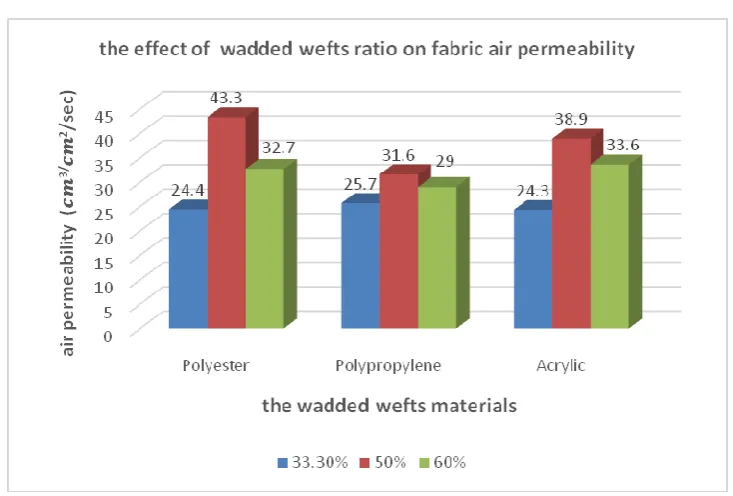
Figure (19) the effect of the wadded wefts ratio on fabric air permeability
According to the statistical analysis of the air permeability test results, the relationship between fabric air
permeability and ratio of the wadded wefts materials is a non- linear correlation as shown in annexure (A).
Furthermore, only a weak correlation could be established between fabric air permeability and the wadded wefts
ratio (R2 = 0.01 to 0.49) as shown in figs. (A-7) and (A-8) for Polyester and Polypropylene.
Additionally, a moderate correlation could be established between fabric air permeability and the wadded wefts
ratio (R2 =0.50 to 0.69) as shown in fig. (A-9) for Acrylic.
Moreover, 50% wadded wefts recorded the highest air permeability values when compared to all other materials
as shown in table (2) and fig. (19). On the other hand the 33.3% and 60% wadded achieved the lowest air
416 |
P a g e
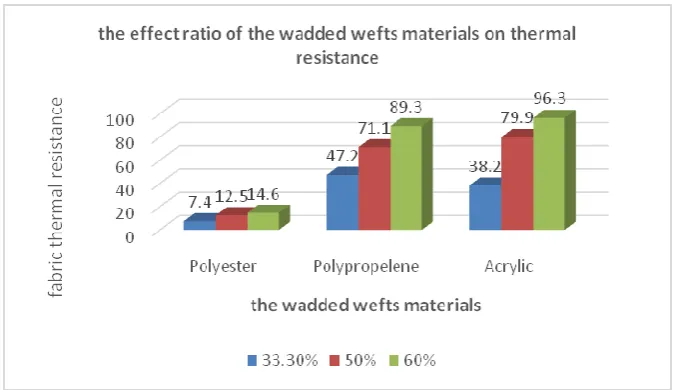
3.4 The effect of wadded wefts on thermal Resistance
Figure (20) the effect of the wadded wefts materials on fabric thermal resistance
Statistical analysis of the thermal resistance results for different wadded weft ratiosshowed that there is a strong
correlation coefficientbetween fabric thermal resistance and the wadded weft ratios (R2 = 0.70 to 0.99) as shown
in figs (A-10), (A-11) and (A-12), annexure (A).
And by referring to table (2) and fig. (20), the ratio of (60%) of the wadded wefts for all materials recorded the
highest thermal resistance values.
Furthermore, the highest thermal resistance values were achieved by using Acrylic and Polypropylene wadded
wefts at a ratio of 60% when were compared with Polyester at the same ratio. The superior thermal resistance
was affected by the bulky morphology and air gabs of Acrylic and Polypropylene wadded weft yarns
respectively
As mentioned in the introduction of this study, manufacturers determined the thermal resistance values of their
duvets in tog (thermal overall grade). This enables the purchaser to select a duvet appropriate to the season: the
higher the tog rating, the warmer the duvet.
Tog = 0.1
Table (3) shows the thermal resistance results test by and (TOG), in addition to the duvet
performance according to the tog value.
Table (3) the results of thermal resistance
& (TOG)
Ratio Material
Thermal Resistance Thermal
Resistance
(TOG)
Duvet Performance
417 |
P a g e
33.3% Polypropylene 47.2 4.7 Summer
Acrylic 38.2 3.8 Summer
Polyester 12.5 1.2 -
50% Polypropylene 71.1 7.1 Spring
Acrylic 79.9 7.9 Spring- Autumn
Polyester 14.6 1.4 -
60% Polypropylene 89.3 8.9 Spring- Autumn
Acrylic 96.3 9.6 Spring- Autumn
IV. CONCLUSION
In this study ninemulti layered fabrics varying in wadded wefts type (Polyester, Polypropylene, and Acrylic)
were tested. Moreover, the ratio of the number of weft waddings to the number of face and back weft yarns were
33.3%, 50%, and 60%.
After statistically analysing the data, the results can be summarizedas follows:
1. Wadded wefts ratio of (60%) recorded the highest weight and thickness values for all materials. Moreover
Polypropylene scored the highest fabric thickness at this category.
2. Samples with 50% wadded wefts recorded the highest air permeability values when compared to all other
materials.
3. The thermal resistance was affected by bulkymorphology and air gabs of Acrylic and Polypropylene
wadded weft yarns respectively.In addition, the highest thermal resistance values were achieved by using
Acrylic and Polypropylene wadded wefts at a ratio of 60% when were compared with Polyester at the same
ratio.
REFRENCES
[1] T. Rowe, Interior Textiles: Design and Developments. Elsevier, 2009.
[2] Ikea duvets.” www.ikea.com, 09-Mar-2016.
[3] R. S. Rengasamy, B. R. Das, and Y. B. Patil, “Thermo-physiological comfort characteristics of polyester
air-jet-textured and cotton-yarn fabrics,” J. Text. Inst., Aug. 2009.
[4] B. P. Saville and T. I. (Manchester England), Physical Testing of Textiles. Woodhead Publishing, Limited,
1999.
[5] A. R. Horrocks, S. Anand, and S. Anand, Handbook of Technical Textiles. Woodhead Publishing, 2000.
[6] G. Song, Ed., Improving Comfort in Clothing, 1 edition. Oxford ; Philadelphia: Woodhead Publishing, 2011.
[7] N. S. Dhoot, L. G. Patil, and P. M. Katkar, “Effect of fabric weaves on compressional behaviour of woven
fabric,” IJFTR Vol391 March 2014, Mar. 2014.
[8] ASTM D3776 / D3776M - 09a, “Standard Test Methods for Mass Per Unit Area (Weight) of Fabric.” 2013.
[9] ASTM D1777, “Standard Test Method for Thickness of Textile Materials.” 2015.
418 |
P a g e
[11] ISO 11092, “Textiles -- Physiological effects -- Measurement of thermal and water-vapour resistance understeady-state conditions (sweating guarded-hotplate test),” 2014.