
ALICE overview
Sami S. Räsänen1,2,aon behalf of the ALICE Collaboration
1University of Jyvaskyla, Department of physics, P.O. Box 35, FI-40014, University of Jyvaskyla, Finland 2Helsinki Institute of Physics, P.O.Box 64, FI-00014 University of Helsinki, Finland
Abstract. Recent results from the ALICE experiment are presented with a particular emphasis on particle identification, the nuclear modification factor (RAA) and azimuthal
anisotropy (v2). Comparison of lead-lead and proton-lead results reveals evidence of
collectivity in small systems.
1 Introduction
The main goal of ultrarelativistic heavy ion collisions is to study the thermal properties of quantum chromodynamics (QCD). It is widely accepted that the thermal state of QCD, the quark-gluon plasma (QGP), is reached in high energy nucleus-nucleus collisions at BNL-RHIC and CERN-LHC. Proper-ties of the QGP medium, such as shear viscosity to entropy ratio, existence and location of the QCD critical point, electromagnetic radiation and energy loss provide a focus for active measurements and theory development; see e.g. the Hot QCD White Paper [1]. Recently there has been a growing interest in possible collective phenomena in smaller collision systems [2], like deuteron-gold [3, 4], helium-gold [5], proton-lead [6–8] or even in proton-proton [9–11].
The ALICE experiment [12] is the dedicated heavy ion experiment at the LHC. Compared to ATLAS [13] and CMS [14], ALICE is a low luminosity experiment with more limited acceptance but equipped with excellent particle identification (PID) and tracking capabilities down to very low transverse momentum,pT. One example of the performance of the ALICE tracking is a recent
mea-surement of the mass difference between light nuclei and anti-nuclei [15]. The left panel of Fig. 1 shows observed counts with respect to the squared mass-over-charge ratio in the Pb−Pb collisions at √
s=2.76 GeV for selected rigidity (p/|z|) intervals and 2σcut of for TPCdE/dxexpectations for (anti-)deuterons and (anti-)helium-3. The mass of the light nuclei can be measured very precisely by fits to these distributions. The right panel of Fig. 1 shows the resulting mass differences and binding energy differences compared to earlier measurements. If the Charge conjugation-Parity-Time reversal (CPT) –symmetry is exact, then these differences should be zero. ALICE has now presented the most precise measurement confirming CPT invariance to hold in relative mass differences at 0.1% level, which gives stringent constraints to any effective theory where CPT is broken.
On top of the measurements of heavy ion collisions, ALICE has also a proton-proton program based upon the strengths of the experiment. One general motivation is to test and tune event gener-ators and basic perturbative QCD predictions, which is important in its own right,but also a precise understanding of QCD background is often crucial for the electroweak measurements at the LHC.
Figure 1. Left: The ALICE measurements [15] for squared mass-over-charge ratio distributions for deuterons
(left) and3He (right) in selected rigidity intervals. Particle and anti-particle spectra are in the top and bottom
plots, respectively. Right: Results for d-d and3He-3He mass-over-charge ratio and binding energy differences
compared with CPT invariance expectation (dotted lines) and other measurements.
Some recent measurements that demonstrate the PID capabilities of ALICE include identified hadrons and particle ratios at √s=7 TeV [16] andπ0’s at √s =2.76 TeV [17]. ALICE has also measured (charged) jet spectrum at √s = 7 TeV [18] and found a good agreement with ATLAS. Here, the excellent tracking capability of ALICE was used to measure the mean number the mean number of constituents down to low-pT jets. On top of these examples, the obvious and important part of the ALICE pp program is to measure reference spectra to the heavy ion collisions.
The rest of this paper will concentrate on summarizing recent ALICE results on the nuclear mod-ification factorRAAand elliptic flowv2with an emphasis on particle identification and small systems.
2 Nuclear modification factor
It has long been predicted that partons traversing hot QCD matter would lose energy and attenuate, but such a phenomena was not observed in early experiments at the CERN SPS [19]. A suppression of high transverse momentum hadron was first observed by experiments at RHIC [16, 20]. To quantify the nuclear modification, PHENIX experiment introduced the nuclear modification factor [20]
RAA(pT)=
(Yield in Pb+Pb)
(Number of collisions)×(Yield in p+p) =
dNAA/dpTdη
NbindNpp/dpTdη. (1)
If the nucleus-nucleus collision could be described as a superposition of independent proton-proton collisions, thenRAA would equal unity for all pT. At the low-pT RAA < 1 since the soft particle production in heavy ion collisions scales with the number of participants rather than the number of collisions [21]. At high-pTat the SPSRAA>1 which is connected with Cronin enhancement [22]. At RHIC a suppression with respect to binary scaling was observed at the high-pT.
measured at the same collision energy and by the same detector. Currently at the LHC, there is a mea-sured pp reference for the√s=2.76 TeV lead-lead measurements, but not yet for the√s=5.02 TeV proton-lead run. This optimal scenario will be achieved at the end of 2015 when the LHC will provide both√s=5.02 TeV reference pp run and also Pb−Pb collisions at this same energy.
Following subsections discuss theRAAof various single particle spectra. ALICE has also measured RAAof jets [24]. See also the dedicated talk on jets in heavy ions collisions presented at this conference
[25] .
2.1 Light flavours
The first ALICERAAmeasurement for charged hadrons was published in [26] and immediately made
an important extension to RHIC results (not shown here). RHIC results reached up topT∼10 GeV/c
and it was open weather the data flattens in that region or ifRAAstarts to rise again. With the LHC
data extending to 50 GeV/c(ALICE) or 100+GeV/c(ATLAS [27], CMS [28]), it is clear thatRAAis
again rising towards unity. This rules out a very simple phenomenological description of energy loss where every parton would loose a constant fraction of its energy, and also gives more constraints to detailed calculations.
) c (GeV/
T
p
AA
R
0.2 0.4 0.6 0.8
1 ALICE 0-5% Pb-Pb -π
+
+ π
+ K
+
+ K p p + Charged
ALICE 60-80% Pb-Pb
0 2 4 6 8 10 12 14 16 18
0.2 0.4 0.6 0.8 1
-+K
+
K p p +
0 2 4 6 8 10 12 14 16 18
ALI-PUB-84488
Figure 2.The nuclear modification factorRAAas a function of pTfor different particle species for central (left)
and peripheral (right) collisions [29].
Fig. 2 shows recent ALICE measurements ofRAA for identified light hadron flavours; charged
pions and kaons and (anti-)protons together with all charged hadrons up topT=20 GeV/cin central
(left) and peripheral (right) collisions. In central collisions,RAA is observed to be the same for all
particle species forpT∼>10 GeV/csuggesting that there is no direct interplay between the energy loss
in the medium and the particle species composition in the hard core of the quenched jet and may disfavour models that predict significant particle species dependence also at high-pT. The region pT∼<2. . .2.5 GeV/cis generally associated with the thermal production which roughly scales as a
number of participants. In the mid-pTregion, 3<pT <10 GeV/c, protons are clearly less suppressed
than pions or kaons. Further studies are needed in order to determine whether models containing only hydrodynamics and jet quenching can describe also the intermediatepTregion or whether a different
2.2 Heavy flavours
Dedicated heavy flavour (HF) theory [31] and experimental [32] talks were delivered in this confer-ence. Here, we summarize briefly ALICE results for HFRAA. One of the key motivations to study HF
in nucleus-nucleus collisions have been the expectation of reduced energy loss in the medium due to so called dead cone effect [33], that arises from suppression of the forward QCD scattering amplitude due to heavy quark mass in the propagator.
)
c
(GeV/
T
p
0 5 10 15 20 25 30 35 40
AA
R
0 0.2 0.4 0.6 0.8 1 1.2 1.4 1.6 1.8 2
|<0.5 y 0-7.5%, |
*+
, D
+
, D
0
Average D
-extrapolated reference
T
p with pp Preliminary
|<0.8
η
Charged particles, 0-10%, | PLB 720 (2013) 52-62
|<0.8
η
Charged pions, 0-10%, | PLB 736 (2014) 196-207
ALICE = 2.76 TeV
NN s
Pb-Pb,
ALI−DER−56048
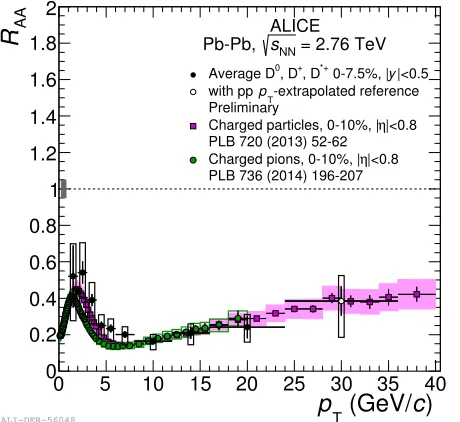
Figure 3.Average D-mesonRAAcompared to
charged hadrons and - pions.
Fig. 3 shows the average D-mesonRAAcompared to all charged particles and charged pions.
Par-ticularly at high-pTthe results agree within one another, and also in lowerpTwithin the experimental
uncertainties, so the dead cone effect is not obvious. Although some models can reproduce this, they tend to have difficulties in simultaneously reproducing the elliptic flow, as will be discussed later in Sec. 3.1.
Suppression of the J/ψstates in presence of QGP was predicted in 1986 [34] and it has been stud-ied extensively at the SPS [35] and RHIC [36]. On top of the effects coming from the hot deconfined medium, there may be cold nuclear matter effects like modification of parton distribution functions or final state absorption in the nuclear medium. Both SPS and RHIC experiments found suppression beyond any cold matter effects. At the LHC, CMS has observed a sequential suppression of the higher mass bottomonium states [37] showing clear medium effects in the suppression.
An earlier measurement in ALICE [38] revealed an interesting surprise: thepT-integratedRAAof
the J/ψwas less suppressed in central lead-lead collisions at the LHC as compared to central gold-gold collisions at RHIC. This is counter intuitive in a sense that naively one would expect the larger and more hot medium to give larger suppression.
Fig. 4 shows ALICE results forpT-dependence of J/ψnuclear modification factorRAAin central
Figure 4.Nuclear modification factorRAAof J/ψin 0–20 % most central lead-lead collisions at forward rapidity
[39] (left) and in 0–40 % most central collisions at mid-rapidity [40] (right).
right panel has open marker indicating that the statistics was too low to determine the meanpTin that bin, hence the marker is placed at the bin center.
A possible explanation for smaller suppression comes from higher density of charmed quarks at the LHC that would increase the recombination probability to J/ψ. The right panel in Fig. 4 shows results from two transport models [41, 42] that can describe the rise ofRAAtowards the smallpT. In both models the rise comes from recombination.
2.3 Proton-lead collisions
In the early RHIC era, deuteron-gold collisions were considered mainly as a control for heavy ions. It was expected that there is no medium created and the measurements would probe only cold nuclear matter effects. Originally proton-lead collisions were expected to play the same role also at the LHC. Experiments at both accelerator centers have now found that there may be collective behaviour also in small systems, as will be discussed in Sec. 3.2.
Fig. 5 shows the nuclear modification factor RAA for charged hadrons [43] (left) and average D-mesons [44] (right) in minimum bias proton-lead collisions compared to central and peripheral lead-lead collisions. At high-pT,RAA is consistent with unity for both charged hadrons and average D-mesons in p−Pb collisions. On the other hand, a clear suppression is seen in central heavy ion collisions. Peripheral heavy ion results lie in between indicating smooth and gradual disappearance of the nuclear effects. The observed cold nuclear matter effects (at high-pT) are rather modest. This was expected if the only source of cold nuclear modifications is due to the nuclear parton distribution functions, see e.g. [45]. However, saturation physics phenomenology [46] gives results that are also consistent with the data.
3 Elliptic flow
(GeV/c)
T
p
0 2 4 6 8 10 12 14 16 18 20
PbPb , R pPb R 0.2 0.4 0.6 0.8 1 1.2 1.4 1.6
1.8 ALICE, charged particles | < 0.3 cms η = 5.02 TeV, NSD, | NN
s p-Pb
| < 0.8 η = 2.76 TeV, 0-5% central, | NN
s Pb-Pb
| < 0.8 η = 2.76 TeV, 70-80% central, | NN s Pb-Pb ALI−PUB−44351 ) c (GeV/ T p
0 5 10 15 20 25
Nuclear modification factor
0 0.2 0.4 0.6 0.8 1 1.2 1.4 1.6 =5.02 TeV NN s p-Pb, <0.04 cms y -0.96< =2.76 TeV NN s Pb-Pb, |<0.5 cms y | centrality 0-20% centrality 40-80% ALICE *+ , D + , D 0 Average D ALI−PUB−79458
Figure 5.Nuclear modification factorRAAfor charged hadrons [43] (left) and average D-mesons [44] (right) in
minimum bias proton-lead collisions compared to central and peripheral lead-lead collisions.
some constant proper time, parametrized collective transverse flow profile, in which case the invariant yield of thermal particles becomes [47]
EdN d3p ∝mT
RA
0 dr rI0
βTγTpT Tkin
K1
γTmT
Tkin
, whereβT =βT(r)=βmax
r RA
α
. (2)
The gamma-factor is related to the collective transverse flow 1/γT =
1−β2
T, transverse massmT =
p2
T+m2 andRA is the nuclear radius. The model has four parameters to be determined by a fit
to the data: the kinetic freezeout temperature of the system,Tkin, the maximum flow velocity,βmax,
the shape parameter for the flow profile,α, and an overall normalization related to the size (also the lifetime) of the fireball. In the case of constant radial flowβT =β0 =(const.), i.e. shape parameter α=0, one finds that asymptotically atpT max(m,Tkin)
1
mT dN dmTdy ∼
exp
−mT Teff
, whereTeff≡Tkin
1+β0
1−β0.
(3)
This illustrates the blue shifts in spectra coming from the collective radial expansion. The increase of the apparent temperature is the dominant flow effect in heavy ion collisions.
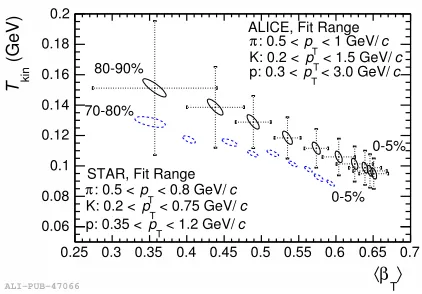
Fig. 6 shows the blast wave parametersTkin and mean of the transverse velocityβTat the LHC
(solid black) and in RHIC (dashed blue) [48]. Centrality increases when moving from left to right. Average flow velocity increases and freezeout temperature decreases with growing centrality. This suggests that more central collisions have longer lifetime and hence the flow has time to build up.
〉
T
β 〈
0.25 0.3 0.35 0.4 0.45 0.5 0.55 0.6 0.65 0.7
(GeV) kin T 0.06 0.08 0.1 0.12 0.14 0.16 0.18 0.2 0-5% 80-90% 70-80% 0-5% ALICE, Fit Range
c < 1 GeV/ T p : 0.5 <
π
c < 1.5 GeV/ T
p K: 0.2 <
c < 3.0 GeV/ T
p p: 0.3 <
STAR, Fit Range c < 0.8 GeV/ T
p : 0.5 <
π
c < 0.75 GeV/ T
p K: 0.2 <
c < 1.2 GeV/ T
p p: 0.35 <
ALI−PUB−47066
Figure 6.Blast wave fit parameters break up temperatureTkinand mean transverse velocity
βTat the LHC and in RHIC [48]. With
increasing centrality, the mean velocity grows and break up temperature reduces. This can be interpreted such that in more central collisions the average lifetime of the system is longer leading to stronger flow and later break up.
Hydrodynamical modeling gives a real dynamical solution of the conservation equations and is the only known thermodynamically consistent way to treat the Equation of State of strongly inter-acting matter in the evolution equations. The solution of the hydrodynamical evolution equations give dynamically the local temperature, densities and collective velocity in every space-time point in-side the fireball. Hence all quantitative thermodynamical characteristics should follow from detailed hydrodynamical simulations. For example, see recent results found using sophisticated theoretical frameworks like VISHNU [50], MUSIC [51] or pQCD+saturation+viscous hydrodynamics [52] in heavy ion collisions or using hydrodynamics in small systems [53].
It was realized [54] that there will be deviations of radial symmetry in the transverse flow due to anisotropic pressure gradients during the evolution. The Fourier decomposition of the angular distribution of particles with respect to the reaction plane has become the standard method with which to analyze flow anisotropies [55]. There are many experimental methods to measure those Fourier coefficients, like flow cumulants [56], but we shall not elaborate the discussion in this note.
Using Fourier decomposition, azimuthal dependence of the final hadron spectra becomes
EdN d3p =
1
pT dN dpTdydφ
= 1 2πpT
dN dpTdy
⎛ ⎜⎜⎜⎜⎜
⎝1+
∞
n=1
2vn(pT) cos(nφ−ψn) ⎞ ⎟⎟⎟⎟⎟
⎠, (4)
wherevn are the flow harmonics andψn event plane angles. The second harmonic coefficient, v2,
is called elliptic flow and it has a clear centrality dependence. Elliptic flow reflects the dominant almond-shaped geometry in the non-central collisions. The third harmonic,v3, is called triangular
flow. Triangular flow comes dominant in the ultra-central collisions and it is related to the fluctuations in the initial state of the collisions. For example, simultaneous description of thepTand centrality
dependence of thev2andv3coefficients puts constraints on the initial geometry fluctuations and the
shear viscosity to entropy ratioη/s. A higher viscosity causes more rapid damping of the fluctuations (v3) and slows the buildup of v2. Based on these studies, it has been concluded that QGP shows
features of nearly perfect liquid. [50, 51]
The hydrodynamical models [50–52] go beyond the event averages of the flow coefficients (the
vn in Eq. (4)) and study e.g. experimentally measured event-by-event fluctuations of flow [57] and
correlations between event plane angles [58]. Such a global analysis provide significantly tighter constraints on QCD matter properties.
the single particle distribution (4), one obtains a similar Fourier decomposition for the two particle distribution [59]
dNpair d(φt−φa) =
: dN
pair
dΔφ ∝1+ ∞
n=1
2VnΔ(pTt,pTa) cos(Δφ), (5)
whereΔφ:=φt−φais a difference in the azimuthal angle between trigger and associated hadron that
have transverse momenta pTtand pTa, respectively. In the case of flow correlations only, one would
have a connection to single particle flow coefficients
VnΔ(pTt,pTa)=vn(pTt)vn(pTa) (6)
and you would see the correlations extending over large rapidity gapsΔη := ηt−ηa. This gives an
opportunity to determine flow coefficients for hadrons and also for identified flow [60]: by choosing a symmetric bins for trigger and associated particles,pTmin<pTa,pTt<pTmax, one finds
vh
n{2PC}=
VnhΔ−h vin{2PC}= VnhΔ−i
VnhΔ−h
, (7)
wherei=π, K,p in case of identified flow. Aboveh−hrefers to unidentified charged hadron-hadron correlation in a symmetricpT-bin andh−ito a case where one of the hadrons is identified.
So far we have related the harmonics with collectivity in the system (hydrodynamical flow). How-ever, one should be a bit careful since particularly hydrodynamics is expected to describe the bulk of the particle production, i.e. it would be valid description atpT <1. . .3 GeV/cdepending on the
par-ticle species. However, as discussed in Sec. 2, hard partons are not expected to thermalize but instead they traverse the medium losing their energy. But since the medium is expected to have a smaller geometrical extension in in-plane as compared to out-of-plane, the partons are (on the average) less suppressed at the in-plane direction, causing a positive second Fourier coefficientv2. Hence, even
though one generally speaks of “flow coefficients”, the full range in pT is not related with
hydrody-namical flow.
The rest of this note concentrates on identifiedv2in Pb−Pb and p−Pb collisions.
3.1 Heavy ion collisions
In the Blast Wave model (2), radial flow breaks themT–scaling present in the non-flowing case (i.e.,
ifβmax=0 then (yield)∼K1(−mT/Tkin)). Heavier particles gain more momentum from the common
collective flow field and this leads into mass ordering of elliptic flow at low-pT. The left panel in
Fig. 7 shows recent ALICE measurement1 [61] for elliptic flow ofπ±, K±, p+¯p,Λ +Λ¯,Ξ +Ξ¯
andΩ +Ω. One sees a clear mass ordering of the different hadrons and also that a sophisticated¯ hydrodynamical simulation [63] can reproduce that qualitatively rather well, although a more detailed analysis presented in the ALICE paper shows some tensions. The study also provided evidence for constituent quark scaling [64–66] to be violated at the intermediatepTregion at the LHC as deviations
up to∼20 % level are observed [61]
The right panel in Fig. 7 shows the elliptic flow of average D-mesons compared to charged particle
v2. The measurements [62] show that D-mesons have a positivev2in range 2<pT<6 GeV/cinterval
with 5.7σsignificance. This high-pTrange is outside the thermal region so these results, together with
the D-mesonRAA, provide very tight constraints on the heavy quark interactions with the medium.
1The published paper includes also thev
) c (GeV/
T
p 0.5 1 1.5 2 2.5 3 3.5 4
2 v 0 0.05 0.1 0.15 0.2 0.25 |>1} η Δ {SP, | 2 v π K p Ξ Ω /s=0.2) η VISH2+1 (CGC, π K p Ξ Ω
AIP Conf. Proc. 1441, 766 PRC84 044903
= 2.76 TeV 20-40% NN
s Pb-Pb
ALI−DER−55851 pT (GeV/c)
0 2 4 6 8 10 12 14 16 18
2 v -0.2 0 0.2 0.4 |>2} η Δ {EP,| 2 v Charged particles, {EP} 2 v average, |y|<0.8, *+ , D + ,D 0 Prompt D Syst. from data Syst. from B feed-down
= 2.76 TeV NN s Pb-Pb, Centrality 30-50% ALICE ALI−PUB−48703
Figure 7. Left: elliptic flowv2for identified particles in √sNN =2.76 TeV measured by ALICE [61]. Right:
D-meson and charged hadronv2compared [62].
3.2 Double ridge in proton-lead collisions
An interesting observation in p-Pb collisions at the LHC was the appearance of a double ridge structure in two-particle correlations [6]. Two-particle correlations are define as
1
Ntrig d2N
dΔφdΔη, (8)
whereΔφ =φt−φa andΔη =ηt−ηa, such that trigger (t) and associated (a) transverse momenta
are in the given bin, and also classify the events globally in terms of the charged particle multiplicity. Typically two-particle correlation functions have a near side peak at (Δφ,Δη) =(0,0) coming from hadrons associated with the fragmentation of the same jet as the trigger particle and an away-side peak atΔφ=π, which is smeared inΔηdue to the different momentum fractions carried by partons in the initial hard scattering. If we now assume that the hard scattering is not significantly modified in proton-lead collision, we can assume that jet correlations from the hard scattering are similar in low- and high-multiplicity p−Pb events. For the further support, we have checked that the correlation function in the low-multiplicity p−Pb collisions is observed to be very similar with the one measured in proton-proton collisions. Then we can study any residual correlations in high-multiplicity events, on top of the hard scattering, by subtracting the correlation functions measured at low-multiplicity from the correlation function measured in the high-multiplicity events. The left panel in Fig. 8 shows the resulting residual correlation function, when you perform such a subtraction [6]. One can observe a clear double ridge structure inΔφthat is elongated inΔη. Returning to the discussion of collective flow of single particles is reflected into two-particle correlations, see Eq. (5), we immediately realize that the observation very much resembles this expectation.
The right panel in Fig. 8 shows the projection of the two-dimensional subtracted correlation func-tion (left) intoΔφtogether with Fourier decomposition including cos(2Δφ) and cos(3Δφ) terms resem-bling elliptic and triangular flow in the single particle distributions. Note, however, that you cannot use directly Eq. (7) to obtain single particlev2,3here because the trigger and associated bins are
Figure 8.Left: Associated yield per trigger particle inΔφandΔηfor pairs of charged particles with 2<pTtrig<
4 GeV/cand 1 < pTassoc < 2 GeV/cin p−Pb collisions at √sNN = 5.02 TeV for the 0–20% multiplicity
class,after subtraction of the associated yield obtained in the 60–100% event class. Right: as left but projected ontoΔφaveraged over 0.8<|Δη|<1.8 on the near side and|Δη|<1.8 on the away side. [6]
Figure 9.Fourier coefficientsv2{2PC,sub}for pions, kaons and protons measured in the
high-multiplicity p−Pb collisions [60].
More detailed study of the properties of the observed double ridge was presented in [60]. Fig. 9 shows thev2{2PC,sub}, extracted using Eq. (7), where “sub” refers that the jet correlations are re-moved by subtracting the low-multiplicity correlation function from the high-multiplicity one before the projection toΔφ. The observedv2values have a similar mass ordering than observed in Pb−Pb collisions, compare to left panel in Fig. 7. While not yet conclusive proof, it shows that the Fourier analysis of the double ridge leads to a mass ordering inv2{2PC,sub}that is characteristic of collective flow. The ATLAS collaboration has also measured higher harmonics using two-particle correlations [67] and the CMS collaboration has also shown that multiparticle correlations [68] give a non-zerov2 at high-multiplicity proton-lead collisions. The latter strongly favour collective correlations.
4 Summary
ALICE is the dedicated heavy ion experiment at the CERN LHC that is equipped with excellent tracking and particle identification capabilities. Recent measurements have been presented of recent ALICE results forRAAand elliptic flow for identified particles in Pb−Pb and p−Pb collisions. There
are interesting hints for collective behaviour in high-multiplicity p−Pb collisions. However, the effect of a Color Glass Condensate or other cold matter effects may yet provide an alternative explanation for the observed behaviour.
References
[1] Y. Akiba et al. (2015),1502.02730 [2] I. Tserruya, These proceedings (2015)
[3] A. Adare et al. (PHENIX), Phys. Rev. Lett.114, 192301 (2015),1404.7461 [4] L. Adamczyk et al. (STAR), Phys. Lett.B747, 265 (2015),1502.07652 [5] A. Adare et al. (PHENIX), Phys. Rev. Lett.115, 142301 (2015),1507.06273 [6] B. Abelev et al. (ALICE), Phys. Lett.B719, 29 (2013),1212.2001
[7] G. Aad et al. (ATLAS), Phys. Rev. Lett.110, 182302 (2013),1212.5198 [8] S. Chatrchyan et al. (CMS), Phys. Lett.B724, 213 (2013),1305.0609 [9] V. Khachatryan et al. (CMS), JHEP09, 091 (2010),1009.4122 [10] G. Aad et al. (ATLAS) (2015),1509.04776
[11] V. Khachatryan et al. (CMS) (2015),1510.03068 [12] K. Aamodt et al. (ALICE), JINST3, S08002 (2008) [13] G. Aad et al. (ATLAS), JINST3, S08003 (2008) [14] S. Chatrchyan et al. (CMS), JINST3, S08004 (2008) [15] J. Adam et al. (ALICE), Nature Phys. (2015),1508.03986
[16] J. Adam et al. (ALICE), Eur. Phys. J.C75, 226 (2015),1504.00024 [17] B.B. Abelev et al. (ALICE), Eur. Phys. J.C74, 3108 (2014),1405.3794 [18] B.B. Abelev et al. (ALICE), Phys. Rev.D91, 112012 (2015),1411.4969 [19] X.N. Wang, Phys. Rev. Lett.81, 2655 (1998),hep-ph/9804384
[20] K. Adcox et al. (PHENIX), Phys. Rev. Lett.88, 022301 (2002),nucl-ex/0109003 [21] K. Aamodt et al. (ALICE), Phys. Rev. Lett.106, 032301 (2011),1012.1657
[22] D. Antreasyan, J.W. Cronin, H.J. Frisch, M.J. Shochet, L. Kluberg, P.A. Piroue, R.L. Sumner, Phys. Rev.D19, 764 (1979)
[23] K.J. Eskola, H. Paukkunen, C.A. Salgado, JHEP04, 065 (2009),0902.4154 [24] J. Adam et al. (ALICE), Phys. Lett.B746, 1 (2015),1502.01689
[25] A. Shabetai, These proceedings (2015)
[26] K. Aamodt et al. (ALICE), Phys. Lett.B696, 30 (2013),1012.1004 [27] G. Aad et al. (ATLAS), JHEP09, 050 (2015),1504.04337
[28] S. Chatrchyan et al. (CMS), Eur. Phys. J.C72, 1945 (2012),1202.2554 [29] J. Adam et al. (ALICE) (2015),1506.07287
[30] R.J. Fries, B. Muller, C. Nonaka, S.A. Bass, Phys. Rev.C68, 044902 (2003),nucl-th/0306027 [31] M. Nardi, These proceedings (2015)
[32] M.J. Kweon, These proceedings (2015)
[34] T. Matsui, H. Satz, Phys. Lett.B178, 416 (1986)
[35] R. Arnaldi (NA60), Nucl. Phys.A830, 345C (2009),0907.5004
[36] A. Adare et al. (PHENIX), Phys. Rev. C77, 024912 (2008), [Erratum: Phys. Rev.C79,059901(2009)],0903.4845
[37] S. Chatrchyan et al. (CMS), Phys. Rev. Lett.109, 222301 (2012),1208.2826 [38] B. Abelev et al. (ALICE), Phys. Rev. Lett.109, 072301 (2012),1202.1383 [39] B.B. Abelev et al. (ALICE), Phys. Lett.B734, 314 (2014),1311.0214 [40] J. Adam et al. (ALICE), JHEP07, 051 (2015),1504.07151
[41] K. Zhou, N. Xu, Z. Xu, P. Zhuang, Phys. Rev.C89, 054911 (2014),1401.5845 [42] X. Zhao, R. Rapp, Nucl. Phys.A859, 114 (2011),1102.2194
[43] B. Abelev et al. (ALICE), Phys. Rev. Lett.110, 082302 (2013),1210.4520 [44] B.B. Abelev et al. (ALICE), Phys. Rev. Lett.113, 232301 (2014),1405.3452
[45] I. Helenius, K.J. Eskola, H. Honkanen, C.A. Salgado, JHEP07, 073 (2012),1205.5359 [46] P. Tribedy, R. Venugopalan, Phys. Lett. B710, 125 (2012), [Erratum: Phys.
Lett.B718,1154(2013)],1112.2445
[47] E. Schnedermann, J. Sollfrank, U.W. Heinz, Phys. Rev.C48, 2462 (1993),nucl-th/9307020 [48] B. Abelev et al. (ALICE), Phys. Rev.C88, 044910 (2013),1303.0737
[49] K.J. Eskola, H. Niemi, P.V. Ruuskanen, S.S. Rasanen, Phys. Lett. B566, 187 (2003),
hep-ph/0206230
[50] H. Song, S. Bass, U.W. Heinz, Phys. Rev.C89, 034919 (2014),1311.0157
[51] C. Gale, S. Jeon, B. Schenke, P. Tribedy, R. Venugopalan, Phys. Rev. Lett.110, 012302 (2013),
1209.6330
[52] H. Niemi, K.J. Eskola, R. Paatelainen (2015),1505.02677
[53] P. Bozek, W. Broniowski, G. Torrieri, Phys. Rev. Lett.111, 172303 (2013),1307.5060 [54] J.Y. Ollitrault, Phys. Rev.D46, 229 (1992)
[55] S. Voloshin, Y. Zhang, Z. Phys.C70, 665 (1996),hep-ph/9407282
[56] A. Bilandzic, R. Snellings, S. Voloshin, Phys. Rev.C83, 044913 (2011),1010.0233 [57] G. Aad et al. (ATLAS), JHEP11, 183 (2013),1305.2942
[58] G. Aad et al. (ATLAS), Phys. Rev.C90, 024905 (2014),1403.0489 [59] K. Aamodt et al. (ALICE), Phys. Lett.B708, 249 (2012),1109.2501 [60] B.B. Abelev et al. (ALICE), Phys. Lett.B726, 164 (2013),1307.3237 [61] B.B. Abelev et al. (ALICE), JHEP06, 190 (2015),1405.4632
[62] B. Abelev et al. (ALICE), Phys. Rev. Lett.111, 102301 (2013),1305.2707
[63] C. Shen, U. Heinz, P. Huovinen, H. Song, Phys. Rev.C84, 044903 (2011),1105.3226 [64] D. Molnar, S.A. Voloshin, Phys. Rev. Lett.91, 092301 (2003),nucl-th/0302014 [65] A. Adare et al. (PHENIX), Phys. Rev. Lett.98, 162301 (2007),nucl-ex/0608033 [66] B.I. Abelev et al. (STAR), Phys. Rev.C75, 054906 (2007),nucl-ex/0701010 [67] G. Aad et al. (ATLAS), Phys. Rev.C90, 044906 (2014),1409.1792
[68] V. Khachatryan et al. (CMS), Phys. Rev. Lett.115, 012301 (2015),1502.05382 [69] H. Niemi, G.S. Denicol (2014),1404.7327
![Figure 1. Left: The ALICE measurements [15] for squared mass-over-charge ratio distributions for deuterons](https://thumb-us.123doks.com/thumbv2/123dok_us/8154087.1359996/2.482.42.441.80.238/figure-left-alice-measurements-squared-charge-distributions-deuterons.webp)
![Figure 2. The nuclear modification factor RAA as a function of pT for different particle species for central (left)and peripheral (right) collisions [29].](https://thumb-us.123doks.com/thumbv2/123dok_us/8154087.1359996/3.482.73.394.303.464/figure-nuclear-modication-function-dierent-particle-peripheral-collisions.webp)
![Figure 4. Nuclear modification factor RAA of J/ψ in 0–20 % most central lead-lead collisions at forward rapidity[39] (left) and in 0–40 % most central collisions at mid-rapidity [40] (right).](https://thumb-us.123doks.com/thumbv2/123dok_us/8154087.1359996/5.482.45.440.82.228/nuclear-modication-collisions-forward-rapidity-central-collisions-rapidity.webp)
![Figure 5. Nuclear modification factor RAA for charged hadrons [43] (left) and average D-mesons [44] (right) inminimum bias proton-lead collisions compared to central and peripheral lead-lead collisions.](https://thumb-us.123doks.com/thumbv2/123dok_us/8154087.1359996/6.482.42.437.89.272/nuclear-modication-inminimum-collisions-compared-central-peripheral-collisions.webp)
![Figure 7. v2D-meson and charged hadron2 √ Left: elliptic flow v for identified particles insNN = 2.76 TeV measured by ALICE [61]](https://thumb-us.123doks.com/thumbv2/123dok_us/8154087.1359996/9.482.44.441.89.233/figure-charged-hadron-elliptic-identied-particles-measured-alice.webp)

