1973 | P a g e
Operation Research and Graph Theory
Manju Dhand
Assistant Professor in Mathematics, D.M. College, Moga (India)
A
BSTRACTGraph theory is a very natural and powerful tool in numerous areas like Computer Technology, Communication
Science, Electrical Engineering, Physics, Architecture, Economics, Sociology, Genetics and especially in
com-binatorial operations research. Graph theory is a combination of vertices and edges whereas Operations
Re-search includes objective function and restrictions. This paper throws light on solving problems in operations
research using graph-theoretic tools. The various areas of O.R. where graph theory is used most frequently and
profitably are: Transport Networks, Travelling Salesman Problem, Matching and Assignment problem and
Game Theory. These problems can be expressed and solved elegantly as graph theory problems involving
con-nected and weighted digraphs.
I.
I
NTRODUCTIONMany practical problems of various fields like business, planning, environment etc. are converted into mathe-matical form by a process called modelling. To properly model a problem, geometrical structures containing points and connected lines are used, which are termed as graphs. Because of its inherent simplicity, graph theory has a wide range of applications in engineering, physical, social and biological sciences in linguistics and in combinatorial operations research. Any problem that requires a positive decision to be made with limited re-sources and constraints, is regarded as operational research. OR uses systematic and scientific approach to solve the problems. A graph can be used to represent almost any physical situation involving discrete objects and a relationship among them. There are various examples in OR where graph theory can be used effectively, some of which will be discussed in this paper. The paper is divided into two sections. Section I describes the brief history or origin of Graph Theory and Operation Research whereas some of the famous problems of OR have been discussed in Section II.
S
ECTION-I
Graph Theory:
1974 | P a g e
that every map could indeed be coloured with four or fewer colurs. After this many modifications were made by Peter Guthrie Tait (1831-1901), Percy John Heawood (1861-1955). In 1969 the four colour problem was solved by Heinrich Heesch with the help of computers. In fact, a simpler solution (Still Computer Assisted), employing an unavoidable set of 633 reducible configurations, has since been given (in 1993) by Neil Roberston, Daniel P. Sanders, Paul Seymour and Robin Thomas.
Operation Research
During World War II, Britain was having very limited military resources, an urgent need was felt to allocate the scarce resources in an effective manner to the various military operations and to the activities within each opera-tion. Therefore the British and American military management invited a large number of scientists to apply a scientific approach to many strategic and tactical problems. Their efforts were instrumental in winning the „Air Battle of Britain‟, „Battle of North Atlantic‟ and „Island Campaign in the Pacific‟. The name „Operations Re-search‟ came directly from the context in which it was used and developed viz. „Research on Military
Opera-tions‟
At the end of World War II, the scientists of this group moved to different sectors e.g., transportation, health, education etc. with a conviction that the operations under the control of management can be analysed scientifi-cally and the optimum method for carrying out operations can be investigated.
In simple words Operation Research Techniques are used in all most all walks of our life for making the best use of anything, whether it is physical resource or human resource.
S
ECTION-II
Graph Theory in Operations Research
In Operations Research, various problems can be solved by following the concept of optimization which in-volves different mathematical techniques and theories. In the present discussion, we shall briefly describe how graph theory is used in a number of situations.
Travelling Salesman Problem
A salesman is required to visit a number of cities during a trip. Given the distances between the cities, in what order should be travel so as to visit every city precisely once and return home, with the minimum distance trav-elled?
This problem can be solved in Graph Theory by using Hamiltonian circuit. If the cities are taken as vertices and roads between them as edges, then the distance between the cities is taken as weight of edges. The graph so ob-tained is a complete weighted graph. The solution of the problem is to find Hamiltonian cycle with sum of
weight minimum. For a complete graph with n vertices, the number of Hamiltonian circuits is and there
will be one with sum of weight minimum. Therefore, the problem always have solution.
The total number of different Hamiltonian circuits i.e. follows from the fact that starting from any vector,
1975 | P a g e
so on. These being independent choices, we get possible number of choices. The number is, however, divided by 2, because each Hamiltonian circuit has counted twice.
Fig. 1 (n=5)
Transport Networks
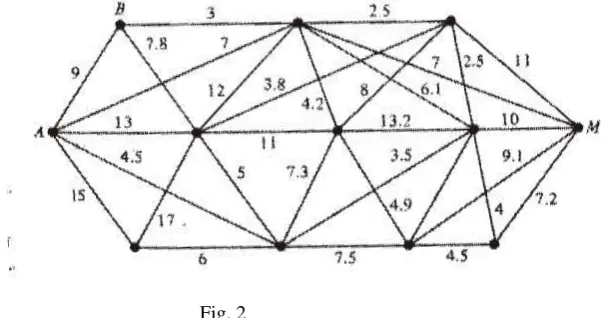
In a network of telephone lines, highways, railroads, pipelines of oil (or gas or water) and so on, it is important to know the maximum rate of flow that is possible from one station to another in the network. This is an opera-tion research problem and can be solved by linear programming. But the graph theoretic approach has been found to be computationally more efficient. The above type of network can be represented by a weighted con-nected graph in which the vertices are the stations and edges are lines through which the given commodity flows. The weight, a real positive number, associated with each edge represents the capacity of the line, i.e. the maximum amount of flow possible per unit of time. The graph in fig. 2 represents a flow network consisting of 12 stations and 31 lines. The capacity of these lines is also indicated in the figure
Fig. 2
It is assumed that at each intermediate vertex the total rate of commodity entering is equal to the rate leaving. Furthermore, the flow through a vertex is limited only by the capacities of the edges incident on it. Finally, the lines are lossless.
In such a flow-problem, generally two questions arise:
1. What is the maximum flow possible through the network between a specified pair of vertices Say, B to M?
1976 | P a g e
The answer for first question is given the most important result in the theory of transport networks-“The maxi-mum flow possible between two vertices „a‟ and „b‟ in a network is equal to the minimaxi-mum of the capacities of all cut sets with respect to „a‟ and „b‟; known as „MAX-FLOW MIN-CUT‟ Theorem. For the answer of second question i.e. for finding the actual value of the maximal flow, an efficient algorithm based on the above said theorem is available. This algorithm uses a vertex-labelling process for constructing a maximal flow pattern. Furthermore, the „max-flow min-cut theorem can be extended appropriately for many other types of network flow problems like „multiple sources and sinks‟, „vertices with specified capacity‟, „networks containing undi-rected edge‟, „lower bound on edges flows‟ and „lossy networks‟ etc.
Matching And Assignment Problem
The problem related to assigning the different jobs to different person or different jobs to different machines is called assignment problem in OR and matching problem in graph theory. A Bipartite or complete graph is used for matching, having two partite sets e.g.
As a result of doing well on an exam, six students A, B, C, D, E and F have earned the right to receive a com-plimentary text in either algebra (a), calculus (c), differential equations (d), geometry (g), history of mathematics (h), programming (p) or topology (t). There is only one book on each of these subjects. The preferences of the students are
A: d, h, t; B: g, p,t; C: a, g, h; D: h, p, t; E: a, c, d; F: c, d, p Can each of the students receive a book he or she likes?
Fig.3
The situations can be modelled by the bipartite graph G of Fig. (3) having partite sets U={A,B,C,D,E,F} and W={a,c,d,g,h,p,t}. We are asking if G contains a matching with six edges. Such a matching exists as shown in figure (4). From this matching, we see how six of the seven books can be paired off with the six students.
Fig. 4
Game Theory
1977 | P a g e
The general idea of game theory is the same as the one we associate with parlor games such as the chess, bridge and checkers.
A game is called a two-person game or n-person game according as it is played between two or more persons. Another classification can be made on the basis of randomness introduced in the game, such as by dice or cards. Thirdly, a game in which each player knows exactly where the game stands is called perfect-information game (e.g. chess). Bridges, in which one does not know what cards the other players have, is an imperfect-information game. A game is called finite if each player has a finite number of choices available at each move and the game must end after a finite number of moves. An infinite game is one in which a player chooses a move from an in-finite set of moves.
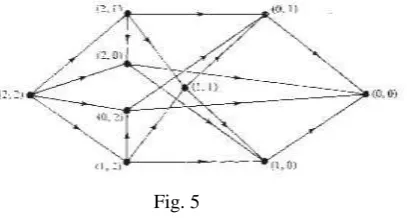
A two-person, perfect-information, finite game without change moves can be depicted naturally by a diagraph. The vertices represent the positions (also called states) in the game and the edges represent the moves. There is a directed edge from vertex vito vjif the game can be transformed from position vito vj by a move permissible by
rules of the game. A simplifed version of a game called „Nim‟ is shown below:
Fig. 5
Two piles of sticks are given and players A and B take turns each taking any number of sticks from any one pile. The player who takes the last stick, is the winner. For example we take two piles of two sticks each. In fig. (5) each state of game is described by an ordered pair of labels (x, y), indicating the number of sticks in the first and second pile resp. Some properties of game digraph are:
1. The digraph has a unique vertex with a zero in-degree. This vertex represents the starting position and is therefore called starting vertex. Vertex (2, 2) is the starting vertex.
2. There are one or more vertices with zero out-degree. These correspond to the closing positions in the game and are called closing vertices. Vertex (0, 0) is the closing vertex.
3. A game digraph is a connected, acyclic digraph. A directed circuit would imply that the game could go on indefinitely.
4. Each directed path from a starting vertex to a closing vertex represents one complete play of the game. This path consists of edges representing the moves of the two players alternately.
Winning Strategy
1978 | P a g e
and remaining as lost. And thus the player who makes the second move has the winning strategy, since he can force his opponent to move to the vertices marked as loos
Conclusion
There is virtually no end to the list of problems that can be solved with graph theory. Graph theory and opera-tion research both are becoming significant as these can be applied to many practical problems effectively. From a practical point of view, all the problems discussed in this paper are trivial if the network is small. Many real-life situations, however consist of huge networks, therefore it is important to look at these netw
ork problems
in terms of solving them on computers.
R
EFERENCES[1] Cesar Rego, “Relaxed tour and path ejection for travelling salesman problem”, 1988. [2] Gary chartand, Ping Zhang, “Introduction to graph theory”, Tata MaGraw Hill Edition 2006.
[3] Monia Bellalouna, Cecile Murat. Vangelis Th. Pasches, “Probabilistic combinatorial optimization problems on graph: a new domain in operational research‟, 1995
[4] Narsing Deo, “Graph Theory with Applications to Engineering and Computer Science”, Prentice Hall of India, 1990
[5] Norman L. Biggs, “Discrete Mathematics” 2nd Edition, Oxford University 2002
[6] S.G. Shrinivas, S. Vetrivel, Dr. N.M. Elango, “Applications of Graph Theory in Computer Science an Overview”, Vol 2(a), 2010