1083 | P a g e
ACCURATE AND EFFICIENT MINING FOR
CONFIDENCE COLOSSAL PATTERNS FROM HIGH
DIMENSIONAL DATASETS: CDFP-MINE
J. Krishna
1, Dr. P. Suryanarayana Babu
21
CSE Department, Research Scholar RU Kurnool, Assistant Professor, AITS, Rajampet, AP, (India)
2Director SVDDC,
RAYALASEEMA UNIVERSITY, KURNOOL, AP,(India)
ABSTRACT
CDFP-Mine, a novel approach for finding huge Colossal Pattern Sequences (CPS) from High Dimensional Biological Datasets is talked about in this paper. CDFP-Mine has successfully found Determinate Frequent Patterns (DFP) which is additionally advanced into a DFPT+ tree to produce CPS with vector intersection operator. CDFP-Mine influences utilization of a novel incorporated data structure called Hyperstructure 'H-struct', as a blend of a data matrix and one-dimensional arrays exhibit as a pair to powerfully find DFP from Biological High Dimensional Datasets. DFPT+ tree is developed as Bitwise Top-Down Column identification tree. H-struct has an assorted element to encourage is, it has amazingly restricted and precisely predictable primary memory and runs rapidly in memory based requirements. The algorithm is planned such that it takes just a single scan at the database to find CPS. The exact investigation on CDFP-Mine demonstrates that the proposed approach achieves a superior mining effectiveness on different high dimensional datasets and beats Colossal Pattern Miner(CPM) and BVBUC in various settings. The execution of CDFP-Mine on the high dimensional dataset is assessed with Accuracy and Frequency measures.
Keywords:
Bitwise Vertical Bottom Up Colossal mining(BVBUC), Colossal Pattern Miner(CPM),
Colossal Pattern Sequences, Determinate Frequent Patterns(DFP), DFPT
+tree
I. INTRODUCTION
1084 | P a g e
in computational biology to explore enormous and complex datasets. KDD and Data Mining have worried as an unavoidable need to separate valuable data and information from these datasets.
Next in Data Mining introduction, Frequent Pattern Mining(FPM) picked up as an unmistakable information mining paradigm that helps to separate patterns that thoughtfully symbolize relationship among discrete attributes and plays out a basic part in data mining and information investigation assignments and in additional applications. Fundamentally in view of the multifaceted design of those relations, select sorts of patterns can emerge. The most widely recognized sort of patterns has a tendency to mine successive patterns[5][6], association rules[1][2], correlations[4], episodic[3], clustering[11], classification[10][12], and maximal patterns and frequently closed patterns[7]–[9].
There are various algorithms produced for frequent patterns quick and proficient mining, which are classified into two classes. The first class candidate era strategy, including apriori[2] and its observations, are in perspective of apriori-property[2]: if a specimen altogether isn't normal, at that point it's incredible example can't visit. The apriori-based arrangement of standards accomplished proper lessening around the estimated hopeful sets. In spite of the way that, when there are many frequent patterns or possibly lengthy patterns, it will take multiple scans over the colossal database to develop candidate sets. The second class, pattern-growth strategy, which incorporates FP-Growth, furthermore makes utilization of the apriori-property. Be that as it may, it recursively partitions the database into sub-databases to generate candidate sets. It makes restricted scans over the database.
II. LITERATURE SURVEY
Within the literature, numerous algorithms had been developed under pattern growth method for discovering frequent patterns and closed patterns[8][14][15]. It uses enumeration primarily based approaches[8][15][16], wherein object mixtures are searched for frequent colossal patterns. In view of this, their running time increases exponentially with growing the average duration of the data and makes minimal two scans over the database. These will consume huge extent of memory utilization and predictably takes sufficient time when memory primarily based constraints are present. Those algorithms are rendering to be impractical on high dimensional microarray datasets. The entire sets of frequent closed patterns have received the use of row enumeration space turned into first shown in[16], which was also found in[13].
Although, the present frequent pattern mining strategies nonetheless encounter the subsequent difficulties. • All object enumeration based totally mining strategies are based on singleton patterns and take lots time to compute those patterns.
1085 | P a g e
• Real-time databases keep all of the instances. Most of the datasets in real time programs are either sparse or dense. It's far hard to pick a right mining method on the fly which fits all instances.
• Real-time programs require high dimensional and scalable. Numerous current procedures are powerful for smaller size data sets. However, as the dataset size will increase the existing strategies suggests fit falls on core data structures and requires sufficient memory.
• Multiple scans over the database. Most of the existing Apriori and FP-Growth strategies make numerous scans over the databases. Efficient data garage systems are needed to keep intermediate results.
Row enumeration search can be explored by way of building projected database recursively[17]. The vertical bottom-up method is enabled to mine efficient huge styles of large size[18]. However, there is a want to consider column enumeration algorithms certain in lots of algorithms are proposed to mine frequent colossal patterns. However, for high dimensional datasets, the pattern mining problem consumes greater time and space. If a dataset is with one hundred rows and one thousand columns, the present enumeration algorithms work properly if a threshold is set to low while discovering colossal patterns and frequently generates a big variety of discovered patterns without an appropriate data. However, traditional fpm techniques are having suit falls in handling high dimensional datasets due to its dimensionality, length and primary memory utilization. Those pretenses a novel mission on design and developing a new method which is efficient in pattern mining on big databases in which space requirement is restricted. For that reason, Determinate Frequent Pattern(DFP) mining is taken into consideration for studying biological datasets.
Table-1. Sample database
xRowid Genes
S1 gG1,gG2,gG3, gG5,gG7,gG8,gG9
S2 gG1,gG3,gG4,gG5,gG6,gG8,gG10
S3 gG2,gG5,gG6,gG7,gG8
S4 gG1,gG2,gG3,gG4,gG5,gG6,gG7,gG11
S5 gG1,gG2,gG4,gG6,gG7
S6 gG2,gG5,gG7,gG8,gG9,gG10,gG11
III.MOTIVATION AND CONTRIBUTION
1086 | P a g e
An effective new algorithm CDFP-Mine that is uniquely intended to find vast Colossal Pattern Sequences over biological high dimensional datasets is portrayed, in this paper. CDFP-Mine influences utilization of another data structure called Hyperstrucure(H-struct) which can be utilized to find Colossal Pattern groupings by performing attribute enumeration as depth-first row-wise, and proficiently decreases the searching time over the dataset. CDFP-Mine has the accompanying stages; initial, a determinate frequent pattern revelation algorithm is proposed for the diminished datasets utilizing H-struct that can fit into the memory. Second, CDFP-Mine utilizes another property list column vector based intersection operator to find pattern arrangements efficiently by decreasing the search time and database scans. The test comes about demonstrate that this approach creates better outcomes when mining biological high dimensional datasets and outflanks Colossal Pattern Miner on various settings.
IV.BASIC PRELIMINARIES
Let G = {G1,G2,….,Gm} be an arrangement of m gene attributes. An X is a subset of attributes with the end goal
that X ⊆ G. So, G = {G1,G2 ,… ..,Gm} is also denoted as G = G1,G2, … ,Gm. Let S = {S1, S2, … .., Sn} be a set
rows speaking to trial conditions opposed over organic dataset, where every Si is an arrangement of n subsets
called genes. Each row in S distinguishes a subset of things. S = ( Rowid, X ) is a two-tuple, where Rid is a
row-id and X is an attribute. S = ( Rowid, X ) is said to contain Y attribute if and just if Y ⊆ X. Table-1 demonstrates
a case of the dataset in which the genes are spoken to from g1 to g11. Give the initial two sections of Table-1 a
chance to be our example data collection. Table-I demonstrates a database is the arrangement of trial conditions. Every Si contains a subset of genes spoke to in lexicographic request. The main objective is to discover all
Colossal Pattern Sequences in a given biological high dimensional dataset DB with regard to user minimum support threshold.
Definition-1: A support(s) is defined as the number of transactions in database that contains both A and B, represented as its frequency. Support (A B) = P(XUY)
Definition-2: Confidence(c) of the Rule A B is true in the database, if it contains the number of transactions containing A that also contains B, represented as Confidence(A B) = P(B|A) = P(A B)|P(A)
Definition-3: The Relative frequency of an attributes, A, B is contained in database, the relative frequency is defined as
Relative frequency (RF) = support(A,B)/support(A)
1087 | P a g e
Definition-5: Determinate Frequent Pattern: A determinate frequent pattern can be frequent if both items in the set are frequent by themselves. A determinate frequent pattern set (A, B) is frequent if both A and B in the set is also frequent and it is true in database, if it is having its min_sup above 2.
Definition-6: Colossal Pattern Sequence: An attribute set A I, is a pattern sequence, if and only if sup(A) ≥ min_sup and must be a determinate frequent pattern.
V.RELATED WORK
For a given set highlights in the biological high dimensional dataset, we have a tendency to characterize a gene articulation matrix(M) with m X n. Table-2 demonstrates a bit framework of M, that is identical to gene articulation matrix of the DB, where 1-signifies 'overexpressed' and 0-signifies 'underexpressed.' A transaction of gene articulation information is identified with 'overexpressed' information.
By performing column-wise prune on gene articulation matrix M in view of minimum support and wipe out the columns whose aggregate occurrences are less than minimum support. Table-3 shows that the pruned gene articulation matrix with the minimum support is three.
Table-2. A sample database of Gene articulation matrix(M) with Support Count(SC)
rRowid gG1 gG2 gG3 gG4 gG5 gG6 gG7 gG8 gG9 gG10 gG11
S1 11 11 11 00 11 00 11 11 11 00 00
S2 11 00 11 11 11 11 00 11 00 11 00
S3 00 11 00 00 11 11 11 11 00 00 00
S4 11 11 11 11 11 11 11 00 00 00 11
S5 11 11 00 11 00 11 11 00 00 00 00
S6 00 11 00 00 11 00 11 11 11 11 11
Support Count (SC)
04 05 03 03 05 04 05 04 02 02 02
Table-3 Gene articulation matrix pruned with 3 as min_sup
rRowid gG1 gG2 gG3 gG4 gG5 gG6 gG7 gG8
S1 11 11 11 00 11 00 11 11
S2 11 00 11 11 11 11 00 11
S3 00 11 00 00 11 11 11 11
S4 11 11 11 11 11 11 11 00
S5 11 11 00 11 00 11 11 00
S6 00 11 00 00 11 00 11 11
Support Count
1088 | P a g e
The support is given as the frequency of the rows in the dataset that contains a set of features G'. The relative frequency of rows in the dataset that contain A is called its support of A, A ⊆ I for a given item set is the recurrence of rows in the dataset that consists A. For a set of patterns, a colossal pattern sequences with a maximum length.
VI.CDFP-MINE
In this segment, we study efficient mining of colossal pattern sequences from biological high dimensional dataset. The mining process of CDFP-Mine illustrated in first subsection with an example and the next, algorithm of the CDFP-Mine.
6.1 Discovering colossal pattern sequences and mining process
Within the literature, there are distinctive approaches to investigate the biological high dimensional datasets. High dimensional databases characterized as experimental conditions as rows and huge gene variables as columns. This extraordinary feature will decrease the quantity experimental conditions in pattern mining procedure through building a data matrix search techniques. Row enumeration algorithms work properly when the dataset size is low dimensions.
Horizontal search method can't do efficient mining of patterns for the reason that possibility of discovering the exponential order of items. H-struct matrix is built the use of vertical seek approach as shown in Fig-1. For the identical gene expression data in Table-1 with minimum support = 3, we introduce a determinate frequent pattern mining method for mining colossal pattern sequences. This method explores the concept of vector databases as shown in Fig-1.
6.1.1 Finding determinate frequent patterns
Using vertical search strategies, construct a data matrix such that each attributes is a bitwise column vector and their corresponding genes are in the all rows of this column vector. Now scan the dataset and mark the row number corresponding to each row and column. Each entry in the matrix is a column vector contains set of bit fields and storing with binary values. Its support values are stored in triple count array as shown in the Fig-1. Pattern pair set K
{G7,G8} 3 28
- G1.G2
{G5,G8} 4 25 1
{G5,G7} 4 24 0
{G5,G6} 3 23 G1 G2 G3 G4 G5 G6 G7 G8 0
- G1 - 1,4,5 1,2,4 2,4,5 1,2,4 2,4,5 1,4,5 1,2 1
{G3,G5} 3 13 G2 - - 1,4 1,5 1,3,4,6 3,4,5 1,3,4,5,6 1,3,6 1
1089 | P a g e
- G4 - - - - 2,4 2,4,5 4,5 2
{G2,G5} 4 10 G5 - - - 2,3,4 1,3,4,6 1,2,3,6 G5.G8
- G6 - - - 3,4,5 2,3 1
{G1,G7} 3 6 G7 - - - 1,3,6 1
{G1,G6} 3 5 G8 - - - 1
{G1,G5} 3 4 0
{G1,G4} 3 3 b) 2-level determinate frequent pattern sequences 0
{G1,G3} 3 2 1
{G1,G2} 3 1 c) Column vector
a) One Dimensional Triple Array Pair Set
Figure-1. Hyper structure Matrix with column vector database and triple pair set array
6.1.2 One dimensional triple array pair set
In general, the ARM algorithms keep up various item count recurrence esteems all through a look over a database. For example, it's fundamental to have sufficient primary memory to store each pattern count that the quantity time’s sets of a pattern pair happen inside the database. It's difficult to update a 1 to a count set where the counting groups are held on various locations of memory and troublesome in loading the page to primary memory. In these cases, the algorithms will be ease back to find that count of pattern pair in primary memory since it requires additional overhead on handling time and expands a time to discover set of a frequent pattern. In this manner, it's hard to count an esteem that necessities enough fundamental memory. When it includes high-dimensional datasets, it's hard all to maintain in one memory.
To optimize main memory, a pattern pair(i, j) occurrence in the dataset should be counted in one place. If the CPS order is i < j, and uses only one entry M[i,j] in two dimensional array M. This approach makes half of the array as useless. Count Array(CA) is a more efficient way to store CPSs in memory.
A count array is defined as a one-dimensional triple array set which will store a count as CA[k] for the pair(i,j), with 1 ≤ i < j ≤ n, where
To discover colossal pattern sequences, CDFP-Mine performs an iterative depth first search (DFS) on column enumeration strategy. By imposing backtracking search order on column sets, we are able to perform a systematic search over colossal pattern sequences.
6.1.3 Pruning the search space by creating a DFPT+ tree
The gene sequence be R discovered from data matrix, R-is gene in database which exclusively contains a particular gene and its Rowid count must be above the min support threshold as shown in Table 4. The
discovered determinate pattern pair sets can be divided into 7 non-overlap subsets based on the data matrix. Each non-cover subset is changed over into DFPT+ tree. The tree is built as a phylogenetic tree. Presently it is conceivable to list gene G1, with the end goal that a non-covering subset which has a place with pattern G1. Then
1090 | P a g e
G1. A vertical top-down tree is developed in a reality that the size of the corresponding pattern of a node G1 in a
vertical top-down search tree DFPT+ is not as much as the span of any of its siblings' comparing to G1. So in
each branch of this tree, the size of the pattern is more prominent than the size of patterns which are delivered in level i of the branch. Since the level one of a tree contains DFP with min_sup. On the off chance that we investigate the tree just to min_sup level; it can find all the colossal patterns of the dataset. The DFPT+ tree seeks just min_sup level of a tree which is conditioned explicitly on non-covering set and prunes its branch. Fig.2 indicates sub tree for the arrangement of a subset that containing only G1 and another sub tree for the
arrangement of subsets containing only G2.
Table-4. A gene DFP database Sl.
No.
Genes Rowid
numbers
On conditioned
1. G1 {G2, G3, G4, G5, G6, G7}
2. G2 {G5, G6, G7, G8}
3. G3 {G5}
4. G4 {G6}
5. G5 {G6, G7, G8}
6. G6 {G7}
7. G7 {G8}
1091 | P a g e
6.1.4 Discovering (CPS) colossal pattern sequences
We can extend each i-level pattern pair sets to frame a new bitwise column vector to decide the equal to CPS which are frequent or not from the discovered gene DFP databases. In the search strategy of column enumeration, each pattern sequence is a segment set and its supplement gene is those which there are on the whole rows of this segment set. By performing the intersection operation on column vectors to decide the corresponding pattern sequence which results a column bit vector. Pattern sequence discovery contains only gene G1, and after that containing just G2 gene and so on. The remaining mining procedure can be performed on
H-struct, just without referring the original database. For every DFP there is a k value.
Within the above instance, the pair set G1•G2 may be explored on G3 to create a brand new pattern pair set as
G1•G2 and G3. It plays bitwise vertical intersection on G1•G2 and G3 and discovers a brand new DFP pair set. Its
corresponding count value is stored on a 3-level triple count array. G1•G2 and G3 isn't identical to both G1•G2 or
G3. Consequently, it's also known as colossal patterns and its count is 2, which is stored in a triple array.
Figure-3 shows min_sup pruned DPT+ tree for the dataset of Table-1. Based totally in this tree we will construct a pruned bitwise vector tree for discovering colossal pattern sequences. We will expand every level 2 node of this tree and construct its children and go on increasing to subsequent level with min_sup. By using performing Column vector intersection and expanding to next level, this procedure is repeated recursively with a brute force backtracking and forwarding, we are able to find out long colossal pattern sequences which are colossal patterns as in Table-5.
Figure-3. DFPT+ Tree for discovering colossal pattern sequences Table-5. Pattern sequences generated using column vector intersection operator.
Sl. No. (CPS) Colossal Pattern Sequences 1 {G1, G2, G3, G5, G7}
2 {G1, G2, G4, G6, G7}
3 {G1, G3, G4, G5, G6}
4 {G2, G5, G6, G7}
5 {G2, G5, G7, G8}
6 {G1, G3, G5, G8}
1092 | P a g e
8 {G1, G4, G6}
9 {G2, G5, G7}
10 {G2, G6, G7}
11 {G5, G6, G8}
12 {G2, G7}
13 {G5, G8}
6.2 Accuracy levels are measured for the discovered CPS
In discovering of CPS from DFP mining, the level of the rightness of our algorithm is measured utilizing the "Frequency” and "Accuracy" measures to assess the general execution; these are described by utilizing the formulas.
Let A→B be the found determinate pattern sequence, at that point
6.3 CDFP-Mine algorithm
In a given gene database, a relevance frequency(RF), the problem of mining the set of DFPs can be considered as partitioning into n-subproblems. The problem of partitioning can be performed recursively that is each subset of mining can be further divided when necessary. This forms a divide and prune framework. To mine the subsets of mining, we construct corresponding DFP Databases.
For each remaining attribute i in Ai, starting from it recursively calls CDFPmine(i X, DT|i , Ai ,CPS) to build its i -level DFP Database DT|i and discover all its patterns using dynamically created count array.
Input: Gene Database and relevance frequency as min support threshold
Output: the complete set of Colossal Patterns
Method:
1. Initialize CP0, let CP as set of colossal patterns
2. Scan the database and compute data matrix and discover all DFPs pair set and create a DFP database DB
3. Call CDFPmine(0,DB,Ai,CP)
Procedure CDFPmine(iX, DT|i, Ai, CP)
Let iX : the DFPs if DB is x-DFP database,
DT|i: DFP Database
Ai: Attribute list.
1093 | P a g e
1. N LENGTH(DT|i);
2. CPempty vector of length N+1;
3. iX data vector of length N+1;initially all 0.0; 4. iX[0]2.0
5. for i = 0 to n do
for j=0 to i-1 do CP DT|i [j:i]
Initialize wLENGTH(CP) if DP[CP] iX [i-w] ≥ iX [i] then
iX [i] DP[CP] * iX [i-w]; CP[i] CP;
6. for i = 0 to N
7. if (level i is min_sup) then 8. while i>0 do
if (CP[i] is colossal) then insert CP[i] onto child of i; call CDFPmine(iX, DT|i, Ai, CP)
9. i i-LENGTH(CP[i]) 10. return(iX [i], CP)
VII.RESULTS & PERFORMANCE ANALYSIS
In this segment, we will modify the execution of our algorithm with Colossal Pattern Miner(CPM) and BVBUC. The run-time is measured as elapsed time and IO seeks for time. CPM has demonstrated its better execution on finding Colossal Pattern Sequences which is an enumeration based algorithm. We executed this algorithm and contrast our technique with them. In our execution consider, we utilized the various size of the datasets; it is hard to evaluate the min_sup threshold as an absolute value. Rather, the min_sup limit dictated by relative frequency (RF). To compare the algorithm, experiments performed on five real datasets from UCI[19]. Table-6 demonstrates the characteristic data about the datasets.
Table-6. Test datasets and their Characteristics
Name of Dataset #genes #samples
1094 | P a g e
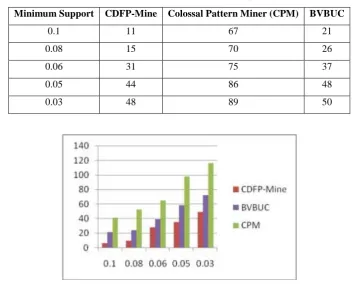
Table-7 and Table-8 demonstrate the consequence of running three algorithms CDFP-Mine, CPM and BUBVC on a real standard dataset Lung-Cancer(LC) and Prostate-Cancer(PC). It seemed that with expanding min_sup all the algorithm executed in the dataset will be diminished.
In regularly FPM algorithms, it is observed that the performance is poor when min_sup is lower value. In this way when the min_sup is small, CDFP-Mine has an effective mining proficiency. From Fig. 4 the performance on Lung-Cancer(LC), the distinction of the effectiveness of CDFP-Mine with CPM and BVBUC is very much when the min_sup is low value. From the Fig. 5 the performance on Prostate-Cancer(PC), it is observed that CDFP-Mine has a most extreme distinction in running time with CPM and least with BVBUC when the support is minimum value.
Table-7. Performance on Lung-Cancer (in sec)
Minimum Support CDFP-Mine Colossal Pattern Miner (CPM) BVBUC
0.1 06 41 21
0.08 09 52 24 0.06 28 65 39 0.05 35 98 58 0.03 49 116 72
Table 8. Performance on Prostate-Cancer (in sec)
Minimum Support CDFP-Mine Colossal Pattern Miner (CPM) BVBUC
0.1 11 67 21
0.08 15 70 26 0.06 31 75 37 0.05 44 86 48 0.03 48 89 50
1095 | P a g e
Figure-5. Performance on PC (sec)
Tables-9 and 10 demonstrate the accuracy of Colossal pattern sequences discovered using CDFP-Mine on different datasets is displayed.
Table-9. Colossal pattern sequences discovered using CDFP-Mine (with uniform RF)
Name of Dataset #Pattern sequences Maximum Accuracy (MA) Highest Frequency Measure (FM) Accuracy Measure (ACC) Average Frequency Measure (FM) Accuracy Measure (ACC)
Diabetes 923 97.79 68.54 74.09 66.87 73.83
Breast-Cancer
6936 100.00 96.08 96.42 94.55 95.12
Heart 41096 100.00 80.37 80.85 66.05 70.27
Table-10 Colossal pattern sequences discovered using CDFP-Mine (with varying RF)
Name of Dataset #Pattern sequences Maximum Accuracy (MA) Highest Frequency Measure (FM) Accuracy Measure (ACC) Average Frequency Measure (FM) Accuracy Measure (ACC)
Diabetes 1133 97.79 68.26 73.70 67.20 73.70
Breast-Cancer
11338 100.00 95.74 96.13 94.22 94.84
Heart 62833 100.00 79.40 79.87 64.74 69.94
VIII.CONCLUSION
H-1096 | P a g e
Struct. The exact investigation demonstrates that our algorithm has accomplished great mining efficiencies under various settings. Besides, our performance analysis shows that this algorithm additionally accomplishes the most elevated Frequency and Accuracy measures in finding CPSs and significantly the best contrasted with earlier created algorithms.
REFERENCES
[1] R. Agrawal and R. Srikant, Fast Algorithms for Mining Association Rules, In VLDB’94, pp. 487–499, (1994).
[2] H. Mannila, H. Toivonen and A. I. Verkamo, Efficient Algorithms for Discovering Association rules, In
KDD’94, pp. 181–192, (1994).
[3] H. Manila, H. Toivonen and A. I. Verkamo, Discovery of Frequent Episodes in Event Sequences, Data Mining and Knowledge Discovery, pp. 259–289, (1997).
[4] S. Brin, R. Motwani and C. Silverstein, Beyond Market Basket: Generalizing Association Rules to Correlations, In Proceedings of the ACM-SIGMOD International Conference on Management of Data, pp. 265–276, (1997).
[5] R. Srikant and R. Agrawal, Mining Sequential Patterns: Generalizations and Performance Improvements, In
EDBT’96, pp. 3–17, (1996).
[6] J. Pei, J. Han, B. Mortazavi-Asl, H. Pinto, Q. Chen, U. Dayal and M.-C. Hsu, PrefixSpan: Mining Sequential Patterns Efficiently by Prefix-Projected Pattern Growth, In ICDE’01, pp. 215–224, (2001).
[7] R. J. Bayardo, Efficiently Mining Long Patterns from Databases, In SIGMOD’98, pp. 85–93, (1998). [8] J. Pei, J. Han and R. Mao, CLOSET: An Efficient Algorithm for Mining Frequent Closed Itemsets, In Proc.
2000 ACM-SIGMOD Int.Workshop Data Mining and Knowledge Discovery (DMKD’00), pp. 11–20, (2000).
[9] M. Zaki, Generating Non-Redundant Association Rules, In KDD’00, pp. 34–43, (2000).
[10] Y. Cheng and G. M. Church, Biclustering of Expression Data, In Proc of the 8th Intl. Conf. Intelligent Systems for Mocular Biology, (2000).
[11] J. Yang, H. Wang, W. Wang and P. S. Yu, Enhanced Biclustering on Gene Expression Data, In Proc. of the 3rd IEEE Symposium on Bioinformatics and Bioengineering (BIBE), Washington DC, March (2003). [12] G. Cong, A. K. H. Tung, X. Xu, F. Pan and J. Yang, FARMER: Finding Interesting Rule Groups in
Microarray Datasets, In Proc. 23rd ACM Int. Conf. Management of Data, (2004).
[13] C. Creighton and S. Hanash, Mining Gene Expression Databases for Association Rules, Bioinformatics, vol. 19, (2003).
[14] N. Pasquier, Y. Bastide, R. Taouil and L. Lakhal, Discovering Frequent Closed Itemsets for Association Rules, In Proc. 7th Int’l Conf. Database Theory (ICDT), (1999).
1097 | P a g e
[16] F. Pan, G. Cong, A. K. H. Tung, J. Yang and M. J. Zaki, CARPENTER: Finding Closed Patterns in Long Biological Datasets, In Proc. ACM SIGKDD Int’l Conf. on Knowledge Discovery and Data Mining (KDD), (2003).
[17] D. Madhavi and M. Shashi, An Efficient Approach to Colossal Pattern Mining., In Proceedings of int. J. Computer Sci. Network Security (IJCSNS), vol. 6, pp. 304–312, (2010).
[18] Mohammed Karim Sohrabi, Ahmad A Barforoush Efficient Colossal Pattern Mining in High Dimensional Datasets, In Proceedintgs of Journal of Knowledge Based Systems, vol. 33, pp. 41–52, (2012).