ENGLISH lANGUAGE TEACHING IN HIGHER EDUCATION IN MOROCCO: AN EVAlUATION OF THE FEZ EXPERIENCE
Mohamed OUAKRIME
University of London Institute of Education
A Thesis submitted for the Degree of Ph.D. 1986
"",,'.-"'---/'BIBt. ' \
~ Cli': CdN. )
ABSTRACT
The study is an evaluation of the English Language Teaching programme implemented in a University Department of English as a Foreign Language in Morocco.
Using an eclectic-illuminative approach, and a predominantly qualitative methodology, the evaluation includes a description, analysis and tentative interpretation of the three general components of the programme: its purposes, its practices and its effects.
The fi rst part includes a) a background chapter on Hi gher Educat ion in Morocco, with special reference to LL.T., b) a conceptual framework which sets out the issues involved in evaluation, more particularly the illuminative style, and c) an account of the methodology adopted for the collection, analysis and interpretation of the data.
Part two is made up of three chapters:
- In Chapter 4, an evaluation is proposed of the purposes of the programme as reflected in the stated or implicit overall aims of Higher Education, the aims of LL.T., and the more specific objectives of the various courses taught as part of the programme.
- Chapter 5 is an eva 1 uat i on of the pract ices of the programme. The institutional context is an important determiner of those practices and is examined as a background to student and teacher evaluation of such areas as course content (syllabuses), teaching, and student learning. The chapter concludes with an account of the partiCipants' perceptions of the assessment system, based on an analysis of the 1984-85 examinations.
- Chapter 6 deals with the long-term effects of the programme as perceived by alumni and as reflected in their description of the impact of their experience of Higher Education.
ACKNOWlEDGEMENTS
The completion of this study was made possible by the help, advice and cri t i ci sm provi ded by a number of peop 1 e to whom I shou 1 d 1 i ke to express my gratitude.
Thanks are due to all my colleagues, students and former students, and members of the administration of the Fez Faculty of Arts who contri buted each in hi s/her own way to the provi s i on or co 11 ect i on of precious information for the study.
Thanks also go to co 11 eagues in Rabat, Meknes, Marrakesh and Oujda who completed questionnaires and those who gave up so much of their time for interviews.
I should like to record my thanks to the Dean of the Faculty of Arts for granting access to administrative documents and permission to distribute questionnaires and conduct interviews during the sensitive examination period.
lowe a speci a 1 debt of gratitude to Dr Roy Cox for hi s advi ce and patience, and the positive criticism he made about the draft version of the thesis. From him I learned the virtue of listening as analternative to talking in one's teaching endeavours.
I am grateful to Mr Ken Cripwell whose comments about the drafts of different chapters provided encouragement when it was most needed.
My thanks are extended to the Sri t ish Counci 1, P. Dawson, T. & Y. O'Brien and G. & A. El-Tayeb who all helped make my stay in London a comfortable one.
Finally, I wish to thank Susan Proctor for her patience in typing the thesis.
-ABSTRACT
ACKNOWLEDGEMENTS
ABBREVIATIONS
INTRODUCTION
CHAPT£R 1 BACKGROUND
CONTENTS
1. HIGHER EDUCATION IN MOROCCO
1.1 Emergence of a Moroccan 'modern' University 1.2 The 'mission' of H.E.
1.3 Open access and selection
1.4 Developmental pattern of institutions of H.E.
2. ENGLISH LANGUAGE TEACHING IN H.E.
2.1 Status of English
2.2 Teacher training in the E.L.T. programme 2.3 The institutional context
2.4 Organisational structure
3. ON THE NEED FOR AN EVALUATION OF THE E.L.T. PROGRAMME
3.1 The 'social-service' view and attrition rates 3.2 The 'unintended' mission of Departments of English 3.3 Changes in the programme
3.4 A special reference to the Fez experience
4. ISSUES OF E.L.T. IN MOROCCO
CHAPTER Z A CONCEPTUAL FRAMEWORK
1. PURPOSES OF THE EVALUATION
1.1 The informative function of evaluation 1.2 The interpretive function
1.3 Formative function 1.4 Decision-making
2. STYLES OF EVALUATION
2.1 Illuminative style 2.2 Responsive evaluation 2.3 Participative evaluation
3. ROLES OF THE EVALUATOR
CHAPT£R 3 METHODOLOGY
1. THE METHODOLOGY OF EVALUATION 1.1 Implications and constraints
1.2 The context of evaluation and methodology 1.3 Methodological procedures and information 2. A DESCRIPTION OF PHASES
2.1 Elicitation of perceived purposes 2.2 Practices and effects
CHAPTER 4 PURPOSES
1. I NTRODUCTI ON
1.1 Analysis of purposes 1.2 Perceptions of definition
1.3 Indicators of awareness and perceived definition 2. PURPOSES OF H.E.
2.1 The 'functional' purpose of H.E. 2.2 The socio-cu1tura1 purpose
2.3 Teaching/learning and research 3. PURPOSES OF THE E.L.T. PROGRAMME 3.1 Rationale: the status of English 3.2 Purposes of the programme
4. COURSE OBJECTIVES
4.1 Objective formulation and related issues 4.2 Stated course objectives
4.3 Course objectives: interpretive evaluation 5. STUDENT PURPOSES
5.1 Students' reasons
5.2 Students' motives and expectations
5.3 What do teachers and decision-makers think? SUlTlllary
CHAPT£R 5 PRACTICES
1. THE INSTITUTIONAL CONTEXT 1.1 Administrative organisation
1.2 Organisation of programme practices 1.3 The Department as a 'social system'
5
2. SYLLABUSES, TEACHING MATERIALS AND RELATED ACTIVITIES
2.1 Syllabus in the general context of E.L.T. 2.2 Approaches to syllabus design in the programme 2.3 Teaching/learning materials
2.4 'Extra-curricular' activities 3. TEACHING AND LEARNING PRACTICES 3.1 Course content
3.2 Evaluation of teaching: the teachers' point of view
3.3 Teaching and resulting learning acts 4. THE ASSESSMENT SYSTEM
4.1 A brief description of the system 4.2 Analysis of the 1984-85 examinations CHAPTER 6 ALUMNI EVALUATION AND PERCEIVED EFFECTS
1. ALUMNI EVALUATION OF PROGRAMME PRACTICES 1.1 Evaluation of courses
1.2 Teaching and assessment 1.3 'Social integration' 2. THE 4TH YEAR MONOGRAPH 2.1 Perceived functions
2.2 Undergraduate and alumni experience 3. 'USEFULNESS' AND LONG-TERM EFFECTS 3.1 'Vocational' effects of the programme 3.2 Attitude and value changes
Conclusion
CONCLUSIONS AND IMPLICATIONS
1. WHAT PURPOSES?
2. PRACTICES: CONSTRAINTS AND THE 'LOFTY' PURPOSES 3. IMPLICATIONS FOR ACTION AND FURTHER RESEARCH NOTES
REFERENCES AND BIBLIOGRAPHY
*
**
LIST OF TABLES
1.1 Staff composition (1984-85)
1.2 Staff teaching experience and rank (1984-85) 1.3 Staff characteristics (1984-85)
3. 1 3.2 3.3 4. 1 4.2 4.3 4.4 4.5 4.6 4.7 4.8 4.9 4.10 4.11 4.12 4.13 4.14 5.1 5.2 5.3 5.4 5.5 5.6 5.7 5.8 5.9 5.10 5. 11 5.12 5. 13
Data collection procedures and techniques Sampling for data collection
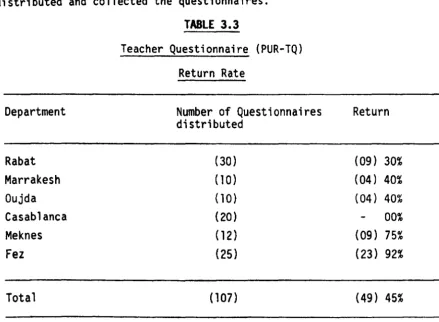
PUR-TQ, Return rate
Research as a purpose of H.E., Staff perceptions (PUR-TQ, Item 35)
Staff assessment of research facilities (PUR-TQ, Item 36)
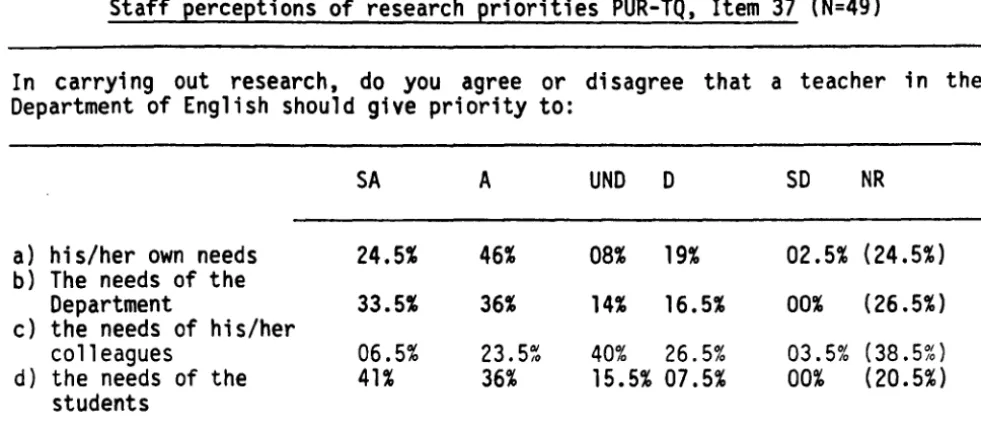
Staff perceptions of research priorities (PUR-TQ, Item 37)
The responsibility of purpose and objective formulation, Staff perceptions (PUR-TQ, Items 25a, 25c, 26a and 26b)
Staff opinions about the issue of objective/goal formulation (PUR-TQ, Items 18, 19 and 34)
Usefulness of course objective formulation (PUR-TQ, Item 22)
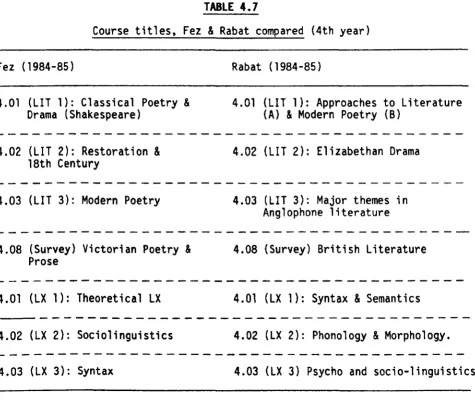
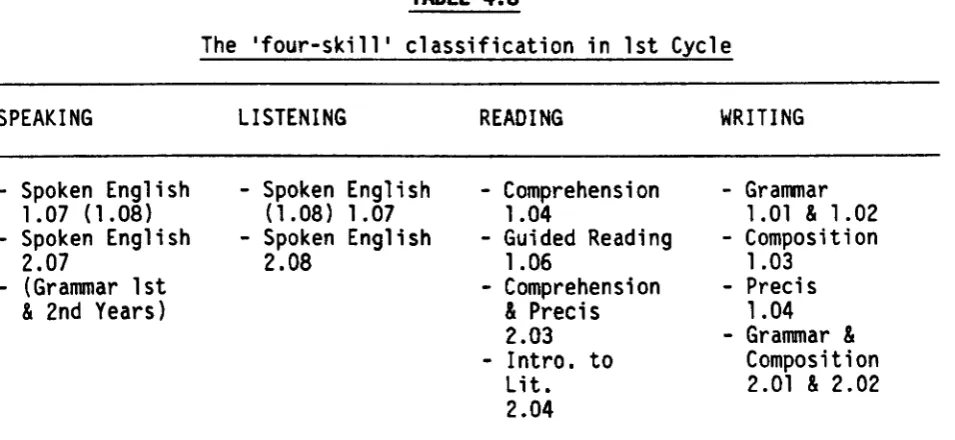
Course titles, Fez and Rabat CDs compared The four-skill classification: 1st Cycle
Choice of foreign languages at secondary school (PUR-SQ, Item 6)
Students' reasons for choice of Eng1 i sh at Secondary School (PUR-SQ, Item 19)
Students' decision to study English at University (Timing)(PUR-SQ, Item 23)
Students' perceptions of the employment market (PUR-SQ, Items 42 and 43)
Students' awareness of course object i ves, Staff perceptions (PUR-TQ, Item 21)
Tentati ve re1 ati onshi ps between H.E. and E.L. T.
purposes
Coordination in the programme: Teachers' opinions (PUR-TQ, Items 14-16)
Staff evaluation of library facilities (TEQ, Items 9-11)
Course distribution (1985-86) Teaching loads (1985-86)
Grouping and teacher-student ratios (1985-86) Student group-size preferences (PUR-SQ, Item 31) Student evaluation of group-size (SEQ, Item 10) Student satisfaction with time-tables (SEQ, Item 9) Staff satisfaction with time-tables (TEQ, Item 7) Distribution of respondents according to Baccalaureate type
Student residential patterns Staff composition (1985-86)
Students' opi nions about the importance of teacher characteristics and enthusiasm and interest (PUR-SQ,
Item 29)
7
-*
3.4**
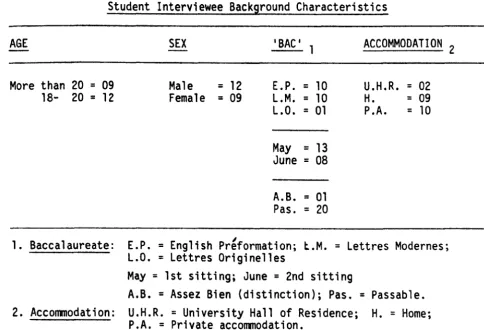
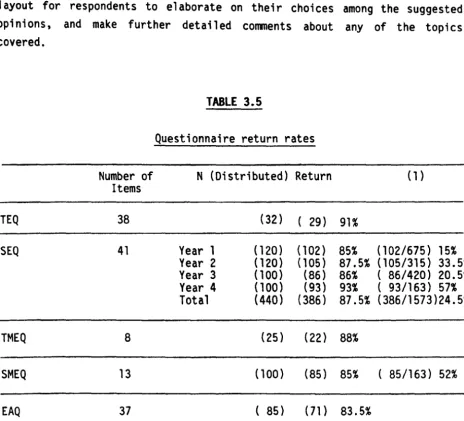
3.5Student Interviewee Background Characteristics Questionnaire Return Rate
5.14
5.15
5.16
5.17
5.18
5.19 5.20
5.21
6. 1 6.2 6.3
6.4
6.5
6.6 6.7
Student evaluation of the regularity of 'extra-curricu1ar'activities (SEQ, Item 12)
Student evaluation of teaching practices (SEQ, Items 13-19)
Student perceptions of teacher professional commitment (SEQ, Items 23-27)
'Conditional' admission required totals (1984-85) 'Conditional admissibility' (May and June 1985) Moderating effects of 'easier' exams
Oral exam results (1984-85) Overall exam results for 1984-85
Alumni evaluation of courses (EAQ, Items 14, 15 and 16)
Compared undergraduate and alumni assessment of the difficulty of courses (SEQ, Item 7 and EAQ, Item 14) Alumni satisfaction with teaching (ESQ, Item 13)
Alumni assessment of teacher-student relationships (EAQ, Item 18)
Staff overall opinions about the monograph system (TMEQ, Item 8)
Staff defi nit i on of the functions of the monograph (TMEQ, Item 1)
Undergraduate and alumni assessment of the monograph experience (SMEQ, Item 13 and EAQ, Item 37)
190 200 202 224 234 236 236 238
243
245
ABBREVIATIONS The following abbreviations are used in the text:
'Bac' Baccalaureate CD Course Description
C.P.R. Centre Pedagogique Regional (1st Cycle Teacher Training Centre)
OM Decision-maker(s)/making EAQ Effects Alumni Questionnaire EAI Effects Alumni Interview ECOM English for communication ECUl
E.l.T.
English for culture
English language Teaching
E.N.S. Ecole Normale Superieure (2nd Cycle Teacher Training College)
EREA English for research ES1 Effects Staff Interview ESl English as a Second Language
ESOl English for Speakers of Other languages ETEA English for Teaching
Fl Foreign language H.E. Higher Education
IDD Informal Discussion Data L2 Second language
LX Linguistics
00 Official Document
PUR Purposes
SEQ Student Evaluation Questionnaire TEQ Teacher Evaluation Questionnaire
TMEQ Teacher Monograph Evaluation Questionnaire
-'Educational systems must undergo a shift of emphasi s, the new stress must not be so much on producing an educated person as on producing an educable person who can learn and adapt himself efficiently all through his life to an environment that is ceaselessly changing.
If an educational system itself is not adaptable to changi n9 env; ronmenta 1 condit ions, how can it expect to produce people who are?'
INTRODUCTION
One of the most important reasons that motivated thi s study is the author's own experi ence of the E. L. T. progral1l11e in H. E. as implemented in the Fez Faculty of Arts. The opportunity to reflect on such experience and assess its components from the perspective of an 'insider-outsider' had the potential of providing a unique insight into the workings of the progral1l11e, and prompting a questioning of the kind of prejudices and misconceptions often formed as a resu 1 t of one's i nvo 1 vement in, and cOl1111i tment to practices developed in the process of the experience.
The evaluation is directed by what have proved to be overriding concerns of participants in the programme (decision-makers, staff and students), and attempts to address the three main questions: 1) what ;s the progral1111e trying to do, 2) how does it go about doing what it ;s trying to do, and 3) how are the effects of its workings perceived by members of the three groups of participants.
Investigating these three problems raises a number of issues relating to the concerns of members of the three groups of participants as , prov; ders ' (dec; s ion-makers) , pract it i oners (teachers) and 'c 1 i ent s ' (students). It assumes the adoption of a conceptual framework that will recognise the plurality of these concerns and the value systems that underliJ(e them, if it is to produce findings likely to clarify the issues at stake, and be responsive to what are perceived as the needs and interests of partiCipants. This also entails a systematic description of the programme, and an interpretation that will allow them to test their own understanding of its various components, and consider the potential uses to be made of the information yielded by the evaluation.
As the type of evaluation contemplated is a concept alien to the context in which the programme is functioning, one of its main aims is to develop participants' awareness of the need for an evaluative process to be incorporated as a component of this programme, and enable them to make informed decisions about the kind of changes most likely to improve both the 'effectiveness' and the 'efficiency' of the educational operation they
-are involved in.
Gi ven that the E. L. T. programme to be evaluated is operat; ng in the
genera 1 context of Hi gher Education, and that the over a 11 organi sat i ona 1 framework for studies in Faculties of Arts applies to all institutions
within these Faculties, we may assume that a certain degree of
generalisation is possible, and that the findings of the evaluation are likely to be relevant to the different situations prevailing in University Departments of Engl i sh all through the Uni vers i ty system. However, the flexibility of the framework, and the various interpretations it lends itself to in terms of implementation (teaching, learning and assessment procedures), points to limitations concerning the genera1iS4bi1ity of whatever results are derived from the evaluation of the Fez experience. Factors such as institutional size, organisation of the programme, internal decision-making in the Department, and the 'traditions' developed in each of these institutions, are important determiners of the ways purposes -however common at a national level - may be translated into practices to produce the anticipated outcomes.
For these reasons, a special reference is made to the Fez experience, wi th an attempt at comparat; ve references where enough ev; dence ex i sts in the data to justify comparisons. The possibility of making of the evaluation report a 'public document' for discussion by participants in the
E.L.T. progr~e in other universities, is an option for the evaluator, to
further assess the relevance of the fi ndi ngs to the concerns of
participants in other institutions of H.E. This we believe should foster the kind of debate needed for a clear definition of purposes, a rational
decision-making process for programme practices, and a systematic
evaluation of both the 'effectiveness' and the 'efficiency' of the E.L.T. programme in H.E.
The various reforms of the organisation of studies in H.E. in
The importance of the present evaluation is viewed in the context of the prevailing debate about the future of H.E., the rationale for including an E.L.T. component in the general curriculum of studies in Faculties of Arts, and the perceived relevance of these studies to the instrinsic educational and the more vocational needs and interests of the group of participants most affected by the decisions made for the implementation of the programme, viz. the students.
-CHAPTER ONE
BACKGROUND
1. HIGHER EDUCATION IN MOROCCO: OVERVIEW
1.1 Emergence of a Moroccan I modern I University
The hi story of Hi gher Education (H. E.) in Morocco seems to fit the
general pattern which has been set for the growth of universities in developing countries (for example, see Court, 1980).1 However. in addition to its specific characteristics which were determined by the very history of the country, the Moroccan University, unlike most universities in developing countries, has had a long tradition with the Qarawyin University which was founded in Fez in the 9th Century, and which is still functioning along5ide the more 'modern ' University established at the time the country became independent. The 'modern ' University was modelled on the French one and was for almost a decade no more than an annexe of Bordeaux University. Except in the Qarawyin, French was the medium of instruction and faculties and other institutions of H.E. adapted or adopted their syllabuses. teaching materials and techniques, and methods of assessment from the French University system.
Ouri ng the 1 ate 1960 I S and early 1970 IS, a seri es of reforms were adopted following the general policy of arabisation and moroccanisation of education in the country. Disciplines such as history and geography. philosophy, sociology etc in the Faculty of Arts, and certain components of the programne in the Faculty of Law, which up to then had been taught in French, were arabi sed. This process emphasised the need for a restructuring of H.E. and the different attempts at reforming the system of studies at University which took place in 1973, 1980, and 1983.
1.2 The 'mission' of H.E.
The first 'mission' assigned to the Moroccan University after
independence was to meet the imnediate national need for trained
professionals (teachers, doctors, engineers, etcJ to replace
expatriates, mainly French. This was to be the main function of faculties and other institutions of H.E., and in some way explains the development of a highly centralised system in which the definition of the needs of the country ; n terms of hi gh ly trai ned manpower was the respons i bi 1 i ty of administrators in different ministries, but in which the interpretation of the aims of educational programnes to meet those needs was inmost cases the responsibility of individual institutions within the University.
The issue of the functions of H.E. is central to the topic of the present study and is taken up in more detail in the section on purposes of
the English Language Teaching (E.L.T.) programne in H.E. (Chapter 4 •
Section 2.2, pp 98-101).
1.3 Open access and selection
The policy adopted for H.E. at the beginning was designed to achieve two aims. The first one, as stated above, was to train as large a number of nationals as possible to take over positions occupied by French expatriates in different sections of both the publ ic and private sectors. The second aim was to accommodate one of the most important tenets of social justice, as ; s usually the case wi th newly independent countri es, vi z. provi ding education for all. Thus, a policy of open access was adopted by most institutions, qualified in some instances by the conditional requirement for the candidate to hold a certain type of baccalaureate (Science or Maths in Faculties of Medicine and Science, and Engineering Schools). Faculties of Arts and Law opted for an even more li bera 1 system by maki ng access to thei r departments open to candi dates who di d not have the baccalaureate, but who had to take a special examination instead.
Soon however, the pressure of numbers was to be used as an excuse for introducing more stringent selection procedures (for example minimum grades in so-called 'primary' subjects, and a competitive examination) by the
-first group of institutions mentioned above. In the Faculties of Arts and Law, the special entrance examination which gave access to non-holders of the baccalaureate was abo 1 i shed and the baccalaureate made a requi rement for all applicants. The result of this development of a dual system was that in the first group of institutions, the student population was kept to reasonable proportions, with a highly favourable teacher-student ratio and quite a rational use of the educational facilities made available. In the second group, student numbers soared, and eventually the Faculties of Arts and Law came to be percei ved as i nst i tut ions desi gned to absorb the huge numbers of 'letters' and 'economic science' baccalaureate holders. In the last few years during which most posts - especially in teaching in secondary schools - have been filled, the risk is looming of these faculties becoming second-rate institutions, preparing their students for second-rate jobs at best, and unemployment at worst.
A direct result of the open access policy in the Moroccan system of H. E. are the hi gh rates of fai 1 ure and repeat; ng. As thi sis one of the most important issues in Departments of English at University, it is discussed in relation to the need for an evaluation of the E.L.T. programme and the proposed analysis of the assessment system (Chapter 5).
1.4 Developmental pattern of institutions of H.E.
As with the general development of education, the growth of institutions of H.E. in Morocco conforms to the pattern noticed for most institutions of the same type in developing countries (Court, op. cit.). For once it was felt that those institutions were managing to perform their function as places for training national future professionals, able to take over from expatri ates, they started concerni ng themselves with thei r own internal development. This consisted in restructuring the departments by introducing new courses, training and developing their own staff, and promoting the kind of research most likely to contribute both towards the national development and the internal development of the individual institution. The general feeling among 'decision-makers', university admi n i strators, and staff, 2 is that thi s stage in the development of H. E. establishments is far from having achieved its declared goals.
institutions of H.E. to be less dependent on teaching materials (especially texbooks) produced ; n Western uni vers i ties, by deve 1 opi ng new syll abuses, more adapted to what are percei ved as the needs of Moroccan students, and adopting new methods of assessment which would take into account the specificity of the national educational background. As pOinted out earlier, the heavy reliance on foreign programmes, and in some cases what amounted to no more than a duplication of course management and structure in universities of Europe and North America - and to a lesser extent the Middle East - still hamper the efforts of institutions to establish an identity for the Moroccan University. As most of these institutions are re 1 at i ve ly young, they have had as a constant preoccupat i on, not on ly establishing their independence vis-a-vis foreign modes of practice in H.E., but also developing their own pattern of management of teaching and research in relation to other national institutions having the same vocation. As will be seen in the description of the growth of Departments of English in Faculties of Arts, the interpretation of official documents into teaching syllabuses and assessment practices may be used to exemplify this stage in the development of institutions and departments within universities.
The last few years have seen a drastic reduction in the number of posts in the public sector, especially in education and administration. This type of employment which was implicitly guaranteed to university graduates is less and less available, which seems to justify the need for rethinking the relationship between H.E. and the training of manpower for the national job market. Students and society at large still place relatively high expectations 3 on the University to accommodate two seemingly contradictory purposes. Universities are expected to provide an environment in which students are offered facil ities and experiences for self development, unique to H.E., and at the same time equip them with the type of skills they will need in their post-university careers by deliberately referring to the job market in designing courses and implementing them. Equally high expectations are placed on the University to offer more and more places for the thousands of secondary school pupils every year, while establishing and maintaining the sound academic standards needed, if graduates are to stand a chance in the compet it; ve emp 1 oyment market.
-Moreover, the imposition of budgetary restrictions on the University
has implications for the quality of the facilities and type of experiences
it can provide. As almost all Moroccan students (more than 95%) receive a
government grant when they enter University, accountabil ity (both
administrative and academic) is already one of the most important issues to
which institutions of H.E. have to address themselves.
2. ENGlISH LANGUAGE TEACHING IN H.E.
2.1 Status of English
The only research survey to date on the motivation for foreign
1 anguage 1 earni ng among Moroccan secondary school pupi 1 s (Guebe 1 s, 1976)
shows the pl ace of Engli sh as the most important forei gn 1 anguage (French
being a second language) studied in educational institutions in Morocco.
Guebe 1 s found that, of the three fore; gn 1 anguages offered for study in
secondary schools (English, Spanish and German), English was preferred by
an overwhelming majority among the respondents. The growth in numbers of
teachers of English and the opening of special English classes
('Prlformation ' ) are evidence of the growing impact of English as a
component of the school curriculum, especially in the Arts section
(Ilettres Modernes ' ).
As will be discussed in detail below, the number of Departments of
English in H.E. has gone up from two in the early 1970 ' s (Rabat and Fez) to six in 1984 (Casablanca, Oujda and Marrakesh were opened in 1980 and Meknes
in October 1984), and the soaring numbers of students in these Departments
(less than 500 in 1973 and over 6,000 in 1984) are also indicators of the
importance of E.L. T. at Uni versi ty. With the openi ng of new Faculti es of
Arts and the prospect of at 1 east four more Departments of Engl i sh bei ng
added to the list already existing, these numbers are bound to go on
increasing.4
2.2 Teacher Training in the E.l.T. programme
The first of the two institutions responsible for training Moroccan
teachers of English was the C.P.R. (Centre P:dagogique Regional). Its
second year 'drop outs', and the other of students who hacl opted for training college after the baccalaureate. On completion of a two-year trai ni ng course, they were recrui ted as fi rst cyc1 e teachers in secondary schools. A recent innovation has been the setting up of a prograntne for staff development designed to help first cycle teachers aspire to second cycle status after one year.
Up until 1982-83, university graduates with a B.A. in English language and literature followed a one year training programme at what was the LN.S. (Ecole Normale Superieure) to become second cycle teachers. Whereas the C.P.R. prograntne included a language and literature component, that of the English Department of the E.N.S. focused on the methodology of T.E.F.L. (Teaching English as a Foreign language) with a practical component.
An important cons~uence of the reform of studi es implemented in 1982-83 was the creation of the new Faculty of Education, the long-term goa 1 of whi ch was to set up a graduate prograllllle ; n the educat i ana 1 sciences. However, the Department of English in this Faculty is still responsible for the professional training of secondary school teachers of English. As all students in this Department are graduates of different faculties of Arts, their perceptions of the effects of the E.L.T. programme they were exposed to at University make up an important part of the body of data analysed in the chapter on Effects. They are at an intermediary stage between their experience as university students and their professional careers, which may greatly affect their reflections on the different aspects of the said progralTll1e as it influences both their training and their future activities as teachers of English.
With the reduction in the number of teaching posts, although this is less acute a problem in E.L.T. than in some of the other disciplines taught in Faculties of Arts, a rethinking seems necessary of the 'mission' of Departments of Eng1 i sh of whi ch one of the 'uni ntended' outcomes has been the 'production' of graduates the majority of whom become teachers of English.
Insofar as the training and development of staff for E.L.T. is
-concerned, a new programme was set up in October 1982 for training national assistant lecturers for Departments of English in Faculties of Arts. The fi rst 1 aureates of thi s programme graduated from Rabat and Fez at the end of 1984. No evaluation of this programme exists and, although it is not a focal point in the present study, those who participated, or are participating in the Fez one are among the respondents.
This evaluative study is meant to concentrate on the E.L.T. programme as implemented in the Department of English of the Fez Faculty and, to help contexua 1 i se the problem, an overvi ew of the hi story and growth of E. L. T.
all through the system of university education in Morocco is called for.
2.3 The institutional context
2.3.1 Departments of English
The first established university Department of English was the Rabat one. With a history of over twenty years, it has contributed to the deve 1 opment of the E. L. T. programme in H. E. in Morocco, as Departments of Engl i sh in other parts of the country all have in one way or another used the Rabat one as a basis for deve 1 opi ng thei r own courses. Promi nent members of staff in Rabat have participated in initiating most of the changes implemented as a result of the three reforms of the organisation of
studies in Faculties of Arts.
The second uni versi ty Department of Engli sh was that of the Faculty
of Arts in Fez. It was set up in October 1973 as part of the new Annexe to
the Rabat Faculty. It started with 145 students and a nucleus of one full-time and three part-time members of staff. Although parts of the
content of speci fi c courses were new (set books for read i ng comprehension
and spoken Eng1 ; sh courses), the general structure of the programme was a
duplication of the Rabat one.
Within the following two years, the total number of students
increased by more than 300% and the number of teachers went up to fifteen
full-time. The institution itself had by then become an autonomous Faculty,
which encouraged the staff to take more initiative in designing and
implementing their programme. An English section of the Faculty library was
set up and a substanti a1 budget devoted to the purchase of books and the
installation of a language laboratory. At that time, what used to be
sections had become Departments, and the Department of English, with one
of the highest intakes in the Faculty, started acquiring a reputation.
Some of the consequences of such development were the increase in student
numbers, over-crowded classes, an insufficient number of books in the
library for students and subsequently, the kind of problems that hamper
academic development of institutions of higher learning found way to all
aspects of the management of the E.l.T. programme.
In October 1980, three new Faculties of Arts with English Departments
were opened as an attempt at decentralising H.E. and relieving the pressure
of student numbers from the already existing institutions. The pattern of
growth of Departments of English in Oujda, Casablanca and Marrakesh was the
same as that for Fez. The teacher-student ratio was far from being
favourable during the first two years and, by the time a large enough
number of staff had been recruited, the numbers of students had gone up to
proportions impossible to manage in a language department. Initially, the
teaching programmes were developed from either the Rabat or Fez ones, or
from a combination of both. With the recruitment of new teachers with
experience in T.E.F.l and the teaching of literature and linguistics, these
new departments are ; n the process of des i gni ng the; r own programmes. The
fi rst group of B.A. graduates from Casablanca, Oujda, and Marrakesh took
thei r fi na 1 fourth year exami nat ions at the end of the academi c year
1983-84.
-2.3.2 Student population
Except for a few individuals, all the students who enrol in Departments of English have followed the secondary school programme in the Arts ('Lettres') section, either 'Preformation', 'Lettres Modernes' or 'Lettres Originelles' (Arabi sed Baccalaureate). The 'Pr~formation' group have been through an intensive programme with eight hours of English tuition per week. A competitive examination is usually set up at the end of the Fifth Form to select suitable candidates for this special English class, and in addition, 'Pr~formation' pupils are required to take a special English paper in the Baccalaureate examination. The second group is made up of students with either a 'Lettres Modernes' or 'Lettres Originelles' baccalaureate. Statistically, there are more 'L.M.' than 'L.O.' candidates for English Departments, although no study has been carried out to investigate the potential differences in aptitude and achievement between members of the two groups.
A 1 arge majority of members of these groups are full-time students who, theoretically, are expected to attend regul arly as they recei ve a grant from the Ministry of Education. The term 'part-time' does not
accurately define the status of non full-time students as the French and Arabic equivalents seem more appropriate. A 'free' student may be either a repeater in one of the years, who attends classes regularly but doesn't get a grant (students are allowed to repeat only once in each cycle before they lose their grants), or a part-time student with an occupation. 'Free' students who are in full-time employment make up less than 10% of the total student population. (Elaborated comments are made about the composition of the student population in the English Department in Chapter 5, 1.3.1,
pp. l73-l77).
2.3.3 Teaching staff
training and experience brought by different members of staff, gives the Department of English its specific attributes which distinguish it from other departments in the instituti.on.
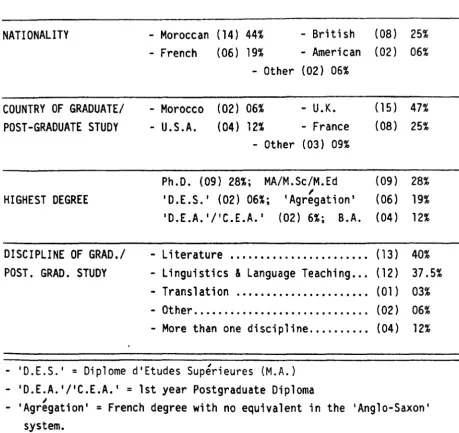
TABLE 1.1
Staff Composition, 1984-855
NATIONAL ITY - Moroccan (14) 44% - British (08) 25% - French (06) 19% - American (02) 06%
- Other (02) 06%
COUNTRY OF GRADUATEI - Morocco (02) 06% - U.K. (15 ) 47% POST-GRADUATE STUDY - U.S.A. (04) 12% - France (08) 25%
- Other (03) 09%
Ph . D . ( 09) 28%; MA/M.Sc/M.Ed (09) 28% HIGHEST DEGREE 'D.E.S. ' (02) 06%; 'Agregation' ~ (06) 19% 'D.E.A.' I'C.E.A.' (02) 6%; B.A. (04) 12%
DISCIPLINE OF GRAD.I - literature •.•.•.••...• (13 ) 40% POST. GRAD. STUDY - linguistics
&
Language Teaching ... ( 12) 37.5%- Translation ...•.•... (Ol) 03% - Other ... (02) 06% - More than one discipline ... (04) 12%
- 10.E.S.'
= Dip10me d'Etudes Superieures (M.A.)
- 'O.E.A.'/'C.E.A.'=
1st year Postgraduate Diploma~
- 'Agregation'
=
French degree with no equivalent in the IAnglo-Saxon' system.-During the first four years in the life of the Department, only two
Moroccan teachers were full-time members of staff. This situation
illustrates the stage in the internal development of institutions of H.E. during which the main preoccupation was to recruit and develop national staff. Thi s need was made even more urgent by the i nstabil i ty of the expatriate element of the staff at University, considering that the financial incentive which could have attracted them did not exist, as the salaries paid to university lecturers in Morocco are far below those offered by certain countries in the Middle East for example. Foreign members of staff are recrui ted on short term contracts (two years) and
institutions have to create a climate in which job
persona~atisfaction
- as opposed to financial contentment - could make up for the material loss those teachers are likely to incur by opting for less lucrative positions than the ones available elsewhere. This melding of products of different types of training and experience is an invaluable asset in a department in which English is taught as a foreign language, and such a melding has contributed not only to the provision of a wide mixture of experiences in terms of practical teaching, but also in creating a unique climate which could only be of benefit to both the students and the institution at large.
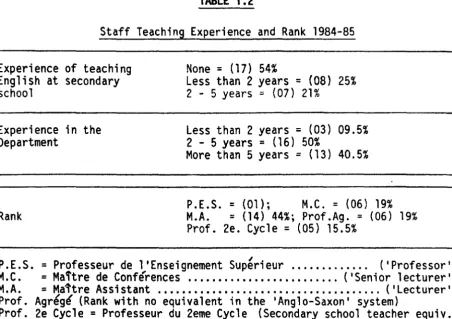
Concerni ng the teachi ng experi ence of members of staff, the fi gures
in Table 1.2 indicate that a large majority among them (90.5%) have
been in the Department for a long enough period of time (more than two years) to be familiar with the workings of the programme. Their experience
should allow them to contribute effectively to the development of the Department and the Faculty by building on the goals so far accomplished and
at the same time cons i deri ng potent i a 1 changes 1 i ke 1 y to foster growth. 46%
of the teachers have had some experi ence of teachi ng Eng 1; sh at secondary school and, although this factor tends to be overlooked, this may imply a better understanding of the value of the students' secondary school background and their perceptions and expectations when they enrol to study English at the University.
Of the seven· senior members of staff indicated in . Table"
2. ,
Union of University Teachers. Considering that th~ graduate programme recently set up in Faculties of Arts aims at training future university lecturers, staff stability seems to be a prerequisite for both supervision and teaching to be effective.
TABLE 1.2
Staff Teaching Experience and Rank 1984-85
Experience of teaching English at secondary school
None
=
(17) 54%Less than 2 years
=
(08) 25% 2 - 5 years; (07) 21%Experience in the
Department Less than 2 years 2 - 5 years
=
(16) 50%=
(03) 09.5% More than 5 years=
(13) 40.5%Rank
P.E.S. M.C. M.A. Prof. Prof.
P.E.S.
=
(01); M.C.= (06) 19%
M.A.=
(14) 44%; Prof.Ag.=
(06) 19%Prof. 2e. Cycle
=
(aS) 15.5%=
Professeur de 1 'Enseignement Sup~rieur ... ('Professor')=
Maitre de Conferences ...•.•...••.••.•.••... ('Senior lecturer')= Ma1'tre Assistant .•.•••.•••••.•.•...•... ('Lecturer') Agr6ge (Rank with no equivalent in the 'Anglo-Saxon' system)
2e Cycle
=
Professeur du 2eme Cycle (Secondary school teacher equiv.)TABLE 1.3
Staff Characteristics: Age
&
Sex 1984-85 (see note 5)AGE 25 - 30
=
(07) 22%30 - 40
=
(22) 69%Over 40 = (03) 09%
SEX Male
=
(23) 72%Female
=
(09) 28%-Only three out of the 14 Moroccan members of staff are female (21.5%). As suggested in Chapter 4 (1.3.2, p. 178), the reasons for this phenomenon remain to be investigated, although the social pressure exerted on female students to take up a job as soon as they graduate from the University is a possible factor. Less female students than male have enrolled in the new graduate programme or opted for further studies abroad and as this is the only way they can obtain teaching posts at the University, at least for graduates of English, this situation is likely to go on prevailing in the future.
The age distribution on the other hand exhibits a pattern which reflects the very nature of the Department as a relatively young institution of H.E. Further comments about this characteristic of teachers are made later, using the students' responses to an item included in the questionnaire on purposes of the prograll'l1le, and more specifically their perception of the importance of the age and sex of their teachers. 6
2.3.4 Facilities
In addition to the usual lecture rooms, four small rooms were allocated to the Department and used for small-group teaching {Spoken Eng1 i sh, 1 st and 2nd years and 4th year semi nar groups}, The app 1 i cat ion for the use of these rooms was a tactical move for two reasons: 1) easing the pressure on the use of class-rooms in time-tabling, and 2) achieving the hidden purpose of imposing the idea of small-group teaching as the administration - at the time responsible for time-tabling - always insisted on making full use of the large rooms, especially amphitheatres which had cost the Faculty a lot of money, whatever the consequences on the effectiveness of teaching.
language laboratories
section on teaching and learning (Chapter 5,1.2.1.2, pp. 162-163).
The library
As the English section of the library was almost nonexistent compared to other sections in 1973, a special effort was made to set up a nucleus, and the most important reference books and certain textbooks were acquired.
Li sts of these were submi tted by the staff, and soon an embryo of what could be called a library was constituted. However, the complex indexing system in use and the general organisation resulted in a state of affairs still prevailing at present: books purchased and indexed but never read by any of the students, much needed books borrowed and never returned, and such seemingly insoluble problems which are far from being an incentive for students to enjoy any kind of reading inside or outside the syllabus. A
Department 1 i brary wi th reference books and some speci ali sed works was set aside for 4th year students with quite a strict system of reserved borrowing. This not only helped the students to have direct access to the shelves but also compelled them to do the required reading in a minimum time. (Alumni assessment of this '2xperiment is reported in Chapter 6, 2.2.3.2, p. 268 ) •
2.4 Organisational structure
2.4.1 Departments of English within the system of H.E.
Departments of English started as sections within Faculties of Arts. Until the 1978 Reform was actually implemented, their decision-making power was limited to aspects of the programme such as content, teaching methods, and the academic organisation and administration of final year examinations. The administrative organisation of the Department (enrolment of students, time-tabling, staff recruitment and administrative organisation of examinations) was the responsibility - although less in Rabat than in Fez - of the administration (Dean, Vice-Dean, Secretary-General and clerical staff).. This pattern reflects the highly centralised character of the system of H.E., especially as the general structure of the progranme relating to the number and nature of courses, the weekly time allocated to each type (oral or written), and the number of examinations as well as regulations, were stipulated in a ministerial decree. Their
-acquisition of the full status of departments has meant a relative sharing in decision-making concerning the general administrative organisation and an advisory role in matters relating to the management of the LL.T.
progranJne in H.E. As a consequence, sections about Eel. T. in the 1983 Reform were the negotiated result of drafts of proposals made by the two departments existing at the time the text was finalised (Rabat and Fez).
The most important however, is that individual departments have exercised initiative in interpreting the terms of the Reform, while at the same time keeping the general framework provided in the official documents. The result of the varying interpretations made by different departments of
English is a difference in course content and modes of assessment, which members of staff in the respective institutions of H.E. generally consider as positive, in that it reflects 'variety within uniformity' and helps preserve national standards with the implementation of relatively autonomous programmes. To demonstrate the importance of such autonomy, the practices component of the proposed evaluation includes an element of comparison between the different interpretations of the E.l.T. programme as defined in the 1983 Reform, and its administration in departments of English in the country as reflected in course descriptions and assessment methods.
2.4.2 Specific characteristics of the Department of English within the Faculty of Arts
Insofar as objectives, content, and assessment of the different components of the progranne are concerned, actual decision-making is to a certain extent the prerogative of individuals and groups responsible for each component. Academic freedom is reflected in the fact that members of staff make what they thipk are appropriate decisions about course objectives and content, and adopt the teaching strategies they perceive as relevant. As no formal system of inspection exists in H.E., teachers are free and theoretically accountable only to other colleagues teaching the same course. This accountability is made necessary by the need for coordination in plannin5 and teaching, at least for the purposes of final assessment. Tenure is granted to Moroccan members of staff after a probat i onary peri od of two years upon recommend at i 00 by the Dean of the Faculty and is theoretically based on the applicant's demonstrated abilities in teaching and research. To date, at least as far as our institution is concerned, no case of failure to obtain tenure has been registered.
Another factor which adds to the uniqueness of the educational context we are concerned with, is the very nature of the fore; gn 1 anguage as the only medium of instruction used. Except for the Arabic, Islamic Studies, and second language components, all the teaching ;s done in English and it has been noted that quite often, students speak the foreign language even outside the learning context of the classroom. This is the main reason why student interviews for the evaluation were conducted mainly in Engli sh to ensure that they are taken seriously by respondents. An impression derived from personal experience is that the classroom atmosphere is relaxed enough for the desired type of interaction to take place and generally speaking, relationships between students and members of staff are less impersonal than the ones imposed by the purely traditional lecturing system of H.E. Student evaluation of teaching and the effects component of the evaluation should contain data to assess these impressions which have been developed as a result of the evaluator's experience in the Department.8
3. ON THE NEED FOR AN EVALUATION OF THE E.l.T. PROGRAMME
3.1 The 'social service ' view and attrition rates
As demonstrated by the open access policy followed during the initial
-st~ges, H.E. in Morocco had as one of its most salient characteristics, a largely 'social service' oriented goal at the beginning. Until the late
1960's and early 1970's, most institutions of H.E. tended to adhere to a
general national policy which made a certain type of baccalaureate the
only requirement for entry.
However, with the growth in student numbers which resulted in very
high rates of attrition, the only faculties with no selective requirements
at present are those of Arts and Law. The situation in Departments of
English is illustrative of this state of affairs and, although efforts have
been made to 'reori ent' app 1 i cants, the growth of the student popu 1 at ion
has reached such proportions that even the most liberal and
democratically-minded individuals in the Department have come to accept
the institution of some kind of selection system as the only solution,
whatever the injustice and drawbacks.
As indicated in Appendix 1.1 (p.319 ) the increase in the number of
new students in 1st year has been constant since the opening of the
Department. In 1980-81, the creation of a new Uni vers ity in Oujda wi th an
English Department, temporarily eased the pressure of numbers on Fez. A
second decrease was noticed in 1982-83 (-7.5%) when new regulations
concerning enrolment were introduced whereby 'part-time' students were
required to submit a special authorisation from their employers (for most
of them the Mi ni stry of Education). A consequence brought about by thi s
change is that since 1982-83, the number of 'part-time' students has been
kept down to a minimum (less than 5%), especially in faculties of Arts
where the majority of applicants are employed by the Ministry of Education.
A compari son of the rates of 1 st year intake and comp 1 et i on rates (see
Appendi x 1.2, p. 319) shows the degree of wastage that has characteri sed
the results obtained in the Department, which is also a characteristic of
all other English Departments in the country.
Failure rates in H.E. in general have come to be considered as a
us~fu1 means of controlling numbers and at the same time upholding the quality of academic standards. As already pointed out, the seriousness
of the system is quite often measured by the number of students who 'don't
make it'. This - it is claimed - is one of the characteristics which the
One wonders however how this restraining factor for the development of an effective structure can still persist after more than a decade of the emergence of the Moroccan University.
Of 2,436 students enrolled in the Department between 1973-74 and 1981-82, only 646 (26.5%) actually graduated. An examination of the results for the following years (1982-83 to 1984-85) suggests that the overall graduation rate of 26.5% obtained during the first ten years in the life of the Department is unlikely to improve, given the present conditions, which are far from being specific to Departments of English.
The attrition rates, which may be inferred from the statistics indicated in Appendix 1.3, (p. 320) for the twelve years of the Department of English, suggest that although the system is not selective at the outset, it has established a tradition of accepting high rates of failure as normal. In some departments in faculties of Arts, pass rates of over 40% are considered as an indicator of the lack of seriousness of examinations and/or teaching staff. Generally speaking, high pass rates (anything above 50%) tend to be associated with an excess of leniency on the part of examiners.
3.2 The unintended mission of Departments of English
Of all the students who did enrol in the Department of English between 1973-74 and 1981-82 (see Appendix I.3), 646 (26.5%) completed the B.A. degree. Although no statistics are available at present, one may say with near certainty that a large majority of them have either followed the E.N.S. (Ecole Norma1e Superieure, present Faculty of Education) training programme, or gone abroad (France, U.K. or U.S.A.) for further studies. It is expected that most members in the latter group will be/have been recruited to teach English in institutions of H.E.
A number of those who managed to pass 2nd year, but did not complete the B.A., used to be recruited by the Ministry of Education as first cycle teachers. A few of these enrol as 'free ' students and, in spite of a heavy teaching load, go on trying to get through the hurdles of 3rd and 4th year examinations. A large majority of those who fail either at the end of 2nd year or in 1st year tend to stay on and repeat. In quite a number of cases,
-a period of up to three ye-ars is spent in either one or both first cycle years. Students who deci ded to gi ve up 1 n the fi rst cyc 1 e used to be recruited as 'charge de cours', a temporary teaching position which is not offered any more, not even to second year drop-outs.
The degree of satisfaction of employers (Ministry of Education through secondary school headmasters and inspectors) with the product of the University in E.l.T. has never been investigated. The university graduates' proficiency in the English language is an important indicator of their success as teachers, although not the most important, and this seems to be the aspect of thei r trai ni ng wh1 ch is acqui red in Departments of English. It justifies the impression that a crucial part of the mission of H.E. in this case is to develop the student's ability to communicate, both in speaking and in writing, in the English language.
3.3 Changes in the programme
The E. l. T. programme as it stands is the product of a seri es of reforms of the organisation of studies in H.E. which have taken place in the last ten years. In~pite of all these changes, most of the issues raised by the designing and implementation of the programe are as relevant in 1986 as they were in 1973 when the Fez Department of English was set up.
The different versions of the E.l.T. component of studies in faculties of Arts as formulated in the three reform texts published since 1973 were the result of lengthy deliberations at the decision-making level and seem to have taken into consideration the proposals made by individual departments. Components of the programme such as courses taught and the assessment procedures are part of the legal texts which legislate the organisation of studies at the University. The impression one gets from talking to members of staff suggests that they generally tend either to r dissociate themselves completely from the official wording of the progranl1\e, or at best interpret its terms in a way that fits their own conceptions of the purpose of the educational operation they are involved
in. Their interpretations are reflected in the content of courses which they think is designed to serve their students' immediate needs.
developmental pattern followed by faculties of Arts is that they are more or less considered as institutions designed to absorb the large numbers of holders of the Arts baccalaureate. Thus, it seems more important than ever before for departments of English, which have one of the highest intakes in the University, to reconsider the purposes of their progralTll1es. Moreover, as the discipline offered in these departments (English as a Foreign Language) is still perceived as one of the few subjects taught at faculties of Arts likely to guarantee future prospects of employment, the motivation of students bei ng hi gh ly i nstrumenta 1, it is essent i a 1 that students are provided with the type of information they need to make decisions which will affect their future careers. The very high expectations students place on the Departments of English plead for an evaluation and, consequently, a rethinking of the purposes and practices of the progralTll1e in which nearly 4,000 students have been involved since the opening of the Department in
1973.
3.4 . Special reference to the Fez experience
For practical reasons, the present study is intended to concentrate on the progralTll1e of E. L. T. in H. E. as concei ved and implemented in the Department of English of the Faculty of Arts in Fez. Following are some of these reasons:
1. The Fez Department of Eng1 i sh was opened at least ten years after the Rabat one and seven years before the three departments in the new uni versi ties of Oujda, Marrakesh and Casablanca. Thi s makes the Fez experience unique in that in establishing the Department, the staff could refer to the Rabat experience, and at the same time take initiatives in designing their own courses and implementing them. In this respect, Fez is neither an old established department nor a new one.
2. What seems to constitute another valid reason for making special
reference to Fez is that the evaluator has had first-hand experience of the progral1lT1e both as a member of staff and as acting chai rman. Thi s status in the institution should make access to useful information relatively easy and ensure the necessary cooperation of administrators, colleagues and students.
-r
3. Restrictions on the amount of time to be devoted to completing the research project, and the need for the evaluation to encompass as many aspects of the programme as possible, dictate limitations on its scope.
However, to gi ve the fi ndi ngs of the study a wi de enough scope of application and for purposes of validating those findings, comparative data are used wherever possible. Feedback on the tentative results of the analysis of data for all three phases of the evaluation was provided to
teachers and decision-makers in other universities than Fez and their
reactions recorded. As the most crucial decisions which have affected - and will in the future affect - the workings of the programme and its general organisation have always been taken at a national level, the proposed
evaluation will lose the most important of its justifications if it does ~O~
take into account the national context of E.L.T. in H.E. in Morocco.
4. ISSUES OF E.L.T. IN H.E. IN MOROCCO
Any attempt at formulating the issues raised by the implementation of the E.L.T. programme in H.E. in Morocco at this stage is bound to be tentative and exploratory. The mere fact that such issues, when discussed
by those concerned, are 'blamed on lithe system" I , does explain their
elusive nature. A formulation of those issues will be derived from a description of the context in which the programne is functioning and. to
conform to the style advocated for our study, it (the formulation) will
need to be corroborated by an investigation of perceptions of participants as to their nature, and the reasons for their existence and importance.
As the evaluator has been involved with the programme from its beginning, both as course planner and practitioner, his own experience, however limited and idiosyncratic, is used as a reference in considering the issues at stake.
Issues re 1 at i ng to the content of programme courses, practices, as well as the outcomes expected to result from them, seem to deri ve from a
numbers have been going up constantly: the number of Departments of English has gone up from two in 1973 to 5 in 1980 with over 10,000 students in 1985-86 (less than 500 in 1973).
The most important however, is that the uncertai nty referred to is more related to what are seen as objectives and practices for achieving purposes. Problems concerning the content of courses, the teaching techniques, and the assessment methods, reflect the lack of conviction that characterises most of the undertakings of people involved in the programme. Another issue is the students' apparent lack of understanding of the programne's broad aims, and the need for them to adopt a new set of attitudes, which may conflict with their held values, to actu~lly think of their experience in H.E. as more than training for a job •
Considering that 'communicative competence,9 in the foreign language is seen by practitioners as a vague aim of E.l. T., the difficulty of actually measuring the extent to which it has been attained by students makes the examinations as conceived by decision-makers at the level of the Ministry of H.E. far from being a satisfactory system of assessment.
The high rates of failure and drop out which are perceived as the result of the practices adopted, raise questions concerning the .emocracy of a system that praises itself for having no selective element at the outset, but which becomes over-selective as it proceeds. Student stri kes are a familiar event in H.E., and one of the main claims of the student-body is a share in the decision-making process. No wonder then, that quite a large number of them have come to view failure in examinations as evidence of the failure of the system, and thus justify their resistance to considering themselves responsible in any way for the experience they are undergoing.
In the same way as the aims and style of the evaluation have methodological implications, the issues deriving from the designing, implementation and assessment of the programme are likely to influence the choice of methods and procedures for carrying out the evaluative study. In order to face up to the cha 11 enge of the complex nature of the issues mentioned, and accolTl11odate the array of points of view likely to result from the discussion, it is worth emphasising the need for an eclectic
CHAPTER TlIO
-A CONCEPTU-AL FR-AMEWORK
Introduction
Making decisions about the theoretical model one is to adopt for an evaluation requires as exhaustive a review of the literature as possible, in order to justify the choice of a particular framework within the array of poss i bili ties open to the researcher. 1h"5 , gi ven the 1 i mi ted scope of the present chapter, and for the purposes of the proposed study, it seems that the importance of such a review will be limited if it sets out to enumerate and discuss the models without offering an appropriate justification for the choice. The main aim of this chapter is to examine the implications of theoretical issues of evaluation such as purposes and style, as well as the roles the evaluator is called upon to assume. The methodological component is dealt with later as it is likely to be determined by the three methodological components involved, namely: purposes, style and roles.
In taking account of the specific nature of the programme to be evaluated and the need for an eclectic approach, we are making assumptions concerning the educational issues at stake, the prevailing relationships between the programe components and the di fferent groups of part i ci pants involved in it and the role and relation systems that obtain among them. Thus, this part of the study is intended to cover the four main determining factors that make up a theoretical framework: 1) the functions that the evaluation is supposed to serve; 2) the style to be adopted in carrying out the evaluative study bearing in mind the implications of 1); 3) the roles of the evaluator in relation to the programe and the participants as determi ned by 1 and 2, and 4) the methodo 1 ogi ca 1 approach for co 11 ect i ng and analysing data and reporting the findings of the study.
1. PURPOSES OF THE EVALUATION
A premise we intend to start from is that a statement of the purposes of the evaluation will set limits to the scope of such an enterprise and