Impact of next future Direct Detection experiments on Dark
Por-tals and beyond
Giorgio Arcadi1,a
1Max Planck Institüt für Kernphysik, Saupfercheckweg 1, 69117 Heidelberg, Germany
Abstract.WIMPs are attractive DM candidates. The simplest model realizations, dubbed Dark Portals are in strong tensions with detection constraints. Two component DM setups can relax these tensions.
1 Introduction
Weakly interacting massive particles (WIMPs) are among the most popular DM candidates. Their production mechanism predicts the existence, in thermal equilibrium, of the DM in the primordial thermal bath and a subsequent decoupling (freeze-out). The value of the DM abundance is determined by a single particle physics input, consisting in the thermally averaged pair annihilation cross-section; more specificallyΩDMh2 ∝1/σvso thatΩDMh20.12→ σv ∼3×10⁻²⁶cm3s−1[1]. This value
of the pair annihilation cross section implies sizeable enough interactions between the DM and the SM states to be in the reach of present experimental facilities. A simple framework for unveiling the potential correlations between the DM relic density and experimental searches is represented by the ’Dark Portals’; simple extensions of the SM in which the DM annihilations into SM states (mostly SM fermions) are induced by a s-channel mediator. In these kind of setups the DM annihilation cross-section and experimentally testable observables, like the scattering cross-section on nucleons, are related by simple crossing-symmetries. Because of these strong correlations, however, Dark Por-tals are in increasing tension with constraints from Direct Detection and many realizations will be substantially ruled-out in case of absence of signals from next generations of 1TON detectors, like XENON1T. A possible way-out for preserving the WIMP paradigm, compatibly with experimental constraints, is represented by considering two-component Dark portals. We will briefly illustrate a specific example in the second part of the text.
2 Single Component Dark Portals
Dark Portals are simple extension of the Standard model with the DM candidate and, possibly, a medi-ator of its interactions with the SM (fermions). Being these models built on purely phenomenological basis one can consider all the possible spin combinations between the DM and the mediator which are allowed by Lorentz invariance. For definiteness we will just focus on the cases of a scalar DM candidateχor a vector stateVμinteracting with a scalar mediator. This kind of interaction does not
require, in general, the presence of extra states, with respect to the SM, since it is realized, at the renor-malizable level and in a Lorentz and gauge invariant way, by the four-field interactionsλχ|χ|2H†Hor
λVVμV
μH†H, withHbeing the SM Higgs doublet andλχ,V adimensional couplings, which lead, after EW symmetry breaking, to trilinear interactions between the SM Higgs and a DM pair. These kind of interactions can be schematically written as (for simplicity we report just the interactions with SM fermions):
Lχ=
μχ|χ|2+λff f¯
h, LV =
μVVμV
μ+λff f¯
h (1)
whereμχ,V = λχ,Vvh andλf = mf/vh, with vh being the Higgs vev. The scalar or vectorial DM
annihilates into SM fermions (as well as gauge bosons and higgs pairs) through s-channel exchange ofh. The corresponding cross sections can be analytically approximated as1:
σvχ≈
f
ncf|μχ|2 4π(m2
h−4m2χ)2
, σvV ≈
f
ncf|μV|2
4π(m2
h−4m2V)2
(2)
At the same time, t-channel exchange ofhinduces Spin Independent (SI) scattering cross-sections on nucleons of the form:
σSI
χ =
|μχ|2μ2Nχ 4πm4
hm2χ
|Z fp+(A−Z)fn|2
A2 , σ
SI
χ =
|μV|2μ2
NV
4πm4
hm2V
|Z fp+(A−Z)fn|2
A2 (3)
whereμ(χ,V)N is the DM-nucleon reduced mass and fp,n are the couplings of the DM with protons
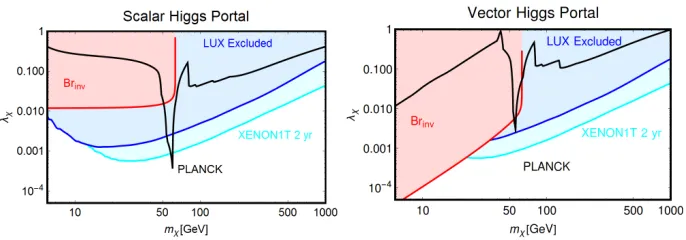
and neutrons. A straightforward comparison between eq. (2) and (3) evidences similar parametric dependences for the two classes of cross-section. We can then compare, the constraints from the cor-rect DM relic density and from DM DD in the bidimensional plane (mχ,V, μχ,V). An example of this
kind of comparison is shown, in fig. (1), in the case of Scalar and Vector Higgs portal (as already mentioned above we can trade, in these kind of scenarios, the dimensional parametersμχ,V with the
dimensionless quantitiesλχ,V.). By imposing the constraint Ωχ,Vh2 = 0.12±10%, it is possible to
identify curves (represented in black in the two panels of fig. (1)) in the plane (mχ,V, μχ,V). These isocontours have been overlapped to the exclusion regions obtained by imposing that the DM scat-tering cross-sections (3) lie below current LUX sensitivity [3] (blue regions), and a 2 year projected sensitivity of XENON1T [4] (cyan regions), and that the decay rate of the Higgs into a DM pair, when kinematically open, corresponds to an invisible branching fraction below present limits [5].
As evident, current direct detection constraints already rule-out thermal DM ad exception of the ’pole’ regions, i.e. mχ,V mh/2 (low values of the DM mass, even outside the reach of DD experiments,
are excluded since induce a too high invisible width of the Higgs). The WIMP hyphothesis would be completely ruled-out by absence of signals in XENON1T.
3 Two component Dark Portals
In order to keep relying on the WIMP paradigm, compatibly with DD constraints, it is necessary to decorrelate (at least partially) the DM annihilation cross-section and the scattering cross-section on nucleons. This makes necessary to go beyond the too simplistic structure of Dark Portals. An inter-esting possibility would be to consider a two-component DM scenario. In such a case the interplay between DM relic density and DD is more complicated. Indeed, a DD signal would arise from a sum of two, possibly different, contributions, weighted by the relative abundances of the two components. The latters are not necessarily dominated by pair annihilations into SM states, which can be directly
1These expressions are not valid close to the pole regions [2], i.em
Figure 1. Combined constraints for scalar (left panel) and vector (right panel) Higgs portals. The black lines represent the isocontours of the correct DM relic density. The blue regions are excluded by current constraints by LUX [3] while the cyan region will be excluded in case of absence of signals at XENON1T after two years of excluded. In the red regions the invisible branching fraction, originated by decays into DM pairs, exceeds the experimental bounds [5].
related to the scattering rates, but processes like pair annihilations of one DM component to the other, can play a relevant role.
An interesting realization of a two-component DM scenario has been proposed in [6]. Here the SM is extended by a dark sector characterized by a newS U(3) gauge symmetry, spontaneosly broken, by the vevs of two fields, φ1 andφ2, belonging to its fundamental representation, into a discrete
globalZ2 × Z2 symmetry. The only states, apart the higgs bosons, present in the new sector are
the 8 (massive) SU(3) gauge bosons. The lightest new states odd under the discrete symmetry are automatically DM candidates. The contact between the dark and the visible (i.e. the SM) sector is established by portal like interactions induced by operators of the typeλH11|H|2|φ1|2+λH22|H|2|φ2|2.
The fields of the dark sector are described by the following Lagrangian:
L=(Dμφ1)†(Dμφ1)†+(Dμφ2)†(Dμφ2)†−
1 4G
a
μνGaμν, Gaμν =∂μAaν−∂νAaμ−g˜fabcAbμAcν (4)
where the Higgs tripletsφ1andφ2are expressed, in the unitary gauge, as:
φ1=
1
√
2
⎛ ⎜⎜⎜⎜⎜ ⎜⎜⎜⎝ 00
v1+ϕ1 ⎞ ⎟⎟⎟⎟⎟
⎟⎟⎟⎠, φ2=
1
√
2
⎛ ⎜⎜⎜⎜⎜
⎜⎜⎜⎝ v2+0ϕ2
v3+ϕ3+i(v4+χ)
⎞ ⎟⎟⎟⎟⎟
⎟⎟⎟⎠ (5)
Under the assumption of CP-conservation the mixing with the Higgs doublet H = (0 v√+h
2)
T gives
rise to 4 CP-even scalarshi=1,4 and on CP-oddχ. The latter is odd also under the residual symmetry
Z2× Z2and can then represent a DM candidate.
Despite the general model is rather complicated (see [6] for more details), its most relevant features can be caught by the following simplified limit. Assuming a direct coupling of onlyφ2with the Higgs,
i.e. λH11 =0 and settingv3 ∼0, v2 v1, the relevant particle spectrum of the dark sector reduces to
a two component DM, consisting into CP-odd dark Higgsχand the mass degenerate vector pairAμ1,2, interacting with the SM through the two lightest CP-even mass eigenstatesh1,2(h1is identified with
the SM Higgs). The DM interaction Lagrangian is thus simply written as:
L= g˜mA
2 (−h1sinθ+h2cosθ)
a=1,2
Aa
with ˜gandθbeing the new gauge coupling and the mixing angle between SM and dark Higgs, and substantially resembles a two-component dark portal Lagrangian. The coupling of the scalar DM componentχdepends on theλH22and on the quartic self-coupling ofφ2,λ2. These can be rexpressed
as:
λ2=g˜2
cos2θm2
h2+sin
2θm2
h1 4m2
A
, λH22=g˜
(m2
h1−m
2
h2) sinθcosθ
2vhmA (7)
Despite the similarity with the Lagrangians (1) the DM phenomenology is sensitively different. We have indeed that the annihilation of the vectorial component is enhanced by the presence of the ’dark’ channelAA→χχwhich is dominant, at least in some regions of the parameter space, because does on depend, contrary to the ones into SM states, on sinθ, which is constrained to be small because of the constraints on not standard decay branching fractions of the 125 GeV Higgs. For what regards the DM direct detection the scalar component features, instead, a peculiar behaviour. In the non relativistic limit, its effective coupling with the quarks is given by:
gχχqq∝
⎡ ⎢⎢⎢⎢⎢ ⎣m12
h1
cos2θλH22vh−sinθcosθλ2v2
− 1
m2
h2
sin2θλH22vh+sinθcosθλ2v2
⎤⎥⎥⎥⎥⎥
⎦ (8)
It can be straightforwardly verified, by substituting eq. (7), that this coupling is null.
An interesting setup thus emerges: only one dark matter component is actually capable of scattering with nucleons but his abundance is reduced by a new annihilation channel, so that the total event rate at a DD experiment would be reduced. Moreover the annihilation and scattering cross-section are not fully correlated since the latter depends on sinθwhileAA→χχprocess not. The other DM component, with an unsuppressed abundance, is instead not capable of scattering off-nuclei.
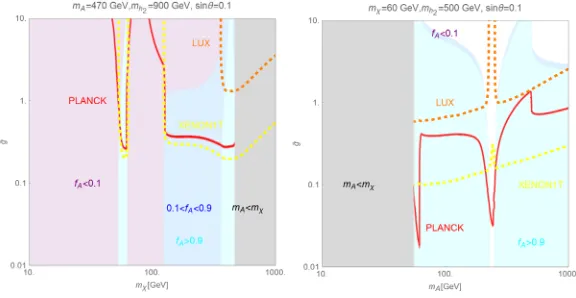
Figure 2. Combined constraints for two two-component DM benchmarks. The red contours represent the ex-perimentally favoured value of the (total) DM relic density. The orange and yellow lines represent, respectively, the current limit by LUX [3] and a 2 yr exposure projected sensitivity by XENON1T [4]. The colored regions represent three ranges,<0.1, 0.1−0.9 and>0.9, of the density fractionfAof the vectorial DM component.
right panel of fig. 2). On the contrary this scenario will be probed, at least partially by XENON1T, although an exposure time of two years will be needed.
4 Conclusions
WIMPs are an attractive class of DM candidates. The simplest model realizations, dubbed dark por-tals, are in increasing tension with limits from Direct Detection. We have shown in an explicit example that this kind of bounds can be easily relaxed in multi-component DM constructions.
Acknowledgements: The author warmly thanks the organizers of the RICAP conference for the chance of giving this contribution.
References
[1] P.A.R. Ade et al. (Planck), Astron. Astrophys.594, A13 (2016),1502.01589 [2] K. Griest, D. Seckel, Phys. Rev.D43, 3191 (1991)
[3] D.S. Akerib et al. (LUX), Phys. Rev. Lett.116, 161301 (2016),1512.03506 [4] E. Aprile et al. (XENON), JCAP1604, 027 (2016),1512.07501