Available online:
https://edupediapublications.org/journals/index.php/IJR/
P a g e | 101Priority Of Overflow Tasks To Increase Performance Of Mobile In Cloud
Computing
Chava.Kavya Sri & M.Sridevi
1M-Tech, Dept. of CSE,Laqshya Institute of Technology and Sciences, Khammam
2HOD, Dept. of CSE,Laqshya Institute of Technology and Sciences, Khammam
Abstract
Portable creations may offload their applications
to a virtual machine running on a cloud have.
This application may fork beginning assignments
which require virtual machines of their own on
the same physical machine. Accomplishing
copacetic execution level in such a situation
requires adaptable asset allotment systems in the
cloud server farm. In this paper we show two
such instruments which utilize prioritization one
in which forked tasks[7] are given full need over
from early on arrived errands, and another in
which an edge is built up to control the need with
the goal that full need is given to the forked
assignments if their number surpasses a
predefined edge. We dissect the execution of the
two instruments using a Mark ovine multi server
lining framework with two need levels to
demonstrate the asset allotment process, and a
multi-dimensional Markov framework predicated
on a Birth-Death lining framework with limited
populace, to show virtual machine provisioning.
Our execution comes about mean that the limit
predicated need plot perform prevalent, as well
as can withal be tuned to accomplish the coveted
execution level.
Key words: - Virtual Machine running, captivated, control need, multi-dimensional, edge predicated need.
1. INTRODUCTION
The pressure between asset hungry applications,
for example, confront apperception, common
dialect handling, intuitive gaming, and expanded
validness, and asset and vitality compelled
portable creations represents a central test for
present and future versatile stage advancement.
Portable distributed computing, where [4]
versatile creations can offload some
computational employments to the cloud is
imagined as a promising way to deal with
address such a test. The qualities of versatile
inventions and remote system makes the usage of
portable distributed computing more bewildered
than stationary mists. Offloading asks for from a
portable creation usually require quick
replication, might be occasional, and are liable to
Available online:
https://edupediapublications.org/journals/index.php/IJR/
P a g e | 102mists bring about generally long setup times, are
rented for long eras, and relish continuous
system network. Moreover, the volume of
workload to be offloaded may not be kenned
ahead of time since a considerable lot of the
offload demands are the result of choices made
by the (by and large fanciful) human utilizer of
the creation. In this work, we address the
flexibility in versatile distributed computing with
an answer that allots assets for on request work
asks for in the portable mists. We don't consider
the offloading choice process in the portable
inventions; rather, we deduce that the choice to
offload has been made, and we focus on the
designation of cloud assets to the offloaded
applications sent to a cloud server farm. In
particular, employments offloaded by portable
creations are executed by virtual machines
(VMs) facilitated on physical machines (PMs) in
a versatile cloud. Amid their lifetime, these
occupations (withal alluded to as essential
undertakings) can fork nascent, optional errands;
work is fulfilled when[1] all the forked
assignments perfect their settlement. As auxiliary
assignments need to speak with the essential
undertaking and additionally with each other,
their dispensed VMs ought to ideally be
facilitated on an indistinguishable PM from the
parent errand's VM. Be that as it may, the host
PM might not have the assets required to execute
the optional assignment, which is then lined as
"flood" undertakings keeping in mind the end
goal to locate a nascent 'home'. Since the
employment itself has been started by a versatile
utilizer, auxiliary assignments, and flood
undertakings specifically, should be overhauled
as anon as could reasonably be expected, in order
to avoid intrusion of the application and the
subsequent utilizer disappointment.
2. RELEGATED WORK 2.1Existing System
The pressure between asset hungry applications,
for example, confront apperception,
characteristic dialect preparing, intelligent
gaming, and increased credibility, and asset and
vitality compelled portable creations represents a
considerable test for present and future versatile
stage advancement. Portable distributed
computing, where versatile contraptions [8] can
offload some computational occupations to the
cloud is imagined as a promising way to deal
with address such a test . The attributes of
portable creations and remote system makes the
usage of versatile distributed computing more
astounded than stationary mists.
2.2Proposed System
Proposed answers for address the issues of
computational puissance. Individual utilize is
authorized, however republication/redistribution
Available online:
https://edupediapublications.org/journals/index.php/IJR/
P a g e | 103assignments has been an approach for stretching
the idea of VM-predicated clone cloud
offloading from LAN surrogates to cloud servers.
Proposed a polynomial time estimation conspire
(FPTAS) calculation to fathom the inactivity
problem. [5] The model proposed in is predicated
on the remote system cloud idea and a
multi-objective straight enhancement approach using
an occasion predicated limited state model and
dynamic requirement programming technique
has been utilized to decide the well suited
transmission power, cloud offloading and ideal
QoS profiles. Proposed a randomized sale
component predicated on an utilization of
smoothed examination and randomized
lessening, for dynamic dispersed cloud server
farms.
3. IMPLEMENTATION 3.1 Network Module
We initially give a concise exordium to the
system model of the proposed conspire. As
appeared in separated from OSN clients, we have
a focal domination (CA) which is in charge of
parameter circulation. The key hypothesis of our
system demonstrate is that there subsists secure
correspondence channels between CA [2] and
each OSN utilizer the safe channels would some
be able to verification and key trade plans or by
physically using scrambled telephone or email.
This place ensures the secrecy of the data
conveyance from CA.
3.2 Privacy-preserving Friendship Establishment.
Not quite the same as customary approaches to
build up friendships, we outline a protection
saving way to deal with set up the trust
connections between two OSN clients. In what
tails, we depict our approach by utilizing clients'
most proximate companion sets to empower the
correspondence in a security protecting manner.
[3] These difficulties are escalated particularly in
the present complex settlement structures in
which numerous facilities are based over
different heterogeneous lodging through
interface, for example, this module.
3.3 Grained Thread:
We propose plans which not just help
multi-watchword look over scrambled information,
however withal accomplish the fine-grained
catchphrase seek with the capacity to explore the
congruity scores and the inclination elements of
catchphrases and, more importantly.[10] The
legitimate run of catchphrases. In additament,
with the consigned sub-word references, our
proposition is proficient as far as list building,
trapdoor inducing and inquiry. Fine-grained
operations of watchword seek, i.e., "AND",
"OR" and "NOT" operations in Google Search,
Available online:
https://edupediapublications.org/journals/index.php/IJR/
P a g e | 104improve the functionalities of scrambled
catchphrase look.
3.4 Cloud Computing:
Distributed computing is a figuring term or
representation that developed in the late 1900s,
predicated on utility and utilization of PC
resources.[9] Cloud registering includes sending
gatherings of remote servers and programming
systems that endorse various types of
information sources be transferred for genuine
time handling to cause figuring comes about
without the goal to store prepared information on
the cloud. Mists can be consigned as open,
private or cross breed.
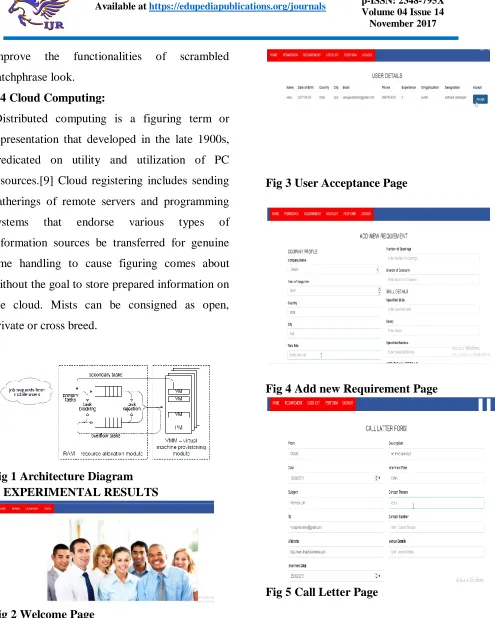
Fig 1 Architecture Diagram 4. EXPERIMENTAL RESULTS
Fig 2 Welcome Page
Fig 3 User Acceptance Page
Fig 4 Add new Requirement Page
Available online:
https://edupediapublications.org/journals/index.php/IJR/
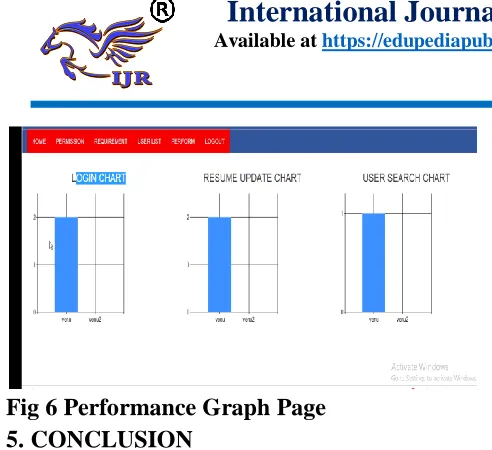
P a g e | 105Fig 6 Performance Graph Page 5. CONCLUSION
We have proposed an answer for asset allotment
of on request work asks for in portable
distributed computing. We have created two need
plans for asset designation in a server pool
predicated on giving diverse needs to the flood
assignments including full need of flood
undertakings and the limit predicated need of
flood tasks.[6] Unlike the majority of subsisting
works that either depend on a straight
programming definition or on naturally inferred
heuristics that offer no hypothetical execution
ensures, our model does not yield the involution
of offloading dilemma just to make it feasible.
Rather, complexity is tended to through the use
of two cooperating stochastic models which are
comprehended through calibrated direct
emphasis toward accomplish any coveted
mistake level. We have researched the effect of
errand arriving rate, settlement time and the
measure of offloaded work on the execution
measurements for both need plans. Withal, we
have assessed the impact of limit area on the
edge predicated need plot. Our outcomes
substantiate that edge predicated need shows
preferred framework execution over full need of
flood errands.
6. REFERENCE
[1] X. Chen. Decentralized Computation Offloading
Game For Mobile Cloud Computing. IEEE Trans.
Parallel and Distributed Systems, 26(4):974–983,
March 2015.
[2] C. Shi, K. Habak, P. Pandurangan, M. Ammar, M.
Naik and E. Zegura. COSMOS: computation
offloading as a service for mobile devices. Proc. 15th
ACM Int. Symp. Mobile ad hoc networking and
computing (MobiHoc), pp. 287–296, Philadelphia,
PA, USA, August 2014.
[3] L. Kleinrock. Queueing Systems, Volume 1:
Theory. Wiley-Interscience, 1975.
[4] A. Demars, S. Keshav and S. Shenker, Analysis
and Simulation of a Fair Queuing Algorithm. ACM
SIGCOMM ’89, pp. 3–26, Austin, TX, USA,
September 1989.
[5] B. Chun, S. Ihm, P. Maniatis, M. Naik and A.
Patti. CloneCloud: Elastic Execution between Mobile
Device and Cloud. The 6th ACM Conf. Computer
systems (ACM EuroSys), pp. 301–314, Salzburg,
Austria, April 2011
[6] E. Cuervo, A. Balasubramanian, D. Cho, A.
Wolman, S. Saroiu, R. Chandra and P. Bahl. MAUI:
making smartphones last longer with code offload.
the 8th Int. ACM Conf. Mobile Systems,
Applications, and Services (MobiSys), pp. 49–62,
Available online:
https://edupediapublications.org/journals/index.php/IJR/
P a g e | 106[7] S. Kosta, A. Aucinas, P. Hui, R. Mortier and X.
Zhang. ThinkAir: dynamic resource allocation and
parallel execution in the cloud for mobile code
offloading. Proc. INFOCOM, pp. 945–953, Orlando,
FL, USA, March 2012.
[8] D. Chae, J. Kim, J. Kim, J. Kim, S. Yang, Y. Cho,
Y. Kwon and Y. Paek. CMcloud: Cloud Platform for
Cost-Effective Offloading of Mobile Applications.
14th IEEE/ACM Int. Symp. Cluster, Cloud and Grid
Computing, pp. 434–444, Chicago, IL, May 2014.
[9] M. A. Hassan, K. Bhattarai, Q. Wei and S. Chen.
POMAC: Properly Offloading Mobile Applications
to Clouds. 6th USENIX Workshop on Hot Topics in
Cloud Computing (HotCloud), pp. 1–6, Philadelphia,
PA, June 2014.
[10] N. Kaushik and J. Kumar. A Computation
Offloading Framework to Optimize Energy
Utilization in Mobile Cloud Computing Environment.
Int. J. of Computer Applications & Information
Technology, 5(2):61–69, April/May 2014.
Authors Profiles
Mrs. CHAVA.KAVYA SRI
She did B-Tech in computer science and
Engineering from Laqshya Institute of
Technology and Sciences, Khammam. She got
80% Aggregate in B-Tech and pursuing M-Tech
from JNTUH, Khammam. She have Knowledge
about java, html, spring &.net.
MRS. M. SRI DEVI
She did M-Tech in Computer Science and
Engineering from G.Narayanamma Institute of
Technology and Sciences for Women,
Hyderabad and pursuing Ph.D(Web Security)
from JNTUH, Hyderabad. She has 18 years of
total work experience. Mrs. Sridevi has been
working for LITS since its inception in 2008. As
Head – Department of CSE, She maintains the
facilities in the department and teaches CSE
subjects, like Computer Programming, Java,
Operating Systems, Software Engineering, Data
Structures, DBMS, Information Security, Web