Scholarship at UWindsor
Scholarship at UWindsor
Electronic Theses and Dissertations Theses, Dissertations, and Major Papers
1-1-2007
Problematic school discipline climate: The discrepancy between
Problematic school discipline climate: The discrepancy between
perceptions of the importance and satisfaction with school
perceptions of the importance and satisfaction with school
discipline climate, and its potential consequences.
discipline climate, and its potential consequences.
Christopher W. Oneschuk
University of Windsor
Follow this and additional works at: https://scholar.uwindsor.ca/etd
Recommended Citation Recommended Citation
Oneschuk, Christopher W., "Problematic school discipline climate: The discrepancy between perceptions of the importance and satisfaction with school discipline climate, and its potential consequences." (2007). Electronic Theses and Dissertations. 6995.
https://scholar.uwindsor.ca/etd/6995
SATISFACTION WITH SCHOOL DISCIPLINE CLIMATE, AND ITS POTENTIAL CONSEQUENCES
by
Christopher W. Oneschuk
A Thesis
Submitted to the Faculty of Graduate Studies and Research Through the Faculty of Education
in Partial Fulfillment of the Requirements for the Degree of Master o f Education at the
University o f Windsor
Windsor, Ontario, Canada 2007
Published Heritage Branch
3 9 5 Wellington Street Ottawa ON K1A 0N 4 C anada
Your file Votre reference ISBN: 978-0-494-35020-1 Our file Notre reference ISBN: 978-0-494-35020-1
Direction du
Patrimoine de I'edition
395, rue Wellington Ottawa ON K1A 0N 4 C anada
NOTICE:
The author has granted a non exclusive license allowing Library and Archives Canada to reproduce, publish, archive, preserve, conserve, communicate to the public by
telecommunication or on the Internet, loan, distribute and sell theses
worldwide, for commercial or non commercial purposes, in microform, paper, electronic and/or any other formats.
AVIS:
L'auteur a accorde une licence non exclusive permettant a la Bibliotheque et Archives Canada de reproduire, publier, archiver,
sauvegarder, conserver, transmettre au public par telecommunication ou par I'lnternet, preter, distribuer et vendre des theses partout dans le monde, a des fins commerciales ou autres, sur support microforme, papier, electronique et/ou autres formats.
The author retains copyright ownership and moral rights in this thesis. Neither the thesis nor substantial extracts from it may be printed or otherwise reproduced without the author's permission.
L'auteur conserve la propriete du droit d'auteur et des droits moraux qui protege cette these. Ni la these ni des extraits substantiels de celle-ci ne doivent etre imprimes ou autrement reproduits sans son autorisation.
In compliance with the Canadian Privacy Act some supporting forms may have been removed from this thesis.
While these forms may be included in the document page count,
their removal does not represent
Conformement a la loi canadienne sur la protection de la vie privee, quelques formulaires secondaires ont ete enleves de cette these.
The focus of this study was problematic school discipline climate. It involved the discrepancy between perceptions o f the importance and satisfaction with school
discipline climate, and its potential consequences. A total of 66 subjects responded from 5 schools, located in urban and rural communities, during the 2003/2004 school year. Subjects were asked to complete four surveys: a demographic survey, the School
Discipline Climate Survey (SDCS), Maslach Burnout Inventory-Educator Survey (MBI- ES), and the Purdue Teacher Opinionaire (PTO). Statistical analyses indicated that subjects perceived their school’s discipline climate as unsatisfactory; SDCS Satisfaction mean values were significantly lower than SDCS Importance values at the p < 0.01 significance level. A Discriminant Function Analysis used Emotional Exhaustion (MBI- ES) as the dependent variable and revealed no (SDCS) Satisfaction variables as
discriminators. Although many educational variables were associated with burnout, the condition itself was perceived as a complex phenomenon, represented by a wide variety o f characteristics.
Keyword: School discipline climate
In memory o f Dr. Erika Kuendiger
I would like to extend my sincere gratitude to Dr. Larry Morton, my advisor, for his guidance and patience. I would also like to thank Dr. Jonathan Bayley, and Dr. Jang Singh, for their assistance in shaping the final draft o f this study.
I express my appreciation to the administrator o f the school board who granted permission to distribute the School Discipline Climate Survey, Purdue Teacher
Opinionaire, and the Maslach Burnout Inventory to teachers. As well, to the principals who allowed their schools’ teaching staff the opportunity to participate in this study.
My gratitude is also extended to Donald Grossnickle Ed. D., for granting
permission to use the School Discipline Climate Survey, Simran Trana, Interim Assistant Vice President for Technology Commercialization, for granting copyright approval to use the Purdue Teacher Opinionaire (Copyright, Purdue Research Foundation, West
Lafayette, Indiana 47906), and Ms. Eliza McLane, authorized representative o f CPP Inc., for granting copyright approval to use the Maslach Burnout Inventory-ES (Copyright 1986 by CPP, Inc., Palo Alto, CA 94303).
ABSTRACT... iii
DEDICATION... iv
ACKNOWLEDGEMENTS ...v
LIST OF TABLES... viii
LIST OF FIGURES... ix
CHAPTER I. INTRODUCTION A. Statement of the Problem ... 10
B. Review of Literature...11
C. Research Hypotheses... 31
II. DESIGN AND METHODOLOGY A. Subjects... 33
B. Instrumentation... 34
Demographic Survey... ... 34
School Discipline Climate Survey... 34
Purdue T eacher Opinionaire ... 35
Maslach Burnout Inventory-ES...37
C. Design and Procedures...39
D. Results...41
E. Discussion... 53
Limitations of the Design. ... 71
Conclusion... ...73
III. REFERENCES... 77
IV. APPENDICES A. Definition o f Terms... .85
B. Demographic Survey...87
C. School Discipline Climate Survey (SDCS)...88
D. Purdue Teacher Opinionaire (PTO)...92
E. Negative items from PTO... 95
F. Maslach Burnout Inventory - ES (MBI-ES)... 96
G. Letter of Permission to University of Windsor Research Ethics Board ... 101
K. Letter of Support from Local Teachers’ Union...107 L. SDCS Satisfaction variables and Teacher Rapport
with Principal PTO correlation coefficients... 108 M. Discipline Policies, Communication, and Due Process
with the remaining SDCS Satisfaction variables... 109 N. PTO and MBI correlation coefficients... 110 O. Emotional Exhaustion and Satisfaction variables... I l l P. Teacher Rapport with Principal and the remaining PTO
variables... 112 Q. Emotional Exhaustion and Importance variables... 113
VITA AUCTORIS... 114
Table 1: Means and Discrepancy Scores for the School Discipline Climate Survey (SDCS) Importance and Satisfaction Subscales and
Ratings from t-test Analysis... 42 Table 2: School Discipline Climate Survey (SDCS) Satisfaction Variables
with Purdue Teacher Opinionaire (PTO) Correlation Coefficients...45 Table 3: School Discipline Climate Survey (SDCS) Satisfaction Variables
with The Maslach Burnout Inventory (MBI) Correlation
Coefficients... ...48 Table 4: Means and Standard Deviations for the Purdue Teacher Opinionaire
(PTO) for High and Low Groups on the Emotional Exhaustion
subscale of the Maslach Bumout Inventory...50 Table 5: Purdue Teacher Opinionaire (PTO) and Maslach Bumout
Inventory (MBI) Correlation Coefficients... 108 Table 6: School Discipline Climate Survey (SDCS) Satisfaction Variables
with Discipline Policies, Communication, and Due Process
Correlation Coefficients...109 Table 7: Teacher Rapport with Principal (PTO) and Satisfaction Subscale
Variables (SDCS) Correlation Coefficients... 110 Table 8: Purdue Teacher Opinionaire (PTO) Variables with Teacher
Rapport with Principal Correlation Coefficients... . I l l Table 9: Means and Standard Deviations for the School Discipline Climate
Survey (SDCS) for the Satisfaction subscale ratings for High and Low Groups on the Emotional Exhaustion subscale of the Maslach
Bumout Inventory... ... 112 Table 10: Means and Standard Deviations for the School Discipline Climate
Survey (SDCS) for the Importance subscale ratings for High and Low Groups on the Emotional Exhaustion subscale of the Maslach
Figure 1: Seven Key Constructs of School Discipline Climate ...31
CHAPTER I INTRODUCTION
A. Statement of the Problem
Teachers have an enormous responsibility to balance curriculum, professional development, parent relations, student discipline, and classroom management. With so many variables, trying to maintain an acceptable level of job satisfaction, while avoiding professional bumout, is a daunting task. One factor that can help with this dilemma is maintaining a healthy school discipline climate. The assessment o f a school’s discipline climate facilitates this process o f maintenance. Discipline policies and procedures can become redundant and ineffective, adding to stress and low job satisfaction for teachers. Teachers who experience low job satisfaction can hinder student learning and
achievement (Goodwin, 1987).
When a school has an unhealthy discipline climate, teachers may lose confidence in administration and feel abandoned. However, an unhealthy discipline climate is not a reflection of the administrator’s abilities but rather the discipline system itself
(Grossnickle, Bialk, & Panagiotaros, 1993). Surveying teachers’ perceptions of their school’s discipline climate can reveal components in the system that may require change and improvement. These modifications may increase job satisfaction and lower bumout thereby increasing teacher productivity and enthusiasm.
and effective policies and procedures. This research is intended to determine if teachers will have a discrepancy between perceptions of the Importance and Satisfaction with school discipline climate, relative to the potential consequences for job satisfaction and bumout.
B. Review o f Literature
In a healthy school environment, teachers experience high morale, have a positive outlook on their profession, and feel a greater sense of accomplishment. Part of a healthy school environment includes a school’s discipline climate. Some research on effective schools has included discipline climate among the characteristics that made a difference in teaching and learning (Grossnickle, et al., 1993). Outside of the classroom, the broader sense o f discipline was strongly influenced and directed by administration. Principals and vice principals utilize regulations from school board policies and apply them to a wide range of situations. At times, these policies may not have satisfied the expectations of teachers regarding student discipline, nor been functional for every situation (Grossnickle, et al., 1993). Although these teacher expectations may not have been consistent with administrations’ discipline practices, communication and
Job Satisfaction:
Some have made the claim that low levels of job satisfaction and morale can lead to decreased teacher productivity and bumout, which would be associated with a decrease in the quality of teaching, depression, greater use of sick leave, efforts to leave the
profession, and a cynical dehumanized perception of students. Stenlund (1995)
concurred and found teachers’ perceptions of students and student learning also affected job satisfaction. Teachers clearly identified students as the primary and central factor that
had an impact on both their professional enthusiasm and discouragement. Teachers valued student responsiveness and enthusiasm as a crucial factor to their own enthusiasm, and found low motivation in students as a discourager (Stenlund, 1995).
The data from Stenlund’s research were derived from a cross-cultural study involving seven countries. These countries were part of a sixteen member Consortium for Cross-Cultural Research in Education (CCCRE). They included: United States of America (the State of Michigan), England (the counties o f South Yorkshire and Derbyshire), Germany (the state of Hessen), Japan (Chugoku and Kinki districts),
Findings from the study revealed that teachers want and need positive relationships with students in order to heighten their own sense o f professional
enthusiasm and worth. Teachers stated that students were at the heart of their existence in front of the classroom. The following was a list o f highlights from the study:
1. Teachers across cultures appear to identify students as the vital element that serves to enhance enthusiasm and discouragement for teaching.
2. Student enthusiasm and responsiveness are an important aspect of teacher enthusiasm across a majority of cultures studied.
3. Student academic achievement does not appear to be an important element in teacher enthusiasm across a majority o f cultures studied.
4. Students exhibiting low motivation appear to be a major contributor to teacher dissatisfaction across a majority of cultures studied.
demographics and responses to the job satisfaction subscale. Cronbach’s coefficient reliability alpha o f .80 was calculated for the subscale with the study sample. Chi-square tests and one- and two-way ANOVA were also utilized.
Findings suggested that these teachers (male and female) were most satisfied with the interaction with their students and least satisfied with general working conditions. Female elementary teachers perceived higher job satisfaction for ‘degree o f challenge of the job’ and ‘satisfaction with interaction with colleagues’ than did male elementary teachers. However, male teachers were still well satisfied with these two variables. Both male and female teachers perceived lower job satisfaction for aspects of salary and autonomy. Overall, elementary school teaching was a satisfying career for both male and female subjects.
Another study from Greenwood and Soar (1973) revealed relationships between teacher morale and teacher behaviour. Their investigation involved 39 female elementary teachers from Kindergarten to Second grade, in six states from the U.S. The
instrumentation included the Purdue Teacher Opinionaire and the Reciprocal Category System for verbal teacher behaviours; a modification of the Flander’s Interaction Analysis. Pearson Product-Moment correlations were determined between the two instruments’ variables. Perceived weaknesses in the study were the choice of a
Teacher Talk increased, teacher morale decreased. Teacher Talk was defined as the time that the teacher talked out of the total amount o f teacher and student talk. Teacher Talk was negatively related to Satisfaction with Teaching, Teacher Load, Curriculum Issues, and Community Support of Education. The variable Teacher Acceptance o f Student Behaviour was positively related to Satisfaction with Teaching and Rapport among Teachers.
A Principal’s ability to create a positive school climate can also affect teacher job satisfaction and their morale (Washington & Watson, 1986). In support o f this claim, Adams (1992) stated that principals were the keys to improving the morale and self esteem of teachers. Research has identified more administrative support and leadership, good student behaviour, and a positive school atmosphere as working conditions
associated with higher job satisfaction for teachers (National Center for Education Statistics, 1997). When teachers perceived higher job satisfaction they created positive learning environments which promoted higher student achievement (Ellenberg, 1972). If a school’s discipline climate was perceived by teachers as supportive and satisfactory, then learning environments were improved, facilitating higher student achievement. These conditions were particularly favourable for school boards when considering the emphasis on standardized test scores.
communities for the English instructed school system. Approximately 75% o f the subjects were female and 25% were male. Although teachers completed a five component questionnaire, data were analysed from only two components: (1) teacher demographic characteristics and (2) job satisfaction. Workplace conditions were measured through four variables: teaching competence, administrative control,
organizational culture, and teacher satisfaction. Teacher responses were based on a 5- point Likert-type scale: 1 = strongly disagree, 2 = disagree somewhat, 3 = neutral, 4 = agree somewhat, and 5 = strongly agree. Cronbach’s alpha was .56 for teaching competence, .73 for administrative control, .78 for organizational culture, and .77 for teacher satisfaction. Statistical procedures included: means, standard deviations, Pearson correlations, and a multiple regression analysis.
One potential weakness of the study was its quasi-experimental design.
Researchers can not fully control participants’ background because of their non-random assignment. Another concern was that the teacher population predominantly worked in rural communities and only represented sixth Grade teachers.
The findings of the study revealed that the three measures of workplace conditions were statistically significant with teacher satisfaction. O f these measures, administrative control was the most important, followed by teaching competence and organizational culture. This indicated that teachers with more positive perception o f their relationship with school administration reported higher satisfaction with their
their school’s discipline climate, superintendents should stress to school administrators that problems with discipline climate are not indicative of poor leadership. Problematic school discipline climate originates from the discipline system’s policies and procedures, not from the principal. To encourage principals to acknowledge the existence o f a problem, superintendents should respond with assistance rather than recrimination (Gaustad, 1991). Williams (2000) recommended avoiding the following: lack o f clear discipline policies, uneven enforcement, focus on petty infractions, and misplaced school priorities. However, in order to understand and implement organizational change and strategic planning at the school level, school boards need to understand the characteristics within their own district (Knoff, 2001).
Duquette, Golaszewski, and Milstein (1984) researched organizationally based stress. The purpose of the study was to establish the level of respondent teachers’ perceived stress, the organizationally based factors that are most stress inducing, and the predominant ways in which teachers manifest stress. The study was conducted in a large urban school system, represented by four elementary schools (K-8). The selection of these four schools was based upon similarities of demographic variables, (e.g., enrolment, racial composition, and years of principals’ experience in the building). As a means of collecting data during a stressful time, the researchers decided to survey teachers during the last week of the 1981 -82 school year.
manifestation items. The scale ranged from (1) very little to (5) very much. Empirical data regarding its reliability and content validity was not provided, however, the researchers stated it had acceptable levels in this regard. The data was tabulated then analysed by calculating the following measures: means, standard deviations, ANOVA, and Pearson correlations.
One possible weakness o f the study was the non-random sample o f schools. Although only nine schools offered to participate, four were selected based on a
predetermined set of characteristics. The data from the study represented schools from only urban areas. In addition, empirical data was lacking in the publication for survey reliability and content validity.
Findings indicated that teachers identified factors centring upon the classroom as those most stressful to them. Issues related to the core task of working with students were more closely associated with stress than issues related to school organization.
Discipline Policies and Practices:
school climate, teacher job satisfaction, and student achievement. Schools need to be orderly and consistent with their discipline practices. Without order and consistency, teachers cannot teach and students cannot learn (Kaufman, 2001). Maintenance of a consistent set o f rules and values that clearly defined school goals and policies were important because it provided a discipline climate in which teachers and students were able to focus on teaching and learning. Petracco (2000) stated that when teachers and students had the opportunity to contribute to the decision-making process for discipline policies and procedures, it had the most significant effect on improving school climate.
Teacher Morale:
Mendel (1987) defined teacher morale as a feeling, a state o f mind, a
mental/emotional attitude that teachers experience regarding their profession, including the work environment and conditions. These feelings were based on how the teacher perceived him/herself in the education system and how this system met his/her needs and expectations. It was demonstrated through the professional interest and enthusiasm that a teacher displayed toward the achievement of individual and group goals.
Intrapersonal stress occurred when teachers believed they were inadequate as contributing members o f society. These categories represented the challenge and importance o f morale for teachers and their students.
Miller (1981) reported that teacher morale had a positive effect on student learning. Raising teacher morale made learning more pleasant for students, as well as teaching more pleasant for teachers. This created a positive school environment
conducive to learning. Goodwin (1987) believed that this relationship of teacher-morale and student achievement can likewise hinder learning and lower achievement. The availability o f the empirical evidence for these claims and beliefs were limited. Thus, one needs to be cautious when assigning merit to such claims.
Others made similar claims (Petracco, 2000) that when teachers experienced high morale, it raised their self-confidence and promoted positive attitudes and expectations about teaching and learning. Teachers who worked in an orderly atmosphere that was conducive to learning experienced high morale. Other variables that affected school climate and job satisfaction were staff reassignment and large physical layouts of schools (McMullen, 2000). Staff reassignment and large physical layouts of schools often made it difficult for teachers to communicate and maintain consistent discipline practices. Under these circumstances, the challenge for school administrators was to uphold a sense of community and cohesion with teachers, while unifying their approach to student discipline.
Ellenburg’s implications. The first implication involved school administrators striving to keep lines of communication open between themselves and staff, as well as within their staff. A lack o f communication will prohibit understanding o f one another and will deter healthy morale within the school. In communicating with staff, principals should be careful to demonstrate respect for the teacher as an individual with worth and dignity and as a professional person qualified to do the job for which he/she was hired.
Secondly, Ellenberg stated that the administrator should strive to publicly support his/her staff. Public support is essential to the well-being of individuals and the staff as a whole. Meaning, principals should be careful in giving criticism or allowing undue criticism o f a staff member. He/she should always strive to build respect for staff
members as professional people. When problems arise due to the deficiencies on the part o f a staff member, the administrator should suggest improvement strategies that will allow the teacher to grow professionally and personally.
Ellenburg concluded by recognizing that the administrator should involve staff members in the operation of the school. When teachers are involved, their understanding of the functions of the administrator increases and this positively affected teacher morale. Ellenburg warned that democratic administration can be overdone and should be
practiced with caution. Only matters that can be decided by the staff and which affect them should be referred to them for consideration and possibly for a decision.
copes successfully with a variety o f external demands from parents and the community. It has effective leadership from the principal and has adequate resources. It is also a place in which the teachers accomplish their jobs with enthusiasm. Principals have the primary responsibility for developing and maintaining such a school climate. Hence principals are the keys to improving the morale and self-esteem o f teachers.
Adams continued to discuss that an organization such as a school is the sum of the individuals who make it up. A collective group process, under the leadership o f a
concerned principal, had a better chance of improving the health of the school and thus the self-esteem and morale of the teachers. Organizational development (OD) is a type o f organizational change where the school focuses on enhancing the entire system, not just individuals. Two main stages o f OD are diagnoses (identifying problem areas) and
interventions (implementing solutions to identified problems). If during the diagnostic phase of OD in a school, low morale or self-esteem on the part of some teachers is detected, then problem analysis and the generation of solution strategies related to their causes would be undertaken. This would be only one of a number of solutions
considered to bring about increased staff morale (Adams, 1992).
School Climate:
and review its school climate and policies. The development o f a School Climate committee would facilitate the creation and monitoring of programs and activities designed to accomplish the school’s mission and goals. The committee would review policies, track their progress over time, anticipate prevention strategies, and offer
recommendations and assistance for improvements (Knoff, 2001). The committee’s role would also include gathering information about perceived school discipline problems. This information could be obtained from the following: truancy and attendance records, attitude surveys, focus groups, and informal interviews with teachers, students, parents, and community members (Williams, 2000). It is vital that the school principal or vice principal be on the committee and reserve time to participate. Without such support, the recommendations o f the committee would carry little authority (Williams, 2000).
Burnout:
Bumout involves feelings of failure and exhaustion resulting from excessive demands on a person’s energy with insufficient reward for the effort (Freudenberger,
1974). Maslach (1976), Seidman and Zager (1987), and Chemiss (1980) had defined bumout as psychological distancing from work. It is a syndrome o f emotional
exhaustion, depersonalization, and reduced personal accomplishment (Maslach, Jackson, & Leiter, 1996). Teacher bumout has serious consequences for the individual, the school, and students. For the individual, this involves physical, psychological and/or behavioural symptoms such as: loss of motivation, decreased self-esteem, and ultimately removal from the teaching profession (Block, 1978).
Leiter (1991) defined bumout as a crisis in self-efficacy. Teacher efficacy was the belief in one’s capability to organize and execute strategies for classroom order (Brouwers and Tomic, 1999). Brissie, Hoover-Dempsey, and Bassler (1988) found that teacher efficacy predicted teachers’ level o f bumout. Teachers with a low sense of efficacy were also found to be the ones most likely to drop out of the teaching profession (Glickman & Tamashiro, 1982).
Many o f the symptoms associated with bumout have been categorized into three main groups: physical, psychological, and behavioural (Block, 1978 & Freudenberger,
Regardless of the indicator, bumout presented serious consequences for the individual, the school, and students.
The ability to control student behaviour is a critical factor in educational settings. If teachers do not adequately address dismptive behaviour, instructional time is lost for all students. A disciplined classroom was an invaluable learning environment for teachers to accomplish their instructional goals and feel satisfied with their efforts (Brouwers & Tomic, 2000). Friedmand and Farber (1992) reported that teachers who considered themselves less competent in classroom management and discipline had higher levels o f bumout than did their counterparts who had more confidence in this regard.
Teaching can be considered a high-stress occupation (Goodwin, 1987). Chronic job stress leads to job bumout and an increased inability to take one’s job seriously (Ray,
Waldhart, & Seibert, 1985). The education system has all the elements associated with stress: a bureaucratic structure, continuous evaluation of its processes and outcomes, and increasingly intensive interpersonal interactions with students, parents, colleagues, principals, and the community (Kremer-Hayon & Kurtz, 1985). In addition, increased student misconduct, student apathy, overcrowded classrooms, inadequate salaries, demanding and/or unsupportive parents, budgetary constraints, expanding administrative loads, lack of infrastructural support, and an increasingly negative public opinion
contributed to an embattled and embittered teacher force in many centres o f the world (Trent, Cooney, Russell, & Warton, 1996).
Stress can make teachers ineffective and inefficient in their teaching roles
and emotional well-being (Kyriacou, 1987). Bumed-out teachers provided significantly less information, praise, and acceptance to their students, and interacted with them less frequently (Beer & Beer, 1992). Stressed and bumed-out teachers were more likely to refer students to school administrators for discipline problems (Walker, 1991). However, where bumout levels increase, teachers’ perceptions of students’ mental health decreased (Cremerius, 1992).
A study by Kokkinos, Panayiotou, and Davazoglou (2005) addressed how bumout influenced teachers’ appraisals o f the severity o f six undesirable student behaviours. These undesirable behaviours were: antisocial, oppositional/defiant, interpersonal sensitivity, inattention/ restlessness, negative affectivity, and inattention/carelessness. Their study involved 465 primary school teachers (53% male) from the broader area of Thrace, Greece. Their teaching experience ranged from 1 to 20 years. The
instrumentation included the Maslach Bumout Inventory - Educator Survey (MBI-ES) and the Pupils’ Undesirable Behaviours Questionnaire (PUBQ).
Mean scores, Multivariate Analysis of Variance (MANOVA), and correlational analyses were used to examine the data. Internal reliability coefficients for each subscale on the MBI-ES were Emotional Exhaustion = .80, Depersonalization = .68, and Personal Accomplishment = .90. Based on the theory that emotional exhaustion appears to be a central or core symptom o f bumout (e.g., Byme, 1994; Koeske & Koeske, 1989; Leiter,
1993), comparisons were made on the emotional exhaustion scale only. For each subscale on the PUBQ, internal reliability coefficients were Antisocial = .90,
weakness to the study was the effect cultural differences may have on comparing its results to other studies outside o f Greece.
Kokkinos, et. al. (2005) found that bumout had a significantly negative effect on teachers’ perceptions o f antisocial and oppositional/defiant behaviours. This suggested that the more stressed teachers were, the less tolerant they became of such challenging and aversive behaviours. The statistical significance of bumout on these behaviours were as follows: Antisocial, F( 1,460) = 4.27, p < 0.05 (effect size = 0.009), and Oppositional/ Defiant, F(1,460) = 4.03, p < 0.05 (effect size = 0.0009).
An investigation by Farber (1984) researched stress and bumout in suburban teachers. The purpose of the study was to investigate the satisfactions and stresses of teachers in suburban schools, with particular reference to identifying factors which either impede or promote teacher bumout. A total of 365 public school teachers participated in this study, from kindergarten through to high school. These teachers were drawn
primarily from school districts in the suburbs of Westchester, Putnam, and Dutchess Counties in the state o f New York. Females represented 65% o f the sample population, with 35% male. Subjects were administered a 65-item Teacher Attitude Survey (TAS). The TAS was a modified version of the Maslach Bumout Inventory (MBI). The 25 items on the MBI was augmented with 40 additional items of exclusive relevance to teachers. Correlation between the 25 MBI items and the 40 additional items was found to be .75 on the frequency dimension, and .70 on the intensity dimension. Split-half reliability
The data were rank-ordered according to both frequency and intensity. A principal components factor analysis with varimax rotation was performed on the frequency dimension. Other statistical analyses included /-tests and one-way ANOVA. Demographic and ecological dimensions were also part o f the data analysis.
A potential weakness in the study was that its sample consisted only of suburban teachers. This sample does not accurately represent the diversity o f settings in which teachers work. Another potential weakness was the duration o f the study. The
phenomenon of teacher bumout may optimally be studied over a number o f years, carried out on a longitudinal basis, rather than a ‘snap shot’ measure in time.
The results of this study suggested that teachers between the ages o f 34 - 44 and those teaching at a junior high school level were particularly vulnerable to bumout. O f the teachers surveyed, approximately 25% were vulnerable to bumout with 15%
experiencing it. In addition, almost 87% of the subjects felt that tension between school administrators and teachers was a significant source of stress. Another finding was that a critical deficit in the bumout process was a lack o f administrative support. Other results suggested that bumout significantly lessened teachers’ motivation to continue in the profession and lessened too the basic satisfaction inherent in the student-teacher
relationship. As well, feelings of bumout among teachers significantly varied with lack of commitment to teaching (r = .49) and lack of satisfaction in working with students (r = .42).
relationship between teachers’ work conditions and the amount of support they gave to students. Furthermore, he inferred that teachers’ behaviour depended on their
perceptions o f how their school functioned. Therefore, teachers had an important role in establishing the overall tone of the school.
An investigation by Benham and O’Brien (2002) addressed the question why experienced teachers were leaving the profession. Their study involved surveying graduates with teaching credentials from Chapman University, in the state o f California. Graduates between the years 1990-91 and 1994-95 were mailed questionnaires in the spring o f 2001. There were 4,534 graduates from this period and 900 were randomly selected for the study. From this sample, 114 potential subjects returned their surveys, a 12.6% response rate. The survey consisted o f two components: questions that required a written response and those that asked respondents to rank-order reasons for leaving or considering leaving the teaching profession. Subjects were then classified into two groups: those who had left teaching and those who would consider leaving the profession. There were no statistical tests performed on the data. Possible weaknesses o f the study may be its inability to statistically generalize findings to the population, especially when considering its response rate of 12.6%.
characteristics, negativity and pressure from parents and the community, and tension between teachers and administration. They ranked low professional status and salary considerations last.
Respondents who were still teaching but considering leaving the profession also ranked paperwork and accountability pressures high, second and third respectively. However, while salary issues were ranked last by teachers who had already left teaching, they were ranked first by those still in the profession. The fourth ranked reason for potentially leaving was low status of the profession. Lack of administrative support was ranked fifth by both groups of respondents. This involved administrators not supporting teachers in the face of criticism and increasing pressure to devote more class time to standardized test preparation.
Purkey (1970) found that teachers need to feel successful and positive about themselves and their abilities before they empower their students to feel the same. If teachers were experiencing feelings of failure and/or lacking satisfaction, their
C. Research Hypotheses
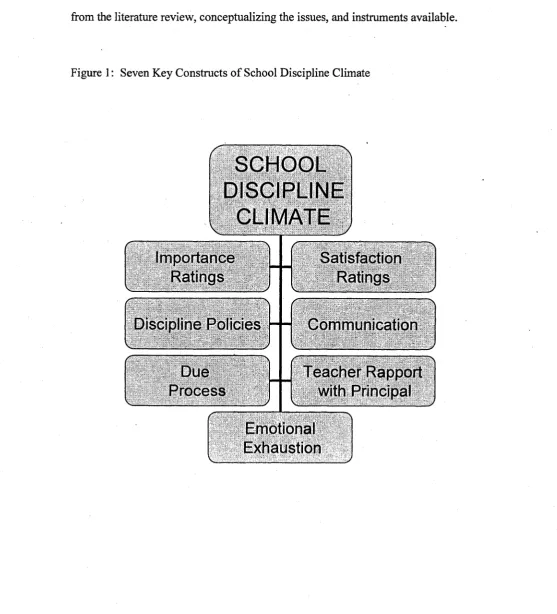
The research hypotheses concern the interrelationships among the School Discipline Climate Survey (SDCS), Purdue Teacher Opinionnaire (PTO), and Maslach Bumout Inventory (MBI) variables. Figure 1 presents seven key constructs that emerged from the literature review, conceptualizing the issues, and instruments available.
Figure 1: Seven Key Constructs of School Discipline Climate
SCHOOL
DISCIPLINE
^ CLIMATE /
r >
Im portance
R atings
V
. . . . .
S atisfaction
R atings
V J
(
"V<
'
^D iscipline P o licies
C om m unication
V
k
J
- .... ^
D ue
P r o c e s s
v V
c ' ...
T ea ch er Rapport
with Principal
^ J
N
Em otional
E xhaustion
The following are proposed as working hypotheses which emerge from logical reasoning and the existing literature review:
Hypothesis 1: Teachers will show a lower Satisfaction rating than Importance rating on the School Discipline Climate Survey.
Hypothesis 2: There will be a positive correlation between Due Process (SDCS) and Satisfaction with Teaching (PTO).
Hypothesis 3:
(i) There will be a positive correlation between Communication (SDCS) and Teacher Rapport with Principal (PTO).
(ii) There will be a positive correlation between Discipline Policies (SDCS) and Teacher Rapport with Principal (PTO).
(iii) There will be a positive correlation between Due Process (SDCS) and Teacher Rapport with Principal (PTO).
Hypothesis 4:
(i) There will be a negative correlation between Due Process (SDCS) and Teachers’ feelings o f Depersonalization (MBI).
(ii) There will be a negative correlation between Discipline Policies (SDCS) and Teachers’ feelings of Depersonalization (MBI). (iii) There will be a negative correlation between Communication
(SDCS) and Teachers’ feelings of Depersonalization (MBI).
Hypothesis 5: There will be a negative correlation between Emotional Exhaustion (MBI) and Satisfaction with Teaching (PTO).
CHAPTER II
DESIGN AND METHODOLOGY A. Subjects
The subjects for this study represented a population of full time elementary school teachers from a school board in Southwestern Ontario. The sample included those
subjects who had returned the survey packages. Although the researcher received
permission by the school board to survey its teachers, only 5 from a total of 48 principals granted permission to use their schools’ teaching staff as potential subjects. The
researcher had a 61% response rate from 108 teachers, with 66 survey packages
completed. As a means of encouraging teachers to participate, the local teachers’ union sent a letter of support for the study via email to all potential subjects. This letter contained the same inform provided to the school board and principals.
B. Instrumentation
Demographic Survey
The Demographic Survey requested information related to personal and professional characteristics. It was comprised of 12 questions ranging from gender to previous grade levels taught. Subjects entered data by placing a check mark in the appropriate location, with one question requiring a written response. The researcher transcribed the check marks to numbers so that the data could be statistically
manipulated. Not all questions were relevant to all teachers. The later six questions did not pertain to French, Early Literacy, nor Special Education teachers. These questions referred to teachers with regular classrooms, where students and teachers were together for most o f the day. Survey questions were created by the researcher and reviewed for content validity by the study’s advisor. Refer to Appendix B.
School Discipline Climate Survey
The School Discipline Climate Survey (SDCS) analyzed school discipline
policies and procedure trends. It was a means of formally assessing teachers’ perceptions of their schools’ discipline climate. The SDCS was intended to be used only for
their level of importance and satisfaction, utilizing a five point Likert type scale (1 = very low, 2 = low, 3 = equally important/satisfactory, 4 = high, 5 = very high). Refer to Appendix C.
The SDCS was structured so that information could be gathered from the Importance subscale and the Satisfaction subscale. When only one scale was
administered, survey components were analyzed to identify areas o f concern. If both scales were administered, discrepancies between scales were examined and a priority list could be created for concerns requiring immediate attention. Respondents used both scales to rank their perceived level of importance and satisfaction with each statement. These rank ordered scores were then compared to establish a subscale discrepancy score. Statements having large discrepancy scores, high importance with low satisfaction, were considered those factors in most need of immediate attention. Once identified, staff members could develop a strategic plan to improve discrepancies in their school’s discipline policies and procedures. Permission to include and reproduce this instrumentation was received from Donald Grossnickle Ed. D.
Purdue Teacher Opinionaire
point scale (A = agree, PA = probably agree, PD = probably disagree, D = disagree). Refer to Appendix D. The researcher transcribed the scale to numbers so that the data could be statistically manipulated. Item responses were weighted for scoring in the following manner: when “AGREE” (A) was the keyed response, (positive item) the weights were A = 4, PA = 3, PD = 2, D = 1; when “DISAGREE” (D) was the keyed response, (negative item) the weights were A = 1, PA = 2, PD = 3, D = 4. Refer to Appendix E.
Odell, Cochran, Lawrence, and Gartin (1990) found the PTO to be valid and reliable, with a Cronbach’s alpha reliability coefficient of 0.96, consistent with the scales of other reliability coefficients noted in previous studies. The Kuder-Richardson internal consistency reliability coefficient for the PTO was 0.96 and test-retest correlations ranging from 0.71 to 0.93 were reported for the 10 subscales on the instrument, (Flowers & Pepple, 1988).
This instrument was selected because of its association to the Importance and Satisfaction components of the SDCS. It was inferred that discipline characteristics that possessed high levels of importance with low levels o f satisfaction, reflected a greater potential as a contributing factor to low morale and job satisfaction. Permission to include and reproduce this instrumentation was received from the Purdue Research Foundation: Department of Technology Commercialization (PTO). The following PTO variable definitions were taken from the instrument’s manual, (Bentley & Rempel, 1980):
Satisfaction with Teaching pertained to teacher relationships with students and feelings of satisfaction with teaching. According to this variable, the high morale teacher ‘loves’ to teach, feels competent in his/her job, enjoys his/her students, and believes in the future o f teaching as an occupation.
Rapport Among Teachers focused on a teacher’s relationship with other teachers. The items here solicited the teacher’s opinion regarding the cooperation,
preparation, ethics, influence, interests, and competency o f his peers.
Teacher Salary pertained primarily to the teacher’s feelings about salaries and salary policies. It posed such questions as: Are salaries based on teacher
competency? Do they compare favourably with salaries in other school systems? Are salary policies administered fairly and justly, and do teachers participate in the development of these policies?
Teacher Load dealt with such matters as record-keeping, clerical work, ‘red tape,’ community demands on teacher time, extra-curricular load, and keeping up to date professionally.
Curriculum Issues solicited teacher reactions to the adequacy of the school program in meeting student needs, in providing for individual differences, and in preparing students for effective citizenship.
Teacher Status sampled feelings about the prestige, security, and benefits afforded by teaching. Several o f the items referred to the extent to which the teacher feels he/she was an accepted member of the community.
Community Support of Education dealt with the extent to which the community understood and was willing to support a sound educational program.
School Facilities and Services had to do with the adequacy of facilities, supplies and equipment, and the efficiency of the procedures for obtaining materials and services.
Community Pressures gave special attention to community expectations with respect to the teacher’s personal standards, his/her participation in outside-school activities, and his/her freedom to discuss controversial issues in the classroom.
Maslach Bumout Inventory-Educator Survey
less, 3 = A few times a month, 4 = Once a week, 5 = A few times a week, 6 = Everyday), (Maslach, C., Jackson, S., & Schwab, R., 1986). The survey consisted o f three subscales: Emotional Exhaustion (EE) 9 items, Depersonalization (DP) 5 items, and Personal
Accomplishment (PA) 8 items. EE referred to being emotionally overwhelmed by the job demands and depleted o f emotional resources. It measures the inability o f the
educator to give of him/herself at a psychological level. DP pertained to the development of negative feelings and callous attitudes toward, or excessively detached response to, one’s students. It measured the development of negative or cynical feelings toward one’s students. PA regarded a decline in one’s feeling of competence and successful
achievement in one’s work. It measured the educator’s perception o f the importance of his/her work with students (see Appendix F). The Iwanicki and Schwab (1981) and Gold (1984) studies substantiated the reliability and validity of the MBI-ES.
Criterion validity was established by comparing bumout scores to ratings of personal experience (Maslach & Jackson, 1981; and Maslach, Jackson, & Leiter, 1996), dimensions of job experience (Maslach & Jackson, 1984), or personal outcomes
(Corcoran, 1986). In addition, researchers (Maslach et al., 1996; McCann & Pearlman, 1990; and Cox, Kuk, & Leiter, 1993) had found evidence of construct validity. MBI-ES scale scores have been shown to be related to measures of job satisfaction, depression, and occupational stress.
Iwanicki and Schwab (1981) found reliability alpha coefficients o f EE = 0.90, DP = 0.76, and PA = 0.76. Gold (1984) reported reliability coefficients of EE = 0.88, DP = 0.74, and PA = 0.72. The MBI-ES manual was used to assist in its implementation (Maslach et al.,
1996).
The MBI-ES was selected because o f its association to the Importance and Satisfaction components of the SDCS. It was inferred that discipline characteristics that possessed high levels o f importance with low levels of satisfaction, reflected a greater potential as a contributing factor to occupational bumout (MBI-ES). Permission to include and reproduce this instrumentation was received from CPP Inc. Permissions Department.
C. Design and Procedures
A survey design was used for the study. Subjects were selected from a school board in Southwestern Ontario.
Prior to the start o f this investigation, an application was submitted to the University o f Windsor’s Research Ethics Board that requested permission to conduct research (refer to Appendix G). Following receipt o f their approval, a letter of permission was forwarded to the Research Review Committee of the selected school board (see Appendix H). Once permission was granted, principals received a letter requesting permission to use their teaching staff for the study (refer to Appendix I). Once permission was confirmed, teachers received a Letter of Information (see Appendix J) and a survey package. Part of the Letter of Information assured subjects of
instrumentation. Each survey package consisted of four instruments: a demographic survey, the School Discipline Climate Survey (SDCS), the Purdue Teacher Opinionaire (PTO), and the Maslach Bumout Inventory for Educators Survey (MBI-ES). Potential subjects received a letter o f support via email from the vice president o f their local teachers union (see Appendix K). The letter explained the study’s benefits to teachers and students, as well as the positive impact it would have on their school’s discipline climate and learning environments. The purpose of the letter was to encourage participation and demonstrate union support. This letter contained the same inform provided to the school board and principals. Teachers who accepted the invitation to participate completed a survey package. Survey packages were dropped off to
participating schools by the researcher. Subjects completed the surveys and placed them in unmarked envelopes which were later picked up by the researcher.
The study had a 61% response rate from 108 teachers with 66 questionnaires returned. Survey completion took approximately 40 minutes and participants were asked to complete them at one time, with no interruption. Participants were able to decide when and where this time period would occur between June 8th and June 11th. These four days were selected because subjects had nearly an entire school year to establish
CHAPTER III RESULTS
A variety of statistical tests were utilized. The data were analyzed using descriptive statistics, /-tests, Pearson Product-Moment correlation, and Discriminant Function Analysis.
A. School Discipline Climate Views
In reference to Hypothesis 1 (Teachers will show a lower Satisfaction rating than Importance rating on the SDCS) the discrepancy range between means o f Importance and means of Satisfaction were examined using a series of /-tests. Since multiple /-tests were used, the more conservative probability level p < .01 was selected for significance. This probability level was utilized for all the scales in this study. There was a significant difference between the mean values for Importance and Satisfaction subscales on the School Discipline Climate Survey (SDCS). Satisfaction mean values were significantly lower than Importance values at the p < .01 significance level. See Table 1 and Figure 2.
and Instructional Management were less than 1.0. This allows one to get a sense of what might be of most concern for teachers.
The variable with the highest mean value for the Importance subscale was School Safety (4.92). It appears that teachers were quite concerned with this issue. Eight other variables with high mean values on the Importance subscale were: Discipline Teamwork (4.87), Discipline Policies (4.86), Penalties/Consequences (4.86), Efficiency (4.82), Instructional Management (4.82), Communication (4.77), Parental Support (4.71), and Due Process (4.69). Lower mean values included: Learning Climate (4.55), Training (4.35), and Attendance Policies (4.31). The lowest mean value on the Importance subscale was Strategic Planning (4.15).
Table 1: Means and Discrepancy Scores for the School Discipline Climate
Survey (SDCS) Importance and Satisfaction Subscales and Ratings from /-test Analysis. SDCS Variables Importance Mean Satisfaction Mean Discrepancy Score /-test Score Significance
p < .01
Attendance 4.31 3.47 0.84 4.31 .00
Discipline 4.86 3.58 1.28 8.12 .00
Training 4.35 3.23 1.12 6.76 .00
Communication 4.77 3.54 1.23 7.12 .00
Efficiency 4.82 3.20 1.62 8.80 .00
Parental Support 4.71 3.45 1.26 9.18 .00
Due Process 4.69 3.31 1.38 8.66 .00
School Safety 4.92 3.63 1.29 7.60 .00
Discipline - 4.87 4.01 0.86 7.60 .00
Teamwork
Learning Climate 4.55 3.97 0.58 4.66 .00
Strategic Planning 4.15 3.40 0.75 6.12 .00
Penalties - 4.86 3.95 0.91 6.23 .00
Consequences
Instructional - 4.82 4.13 0.69 6.50 .00
Figure 2: Showing the Lower Satisfaction Ratings on all Scales
School Clim ate Survey
Rating Scale Importance S Satisfaction 6
5
4 3
2
1
0
J-.iP J'.
jp
-J"
\SDCS Subscale
On the Satisfaction subscale, Instructional Management (4.13) received the highest mean value. Other variables with high mean values were: Discipline Teamwork (4.01), Learning Climate (3.97), and Penalties/Consequences (3.95). Eight variables that received lower mean values on the Satisfaction subscale included: School Safety (3.63), Discipline Policies (3.58), Communication (3.54), Attendance Policies (3.47), Parental Support (3.45), Strategic Planning (3.40), Due Process (3.31), and Training (3.23). The lowest mean value on the Satisfaction subscale was Efficiency (3.20).
rating on Satisfaction (4.92, 3.63). Other variables with high rankings on the Importance subscale with lower rankings on Satisfaction were: Due Process (4.69, 3.31), Discipline Policies (4.86, 3.58), Parental Support (4.71, 3.45), and Communication (4.77, 3.54). Although Efficiency received a high ranking on the Importance subscale, it ranked the lowest on Satisfaction (4.82,3.20). Variables that received high ratings on both
subscales were Instructional Management (4.82,4.13) and Penalties/Consequences (4.86, 3.95).
B. Satisfaction as a Correlate of Opinion and Bumout
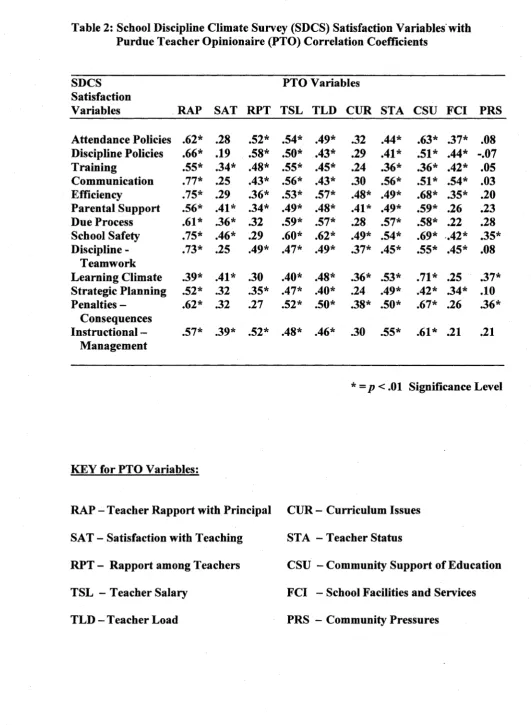
SDCS Satisfaction
Variables RAP SAT RPT
PTO Variables
TSL TLD CUR STA CSU FCI PRS
Attendance Policies .62* .28 .52* .54* .49* .32 .44* .63* .37* .08 Discipline Policies .66* .19 .58* .50* .43* .29 .41* .51* .44* -.07
Training .55* .34* .48* .55* .45* .24 .36* .36* .42* .05
Communication .77* .25 .43* .56* .43* .30 .56* .51* .54* .03
Efficiency .75* .29 .36* .53* .57* .48* .49* .68* .35* .20
Parental Support .56* .41* .34* .49* .48* .41* .49* .59* .26 .23
Due Process .61* .36* .32 .59* .57* .28 .57* .58* .22 .28
School Safety .75* .46* .29 .60* .62* .49* .54* .69* .42* .35*
Discipline - .73* .25 .49* .47* .49* .37* .45* .55* .45* .08
Teamwork
Learning Climate .39* .41* .30 .40* .48* .36* .53* .71* .25 .37*
Strategic Planning .52* .32 .35* .47* .40* .24 .49* .42* .34* .10
Penalties - .62* .32 .27 .52* .50* .38* .50* .67* .26 .36*
Consequences
Instructional - .57* .39* .52* .48* .46* .30 .55* .61* .21 .21
Management
* = p < .01 Significance Level
KEY for PTO Variables:
RAP - Teacher Rapport with Principal CUR - Curriculum Issues
SAT - Satisfaction with Teaching ST A - Teacher Status
RPT - Rapport among Teachers CSU - Community Support of Education
TSL - Teacher Salary FCI - School Facilities and Services
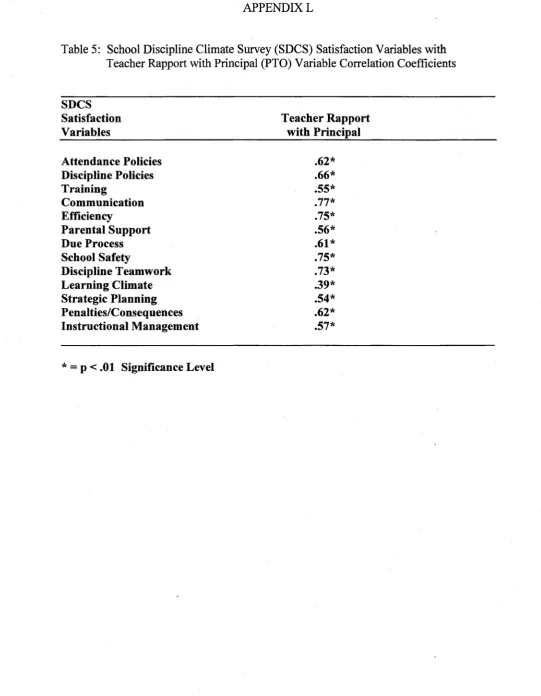
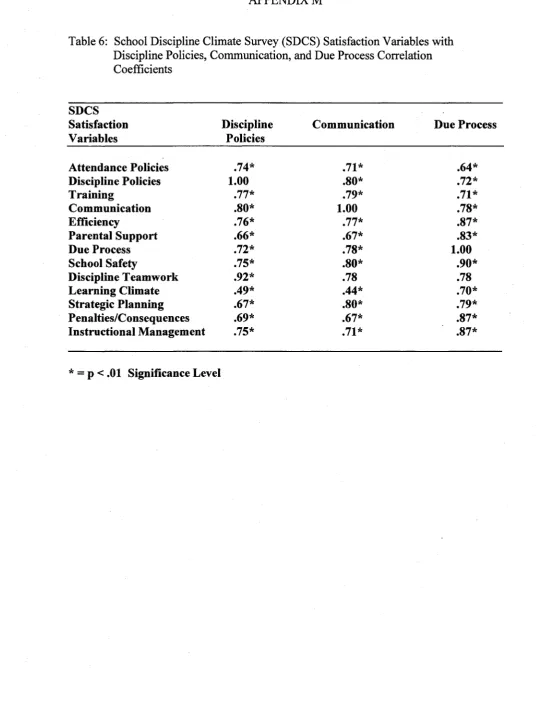
PTO variables. In response to Hypothesis 3(i), there was a positive correlation between SDCS variable Communication and PTO variable Teacher Rapport with Principal (r = .77). As teachers’ satisfaction with Communication increased, their satisfaction with Teacher Rapport with Principal also increased. For Hypothesis 3(ii), there was a positive correlation between Discipline Policies and Teacher Rapport with Principal (r = .66). When teachers’ satisfaction with Discipline Policies increased so did their satisfaction with Teacher Rapport with Principal. In reference to Hypothesis 3(iii), there was a positive correlation between Due Process and Teacher Rapport with Principal {r = .61). As teachers’ satisfaction with Due Process increased, their satisfaction with Teacher Rapport with Principal also increased. For the above correlation statements, the opposite was also true (e.g., as teachers’ satisfaction with Teacher Rapport with Principal
decreased, their satisfaction with Communication also decreased). Refer to Appendix L for the remaining correlation coefficients between SDCS variables and Teacher Rapport with Principal. All thirteen Satisfaction subscale variables (SDCS) were significantly correlated with Teacher Rapport with Principal.
Comparing SDCS and MBI:
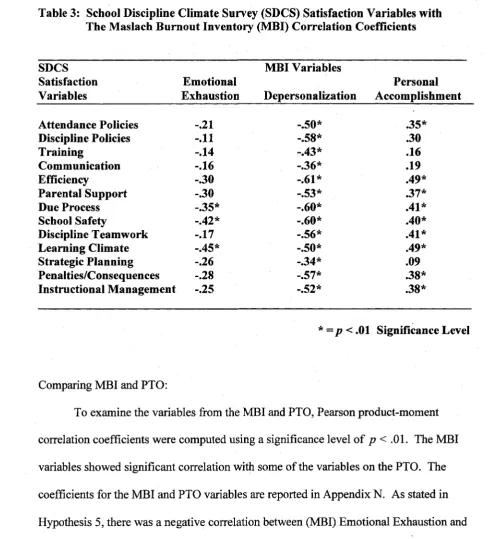
Depersonalization (r = -.60). As teachers’ perception of satisfaction for Due Process increased, they were more likely to experience a decrease in Depersonalization. For Hypothesis 4(ii), there was a negative correlation between Discipline Policies (SDCS) and Teachers’ feelings o f Depersonalization (r = -.58). As teachers’ perception of satisfaction for Discipline Policies increased, they were more likely to experience a decrease in Depersonalization. In reference to Hypothesis 4(iii), there was a negative correlation between Communication (SDCS) and Teachers’ feelings of Depersonalization (r = -.36). As teachers’ perception of satisfaction for Communication increased, they were more likely to experience a decrease in Depersonalization. For the above
Table 3: School Discipline Climate Survey (SDCS) Satisfaction Variables with The Maslach Burnout Inventory (MBI) Correlation Coefficients
SDCS MBI Variables
Satisfaction Emotional Personal
Variables Exhaustion Depersonalization Accomplishment
Attendance Policies -.21 -.50* .35*
Discipline Policies -.11 -.58* .30
Training -.14 -.43* .16
Communication -.16 -.36* .19
Efficiency -.30 -.61* .49*
Parental Support -.30 -.53* .37*
Due Process -.35* -.60* .41*
School Safety -.42* -.60* .40*
Discipline Teamwork -.17 -.56* .41*
Learning Climate -.45* -.50* .49*
Strategic Planning -.26 -.34* .09
Penalties/Consequences -.28 -.57* .38*
Instructional Management -.25 -.52* .38*
* - p <.01 Significance Level
Comparing MBI and PTO:
To examine the variables from the MBI and PTO, Pearson product-moment correlation coefficients were computed using a significance level o f p < .01. The MBI variables showed significant correlation with some of the variables on the PTO. The coefficients for the MBI and PTO variables are reported in Appendix N. As stated in Hypothesis 5, there was a negative correlation between (MBI) Emotional Exhaustion and (PTO) Satisfaction with Teaching (r = -.66). As teachers’ feelings o f Emotional
Emotional Exhaustion decreased, they were less likely to experience an increase in Satisfaction with Teaching).
The Emotionally Exhausted Educator
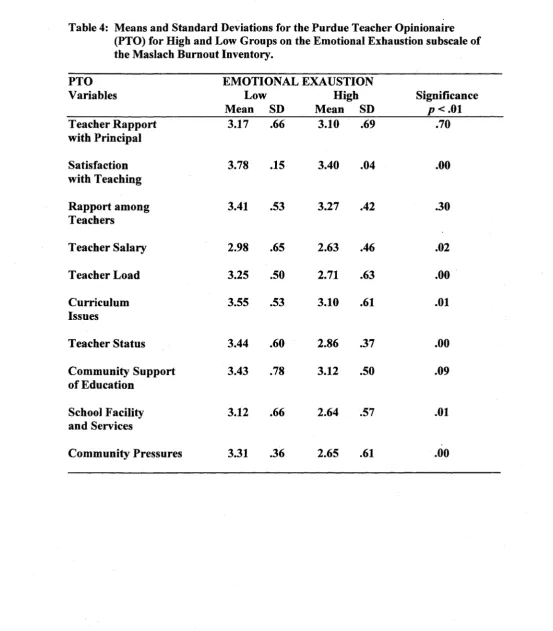
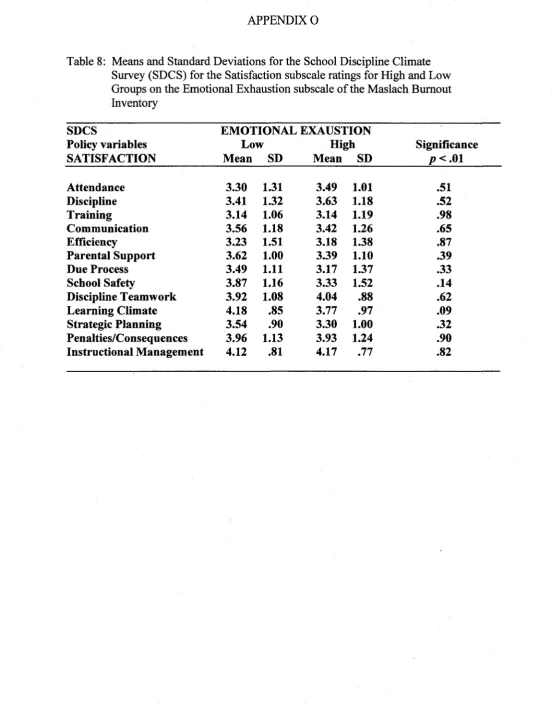
To obtain an image of what the emotionally exhausted educator would look like, with respect to Satisfaction (SDCS) and opinion (PTO), a discriminant function analysis was used. The sample was organized into two groups, one of Low Exhaustion and another o f High Exhaustion, from the MBI scale for Emotional Exhaustion. Using Emotional Exhaustion as the dependent variable, the Satisfaction subscales (SDCS) and PTO scales as the independent variables, the discriminant function analysis revealed no Satisfaction variables as discriminators (see Appendix O). However, there were
significant PTO variables that discriminated Low group from High group members (see Table 4).
among Teachers did not discriminate. (Refer to Figure 1 for Seven Key Constructs of School Discipline Climate.)
Table 4: Means and Standard Deviations for the Purdue Teacher Opinionaire (PTO) for High and Low Groups on the Emotional Exhaustion subscale of the Maslach Burnout Inventory.
PTO EMOTIONAL EXAUSTION
Variables Low High Significance
_________ Mean SD_____ Mean SD_________p < .01
Teacher Rapport with Principal
3.17 .66 3.10 .69 .70
Satisfaction with Teaching
3.78 .15 3.40 .04 .00
Rapport among Teachers
3.41 .53 3.27 .42 .30
Teacher Salary 2.98 .65 2.63 .46 .02
Teacher Load 3.25 .50 2.71 .63 .00
Curriculum Issues
3.55 .53 3.10 .61 .01
Teacher Status 3.44 .60 2.86 .37 .00
Community Support of Education
3.43 .78 3.12 .50 .09
School Facility and Services
3.12 .66 2.64 .57 .01
Additional findings for Discipline Policies (SDCS)
The Discipline Policies variable from the SDCS was significantly correlated with seven PTO variables. These variables were: Teacher Rapport with Principal (r = .66),
Rapport Among Teachers (r - .58), Community Support of Education (r = .51), Teacher Salary (r - .50), School Facilities and Services (r = .44), Teacher Load (r = .43), and Teacher Status (r = .41). Subjects who reported satisfaction with Discipline Policies were more likely to experience satisfaction with these variables. No significant correlation was revealed for Satisfaction with Teaching, Curriculum Issues, and Community Pressures. These variables did not have a significant relationship to teachers’ satisfaction with discipline policies.
Additional findings for Communication (SDCS)
The Communication variable from the Satisfaction subscale (SDCS) was correlated with variables from the PTO. The results from this analysis revealed the following seven significant coefficients: Teacher Rapport with Principal (r = .77), Teacher Salary (r = .56), Teacher Status (r = .56), School Facilities and Services
(r = .54), Community Support of Education (r = .51), Teacher Load (r = .43), and Rapport Among Teachers (r = .43). It seems that a large number of these PTO variables have a direct relationship with Communication. No significant correlation occurred with the remaining PTO variables Curriculum Issues, Satisfaction with Teaching, and
Additional findings for Due Process (SDCS)
The Due Process variable, from the Satisfaction subscale (SDCS), was examined with respect to the PTO variables. Due Process was significantly correlated with the following six PTO variables: Teacher Rapport with Principal (r = .61), Teacher Salary
(r = .59), Community Support o f Education (r = .58), Teacher Load (r = .57), Teacher Status (r = .57), and Satisfaction with Teaching (r = .36).
Additional findings for Teacher Rapport with Principal (PTO)
On the PTO, the Teacher Rapport with Principal variable was significantly correlated with all thirteen Satisfaction subscale variables (SDCS). Twelve o f these variables had correlation coefficients greater than 0.5 (see Appendix L). The remaining thirteenth variable, Learning Climate, had a correlation coefficient o f (r = .39).
Correlations between Teacher Rapport with Principal (PTO) and MBI variables had a variety o f results. Teacher Rapport with Principal was significantly correlated with Personal Accomplishment (r = .39) and Depersonalization (r = -.50) but not with
CHAPTER IV DISCUSSION
School Discipline Climate Views:
The first hypothesis for this research was that teachers would show a lower Satisfaction rating than Importance rating on the School Discipline Climate Survey. The data gathered in this study revealed that there was a significant difference in these
perceptions. School Discipline Climate Survey (SDCS) variables showed higher ratings on the Importance subscale than on the Satisfaction subscale. This discrepancy suggested that teachers were dissatisfied with their present school’s discipline climate.
Discrepancy Scores (SDCS):
Teachers’ School Discipline Climate Survey (SDCS) Satisfaction subscale scores were lower than their Importance subscale scores. The (SDCS) variable Efficiency had the greatest discrepancy score. It would seem that teachers were most dissatisfied with the efficiency of their school’s discipline system. Such issues surrounding this variable include: how referrals to the disciplinarian were processed in a timely manner, how referrals to the disciplinarian were processed according to policy, and how disciplinary actions conveyed support to staff members. As a measure to improve teachers’
satisfaction with efficiency, school administrators could survey teachers’ opinions of school discipline efficiency and discuss their concerns at staff meetings. Teachers’ level o f satisfaction with discipline efficiency could contribute to their overall job satisfaction.
dissatisfaction. Issues surrounding Learning Climate included: how school and
classroom climate support learning, how ‘good’ teaching practices minimize discipline problems, that students discuss classroom rules with their teachers, and that students are involved in establishing such rules. Although Learning Climate had the lowest
discrepancy score, teachers still perceived this variable with dissatisfaction. Possible strategies to address this discrepancy may include school boards offering professional development workshops for their teachers and school administrators discussing their expectations of appropriate learning climates for the school and classroom.
All of the SDCS variables were generally separated into two groups, those with discrepancy scores above 1.0 and those below. Seven SDCS variables had discrepancy scores above 1.0. These variables were: Efficiency, Due Process, School Safety, Discipline Policies, Parental Support, Communication, and Training. This group of variables represented those that had greater dissatisfaction for teachers. These variables gave a sense of what might be o f most concern for teachers regarding their schools’ discipline climate. As suggestions for improvement, Williams (2000) recommended avoiding unclear discipline policies and uneven enforcement of disciplinary
consequences or Due Process to maintain a healthy climate. A school’s climate can influence both the teachers and the students on professional and academic levels (Van der Sijde, 1988).