ABSTRACT
LYNN, AMY ELIZABETH. Internal Working Models as Predictors of Social Information Processing in Maltreated Children. (Under the direction of Mary Haskett, Ph.D.).
The purpose of this study was to examine whether children’s internal working models predict their social information processing with their peers. Specifically, the study examined if the self representations, parent representations, and attachment themes of maltreated children predicted their attributions of intent or response generation. Participants were a sample of 65 maltreated children who were in preschool, kindergarten, or first grade at the time of the assessment. The MacArthur Story Stem Battery was used to assess children’s internal working models and the Home Interview with Children was used to assess social information processing. A number of significant correlations were found between children’s representations of themselves, their representations of their parents, and their expressed attachment themes. Findings also indicated that only children’s positive self representations predicted their response generation, in that children who represented themselves positively had fewer aggressive responses. However, negative self representations, parent
Internal Working Models as Predictors of Social Information Processing in Maltreated Children
by
Amy Elizabeth Lynn
A thesis submitted to the Graduate Faculty of North Carolina State University
In partial fulfillment of the Requirements for the degree of
Master of Science
Psychology
Raleigh, North Carolina November 2008
APPROVED BY:
_______________________________ ______________________________
Mary Haskett, Ph.D. William Erchul, Ph.D.
Committee Chair
ii
BIOGRAPHY
iii
TABLE OF CONTENTS
LIST OF TABLES.……….. v
INTRODUCTION……… 1
Purpose of the Study……….………..…... 5
LITERATURE REVIEW....……… 6
Attachment and Internal Working Models...……….. 6
Attachment in Maltreated Children………... 10
Representations of Maltreated Children………….………... 12
Links Between Representations and Social Adjustment………….………….. 17
Peer Relationships...……….…………. 20
Social Information Processing……… 23
Attributions of Intent...……….………. 25
Response Generation/Problem Solving………. 26
Social Information Processing in Maltreated Children………….……… 27
Connecting Internal Working Models and Social Information Processing.……... 28
STATEMENT OF THE PROBLEM……….…. 31
Research Questions and Hypotheses……….……….… 32
METHOD……… 36
Participants……….…….………... 36
Instrumentation……….. 37
Measure of Internal Models………... 37
Measure of Social Information Processing……….…………...…… 39
Procedures……….…………. 41
RESULTS……….……… 48
Descriptive Statistics……….….……… 48
Representations of Self as Predictors of SIP………….………….……….……... 49
Representations of Parent as Predictors of SIP ……….……… 49
Expressed Attachment Themes as Predictors of SIP………. 50
DISCUSSION.……….………….………..…… 51
Correlations within Children’s Internal Working Models ……….……... 52
Internal Models as Predictors of Social Information Processing….….…………. 53
Study Limitations……….….……. 57
iv
REFERENCES……….……… 63
TABLES……….….…... 76
v
LIST OF TABLES
Internal Working Models 1
Internal Working Models as Predictors of Social Information Processing in Maltreated Children
Introduction
The National Child Abuse and Neglect Data System (NCANDS, 2006) reported that 867,253 children across the country experienced abuse in 2006. If this rate were to remain constant it would mean that one out of every 84 children in our country experience reported abuse every year. Reports (NCANDS, 2006) also show that younger children (i.e., infancy through the preschool years) tend to have the highest rates of victimization. It is these younger children that are more prone to experience the negative effects that have been associated with abuse (Erikson, 1989). The effects of child abuse and neglect are serious and impact not only the children but society as a whole.
Many investigators have examined the consequences of maltreatment and
documented negative effects on children’s physical, cognitive, psychological, and social functioning (Cicchetti, 1990; Springer, Sheridan, Kuo, & Carnes, 2007). Negative outcomes include high rates of delinquent behavior (Lewis, 1989), depression (Sternberg, Lamb, Guterman, & Abbott, 2006), risk for substance abuse (Kilpatrick, Acierno, Saunders,
Internal Working Models 2
of exploring the effects of abuse is to prevent these potential negative outcomes from occurring among children who have experienced abuse by shaping intervention practices. One major way to aid prevention of negative outcomes is to understand more completely the precursors that influence the negative outcomes. Leventhal (2005) has suggested that there is a need for improvement in the area of preventing child abuse and neglect and the resultant negative outcomes; one major task is to revise and strengthen models of how negative outcomes develop in order to investigate new intervention approaches.
Research has shown that quality of children’s attachment to their caregivers is one of the major predictors of social competence in children. Children who experience sensitive and responsive care tend to develop secure attachments to their caregiver. Secure attachments are thought to reflect confidence in the mother’s emotional availability and responsiveness and to promote children’s positive orientation toward their mother, themselves, and the world (Belsky & Pasco-Fearon, 2002). Secure attachment has been shown to result in optimal outcomes for children (Belsky & Pasco-Fearon, 2002; Bohlin, Hagekull & Rydell, 2000; Simpson, Collins, Tran, & Haydon, 2007). Insecure attachment, in contrast, is associated with a host of negative outcomes in childhood and adolescence (Crittenden & Ainsworth, 1989; Egeland & Sroufe, 1981; George & Main, 1979). These negative outcomes include poor psychological and social functioning (Cicchetti, 1990; Springer, Sheridan, Kuo, & Carnes, 2007) as well as increased rates of delinquent behavior (Lewis, Mallouh, & Webb, 1989) and continuing the cycle of abuse by abusing future generations of children
Internal Working Models 3
abuse, often by their caregiver, are frequently characterized as having an insecure attachment to their caregivers (Baer & Martinez, 2006; Cicchetti & Barnett, 1991) and are therefore at risk for problematic social relationships with caregivers as well as other adults and peers (Seuss, Grossman, & Sroufe, 1992; Verschueren & Marcoen, 1999).
Links between quality of attachment to caregivers and later social competence are likely mediated by children’s “internal working models” of relationships (Bowlby, 1973). That is, during early relationships, children create mental representations of people and relationships and these representations form their internal working models. Over time, these internal working models create “knowledge structures” in order for the child to understand current and future relationships (Bowlby, 1982). Children’s knowledge structures, based on their internal working models, create foundations for the relationships they will have throughout their lives. Shields, Ryan, and Cicchetti (2001) examined the relationship between children’s representations of their caregivers and their emotion dysregulation, aggression, and peer relationships. Shields and colleagues found that negative representations were associated with problematic peer relationships, suggesting that the mental
Internal Working Models 4
children have been shown to display significantly more negative representations of self and parent compared to the representations of their non-maltreated peers (Toth et al., 1997) Maltreated children also have exhibited fewer positive parent representations (Toth, Cicchetti, Macfie, Maughan, et al., 2000) and more conflictual themes (Toth, Cicchetti, Macfie, Rogosch, & Maughan, 2000) than their non-maltreated peers.
Internal Working Models 5
Purpose of the Study
It is clear from many decades of research that children’s early relationships with their parents predict many aspects of children’s peer relationships (Anthonysamy & Zimmer-Gembeck, 2007; Kaufman & Cicchetti, 1989; Waldinger, Toth, & Gerber, 2001). The present study built on this literature by exploring whether internal working models, developed during early relationships with parents, predict children’s social information processing in peer problem situations. The present study explored if specific aspects of the internal working models (e.g., representations of parents and self) predicted the processing of social
Internal Working Models 6
Literature Review
The following sections contain an introduction to attachment theory, followed by a discussion of literature related to attachment of abused children. Internal working models, developed through attachment relationships, will then be explored in terms of typical
development and differences that exist between models for abused and non-abused children. Information on internal working models will lead into research on social relationships and how children typically process social information. The model of social information
processing proposed by Crick and Dodge (1994) will then be described followed by an explanation of social information processing of abused children. These sections will conclude with a discussion of research that examines a link between attachment and social information processing.
Attachment and Internal Working Models
Internal Working Models 7
(Ainsworth, Blehar, Waters, & Wall, 1978). In her work, Ainsworth used the “Strange Situation” task to identify various patterns in attachment relationships, and two broad categories were identified: Secure and Anxious/Insecure. The anxious/insecure category has been further divided into three categories: Anxious-avoidant, Anxious-ambivalent, and Disorganized.
Ainsworth and colleagues (1978) suggested that children with secure attachments to their caregivers functioned with a beneficial balance between attachment and freedom for exploration. This style of secure attachment develops when caregivers are sensitive and responsive to their children (Ainsworth et al.; Ainsworth, 1979). Securely attached infants are confident in their exploration and mastery of their environments because they are certain of the sensitivity and availability of their caregivers (Weinfield, Sroufe, Egeland, & Carlson, 1999). However, infants who have anxious/insecure attachments have not had the same sensitive caregiver experiences. The caregivers of anxiously attached children tended to be angrier and more avoidant, and had more restricted affect than mothers of securely attached children (Ainsworth). These caregivers may have been indifferent or responded
inconsistently to bids for attention by their infants (Ainsworth et al.). Due to their interactions with insensitive caregivers, anxiously attached infants tend to be apprehensive about
availability of caregivers, fearful of ineffective responses, and may also exhibit anger towards the caregiver because of the caregiver’s lack of responsiveness (Weinfield et al.).
Differences between securely attached children and children with insecure
Internal Working Models 8
evident in various other aspects of children’s lives. Of particular relevance is the fact that peer relationships of children are related to the quality of their attachment to their caregiver. Specifically, research indicates that securely attached children are more socially competent and have stronger friendships in later childhood (Elicker, Englund, & Sroufe, 1992) and adulthood (Kobak & Sceery, 1988) compared to the social relationships of children with insecure attachment to their early caregivers.
Internal Working Models 9
and protection and others are viewed as available or unavailable to provide care and protection (Bowlby).
During the preschool years children become more involved in social relationships outside the family and begin to depend more heavily on their mental representations than on their actual attachment relationships to assist in understanding new social interactions (Crittenden & Ainsworth, 1979). It is at this time that the models become increasingly important and influential for a child. Dodge (2001) and others have agreed with the work of Bowlby, and propose that a child’s early relationship experiences become internalized in the form of expectations about how one is likely to be treated by others. That is, children will expect from peers what they have learned to expect from their caregivers. Specifically, children who experienced trustworthy, available caregivers and had secure attachments would expect peers to be available and trustworthy, whereas children who experienced uncertain and unavailable caregivers would expect peer relationships to be uncertain as well (Cicchetti, Lynch, Shonk, & Manly 1992).
Internal Working Models 10
preexisting internal models when assessing novel social situations or new relationships. Laible, Carlo, Torquati, and Ontai (2004) have shown that there are consistent links between children’s internal models, expressed as representations of relationships, and their social behaviors, with positive representations of relationships related to higher levels of social competence. These findings support the belief that different attachment styles and internal working models will lead to differences in social relationships.
In sum, research indicates that children’s early attachment relationships contribute to the formation of internal working models of social relationships. These working models are largely based on representations of the self and a caregiver, but predict other future social relationships with peers. Due to the importance of the caregiver relationship in the formation of internal working models, the type of relationship a child has with his or her caregiver will influence the models of relationships that are developed. As a result of the importance of attachment and its influence on future relationships, a large amount of research has examined how attachment and internal working models may differ between maltreated and
non-maltreated children. The following section will discuss differences that have been found in the attachment relationships of maltreated children.
Attachment in maltreated children. One major difference between abused and
Internal Working Models 11
experienced maltreatment display insecure attachments of the disorganized type, in that they show a lack of clear attachment behavior and often appear confused, avoidant, or
apprehensive (Carlson, Cicchetti, Barnett, & Braunwald, 1989). The percentage of maltreated children with insecure attachment styles is much higher than the percentage of non-abused children with insecure attachments (Egeland & Sroufe). Lynch and Cicchetti (1991) also suggested that these insecure attachments were still evident when maltreated children were in their school-age years. Thus, differences in the attachment styles of maltreated and non-maltreated children are not temporary. As previously indicated, attachment relationships contribute to the development of internal working models and because maltreated children often develop insecure attachments, a discussion of their internal working models is warranted.
The dialogue about differences in internal working models between maltreated children and non-maltreated children stems from the concept that maltreated children have a model of a distorted reality rather than a distorted model. This conclusion suggests that when a child experiences an altered reality, the alteration becomes the basis for their internal working model. Thus it is not their model that is distorted, but rather it is an accurate representation of the harsh reality on which the model is based (Crittenden, 1990). It is this concept that is often applied to the internal working models of children who experienced maltreatment. Many abused children do not experience a warm and reciprocal pattern of early relationships and therefore their relationships are likely to be represented as
Internal Working Models 12
Toth (1995) the abuse of children involves extreme distortions of the caregiving environment in which internal models initially develop. Children then use these altered environments and relationships to develop their initial internal working models of themselves and others. In fact, a number of studies have found differences in the expression of internal models between maltreated children and their non-maltreated peers (Toth, Cicchetti, Macfie, & Emde, 1997; Toth, Cicchetti, Macfie, Maughan, & Vanmeenen, 2000; Waldinger, et al., 2001). A
summary of these studies is provided in the following section.
Representations of maltreated children. A number of studies have been conducted to
examine whether representations of maltreated children differ from those of non-maltreated children. Narrative measures such as the McArthur Story Stem Battery have frequently been used to assess children’s representations of both self and caregiver. A number of
Internal Working Models 13
methodologically sound studies designed to examine various aspects of the representations of maltreated children within the current literature.
Toth and colleagues (1997) used a story stem completion task to examine maternal and self representations of maltreated and non-maltreated comparison children.This study included a sample of 107 preschool children between 3 and 6 years old, 62% of which were male. Forty-seven percent of the participants were from minority groups, including African American and Hispanic children. The maltreated group included 80 children designated by the Department of Social Services as in need of intervention. The maltreated group was further divided by subtype of maltreatment, including neglect, physical abuse, and sexual abuse. The comparison group consisted of 27 children whose families were receiving federal Aid to Families with Dependent Children. Maltreated and non-maltreated children were comparable on variables such as age, minority status, gender, and receptive vocabulary.
The authors used data from the McArthur Story Stem Battery to answer their research questions and hypotheses. The McArthur Story Stem Battery is a story stem completion task in which children use dolls to act out the end of story stems read to them by experimenters. Children were presented with a total of 10 story stems and were asked after each story stem to “show me and tell me what happens now.” The authors coded the children’s stories to assess both maternal and self representations. Representations of caregiver and self were coded as positive and negative representations. The authors hypothesized that maltreated children would provide narratives with higher rates of negative maternal and self
Internal Working Models 14
wanted to examine if maltreated children who had experienced different subtypes of abuse showed unique patterns of representations.
The authors initially examined how different representations (i.e., positive and negative parent and self representations) correlated with each other. These correlations showed that positive maternal representations were significantly correlated with positive self representations (r = .38, p < .001) and negative maternal representations were significantly correlated with negative self representations (r = .50, p < .001). These correlations provide further support for the theory that representations of self and caregiver are related. Results indicated that maltreated children had significantly more negative maternal representations than the non-maltreated children, F (1, 105) = 8.30, p < .01. Additionally, results revealed that maltreated children had significantly more negative self representations than their non-maltreated peers, F (1, 105) = 13.21, p < .001. The authors also found that physically abused children had the highest number of negative maternal and self representations compared to the other subtypes of maltreatment. Given the association between representations and future relationships, the higher rates of negative representations may lead to increased negative social outcomes for physically abused children, although such outcomes were not measured in this study. Toth and colleagues (1997) concluded that relationships that could be
potentially positive may be adversely affected by the relationship expectations of maltreated children, and this could be especially true for physically abused children.
Internal Working Models 15
children; however, results were typically presented as case examples rather than group differences. In spite of this strength, there were limitations to the study. The authors stated that because each narrative story contained information about both the self and caregiver, separating caregiver and self representations was slightly difficult. However, the stories were said to be a valid measure because they were expressions of the inner worlds of the children where the caregiver and self affect each other, thus making the stories a more accurate
representation of the children’s inner worlds than stories that did not include both the self and caregiver. Another limitation of this study was that the researchers examined representations at only one time point, thus nothing was learned about the stability of children’s
representations. Finally, the study did not address possible links between the narrative representations and outcomes such as social competence.
Internal Working Models 16
maltreated children. It was also hypothesized that maltreated children would portray parents as more controlling and less likely to use positive discipline than would non-maltreated children. However, the authors made no specific hypotheses about the stability of
representations over time, as there were no previous studies that examined the stability of representations for maltreated children.
As expected, maltreated children had significantly more negative representations of self and parent compared to the representations of their non-maltreated peers, t(90.56) = 3.03, p <.05, which is analogous to the results found by Toth and colleagues (1997). Findings also
showed that maltreated children had fewer positive parent representations than did non-maltreated children, t(54.88) = 2.45, p < .05. Representations of parent remained stable over time for both abused and non-abused children. Although positive and negative self
representations remained stable over time, grandiose self representations (i.e., the child is portrayed to have over-inflated abilities) rose marginally between Time 1 and Time 2. In the discussion it is suggested that the self continues to change through the developmental process and that the pre-school period may be particularly fluid in terms of self representations.
To help ensure the validity of their results, the authors made sure that the maltreated and non-maltreated groups were equivalent on demographic characteristics. The authors also controlled for gender and language ability in case these variables were related to
Internal Working Models 17
language was only assessed at Time 1 but the authors commented that scores on the receptive language assessment have acceptable short term stability, making a reassessment
unnecessary. The longitudinal nature of this study was a definite strength in that it attempted to fill a gap in the literature related to the stability of representations. However, a limitation was that the maltreated children were receiving services throughout the one year study. The services may have affected the results in that the maltreated children’s internal models may have been altered from the first to second assessments as a result of treatment. The authors argued that because services would be expected to improve child functioning, their findings of more negative representations over time for maltreated children may be an
underestimation of the true differences between maltreated and non-maltreated children. Unfortunately, analyses to assess of the impact of services received were not conducted. This further limits knowledge of the potential effects that services may have had on results.
Finally, although this study added to the literature by examining stability of representations, the authors did not fully examine all aspects of representations that are present in children’s narrative stories, such as representational themes (e.g., affection, empathy, aggression, and verbal conflict). Examining these representational themes could have provided additional information about how maltreated children represent relationships and what types of themes are common among maltreated children. Finally, once again the authors did not correlate representations to children’s social competence.
Links between representations and social adjustment. Crittenden (1992) stated that
Internal Working Models 18
relationships, and that these road maps predict similar experiences and provide methods for coping with the dangers that are expected from these future relationships. Using models of harsh realities when assessing novel situations and new relationships could hinder the ability of maltreated children to accurately process the situation and develop healthy relationships. Waldinger and colleagues (2001) proposed that because many maltreated children perceive experimenting with new social behaviors as risky, they may be left with fewer responses to new situations and ultimately perpetuate their negative relationship experiences. A number of studies have actually found that maltreated children tend to generalize negative
representational models to new situations, increasing the likelihood that they will perpetuate their relationship histories (Toth et al., 1997; Toth & Cicchetti, 1996). These findings suggest that the internal models maltreated children use may distort not only their views of
themselves and caregivers, but also their social interactions and peer relationships.
non-Internal Working Models 19
maltreated comparison children. The mean age of the children was 4.8 years, and maltreated and non-maltreated children were comparable on gender, ethnicity, socioeconomic status, and receptive vocabulary.
The authors used the MacArthur Story Stem Battery to assess themes present in narrative stories, and the Child Behavior Checklist – Teacher Report Form (CBCL-TRF) was used to assess behavior problems. The authors hypothesized that the narratives of maltreated children would contain more conflictual themes and fewer moral-affiliative themes than the narratives of their non-maltreated peers. It was also hypothesized that maltreated children would have more externalizing behavior problems than non-maltreated children. Finally, the authors hypothesized that moral-affiliative representations would be negatively correlated with child behavior problems and conflictual representations would be positively correlated with behavior problems.
As was expected, results indicated that maltreated children expressed significantly fewer moral-affiliative themes, t(63)= 2.67, p = .01, and significantly more conflictual themes than non-maltreated children, t(55.03) = 4.57, p < .001. Consistent with decades of prior research, maltreated children obtained significantly higher scores on internalizing and externalizing behavior problems compared to non-maltreated children. Finally, the authors found significant positive correlations between conflictual themes and internalizing behavior problems (r = .27, p = .03) as well as between conflictual themes and externalizing behavior problems (r = .48, p < .001). These results suggest that themes present in maltreated
Internal Working Models 20
exhibited by maltreated children. The results also suggest that maltreated children who have higher rates of positive themes than negative themes may be less likely to exhibit the
externalizing behaviors common among maltreated children.
The authors of this study chose to examine not only differences in themes and
behavior problems between maltreated and non-maltreated children, but also how the themes and behavior problems were related to each other. This additional assessment allowed for further exploration of possible associations among various negative outcomes (e.g., negative representations and behavior problems) experienced by maltreated children. This study was not free of limitations: for example, the authors used only teacher ratings of behavior (CBCL-TRF), which assessed a child’s behavior in the school setting but not in the home setting. Given that children may behave differently at home than at school and parents and teachers may view behaviors differently, it is important to assess functioning in both social contexts. Including a rating of child behavior at home would have created a more complete examination of child behavior.
Peer relationships. Distorted views of novel social situations could lead maltreated
children to have difficult or deficient peer interactions and/or friendships. Mueller and Silverman (1989) reviewed a number of studies that compared the social interactions and relationships of maltreated children to those of their non-maltreated peers and found that maltreated children tended to have heightened aggression in their peer interactions. They also found that maltreated children showed more withdrawal and active avoidance of peer
Internal Working Models 21
further support for problematic peer interactions when they showed that maltreated children expressed fewer wishes to be close to others and tended to represent themselves as angry and oppositional towards others. Maltreated children have also been found to exhibit less
prosocial behavior than their peers (Anthonysamy & Zimmer-Gembeck, 2007; Kaufman & Cicchetti, 1989).
Kinard (1999) provided further evidence of problematic peer relationships with results that showed that mothers of maltreated children rated their children as less socially competent than mothers of non-maltreated children. Bolger, Patterson, and Kupersmidt (1998) found that children who experienced chronic maltreatment not only had more difficulties with peer relationships (e.g., fewer reciprocated playmates, and inability to maintain close positive friendships), but they also were less well liked by their peers. Salzinger, Feldman, and Ng-Mak (2007) indicated that maltreated children’s social expectations and prosocial behavior mediated the link between abuse and positive and
negative social status, and between abuse and positive and negative reciprocity. These results suggest that children’s expectations for relationships play an important role in their success in social relationships.
Internal Working Models 22
when assessed by teachers and peers, maltreated children had more difficulties in peer relationships and displayed more undercontrolled and aggressive behavior than their non-maltreated peers. Maltreated children, specifically physically abused children, have also been shown to be at heightened risk for reactive aggression (Shields & Cicchetti, 1998). Finzi, Ram, Har-Even, Shnit, and Weizman (2001) added that abused children tend to be more aggressive than their non-abused peers and are also at higher risk for future antisocial behavior. In their study using a community sample, Johnson, Kotch, Catellier, Winsor, Dufort, Hunter, et al. (2002) also found that children who had histories of abuse were rated by their parents as having significantly higher rates of aggression than other children in the sample. These findings suggest that not only are problematic peer relationships common among maltreated children, but that aggressive behavior is also typical for these children.
In sum, differences have been seen in the attachment styles of maltreated children, in that maltreated children tend to have higher rates of insecure attachments than
non-maltreated children. Given these differences in attachment style, it should come as no
Internal Working Models 23
on the concept of social information processing and how it relates to successful peer interactions.
Social Information Processing
A prominent theory developed to explain the etiology of children’s problematic social interactions, including aggressive behavior, is the social information processing theory, which describes the manner in which the cognitive tasks of social perception and problem solving interact with one’s own goals, motivational state, and arousal regulation to predict their behavior in social situations with peers (Dodge, 1993). Over the past two decades, research designed to test this theory has demonstrated that the theory is useful in predicting social, cognitive, and behavioral differences between socially competent children and those who have more difficulty with social interactions.
Internal Working Models 24
situation with a behavioral enactment of their selected response. The cycle is repeated when the child’s behavioral enactment invokes a peer’s response.
Peer relationships and social interactions require children to constantly process the information that is received during interactions. Fraser, Galinsky, Smokowski, Day, Terzian, Rose, et al. (2005) suggested that accurate social information processing is imperative in order for children to be socially competent and that patterns of social information processing relate to early life experiences and later conduct. There is a substantial body of research to support the validity of the social information processing framework. To illustrate, Dodge and Price (1994) found a pattern of consistent associations between social information processing variables and behavioral competence in a sample of socially competent children. They also found that measures of each step of the process were correlated in the expected direction with behavior in at least one social situation that they assessed.
Internal Working Models 25
children at all stages of processing, Crick and Dodge (1994) proposed that the interpretation of cues, specifically children’s attributions of intent, and response generation were the most problematic steps for aggressive children. Due to the suggested importance of those two steps, they are the focus of this study and will be discussed in more detail in the following sections.
Attributions of intent. Attributing intent to another’s actions takes place during the
first two steps of social information processing: encoding of cues, and interpretation and representation of those cues. It is during these steps that a child decides why a peer acted in a particular manner. Dodge, Murphy, and Buschbaum (1984) suggested that the child’s
perception of intent was more important than the actual intent in determining the child’s response. Dodge (1980) found that when a child attributed hostile intent to a peer, there was a greater likelihood of an aggressive response than when a benign attribution was made. A great deal of subsequent research was designed to further examine the link between
aggression and hostile attributional biases. In specific studies, aggressive children have been found to attribute hostile intentions to a peer’s behavior in a situation where the intent was ambiguous (Quiggle, Garber, Panak, & Dodge, 1992). Consequently, it has been surmised that these children are incorrectly interpreting social cues and situations, and that may be what is leading them to display heightened levels of aggression.
Internal Working Models 26
and hostile attributions of peers’ intentions. Using Fisher Z calculations, the authors found that the overall relationship between aggression and hostile attributions of intent was highly significant Z = 11.25, p < .01. Additionally the authors assessed the magnitude of the association by transforming the Fisher Z scores to correlations, and found weighted mean effect sizes ranging from r = -.29 to r = .65. The results of this meta-analysis suggest that, across the research examining hostile attributions of intent, a strong tie to aggressive
behavior has been consistently reported. However, according to the authors, the link between hostile attributions and aggressive behavior tended to be stronger in studies that included the following: children who had more severe behavior problems, children who were 4 - 6 years old or 8 - 12 years old, stimuli that were read to the children, and when intelligence was not controlled in data analyses.
Response generation/problem solving. As stated earlier, Crick and Dodge (1994)
considered the ability to problem solve and generate responses to peer conflict as particularly problematic for aggressive children. Research has shown that aggressive children tend to be poor social-problem solvers, in that they generate fewer solutions to problems and select aggressive solutions more often than their non-aggressive peers (Quiggle et al., 1992). Aggressive children also have been found to anticipate more positive outcomes from
Internal Working Models 27
peer relationships and to use aggression in an attempt to resolve difficult situations with peers. It follows that maltreated children might hold hostile attributions for peers’ intentions and might have deficits in social problem solving skills. Research designed to examine the social information processing of maltreated children will be explored in the following section.
Social information processing of maltreated children. The link between aggression
and social information processing that was presented in the previous section can also be applied to the aggressive behavior of maltreated children, suggesting that the aggression exhibited by maltreated children may be linked to their social information processing. In fact, a great deal of research indicates that maltreated children tend to show deficits in social information processing similar to other aggressive children (Dodge, Bates, Petit, & Valente, 1995; Salzinger et al., 2001). Specifically, in their processing of social information,
Internal Working Models 28
In addition to misinterpretation of peers’ social cues, maltreated children tend to demonstrate difficulty in problem solving and generating responses to social problems. Maltreated children have been found to generate significantly more low-quality responses (i.e., solutions involving force, aggression, ignoring, tricking or lying) than their
non-maltreated peers (Trickett, 1993). These results suggest that although non-maltreated children are capable of generating responses to social situations, they are not generating socially
appropriate solutions. Price and Landsverk (1998) found that response generation/social problem solving skills of maltreated children predicted their level of social competence and their social behavior. These results provide further support for the theory that disrupted social information processing, in particular interpretation of social cues and response generation, might contribute to maltreated children having higher rates of aggressive behavior.
Connecting Internal Working Models and Social Information Processing
Internal Working Models 29
database of information stored in memory (e.g., social schemata, scripts, and social
knowledge), and that engaging in interpretational processes may result in subsequent changes or revisions to the database (Crick & Dodge, 1994). Thus, it could be argued that children’s internal working models, including their representations of self and caregiver, influence how they encode, interpret and respond to social situations.
Indeed, Cicchetti and colleagues (1992) suggested that the construct of children’s internal working models of self and caregiver, which are derived from attachment
relationships, may contribute to expectations of how peers will act and react in social situations. Cassidy, Kirsh, Scolton, and Parke (1996) showed that attachment was significantly related to a child’s social information processing. Specifically, security of attachment (as measured by the Strange Situation Paradigm) was related to attributions of peer intent in ambiguous situations, with securely attached children having more positive attributions of peer intent than insecurely attached children. Ziv, Oppenheim, and Sagi-Schwartz (2004) also showed that attachment (as measured by the Strange Situation Paradigm) was significantly related to children’s social information processing such that securely attached children evaluated competent social responses more positively than did insecurely attached children. In addition, insecurely attached children anticipated negative social outcomes regardless of the situation presented to them, and also anticipated better social outcomes for hostile responses than did the securely attached children.
The research of Cassidy and colleagues (1996) and Ziv and colleagues (2004)
Internal Working Models 30
Internal Working Models 31
Statement of the Problem
Maltreatment has been associated with poor quality of relationships with caregivers and negative internal models of relationships (Toth et al., 1997). The difficulties in
relationships tend to extend to maltreated children’s peer relationships (Mueller & Silverman, 1989). Previous studies have examined how abuse can relate to a child’s internal models and results have shown that not only are the representations of the mother influenced by abuse, but the representations of self and others also are influenced (Toth et al.; Toth, Cicchetti, Macfie, Maughan, & Vanmeenen, 2000). A child’s internal working models and
representations of self and caregiver have been linked to difficulties with peer relationships (Bolger et al., 1998). However, mechanisms that might account for the relation between children’s internal models and difficulties with peers have not been adequately examined in prior research; leading investigators have called for increased attention to identification of potential mechanisms.
Internal Working Models 32
consistency across literature showing difficulties with peer relationships for children who have experienced abuse. Although there is agreement about outcomes related to faulty social information processing, factors that may contribute to this faulty processing have not been fully explored.
Within the literature on social information processing, there is consensus that a child’s preexisting database of social knowledge is intimately linked with all of the steps involved in processing social information. The model of relationships a child has internalized becomes part of their preexisting database of knowledge that is subsequently used in social interactions. Although there are clear theoretical links between working models of
relationships and social information processing, the association between these constructs has not been examined empirically. Thus, the purpose of the present study was to examine if children’s internal models predicted their processing of social information within a sample of children who have experienced abuse. This research specifically examined whether abused children’s representations of parent and self predicted their attributions of intent and response generation. This study also investigated if the themes within children’s representations predicted attributions of intent and response generation.
Research Questions and Hypotheses
Due to the paucity of research specifically examining the connection between internal models and children’s social information processing, it was difficult to make specific
Internal Working Models 33
working models of relationships of abused children would predict their social information processing skills. Specifically, it was expected that children’s internal working model of the parent and of the self would predict children’s attributions for peers’ intentions and
children’s response generation when faced with problematic peer situations. Hypothesis 1: Children’s representations of self would significantly predict attributions of peer intent.
1a. Positive self representations would predict the number of peer problems for which children report a hostile attribution of peer intent, with higher rates of positive representations being associated with fewer hostile attributions. 1b. Negative self representations would predict the number of peer problems for
which children report a hostile attribution of peer intent, with higher rates of negative representations being associated with more hostile attributions. Hypothesis 2: Children’s representations of self would significantly predict generation of solutions to peer problems.
2a. Positive self representations would predict the number of peer problems for which children report aggressive solutions, with higher rates of positive representations being associated with fewer aggressive responses.
Internal Working Models 34
Hypothesis 3: Children’s representations of parent would significantly predict attributions of peer intent.
3a. Positive parent representations would predict the number of peer problems for which children report a hostile attribution of peer intent, with higher rates of positive representations being associated with fewer hostile attributions.
3b. Negative parent representations would predict the number of peer problems for which children report a hostile attribution of peer intent, with higher rates of negative representations being associated with more hostile attributions. Hypothesis 4: Children’s representations of parent would significantly predict generation of solutions to peer problems.
4a. Positive parent representations would predict the number of peer problemots for which children report aggressive solutions, with higher rates of positive
representations being associated with fewer aggressive responses.
4b. Negative parent representations would predict the number of peer problems for which children report aggressive solutions, with higher rates of negative representations being associated with more aggressive responses.
Hypothesis 5: Children’s expressed attachment themes would significantly predict attributions of intent.
Internal Working Models 35
5b. Conflictual themes would predict the number of peer problems for which children report a hostile attribution of peer intent, with higher rates of conflictual themes being associated with more hostile attributions.
Hypothesis 6: Children’s expressed attachment themes would significantly predict their responses to problematic social situations.
6a. Moral-affiliative themes would predict the number of peer problems for which children report aggressive solutions, with higher rates of moral-affiliative themes being associated with fewer aggressive responses.
Internal Working Models 36
Method Participants
Participants for the present study were a subset of physically abused children enrolled in a larger study. The purpose of the larger study was to determine predictors of abused children’s successful transition from preschool into the elementary school setting. A number of potential predictors were under examination in the larger study, including familial
relationships, parenting practices/beliefs, as well as self perceptions and social capabilities of the child. Criteria for inclusion in the larger study included (a) a substantiated report of physical abuse to the social service registry within the prior 12 months, (b) confirmation that the child/parent dyad was living in the same home, (c) an absence of sexual abuse of the child, and (d) the child was in his or her last year of preschool at the time of the initial visit. Although the goal of the study was to have children enter the study while in preschool, a number of children entered the study while in kindergarten or first grade. Children were included in the present study if they completed the measures of social information processing and internal working models.
Nearly all children enrolled in the larger study (N = 79) were included in this study. The sample included 65 children who ranged in age from 4 to 7 years (M=5.5). A large majority of children in the sample were male (63%) and African American (75%). All
Internal Working Models 37
well as their siblings. Each child has unique representations of their experiences and unique social information processing abilities and results were not affected by the inclusion of siblings.
Instrumentation
Measure of internal models. Children’s internal models of relationships were
measured using a story-stem completion task based on the MacArthur Story Stem Battery (Bretherton, Oppenheim, Buschbaum, & Emde, 1990) and developed by Bretherton and colleagues (Bretherton, Ridgeway, & Cassidy, 1990). Using dolls, children were presented with the beginning of a story and were asked to complete the story. All stories were narrated and acted out by the research assistant using a set of family dolls. Stories portrayed
emotionally-laden family interactions designed to be relevant to the lives of young children; content areas included child accident, child injury, parental conflict, child fear, parent-child separation and reunion, and family interaction. Each story is provided in Appendix A.
The MacArthur Story Stem Battery contains many stories and investigators choose those stories and content areas that best fit their research questions. This study included seven stories presented using a combination of dolls that can include a mother, father,
Internal Working Models 38
was asked to “Show me and tell me what happens now.” An initial story about a birthday party was presented as a practice story to introduce the children to the task and allow them to gain familiarity with the procedures. Administration of all stories was audiotaped and
videotaped for later coding.
Toth, Cicchetti, Macfie, Maughan, and colleagues (2000) reported the inter-rater agreement of the MacArthur narrative coding manual – Rochester Revision ranges from kappa = .71 to 1.0 for all categorical variables. Toth, Cicchetti, Macfie, Rogosch, and
colleagues, (2000) also assessed inter-rater reliability of this coding system and reported it to range from kappa = .73 to .95 and the Moral-affiliative and Conflictual composite scores are negatively correlated (r = -.28, p < .05). Oppenheim, Emde, and Warren (1997) also found adequate rater reliability of the coding system, kappa = .85. In the present study inter-rater reliability was assessed for approximately 30% of the sample. However, due to the fact that kappa could not be computed for certain variables in this study, percent agreement was calculated for all variables and ranged from 72% to 100% for all variables of interest.
Internal Working Models 39
Representation composites, and scores on the Conflictual composite mediated the relation between maltreatment status and externalizing disorders (Buchsbaum, Toth, Clyman, Cicchetti, & Emde, 1992; Toth, Cicchetti, Macfie, Rogosch et al.). These findings suggest that this measure is a valid tool to assess children’s internal working models; the measure captures differences between abused and non-abused groups and scores are linked to measures of behavioral outcomes.
Measure of social information processing. The Home Interview with Children
(HIWC) was used to assess several aspects of children’s social information processing. The HIWC (Appendix B) was developed by investigators on the Fast Track Project to assess children’s attributional style for peer intent and children’s response generation skills (Conduct Problems Prevention Research Group, 1991). To administer the HIWC,
Internal Working Models 40
Dodge and colleagues (2002) reported high inter-rater reliability for the HIWC (κ = .91). Rains (2002) showed that there is acceptable inter-item reliability and acceptable subscale reliability for Hostile Attributions and Aggressive Response with alpha ranging from .72-.84. Internal consistency was assessed by the developers of the measure using Cronbach’s alpha and reliability was found to be .80 for items that assess attributions (Conduct Problems Prevention Research Group, 1991). For the present study, inter-rater agreement of coding was estimated using a second coder for approximately 30% of
participants. Kappa was used to estimate inter-rater agreement on variables that were being coded in the measure. In order to maintain a more conservative approach, kappa was
computed individually for each scenario rather than for the composite scores. Kappa ranged from .71-1.0 for both variables of interest in this measure. The scenarios that resulted in a lower kappa (e.g, .71) tended to be response generation variables. However, because these codes are then categorized into either aggressive or non-aggressive response type scores, the slight variations in codes did not affect the final aggressive response scores and were
therefore considered appropriate to use.
Internal Working Models 41
and social behavior in studies that used hypothetical vignettes read to children compared to studies that used measures where children watched video taped vignettes or simply looked at pictures that portrayed social situations.
Procedures
Participants were identified through the Department of Social Services (DSS) as having substantiated cases of physical abuse. Parents of abused children in the appropriate age range were sent a letter informing them of the study and providing them with contact information for the study. Interested parents called the research office and were screened for participation by a doctoral level psychologist. A psychosocial interview was conducted during the phone interview screening. This interview involved gathering demographic information and medical and mental health histories for the parent and child. Families were informed that the study included three data collection sessions that would span three years. The family was informed that they would be scheduled to attend one three-hour session each year. Optimally, the initial session was scheduled when the child was in preschool, the second session occurred approximately one year later when the child was in kindergarten, and the third and final session was scheduled when the child was in first grade. Data from the earliest time point available for each child was used in this study. The final sample included data for 28 children in preschool, 27 children in kindergarten, and 10 children in first grade. After completion of the Psychosocial Interview, families were scheduled for a three-hour data collection session at a university-based clinic. To encourage participation,
Internal Working Models 42
$70 for participating. To encourage families to participate in all three time-points of the study, the payments were increased by $10 each year the family participated. Therefore, families that returned for the second and third assessments received $80 and $90,
respectively. Parents also received a book with contact information for local parenting and family support resources and their child was given educational materials and a small toy. Parent participants were also entered into a monthly drawing for a $50 cash “bonus” when they scheduled their appointment. Confidentiality was maintained by assigning identification numbers to all participating families and cataloging data according to these numbers in locked filing cabinets. To take further precautions for confidentiality, a Certificate of Confidentiality was obtained from the federal Department of Health and Human Services, which protects families from research information being used in court proceedings. Procedures were approved by the university Institutional Review Board.
Informed consent was obtained from parents at the beginning of each session and assent was obtained from children. Teams of undergraduate research assistants, supervised by a graduate student, administered all measures with parents and children. Undergraduate research assistants were not aware of the families’ involvement with the Department of Social Services or the children’s substantiated histories of abuse. All measures were completed in private interview rooms and participants were given the option to decline to participate in any aspect of the data collection process.
Internal Working Models 43
scores using the codes. A flow chart of score creation is provided in Appendix C. Each story was coded separately using the Rochester Narrative Coding II Manual (2001). This manual is the latest revision of the MacArthur narrative coding manual – Rochester Revision
(Robinson, Mantz-Simmons, Macfie, & the MacArthur Narrative Working Group, 1996). Stories were coded by undergraduate research assistants. All coders were unaware of the child’s history of maltreatment as well as hypotheses to be tested. All coders completed a series of training sessions with the same graduate student trainer (the author) until 80% minimum inter-rater agreement was established. After reaching reliability during training, coders were assigned a series of tapes to code individually and approximately 30% of the narratives were coded by a second coder to assess inter-rater reliability.
Each of the six stories (excluding the practice story) was coded for representations of self (child representations) and representations of caregivers (parent representations). First, all stories were coded for the presence of positive, negative, and false child representations. Positive child representations included pride, helping, and feeling good about self in any domain (e.g., child helps clean up the spilled juice). Negative child representations included aggression, shame, self-blame, and feeling bad about oneself in any domain (e.g., child hits the mom). False child representations encompassed reports of inappropriate emotions or an overly compliant strategy (e.g., when asked how the child feels about the parents arguing, participant says “good” or “fine”).
Internal Working Models 44
protection, caretaking, affection, and helpfulness (e.g., parent puts a band-aid on the hurt finger). Negative parent representations involved harsh or punitive behaviors, rejection, and ineffectual actions (e.g., parent rejects a child’s bid for closeness, or moves rather than deal with the monster). Disciplining parent representations consisted of descriptions of the parents or grandmother disciplining a child, which may have included physical punishment if it was not overly harsh (e.g., parent put the child in time out, or parent spanked the child).
Controlling parent representations were parental attempts to control the child independent of discipline (e.g., parent tells the child to go to bed, not as a punishment). Incongruent parent representations were when a child told a story about a parent dealing inconsistently with the child (e.g., Mom comforted the child and put a band-aid on the hurt knee, then yelled at the child for falling off the rock).
In addition to specific representations, all stories were coded for themes including: (a) affection (an appropriate display of hugs, kisses, and compliments); (b) affiliation (a positive situation where two or more dolls were participating in an activity together); (c) compliance (when a character yielded to the rules or requests of an adult in the story); (d)
Internal Working Models 45
Once the stories were coded for child and parent representations and for themes, the codes were used to generate scores using the method employed by Toth, Cicchetti, Macfie, Maughan, and colleagues (2000). Procedures for generating summary scores and composite scores are described next. Self representations were assessed using the child representations scale, which contains positive representations, negative representations, and false
representations. The codes for positive, negative and false representations were summed across narratives to create summary scores. The Positive Child Representations composite was the sum of the positive representations scale with a range of 0-6, with a score of 6
corresponding to having a positive representation in each of the 6 stories. The Negative Child Representations composite was the sum of both the negative and false scales. Therefore, the Negative Child Representations composite score was divided by two, to create the average composite score, because it combined two scales (i.e., the negative and false scales). The composite score ranged from 0-6, and a 6 equated with having a negative and false representation in each story.
Internal Working Models 46
incongruent representations. Therefore, the Negative Parent Representations composite score was divided by 3, to create an average composite score, because it combined three scales (i.e., negative, controlling, and incongruent). Scores range from 0-6, and a score of 6 showed that there were negative, controlling, or incongruent representations in each story. Please see the flow chart in Appendix B for further explanation of variable composites.
Finally, using the method employed by Toth, Cicchetti, Macfie, Rogosch, and Maughan (2000) the coded themes were used to create composite scores for
Moral-Affiliative themes and Conflictual themes. The score for each individual theme was created by summing the presence of that theme across the six stories to create a summary score. Composite scores for Moral-Affiliative and Conflictual themes were generated by averaging the sum of relevant content codes for each theme. The Moral-Affiliative composite consisted of scores for affection, affiliation, compliance, empathy, and reparation/guilt. The total score was the sum of the scores for all five themes divided by 5, in order to create an average composite score. The Conflictual composite consisted of scores for aggression, verbal conflicts, and escalation of conflict. Once again the total score was the sum of the three themes divided by 3, so that an average composite score was created.
Internal Working Models 47
1991). Responses were coded as either Hostile (e.g., "he was being mean"), Non-hostile (e.g., "it was an accident"), or Don’t Know (when participant was unable to generate a reason for the child's behavior). The attribution style score was based on the total number of vignettes for which a child gave a response characteristic of a hostile attribution bias (possible range 0-8). Higher scores were equated with higher rates of hostile attributions.
Additionally, the HIWC was used to measure the child’s tendency to choose
Internal Working Models 48
Results
Descriptive Statistics
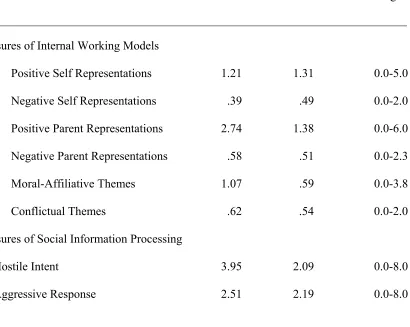
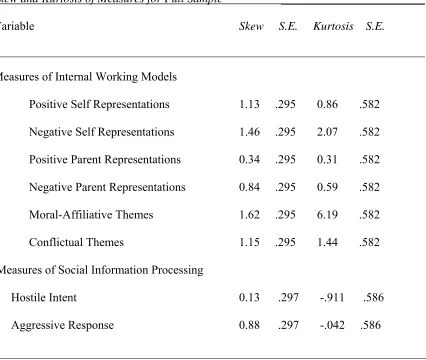
To assess normality of data, means, standard deviations, and ranges were calculated for all variables. Values for all variables can be found in Table 1. Additionally, skewness and kurtosis values were computed to examine the distribution of the dependent variables and predictors. The ratio of kurtosis and skewness to its standard error was used as a test of normality for each predictor. Positive Self Representations, Negative Self Representations, Negative Parent Representations, Moral-Affiliative Themes, Conflitcual Themes, and Aggressive Response were significantly skewed. Additionally, Negative Self
Representations, Moral-Affiliative Themes, and Conflictual Themes were kurtotic. Variables that were skewed or kurtotic were transformed using non-linear log transformations;
however, running the analyses using the corrected values did not change the pattern of
results. Therefore, results using the uncorrected true values will be presented. All uncorrected skew and kurtosis values can be found in Table 2.
Internal Working Models 49
analyses did not change the significance of any of the predictors in the study. Therefore, to increase the sample size the analyses that included the siblings will be presented in the following sections.
Representations of Self as Predictors of SIP
First, the degree to which children’s representations of themselves predicted their attributions of peer intent, specifically hostile attributions, was examined using a multiple regression analysis. Positive Self Representations was not a significant predictor of Hostile Intent, β (65) = .099, t = -.793, p = .431; nor was Negative Self Representations a significant predictor of Hostile Intent, β (65) = .152, t = -1.218, p = .228. The model as a whole
accounted for 3.3% of the variance in attributions of hostile intent.
Second, to assess whether children’s representations of themselves predicted their solutions to peer problems, specifically the number of aggressive responses, a multiple regression analysis was conducted. The model accounted for 7.1% of the variance in Aggressive Response. Positive Self Representations was found to be a significant predictor of Aggressive Response in the expected direction β (65) = -.265, t = -2.165, p = .034.
However, Negative Self Representations did not significantly predict Aggressive Response, β (65) = .033, t = .273, p = .786.
Representations of Parent as Predictors of SIP
-Internal Working Models 50
.054, t = -.424, p = .673; nor was Negative Parent Representations found to be a significant predictor of Hostile Intent, β (65) = .055, t = .434, p = .666. The entire model accounted for only .6% of the variance in Hostile Intent.
The degree to which children’s representations of their parents predicted their
aggressive responses to peer problems was analyzed by using multiple regression. The model as a whole predicted 2.9% of the variance in Aggressive Response. Positive Parent
Representations were not found to significantly predict Aggressive Response, β (65) = -.099, t = -.790, p = .432; nor was Negative Parent Representations a significant predictor of
Aggressive Response, β (65) = -.138, t = -1.099, p = .276.
Expressed Attachment Themes as Predictors of SIP
In order to examine whether the moral-affiliative themes and conflictual themes expressed in children’s stories would predict the number of problems for which they would attribute hostile peer intent a multiple regression analysis was used. Children’s moral-affiliative themes differed by gender and therefore gender was entered initially into the model as a covariate. The overall model accounted for 1.5% of the variance in Hostile Intent. There were no significant relationships found with Moral-affiliative themes predicting Hostile Intent, β (65) = -.098, t = -.733, p = .466; nor with Conflictual themes predicting Hostile Intent, β (65) = -.025, t = -.190, p = .850.
Internal Working Models 51
the model in the first step of the analysis. This model accounted for 1.6% of the total variance in Aggressive Response. Moral-affiliative themes did not significantly predict Aggressive Response, β (65) = -.076, t = -.569, p = .572; nor did Conflictual themes predict Aggressive Response, β (65) = .011, t = .088, p = .931.
Discussion
Numerous studies have documented the negative effects that maltreatment can have on children’s familial and peer relationships (Toth & Cicchetti, 1996; Waldinger et al., 2001). Specifically, maltreated children’s internal models of relationships have been linked to poor relationships with caregivers (Toth et al., 1997) as well as to problematic peer relationships (Bolger et al., 1998). To understand maltreated children’s social interactions with peers, it is important to consider the manner in which maltreated and non-maltreated children process social information. Specifically, differences have been found in the social information processing of maltreated children compared to their non-maltreated peers, such that maltreated children are more likely to attribute hostile intent to ambiguous peer
Internal Working Models 52
tested. Therefore, the purpose of this study was to examine whether the internal models of maltreated children predicted their social information processing, specifically examining attributions of intent and response generation.
Correlations within Children’s Internal Working Models
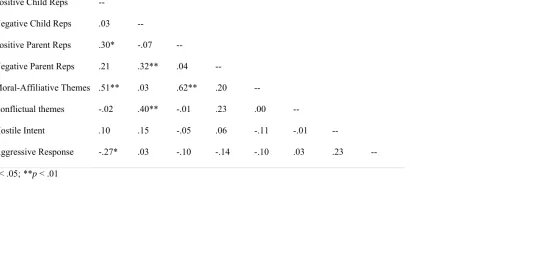
Previous researchers who have used the MacArthur Story Stems to explore the internal models of maltreated children have found that various aspects of children’s models are significantly correlated with each other (Toth, Cicchetti, Macfie, Maughan, &
Vanmeenen, 2000). A number of these findings were replicated in this study. Specifically, children who viewed their attachment relationship with their parents positively also viewed themselves positively. Results also demonstrated that children who viewed their parents negatively likewise viewed themselves negatively in their attachment relationships. These results suggest that the ways in which maltreated children view themselves and their caregivers are not completely independent of one another. Therefore, maltreated children may form internal models where their representations of themselves are tied to how they are representing their parents and these children may not have completely separate views of each person in their attachment relationships. These associations are to be expected because a child’s internal models combine the various aspects of his or her attachment relationship into an internal working model (Bowlby, 1973; Crittenden, 1990; Toth, Cicchetti, Macfie,