1
Cognitive predictors of parent-rated inattention in very preterm children:
the role of working memory and processing speed
Jenny Retzler
a, Samantha Johnson
b, Madeleine Groom
c, Chris Hollis
ce, Helen
Budge
d, Lucy Cragg
a.
a School of Psychology, University of Nottingham, UK
b Department of Health Sciences, University of Leicester, UK
c Division of Psychiatry & Applied Psychology, School of Medicine, University of
Nottingham, UK
d Division of Child Health, Obstetrics and Gynaecology, School of Medicine, University of
Nottingham, UK
e NIHR Nottingham Biomedical Research Centre and NIHR MindTech Healthcare
Technology Co-operative
Short title:
Inattention in very preterm children
Correspondence to:
Dr Jenny Retzler, Department of Psychology, School of Human and Health Sciences, University of Huddersfield, UK
Acknowledgements:
We would like to thank the families who participated, without whom this would not have been possible, and Valerie Astle for her help identifying eligible VP patients. This work was supported by the Economic and Social Research Council (grant number 1230421). JR is now affiliated with the University of Huddersfield.
Conflict of interest: The authors declare that they have no conflict of interest.
This is the authors’ accepted manuscript. The final published version will appear in
2 Abstract
Background: Inattention is one of the most common neurobehavioural problems following very preterm birth. Attention problems can persist into adulthood and are associated with negative socio-emotional and educational outcomes. This study aimed to determine whether the cognitive processes associated with inattention differ between term-born and very preterm children.
Methods: Sixty-five children born very preterm (<33+0 weeks’ gestation) aged 8-11 years were recruited alongside 48 term-born controls (≥37+0 weeks’ gestation). Both groups included children with a wide spectrum of parent-rated inattention (above average attention to severe inattention) measured as a continuous dimension using the Strengths and Weaknesses of ADHD and Normal-behaviour (SWAN) scale. Children completed tests to assess basic cognitive processes and executive function. A
hierarchical multiple regression analysis was implemented to assess which
neurocognitive processes explained variance in parent-rated inattention and whether these differed between preterm and term-born children.
Results: In both groups, poorer verbal and visuospatial short-term memory, and poorer visuospatial working memory independently explained variance in parent-rated
inattention. Slower motor processing speed explained variance in inattention among very preterm children only.
Conclusions: The cognitive mechanisms associated with parent-rated inattention were predominantly overlapping between groups, but relationships between motor
processing speed and inattention were unique to very preterm children. These
associations may reflect risk factors for inattention in term and very preterm children. Future research should assess the efficacy of these cognitive processes as potential targets for intervention.
3 Introduction
Very preterm (VP; <32+0 weeks’ gestation) birth is a risk factor for the development of neurobehavioural psychopathology, with inattentive behaviour being the most common adverse outcome (Aarnoudse-Moens et al., 2009). Risk of attention-deficit/hyperactivity disorder (ADHD) diagnosis is 2-3 times greater in VP children compared with children born at term and mean symptom scores are significantly elevated even where children do not meet the threshold for diagnosis (Johnson & Marlow, 2011; Jaekel et al. 2013; Johnson et al., 2016). Notably, developmentally inappropriate inattentive behaviour is more often elevated than hyperactivity/impulsivity among children born very preterm (Brogan et al., 2014, Johnson et al., 2016), and inattention is a stronger predictor of academic underachievement than hyperactivity/impulsivity in both VP (Jaekel et al., 2013) and general population samples (Sayal et al., 2015). Moreover, inattentive behaviour in the VP population persists into adulthood and has greater stability in VP than term-born individuals (Breeman et al., 2016). Taken together, these findings suggest that inattention is a core, lifelong impairment following VP birth. Early detection of inattention and appropriate interventions may improve long-term outcomes for VP individuals.
Although rates of inattentive behaviour are increased in VP children, it is unclear whether the underlying mechanisms are the same as those in the general population. Whilst ADHD symptoms in the general population are considered to be of primarily genetic origin (Faraone et al., 2005; Li et al., 2006; Cornish et al., 2005), increased risk for inattentive behaviour in VP children may result from the combined impact of brain injury and
neurodevelopmental disruption that is conferred following VP birth (Volpe, 2009). Indeed, a study of mothers who had given birth to term as well as preterm children, indicated that genetic factors could not explain the relationship between preterm birth and ADHD
4
failed to find a relationship between psychiatric symptoms and SES in preterm children (Loe, Lee, Luna, & Feldman, 2011). Moreover, evidence of a ‘gestational gradient’, whereby the risk of psychiatric disorders increases as gestational age at birth decreases (Aarnoudse-Moens, Weisglas-Kuperus, Goudoever, & Oosterlaan, 2009; Johnson, 2007) reinforces the idea that the increased ADHD prevalence in preterm populations is directly linked to preterm birth and/or perinatal medical factors, rather than to genetics or later environmental factors during development.
Different initial causal factors may lead to similar developmental trajectories with
equivalent cognitive and neural mechanisms that result in similar phenotypic presentation.
Alternatively, different causal factors may lead to separable trajectories that affect different
cognitive mechanisms but still lead to similar phenotypic presentations. Whether the underlying
mechanisms for inattentive behaviour differ for those born VP from those born around term gestation is an important theoretical question with significant clinical implications. For instance, if the mechanisms underpinning inattentive behaviour are equivalent to those in the term-born population, new and existing interventions that are efficacious in treating
inattentive symptoms of ADHD may be appropriate. Conversely, if inattentive behaviour arises from different mechanisms in those born preterm, alternative interventions with proven efficacy in the VP population specifically may be needed.
5
inattentive behaviour in studies of children with ADHD and/or those born preterm. These include working memory (storage of information with concurrent processing of additional information, also referred to as an ‘executive attention’ process), inhibitory/interference control (suppression of pre-potent responses/distracting information) and shifting (flexibly directing attention between tasks).
Poor working memory has been related to teacher-rated inattentive behaviour in community (Gathercole et al., 2008), VP (Mulder, Pitchford, & Marlow, 2011) and ADHD samples (Castellanos & Tannock, 2002; Diamond, 2005; Kasper, Alderson, & Hudec, 2012; Martinussen, Hayden, Hogg-Johnson, & Tannock, 2005), with larger effect sizes for
visuospatial working memory (visuospatial-WM) than verbal working memory (verbal-WM) in VP children (de Kieviet, van Elburg, Lafeber, & Oosterlaan, 2012) and those with ADHD (Martinussen, Hayden, Hogg-Johnson, & Tannock, 2005). In addition, poor inhibitory control predicted inattentive symptoms in children with ADHD (combined and inattentive subtypes; Chhabildas, Pennington, & Willcutt, 2001), although evidence in VP children is mixed
(Aarnoudse-Moens, Weisglas-Kuperus, Duivenvoorden, van Goudoever, & Oosterlaan, 2013; Mulder et al., 2011; Scott et al., 2012; Shum, Neulinger, Ocallaghan, & Mohay, 2008).
Finally, shifting is impaired in children with ADHD (Cepeda, Cepeda, & Kramer, 2000) and has been implicated as a risk factor for the ADHD inattentive subtype in extremely preterm (<28 weeks gestation) children aged 5-6 years (Scott et al., 2012). Thus, EFs, particularly visuospatial-WM and shifting, are associated with ADHD and inattentive behaviour in term-born and VP children, but few studies have directly compared the relative contribution of EFs to inattentive behaviour in these populations. It therefore remains unclear whether the
6
In addition to the assessment of EF processes, we included measures of visuospatial and verbal short-term memory (visuospatial-STM; verbal-STM), processing speed and visuospatial processing in the current study. These more basic cognitive processes are known to be impaired in VP children (Mulder et al., 2011; Shum et al., 2008; Simms et al., 2015). In spite of evidence that visuospatial-STM predicts parent-rated inattention (Shum et al., 2008), it is
often absent from studies investigating cognitive mechanisms of preterm inattentive behaviour,
including those investigating working memory. Similar evidence of importance for inattention
has not yet been established for other basic processes, but visuo-spatial processing has been
shown to impact upon the mathematics abilities of children born preterm (Simms et al., 2015),
and each of the basic processes may contribute non-specifically to the EFs measured in this
study. Accordingly, we felt it important to model each of these basic processes as predictors of inattentive behaviour and to control for their influence when measuring associations between EFs and parent-rated inattention.
The role of processing speed was of particular interest. Multiple studies have shown that children born very preterm are at increased risk of slow processing speed compared with term-born peers (Aarnoudse-Moens et al., 2012; Foulder-Hughes & Cooke, 2003; Luciana, Lindeke, Georgieff, Mills, & Nelson, 1999; Mulder et al., 2011; but see Aarnoudse-Moens et al., 2013; de Kieviet et al., 2012). Processing speed has also been implicated in term-born inattention more generally (Diamond 2005). Importantly, however, in a direct comparison the association between slow processing speed and parent-rated inattention previously observed in VP children using both verbal and motor processing speed tasks, was not evident in term-born children (Mulder et al., 2011). Studies have linked the increased risk of poor processing speed to atypical white matter growth following preterm birth (Soria-Pastor et al., 2008), and it has been proposed that this could lead to a cascade of impairments resulting in both
7
basis of a clear preterm-specific developmental pathway that slow processing speed results from aberrant white matter growth conferred by preterm birth, further exploration of whether or not the impact of processing speed is indeed preterm-specific, as indicated by emerging evidence (Mulder et al., 2011), is warranted.
Processing speed is a difficult concept to define, with a wide variety of measures across different sensory modalities (e.g. audio or visual targets) and response domains (e.g. motor, verbal). These different measures are assumed to tap into the same underlying concept, however they may, in fact, lead to contradictory results. Most measures comprise multiple mental processes (e.g. stimulus detection, stimulus evaluation, response initiation), and may well favour the particular domain of evaluation or response, any of which may be impaired. For instance, the tasks used in Mulder et al. (2011) favoured verbal and motor domains (part one of the Same Worlds task from the TEA-Ch, in which children read out a string of ones and twos as quickly as possible and the Sky Search task from the TEA-Ch, in which children circle targets in a large display as quickly as possible). Computer-based response time measures of processing speed used in previous studies of inattention that had lengthy tasks (Aarnoudse-Moens et al., 2013; de Kieviet et al., 2012) may also have been susceptible to interference from lapses in attention. As such, the task in this study (a short finger tapping task which did not require detection of a stimulus in order for the response to be made) was selected to measure processing speed while minimising the number of
‘processes’ required and domains involved, and reducing the opportunity for contamination from attentional lapses.
8
them with preterm groups with high inattentive behaviour scores (e.g. Mulder et al., 2011; Aarnoudse-Moens et al., 2013; de Kieviet et al., 2012). By not including term-born children who display the full range of inattentive behaviour, these studies may have failed to
accurately capture associations between cognition and (in)attention that are present in their term-born control groups. In the present study, we, therefore, recruited VP children and a term-born comparison group with varying levels of inattentive behaviour, as rated by their parents, ranging from above average attention to severe inattention, in order to identify and compare underlying cognitive predictors of inattention in term-born and VP children. Importantly, this design facilitated direct comparison of cognitive predictors of inattentive behaviour in VP and term-born children with an equivalent range of scores. Moreover, previous studies investigating inattentive behaviour in VP children have used scales designed to detect clinically significant inattention (e.g. Shum et al., 2008; Mulder et al., 2011). These scales can be insensitive to the full range of attention scores in non-clinical samples and often include only a small number of items that assess inattention specifically, which may not capture the full range of these traits observed in children born very preterm. We therefore selected a dimensional measure of inattentive behaviour appropriate for use in non-clinical samples, the Strengths and Weaknesses of ADHD and Normal-behaviour (SWAN; Swanson et al., 2006; Polderman et al., 2007; Swanson et al., 2012), which is designed for teachers or parents to complete.
The aims of the current study were to establish whether parent-rated inattention is associated with impairment in basic cognitive processing (visuospatial processing, processing speed, visuospatial-STM, verbal-STM) and/or in EF (shifting, interference control,
9
visuospatial-WM would explain more variance in parent-rated inattention than verbal-WM in both groups; (3) processing speed would predict parent-rated inattention only in VP children and (4) variation in performance on EF tasks would explain parent-rated inattention beyond that explained by basic cognitive processing.
Materials and Methods
Ethical Standards
Ethical approval was granted by a UK NHS Research Ethics Committee (Coventry and Warwickshire; Ref: 13/WM/0203) and informed parental consent was obtained for all children.
Participants
10
The final VP sample had a mean gestational age of 29+6 weeks (SD=1+6 weeks); mean birthweight 1.48kg (SD=0.42kg); 36 male (55.4%). These children did not differ significantly with respect to gestational age (p=0.89), birthweight (p=0.59), or sex (p=0.81) from the VP children not recruited (n=406). However, the recruited children were of significantly higher socio-economic status (SES) (p=0.006), as measured using the English Indices of Multiple Deprivation (IMD; McLennan et al., 2011). No VP children in the sample were on stimulant medication for ADHD.
Term-born children. Recruitment of term-born children was conducted in two stages.
In Stage 1, the study was advertised to parents of children aged 8-11 years in the local
11
study and undertook the study assessments. No term-born children were on stimulant medication for ADHD.
Materials and Procedure
Children undertook a battery of tasks measuring basic cognitive processing and EF, and parents completed questionnaire measures of clinical symptoms.
Participant characteristics and clinical symptoms. An age-standardised estimate of full scale IQ (FSIQ-2) was calculated from the Wechsler Abbreviated Scale for Intelligence (WASI; Wechsler, 1999) using the vocabulary and matrices subtests. Inattentive and
hyperactive-impulsive behaviour were measured using the SWAN. To characterise the sample more fully, measures of risk of ADHD, ASD and anxiety disorder were assessed using the Conners 3-P (Conners, 2008), parent-rated Social Communication Questionnaire Lifetime version (SCQ; Rutter, Bailey, & Lord, 2003) and Multidimensional Anxiety Scale for Children-2 Parent (MASC-2P; March et al., 1997) respectively, with higher scores
indicating greater symptoms. Children with scores above the pre-defined clinical cut-off were classified as ‘at risk’ of diagnosis on these measures.
Basic cognitive processing. The finger tapping subtest from the Developmental Neuropsychology Test II (NEPSY-II; Korkman, Kirk, & Kemp, 2007) was used to measure motor processing speed. A composite score was calculated by averaging the seconds taken for 20 finger-tapping repetitions on the dominant and non-dominant hand. Higher scores represent slower processing speed.
12
Short-term memory was assessed using computer-based verbal and visuospatial immediate serial recall tasks programmed using PsychoPy (Peirce, 2007). The verbal task involved recalling single-syllable words while the visuospatial task involved recalling locations on a four-by-four grid. The task began with only two items to remember, and increased in one-item increments up to a maximum of 8 items. To proceed to the next span level, two of the three trials in that span level had to be recalled correctly. The total number of items recalled in the correct serial position was calculated. Higher scores represent better short-term memory.
Executive functions. The tasks used to measure working memory were identical to the short-term memory tasks described above with the addition of a 5000ms retention interval between the list presentation and recall. During this interval, children completed a concurrent processing task. To achieve comparable concurrent processing during both the verbal and visuospatial working memory tasks the same task was used. Children were presented with a series of pictures of two faces. They were asked to judge whether the pictures were of the same person, or two different people, and to respond out loud by saying ‘same’ or ‘different’. This task does not involve auditory stimuli and previous research suggests that it is not related to visual short-term memory (r = 0.05; Burton, White, & McNeill, 2010), therefore it was considered relatively domain-neutral and likely to result in comparable cognitive load in both verbal and visuospatial working memory tasks. Scoring was conducted as for the short-term memory tasks above, with higher scores indicating better working memory.
13
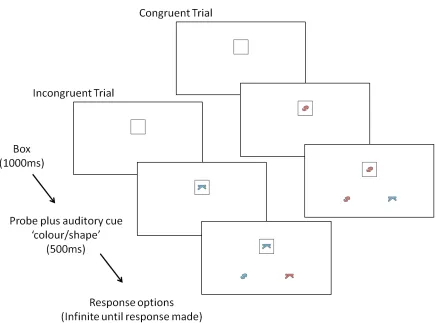
stating whether they should match the stimuli based on either colour or shape (Supplement A). On congruent trials, the correct response stimulus was identical to the target. On
incongruent trials, the correct response stimulus matched the target on the relevant dimension (colour or shape) and the incorrect response stimulus matched the target on the irrelevant dimension, creating conflict. Cronbach’s alpha indicated good internal reliability of this task (congruent switch trials = 0.89; congruent non-switch trials = 0.79; incongruent switch trials = 0.75; incongruent non-switch trials = 0.89). A measure of interference control was
calculated by subtracting median response time on correct congruent trials from that on correct incongruent trials to produce a cost score. Higher cost scores represent poorer interference control. Trials also differed in the level of switching. In pure blocks, all trials were matched on the same dimension (e.g. colour). Within mixed blocks, on non-switch trials the matching dimension in the current trial was the same as in the previous trial (e.g. a colour trial followed by a colour trial), while on switch trials the matching dimension was different to the previous trial (e.g. a colour trial followed by a shape trial). Local switch costs were calculated by subtracting the median response time on correct non-switch trials from correct switch trials. Global switch costs were calculated by subtracting the median response time on correct trials in the pure blocks, from those in the mixed blocks. Higher cost scores represent slower switching.
Analysis
Analyses were conducted using IBM SPSS (Version 22.0). Term and VP groups were first compared on participant characteristics, demographic information, and clinical
14
multivariate analysis of covariance (MANCOVA) was conducted on all of the cognitive measures with group as a between-subjects factor and age as a covariate to account for the older age of the VP children. Significant multivariate effects were followed up with appropriate univariate ANOVAs and post-hoc tests.
A hierarchical multivariable linear regression was then conducted to assess cognitive predictors of parent-rated inattention. Variables entered into the models were selected based on partial correlations controlling for age. These correlations were initially collapsed across both groups to maximise the power to detect associations that were consistent across groups, and then repeated separately by group. Where a correlation was significant only in one group, Fischer’s r-to-z was applied to assess the statistical significance of the between-group
difference in the size of the correlations. Variables that were significantly correlated with parent-rated inattention (p<0.05) in one or both groups were then entered into the regression model. All predictor variables were grand-mean centred to minimise effects of
15
Additional analyses were performed to examine the role of IQ. Specifically,
significant interactions with the Group factor (identified in the fourth step of the regression analysis) were further analysed to check for the influence of IQ on the relationship between Group and a specific cognitive measure (presented in Supplement C). This approach was chosen rather than including IQ as a covariate in all steps of the regression analysis for the following reasons. The measurements used in the IQ test are likely to rely on some of the same cognitive skills measured in the study, and thus IQ adjustment may mask variance of interest (Taylor, 2006). In addition, cognitive deficits associated with VP birth are better described as selective deficits than global cognitive impairment (Johnson, 2007) and it is, therefore, more informative to investigate the independent contribution of specific cognitive processes to inattention in VP children, without controlling for global cognitive impairments by covarying IQ. Finally, arguments fully described in Dennis et al. (2009) detail the ways in which IQ does not meet the logical, statistical, nor theoretical requirements for a covariate in neurodevelopmental analyses. Specifically, covarying IQ results in a comparison of groups at a value of IQ that is unrepresentative of the populations of interest, and can, therefore, lead to unrealistic interpretation of results. The findings relating to IQ are reported in Supplement C and provide reassurance that the main findings reported below are not attributable to group differences in IQ.
Results
Treatment of Data
16
missing data, SWAN questionnaires were missing for six VP children and FSIQ-2 scores were missing for one child. Therefore, these children were excluded from analyses of group characteristics.
Little’s test indicated that missing data for variables involved in subsequent analyses were missing completely at random (χ2(109)=99.965, p=0.720), thus missing data points (5.4%) were replaced using the expectation maximisation procedure implemented in SPSS. No multivariate outliers were detected. Assumptions for each statistical analysis were checked, and where appropriate, corrections of violations were applied and are reported. As the correlations guided the selection of variables for the regression analysis, Bonferroni correction was deemed too conservative and was, therefore, not applied to the correlational analyses. Elsewhere, Bonferroni corrected alpha levels were applied and are reported.
Participant characteristics
Table 1 shows the demographic information, participant characteristics and scores on
clinical symptom questionnaires for the term-born and VP children. By design, the groups did not differ significantly on SWAN-inattention scores. There were also no significant
differences on the SWAN-hyperactivity/impulsivity subscale and the Conners sub-scales, or in the proportion of children who scored ‘at risk’ for ADHD. Further, VP and term-born children did not differ significantly on sex, ethnicity, SES, anxiety disorder symptoms or ASD symptoms. As the term-born group was significantly younger than the VP group (based on chronological age), age was covaried in subsequent analyses. Similarly, VP children had significantly lower IQ than term-born children, and the impact of this was assessed in Supplement C.
Table 1: Characteristics of term-born and very preterm children.
17
(n=65a) (n=48a)
Participant characteristics Gestation (weeks)
Mean (SD) 29+6 (1+6) 40+0 (1+1)
Range 26-32 37-42
Age (years)
Mean (SD) 10.1 (0.9) 9.6 (1.0)
0.006*
Range 8.4-11.5 8.0-11.7
FSIQ-2b
<0.001*
Mean (SD) 101.1 (13.9) 111.1 (9.9)
Range 67-131 83-127
Score <70 n(%) 1 (1.5%) 0 (0.0%) 0.383 n.s.
Demographics, n(%)
Female sex 29 (44.6%) 22 (45.8%) 0.898 n.s.
Ethnicity
0.855 n.s.
White 47 (82.3%) 42 (87.5%)
Mixed 7 (12.3%) 4 (8.3%)
Asian 1 (1.8%) 1 (2.1%)
Black 1 (1.8%) 1 (2.1%)
Chinese 0 (0%) 0 (0%)
Other 1 (1.8%) 0 (0%)
Socio-economic Status (SES)
0.074 n.s.
Low SES 12 (18.5%) 13 (27.1%)
18
High SES 28 (43.1%) 26 (54.2%)
Conner’s 3 ADHD symptom scores Conner’s 3 T-scores, mean (SD)
DSM ADHD/I 62.11 (15.48) 57.79 (13.51) 0.136 n.s. DSM ADHD/C 61.63 (14.42) 58.48 (14.08) 0.399 n.s. Inattention 60.71 (15.64) 57.13 (12.29) 0.215 n.s. Hyperactivity/
Impulsivity
62.15 (16.24) 59.06 (14.47) 0.297 n.s.
IA-HI correlation, r 0.78 0.83 0.233 n.s.
Conner’s 3 scores above clinical cut offs, n(%)
DSM ADHD/I 22 (34.4%) 12 (25.0%) 0.286 n.s.
DSM ADHD/C 21 (32.3%) 13 (27.1%) 0.549 n.s.
Inattention 22 (33.8%) 10 (20.8%) 0.129 n.s.
Hyperactivity/ Impulsivity
22 (33.8%) 15 (31.3%) 0.771 n.s.
SWAN symptom scores c
Inattention
Mean (SD) -.068 (10.89) -4.67 (12.22)
0.080 n.s.
Range -26 to 26 -27 to 20
Hyperactivity/ Impulsivity
Mean (SD) -2.86 (11.130) -6.71 (12.549) 0.099 n.s.
Range -27 to 25 -27 to 27
19
T-scores, mean(SD) 55.87 (13.59) 52.42 (10.50) 0.147 n.s. T-scores above clinical
cut offs, n(%)
17 (27.0%) 9 (18.8%) 0.310 n.s. SCQ autism spectrum symptom scores e
Lifetime symptom
scores, mean(SD) 6.66 (7.67) 5.53 (5.88) 0.327 n.s. Scores above clinical
cut offs, n(%) 11 (17.7%) 3 (6.5%) 0.086 n.s.
Note: Age reflects chronological age for VP children. Continuous variables were compared using independent samples t-tests, rank variables were compared using Pearson's chi-square,
correlations were compared using Fischer’s r-to-z. SD=standard deviation, FSIQ-2= two-subtest full scale intelligence quotient calculated using the Wechsler Abbreviated Scale for Intelligence. IA-HI correlation = correlation between inattentive (IA) and hyperactive-impulsive (HI)
symptoms as measured using the Conner’s 3 subscale T-scores. *p<0.05, n.s.= not significant. a accurate unless otherwise indicated. b VP(n)= 65, term(n)= 47 due to missing data; c VP (n) = 57, term(n) = 48 due to missing data; d VP (n) = 64, term(n) = 48 due to missing data; e VP (n) = 62, term(n) = 46 due to missing data. Group differences in task performance
There was a significant multivariate group effect on task performance when
[image:19.595.73.544.546.734.2]controlling for age (V=0.244, F(9,102)=3.3663, p=0.001) and a significant main effect of age (V=0.235, F(9,102)=3.475, p<0.001).
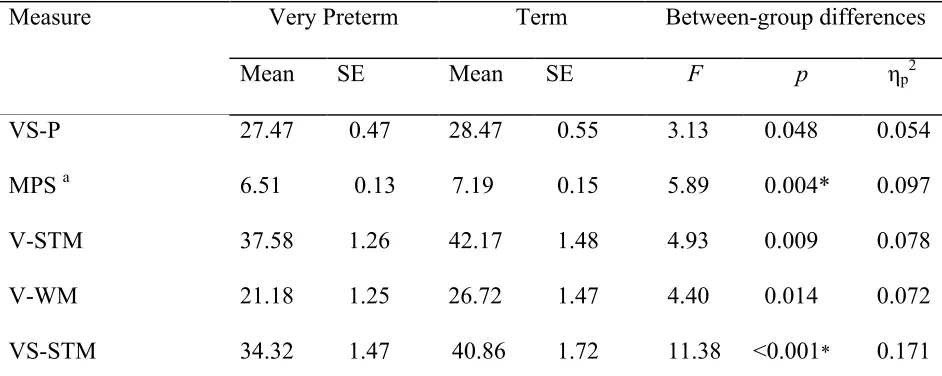
Table 2: Age adjusted marginal means and standard errors (SE) on cognitive measures in term-born and very preterm children.
Measure Very Preterm Term Between-group differences
Mean SE Mean SE F p ηp2
VS-P 27.47 0.47 28.47 0.55 3.13 0.048 0.054
MPS a 6.51 0.13 7.19 0.15 5.89 0.004* 0.097
V-STM 37.58 1.26 42.17 1.48 4.93 0.009 0.078
V-WM 21.18 1.25 26.72 1.47 4.40 0.014 0.072
20
VS-WM 16.17 1.21 18.58 1.47 2.83 0.063 0.049
Local switching a 92.39 22.14 67.42 25.95 1.02 0.365 0.018 Global switching a 231.01 18.32 244.84 21.47 0.19 0.827 0.003 Interference control a 201.52 13.49 160.27 15.80 2.52 0.085 0.044
Note: These results reflect the model corrected for age. a For these measures, higher scores reflect poorer performance. * p<0.005 (Bonferroni corrected alpha). VP= very preterm, ηp2= partial eta squared. VS-P = visuospatial processing. MPS = motor processing speed. V-STM = verbal short-term memory. V-WM = verbal working memory. VS-STM = visuospatial short-term memory. VS-WM = visuospatial working memory.
Univariate statistics revealed significantly faster motor processing speed in very preerm compared with term-born children (Table 2), while term-born children had significantly better visuospatial-STM than those born very preterm Between-group differences were not observed in performance on other tasks.
Cognitive predictors of parent-rated inattention
Partial correlations between cognitive performance and parent-rated inattention (as measured using the SWAN) controlling for age (Supplement B) indicated that motor processing speed, visuospatial-STM, verbal-STM, visuospatial-WM, verbal-WM and
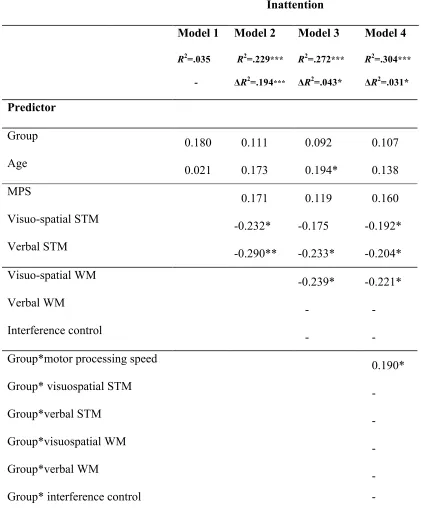
interference control were significantly correlated with parent-rated inattention in one or both groups. These variables were entered into a hierarchical multiple regression with parent-rated inattention as the dependent variable (Table 3).
21
Table 3: Regression model for cognitive predictors of parent-rated inattention Inattention
Model 1
R2=.035
-
Model 2
R2=.229***
ΔR2=.194***
Model 3
R2=.272***
ΔR2=.043*
Model 4
R2=.304***
ΔR2=.031*
Predictor β β β β
Group
0.180 0.111 0.092 0.107
Age 0.021 0.173 0.194* 0.138
MPS 0.171 0.119 0.160
Visuo-spatial STM -0.232* -0.175 -0.192*
Verbal STM
-0.290** -0.233* -0.204*
Visuo-spatial WM -0.239* -0.221*
Verbal WM - -
Interference control - -
Group*motor processing speed 0.190*
Group* visuospatial STM -
Group*verbal STM -
Group*visuospatial WM -
Group*verbal WM -
Group* interference control -
Note: *p<0.05; ** p<0.01;*** p<0.001. - = did not meet criteria for forward entry model selection. MPS = motor processing speed. STM = short term memory. WM = working memory.
22
27.3% of the variance in parent-rated inattention (F(6,106)=6.608, p<0.001). Age, verbal-STM and visuospatial-WM each explained unique variance.
[image:22.595.73.531.355.729.2]In the final step, with the introduction of interaction terms, only the group*processing speed interaction contributed enough unique variance to be entered into Model 4. This model significantly improved upon Model 3 (ΔR2=0.031*) and explained 30.4% of the variance in parent-rated inattention (Model 4; F(7,105)=6.538, p<0.001). In this model, verbal-STM and visuospatial-STM, visuospatial-WM, and the interaction between group and motor processing speed each explained unique variance (Figure 1).
23
Note: Values plotted are unstandardised residuals (resid.: residual) from regressing each variable against age. The dotted line represents ‘average’ attention, positive scores indicate more severe ratings of inattention and negative scores indicate above average ratings of attention. Grey: very preterm children; Black: Term-born children.
From these planned analyses it was not possible to determine whether the group by processing speed interaction was driven by children with lower SWAN scores (reflecting better than average attention) or by those with higher SWAN scores (reflecting poorer than average attention). It was also considered possible that the presence of a relationship between parent-rated inattention and motor processing speed only in children born very preterm may have been affected by lower IQ in the preterm children. In order to clarify these issues, two post-hoc analyses (Supplement C) were performed.
Firstly, the VP sample was divided into two sub-groups based on parent-rated SWAN scores: better attenders (SWAN score of zero or below) or poorer attenders (SWAN score of one or above), where a score of ‘0’ reflects average attention. Correlations between parent-rated inattention scores and motor processing speed in the VP group demonstparent-rated that the association between motor processing speed and parent-rated inattention in children born very preterm was observed in poorer attenders only.
24 Discussion
This study aimed to determine whether the cognitive processes associated with parent-rated inattention differ between term-born and VP children. The groups were
compared on the associations between specific aspects of EF (visuospatial-WM, verbal-WM, inhibition, interference control), basic cognitive processes (verbal-STM, visuospatial-STM and motor processing speed) and parent-rated inattention. Visuospatial-WM was a significant predictor of parent-rated inattention in VP and term-born children after controlling for the variation explained by STM. In children born very preterm only, parent-rated inattention was also predicted by slower processing speed.
Executive function
As hypothesised, visuospatial-WM predicted parent-rated inattention in both groups. This builds on previous evidence that working memory is a key factor underlying inattentive behaviour in VP (Aarnoudse-Moens et al., 2013; Mulder et al., 2011) and term-born children (Gathercole et al., 2008) and further extends previous research by demonstrating that the effects of visuospatial-WM cannot be fully explained by variance in short-term memory, a more basic cognitive process. The results also suggest a larger role for visuospatial-WM than verbal-WM, consistent with previous findings in ADHD (Martinussen, Hayden, Hogg-Johnson, & Tannock, 2005), VP (de Kieviet et al., 2012) and typically developing (Gathercole et al., 2008) children.
Neither interference control nor shifting predicted parent-rated inattention. Moreover, there were no between-group differences in performance on either of these measures,
25
specific EFs, such as visuospatial-WM, drive inattentive behaviour, rather than global executive dysfunction.
Basic cognitive processing
Both verbal-STM and visuospatial-STM were significant predictors of parent-rated inattention, with no evidence of differences in the strength of the relationship between
groups. This adds to previous evidence showing associations between short-term memory and inattentive behaviour in both VP and typically developing children (e.g. Shum et al., 2008; Tillman, Eninger, Forssman, & Bohlin, 2011), emphasising the importance of controlling for short-term memory skills when assessing working memory.
Consistent with our hypotheses and with Mulder et al. (2011), motor processing speed predicted parent-rated inattention in VP but not term-born children, reflected in a significant group by processing speed interaction term, which could not be explained by group
differences in IQ. Post-hoc analyses indicated that the association between parent-rated inattention and motor processing speed in the VP group was specific to children with poorer than average parent-rated inattention. This suggests that slow motor processing speed is a risk factor for inattentive behaviour in VP children rather than acting as a protective factor against inattentive behaviour. While attempts were made to select a processing speed task that
26 Strengths and limitations
The analyses reported here benefit from (i) a term-born comparison group with a similar parent-rated inattention range to the VP group, (ii) a group of very preterm children representative of the population from which it was drawn in terms of birth weight, gestational age and sex, (iii) inclusion of basic cognitive processing measures in analyses assessing the influence of executive functioning, (iv) a moderately large sample size and (v) a dimensional approach to assessing inattention.
27 Implications
VP children with no identified special educational needs often show high levels of inattentive behaviour (Brogan et al., 2014). These difficulties may be overlooked in the classroom as very preterm children often do not cause class disruption, suggesting that more efforts need to be made to identify children who may benefit from intervention. These results build on existing research to identify cognitive processes that may underpin inattentive symptoms. The cognitive predictors identified may be useful both as candidates for intervention, and to identify children who may be at risk.
Although the analyses reported here are cross-sectional, longitudinal studies have shown that cognitive performance in two-year old children born very preterm can reliably predict cognitive ability throughout childhood and into adulthood (Linsell, Johnson, O’Reilly et al., in press; Breeman, Jaekel, Baumann, Bartmann, & Wolke, 2015). Therefore, if
weaknesses in particular cognitive domains or neural processes underpin later-emerging inattentive behaviour, early identification of such risk factors may be possible. Identification of children who may benefit from intervention would allow for targeted support that could facilitate cognitive development to improve behavioural and academic outcomes, either by directly reducing symptoms, or by providing compensatory support that indirectly reduces the risk of the consequences associated with inattention.
28 Conclusion
The findings of this study indicate equivalent cognitive mechanisms for parent-rated inattention in term and VP children, but with an additional effect of processing speed among the VP group only. In both VP and term-born children, parent-rated inattention was
29 References
Aarnoudse-Moens, C. S. H., Duivenvoorden, H. J., Weisglas-Kuperus, N., Van Goudoever, J. B., & Oosterlaan, J. (2012). The profile of executive function in very preterm children at 4 to 12 years. Developmental Medicine & Child Neurology.
Aarnoudse-Moens, C. S. H., Weisglas-Kuperus, N., Duivenvoorden, H. J., van Goudoever, J. B., & Oosterlaan, J. (2013). Executive Function and IQ Predict Mathematical and Attention Problems in Very Preterm Children. PLoS ONE, 8(2), e55994.
Aarnoudse-Moens, C. S. H., Weisglas-Kuperus, N., van Goudoever, J. B., & Oosterlaan, J. (2009). Meta-analysis of neurobehavioral outcomes in very preterm and/or very low birth weight children. Pediatrics, 124(2), 717-728.
Breeman, L. D., Jaekel, J., Baumann, N., Bartmann, P., & Wolke, D. (2016). Attention problems in very preterm children from childhood to adulthood: the Bavarian Longitudinal Study. Journal of child psychology and psychiatry,57(2), 132-140. Brogan, E., Cragg, L., Gilmore, C., Marlow, N., Simms, V., & Johnson, S. (2014).
Inattention in very preterm children: implications for screening and detection. Archives of Disease in Childhood, archdischild–2013–305532.
Burnett, A. C., Anderson, P. J., Cheong, J., Doyle, L. W., Davey, C. G., & Wood, S. J. (2011). Prevalence of psychiatric diagnoses in preterm and full-term children, adolescents and young adults: a meta-analysis. Psychological Medicine, 41(12), 2463–2474.
Burton, A. M., White, D., & McNeill, A. (2010). The Glasgow face matching test. Behavior Research Methods, 42(1), 286-291.
Castellanos, F. X., & Tannock, R. (2002). Neuroscience of attention-deficit/hyperactivity disorder: the search for endophenotypes. Nature Reviews Neuroscience, 3(8), 617– 628.
Cepeda, N. J., Cepeda, M. L., & Kramer, A. F. (2000). Task Switching and Attention Deficit Hyperactivity Disorder. Journal of Abnormal Child Psychology, 28(3), 213–226. Chhabildas, N., Pennington, B. F., & Willcutt, E. G. (2001). A Comparison of the
Neuropsychological Profiles of the DSM-IV Subtypes of ADHD. Journal of Abnormal Child Psychology, 29(6), 529–540.
30
Cornish, K. M., Manly, T., Savage, R., Swanson, J., Morisano, D., Butler, N., ... & Hollis, C. P. (2005). Association of the dopamine transporter (DAT1) 10/10-repeat genotype with ADHD symptoms and response inhibition in a general population
sample. Molecular psychiatry, 10(7), 686-698.
de Kieviet, J. F., van Elburg, R. M., Lafeber, H. N., & Oosterlaan, J. (2012). Attention Problems of Very Preterm Children Compared with Age-Matched Term Controls at School-Age. The Journal of Pediatrics.
Dennis, M., Francis, D. J., Cirino, P. T., Schachar, R., Barnes, M. A., & Fletcher, J. M. (2009). Why IQ is not a covariate in cognitive studies of neurodevelopmental
disorders. Journal of the International Neuropsychological Society, 15(03), 331–343. Diamond, A. (2005). Attention-deficit disorder (attention-deficit/hyperactivity disorder
without hyperactivity): A neurobiologically and behaviorally distinct disorder from attention-deficit/hyperactivity disorder (with hyperactivity). Development and Psychopathology, 17(3), 807–825.
Faraone, S. V., Perlis, R. H., Doyle, A. E., Smoller, J. W., Goralnick, J. J., Holmgren, M. A., & Sklar, P. (2005). Molecular Genetics of Attention-Deficit/Hyperactivity Disorder. Biological Psychiatry, 57(11), 1313–1323.
FitzGibbon, L., Cragg, L., & Carroll, D. J. (2014). Primed to be inflexible: the influence of set size on cognitive flexibility during childhood. Frontiers in Psychology, 5.
Foulder-Hughes, L., & Cooke, R. (2003). Motor, cognitive, and behavioural disorders in children born very preterm. Developmental Medicine & Child Neurology, null(02), 97–103. Gardener, H., Spiegelman, D., & Buka, S. L. (2011). Perinatal and Neonatal Risk Factors for
Autism: A Comprehensive Meta-analysis. Pediatrics, 128(2), 344–355.
Gathercole, S. E., Alloway, T. P., Kirkwood, H. J., Elliott, J. G., Holmes, J., & Hilton, K. A. (2008). Attentional and executive function behaviours in children with poor working memory. Learning and Individual Differences, 18(2), 214–223.
Jaccard, J., Wan, C. K., & Turrisi, R. (1990). The detection and interpretation of interaction effects between continuous variables in multiple regression. Multivariate Behavioral Research, 25(4), 467–478.
Jaekel, J., Wolke, D., & Bartmann, P. (2013). Poor attention rather than
31
Johnson, S. (2007). Cognitive and behavioural outcomes following very preterm birth. Seminars in Fetal and Neonatal Medicine, 12(5), 363–373.
Johnson, S., Kochhar, P., Hennessy, E., Marlow, N., Wolke, D., & Hollis, C. (2016).
Antecedents of Attention-Deficit/Hyperactivity Disorder Symptoms in Children Born Extremely Preterm. Journal of developmental and behavioral pediatrics:
JDBP, 37(4), 285-297.
Johnson, S., & Marlow, N. (2011). Preterm birth and childhood psychiatric disorders. Pediatric Research, 69, 11R–18R.
Kasper, L. J., Alderson, R. M., & Hudec, K. L. (2012). Moderators of working memory deficits in children with attention-deficit/hyperactivity disorder (ADHD): a meta-analytic review. Clinical Psychology Review, 32(7), 605–617.
Korkman, M., Kirk, U., & Kemp, S. (2007). NEPSY—Second Edition (NEPSY-II). San Antonio, TX: Harcourt Assessment. Journal of Psychoeducational Assessment, 28(2), 175–182.
Li, D., Sham, P. C., Owen, M. J., & He, L. (2006). Meta-analysis shows significant association between dopamine system genes and attention deficit hyperactivity disorder (ADHD). Human molecular genetics, 15(14), 2276-2284.
Lindström, K., Lindblad, F., & Hjern, A. (2011). Preterm Birth and
Attention-Deficit/Hyperactivity Disorder in Schoolchildren. Pediatrics, 127(5), 858–865.
Linnet, K. M., Wisborg, K., Agerbo, E., Secher, N. J., Thomsen, P. H., & Henriksen, T. B. (2006). Gestational age, birth weight, and the risk of hyperkinetic disorder. Archives of Disease in Childhood, 91(8), 655–660.
Linsell L, Johnson S, O’Reilly H et al. Cognitive trajectories from infancy to early adulthood following birth before 26 weeks’ gestation: prospective population based cohort study. Archives of Disease in Childhood, In Press
Loe, I. M., Lee, E. S., Luna, B., & Feldman, H. M. (2011). Behavior problems of 9–16 year old preterm children: Biological, sociodemographic, and intellectual contributions. Early
Human Development, 87(4), 247–252.
Luciana, M., Lindeke, L., Georgieff, M., Mills, M., & Nelson, C. A. (1999). Neurobehavioral evidence for working-memory deficits in school-aged children with histories of prematurity. Developmental Medicine & Child Neurology, null(08), 521–533. March, J. S., Parker, J. D., Sullivan, K., Stallings, P., & Conners, C. K. (1997). The
32
and validity. Journal of the American academy of child & adolescent psychiatry, 36(4), 554-565.
Martinussen, R., Hayden, J., Hogg-Johnson, S., & Tannock, R. (2005). A Meta-Analysis of Working Memory Impairments in Children With Attention-Deficit/Hyperactivity Disorder. Journal of the American Academy of Child & Adolescent Psychiatry, 44(4), 377–384.
McLennan, D., Barnes, H., Noble, M., Davies, J., Garratt, E., & Dibben, C. (2011). The English indices of deprivation 2010. London: Department for Communities and Local Government.
Mulder, H., Pitchford, N. J., Hagger, M. S., & Marlow, N. (2009). Development of executive function and attention in preterm children: a systematic review. Developmental Neuropsychology, 34(4), 393–421.
Mulder, H., Pitchford, N. J., & Marlow, N. (2011). Inattentive behaviour is associated with poor working memory and slow processing speed in very pre-term children in middle childhood. British Journal of Educational Psychology, 81(1), 147–160.
Peirce, J. W. (2007). PsychoPy—Psychophysics software in Python. Journal of Neuroscience Methods, 162(1–2), 8–13.
Polderman, T. J., Derks, E. M., Hudziak, J. J., Verhulst, F. C., Posthuma, D., & Boomsma, D. I. (2007). Across the continuum of attention skills: a twin study of the SWAN ADHD rating scale. Journal of Child Psychology and Psychiatry, 48(11), 1080–1087. Rose, S. A., Feldman, J. F., & Jankowski, J. J. (2011). Modeling a cascade of effects: the role of
speed and executive functioning in preterm/full-term differences in academic achievement. Developmental Science, 14(5), 1161–1175.
Rutter, M., Bailey, A., & Lord, C. (2003). SCQ. The Social Communication Questionnaire. Torrance, CA: Western Psychological Services.
Sayal, K., Washbrook, E., & Propper, C. (2015). Childhood behavior problems and academic outcomes in adolescence: longitudinal population-based study.Journal of the
American Academy of Child & Adolescent Psychiatry, 54(5), 360-368.
Schatz, D. B., & Rostain, A. L. (2006). ADHD with comorbid anxiety: a review of the current literature. Journal of Attention disorders, 10(2), 141-149.
33
Shum, D., Neulinger, K., Ocallaghan, M., & Mohay, H. (2008). Attentional problems in children born very preterm or with extremely low birth weight at 7–9 years. Archives of Clinical Neuropsychology, 23(1), 103–112.
Simms, V., Gilmore, C., Cragg, L., Clayton, S., Marlow, N., & Johnson, S. (2015). Nature and origins of mathematics difficulties in very preterm children: a different etiology than developmental dyscalculia. Pediatric Research, 77(2), 389–395.
Soria-Pastor, S., Gimenez, M., Narberhaus, A., Falcon, C., Botet, F., Bargallo, N., … Junque, C. (2008). Patterns of cerebral white matter damage and cognitive impairment in adolescents born very preterm. International Journal of Developmental Neuroscience: The Official Journal of the International Society for Developmental Neuroscience, 26(7), 647–654. Swanson, J., Schuck, S., Mann, M., Carlson, C., Hartman, K., Sergeant, J., … McCleary, R.
(2006). Categorical and Dimensional Definitions and Evaluations of Symptoms of ADHD: The SNAP and the SWAN Ratings Scales.
Swanson, J. M., Schuck, S., Porter, M. M., Carlson, C., Hartman, C. A., Sergeant, J. A., ... & Wigal, T. (2012). Categorical and Dimensional Definitions and Evaluations of Symptoms of ADHD: History of the SNAP and the SWAN Rating Scales. The International journal of educational and psychological assessment, 10(1), 51. Taylor, H. G. (2006). Children born preterm or with very low birth weight can have both
global and selective cognitive deficits. Journal of Developmental & Behavioral Pediatrics, 27(6), 485–486.
Tillman, C., Eninger, L., Forssman, L., & Bohlin, G. (2011). The Relation Between Working Memory Components and ADHD Symptoms From a Developmental Perspective. Developmental Neuropsychology, 36(2), 181–198.
Volpe, J. J. (2009). The Encephalopathy of Prematurity – Brain Injury and Impaired Brain Development Inextricably Intertwined. Seminars in Pediatric Neurology, 16(4), 167– 178.
1
SUPPLEMENTARY MATERIAL
[image:34.595.66.502.158.481.2]SUPPLEMENT A
2
[image:35.595.72.533.130.385.2]SUPPLEMENT B
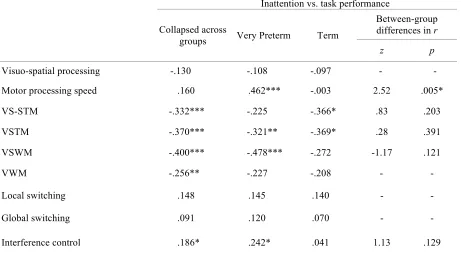
Table B1: Partial correlations between parent-rated inattention and cognitive task-performance controlling for age.
Inattention vs. task performance
Collapsed across
groups Very Preterm Term
Between-group differences in r
z p
Visuo-spatial processing -.130 -.108 -.097 - -
Motor processing speed .160 .462*** -.003 2.52 .005*
VS-STM -.332*** -.225 -.366* .83 .203
VSTM -.370*** -.321** -.369* .28 .391
VSWM -.400*** -.478*** -.272 -1.17 .121
VWM -.256** -.227 -.208 - -
Local switching .148 .145 .140 - -
Global switching .091 .120 .070 - -
Interference control .186* .242* .041 1.13 .129
Note: Between-group differences were only provided where the correlation in at least one of the groups was p<0.05. All correlations have been controlled for the effect of age. *p<0.05, **p<0.01, ***p<0.001. VS-STM = visuo-spatial short-term memory. VSTM = verbal short-term memory. VSWM = visuo-spatial working
memory. VWM = verbal working memory.
Table B2. Partial correlation matrix between all inattention and task-performance measures, controlling for age, for both groups combined.
IA IQ VS-P MPS VS-STM VS-WM V-STM V-WM LS GS IC IA
IQ -.441***
VS-P -.130 .295**
MPS .160 .039 .084
VS-STM -.332*** .290** .200* -.061
VS-WM -.400*** .312*** .218* -.221* .325***
V-STM -.370*** .412*** .173 -.028 .261** .323***
V-WM -.256** .229* .166 -.041 .124* .257** .613***
LS .148 -.095 .116 -.051 -.060 -.109 -.094 -.207*
GS .091 -.164 .100 .082 -.050 -.018 -.060 .002 .411*** IC .186* -.356*** -.257** -.017 -.092 -.085 -.154 -.114 -.047 .029
[image:35.595.46.571.495.680.2]3
SUPPLEMENT C
The significant group by motor processing speed interaction predicting inattention
reflects the presence of the association between inattention and motor processing speed only
in the children born VP. Post-hoc analyses were performed to clarify whether the association
with inattention in the preterm children was driven by better attenders (implicating faster
motor processing speed as a protective factor against inattention), or by poorer attenders
(implicating slower motor processing speed as a risk factor for inattention).
The VP sample was divided into better and poorer attenders by assigning all those
with a SWAN score of zero or below as ‘better attenders’ and all those children with a
SWAN score of one or above as ‘poorer attenders’, where a score of ‘0’ reflects average
attention. Split group correlations were conducted. VP children who were poorer attenders (n
= 31) were significantly older than VP children who were better attenders (n = 34; 10.33
years and 9.89 years respectively; t(63)=2.088, p=0.041), thus age effects were controlled.
For children born VP, in poorer attenders slower processing speed was significantly
correlated with more severe parent-rated inattention (r(28)=0.522, p=0.003), but there was no
correlation in better attenders (r(31)=0.005, p=0.977), a difference which was confirmed by
the Fischer’s comparison (z=2.09, p=0.019). This suggests that the association between
inattention and processing speed in VP children was driven by poorer attenders.
The role of IQ
It was considered possible that the group difference in the relationship between motor
processing speed and inattention could be explained by lower IQ in the children born very
preterm. It is not appropriate to include IQ as a covariate when measuring differences
4
We therefore took a different approach to explore the potential role of IQ in the
group*processing speed interaction.
Partial correlations between motor processing speed and inattention were conducted
for each group, controlling for the effect of IQ, along with age, to assess whether IQ
accounted for the relationship observed in the very preterm group. Differences in the
magnitude of correlations observed in term and preterm groups were compared using Fisher’s
r to z. The magnitude of the correlations was very similar to that observed without
controlling for IQ (see Table B1; VP: r =.462; Term: r = -.003), whereby slower motor
processing speed was related to more severe parent-rated inattention in children born very
preterm (r =. 420, p =.001) but not in children born at term (r = .006, p = .969; z=2.26, p=