WU, KEHANG
Flow Aggregation based Lagrangian Relaxation with
Applications to Capacity Planning of IP Networks with Multiple Classes of Service
(Under the direction of Professor Douglas S. Reeves)
Nonlinear multicommodity flow problem with integer constraints is an important
subject with a wide variety of application contexts. Given the inherent difficulty of
solving nonlinear integer programming problems and the lack of efficient systematic
approaches, research has primarily been focused on heuristics, which may be
inade-quate in many cases.
In this dissertation, we present a novel Lagrangian Relaxation based approach to
attack the nonlinear multicommodity flow problem with integer constraints. Unlike
other methods based on the relaxation of integer constraints or nonlinear constraints,
our approach relaxes the flow aggregation equation, or the relationship between
in-dividual flows and the variable representing the total amount of traffic in each link.
The relaxation of the flow aggregation equation makes the resulting Lagrangian dual
multipliers.
The aforementioned method is subsequently applied to three closely related
ca-pacity planning problems to verify its effectiveness. We address the problems of link
dimensioning and routing optimization for IP networks supporting DiffServ
Expe-dited Forwarding (EF) and best effort (BE) traffic classes. We first study capacity
planning in the context of legacy IP networks, where only non-bifurcated routing is
allowed for traffic with the same source and destination. In the second problem, we
assume the use of Multiprotocal Label Switching (MPLS), and therefore allow
bifur-cated routing. The third problem deals with the design of survivable MPLS networks,
where spare capacity is required.
We investigated experimentally the solution quality and running time of this
ap-proach. The results from our experiments indicate that our method produces
solu-tions that are within a few percent of the optimal solution, while the running time
remains reasonable on practical-sized networks. This represents the first work for
capacity planning of multi-class IP networks with non-linear performance constraints
and discrete link capacity constraints. We also expect the solution method to be a
of Service
by
Kehang Wu
A dissertation submitted to the Graduate Faculty of North Carolina State University
in partial satisfaction of the requirements for the Degree of
Doctor of Philosophy
Department of Electrical and Computer Engineering
Raleigh 2004
Approved By:
Dr. Douglas S. Reeves Dr. Arne A. Nilsson Chair of Advisory Committee
To my wife Yang Tang
Biography
Kehang Wu was born in Fujian, P.R. China. He received his B.E degree in
Elec-tronic Engineering from Tsinghua University, P.R. China in July, 1996. Upon
grad-uation, he worked for China Telecom. He was admitted to North Carolina State
University, Department of Electrical and Computer Engineering, in the Fall of 1998
as a Master student. After finishing his Master’s degree in December 1999, he went
on to pursue the Ph.D degree under the supervision of Dr. Douglas S. Reeves. His
Acknowledgements
First of all, I would like to express my deep appreciation to my Ph.D. advisor, Dr.
Douglas S. Reeves. This dissertation would not be possible without the guidance,
encouragement and support from Dr. Reeves. His vision has led me through my
graduate research.
I would like to thank Dr. Arne A. Nilsson, Dr. Mo-Yuen Chow, and Dr. Mladen
A. Vouk for serving on my advisory committee. Special thanks to Dr. Nilsson for
insightful advice and his excellent lectures on telecommunication networks design.
Thanks also to Dr. Micha Pioro (Warsaw Institute of Technology, Poland & Lund
University, Sweden) and Dr. J. Cole Smith (University of Arizona), for their valuable
discussions and comments on various papers.
Many thanks go to all the former members of the ARQoS research project and the
current members of the Cyber Defense Laboratory, Errin Fulp, Zhaoning Li, Vinay
Mahadik, Hui Gao, Khurram Khan, Nipul Shah, Zhi Fu, Qingling Jiang, Fang Feng,
etc. I have enjoyed the collaboration in our group very much.
I would like to thank my wife, Yang Tang, and my mother, Jiequn Chen, for their
Table of Contents
List of Figures vii
List of Tables viii
1 Introduction 1
1.1 Multicommodity flow problem and its applications . . . 1
1.2 Capacity planning of multiclass IP networks . . . 7
1.3 Contributions of the dissertation . . . 11
1.4 Outline of the Dissertation . . . 13
2 Previous Work on Multicommodity Flow Problems 15 2.1 Comparison of formulations . . . 16
2.2 Linear continuous multicommodity flow problems . . . 19
2.2.1 Basic partition methods . . . 19
2.2.2 Resource-directive methods . . . 20
2.2.3 Price-directive method . . . 21
2.3 Nonlinear multicommodity flow problems . . . 23
2.3.1 Proximal point methods . . . 23
2.3.2 Alternating direction methods . . . 23
2.3.3 Other nonlinear programming methods . . . 24
2.4 Multicommodity flow problems with integer constraints . . . 24
2.5 Nonlinear multicommodity flow problems with integer constraints . . 26
2.5.1 Simple heuristics . . . 26
2.5.2 Local search methods . . . 27
3 Lagrangian Relaxation of Flow Aggregation Equation 28 3.1 Basics of Lagrangian relaxation . . . 28
4 Capacity Planning of MultiClass IP Networks 34
4.1 Overview . . . 34
4.2 Previous work . . . 35
4.3 Models and assumptions . . . 37
4.4 Solution methods . . . 41
5 Legacy IP Networks Supporting DiffServ EF and BE Classes 43 5.1 Models and formulation . . . 43
5.2 Solution method . . . 45
5.3 Experimental results . . . 49
6 MPLS Networks supporting Diffserv EF and BE classes 55 6.1 Models and formulation . . . 55
6.2 Solution method . . . 58
6.3 Experimental results . . . 61
7 Survivable MPLS Networks Supporting DiffServ EF and BE Classes 64 7.1 Overview of survivable network design . . . 64
7.2 Models and formulation . . . 67
7.3 Solution method . . . 70
7.4 Experimental results . . . 74
8 Conclusions and Future Work 79
List of Figures
5.1 f(βefl ) vs. β l ef, (β
l
be = 5×10
7
List of Tables
Chapter 1
Introduction
1.1
Multicommodity flow problem and its applications
The classic multicommodity flow (MCF) problems play a central role in the area
of combinatorial optimization. The MCF problems generalize the well-known
single-commodity flow (SCF) problems in that flows with different nature, each governed
by its own flow constraints, coexist in the same network. Different flows compete for
the network resource, such as the link capacity. Multiple flows couple though link
capacity, cost function, or any other constraints that relate more than multiple flows.
MCF problems share many characteristics of the SCF variants, but the coupling of
multiple flows often invalidates the theoretical basis of the SCF problems, and
there-fore reduces the usefulness of some well-developed algorithms for the SCF problems.
prob-lems guarantees that the maximum flow is equal to the minimum cut. Furthermore,
in SCF problems with integral arc capacities and node demands, the maximum flow
is guaranteed to be integral [2]. None of these properties can be extended to MCF
problems, except for several special planar graphs [72] [60], or two-commodity flows
with even integral demands and capacities [47] [77]. Many SCF algorithms exploit the
single commodity flow property in which flows in the opposition direction on an arc
can be cancelled out [2]. In MCF problems, flows do not cancel if they are different
commodities.
Hence, most of the techniques developed over the years for continuous MCF
prob-lems are essentially based on the solution methods for the large scale linear or
non-linear problems, while the integer MCF problems, which are considered among the
most difficult NP-hard problems, call for approximations or heuristic approaches[14].
Since 1960s, MCF has motivated many research topics. For example, column
gen-eration by Ford and Fulkerson [34] was originally designed to solve MCF problems,
and is still a common technique for solving large-scale linear programming problems.
Seymour [80] proposed the max-flow min-cut matroid and several important matroid
theorems by studying multicommodity flow. The nonintegrality property of MCF has
complexity, and polyhedral combinatorics [43]. The block-angular constraint
struc-ture of the MCF constraints serves as a “best practice” for decomposition techniques
such as Dantzig-Wolfe decomposition [25] and basis partitioning methods, such as
generalized upper bounding [58].
From an application viewpoint, the min-cost MCF problem and its variants are
models of a wide variety of telecommunication, transportation, and scheduling
prob-lems. Most of them are network routing and network design probprob-lems. Listed below
are a few applications of the MCF problem.
• Network routing
– Message or packet routing in telecommunication and computer networks:
Consider each requested OD pair to be a commodity. The problem is to
find a min-cost flow routing for all demands of requested OD pairs while
satisfying the arc capacities. This appears often in telecommunication and
computer networks. For example, message routing for multiple OD pairs
[11], packet routing on virtual circuit data network [66], or routing on a
ring network [81] are all min-cost MCF problems.
In logistics or transportation problems, commodities may be objects such
as products, cargo, or even personnel. The commodity scheduling and
routing problem is often modeled as a MCF problem on a time-space
net-work where a commodity may be a tanker [12], aircraft [45], crew [16], or
rail freight [8]. Golden [42] gives a MCF model for port planning that seeks
optimal simultaneous routing where commodities are export/import cargo,
nodes are foreign ports (as origins), domestic hinterlands (as destinations)
and US ports (as transshipment nodes), and arcs are possible routes for
cargo traffic. Similar problems appear in grain shipment network [5]. A
disaster relief management problem is formulated as a multicommodity
multimodal network flow problem with time windows by Haghani and Oh
[44] where commodities (food, medical supplies, machinery, and personnel)
from different areas are to be shipped via many modes of transportation
(car, ship, helicopter,...,etc.) in the most efficient manner to minimize the
loss of life and maximize the efficiency of the rescue operations.
– Production scheduling and planning:
products by formulating it as a MCF model where each time period is
a transshipment node, one dummy source and one dummy sink node
ex-ist for each product, and arcs connect from source nodes to
transship-ment nodes, earlier transshiptransship-ment nodes to later transshiptransship-ment nodes,
and transshipment nodes to sink nodes. Commodities are products to be
shipped from sources to sinks with minimum cost. D’Amours et al. [24]
solve a planning and scheduling problem in a Symbiotic Manufacturing
Network (SMN) for a multiproduct order. A broker receives an order of
products in which different parts of the products may be manufactured by
different manufacturing firms, stored by some storage firms, and shipped
by a few transportation firms between manufacturing firms, storage firms
and customers. The problem is to design a planning and scheduling
bid-ding scheme for the broker to make decisions on when the bids should be
assigned and who they should be assigned to, such that the total cost is
minimized. They propose a MCF model where each firm (manufacturing
or storage) at each period represents a node, an arc is either a possible
transportation link or possible manufacturing (storage) decision, and a
– VLSI design:
Global routing in VLSI design can be modeled as an origin-destination
MCF problem where nodes represent collections of terminals to be wired,
arcs correspond to the channels through which the wires run, and
com-modities are OD pairs to be routed [17][75].
• Network design
– Capacitated telecommunication network design
Given a graph G, a set of commodities K to be routed according to known
demands, and a set of facilities L that can be installed on each arc, the
capacitated network design problem is to route flows and install facilities at
minimum cost. This is a MCF problem, which involves flow conservation
and bundle constraints plus some side constraints related to the installation
of the new facilities. The objective function may be nonlinear or general
discontinuous step-increasing.
Problems such as the design of a network where the service quality and
survivability constraints are met with minimum cost in telecommunication
capacity planning of multi-class IP networks in [89][90][88]. Both routing
variables and link capacities are subject to optimization.
– Transportation network design
Similar problems also appear in transportation networks, such as locating
vehicle depots in a freight transportation system so that the client demands
for empty vehicles are satisfied while the depot opening operating costs and
other transportation costs are minimized [3][23]. Crainic also has a survey
paper [22] about service network design in freight transportation.
1.2
Capacity planning of multiclass IP networks
In this dissertation, we are interested in the problem of capacity planning of
mul-ticlass IP networks. Capacity planning is the process of designing and dimensioning
networks to meet the expected demands of users. If networks need to stay ahead of
the growth of user demand while still being able to provide a satisfactory service,
ca-pacity planning is indispensable. Recent years have witnessed the spectacular growth
of the Internet traffic. The nature of offering only best effort (BE) service in the
Quality of service (QoS) is the ability of a network element to have some level
of assurance that its traffic and service requirements can be satisfied. With the
popularizing of e-commerce and new value-added services over IP, like Voice over IP,
QoS has become a must. Capacity planning will be an imperative part of IP network
management to support various qualities of service.
MPLS and Differentiated Service [78][71] are regarded as two key components of
QoS.
MPLS uses a short, fixed-length, locally significant label in the packet header to
switch the packets. The initial label is chosen and inserted by the ingress node of a
MPLS domain, based on the information in the IP header, associated QoS, or any
other policies in effect. The intermediate nodes use the label as an index to find
the next hop and the corresponding new label. A label distribution protocol (LDP)
propagates label bindings among the nodes in order to establish and tear down the
label switched path (LSP). The power of MPLS lies in the fact that the mappings
between the packet flows and the LDPs are flexible, which enables an IP network
to be traffic engineered. Packets with the same source and destination addresses,
which will inevitably follow the same path in the traditional IP network, can be
setup explicitly to optimize the resource utilization. The use of MPLS labels may
also provide faster switching than the normal IP forwarding algorithm.
The essence of DiffServ is prioritization. In traditional IP networks, the
Diff-Serv Code Point (DSCP) field in the headers of IP packets is marked at the edge of
the network. Routers within the core of the network forward packets using
differ-ent predefined per-hop behaviors (PHBs), according to their DSCP field. In MPLS
networks, the DSCP field is not visible to the core LSRs. The label value and EXP
field (3 bits experimental field) are used instead to determine the PHB scheduling
class (PSC) associated with packets [91]. Note that even with MPLS, the signaling
and traffic control are still at the level of flow aggregation. Since there is no per-flow
signaling or control, accurate dimensioning of the network is particularly important
for achieving performance guarantees. To prepare for the deployment of DiffServ in
MPLS network, it is necessary to study the capacity planning problem in the context
of multiple class-of-service networks.
The IETF DiffServ working group has standardized two PHBs: Expedited
For-warding (EF) and Assured ForFor-warding (AF). The EF PHB [26] is defined as being
such that the EF packets are guaranteed to receive service at or above a configured
bandwidth, end-to-end service, through a DiffServ Domain. As has been discussed
in [18], three expected major initial applications of QoS in the IP network are: 1)
to distinguish ”mission critical” or preferred customers; 2) to provide voice over IP
service; 3) to enable services competitive with leased lines. It can be easily seen that
the services based on the EF PHB are ideal for all three of these applications.
Be-cause of its great value, the EF PHB is very likely to be the first PHB to be put into
action. The priority queue is widely considered to be the canonical way to implement
the EF PHB, due to its ability to offer a tighter delay bound and smoother service
over relatively short time scales [26]. AF PHBs are designed to realize different
for-warding assurances, or dropping preferences, for IP packets. AF PHBs are considered
useful to differentiate TCP traffic, where the performance is sensitive to the packet
loss rate. However, simulations showed that the standard traffic control methods of
routers, such as RED(Random Early Detection), do not satisfactorily differentiate
between AF PHBs and best effort traffic [7]. Since our approach requires a precise
performance model for optimization, we do not include the AF traffic classes in this
paper, due to the lack of a consensus on the implementation of the AF PHB.
The problem of link dimensioning and path optimization of networks providing
a capacitated network design problem. We formulate the problem as a MCF problem.
The novel aspect of our problem, unlike most of other capacity planning problems, is
the fact that two traffic classes, EF and BE, with independent performance and
sur-vivability requirements, share the same capacity resource, which results in a complex
non-linear performance constraint. In addition to the nonlinear performance
con-straints, non-bifurcated routing and discrete link capacity constraints dramatically
increase the degree of difficulty, and significantly limit the viable solution approaches.
1.3
Contributions of the dissertation
In the practical environment, a realistic modeling of the MCN problem often turns
out to be nonlinear integer programming problem. As evidenced in the capacity
planning of multiclass IP network, the interaction of BE and EF traffic results in
nonlinear performance constraints, while non-bifurcated routing and discrete link
capacity yield integer constraints. Due to the inherent difficulty of solving nonlinear
integer programming problems, one may prefer to settle for an approximate solution,
obtained through some heuristics. There are a broad variety of heuristic procedures
that are based on integer or side constraint relaxation. Some of these heuristics
satisfactory solutions. But in most of the cases, a heuristic may be inadequate and
there may be need for a more systematic procedure.
Lagrangian relaxation is a general method. It has been successfully applied to
linear MCF problems and integer MCF problems by relaxing bundle constraints or
the integer constraints. But those two relaxation approaches do not work well for
nonlinear integer MCF problem, primarily because the resulting Lagrangian dual
problem is not separable unless the nonlinear function is separable, which does not
hold in most instances.
In this dissertation, we propose a new Lagrangian relaxation based approach. Our
approach relaxes the flow aggregation equation, or the relationship between
individ-ual flows and the variable representing the total amount of traffic in each link. The
relaxation of flow aggregation equation makes the resulting Lagrangian dual problem
separable to simpler subproblems, which will not be possible if the problem is
re-laxed otherwise. The subgradient method is used to find out the optimal Lagrangian
multipliers.
We then apply our method to the problems of link dimensioning and routing
optimization for IP networks supporting DiffServ Expedited Forwarding (EF) and
networks, where only non-bifurcated routing is allowed for the traffic with the same
source and destination. In the second problem, we assume the presence of MPLS,
and therefore allow bifurcated routing. The third problem deals with the design of
survivable MPLS networks, where spare capacity is required. We investigated
experi-mentally the solution quality and running time of our proposed approach. The results
from our experiments indicate that our method produces solutions that are within a
few percent of the optimal solution, and that the running time remains reasonable
on practical-sized networks. This srepresents the first work for capacity planning of
multi-class IP networks with non-linear performance constraints and discrete link
ca-pacity constraints. We also expect the solution method to be a promising approach
for other non-linear multicommodity flow problem with integer constraints.
1.4
Outline of the Dissertation
Chapter 2 surveys MCF solution techniques from the literature. Chapter 3
de-scribes the flow aggregation based Lagrangian relaxation method in detail. Chapter
4 overviews the problem formulation of capacity planning of multiclass IP networks
and how the proposed method can be applied. Chapter 5 shows the solution method
networks. Chapter 6 studies the problem in MPLS networks. Chapter 7 looks into
the problem of survivable MPLS network design. This dissertation is concluded in
Chapter 2
Previous Work on Multicommodity Flow
Problems
In this chapter, we will summarize the formulations and most of the solution
tech-niques that have appeared in the literature for solving the MCF problems. We briefly
touched on the differences of the multicommodity flow problems and single
com-modity flow problems in Section 1.1. As to the MCF problems themselves, different
solution techniques may be advantageous for different MCF problems depending on
the problem characteristics, such as the linearity of the cost function and constraints,
whether there are discrete variables or constraints, the number of flows with respect
to the number of nodes, etc. This dissertation focuses on solving the class of
nonlin-ear MCF problems with integer constraints. But the method we proposed is actually
problems.
2.1
Comparison of formulations
• Arc-based formulation
Let N denote the set of all nodes in the network G, L the set of all arcs, and
K the set of all commodity OD pairs. Each individual link is defined as (i, j),
where i is the starting node of the link while j is the terminating node. For
commodity k with origin sk and destination tk, let αk be the total demand. bik
is the supply/demand at nodei. bi
k = 1 if i=sk, −1 ifi=tk, and 0 otherwise.
xijk is defined as the decision variable, a value between 0 and 1 representing the portion of demand k that is assigned to link (i,j). Let ˜ψij be the total capacity
on link (i,j),cij represents the unit cost of arc (i,j).
The arc-based formulation of MCF problem is a direct extension of the
conven-tional SCF formulation. A simple linear MCF problem can be formulated as
follows:
min X (i,j)∈L
subject to:
X
(i,j)∈L
xijk − X (j,i)∈L
xjik =bik,∀i∈N,∀k ∈K (2.2)
X
k∈K
αkx ij
k ≤ψ˜ij,∀(i, j)∈L (2.3)
(2.2) represents flow balance constraint. (2.3) is the bundle constraint. It has
|K||L| variables and |N||K|+|L| nontrivial constraints.
• Path-based formulation
First suggested by Tomlin [84], the path-based form of the MCF problem is
based on the fact that any network flow solution can be decomposed into path
flows and cycle flows. Under the assumption that no cycle has negative cost,
any arc flow vector can be expressed optimally by simple path flows.
For commodityk, letJk denote the set of all possible paths fromsk totk. Each
individual link is defined by l, l ∈ L. xjk is defined as the decision variable, a value between 0 and 1 representing the portion of demandk that is assigned to
candidate path j, j ∈ Jk. δjl is a binary indicator which equals to 1 if path j
represents the unit cost of link l,
minX
l∈L
clψ˜l (2.4)
subject to:
X
j∈Jk
xjk = 1,∀k ∈K (2.5)
X
k∈K
xkjδjlαk ≤ψ˜l,∀l∈L (2.6)
(2.5) represents flow balance constraint, while (2.6) is the bundle constraint.
The above formulation has Pk∈K|Jk| variables and |K|+|L| nontrivial
con-straints.
When commodities are OD pairs, |K| may be O(|N|2) in the worst case. In such
case, the arc-based form may haveO(|N|3) constraints which make its computations
more difficult and memory management less efficient.
The path-based formulation, on the other hand, has at most O(|N|2) constraints
but exponentially many variables in the worst case. The problem caused by a huge
number of variables can be resolved by column-generation techniques or by limiting
the number of candidate paths for each OD. The path-based formulation is
particu-larly advantageous when the number of OD is vary large with respect to the number
Knowing this fact, our solution method will use path-based techniques in this
dissertation.
2.2
Linear continuous multicommodity flow problems
Due to the special structure of linear MCF problems, many special solution
meth-ods have been suggested in the literature. Basis partitioning methmeth-ods partition the
basis in a way such that computing the inverse of the basis is faster. Resource-directive
methods seek optimal capacity allocations for commodities. Price-directive methods
try to find the optimal penalty prices (dual variables) for violations of the bundle
constraints. Primal-dual methods raise the dual objective while maintaining
comple-mentary slackness conditions. In the last two decades, many new methods such as
approximation methods, interior-point methods and their parallelization have been
proposed. For a complete treatment of the issue, please refer to [2].
2.2.1
Basic partition methods
The underlying idea of basis partitioning methods is to partition the basis so that
the special network structure can be maintained and exploited as much as possible
Generalized Upper Bounding (GUB) technique which is a specialized simplex method
whose only non-graphic operations involve the inversion of a working basis with
di-mension equal to the number of currently saturated arcs. Other basis partitioning
methods have also been suggested by McCallum [65] and Maier [62].
2.2.2
Resource-directive methods
Suppose on each arc (i,j) we have assigned capacity rk
ij for each commodity k
so that P
k∈K
αkx ij
k ≤ ψ˜ij is satisfied. Then the original problem is equivalent to the
following resource allocation problem (RAP) that has a simple constraint structure
but complex objective function:
minX
k∈K
zk(rk) (2.7)
s.t. X
k∈K
rijk ≤ψ˜ij,∀(i, j)∈L (2.8)
0≤rijk ≤ψ˜ij,∀(i, j)∈L,∀k ∈K (2.9)
For each commodity k, zk(rk) can be obtained by solving the following single
min X (i,j)∈L
cijx ij k =z
k
(rk) (2.10)
s.t. X (i,j)∈L
xijk − X (ji)∈L
xjik =bik,∀i∈N,∀k ∈K (2.11) 0≤xijkαk≤r
ij
k,∀(i, j)∈L (2.12)
It can be shown that the objective functionz(r) is piecewise linear on the feasible
set of the capacity allocation vector r. There are several methods in the literature to
solve the RAP such as tangential approximation [38], feasible directions [51], and the
subgradient method [38]. Shetty and Muthukrishnan [82] give a parallel projection
algorithm which parallelizes the procedure of projecting new resource allocations in
the resource-directive methods.
2.2.3
Price-directive method
Price-directive methods are based on the idea that by associating the bundle
constraints with ”correct” penalty functions (dual prices, or Lagrange multipliers), a
hard MCF problem can be decomposed into k easy SCF problems.
Price-directive methods includes Lagrangian relaxation, Dantzig-Wolfe
method, which is related to our method. Please refer to [2] for more information
about other methods.
Lagrange relaxation dualizes the bundle constraints using a Lagrangian multiplier
λl so that the remaining problem can be decomposed into smaller min-cost network
flow problems [2]. In particular,
h(λl) = min[
X
l∈L
clψ˜l+
X
l∈L
λl(
X
k∈K
xjkδljαk−ψ˜l)] (2.13)
= X
l∈L
min (clψ˜l−λlψ˜l) +
X
k∈K
min(X
l∈L
λlx j kδ
l
jαk) (2.14)
Note that since the bundle constraint is relaxed and the variable xjk becomes independent of each other, therefore (3.8) is separable in K.
The Lagrangian dual problem seeks the optimal Lagrangian multiplier λl for
L∗ = maxh(λ
l). This is a non-differentiable optimization problem. Subgradient
methods [38][2] are common techniques for determining the Lagrange multipliers.
They are easy to implement but have slow convergence rates. They usually do not
have a good stopping criterion, and in practice usually terminate when a
predeter-mined number of iterations or nonimproving steps is reached.
More recently, the bundle method [35] has been proposed to solved the Lagrangian
2.3
Nonlinear multicommodity flow problems
Nonlinear multicommodity flow problems refer to the type of MCF problems with
nonlinear cost function or nonlinear constraint.
2.3.1
Proximal point methods
Ibaraki and Fukushima [48] apply a primal-dual proximal point method to solve
the convex MCF problems. The method identifies an approximate saddle point of
the augmented Lagrangian at each iteration and guarantees the convergence of these
points. Similar methods are also developed by Chi2et et al. [21] and Mahey et al.
[61].
2.3.2
Alternating direction methods
DeLeone et al. [27] propose three variants of alternating direction methods [57],
which may be viewed as block Gauss-Seidel variants of augmented Lagrangian
ap-proaches that take advantage of block-angular structure and parallelization. These
methods take alternating steps in both the primal and the dual space to achieve
2.3.3
Other nonlinear programming methods
Ouorou and Mahey [73] use a minimum mean cycle canceling based algorithm to
solve a MCF problem with a nonlinear separable convex cost function. Nagamochi et
al. [69] use the relaxation method of Bertsekas’ algorithm [13] to solve strictly convex
MCNF problems. Bertsekas [14] (section 8.2) surveys techniques for the nonlinear
MCF problem.
2.4
Multicommodity flow problems with integer constraints
All the algorithms introduced before this section are fractional solution methods.
Adding the integer constraints makes the MCNF problems much harder. Much
re-search has been done regarding the characterization of integral MCF problems. For
example, Evans et al. [32] have given a necessary and sufficient condition for
uni-modularity in some classes of MCF problems. Evans makes the transformation from
some MCF problems to their equivalent uncapacitated SCNF problems, and proposes
a specialized simplex algorithm and heuristics for certain MCF problems. Truemper
and Soun [85] further investigate the topic and obtain additional results about
the characteristics of quarter-integral, half-integral and integral solutions of MCNF
problems can be found in [79][60].
The general integral MCF algorithms can also be based on LP-based
branch-and-bound schemes such as branch-and-cut or branch-and-price [14]. In branch-and-cut,
cuts are dynamically generated throughout the branch-and-bound search tree to cut
off fractional solutions. On the other hand, branch-and-price generates variables that
are used in conjunction with column generation to strengthen the LP relaxation and
resolve the symmetry effect due to formulations with few variables. Barnhart et al.
[11] apply branch-and-price-and-cut which generates both variables and cuts during
the branch-and-bound procedures to solve binary MCF problems in which integral
flow must be shipped along one path for each OD pair. The branch-and-bound
schemes are capable of obtaining the optimal solution at the expense of large running
time. It is only applicable to problems with small number of integer valuables or
2.5
Nonlinear multicommodity flow problems with integer
constraints
Given the inherent difficulties of the nonlinear integer MCF problems, one may
prefer to settle for an approximate solution, obtained through some heuristics. Even
though some heuristics may provide satisfactory solutions, it is generally difficult
to evaluate the solution quality with respect to the real optimal solution from the
heuristics alone.
2.5.1
Simple heuristics
Two of the simplest and most often used general approaches are the following:
• Discard the integer constraints, solve the resulting problem as a nonlinear MCF
problem, and use an ad hoc method to round the solution to an integer.
• Approximate the nonlinear function to a piece-wise linear function, discard the
complicating side constraints, and solve the problem as a integer programming
problem, then use some heuristic to correct this solution and verify its
feasibil-ity. This is a less desirable approach since the resulting integer programming
2.5.2
Local search methods
Local search methods are a broad and important class of heuristics for discrete
optimization. They apply to the general problem of minimizing a function over a
finite set of solutions. In principal, the integer programming problem can be solved
by enumerating of the entire set of solutions, which is what branch-and-bound does.
A local search method tries to save computation time by iteratively searching through
the neighbors of the current solution for a better solution.
More recently, local search methods which can be loosely classified as intelligent,
like genetic algorithms, tabu search, and simulated annealing, are gaining more and
more attention. Genetic algorithms locate the optimal solution using processes similar
to those in natural selection and genetics. Tabu search is a heuristic procedure that
employs dynamically generated constraints (or tabus) to avoid getting trapped at a
poor local minimum. Simulated annealing finds optima in a way analogous to reaching
of minimum energy configurations in metal annealing. See [14] by Bertsekas for more
Chapter 3
Lagrangian Relaxation of Flow
Aggregation Equation
In this chapter, we show how we can effectively apply the Lagrangian relaxation
method to a class of nonlinear integer MCF problems.
3.1
Basics of Lagrangian relaxation
Lagrangian relaxation is a flexible solution strategy. The basics of Lagrangian
relaxation is to relax the complicated constraints, placing them in the objective
func-tion with associated multipliers. For a given optimizafunc-tion problem, there are usually
multiple ways to relax the problem. Usually, we choose the constraints to relax so
that the Lagrangian dual problem is much easier to solve than the original problem.
In these instances, Lagrangian relaxation permits us to decompose a problem into
smaller, more tractable subproblems. For this reason, Lagrangian relaxation is also
referred to as a decomposition technique.
Since the Lagrangian dual problem is a relaxation of the original problem, key
principal of Lagrangian relaxation is that the optimal solution of the dual problem
is always a lower bound on the optimal objective value of the primary problem. It
provides means to evaluate the solution quality. To obtain the best lower bound,
we want to find the Lagrangian multiplier that maximizes the optimal value of the
Lagrangian dual problem, which is called the Lagrangian multiplier problem. As
mentioned in section 2.2.3, the subgradient method is the most common technique
for determining the Lagrange multipliers.
3.2
Bundle constraint based Lagrangian relaxation and
lin-ear MCF problems
We will first review how the Lagrangian relaxation works for linear MCF problems.
follows:
minX
l∈L
clψ˜l (3.1)
s.t. X
j∈Jk
xjk = 1,∀k ∈K (3.2)
X
k∈K
xkjδjlαk ≤ψ˜l,∀l∈L (3.3)
Note that the bundle constraint represented by (3.3) is the only thing that couples
the variable xjk of different commodities. If we choose (3.3) as the target constraint to relax, we have the Lagrangian dual problem as follows:
h(λl) = min[
X
l∈L
clψ˜l+
X
l∈L
λl(
X
k∈K
xjkδljαk−ψ˜l)] (3.4)
= X
l∈L
min (clψ˜l−λlψ˜l) +
X
k∈K
min(X
l∈L
λlx j kδ
l
jαk) (3.5)
s.t. (3.2)
The major benefit of the relaxation is the the problem becomes separable in k,
which significantly lower the computation cost.
3.3
Lagrangian relaxation of the flow aggregation equation
Let
βl =
X
k∈K
xjkδjlαk (3.6)
which is the total amount of flow in linkl. We call (3.6) the flow aggregation equation.
If we replace the constraint (3.3) with a nonlinear constraint:
f(βl)≤ψ˜l, ∀l ∈L (3.7)
where f(βl) is a nonlinear function of βl, the original problem becomes a nonlinear
MCF problem.
Now, in addition to the bundle constraint,xjkis also coupled through the nonlinear function f(). It is clear that if we still relax the problem as we did in the previous
section, we will have the dual problem:
min[X
l∈L
clψ˜l+
X
l∈L
λl(f(βl)−ψ˜l)] (3.8)
which is neither separable in k, nor inl.
But if we treat the flow aggregation equation (3.6) as a constraint, and choose it
as the target of Lagrangian relaxation, we have a Lagrangian dual problem:
min[X
l∈L
clψ˜l+
X
l∈L
λl(βl−
X
k∈K
xjkδjlαk)] (3.9)
Note that βl and x j
k become independent variables, and it is clear that (3.9) is
separable.
A welcome outcome is that the dual problem is separable regardless of the form of
the cost function and the additional integer constraint onxjk. As long as the problem is separable, the dual problem is relatively easy to solve.
So far we assume that the bundle constraint is a function of the total flow
aggre-gation, βl. We can further generalize the formulation to support multiple classes of
traffic. Assume there are I different types of traffic. βi
l represents the total amount
of traffic type i in link l. Replace the bundle constraint 3.7 with the following:
f(βl1, ..., β I
l)≤ψ˜l, ∀l ∈L (3.10)
We can treat the problem as same before and relax all the flow aggregation
equa-tions.
From what we described above, the flow aggregation based relaxation is able to
effectively decompose the complex nonlinear integer MCF problem. But an
impor-tant question remains: will it yield high quality solutions? Since it is not possible to
theoretically analyse the solution quality, we apply the method to capacity planning
exper-iments will show consistently that the proposed method is able to produce solutions
Chapter 4
Capacity Planning of MultiClass IP
Networks
In this chapter, we will overview three closely related problem that will be
in-vestigated, and show how the flow aggregation based Lagrangian relaxation can be
applied.
4.1
Overview
As mentioned in section 1.2, the nature of offering only best effort (BE) service
has made capacity planning a straightforward matter[52] in the current Internet.
Multiprotocol label switching (MPLS) [31] [76] and Differentiated services (DiffServ)
[78] [71] are regarded as two key components for providing QoS in the Internet.
providing DiffServ BE and EF traffic classes. We do not include the AF traffic classes
in this thesis, due to the lack of a consensus on the implementation of the AF PHB.
In the first problem, we study capacity planning of legacy IP networks, where
only non-bifurcated routing is allowed for the traffic with the same destination. In
the second problem, we assume the presence of MPLS, therefore the allowance of
bifurcated routing. The third problem deals with the design of survivable MPLS
networks, where spare capacity is required. Each problem also differs slightly in one
or more of the following aspects: the choice of the cost function (linear or discrete),
the definition of BE and EF traffic demand (OD based or link based, ), how EF traffic
is multiplexed, and how BE traffic is routed. Please see Chapters 5-7 for details. We
will only depict the common assumptions and models used by those three problem in
this chapter.
4.2
Previous work
Although there is no previous work specifically targeting the dimensioning and
routing problems for IP networks supporting Diffserv other than our own works
[89][90][88], there are many papers addressing the issues of QoS routing in general. An
problems are closely related to each other, it is inappropriate to separate them.
There is extensive research dealing with traffic engineering issues in MPLS
net-works, such as [29] [56], or the LSP setup and dimensioning problem [4]. However, in
those works the link capacity is fixed and not something to be optimized.
Papers where the routing and capacity assignment problems are treated
simulta-neously include [39] [37] [40][70] [66] [67] [6] [63]. Gerla and Kleinrock [39] presented
heuristic methods based on the flow deviation algorithm [36]. Gavish and Neuman
[37] proposed a Lagrangian relaxation based approach. [63] studied the network with
elastic traffic and approximated the non-linear cost function by a piece-wise linear
function. The networks studied in [39] [37] [63] only include one traffic class, though.
Medhi and Tipper [67] proposed four approaches for reconfigurable ATM networks
based on the Virtual Path concept. Even though ATM networks include multiple
traffic classes, Medhi proposed a model that assumes the deterministic multiplexing
of different virtual paths, which results in linear performance constraints.
Compared with previous work in the area of IP network dimensioning, the novel
aspect of our problem is the fact that two traffic classes, EF and BE, with
indepen-dent performance and survivability requirements, sharing the same capacity resource,
4.3
Models and assumptions
DiffServ is still under active research. Performance issues related to traffic
aggre-gation and the interaction between multiple classes are not fully understood. Those
factors impose challenges on the formulation of capacity planning problems. Given
the urgency for the need of capacity planning in DiffServ network on the one hand,
and the difficulty and complexity of the problem on the other hand, we have to resort
to simplifications and approximations.
In the capacity planning problem, we are given a network, which is defined by a set
of linksL, candidate pathsJ, and link-path indicators{δlj}. We are also given the EF
and BE user demands. Since the purpose of EF PHB is to build a leased line type of
service, the projected EF user demands are defined in the form of origin-destination
(O-D) pairs(i.e., the origin and destination of each traffic source is given). Note that
what we are studying in this paper is the core network. Therefore, when we speak of
O-D pairs, we are referring to the traffic between pairs of edge routers, not between
individual hosts.
For each OD pair, we allow multiple EF demands to be coexist. For an EF
bandwidth, ρk. ρk is usually a value between the average arrival rate and the peak
rate. EF and BE demand on linkl is characterized byβl
ef andβ l
be, the average arrival
rate. User demand estimation is out of the scope of this paper. We would like to point
out, however, that even if demand estimation is inaccurate, a high-quality solution
method for the capacity planning problem, given the estimated demands, is still very
desirable.
The goal of the capacity planning problem is to find the minimum cost network
that satisfies the projected user demands of both EF and BE user classes. In the case
of survivable network design, the network has to have spare capacity to accommodate
the traffic that is rerouted due the failure. The variables here are the path routing
variable of EF traffic, and depending on the problem, the routing variable of BE
traffic,xclass
kj , which shows whether OD pairk will use the candidate pathj., and the
discrete link capacity, {ul}. The non-bifurcated routing model is used for EF class,
where the traffic from a single EF demand pair will follow the same path between the
origin and the destination. According to [26], the non-bifurcated routing assumption
is necessary to ensure no packets are delivered out of order.
For each OD pair, we allow multiple EF demands to be coexist. But for
way such that the performance of an EF demand will be guaranteed if it is given the
requested bandwidth.
ηl6ψ˜l, ∀l∈L (4.1)
where ηl is the total amount of EF demand, ˜ψl is the link capacity.
There are many discussions regarding the limits on the link utilization of EF user
demands. EF PHB was initially defined in RFC2598 [87]. Unfortunately, [19] shows
that the worst case delay jitter can be made arbitrarily large using a FIFO queue
un-less the amount of EF traffic was limited to a very small fraction of the total capacity.
Subsequently, an alternative EF definition, RFC3246 [26], was proposed. The revised
EF PHB introduces an error term Ea for the treatment of the EF aggregate, which
represents the allowed worst case deviation between the actual EF packet departure
time and the ideal departure time of the same packet. This revision makes it possible
for the EF utilization to go up as high as 100% [94]. We assume that there is no
additional constraints on the EF utilization.
How to define the performance requirement of BE traffic in the service level
agree-ment (SLA) remains an active research topic. [64] suggests using the latency averaged
IP network service level agreements (SLAs). We pick the average delay as the sole
performance measurement for BE traffic in this paper. We evaluate the performance
of BE traffic on a per-link basis (i.e., not end-to-end). The value y˜˜
ψl stands for the
average transmission delay of packets. We use y˜˜
ψl as the basis for the delay bound.
Letdlmax =gl
˜
y
˜
ψl, wheregl is a parameter defined by the network designer. The larger
the value ofgl, the more bandwidth is required for link l, therefore the lower the link
utilization. We assume that the performance of BE traffic is satisfactory ifdl6dlmax.
Note that the delay bound dlmax remains the same under the normal condition and
the failure scenarios.
Every router is modeled as a M/G/1 system with Poisson packet arrivals and an
arbitrary packet length distribution. While it has been suggested that the Internet
traffic is long-range dependent [74] and thus bursty, a recent work [68] shows that
the network traffic can be smooth and “Poisson-like”. [83] concludes, through both
simulation and analytic study, that even though the traffic exhibits bursty behavior
at certain time scales, the relationship between the variance and the mean is
ap-proximately linear if they are measured over larger time scales, where the traffic can
be treated as if it were smooth. Our choice of the Poisson arrival model is justified
scale for capacity planning purposes.
From the average queueing delay formula of the priority queue [53], we obtain the
performance constraint for BE traffic:
dl =
˜ y ˜ ψl
+ ye 2
2˜y
βlef +βbe l
( ˜ψl−β ef
l )( ˜ψl−β ef l −β
be l )
6 gl
˜ y ˜ ψl
(4.2)
With some rearrangement, (4.2) yields
˜
ψl >f(β ef l , β
be
l ) (4.3)
where
f(βlef, βlbe) = βlef +β
be l
2 +
e
y2(βef
l +β be l )
4(˜y)2(g
l−1)
+1 2
s
(2βlef +βbe l +
e
y2(βef
l +β be l )
2(˜y)2(g
l−1)
)2−4βbe l (β
be l +β
ef l ).
In order to have a meaningful solution for constraint (4.3), ˜ψl > β ef l +β
be l is
required.
4.4
Solution methods
The basic solution approaches is to apply flow aggregation based Lagrangian
relax-ation as shown in section 3.3. Due to the different in the structure of three problem,
please refer to their corresponding chapter for details in the way the problem is
We pick the most commonly used subgradient method to solve the Lagrangian
multiplier problem. For the detailed description of the subgradient method and choice
of parameters, please refer to the book [2] by Ahuja, Magnanti ,and Orlin.
At each iteration, the solution of path routing variables for the primal problem
can be generated from the solution of dual problem. Subsequently he value of link
capacity can be computed, the primary objective function can be obtained. As the
iteration proceeds, we store the best solution found so far for the primal problem (P).
In this way, we are always able to obtain a feasible solution. We set the maximum
iterations to 400 in the implementation.
As mentioned earlier, the benefit of Lagrangian optimization procedures is that
the solution of the dual problem provides a lower bound for the primal problem.
Therefore, the solution quality can be assessed by the duality gap, which is the
dif-ference between the solutions of problem (P) and problem (D). Note that because
the duality gap is always no smaller than the actual difference between the obtained
feasible solution and the optimal solution, it is a conservative estimate of the solution
Chapter 5
Legacy IP Networks Supporting DiffServ
EF and BE Classes
5.1
Models and formulation
In this chapter, we address the problem of capacity planning for DiffServ networks
with only EF and best effort traffic classes. The problem is formulated as an
opti-mization problem, where we jointly select the route for each EF user demand pair,
and assign a discrete capacity value for each link to minimize the total link cost,
sub-ject to the performance constraints of both EF and BE classes. The non-bifurcated
routing model is used for EF class, where the traffic from a single EF demand pair
will follow the same path between the origin and the destination. While the
performance constraint of the BE class is characterized by the average delay in each
link. Queueing is modeled as M/G/1 strict priority queues.
In this problem we take the approach of defining BE user demands for each link
instead of OD based.
We assume the cost function to be linear in this problem. Also assume that the
link capacity if much larger than the EF demand, so that there is no concern about
the EF performance.
The formal problem definition is presented below.
min(X
l∈L
clulγ) (5.1)
where ul is the number of units of capacity needed on link l ∈L. ul is integer. γ is
the size of a unit capacity.
Subject to:
ulγ >f(βefl ), ∀l ∈L (5.2)
whereβefl =X
k∈K
αk
X
j∈J
δjlxkj (5.3)
ul>0 and integer, ∀l ∈L (5.4)
X
j∈J
xkj = 1, ∀k∈K (5.5)
Constraint (5.2) ensures the performance of EF and BE traffic. (5.4) imposes a
discrete constraint on the link capacities. (5.5) and (5.6) ensure that all traffic from
one EF O-D pair will follow one single path.
The fact that the function f(βl
ef) is increasing in β l
ef enables us to rewrite the
constraint (5.3). The resulting problem is:
min(X
l∈L
clulγ) (5.7)
Subject to:
βefl >X
k∈K
αk
X
j∈J
δjlxkj (5.8)
(5.2), (5.4), (5.5), and(5.6)
We refer to the problem defined by (5.7,5.8,5.2,5.4,5.5,5.6) as problem (P).
5.2
Solution method
Letλ= (λl) be the dual multiplier associated with the flow aggregation constraint
(5.8). Then the Lagrangian can be expressed as
L(x, u, λ) = X
l∈L
clulγ+
X
l∈L
λl(βefl −
X
k∈K
αk
X
j∈J
δjlxkj)
=X
l∈L
(clulγ+λlβefl ) +
X
k∈K
X
l∈L
−αkλl
X
j∈J
The Lagrangian dual problem (D) is then:
max
λ60 h(λ) (5.10)
where h(λ) = min
x,u L(x, u, λ) (5.11)
Subject to the constraint:
ulγ >f(βefl ), ∀l ∈L (5.12)
ul>0 and integer, ∀l ∈L (5.13)
X
j∈J
xkj = 1, ∀k∈K (5.14)
xkj = 0/1, ∀j ∈J, k ∈K (5.15)
For a givenλ, the Lagrangian is separable inxand u. (5.11) is reduced to solving
two independent subproblems,
min
x,u L(x, u, λ) = minu L1(u, λ) + minx L2(x, λ) (5.16)
Subproblem (D1):
min
u L1(u, λ) = minu
{X
l∈L
(clulγ+λlβefl )} (5.17)
Subject to the constraint:
ulγ >f(βefl ), ∀l ∈L (5.18)
Subproblem (D2):
min
x L1(x, λ) = minx (
X
k∈K
X
l∈L
−αkλl
X
j∈J
δjlxkj) (5.20)
Subject to the constraint:
X
j∈J
xkj = 1, ∀k ∈K (5.21)
xkj = 0/1, ∀j ∈J, k ∈K (5.22)
Subproblem (D1) can be separated into Lproblems, one for each link. The
prob-lem for each link l can be expressed as:
min
u (clulγ+λlβ l
ef) (5.23)
Subject to the constraint:
ulγ >f(βefl ) (5.24)
ul >0 and integer, (5.25)
Because f(βl
ef) is increasing in β l
ef and λl 60, the problem (5.23) can be simply
rewritten as:
min
u (clulγ+λlf
−1
The value ofu∗
l, which satisfies the equation (5.27) below, can be obtained
numer-ically through any one-dimensional optimization method, such as Newton’s method
[10].
dz(ul)
dul
= 0, ul >0 (5.27)
where z(ul) =clulγ+λlf−1(ulγ)
Let u∗
l1 and u
∗
l2 be the two non-negative integers closest to u
∗
l. We know that the
solution of ul to the problem (5.26) is either u∗l1 or u
∗
l2. Among them, the one that minimizes (5.26) is picked as the final solution.
Subproblem (D2) can be separated into K subproblems, one for each O-D pair.
The problem for each k is:
min
x (
X
l∈L
−αkλl
X
j∈J
δljxkj) (5.28)
Subject to the constraint:
X
j∈J
xkj = 1 (5.29)
xkj = 0/1, ∀j ∈J (5.30)
satisfying:
P(j∗) = min
j (P(j)) (5.31)
where P(j) = X
l∈L
−αkλlδjlxkj
For a given initialλ, once we solve the problem (D), a dual subgradient is computed
as follows:
ωl =βefl −
X
k∈K
αk
X
j∈J
δjlxkj,∀l ∈L (5.32)
The subsequent values of the Lagrangian multipliers are updated:
λl ←min(0, λl+tωl),∀l∈L (5.33)
where the step size, t, is defined by:
t=φh
∗(u)−h(u)
||ω||2 (5.34)
whereh∗(u) is the value of the best feasible solution found so far, andφis a scalar
between 0 and 2. φ is set to 2 initially in our study and is halved if the solution does
not improve in 10 iterations.
5.3
Experimental results
In this section, we present numerical results based on experimentation. The
the algorithm. The program is implemented in C and the computational work is
performed on a Pentium IV 2.4GHz PC with 512M memory, running Redhat Linux
7.2.
The network topologies are generated using the Georgia Tech Internetwork
Topol-ogy Models(GT-IMT) [95]. Link cost is set to be proportional to its length.
The locations of originations and destinations are randomly selected. For each
O-D pair, 10 candidate paths are calculated using Yen’s K-shortest path algorithm [93].
According to our experimental results, more than 99% of the time, the final solution
is chosen among the 5 shortest candidate paths. Therefore, 10 candidate paths are
considered adequate. Having more than 10 candidate paths will have minimal impact
on the solution quality, while significantly increases the running time.
If not specified, EF demands are randomly generated with a uniform distribution
from 0 Mbps to 10 Mbps, while the average BE traffic load of each link is also
uniformly distributed from 30 Mbps to 100 Mbps. The link unit γ is set to be 45
Mbps. We use ˜y= 4396 (bits) and ˜y2 = 22790170 (bits2) for all the test cases. They
are calculated based on a traffic trace (AIX-1014985286-1) from the NLANR Passive
Measurement and Analysis project [1].
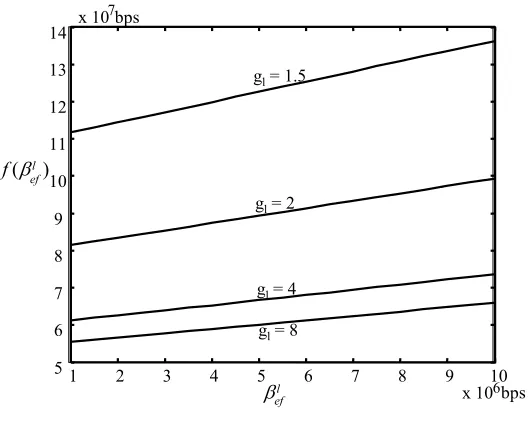
prac-tice, gl should be carefully chosen to reflect the desired BE performance and the link
utilization. Figure (5.1) shows the value of f(βl
ef) with respect to β l
ef, when gl=1.5,
2, 4, and 8. As can be seen from the figure, the link utilization varies significantly as
gl changes.
1 2 3 4 5 6 7 8 9 10
x 106 5 6 7 8 9 10 11 12 13 14
x 107bps
bps
( l) ef f β l ef β g
l= 1.5
gl= 2
g
l= 4
g
l= 8
Figure 5.1: f(βefl ) vs. β l ef, (β
l
be = 5×10
7 bps)
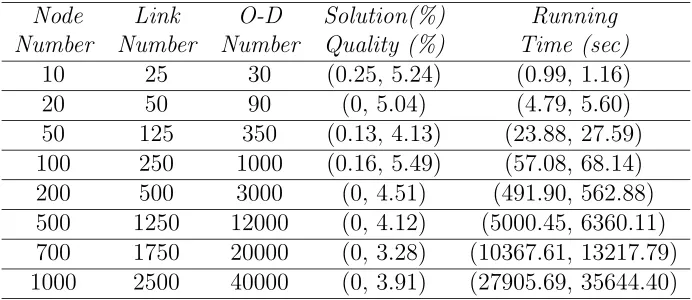
The algorithm was tested on 8 different sizes of networks, ranging from 10 nodes
to 1000 nodes. Some details of the network topologies are listed in Table 6.1. To
obtain confidence intervals, we generate 30 different topologies for each network size,
with the same number of nodes, links, and O-D pairs.
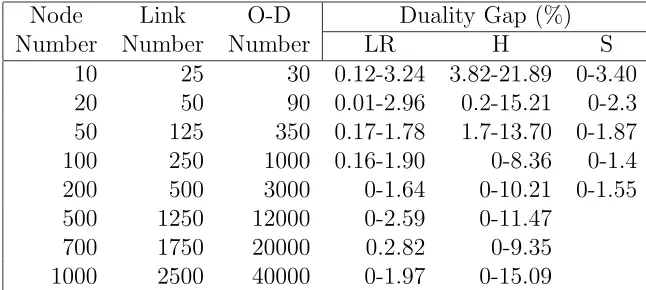
solu-tion of the primal problem and the dual problem.
Solution Quality =
sp−sd
sd
(5.35)
where sp and sd are the solutions of primal problem and dual problem respectively.
Table 5.1: Network topology information and experimental results
Node Link O-D Solution(%) Running
Number Number Number Quality (%) Time (sec) 10 25 30 (0.25, 5.24) (0.99, 1.16)
20 50 90 (0, 5.04) (4.79, 5.60)
50 125 350 (0.13, 4.13) (23.88, 27.59) 100 250 1000 (0.16, 5.49) (57.08, 68.14) 200 500 3000 (0, 4.51) (491.90, 562.88) 500 1250 12000 (0, 4.12) (5000.45, 6360.11) 700 1750 20000 (0, 3.28) (10367.61, 13217.79) 1000 2500 40000 (0, 3.91) (27905.69, 35644.40)
Table 6.1 shows the running time and solution quality of various network sizes
with 95% confidence intervals. In all 240 test cases, the algorithm converges without
difficulty. It is easy to see from the table that the Lagrangian Relaxation together with
the subgradient method produces reasonable results as the duality gap is bounded by
no more than 6%. Given the large number of networks being tested, we are confident
that the solution should have good quality for other sizes of networks.
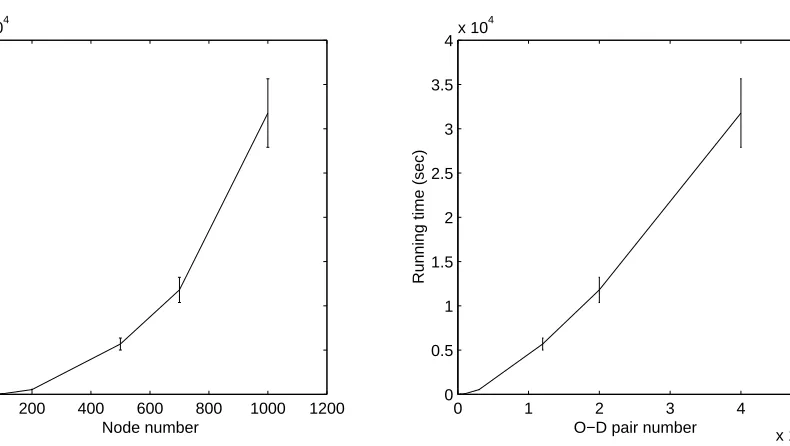
Because capacity planning is usually performed on the time scale of weeks to
0 200 400 600 800 1000 1200 0 0.5 1 1.5 2 2.5 3 3.5
4x 10 4
Node number
Running time (sec)
0 1 2 3 4 5
x 104 0 0.5 1 1.5 2 2.5 3 3.5
4x 10 4
O−D pair number
Running time (sec)
Figure 5.2: Running Time
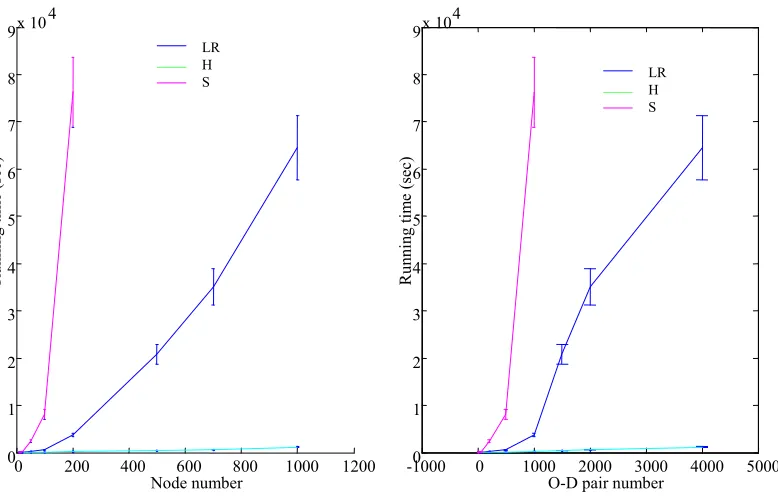
still desirable to know how the running time scales up with respect to the network
size. As can be seen from the Figure (5.2), while the running time goes up more
quickly than the number of nodes, it increases linearly with respect to the number of
O-D pairs in our test cases. This is understandable; sinceK >> L, when the network
size increases, the dominant portion of the running time is spent on the subproblem
(D2), which in turn has K subproblems. The running time of each one of those K
subproblems is insensitive to the size of the network, due to the fixed number of
candidate paths and the reuse of the link cost throughout all iterations. The size of
is much larger than the test cases used in most work on capacity planning. It is fair
to predict that the running time of the algorithm will stay reasonable for practical
Chapter 6
MPLS Networks supporting Diffserv EF
and BE classes
6.1
Models and formulation
In this chapter, we address the problem of link dimensioning and path optimization
for MPLS networks providing DiffServ EF and BE traffic classes. The problem is
formulated as an optimization problem, where we jointly select the routes for edge to
edge EF and BE user demand pairs, and assign a discrete capacity value for each link.
The goal is to minimize the total link cost, subject to the performance constraints of
both EF and BE classes. The non-bifurcated routing model is used for the EF class
as required by [26], so that the traffic from a single EF demand pair will follow the
be split across multiple LSPs. While the performance constraint of EF traffic is only
represented by a bandwidth requirement, the performance constraint of the BE class
is characterized by the average delay in each link. Queueing is modeled as M/G/1
strict priority queues.
We assume the cost function to be discrete. let Tl be the index of link type for
link l∈L, ult be the link type decision variable, ult= 1 if link type t is used for link
l ∈ L, 0 other wise. Only one link type can be chosen. ψlt is defined as the size of
the capacity of link type t, ˜ψl as the total capacity of linkl.
Let Mk be the set of EF demands for the same O-D pair k. For an EF demand
m, m∈Mk. The EF path routing variable is defined by x ef kmj.
We have the flow aggregation equation:
βlef =X
k∈K
X
m∈Mk
αefkmX
j∈Jk
xefkmjδjl (6.1)
For each O-D pair k , we define one BE demand pair. Like before, we allow an
arbitrary portion of the BE demand to route through any candidate LSP. Because
of the connectionless nature of IP traffic, it is unlikely that all the BE demand can
be clearly mapped to specific O-D pairs. We introduce another variable γl, which is
pairs {k :k∈K}. Thus the total BE load (average arrival rate) on link l is:
βlbe =γl+
X
k∈K
αbek X
j∈Jk
xbekjδjl (6.2)
The capacity and the cost of link l, ˜ψl and ˜Cl respectively, are:
˜ ψl =
X
t∈T
ultψlt, C˜l=
X
t∈T
ultClt (6.3)
There is no linear relationship assumed between Clt and ψlt, therefore ˜Cl is not
necessarily a linear function of ˜ψl.
The formal problem definition is presented below.
Given: K, Mk, L, Jk, α ef km, ρ
ef km, α
be
k, γl, δjl, T, ψt, Clt
Variable: xefkmj, xbe kj, ult
Goal:
minX
l∈L
˜
Cl (6.4)
Subject to:
˜
ψl>f(βefl ) (6.5)
xefkmj = 0/1,X
j∈Jk
xefkmj = 1 (6.6)
X
j∈Jk
xbekj = 1 (6.7)
ult= 0/1,
X
t∈Tl