ISSN(Online): 2319-8753 ISSN (Print) : 2347-6710
I
nternational
J
ournal of
I
nnovative
R
esearch in
S
cience,
E
ngineering and
T
echnology
(A High Impact Factor, Monthly, Peer Reviewed Journal)
Visit: www.ijirset.com Vol. 7, Issue 6, June 2018
Comparative Analysis of Classifiers for
Gender Identification Using Fingerprints
Shivanand S. Gornale1 , Basavanna M 2 , Kruthi R3
Professor, Department of Computer Science, School of Mathematics and Computing Science, Rani Channamma
University, Belagavi, India
Assistant Professor, Department of Computer Science (PG), Government College (Autonomous), Mandya, India
Research Scholar, Department of Computer Science, Jain University, Banglore, India.
ABSTRACT: Gender identification of the person can be distinguish by certain forms, as human have different characteristics and inimitable traits. Based on the aspect of individuals anatomy of biometrics like palm print or fingerprint interleaved ridges and valleys measured to identify the person. Biometric traits are essential to build applications such as human computer interaction searching, surveillance, content based indexing, biometric and demographic studies are necessary for gender identification. Several previous studies have investigated the gender information from the face image; some appreciable results have been obtained. Due to the age varying it limits the gender identification through machine learning approaches. In this proposed work an attempt is made of study and comparing different classifiers for gender information from the fingerprints.
KEYWORDS: Gender identification, fingerprint, LDA, QDA, DWT, KNN, SVM.
I. INTRODUCTION
Human vision system is self-sufficient and quite adaptive in identifying the approximated attributes of individuals such as age and gender. For example, the first moment of life we try to recognize mother and father. We constantly perform gender recognition, often without being aware of it. However, the computer vision system is not fully mature to do all these tasks. Consequently, gender identification of human beings play a vital role in bisects to the search space and developing various applications such as human-computer interaction, surveillance, targeted advertising and demographic studies etc[1][9][12].
Classification and identification of fingerprint have been used by many researchers; some researchers have studied the fingerprint gender classification problem. The gender of the person can be identified using fingerprints which is unique, based on the ridges counts gender of the person can be judged[2,4,7,10,11]. In [8] shows both males and females have higher right word directional asymmetry in the ridge count. According to the survey the average ridges count of the male is slightly higher the females, fingerprints are widely used biometric for personal individual authentication. As fingerprint acquisitions is a simple and is one of the prominent biometrics as fingerprints are unvarying but its size and shape may change and differ with age, but basic patterns of the fingerprint remain unchanged..
ISSN(Online): 2319-8753 ISSN (Print) : 2347-6710
I
nternational
J
ournal of
I
nnovative
R
esearch in
S
cience,
E
ngineering and
T
echnology
(A High Impact Factor, Monthly, Peer Reviewed Journal)
Visit: www.ijirset.com Vol. 7, Issue 6, June 2018
extraction and the flow of work carried out is placed in Section 3. Experimental results are discussed in section 4 and concluding remarks are reported in Section 5.
II. RELATED WORK
Preceding research have shown that it is possible to authenticate an individual by obtaining information from fingerprint images but however a limited work is carried out on identifying individuals gender using fingerprint images. However a few studies are reported on gender identification using fingerprint.
The authors in [13] have worked on integrating faced, fingerprints and soft biometrics traits, using gender, height, weight, eye color, ethnicity and age for user identification. Dataset of ten images were collected for 263 users. The result of 96.3% for authenticity 89.6% for gender classification is obtained.
In the work [14] the authors have worked on gender classification from fingerprints, which is important in forensic anthropology. A fingerprint data set of 2200 person of different age groups were collected, where 1100 were males and 1100 females. Features like ridges count, ridge thickness and valley thickness ratio (RTVTR), white lines count, ridge count asymmetry and pattern type concordance were extracted the dominant feature like Fuzzy-C means (FCM), linear discriminate analysis (LDA) and neural network (NN) were used for classification. The results of 80.39% , 86.5% and 88.5% were obtained for FCM, LDA and NN respectively.
In[15] authors have worked on gender classification from fingerprints. Many features like ridge width, ridge thickness to valley thickness ratio and ridge density [7] were extracted. Support vector machine is used as classifier. The internal data set of 400 fingerprints of male and female were used for experiments and achieved 91% classification rate.
In [16] authors have proposed the method for gender classification using discrete wavelet transform and singular value decomposition. The authors have computed the energy from all the sub-bands of DWT and combined with special features of non-zero singular values. Obtained SVD of fingerprints were extracted for gender classification using K nearest neighbor (KNN) as a classifier. The experiments was conducted on internal database of 3570 fingerprints where 1980 are male and 1590 are female. The result of 94.32% and 95.46 is obtained for left hand little finger for female and male respectively and also the result of gender classification for any finger for male and female was 91.67% and 84.69% respectively which gives the classification rate of 88.28%.
In the work [17] gender identification based on fingerprints using frequency domain analysis, gender classification is achieved by analyzing fast Fourier transform (FFT), discrete cosine transform (DCT) and power spectral density (PSD). An internal dataset of 220 person of different age group were collected. Using pre determined threshold frequency domain collection are compared the results of 70.07% and 90% for male and female obtained respectively. In [18] have presented the worked on real time approach to determine the gender using fingerprints and they have focused on extracting the features based on frequency domain analysis, Discrete wavelet transform (DWT) and singular value decomposition(SVD). A dataset of 300 persons of different age and gender is collected. The proposed algorithm produces an accuracy decision of 92% for female and 80.02% for male.
ISSN(Online): 2319-8753 ISSN (Print) : 2347-6710
I
nternational
J
ournal of
I
nnovative
R
esearch in
S
cience,
E
ngineering and
T
echnology
(A High Impact Factor, Monthly, Peer Reviewed Journal)
Visit: www.ijirset.com Vol. 7, Issue 6, June 2018
In [20] presented a method for gender identification by means of combined feature have been proposed using FFT, Major Axis Length on the dataset combination of 450 male and 550 female samples of total 1000 numbers. Analysis of left thumb impression of each sample has been done for internal database. Optimal threshold was chosen to get promotable result. The algorithm produces accurate classification of 80% of male and 78% of female.
In the work [21] the authors have proposed a method for fingerprints based gender classification through frequency domain analysis and work with the features of 2D discrete wavelet transform (DWT) and principle component analysis (PCA) with the dataset of 2400 person fingerprints of different age groups. Classification is obtained using minimum distance method and overall success rate of 70% is obtained for gender classification.
The Neural net-work based gender classification [23], using Discrete wavelet transform (DWT) the directional images of fingerprints are obtained. Then the feed-forward back-propagation neural network is applied for male-female fingerprints recognition. The dataset of 300 fingerprints were collected. Success rate of classification was 91.3%.
In the work [24] authors have focused on gender classification through finger print biometric using discreet curvelet transform and back propagation with feed forward using neural network as classifier. The extracted features from fingerprints data base used for learning the stage of neural networks, which acts as automatic classifier two identify the gender. Image orientation wedges are decomposed using fast discreet curvelet transform which provides texture pattern and intensities. Using these pattern haralick or glcm features are estimated to get better gender classification using fingerprints.
In [25] have carried out a research work on fingerprint based gender classification using minutiae extraction by considering the minutiae details like intersecting points, ridge counts, number of blobs, terminating points and ridge counts. Acceptable and spirited results were observed which are helpful and practically applicable in forensic anthropology.
In Gender classification using fingerprints based on support vector machine (SVM) with 10-cross validation techniques [26] 89% and 91% classification rate is achieved for DWT using SVM(RBF sigma) and SVM(polynomial) using SVM classifier respectively.
In [27] have proposed heralick features descriptors for gender classification using fingerprint, using machine learning approach. The classifier like linear discriminant analysis and quadratic discriminant analysis classifier are used to extract the result of 92% and 94& are obtained for male and female respectively. In a proposed method[28] authors have tried to identifying individual’s gender along with their age parameter from 280 fingerprint images, with combining the features of DWT and Principal Component analysis(PCA) over Back propagation Neural Network they showed accuracy of 82.14%.
In [29] took advantage of lab setup and extracted ridge related local features like white line count, ridge thickness to valley ratio(RTVTR),ridge density are calculated with multilayer perception neural network classifier over 3000 fingerprint database ,overall obtained accuracy is of 97%with complex setup.
ISSN(Online): 2319-8753 ISSN (Print) : 2347-6710
I
nternational
J
ournal of
I
nnovative
R
esearch in
S
cience,
E
ngineering and
T
echnology
(A High Impact Factor, Monthly, Peer Reviewed Journal)
Visit: www.ijirset.com Vol. 7, Issue 6, June 2018
III. PROPOSED WORK
Our method consists of three steps namely pre-processing, feature-extraction and classification. First an input image is gone though preprocessing which involves usage of adaptive Histogram equalization technique for improving the quality of the fingerprint image. Further for feature computation we employed discrete wavelets transformation. Lastly behavior of different classifiers is observed for gender identification task. We have shown the diagrammatic representation of proposed method in the figure 1
Fig. 1. General approach involved in the Gender Identification System
A. Image Acquisition
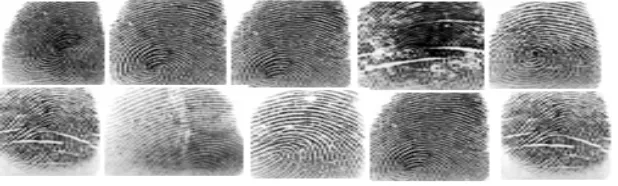
As there is no separate standard dataset for male and female fingerprints, a dataset of fingerprints of different age group were collected from rural and urban areas. Hence experiment was conducted using our own dataset. The main purpose for the creation of database is to check the robustness in the gender identification. Database contains of totally 74 healthy persons fingerprints, of which 37 are male volunteers and 37 female volunteers. Each individuals ten fingers print images are collected giving them a prior directions. Thus totally we have 740 fingerprints images, which are further been considered for the experiment. Sample from our database are shown below in figure 2.
Fig. 2. Sample of fingerprints
B. Pre-Processing
ISSN(Online): 2319-8753 ISSN (Print) : 2347-6710
I
nternational
J
ournal of
I
nnovative
R
esearch in
S
cience,
E
ngineering and
T
echnology
(A High Impact Factor, Monthly, Peer Reviewed Journal)
Visit: www.ijirset.com Vol. 7, Issue 6, June 2018
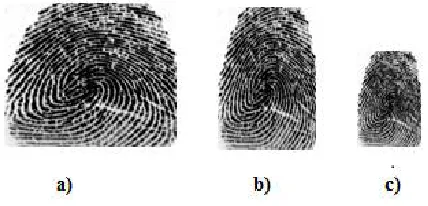
Fig. 3. Preprocessing Step a) Input Fingerprint image b) Enhanced Image after applying CLAHE, c) Image resized by 164*164
C. Feature extraction
Wavelets have been shown to be useful for texture analysis and most popular tool in multi-resolution image analysis and in object recognition research area . in this proposed methodology two dimensional DWT over fingerprints are implemented. Image representations of low-high, high-low and high-high sub bands of horizontal, vertical and diagonal representation are obtained respectively. Finally low-low sub band presents the approximation of all three details. A fingerprint images are decomposed into four levels with returns 16 sub-bands by applying DWT. Let us consider ‘a’ be the mother wavelet transform represented by:
Ψ(x,y)(a)= ………... .(1)
Where x & y are shifting parameters. By multiplying one dimensional scaling with wavelet function, one dimensional wavelets extends to two dimensional scaling to get two dimensional wavelet transform, one two dimensional scaling function Φ A (x,y) and three two dimensional scaling function ΨH(c,d), Ψ V(c:d) and Ψ D(c:d) are used. The product of one- dimensional scaling Φ and corresponding wavelet are followed in equation 1-5. ……….. (2)
……… (3)
)………. (4)
………. (5)
Where Φ A represents global information of the preserved image under low frequency components.
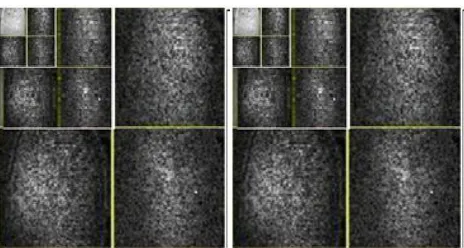
Approximation co-efficient ΨH , Ψ V and Ψ D represents horizontal, vertical and diagonal directions variation respectively. A two level decomposition of fingerprint image is shown in figure 4.
Discreet wavelet transform is applied to each input image. Upto fourth level decomposition we got 16 sub bands. From each sub band 2 statistical measures namely standard deviation and entropy are calculated. Using 2 statistical measures from each sub band we got 16*2=32 dimensional feature vectors for each input fingerprints.
ISSN(Online): 2319-8753 ISSN (Print) : 2347-6710
I
nternational
J
ournal of
I
nnovative
R
esearch in
S
cience,
E
ngineering and
T
echnology
(A High Impact Factor, Monthly, Peer Reviewed Journal)
Visit: www.ijirset.com Vol. 7, Issue 6, June 2018
Fig 4. Feature extraction from male and female image
D. Classification
K-NN Classifier:
KNN classification is found to be simple and conventional non-parametric classifier; it classifies the data based on measuring the distances between the test data and each of the training data to decide the final classification output. Prediction of class data is done on the basic of its neighbor [17].In this work, we have used value of k=3, which is fixed empirically with city-block distance as distance measures and 5 fold cross validation.
Let us consider M represents training data and N denotes for testing pattern Then KNN finds the minimum distance d between using its components Mj and Nj
dCity-block(M,N)=
SVM Classifier:
Support Vector Machine (SVM) is a classification technique based on the statistical learning theory proposed by vapnik in 1995 [5]. It is a binary classifier it abstracts a decision boundary in multidimensional space using an appropriate sub set of the training set of vectors; the elements of this sub set are the support vectors. Geometrically SVM are those training patterns that are closest to the decision boundary. As a kernel function is simply a dot product of two feature vectors transformed in such a expanded feature vector spaces. Various kernel functions are available in SVM classifier, in our experiment we have used with cubic Kernel with 3rd degree kernel function.
LDA Classifier:
Fisher discriminant analysis is also called ad discriminant analysis in a classification. Based on different Gaussion distributions different classes are generated. Gaussian distribution parameters are estimated by fitting function for each class in order to train the classifier. A trained classifier predict new classes of data and find class with smallest misclassification cost[1].
Random forest and random tree:
ISSN(Online): 2319-8753 ISSN (Print) : 2347-6710
I
nternational
J
ournal of
I
nnovative
R
esearch in
S
cience,
E
ngineering and
T
echnology
(A High Impact Factor, Monthly, Peer Reviewed Journal)
Visit: www.ijirset.com Vol. 7, Issue 6, June 2018
Table 1: Detail Result
DETAIL RESULT
CLASSIFIERS OVERALL
ACCURACY
Linear Discriminant Analysis(LDA)
85.48%
Quadratic discriminating analysis(QDA)
92.2
KNN 96.1%
Random forest 97.7
SVM 99%
IV. EXPERIMENT AND RESULTS
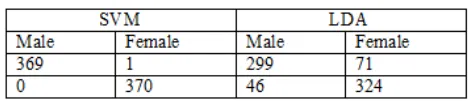
In the proposed method, we aim to study comparative analysis of classifiers for the task of gender identification using fingerprints. For identifying gender of an individual, we have trained the system to classify male and female based on their fingerprints, creating dataset, which consists of 740 fingerprints belonging to 74 volunteers. We have trained our proposed system with different parametric and non-parametric classifiers to check the performance evaluation of well known classifying techniques, with best accuracy of 99% achieved with support vector machine (Cubic-SVM) classifier. Random Forest Classifier gives an accuracy of 97.7%..But K-NN follows similar tends with accuracy of 96.1%.QDA classifier follows with 92.2% of accuracy and poorest accuracy of 85.48% is obtained with Linear discriminant analysis(LDA). SVM follows similar trend and yield highest accuracy of 99.0%repectively, LDA provides accuracy of 85.48% respectively. The confusion matrix of highest and lowest results is shown in the table 2.
Table 2: Confusion Matrix
V. CONCLUSIONS
ISSN(Online): 2319-8753 ISSN (Print) : 2347-6710
I
nternational
J
ournal of
I
nnovative
R
esearch in
S
cience,
E
ngineering and
T
echnology
(A High Impact Factor, Monthly, Peer Reviewed Journal)
Visit: www.ijirset.com Vol. 7, Issue 6, June 2018
biometric traits fuse them according to their modality and find gender using multimodal biometrics.3) We plan to evaluate the auxiliary information like age along with gender.
REFERENCES
[1] Fisher, R. A. “The Use of Multiple Measurements in Taxonomic Problems” Annals of Eugenics, Vol. 7, pp. 179–188, 1936. [2] Wendt GG, “ Uber weibe Linien in Abdruck der menschilichen fingerbeere” Homo 6:180-188,1955.
[3] Zuiderveld, Karel “Contrast Limited Adaptive Histograph Equalization” Graphic Gems IV. San Diego: Academic Press Professional, 1994. 474–485. [4] J. A. Y. Hall and D. Kimura “Dermatoglyphic Asymmetry and Sexual Orientation in Men.” ,Behavioral Neuroscience, 108, 1203-1206, 1994. [5] V. N. Vapnik, “The Nature of Statistical Learning Theory,” Springer, New York, 1995. doi:10.1007/978-1-4757-2440-0.
[6] B.S. Manjunathi and W.Y. Ma “Texture Features for Browsing and Retrieval of Image Data”, IEEE Transactions on Pattern Analysis and Machine Intelligence, Vol. 18, NO 8, 1996.
[7] Acree M A “Is there a gender difference in fingerprint ridge density?”, Federal bureau of investigation, Forensic science international, volume 102, Issue 1, May 31, 1999.
[8] Sanders G, Kadam A “Prepubescent children show the adult relationship between dematoglyphic saymmetry and performance on sexually dimorphic tasks”, Cortex, 37(1): 91-100, Feb 2001.
[9] Karine Cote, Christopher M. Earls,and Martin L. Lalumiere “Birth Order, Birth Interval, and Deviant Sexual Preferences Among Sex Offenders”, Sexual Abuse: A Journal of Research and Treatment, Vol. 14, No. 1, January 2002.
[10] R. Austin Hicklin, Christopher L. Reedy, “Implications of the IDENT/IAFIS Image Quality Study for Visa Fingerprint Processing”, Mitertek Systems (MTS), October 31, 2002
[11] Sukanta Saha, Danuta Loesch, David Chant, Joy Welham, Ossama, El Saadi, Lourdes Fañanás, Bryan Mowry and John McGrath “Directional and fluctuating asymmetry in finger and a-b ridge counts in psychosis: a case-control study.” BMC Psychiatry, 3:3, 23 March 2003.
[12] Kralik M and Novotny V.” Epidermal ridge breadth: an indicator of age and sex in paleodermatoglyphics”, Variability and Evolution, Vol. 11, PP 5–30, 2003.
[13] Anil K. Jain, Karthik Nandakumar, Xiaoguang Lu,and Unsang park, “Integrating Faces, Fingerprints, and Soft Biometric Traits for user Recognition” Proceedings of Biometric Authentication Workshop, LNCS 3087, PP.259-269, prague,-May 2004.
[14] A.Badawi, M.Mahfouz, R.Tadross, and R.Jantz “Fingerprint - based gender classification” in The International Conference on Image Processing, Computer Vision, and Pattern Recognition, June 2006.
[15] Manish Verma and Suneeta Agarwal.’’ Fingerprint Based Male- Female Classification. ’’ in Proceedings of the international workshop on computational intelligence in security for information systems (CISIS’08), Genoa, Italy,pp.251 – 257, 2008.
[16] Gnanasivam .P, and Dr. Muttan S, “Fingerprint Gender Classification Using Wavelet Transform and Singular Value Decomposition”, International Journal of Computer Science Issues, Vol. 9, Issue 2, No 3, March 2012.
[17] RituKaur, Susmita Ghosh Mazumdar, Mr. Devanand Bhonsle, “A Study On Various Methods of Gender Identification Based on Fingerprints”, International Journal of Emerging Technology and Advanced Engineering, ISSN 2250-2459, Volume 2,Issue 4, March 2012.
[18] Naveen Kumar Jain, Sunil Sharma, Anurag Paliwal, “A Real Time Approach To Determine The Gender Using Fingerprints” in International Journal of Agriculture Innovations and Research, ISSN: 2278-7844, pp:229-233, 2012.
[19] Pallavi Chand, Shubhendu Kumar Sarangi, “A Novel Method for Gender Classification Using DWT and SVD Techniques”, International Journal of Computer Technology & Applications, Vol 4 (3),445-449, May-June 2013 ( [email protected].)
[20] S. S. Gornale, Geetha D, Kruthi R “Analysis of fingerprint image for gender classification using spatial and frequencydomain analysis”, American International Journal of Research in Science, Technology, Engineering and Mathematics”,ISSN (Print): 2328-3491, ISSN (Online): 2328-3580, ISSN (CD-ROM): 2328-3629, PP: 46-50, 2013
[21] Rijo Jackson Tom, T. Arulkumaran , “Fingerprint Based Gender Classification Using 2D Discrete Wavelet Transforms and Principal Component Analysis” in International Journal of Engineering Trends and Technology, Volume 4, pp 199-203, Issue 2,2013
[22] S. S. Gornale, “Fingerprint Based Gender Classification for Biometric Security: A State-Of-The-Art Technique”,International Journal of Re-search in Science, Technology, Engineering & Mathematics ISSN (Print): 2328-3491, ISSN(Online): 2328-3580, ISSN (CD-ROM): 2328-3629 9(1), , pp. 39-49, December 2014-February 2015
[23] Pragya Bharti, Dr. C. S. Lamba, ” DWT-Neural Network based Gender Classification”, International Journal of Digital Application & Contemporary research, ISSN: 2319-4863,Volume 2, Issue 8, March 2014.
[24] M vadivel ,T Arulkumaran “Gender Identification from Finger Print Images Based on a Supervised Learning Approach” in Publications of Astronomical Society of Japan International Journal of Computer Science (IIJCS), Volume 2, Issue 7, July 2014.
[25] Shivanand Gornale, Basavanna M,KruthiR, “Fingerprint Based Gender Classification using Minutiae extraction” Internationl Journal of Advanced Research in Computer Science, Volume 6, No 1, pp. 72-77, Jan- Feb 2015.
[26] Shivanand Gornale, Basavanna M,Kruthi R,Gender Classication Using Fingerprints Based On Support Vector Machine(SVM) with 10-Cross Validation Technique",International Journal Of Scientic and Engineering Research,Vol(6),Issue7,July-2015.
[27] S. S. Gornale, Mallikarjun Hangarge, Rajmohan Pardeshi ,Kruthi R“ Haralick Feature Descriptors for Gender Classification Using Fingerprints: A Machine Learning Approach “,IJARCSSE Volume 5,Issue 9,September 2015
[28] A. S. Falohun, O.D.Fenwa ,F. A . Alala,” A Fingerprint-based Age and Gender Detector System using Fingerprint Pattern Analysis ”, International Journal of Computer Applications (0975 – 8887) Volume 136 – No.4, February 2016