A Novel Algorithm of Surface Eliminating
in Undersurface Optoacoustic Imaging
Yulia V. Zhulina
Vympel Interstate Joint Stock Corporation, P.O. Box 83, Moscow 107000, Russia Email:yulia [email protected]
Received 7 January 2003; Revised 25 April 2004; Recommended for Publication by Xiang-Gen Xia
This paper analyzes the task of optoacoustic imaging of the objects located under the surface covering them. In this paper, we suggest the algorithm of the surface eliminating based on the fact that the intensity of the image as a function of the spatial point should change slowly inside the local objects, and will suffer a discontinuity of the spatial gradients on their boundaries. The algorithm forms the 2-dimensional curves along which the discontinuity of the signal derivatives is detected. Then, the algorithm divides the signal space into the areas along these curves. The signals inside the areas with the maximum level of the signal amplitudes and the maximal gradient absolute values on their edges are put equal to zero. The rest of the signals are used for the image restoration. This method permits to reconstruct the picture of the surface boundaries with a higher contrast than that of the surface detection technique based on the maximums of the received signals. This algorithm does not require any prior knowledge of the signals’ statistics inside and outside the local objects. It may be used for reconstructing any images with the help of the signals representing the integral over the object’s volume. Simulation and real data are also provided to validate the proposed method.
Keywords and phrases:optoacoustic imaging, surface, laser, maximum likelihood.
1. INTRODUCTION
The task of reconstructing the spatial configuration of the sources using their scattered wideband signals received out-side the area of the sources location is that of great theoret-ical and practtheoret-ical interest for various applications. The well-known tasks of this type include: the optoacoustic detection of inhomogeneities in human tissues (breast tumor detec-tion) [1], and the underground penetrating imaging [2]; a nondestructive analysis of materials [3]. The systems solving these tasks have some common features: (1) the wideband (radar or laser) pulse signal illuminates the object; (2) the scattering object is of a 3-dimensional (3D) shape and com-posed of point scatters, so the received signal consists of a sum of some scaled and delayed versions of the transmitted signal; (3) the objects which are to be detected are located under a covering surface. The signals from this surface dom-inate in the dynamic range of the received signals and com-plicate the process of restoration. Thus, the signals from the surface should be removed. The surfaces in these tasks are the ground surfaces, the surface of the studied material, the skin of some organic body. Among these tasks, the most difficult is the task of medical optoacoustics, since the spatial position of the 3D surface is not known.
Several techniques of “penetrating” imaging are devel-oped in [1, 2]. They use different criteria and calculation
techniques, based mostly on the idea of cutting offthe ar-eas of signals with the maximum magnitude. However, this is not the best criterion. The mathematical technique, us-ing the image gradients’ flows for constructus-ing the bound-aries contours, has recently become widely used. It consists of building up the contour curve, that satisfies to the mini-mum of the criterion, in order to adapt it to the boundary of an object. The criteria are various in different works: in [4,5,6,7], the segmentation methods use some special statis-tical properties of images, which are different in areas divided by the contours. The methods are based on prior knowledge of statistical properties of images and assume a large num-ber of resolution elements in the image. The common fea-tures of these most approaches are: the iterative calculating algorithms and the segmentation of the given 2-dimensional (2D) image, when the task of the surface elimination is al-ready resolved or does not exist. The authors of [8] suggested the maximization of the correlation between the ultrasound and MR images for the automatic reconstruction of the 3D ultrasound images.
end encodes them for compressing the image. The areas re-stricted by the definite levels of intensity do not necessarily provide the information about the position of the surface, so the algorithms cannot be applied directly to the task of elim-inating the covering surface.
Here we address to the optoacoustic task in detail and suggest an algorithm, using the assumption that the objects change smoothly within the inhomogeneities and have the discontinuity of spatial gradients on the boundaries of these inhomogeneities. The algorithm is synthesized to find the lines of the gradients’ discontinuities using some mathemat-ical model for these lines. Parameters of this model are es-timated by the method of maximum likelihood. The pro-cedure draws 2D (the time index of the received signal, the number of the received signal) curves along which the dis-continuity of the signal gradients occurs, removes the areas with the covering surface and leaves the signal areas for the reconstruction of the inhomogeneities. The position of the surface is estimated by a set of the gradients of the signals re-ceived along the range coordinate. Then, the detected points of the surfaces are banded in the neighboring signals into the curves, and then, the surface is cut inside these curves. Only then, the restoration of the image is performed. The num-ber of the received signals depends on the characteristics of the receiving aperture and, in practice, may not be very large. Thus, the iterative reconstructing of the active contours may not converge to any reliable result.
The proposed algorithms are investigated by using simu-lation. The performance of the algorithm is also tested with the help of real signals of the physical model “phantom.”
2. TASK STATEMENT
The task of optoacoustic image reconstruction has the fol-lowing physical basis [11,12,13,14,15]: the 3D object is placed into some liquid and irradiated by some source. (In our case it is a laser, which generates short pulses, it may also be a radar generating some short high frequency pulses [1].) These irradiating pulses induce an acoustic signal at each point of the 3D object. The acoustic signals from the points are summarized and spread in the 3D space as an acoustic wave. The wave reaches an acoustic receiver, located at some point in the space, and creates some acoustic pressure inside it. This acoustic pressure is transformed into the digital signal in the output of the receiver. If the irradiating laser (or radar) pulse is short enough, the output signal in the receiver has a very high-range resolution. If we have the aperture consist-ing of a set of such receivers and if the whole aperture covers a large angle of observation, we can restore a 3D image of the irradiated object. If we have a 2D aperture, it gives us op-portunity of reconstructing a 3D image. In the case of the 1-dimensional (1D) aperture, looking like a curve, only the integral of the object over the unresolved coordinate can be reconstructed.
Suppose we haveN optoacoustic signalsY(Rn,t) (n =
1,. . .,N). According to [11,12,13,14,15], the temporal
in-tegral of the acoustic pressure, detected by the transducer,
located in point Rn, can be described by the following for-mula: 3D object when it is irradiated by the inducing source:
YRn,t the momentt,Kis the constant proportional to the thermal coefficient of the object volume expansion, exp(−α|r|) is the coefficient of the amplitude attenuation of the signal during its passing through the medium, 1/|r|is the coefficient of the weakening of the wave when it is spread from sourceO(r) (the result of resolving the wave equation).O(r) is in (2) is the shape of the object in the coordinate spacer,Rn is the vector of the coordinates of the receiver with numbern,vis the velocity of the wave spreading (in our case, the velocity of the sound),tis the time index,m(Rn,t) is the additive noise in the receiver, which is assumed to be the Gaussian stochas-tic process, with no correlation between different pointsRn and the time correlation functionρn(t) (n =1,. . .,N), and
u(t) is the shape of the laser pulse, inducing the acoustic sig-nalY(Rn,t). This pulse is very short (∼ 10 nanoseconds in the real system described below).
On this supposition, the formula (2) can be simplified as follows (the slowly changing functions can be taken out of the integration sign):
we will get the following expression for it:
2058 the additive noise in the receiver is closed to the uncorrelated one) we can write a simpler approximation for ρ1,n(t1,t2)
The noisen(Rn,t) is uncorrelated between different receivers as before.
Exponentαin (3) is generally unknown. The task of its estimation is a separate and a difficult one. In this paper, we will not consider this question, but suppose thatαis a pri-ori known. Our task is to get a possibly effective estimate of functionO(r) in the presence of some interfering surface as well as to investigate the quality of this estimating in real con-ditions.
The functionO(r) is a superposition of the in-question inhomogeneitiesOobj(r) and the surfaceOsur(r), that is,
The task of the early medical diagnostics is the detection of small-sized inhomogeneities, that is, the restoration of the image Oobj(r). The signals from the inhomogeneities have a low amplitude and each of the inhomogenities is located within a narrow time (range) interval. The signal from the surface Osur(r) is the signal from the skin and it is gener-ated by a thin irregular curved layer covering a wide spatial range. This signal is very strong and, in fact, it is not zero along the whole time axis (Figures1and2). Each differential
element of the surface may not give a significant amplitude of the signal, but a large quantity of such elements, disposed at the identical distance from the receiver, makes a strong contribution into the integral (5). We mean, that the surface spreads into a wide spatial area around inhomogeneities (in a real case, the inhomogeneities can be of several millimeters in a diameter, and the surface-breast skin has an area about a square decimeter).
The task of the algorithm is to separate in each signal (5), the areas generated by the surfaceOsur(r) and the ob-jectOobj(r), and to suppress the areas in signals, generated by the surfaceOsur(r).
Figure2: The magnitude of the gradients of all the signals prior to cutting offthe surface.
We will have more convenient conditions for the analysis and the separation of the signals into the areas if we switch to the new coordinate system under a 3D integral (5). Instead of coordinatesrx,ry,rz, we will introduce a new coordinate system (τ,ρ1,ρ2), where
τ=r−Rn
v (9)
and the coordinates (ρ1,ρ2) are disposed in the plane which is orthogonal to the sight line from the chosen receiver. These coordinates supplement (9) to the full 3D coordinates sys-tem. Using the coordinates (τ,ρ1,ρ2), we can get a new form an integral over the object space in the plane, orthogonal to the sight line from the given receiver. This record ˜On(τ) is the 1D function of time, andO(r) is a 3D function. At the same time the ˜On(τ) is an unknown function, different for each new signalX(Rn,t), andO(r) is the function, common for all the signals. Taking (8) into account, we can write
XRn,t
We need to find some informative characteristics of the func-tions ˜On,sur(τ) and ˜On,obj(τ) in (13), which allow to sepa-rate the respective signals. We can suggest the time deriva-tives of these functions as the informative characteristics. These derivatives have their maximums (of absolute values) at the boundaries of the object (at the front edges of ˜On,sur(τ),
˜
close to the spherical one (with a small radius) and for the surfaces of some arbitrary shape and size, but thin, however. Very often, the task of the medical diagnostics has the simi-larity to the task of detecting a small-sized inhomogeneity of a spherical shape.
We consider the time-derivatives of the signals given by (14) and design them as Gr(Rn,t). Using (14), we can write where ˜mn(t) is the additive noise with the new-time correla-tion funccorrela-tion. This correlacorrela-tion funccorrela-tion can be calculated di-rectly and it equals toρ2,n(t1,t2)=∂2ρ1,n(t1,t2)/∂t1∂t2(n=
1,. . .,N). All the noises ˜mn(t) are uncorrelated between the
different receivers, because the transformation (15) is being performed independently between the different positions.
We can easily see that (15) can be replaced by
Now we can formalize the problem of signal separation. Further, we will search for the functiondO˜n(τ)/dτas a sum of a certain slow function and an unknown number of delta functions with some arbitrary amplitudes and location of maximums unknown and should be estimated. The approximation (17) assumes that the form of the signal ˜On(τ) along the rangeτis a smooth function ofτ except for some areas, where the in-homogeneities and surfaces are located; and the derivatives dO˜n(τ)/dτhave the discontinuities on the edges of these ar-eas.
This approximation does not fully correspond with the physical properties of the signals, of course. But, the approx-imation (17) permits to extract the delta-form peaks in the derivatives of signals and to detect the local objects with us-ing asymptotic methods [16]. A method of estimating pa-rameters In,Ain, and τin, and the functions A0n(t) is given below inAppendix A.
3. FULL ALGORITHM OF IMAGE RESTORATION UNDER THE SURFACE
Formulas (A.11) and (A.13) give the estimates of parameters ˆ
Ain, ˆτin, and ˆIn(i=1,. . ., ˆIn;n=1,. . .,N); overall, the algo-rithm of building and using the separating curves consists of the following operations.
(1) The evaluation of all the parameters ˆτin (i=1,. . ., ˆIn;
n=1,. . .,N).
(2) The construction of the curves of the gradients’ dis-continuity. The curve with the numberi=i0is a set of parameters ˆτi0nfor a certain numberi=i0and for all the numbersn(n=1,. . .,N), constructed on the ba-sis of the whole set of the received signals. This curve
Ti0=( ˆτi01, ˆτi02,. . ., ˆτi0N) can be considered the
bound-ary of the local object and, thus, it can be used as the line separating the signals into the areas. If, in addition, this region is characterized by the maximum values of the estimates |Aˆi
0n|, it can be considered exactly the area where the signals from the surface are located. (3) If the curveTi0=( ˆτi01, ˆτi02,. . ., ˆτi0N) is a closed one, all
the values of the signals within this curve should be set to zero. If the surface lies between the receives and the unclosed curveTi0 =( ˆτi01, ˆτi02,. . ., ˆτi0N), then we have to set all the signals at axistin the intervals (0, ˆτi0n)
(n=1,. . .,N) equal zero. If the surface lies behind the
inhomogeneities along the range, then we have to set all the signals at axistat the intervals ( ˆτi0n,T) (n =
1,. . .,N) equal to zero (hereTis the last time point of
all the received signals).
(4) After this operation, we can apply the image recon-struction procedure described in [17]. This procedure comprises two operations (in a case of the 2D restora-tion).
(a) The summation of all the signals in the plane of the image reconstruction performing the transi-tion from the time coordinates to the spatial co-ordinates of the image:
Zr=
(b) We will design the 2D Fourier transform of (18) asFZ(ω), whereωis the variable of the spatial fre-It should be noted that formula (19) was exactly derived in [17] only for the Gaussian form of the pulse
The filter (19) suppresses the low frequencies down to zero, retains the middle frequencies with-out any changes, and suppresses the high frequen-cies;
(d) The reverse Fourier transform of the result re-ceived by multiplying gives the final estimation of
32 16 1
n
0 20 40 60 80 100 120
Range (mm)
Figure3: The magnitude of the gradients of real signals prior to cutting offthe surface.
It is clear from formulas (19) and (20), that the essen-tial parameters of the algorithm are the velocity of the wave propagationvand the length of the inducing pulseτpulse.
It should be noted that there are two options for the implementation of the algorithm in constructing the curves
Ti0=( ˆτi01, ˆτi02,. . ., ˆτi0N).
(A) By the analytical calculation of (A.10) and its maxi-mization.
(B) By using the interactive computer work mode. In this case, we have to take into account the following con-siderations:X(Rn,t) is a function in 3D space; Rnis the point of the aperture where exactly the receivers are located (e.g., a semisphere [1] or a plane [18]),tis the time axis for the signal. We can assume that the re-ceivers are located in a single-plane layer, for example, along a certain curve in the planeXY. This assumption retains the applicability of the technique for any 3D shape of the aperture, since for each new layer (along theZ-axis), we can use the procedure again. In case we have a rather large receiving aperture with the receivers located closely to each other, the signals (15) and (16) will vary continuously between the receivers. Thus, the processing should include the following operations: (1) to reconstruct on the display of the computer all
theNmodules of the signal gradients:
ModGrRn,t
=dX
Rn,t
dt
=GrRn,t, (21)
received within the single plane (Figures2and3); (2) to set to zero all the signals on the left-hand side or
on the right-hand side (depending on the specific location of the surface) of the curvesTiproviding the maximums to the values of (21). In the inter-active mode, the positions of these curves should be indicated by an analyst with using the “mouse.” Below, we will discuss this technique and demon-strate the procedure.
4. TESTING THE ALGORITHM BY USING SIMULATION
The computer simulation model of the signals is useful for testing the performance of the algorithm. All the objects
60
50
40
30
Y
(mm)
Z
40 60 80
X(mm)
Figure4: The view of the model in the plane of image reconstruc-tion.
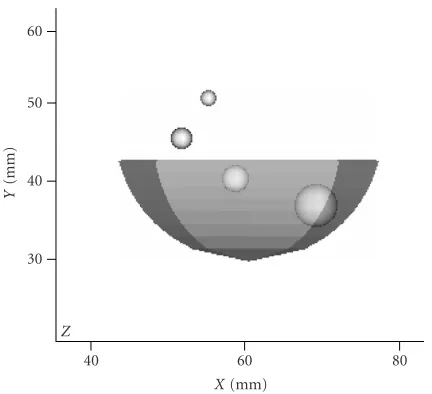
(the four spheres of different diameters and the interfering surface) were simulated by using “OpenGL” package of 3D graphics [19]. The surface model is a set of polygons simu-lating a certain large sphere. All the polygons are equally thin (about a diameter of the smallest sphere).
The number of the receivers is 32. They are arranged along the circle with a radius of 60 mm in plane XY and cover the observation angle of 120 degrees. Figure 4shows the whole true object in planeXY, where the receivers are located and it is the area of the image to be restored as well.
Each position receives a signal at the time interval of 134.228 nanoseconds. The number of the points in the sig-nal is 596. The velocity of the sound is 1500 m/s. The sigsig-nal covers the range interval of 120 mm. This interval was taken as the size of the volume under investigation. The arrange-ment of the receivers is shown in Figures5,6,7, and8.
The signal (14), received by the position under number 17 (in the center of the receiving aperture) prior to cutting, is shown atFigure 1as the function of the range.
120 100 80 60 39 19 −1
Y
(mm)
0 20 40 60 81 101 121
X(mm)
0 50 100
Figure5: The restored image of the four spheres (the interfering surface is absent).
120 100
80 60 39
19 −1
Y
(mm)
0 20 40 60 81 101 121
X(mm)
0 50 100
Figure6: The restored image of the four spheres under the inter-fering surface without space filtration.
memory. After that, all the 32 signals on the left-hand side area of the curve were set to zero. The result of the cutting operation is shown inFigure 9. We can see fromFigure 9that the signals from the spheres and from the part of the surface overlapping with the useful signal are retained in the plane (n,t=ρ/v).
Figures5,6,7, and8present the reconstructed images of the four spheres: Figures6,7, and8, under the surface and
Figure 5, with no surface at all.
As it was said, all the signals cover the range interval of 120 mm (beginning from the range which is equal to zero). So the volume within which the restoration of the image is principally possible, has the dimensions of 120×120× 120 mm. As our aperture has only 32 receivers, located in the plane, the 2D space of the image restoration is 120×120 mm, that in pixels equals to 596×596. The central point of the
im-120 100 80 60 39 19 −1
Y
(mm)
0 20 40 60 81 101 121
X(mm)
0 50 100
Figure7: The restored image of the four spheres under the inter-fering surface after space filtration.
120 100 80 60
39 19 −1
Y
(mm)
0 20 40 60 81 101 121
X(mm)
0 50 100
Figure8: The image of the four spheres after cutting offthe surface of the signals and space filtration.
age frame has the range of 60 mm from the central receiver. The scale (in mm) is shown along the axesX andY in all the pictures. The arrangement of the receivers is shown at the bottom of the figures. Figures5,6,7, and8present the result of the image restoration using the algorithm [17]. The image is shown in the planeXY.Figure 5is the restored im-age of the four spheres without any interfering surface (only spheres). Figure 6presents the result of the image recovery with the surface present, when only the summing up proce-dure of all the signals is performed in the plane of the image (the first stage of the algorithm [17]).Figure 7shows the re-sult of the image restoration under the surface after the opti-mal space filtration (the second stage of the algorithm [17]).
32 16 1
n
0 15 30 45 60 75 90 105
Range (mm)
Figure9: Magnitude of the gradients of all the signals after cutting offthe surface.
and the resolution of each of the spheres is improved. The smallest sphere placed at the greatest distance from the re-ceivers can be observed almost as sharply as inFigure 5(only spheres).
All modeling was performed without taking into account the noises in the receiver. To evaluate a comparative efficiency of the described algorithms, some calculations of the poten-tially reachable signal/noise ratios are given inAppendix B.
5. TESTING THE ALGORITHM BY USING THE REAL SIGNAL FROM THE PHANTOM
The real optoacoustic system with the arc-array transduc-ers processing the optoacoustic signals was described in de-tail in [20]. The aperture has 32 rectangular receivers of 1.0×12.5 mm dimensions, and the distance of 3.85 mm be-tween them. The transducers are located on the circle with the radius of 60 mm.
The real physical model was a sphere with the diameter of 0.8 mm, placed in milk. The milk was diluted with wa-ter to obtain optical properties of the medium close to the ones of the breast tissue. The optical absorption coefficient of the sphere was about 1.0 cm−1. This value is typical of some light absorption in tumors [20]. The sphere is disposed in the near zone, approximately above the central receiver, at the distance of 19 mm from it.
The laser radiation comes along theY axis. The energy of the laser pulse is within the range of 0.025–0.050 J to com-ply with the regulations for the medical procedures, which require that the density of laser radiation at the surface of the breast should not exceed 0.1 J/cm2. All the receivers are ar-ranged equally and they cover the angle of 120 degrees. Each position receives the signal with the rate of 66.667 nanosec-onds. The number of the points in the signal is 1200. The range interval covered by the signal is that of 120 mm. This interval was taken as the size of the volume to be investi-gated. The arrangement of the receivers is shown in Figures
11and12.Figure 3presents the set of the gradients’ magni-tudes of all the 32 signals, calculated by using formula (21), for all the real signals. The strongest part of the surface has been already cut offfrom the signals previously and, thus, is not shown inFigure 3. However, the significant elements with the surface areas still remain. We can see in Figure 3
that there are several areas (on the right-hand side and in the middle of the picture) occupied by the surface. These are the areas with the maximum values of the signal gradients.
32 16 1
n
0 20 40 60 80 100 120
Range (mm)
Figure10: The magnitude of the gradients of real signals after cut-ting offthe surface.
Several lines and several areas for signal cutting are distinctly visible. The brightest area on the right-hand side and in the center of the picture was the first to be cut offin the interac-tive mode. Then, on the left-hand side of the picture, a new bright area stood out, that was cut offas well. The final re-sult of cutting is shown in Figure 10. We can see that only signals coming from the sphere and some background noise remained in the plane (n,t=ρ/v).
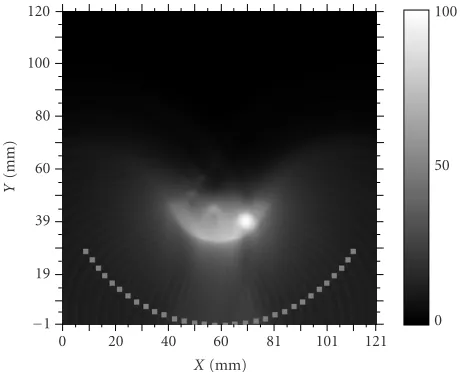
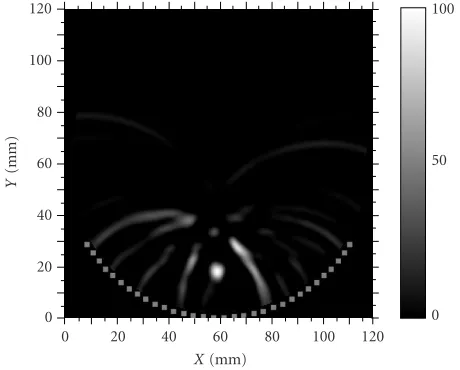
In Figure 11, we present the image, constructed in the plane (X,Y), where the receivers are located, and prior to cutting offthe surface-related signals. The image was recon-structed in the frame of 120×120 mm or 1200×1200 points. The recovered image is the result of the summing and filtra-tion, performed according to [17].Figure 12shows the re-stored image after removing the surface. We can see that, in fact, the sphere only remained in the image.
6. DISCUSSION
120 100 80 60 40 20 0
Y
(mm)
0 20 40 60 80 100 120
X(mm)
0 50 100
Figure 11: The recovered image of real phantom (one sphere in milk medium) prior to cutting offthe signals from the surface.
Figure 12shows that the algorithm can be applied to the real experimental system [20] with the real signal energy and the real contrast levels.
It is useful to discuss the computational demands on the proposed algorithm.
The main computational requirements are imposed to the procedure of the image restoration, that is, to the oper-ations, described by (18), (19), and (20). The operation of the signals summing (18) in the window of 1200×1200 pix-els was calculated within 52 seconds at the computer with 256 Mb RAM and 1300 MHz clock rate. The operation of fil-tration (19) took 16 seconds. The procedures of the surface elimination are less laborious; searching for local maximums and bunching them into the curves took 7 seconds with using 32 signals each of 1200 points of the length (formula (A.10)) with the approximate calculation of integrals along the time. Performing this procedure in the interactive mode is slower, but it is more reliable.
APPENDICES
A. ESTIMATING ALL THE PARAMETERS OF(17) We chose the approximation (17) to insert it into (16) to lo-cate the peaks in the gradients (16). The parameters of these peaks,τin,Ain, and their numberInare unknown and must be estimated. In (17),τin are the time indexes of the local edges of ˜On(τ), and the sign ofAinis the sign of the gradient at the local edge of ˜On(τ).Inis the number of discontinuities (proportional to the number of the separate local objects).
It should be noted that the delta functionδ(τ) is a gener-alized function with the property of filtrating the single point of the function under an integral, that is [21],
ft−τ0
=
f(t−τ)δτ−τ0
dτ. (A.1)
120 100 80 60 40 20 0
Y
(mm)
0 20 40 60 80 100 120
X(mm)
0 50 100
Figure12: The recovered image of real phantom after cutting off the signals from the surface.
By inserting (17) into (16) and by using the property (A.1), we will get
GrRn,t
=A0n(t) + In
i=1
Ainu
t−τin
+ ˜mn(t). (A.2)
An approximation (17) leading to formula (A.2) is the math-ematical assumption and of course does not always corre-spond with the real physical conditions. The proposed model (17) is only an asymptotic approximation to the real phys-ical model. But the digital modeling and processing of the real signals show (in the sections describing the testing algo-rithm) acceptability of such approximation. In this section, we will estimate the parameters of this model (A.2) by the method of maximum likelihood.
As it was said above, we assume that the pulseu(t) is very short compared to the interval of constancy of the slow func-tion A0n(t). On this assumption, it is easy to see from the (A.2) that the peaks of all the gradients in the signals have the width as the width of the inducing pulseu(t). In other words, the edges of the inhomogeneities can be detected with the accuracy not exceeding the range resolution of the given system.
We have N signals (A.2), and our task is to make the estimations of all the unknown parametersA0n(t),Ain,τin, andIn. The most important parameters areInandτin (i =
1,. . .,In;n=1,. . .,N). These parameters describe the shape
of the curves which separate the local objects. The curves al-low to detect and remove the strongest signals from the sur-face and to find all the other local objects of smaller sizes.
be a narrow one and approximately of the same duration as the function ρn(t) itself, and all the measurements of gra-dients (15) and (16), having the time correlation function
ρ2,n(t1,t2)=∂2ρ1,n(t1,t2)/∂t1∂t2(n=1,. . .,N) (see (6), (7)),
can also be approximately considered uncorrelated in time. On this assumption we can write the logarithm of likelihood function LnP [22] for the functions Gr(Rn,t) (A.2) under the
N0 in (A.3) is the spectral density of additive noises, while
Tis the total observation time. Expression (A.3) can be pre-sented as a sum of logarithms of the likelihood functions for the different pulses each of numbern:
Here, LnPnis a logarithm of the likelihood function for signal gradients in the pulse with numbern:
LnPn= −
In (A.5), a designation was introduced:
Sn(t)=Gr whole LnP breaks up into the independent maximization of each of the functions LnPn.
The maximization of (A.5) over the parameterAin can be performed exactly. This maximization gives the following estimations:
HereC0is the energy of the pulse:
C0=
T
0 u
2(t)dt. (A.8)
The insertion of (A.7) into (A.5) gives the new view of the function LnPndepending onτinandInonly as follows:
LnPn=− 1 So, we have a function LnP(1)n for maximization on these parameters:
The likelihood function (A.10) is analogous to the likelihood function in a process of detecting the radar targets in a radar receiver having a square detector when the number of targets Inis unknown [23,24,25].
In our task, the edges of local objects perform a role of targets in the space of gradients. In a correspondence with [23,24,25], this detection andInestimation should be per-formed by the following algorithm: with no prior knowledge of the target numberInand their positionτin, we have to use a maximally possible range (0,T) of valuesτin (defined by the experimental conditions) and to construct the likelihood ratio: in every pointτinof the whole range.
Formula (A.11) is the likelihood function for the local edge in the pointτin. It can be seen from (A.11) that the local likelihood equals the ratio signal/noise for the parameter ˆAin, whereσnoise2 is the dispersion of the noise in the signal gradi-ent function. It can be expressed through the energy of the pulse as follows:
After the ratio (A.11) is formed, we have to check a condition of exceeding ˆAinover the noise, that is, we have to check the next condition in every pointτin:
Λsignal/noise=
>Threshold. (A.13)
We make a decision about the new detected maximum in the signal gradients if (A.11) exceeds some threshold. In statisti-cal measuring tasks, a value of the threshold is often taken in an interval 1–9. The total number of maximums ˆAin, satisfy-ing (A.13), gives the estimate ˆInof all the front and back edges in all the local objects detected in the signal under numbern. The time positions of these maximums are given by the val-uesτinin (A.11).
Now, it should be mentioned that (A.10) and (A.11) comprise the unknown functionsA0n(t) inside the function
Sn(t) (formula (A.6)). It is natural to assume that|A0n(t)|
|Ain|(i= 1,. . .,In), that is, the boundaries have the higher
the calculations at any rate), and the likelihood function for maximization LnP(1)n will obtain the following form:
LnP(1)n = 1
An algorithm of getting the estimates of the slow background ˆ
A0n(t) is described below. After these estimates ˆA0n(t) are ob-tained, we have to use the function for LnP(1)n in the view (A.10), but formula (A.14) may be used as the first approx-imation. The sense of the maximization of (A.10) or (A.14) is obvious; the best estimates ofτin andInprovide the max-imum for the correlation of the gradients (16) (after leav-ing the slow backgroundA0n(t) out of the gradient Gr(Rn,t)) with pulseu(t). Ifu(t) is a short pulse, the maximization of (A.10) or (A.14) simply leads to the search of all the maxi-mums of Gr2(Rn,t) along the time axis.
The last step is the evaluation of the slow component of the gradients, that is, the functionsA0n(t) (n = 1,. . .,N).
The first approximation for the solution of (A.15) is located in the vicinity ofA0n(t)= 0, and for the short pulses,u(t)
Strictly speaking, we should return to the operation (A.11) after getting (A.16) and repeat all the calculations again in-cluding (A.15). In other words, the process of the simultane-ous estimation of the backgroundA0n(t) and the parameters
τin andAin must be iterative. In a case of the low levels of
A0n(t), the single iteration will be enough.
Now it is necessary to say that the described algorithm gives estimates ˆτin with accuracy equal to a discrete Del of the data receiving signals. The more accurate measuring of the gradients maximums position will demand the more ac-curate evaluation τin in the functional (A.10). It is possible to use the accurate methods analogous to the radar methods of the target location measurement. But the image can be re-stored only with the resolution Del, even in the absence of the interfering surface. So, the determination of the edges of local objects with a higher accuracy is not necessary, but may appear more labor intensive.
B. COMPARISON OF TWO ALGORITHMS IN SNR
The signal from a sphereSsph(r) as a function of the distance from the receiverrcan be described by formula [13,17] as follows:
R0 sph is the position of the sphere’s center, Radsphis the ra-dius of the sphere. Further, we will suppose that the surface is a sphere, which is empty inside and has the thickness of its sheath equal to∆sur.
The signal from the surfaceSsur(r) can be described by formula [13,17] as follows: Here, R0 sur is the position of the surface’s center and Radsuris radius of the surface sphere.
The full signalS(r) in the receiver got from the distancer will be equal to
S(r)=Ssph(r) +Ssur(r) +n(r), (B.3)
where n(r) is the Gaussian noise uncorrelated between the neighbor data measurements with a dispersionσ2
noise. A ratio of the sphere signal to the sum of the noise and the surface signals (SNR) in (B.3) is equal to
Qsph/(sur +n)(r)=
Now, we will compare this SNR got after the surface elimi-nating by two methods: (1) cutting offthe maximum surface signal; (2) cutting the surface in the gradients space.
(1) If we cut offthe maximal level of signal up to the level of the first neighbor minimum, we will receive the new max-imal signal of the surfaceSsur,1 minapproximately as follows:
Ssur,1 min≈2π∆surRadsur
After cutting the surface SNR for the sphere at the point of it’s maximum is as follows:
(2) Now, we will consider the process of cutting the sur-face in the gradients space. As it was shown above, the sursur-face can be cut offalmost totally. But the process of gradients cal-culating leads to an increase in the noises power. The new dispersion of noises is as follows:
σ2
1 noise= 2σ2
noise
∆r2 . (B.8) Here,∆r is the discrete of receiving the signal data over the distance.
σ2
1 noisehas the units ofm2. After cutting the surface SNR for the sphere at the point of it’s maximal gradient becomes as follows:
Now, we can estimate a gain in the SNRQ0by processing the gradients as follows:
It can be seen from (B.10) that the most gain is reached for the spheres of a small radius. And this is the most interesting case. Supposing that Radsph=∆r, we can simplify expression (B.10) as follows: To estimate Q0, we will consider two extreme cases of the sphere and the surface relative position.
(a) α=0 (the center positions of the sphere and the sur-face coincide). In this case,
Q0=2 +
Formula (B.14) should be performed if we want to get the object images of the high quality. So in this case the cutting surfaces in the space of gradients will be more effective than cutting surfaces in the signals itself.
(b) α = 1;β ≈ 1 (the sphere is disposed on the edge of the surface; the second condition is valid practically al-ways). In this case, the calculations by formula (B.10) give strong restriction than (B.14). It means that it is more difficult to detect a small sphere on the edge of the sur-face by the gradient’s method. But even in this case, the minimal value ofQ0equals 2.
ACKNOWLEDGMENT
The author is thankful to V. G. Andreev for the real signals provided for the calculations.
REFERENCES
[1] R. A. Kruger, K. D. Miller, H. E. Reynolds, W. L. Kiser Jr., D. R. Reinecke, and G. A. Kruger, “Breast cancer in vivo: contrast enhancement with thermoacoustic CT at 434 MHz-feasibility study,”Radiology, vol. 216, no. 1, pp. 279–283, 2000. [2] M. Acheroy, Y. Baudoin, and M. Piette, “Belgian project on
humanitarian demining (HUDEM),” inProc. 2nd Interna-tional Conference on Climbing and Walking Robots (CLAWAR ’98), pp. 215–218, Brussels, Belgium, November 1998. [3] J. V. Candy, D. J. Chinn, R. D. Huber, J. Spicer, and G. H.
Thomas, “Techniques for enhancing laser ultrasonic non-destructive evaluation,” Tech. Rep., Lawrence Livermore Na-tional Laboratory, Livermore, Calif, USA, February 1999. [4] S. Ranganath, “Contour extraction from cardiac MRI studies
using snakes,”IEEE Trans. on Medical Imaging, vol. 14, no. 2, pp. 328–338, 1995.
[5] P. Brigger, J. Hoeg, and M. Unser, “B-spline snakes: a flexi-ble tool for parametric contour detection,”IEEE Trans. Image Processing, vol. 9, no. 9, pp. 1484–1496, 2000.
[6] H. Sjoberg, F. Goudail, and Ph. Refregier, “Optimal algo-rithms for target location in nonhomogeneous binary im-ages,” Journal of the Optical Society of America{A}, vol. 15, no. 12, pp. 2976–2985, 1998.
[7] O. Germain and Ph. Refregier, “Edge location in SAR images: performance of the likelihood ratio filter and accuracy im-provement with an active contour approach,”IEEE Trans. Im-age Processing, vol. 10, no. 1, pp. 72–78, 2001.
[8] A. Roche, X. Pennec, G. Malandain, and N. Ayache, “Rigid registration of 3-D ultrasound with MR images: a new ap-proach combining intensity and gradient information,”IEEE Trans. on Medical Imaging, vol. 20, no. 10, pp. 1038–1049, 2001.
[9] V. Kovalevsky, “Algorithms and data structures for computer topology,” inDigital and Image Geometry: Advanced Lectures, G. Bertrand, A. Imiya, and R. Klette, Eds., vol. 2243 ofLecture Notes in Computer Science, pp. 38–58, Springer-Verlag, Hei-delberg, Germany, 2001.
[11] R. A. Kruger, P. Liu, Y. R. Fang, and C. R. Appledorn, “Photoacoustic ultrasound (PAUS)—Reconstruction tomog-raphy,”Medical Physics, vol. 22, no. 10, pp. 1605–1609, 1995. [12] M. I. Khan and G. J. Diebold, “The photoacoustic effect
gen-erated by an isotropic solid sphere,”Ultrasonics, vol. 33, no. 4, pp. 265–269, 1995.
[13] P. Liu, “Image reconstruction from photoacoustic pressure signals,” inProc. SPIE Laser-Tissue Interaction VII, vol. 2681 ofProceedings of SPIE, pp. 285–296, San Jose, Calif, USA, January–February 1996.
[14] P. Liu, “Recent developments in photoacoustic image recon-struction,” inProc. SPIE Laser-Tissue Interaction IX, vol. 3254 ofProceedings of SPIE, pp. 325–330, San Jose, Calif, USA, Jan-uary 1998.
[15] G. S. Kino, Acoustic Waves. Devices, Imaging, and Analog Signal Processing, Prentice-Hall, Englewood Cliffs, NJ, USA, 1987.
[16] F. W. J. Olver, Asymptotics and Special Functions, Academic Press, New York, NY, USA, 1974.
[17] Y. V. Zhulina, “Optimal statistical approach to optoacous-tic image reconstruction,” Applied Optics, vol. 39, no. 32, pp. 5971–5977, 2000.
[18] C. G. A. Hoelen and F. F. M. de Mul, “Image reconstruction for photoacoustic scanning of tissue structures,”Applied Op-tics, vol. 39, no. 31, pp. 5872–5883, 2000.
[19] J. D. Foley, A. van Dam, S. K. Feiner, and J. F. Hughes, Com-puter Graphics: Principles and Practice, Addison-Wesley, Read-ing, Mass, USA, 1991.
[20] V. G. Andreev, A. A. Karabutov, S. V. Solomatin, et al., “Op-toacoustic tomography of breast cancer with arc-array trans-ducer,” inProc. SPIE Biomedical Optoacoustics, vol. 3916 of Proceedings of SPIE, pp. 36–47, San Jose, Calif, USA, January 2000.
[21] P. Antosik, J. Mikusinski, and R. Sikorski,Theory of Distribu-tions. The Sequential Approach, Elsevier Scientific Publishing, Amsterdam, The Netherlands, 1973.
[22] D. E. Dudgeon, “Fundamentals of digital array processing,” Proceedings of the IEEE, vol. 65, no. 6, pp. 898–904, 1977. [23] D. Middleton, An Introduction to Statistical Communication
Theory, IEEE Press, Piscataway, NJ, USA, 1996.
[24] P. A. Bakut, I. A. Bolshakov, B. M. Gerasimov, et al., The Questions of Statistical Theory of the Radar Observations. Vol 1, Sovetskoe Radio, Moscow, Russia, 1963.
[25] P. A. Bakut, I. A. Bolshakov, B. M. Gerasimov, et al., The Questions of Statistical Theory of the Radar Observations. Vol 2, Sovetskoe Radio, Moscow, Russia, 1964.
Yulia V. Zhulinawas born in Igarka, Rus-sia. She graduated from the Moscow Phys-ical Engineering Institute, Moscow, Russia, in 1963. She received the Ph.D. degree in radar engineering from the Moscow Phys-ical Engineering Institute, Moscow, Russia, in 1968. In 1963, she joined the Radar Engi-neering Department at “Vympel” company where she is currently a Senior Scientist Re-searcher. She is a coauthor of a book