ISSN(Online): 2319-8753 ISSN (Print) : 2347-6710
I
nternational
J
ournal of
I
nnovative
R
esearch in
S
cience,
E
ngineering and
T
echnology
(A High Impact Factor, Monthly, Peer Reviewed Journal)
Visit: www.ijirset.com
Vol. 7, Issue 9, September 2018
Vibration Analysis of Single Point Cutting
Tool on Lathe Machine by Using FFT
Analyzer
Prof. A. M. Patil1, Pooja I. Patil2, Trupti Patil3, Shreya Sonmale4
Dept. of Mech, T.K.I.E.T. Warananagar, Shivaji University Kolhapur, India1
Students, Dept. of Mech, TKIET Warananagar, Shivaji University Kolhapur, India2-4
ABSTRACT: The present work concentrates and aims on study of different controllable parameter that affects the responses like vibration amplitude. The prediction of vibration between the tool and work piece is important as guideline to the machine tools user for an optimal selection of depth of cut and rotation of spindle to minimize the vibration. Machining is a complex process in which different parameters can deleterious the desired result. Among them, cutting tool vibration is an important which influences dimensional precision of components machined, life of the cutting tool is very important. Cutting tool vibration are mainly produced cutting parameters like cutting speed, depth of cut and tool feed rate. In this work, the cutting tool vibrations are controlled in lathe machine where the tool holder is supported with and without damping pad. The cutting tool vibration signals were controlled through FFT analyzer. To predict and validate result by using Taguchi method, Experimental studies and data analysis have been performed to validate the proposed damping system. By using regression analysis best suitable equation is developed to predict the probable value response for given predictor value.
KEYWORDS:life of the cutting tool, Four Channel B & K’s FFT Analyzer & cutting speed, depth of cut and tool feed rate.
I. INTRODUCTION
ISSN(Online): 2319-8753 ISSN (Print) : 2347-6710
I
nternational
J
ournal of
I
nnovative
R
esearch in
S
cience,
E
ngineering and
T
echnology
(A High Impact Factor, Monthly, Peer Reviewed Journal)
Visit: www.ijirset.com
Vol. 7, Issue 9, September 2018
II. OBJECTIVE AND PROBLEM DEFINITION
1. Objectives
1) To measure the vibrations of HSS single point cutting tool.
2) To measure the vibrations of Carbide tipped single point cutting tool.
3) To find the better tool with cutting parameters for maintaining good surface finish. Vibration Analysis of Single Point Cutting Tool On Lathe Machine By Using FFT Analyzer Department Of Mechanical Engineering T.K.I.E.T., Warananagar.
2. Problem Statement-
Vibration of cutting tool affects surface finish quality of component which is under machining. If vibrations are beyond limit and acceptance level chattering will be developed. These vibration of cutting tool depends upon cutting speed and depth of cut and finally come with conclusion.
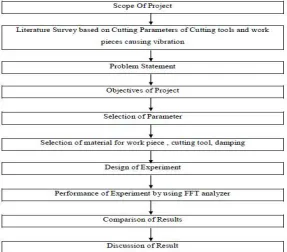
III.METHODOLOGY
ISSN(Online): 2319-8753 ISSN (Print) : 2347-6710
I
nternational
J
ournal of
I
nnovative
R
esearch in
S
cience,
E
ngineering and
T
echnology
(A High Impact Factor, Monthly, Peer Reviewed Journal)
Visit: www.ijirset.com
Vol. 7, Issue 9, September 2018
IV.DETAILSOFEXPERIMENTALSETUP
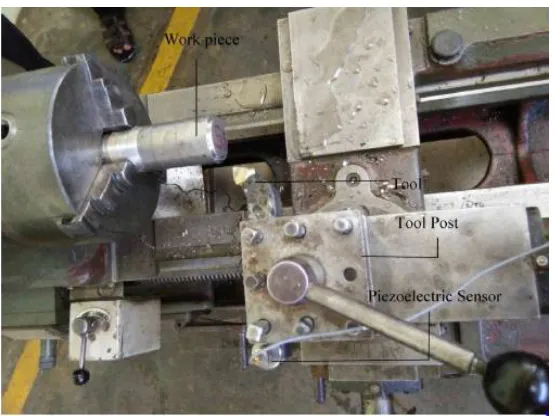
Fig. No.2. Experimental Setup
ISSN(Online): 2319-8753 ISSN (Print) : 2347-6710
I
nternational
J
ournal of
I
nnovative
R
esearch in
S
cience,
E
ngineering and
T
echnology
(A High Impact Factor, Monthly, Peer Reviewed Journal)
Visit: www.ijirset.com
Vol. 7, Issue 9, September 2018
V. EXPERIMENTAL RESULTS
3. SPECIFICATIONS AND TOOL GEOMETRY
1) Back Rake Angle – It is the angle between the face of the tool and a line parallel to the base of the tool and measured in the plane through the side cutting edge.
2) Side Rake angle- It is the angle between the tool face and a line parallel to the base ofthe tool and measured in plane perpendicular to the base and the sidecutting edge.
3) End Relief Angle- It is the angle between the portions of the end flank immediately below The edge of cutting edge and a line perpendicular to the base of the tool and measured at right angle to the end flank.
4) Side Relief Angle- It is the angle between the portion of the side flank immediately belowthe side cutting edge and a line perpendicular to the base of the tooland measured at the right angle to the side flank.
5) End Cutting Edge Angle- This is the angle between the end cutting edge and a line normal to thetool shank.
6) Side Cutting Edge Angle- It is also known as lead angle is the angle between side cutting edgeand the side of the tool shank.
Table No.1 Tool Specifications
4. Material Specifications
ISSN(Online): 2319-8753 ISSN (Print) : 2347-6710
I
nternational
J
ournal of
I
nnovative
R
esearch in
S
cience,
E
ngineering and
T
echnology
(A High Impact Factor, Monthly, Peer Reviewed Journal)
Visit: www.ijirset.com
Vol. 7, Issue 9, September 2018
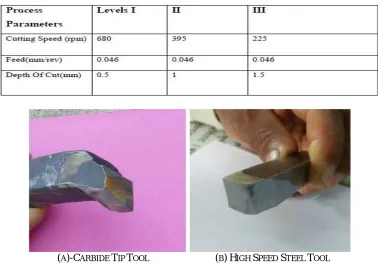
Table No. 3. Process Parameters
(A)-CARBIDE TIP TOOL (B)HIGH SPEED STEEL TOOL
EXPERIMENTALANALYSIS
For experimental analysis we change 3 depth of cut for single spindle speed of lathe machine. We selected minimum auto feed configuration for longitudinal propagation of 0.046 (mm/rev).Selected Speeds are of high level speed of lathe machine which got by changing belt position on stepped cone pulley drive.
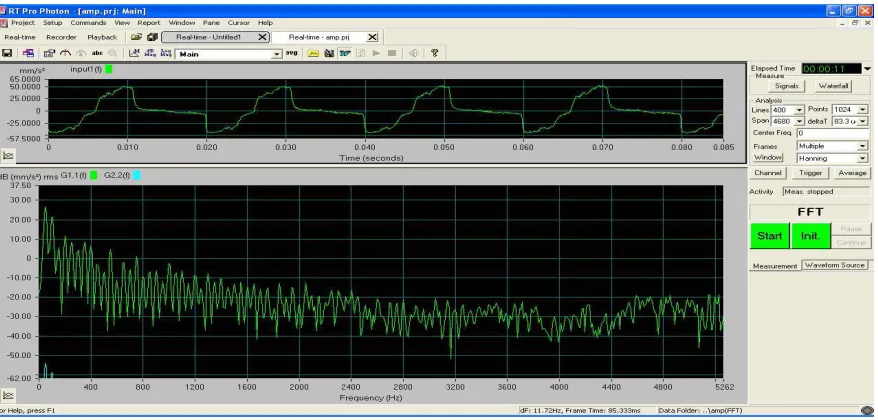
Project File Name: Carbide tip single point cutting tool Speed = 225 rpm
ISSN(Online): 2319-8753 ISSN (Print) : 2347-6710
I
nternational
J
ournal of
I
nnovative
R
esearch in
S
cience,
E
ngineering and
T
echnology
(A High Impact Factor, Monthly, Peer Reviewed Journal)
Visit: www.ijirset.com
Vol. 7, Issue 9, September 2018
Fig. No. 4. Frequency Vs Amplitude graph on FFT Analyser.
VI.RESULTS
ISSN(Online): 2319-8753 ISSN (Print) : 2347-6710
I
nternational
J
ournal of
I
nnovative
R
esearch in
S
cience,
E
ngineering and
T
echnology
(A High Impact Factor, Monthly, Peer Reviewed Journal)
Visit: www.ijirset.com
Vol. 7, Issue 9, September 2018
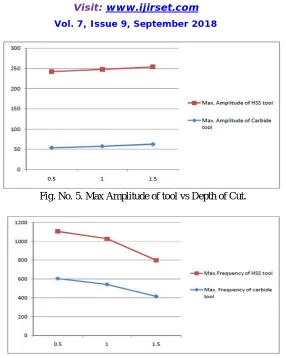
Fig. No. 5. Max Amplitude of tool vs Depth of Cut.
Fig.No.6.Max Frequency of tool vs Depth of Cut
VII. CONCLUSION
From the result table the graph (depth of cut vs max. amplitude) and (depth of cut vs frequency) is plotted as shown in figure. From this graph following conclusion can be drawn
As depth of cut goes on increasing the amplitude of vibration for both HSS and Carbide Single Point Cutting Tool goes on increasing that is amplitude is proportional to depth of cut
As depth of cut goes on increasing frequency goes on decreasing for both HSS and Carbide Tool that is frequency is inversely proportional to depth of cut.
For Carbide tools have vibrations with low amplitude as compare to HSS tool.
Carbide tipped Single point Cutting tool gives better surface finish as compared with High Speed Cutting Tool.
REFERENCES
1. Prof. A. M. Patil, Dr. A.S. Todkar “Experimental & Finite Element Analysis of Left Side Lower Wishbone Arm of Independent Suspension System” IOSR Journal of Mechanical Engineering (IOSR-JMCE) e-ISSN: 2278-1684, p-ISSN: 2320-334X, Volume 7, Issue 2 (May. - Jun. 2013), PP 43-48.
2. Prof. Ranjeet Mithari, Prof. Amar Patil, Prof. E. N. Aitavade “Analysis of Composite Leaf Spring by Using Analytical & FEA” International Journal of Engineering Science and Technology (IJEST), ISSN: 0975-5462 Vol. 4 No.12 December 2012, PP-4809-14.
ISSN(Online): 2319-8753 ISSN (Print) : 2347-6710
I
nternational
J
ournal of
I
nnovative
R
esearch in
S
cience,
E
ngineering and
T
echnology
(A High Impact Factor, Monthly, Peer Reviewed Journal)
Visit: www.ijirset.com
Vol. 7, Issue 9, September 2018
4. Prof. Amar Patil, Prof. Ranjeet Mithari, Prof. P. B. Kadam “Vibration analysis of bearings using FFT analyzer” International Journal of Advanced Technology in Engineering and Science IJATS Volume No.02, Issue No. 04, April 2014 ISSN (online): 2348 – 7550
5. Prof. Vivek V. Patil, Prof. Amar M. Patil, Dr.D. V. Ghevade “Design of facility for measuring and inspection of plate cylinder dimensions and tolerances” International Journal of Advance Research In Science And Engineering IJARSE, Vol. No.3, Issue No.4, April 2014 ISSN-2319-8354(E)
6. Prof. Vivek V. Patil, Prof. A. M. Patil, Prof. P. D. Kulkari “Design and development of bagasse dryer For modern jaggery house.” International Journal of Advance Research In Science And Engineering. IJARSE, Vol. No.3, Special Issue (01), September 2014 ISSN-2319-8354(E) 7. Prof. A. M. Patil, Prof. Vivek V. Patil, Prof. P. D. Kulkari “Design & Development Of Sunflower Seeds Extraction Machine.” International
Journal of Advanced Engineering Research and Science (IJAERS) [Vol-1, Issue-5, Oct- 2014]ISSN: 2349-6495 PP 63 – 69.
8. Gerald L. “The Application of Fluid Mixers in Edible Oil Processing”. Available at: www.emimixers.com (accessed on 9thApril, 2009) . 9. Bamgboye, A.I and Adejumo, A.O “Development of a Sunflower Oil Expeller” Agricultural Engineering International: the CIGR Ejournal, Vol.