MOSTAFAVI, BEHROOZ ZAKARIA. Improving Individualized Instruction in a Logic Tutor using Data-driven Methods. (Under the direction of Dr. Tiffany Barnes.)
Intelligent tutoring systems (ITS) have the greatest potential to increase problem-solving per-formance when they adapt to individual students and domains. However, developing an ITS to
adapt to individual students requires the involvement of experts to provide knowledge about both
the academic domain and novice student behavior in that domain’s curriculum. Because of the large possible range of problem-solving behavior for any individual topic, the amount of expert
involvement required to create an effective, adaptable tutoring system can be high, especially in
open-ended problem-solving domains.
Data-driven methods have shown much promise in increasing ITS effectiveness by analyzing
previous data in order to quickly adapt to individual students. Intelligent tutoring systems that
incorporate data-driven methods can present appropriate problems and challenges for each new student, provide individualized feedback by analyzing previous data for similar student behavior,
and present problems and feedback accordingly while minimizing the amount of expert involvement
required for development.
This work hypothesizes that applying data-driven methods to the feedback generation, problem
selection, and pedagogical strategy in an intelligent tutor will increase problem-solving performance.
To test this hypothesis, the Deep Thought logic proof tutor was used in three studies which test the effectiveness of applying these data-driven methods. The addition of data-driven methods to Deep
Thought has been shown to reduce student dropout, allowing more students to complete the tutor,
and improve student performance in constructing logic proofs.
The end goal of this work is a fully data-driven intelligent tutoring system framework that
is domain agnostic. Utilizing previous student data, this framework provides interval-evaluated
mastery learning, individualized problem selection, and formative feedback and pedagogy in the form of hints and worked examples. A tutor in any new domain can be developed from this framework
based only on an initial expert provided description of the domain and knowledge components, a
by
Behrooz Zakaria Mostafavi
A dissertation submitted to the Graduate Faculty of North Carolina State University
in partial fulfillment of the requirements for the Degree of
Doctor of Philosophy
Computer Science
Raleigh, North Carolina
2016
APPROVED BY:
Dr. Kristy Boyer Dr. Min Chi
Dr. Deniz Eseryel Dr. Roger Azevedo
Behrooz Zakaria Mostafavi was born in Stillwater, Oklahoma in late 1981 to first generation immi-grants. After a typical American childhood full of DIY engineering projects and genetic research,
Behrooz attended the North Carolina School of Science and Mathematics, where his boundless love
of learning and occasionally dangerous curiosity was nourished. After spending many years of his undergraduate career at UNC-Chapel Hill exploring music, bio-medical engineering and his future
spouse, Behrooz settled at UNC-Charlotte, receiving Bachelor’s and Master’s degrees in Computer Science with a focus on educational systems. He currently resides in Raleigh, North Carolina with
Dr. Amanda Cohen Mostafavi. A lover of all things art, science and engineering, Behrooz hopes to
Dr. Tiffany Barnes, thank you so much for your patience and intimidation. You motivate me in the way I need, and allow me to work the way I want.
Dr. Amanda Twyla Cohen Mostafavi, you are the first and last reason I am ever able to focus my scattered thoughts and structure them into something meaningful.
A big thanks
• to the experts and faculty that have worked with me while completing this work: Dr. Marvin Croy, Richard Ilson, Dr. John Stamper at UNC-Charlotte; my committee Dr. Roger Azevedo, Dr.
Kristy Boyer, Dr. Min Chi, Dr. Deniz Eseryel; Dr. Jennifer Albert and Dr. Collin Lynch.
• to the graduate students who have worked with me on this project: Dr. Michael Eagle, Zhongxiu
Aurora Liu, Dr. Matthew Johnson, Thomas Price, Stephen Schroeder, Shitian Shen, Guojing Zhou.
• to the undergraduate students who put a lot of time into development of Deep Thought:
Robert Benson, Cameren Dolecheck, Kathleen Wassell.
• to the friends and lab members who have been supportive and distracting: Dr. Acey Boyce,
Rachel Brinkman, Dr. Thomas Butkiewicz, Veronica Catete, Dr. Remco Chang, Dustin Culler, Dr. Wenwen Dou, Katelyn Doran, Rachael Eagle, Samantha Finkelstein, Alex Godwin, Dr.
Frederick Heckel, Dr. Andrew Hicks, Richard Pallo, Barry Peddycord III, Shaun Pickford, Dr.
Evie Powell, Emily Purdie, Dr. Evan Suma, Dr. Xiaoyu Wang, Dr. Caroline Ziemkiewicz.
Daddy, Mommy, Ana, Meredith, Mom, Dad, I love you.
This material is based on work supported by the National Science Foundation under Grants 1432156
LIST OF TABLES . . . .viii
LIST OF FIGURES. . . x
Chapter 1 INTRODUCTION . . . 1
1.1 Research Question . . . 1
1.2 Objective . . . 2
1.3 Hypotheses . . . 3
1.4 Contributions . . . 3
Chapter 2 RELATED WORK. . . 5
2.1 Tutoring Systems . . . 5
2.1.1 Meta-analyses of Intelligent Tutoring Systems . . . 5
2.1.2 Logic Tutors . . . 6
2.1.3 Knowledge Tracing . . . 7
2.1.4 Hints and Hint Generation . . . 9
2.1.5 Worked Examples . . . 10
2.2 Data-Driven Methods . . . 11
Chapter 3 THE DEEP THOUGHT LOGIC TUTOR . . . 13
3.1 Problem Space . . . 13
3.2 Deep Thought Versions . . . 14
3.2.1 Deep Thought 0 (DT0) . . . 14
3.2.2 Deep Thought 1 (DT1-NSH) . . . 17
3.2.3 Deep Thought 2 (DT2-MP) . . . 18
3.2.4 Deep Thought 3 (DT3) . . . 19
3.2.5 Deep Thought 4 (DT4) . . . 21
3.2.6 Deep Thought 5 (DT5) . . . 22
3.2.7 Deep Thought 6 (DT6) . . . 24
Chapter 4 STUDY ONE - DATA DRIVEN MASTERY LEARNING . . . 26
4.1 Research Question . . . 26
4.2 Objective . . . 26
4.3 Hypothesis . . . 28
4.4 Approach . . . 29
4.4.1 Mastery Learning: DT2-MP Leveling Up . . . 29
4.4.2 Assessment: DDKT Rule Score Updating . . . 34
4.4.3 Assessment: Proficiency Determination . . . 36
4.5 Method . . . 37
4.5.1 Dataset & Sampling Method . . . 37
4.5.2 Statistics & Metrics . . . 38
4.6.3 Rule-Application Errors . . . 43
4.6.4 Rule Score Threshold Comparison . . . 43
4.7 Discussion . . . 44
4.8 Conclusions . . . 45
Chapter 5 STUDY TWO - DATA-DRIVEN MASTERY LEARNING WITH HINTS AND WORKED EXAMPLES . . . 47
5.1 Research Question . . . 47
5.2 Objective . . . 47
5.3 Hypothesis . . . 48
5.4 Approach . . . 48
5.4.1 Tutor Redesign . . . 48
5.4.2 Next-Step Hints . . . 49
5.4.3 Worked Examples . . . 50
5.4.4 Pedagogical Policy . . . 50
5.5 Methods . . . 52
5.5.1 Problem Set . . . 52
5.5.2 Dataset & Sampling Method . . . 52
5.5.3 Statistics & Metrics . . . 53
5.6 Results . . . 53
5.6.1 Direct Group Comparison . . . 53
5.6.2 Sample Group Comparison . . . 55
5.6.3 Worked Example Ordering . . . 56
5.7 Conclusion . . . 58
Chapter 6 STUDY THREE - DATA-DRIVEN PROFICIENCY PROFILING . . . 59
6.1 Research Question . . . 59
6.2 Objective . . . 60
6.3 Hypothesis . . . 60
6.4 Approach . . . 61
6.4.1 Cluster-based Classification . . . 62
6.4.2 Data-driven Proficiency Profiler . . . 62
6.5 Method . . . 64
6.5.1 Study Stage 1: Comparison of Methods . . . 64
6.5.2 Study Stage Two: Implementation into Deep Thought . . . 65
6.5.3 Statistics & Metrics . . . 65
6.6 Results . . . 66
6.6.1 Stage 1: Comparison of Methods . . . 66
6.6.2 Stage 2: Implementation into Deep Thought . . . 68
6.7 Discussion . . . 71
7.1 Research Question . . . 74
7.2 Objective . . . 75
7.3 Methods . . . 75
7.4 Results . . . 77
7.5 Conclusion . . . 81
Chapter 8 CONCLUSIONS. . . 82
BIBLIOGRAPHY . . . 86
APPENDIX . . . 92
Appendix A DEEP THOUGHT . . . 93
A.1 Knowledge Component Definitions . . . 93
A.2 Problem List . . . 94
Table 3.1 A solution to the proof shown in Figure 3.1. . . 16 Table 3.2 A generated on-demand hint sequence for the proof-state in Figure 3.1 . . . 18
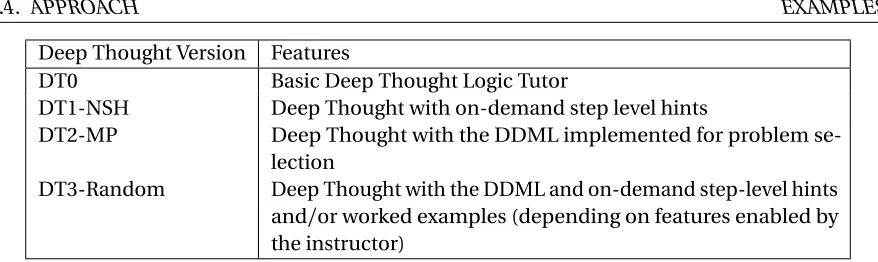
Table 4.1 Overview of Deep Thought versions 0-2 . . . 29 Table 4.2 An example of lower and higher proficiency set problems from DT2-MP
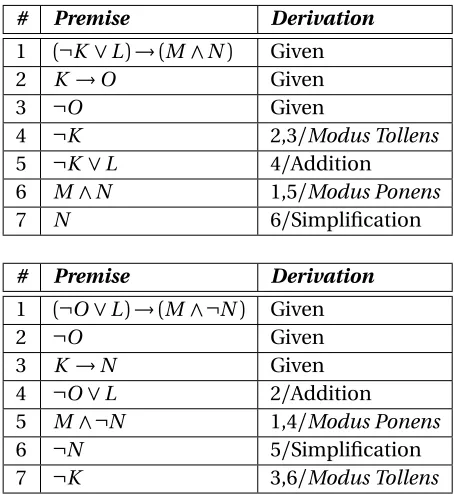
re-quiring the same target-rules: Level 4 Problem 3 from the lower proficiency set (top); Level 4 Problem 2 from the higher proficiency set (bottom). The pri-oritized rules required for these problems are Conjunction and Constructive Dilemma. . . 30 Table 4.3 An example of regular and alternate problems from a lower proficiency set in
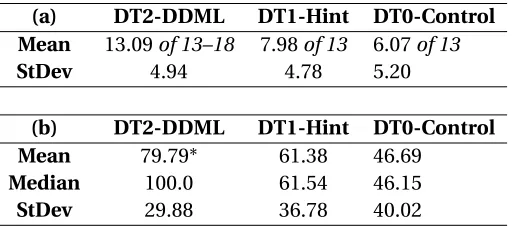
DT2-MP: Level 2 Problem 2 (top); Level 2 Problem 2-Alt (bottom). . . 33 Table 4.4 List of rules required for completion of DT2-MP. . . 35 Table 4.5 (a) Number of total assigned problems solved in tutor. (b) Percentage of tutor
completion. * indicates significance over the control. . . 40 Table 4.6 Student completion of the tutor by group. Dropped indicates that the student
did not complete Deep Thought. . . 42 Table 4.7 Percentage of rule-application errors to total interactions in tutor. * indicates
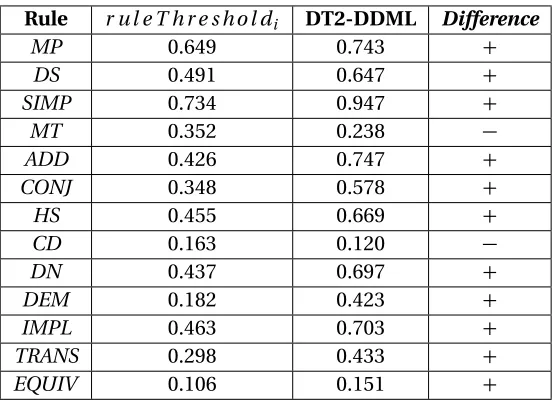
significance over the other groups. . . 43 Table 4.8 Average rule DDKT scores for DT2-DDML group students who completed the
entire tutor (n=26), compared to end-of-tutorr u l e T h r e s h o l di averages
from DT0 (n=302). . . 44
Table 5.1 Overview of Deep Thought versions 0-3 . . . 49 Table 5.2 A generated on-demand hint sequence for the proof-state in Figure 3.2 . . . 50 Table 5.3 The number of problems solved, number of worked examples received, and
total tutor time for the WE and NoWE groups. . . 54 Table 5.4 (a) Percentage of the tutor completed by group. (b) The number and percent of
students who completed and dropped the tutor by group. Dropped indicates that the student did not complete Deep Thought. A * indicates significance. . . 55 Table 5.5 Percent tutor completion, percent students dropped, and time in tutor for the
NoWE group, as well as mean, median, and standard deviation values for the 10,000 random samples of sizen=47 from the WE group. The means, medians, and standard deviations for p-value results from the 10,000 individual ANOVA tests for each sample are also presented. . . 56 Table 5.6 Levels 3 and 4 post-test problem mean seconds per step, by tracks and ordering
of practice problems within each level. . . 57
Table 6.1 Overview of Deep Thought versions 0-5 . . . 61 Table 6.2 Path prediction accuracy of the original DDML system, (DT2-MP) the DDPP
ment (MEP), for Philosophy students . . . 67
Table 6.4 Path prediction accuracy of the original DDML system (DT2-MP), the DDPP system (CEP), average score assessment (AEP), and minimum score assess-ment (MEP), for Computer Science students . . . 68
Table 6.5 Path prediction accuracy of the DDPP and DDML in the new study, and the accuracy of the DDPP and DDML in the exploratory study (E) at the end of each level. . . 69
Table 6.6 Path placement percentage of the DT5-DDPP and DT5-Random students at the end of each level. . . 69
Table 6.7 The number of types identified per level from historical data (DDML), the number of types matched with students using the DDPP system, and the percentage of students who were matched an existing type in the DDPP system. 70 Table 7.1 Overview of Deep Thought versions 0-6 . . . 75
Table 7.2 Percentage of AB Students and dropped students in PS, PS/WE, and DDPP groups. . . 78
Table 7.3 Total Time, Average Problem Time, Percentage of Correct Rule Applications, and Total Rule Applications for AB and CDF students in the PS, PS/WE, and DDPP groups, separated by High and Low Track. The numbers listed are all median values. . . 79
Table 7.4 Number of Hints, number of Skips, and number of Rule Reference requests for AB and CDF students in the PS, PS/WE, and DDPP groups, separated by High and Low Track. The numbers listed are all median values. . . 80
Table A.1 Logical Implication (Inference) Rules . . . 93
Table A.2 Logical Equivalence (Replacement) Rules . . . 94
Table A.3 Logical Binary Operation Rules . . . 94
Figure 3.1 A screen capture of the Deep Thought tutor, showing given premises at the top, conclusion at the bottom, and rules for application on the right. The inset window is an example of a rule-axiom reference that appears when a student hovers a mouse pointer over a rule button. . . 15 Figure 3.2 A screen capture of the Deep Thought tutor redesign, mirroring the
proof-state in Figure 3.1. . . 20
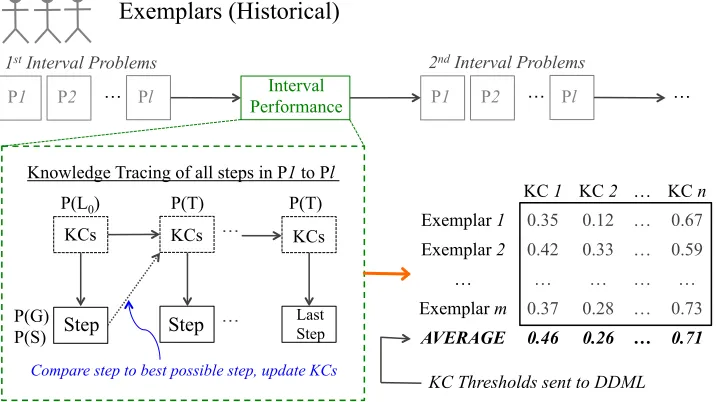
Figure 4.1 The data-driven threshold builder. Knowledge components (KCs) for each exemplar are updated using action steps from an interval set of tutor problems. The KC score averages at each interval are used as thresholds in the DDML system. . . 27 Figure 4.2 The Data-Driven Mastery Learning system. At each level interval, new student
KC scores are calculated and then compared to exemplar thresholds for cor-responding problem sets (see Figure 4.1). The+/−threshold sign difference is weighted by KC priority and summed (see Section 4.4.3). The sign of the result determines whether students are assigned problem sets of high or low proficiency in the next level. . . 28 Figure 4.3 DT2-MP path progression. At each level, students are evaluated and provided
either the higher or lower proficiency problem sets. Students can also be switched from the higher to lower proficiency set within a level. . . 32 Figure 4.4 An example of lower and higher proficiency set problems from DT2-MP, Level
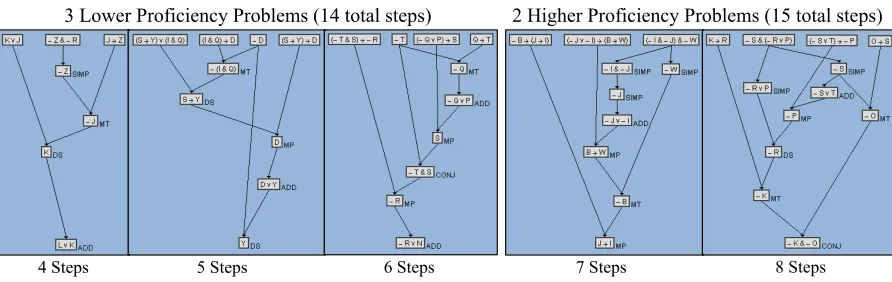
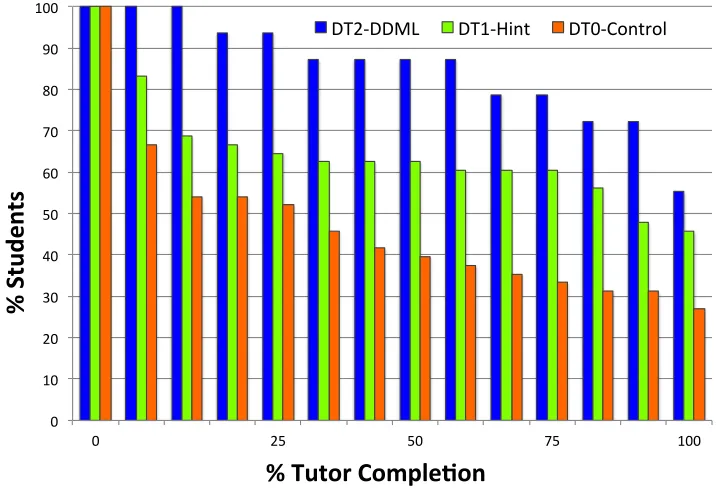
3. Lower proficiency proofs contain fewer rule application steps so students do one more problem to have more target-rule opportunities. The target-rules for this level are Modus Tollens, Addition, Conjunction (high priority) and Modus Ponens, Disjunctive Syllogism, Simplification (low priority). . . 32 Figure 4.5 Rate of student dropout for the DT2-DDML, DT1-Hint, and DT0-Control
groups over the course of the tutor. . . 41
Figure 5.1 A worked example from DT3-Random, for the same problem in Figure 3.2. A problem step-state is displayed on the screen, with an annotation in the box below describing the next step. Students can move between worked example steps using the arrow buttons next to the annotation. . . 51 Figure 5.2 Rate of student dropout for the WE and NoWE groups over the assignment. . 55
Figure 6.1 The Data-Driven Proficiency Profiler. (Left) At each level interval, exemplar KC scores are clustered, and exemplars are assigned a cluster for each KC Score. (Center) KCs that make up 25% of importance in the current level are used to assign exemplars to types. (Right) New student scores are assigned to clusters, and compared to existing types to determine next level path. . . 63 Figure 6.2 The percentage of students at the end of each level of the tutor. . . 70 Figure 6.3 The median percentage of correct rule application in each level of the tutor.
Figure A.3 The Deep Thought main problem window (English representation). . . 97
Figure A.4 The Deep Thought instructions pop-up. . . 98
Figure A.5 The Deep Thought window information pop-up. . . 98
Figure A.6 The Deep Thought contact information pop-up. . . 99
Figure A.7 The Deep Thought main problem window (indirect proof mode). . . 99
Figure A.8 The Deep Thought text entry window for rule application. . . 100
Figure A.9 A Deep Thought rule reference pop-up (for Simplification). . . 100
Figure A.10 The first Hint Factory hint for the current screen state. . . 101
Figure A.11 The second Hint Factory hint for the current screen state. . . 101
Figure A.12 The third Hint Factory hint for the current screen state. . . 102
Figure A.13 The fourth and final (bottom out) Hint Factory hint for the current screen state.102 Figure A.14 The worked example (in process) for problem 1.0.1.0. . . 103
1
INTRODUCTION
1.1
Research Question
Can data-driven methods be used to create an intelligent tutoring system that:
1. improves tutor performance by selecting appropriate problems and feedback,
2. reduces student dropout and time needed to complete the tutor.
Individualized student instruction is one of the most effective educational strategies, and stu-dents who receive individualized instruction often perform significantly better on performance
evaluations than students who receive classroom instruction[Ma14; Van11a; SHC14]. However, the
lack of human instructors and tutors in proportion to the learning populace make individual human interaction infeasible in a large scale setting. Computer learning environments that mimic aspects
of human tutors have also been highly successful. Intelligent tutoring systems (ITS) have been
shown to be highly effective in improving performance when used in combination with classroom instruction through scaffolding of domain concepts and contextualized, individual feedback[Van05].
Additionally, the development of ITSs has enabled schools and universities to reach out and educate
However, the development costs of individualized computer-human instruction are high, aver-aging 100–300 hours of domain-expert time to construct one hour of course material[Mur99]. Much
of ITS development time is spent building models of student knowledge and behavior. While some
model-building techniques and their derivations (such as the use of Bayesian Knowledge Tracing [CA95]), and the use of authoring tools to construct intelligent tutors (such as the Cognitive Tutor Authoring Tools[Koe04]) can reduce the construction time to around 20–30 hours of development
for one hour of instruction, time cost is still high. ITSs still require significant expert involvement to determine pedagogical policy; what to teach, and how to effectively teach it to the student.
Additionally, it is important for intelligent tutoring systems to present problems to students
that are appropriate to the student’s current level of proficiency in the subject matter. Students are more likely to perform better in-tutor when given problems in their zone of proximal development
through scaffolding of major concepts[MA02; Van06]. Proper scaffolding increases performance, and
therefore increases the likelihood of further progression through the tutor and exposure to higher-level concepts. However, in open-ended problem solving domains such as deductive logic and
programming, there is no defined breakdown of knowledge components, and traditional knowledge
tracing models are therefore difficult to apply without developing an entire cognitive model and increasing the amount of development time and expert involvement required.
1.2
Objective
1. To show how data-driven methods can be used to develop an adaptive tutoring system in an
open-ended problem solving domain with minimal expert involvement
2. To show the effectiveness of data-driven methods in an individualized, adaptive tutoring
system to improve tutor performance in an open-ended problem-solving domain.
Data-driven methods have been used to great effect to increase student performance, particularly
through contextualized formative feedback (hint generation) and appropriate task selection[BS08;
Koe13]. These methods leverage student data to directly inform tutor instructional decisions. This circumvents the need to model student knowledge, and allows data-driven tutors to adapt to
focusing on supporting students engaged in incorrect, but frequently observed, student behaviors.
Our data-driven approaches can be particularly effective in open-ended problem solving domains, such as deductive logic and programming. In these cases, creating an expert system to diagnose
student behavior and prescribe adaptive feedback would require a great deal of effort, and we have
What is proposed here is a set of experiments to test the effectiveness of data-driven methods on reducing student dropout in a tutor and selecting appropriate problems for increased
problem-solving performance. The tutor used in these experiments is a deductive logic proof building tool
called Deep Thought. Previous experiments with Deep Thought showed that using data-driven hint generation reduced problem solving time and increased student retention in the tutor (see Chapter
3). In our initial experiments with data-driven mastery learning, we have shown that we can achieve
even higher student performance and retention rates while reducing the average time in the tutor. The ultimate goal of this research is to create a fully data-driven intelligent tutor.
1.3
Hypotheses
H1
The data-driven, adaptive and individualized instructional methods presented for mastery learning,
assessment, feedback generation, worked example selection, and problem selection will improve student performance, as measured by performance on rule scores, in an open-ended
problem-solving domain.
H2
The data-driven methods presented will reduce student dropout in the Deep Thought tutor.
H3
The data-driven methods presented will reduce the time spent to complete the Deep Thought tutor.
1.4
Contributions
This dissertation presents the following research contributions:
1. An implemented and tested data-driven mastery learning system (DDML), that incorporates Bayesian knowledge tracing into a problem-solving environment that does not have a skill
inventory. This research has shown that the DDML is effective in improving tutor completion
and reducing student dropout.
DDPP, unlike DDML, automatically sets thresholds for rule application based on clusters of prior successful students.
3. Results from three studies to determine the impact of different instructional methods
(specifi-cally worked examples and/or on-demand hints) on student performance.
4. A fully data-driven intelligent tutoring system for logic that incorporates problem selection,
worked examples, on-demand hints, and the automatic setting of thresholds for mastery.
The impact of this work on student problem-solving performance is broad, since logic is taught to
all students in computer science and computer engineering at NC State and in many other programs.
Deductive logic is an important fundamental topic in computer science education. Meyers[MJ90] outlined this necessity very clearly. He noted that almost every aspect of computer science required
logic as a foundational basis in order to understand it. In 2003 a study conducted by Page[Pag03]
confirmed the necessity of discrete math, including deductive logic, to computer science education. While all the research in this dissertation is based on logic proofs, the methods we have derived are
domain agnostic, and should be applicable in other open-ended problem-solving STEM domains.
I believe that our data-driven methods can be used to augment computer-assisted instruction with intelligence to adapt to individual students, potentially expanding the availability of effective
individualized instruction to a larger audience. Where data driven methods do not offer significant
2
RELATED WORK
2.1
Tutoring Systems
Most intelligent tutors are structured as two loops; an outer loop that operates at the problem-level, such as selecting the problem or task the student should work on next, and an inner loop that
governs step-level decisions during problem solving, such as the type and amount of guidance (i.e. the kind of hints and feedback) to give the student[Van06]. An effective tutor should adapt its
instruction to student needs based upon their current knowledge level[And95]; however, in order
to make instructional decisions, most existing ITSs either use fixed pedagogical policies providing little adaptability, or expert-authored pedagogical rules based on existing instructional practices [And95; Van06]. Data-driven approaches to making these decisions, in particular selecting problems, when to apply worked examples, and the type of hint or feedback to provide would reduce the cost involved in creating and improving the effectiveness of ITSs.
2.1.1 Meta-analyses of Intelligent Tutoring Systems
Several meta-analyses of current intelligent tutoring systems have been conducted, comparing them
in relation to based tutoring; conclusions range from slightly less effective than human-based tutoring[SHC14]to as effective as human-based tutoring[Van11a; Ma14].
VanLehn[Van11a]conducted a meta analysis of a set of intelligent tutoring systems (based on
step and sub-step granularity) and non-intelligent computer-based tutoring systems, and compared them to the effects of human tutoring. He found that step-based intelligent tutoring was currently
effective at approximating the effects of human tutoring. Meanwhile Ma et al.[Ma14]conducted a
meta analysis of 107 studies that compared the learning outcomes from intelligent tutoring systems, human-based tutoring, and other classroom-based instructional methods. Similarly, these authors
also found intelligent tutoring systems were overall more effective than other instructional modes,
aside from human tutoring (although they also found intelligent tutoring systems approximated human-based tutoring).
In 2014, Steenbergen-Hu and Cooper[SHC14]conducted a meta-analysis on the effect of 22
intelligent tutoring systems on the learning gains of college students in 39 studies. Unlike previous work, they found that using ITSs in an academic environment resulted in smaller gains than human
tutoring, while still resulting in higher learning gains than classroom based methods. The authors
additionally note the following conclusions for future ITS development: development of ITSs must focus on ill-defined domains, and there is at least an observed but non-robust observation in the
meta-analysis that teacher involvement in the development of ITSs may affect the learning gains. Deep Thought best approaches the concerns listed in the conclusions in Steenbergen-Hu and
Cooper’s work[SHC14]. Deep Thought focuses on an ill-defined domain (logic-proof construction)
and, as a data-driven intelligent tutor, seeks to mitigate the need for teacher involvement to increase its effectiveness by using data-driven methods. Steenbergen-Hu and Cooper[SHC14]also note that
there is a marked increase in effectiveness when ITSs are used in a college setting in comparison to
other instructional methods, which implies that the positive gains made in Deep Thought should be more pronounced than otherwise.
2.1.2 Logic Tutors
Several computer systems have been built for instruction in solving logic proofs. However, many of
these tools simply teach logic without any sort of adaptability. LogEx[Lod], for example, is a learning environment for propositional logic that logs student data, but does not currently use that data to
enhance the tutor. Sequent Calculus Trainer[Ehl], on the other hand, incorporates feedback only in the form of information presented on how to use each logic rule or an error if a rule is applied
incorrectly, features that were present in the earliest version of Deep Thought.
improve its effectiveness. Logic is of particular interest because it is an open-ended problem solving domain that computer science students must learn[MJ90; Pag03]. To that end, there are several logic
tutors that incorporate data-driven methods, mainly to improve feedback. Logic-ITA[MY05]provides
students with performance feedback upon proof completion, but not much feedback beyond that. The authors performed association rule mining, clustering, and classification on the data gathered
to determine indicators for students completing the tutor successfully, such as how many problems
the student was able to successfully solve, number of mistakes made (as well as what kind of mistakes), number of rules used, and number of steps taken. They later implemented proactive
hints based on previous student behavior that the instructor could apply or alter. CPT[Sie07]uses
an automated proof generator to provide contextual hints. The proof generator specifically uses interaction calculus to automatically find a completed proof based on a set of premises. This search
algorithm is used to generate hints for students based on the best possible path to completion
from the current set of premises in that step of the problem. PLT[Luk02]uses a combination of dynamically generated hints and more general examples for rule applications and axiom generation
based on previous student data. However, the authors determined that based on student responses,
the tutor setup and design prevented students from gaining as much as they could have from a more effectively designed and user-friendly system. More recently, Gluz et al. implemented a dynamic
and adaptive natural deduction proof tutor called Heraclito based on a dynamic student model that can automatically solve problems using strategies employed by instructors[Glu14]. The authors
argue that the Heraclito system is fully adaptive, conforming to the way students reason and solve
logic proofs.
The Deep Thought logic tutor detailed in Chapter 3 has been augmented for adaptive learning
via hints and intelligent problem selection using data-driven methods. Unlike the previously listed
tutors, which incorporate specific feedback generation methods, Deep Thought has been developed to flexibly provide students with a combination of hints and worked examples. Additionally, while
the previous logic tutors use data-based or data-driven methods to improve feedback to students,
they do not make any changes to the difficulty or type of problem presented to the students. Deep Thought uses a data-driven system to select the best next set of problems for students to solve.
2.1.3 Knowledge Tracing
On-going work in reducing tutor development time and improving problem-level decision making has focused on developing and using models based on previous and current student behavior to
predict learning outcomes and leverage those predictions to select an appropriate subsequent
Cognitive tutors use knowledge tracing (KT) to track students’ mastery of particular Knowledge Components (KCs) based on their performance at each opportunity to apply that KC. A knowledge
component is a structure or process that a learner uses, alone or in combination with other
knowl-edge components, to accomplish steps in a task or problem[Van06]. Knowledge components in a tutoring system can range from domain concepts or operators, such as addition or multiplication in
algebra, to elements of student behavior, such as the use of in-tutor references and time on-task.
The classic model used by Corbett and Anderson uses Bayesian Knowledge Tracing (BKT) to predict the probability of learned components based on learning, guess, and slip parameters[CA95].
Gong et al.[Gon10]compared several fitting methods for the BKT model, namely the
expectation-maximization model (parameters are calculated based on maximizing the likelihood of student data) and the "brute force" method (ideal parameters are searched for within a given range). KT
models with these fitting methods applied were then compared to performance factor analysis and
found to be comparable in terms of accuracy and model complexity.
Once a KT model is created, it can be used to select problems which best suit the student and
what he or she still needs to learn. BKT has been shown to be generally effective for predicting
success on subsequent problems (meaning it can be used for problem selection), although it is more effective in domains with fewer and more well defined knowledge components, such as algebra [Xu12]. There have been attempts to improve and expand on the BKT model, such as incorporating item and problem difficulty by Pardos and Heffernan[PH11]. Pardos et al. used multiple models in
ensemble-based classification algorithms to improve student knowledge prediction. Their results
showed significant improvement in learning model prediction accuracy[Par11].
However, BKT is not perfect. It gets time and computationally expensive when there are more
fea-tures (KCs) to analyze, and its reliance on calculating conditional probabilities is a weakness[Hua14].
In addition, in tutoring systems with an intelligent problem selection component, problem selection thrashing can occur. Thrashing is a cycle that can occur in problem selection, where students will
be given a string of problems that focus on concepts they have already mastered until they reach a
problem with multiple concepts, including concepts they have not yet mastered, inevitably get the incorrect answer, and then are given a similar string of easy but unhelpful problems. Koedinger et al.
argued that thrashing was caused by incorrect blame assignment in knowledge tracing systems;
when a student attempts a problem with multiple knowledge components and gets an incorrect answer, knowledge tracing works on the assumption that each knowledge component must have
been applied or executed equally incorrectly[Koe11]. This can result in greater problems in domains
particular, the authors focus on the challenge of determining the knowledge components acquired in any given domain[AK13].
The data-driven mastery learning (DDML) system presented in Chapter 4 was designed to
avoid problem selection trashing, in that we sought to intelligently select appropriate problem sets by determining which knowledge components each student needed to focus on and use that
determination to select appropriate problems. The DDML system uses historical student data
to provide thresholds for target-rule KT score comparison to current students, and weights the importance of those rules strictly based on expert-decided priority for the level. In other words, a
behavioral analysis is performed on the performance of successful students, broken down by their
application of available rules in the system, and the intended rules the problems were designed to use. The performance of these successful students provides a benchmark for new students in the
tutor. Snow et al. showed that students who were more controlled in their behavior exhibited much
higher strategy performance than their less controlled counterparts[Sno14]. The DDML system accomplishes this through strict ordering of selected problems. In the DDPP system presented in
Chapter 6, the problem selection bypasses the need for expert-decided KC priorities by clustering
the actions taken by students who had previously completed the tutor to determine problem solving strategies and determining the most important rules for each strategy.
2.1.4 Hints and Hint Generation
Providing hints to students in the course of an intelligent tutor as a possible form of step-based feedback has the potential to increase learning gains. Razzaq, Leena, and Heffernan[RH10]compare
the effects of proactively providing hints to students and allowing them to seek hints themselves.
They found that learning gains increased for students given on-demand hints in comparison to students who were provided hints proactively. Additionally Mitrovic et al.[Mit13]implemented a
system to provide positive feedback in a SQL language tutor and compared it to the previous system
they had, SQL-Tutor, which only provided feedback when a student committed an error. The authors in this case similarly found an improvement when incorporating positive feedback: students were
able to learn new constraints much faster when compared to the control group, which only received
negative feedback.
This research contains studies that compare performance results from problems presented both
with and without on-demand hints. In Deep Thought, the hint system used is called Hint Factory. Hint Factory is an automatic data-driven hint generator that converts an interaction network of
student trace behavior into a Markov decision process (MDP) to automatically select on-demand
MDP is data-driven, using actions logs from previous Deep Thought use in the classroom to assign weight to proof-state actions based on whether or not that action ultimately led to successful
completion of the proof. In this way Hint Factory provides contextualized hints. These hints help
students solve problems by suggesting what step should be taken next on a multi-step problem. Hint Factory has been implemented in the Deep Thought logic tutor to automatically deliver
context-specific hints to students during problem-solving[BS08]. While help-seeking behaviors can be
unproductive[Ale04], hint use is not limited in Deep Thought, particularly since bottoming out hints can be seen as searching for a worked example, an effective learning strategy[Shi08].
In a previous study Hint Factory was shown to provide context-specific hints over 80% of the time [Bar08]. In a pilot study, Barnes & Stamper found that Hint Factory can provide sufficient, correct, and appropriate hints for the Deep Thought Logic tutor and help students to solve more logic proof
problems in the same span of time[BS08]. The Hint Factory can evolve over time, providing some
automatically generated hints initially and improving as additional expert and student problem attempts are added to the model.
2.1.5 Worked Examples
Numerous studies have shown the benefits of combining worked examples with problem solving as compared to problem solving alone[Atk00; SC85]. However since there is little empirical evidence
to show how worked examples and problem solving should be combined, most existing tutoring
systems exclusively choose problem solving[And95; Van05]. Najar and Mitrovic[NM12]presented a more modern review of previous research in using worked examples in intelligent tutoring systems.
Their conclusion was that the research was still inconclusive, and raised several questions on when
to give examples, when to scaffold, and how to design examples. However Hilbert and Renkl[HR09] found that improved learning outcomes occurred when providing worked examples with a prompt,
and proposed that this was due to allowing the students to have a greater cognitive load at once.
Sweller and Cooper[SC85]came to similar conclusions when they found that students who were given a combination of unguided problem solving and worked examples learned faster and
demon-strated better performance. However, students who were given worked examples received more
information than students solving problems without aid, which could explain the improvement. There has also been research in comparing worked examples with existing intelligent
tutor-ing systems. McLaren, Kim, and Koedtutor-inger[McL08]found that replacing selected problems with worked examples does not increase learning gains over tutoring alone. However students had higher
learning efficiency and achieved learning gains much more quickly. Similar results were found in
exam-ples, all traditional unguided problem solving, and a mix of worked examples and problem solving. Each group achieved similar learning gains, but the students who were given all worked examples
required less time to achieve those gains. McLaren et al. later conducted a similar study comparing
the results from giving students worked examples, erroneous examples, tutored problem solving via an ITS, and traditional unguided problem solving[McL14]. Again, students who were given worked
examples had higher learning efficiency.
Based on the current literature, worked examples have the potential to improve learning gains and increase how quickly students achieve these gains when combined with an intelligent tutor.
The studies planned for Fall 2014 and Spring 2015 (see Chapters 5 and 6) are being used to further
explore the effects of worked examples, and use the results to inform pedagogical policy regarding intervention with worked examples. In using Deep Thought with Hint Factory, we have a unique
opportunity to explore the use of bottom-out hints as worked examples, since the method that Hint
Factory presents requested hints will lead to a worked example for that problem step.
2.2
Data-Driven Methods
The use of data-driven methods to develop intelligent tutoring systems is just starting to be explored in the field. Koedinger et al.[Koe13]gave a very detailed overview on developing data-driven
intel-ligent tutoring systems, in particular techniques for incorporating data in a useful way. They first
summarized the general process of intelligent tutoring systems; the system selects an activity for the student, evaluates each student action, suggest a course of action (either via hints, worked examples,
or another form of feedback), and finally updates its own internal evaluation of the student’s skills
(depending on how this information is represented and updated, e.g. Knowledge Tracing). This is similar to the outer and inner loop of most intelligent tutoring systems described by VanLehn [Van06], with the addition of an evaluation and reevaluation of student skills. With this process and the functions required in mind, the authors then present several machine learning approaches for using data to develop intelligent tutoring systems (particularly SimStudent and Hint Factory).
The authors concluded by discussing various data-driven ways to improve the effectiveness of
intelligent tutoring systems. They discussed optimizing the cognitive model using learning factors analysis; fitting statistical models to individual students; developing a model of student mood and
engagement by modeling off-task behaviors, careless errors, and mood; and improving how the tutor selects actions for the student via Markov Decision Processes (MDP) or Partially Observable
Markov Decision Processes (POMDP). In a later work Koedinger et al.[Koe14]compared and
coursework, in particular cognitive task analysis.
An early example of a data-driven intelligent tutor is the Cognitive Algebra Tutor, first introduced
by Ritter and Steven[Rit07]. Here the authors introduce an algebra tutor which is fully driven by
historical data, interpreted based on a cognitive theory. Student behavior is modeled based on the cognitive theory ACT-R and student data was gathered from several previous studies. This was
several years and studies into development at this time, and the result is an example of a fully
data-driven tutor that improved student performance. The authors noted that although it over-predicted student performance, it would be improved the more data was collected.
There have also been several recent studies that demonstrate the potential for data driven
meth-ods to result in more effective tutors that accurately predict student behavior. Lee and Brunskill [LB12]examined the benefits and drawbacks to basing model parameters on existing data from in-dividual students in comparison to data from an entire population, specifically as it pertained to the
number of practice opportunities a student would require (estimated) to master a skill. The authors estimated that using individualized parameters would reduce the number of practice opportunities
a student would need to master a skill. González-Brenes and Mostow[GBM13]demonstrated a
data-driven model which automatically generates a cognitive and learning model based on previous student data in order to discover what skills students learn at any given time and when they use
skills they have learned. They used a topical Hidden Markov Model to create a cognitive model and a student model for a set of students using an algebra tutor. The resulting model predicted student
behavior without the aid of previous domain knowledge and performed comparably to a published
model.
Data-driven intelligent tutors not only have the potential to more accurately predict student
be-havior, but interpret why it occurs. For instance, Elmadani, Mathews, and Mitrovic[Elm12]proposed
using data-driven techniques to detect student errors that occur due to genuine misunderstanding of the concepts (misconception detection). They processed their data using FP-Growth in order
to build a set of frequent itemsets which represented the possible misconceptions students could
make. The authors were able to detect several misconceptions based on the resulting itemsets of student actions. Fancsali[Fan14]used data-driven methods to detect behaviors that usually detract
from a student’s experience with an ITS (off-task behavior, gaming the system, etc).
Overall the literature shows that incorporating data-driven methods has a great deal of potential to accurately adapt to and predict student behavior, and increase learning gains. However the focus
has been on using data to develop or determine a cognitive model, and predict student behavior
3
THE DEEP THOUGHT LOGIC TUTOR
The Deep Thought logic tutor is central to the work presented in this thesis, forming both part of the motivation, and a framework for implementation and testing. This chapter presents a description
of problem space and the time-line and significance of Deep Thought’s development towards a fully
data-driven intelligent tutor.
3.1
Problem Space
The problem space for the construction of logic proofs in Deep Thought is open-ended, without any limitations on the length or quality of a proof’s solution. There are 59 possible proof problems within
the 7 different versions of the tutor, with each problem giving between 2 and 4 logical expressions
as premises, in order to reach a single logical expression as a conclusion. While no individual problem in Deep Thoughtrequiresmore than 10 steps (applications of logical axioms on one or two expressions in the problem space) in order to reach the problem’s conclusion, the actual length of
problem solutions by students in practice ranges from the minimum length of a problem’s solution to over two dozen steps in practice, not counting expressions deleted by the user mid-proof. When
considering that students can delete steps and continue forward within a given proof, the number
This is possible because of the mechanisms provided to the students to solve proofs. Students are given 19 different rules (axioms) that can be applied to logic expressions in Deep Thought, with
8 of these rules being logical implication (inference) rules, 5 of these rules being logical equivalence
(replacement) rules, and 6 of these rules being logical binary operation rules. Logical implication rules (Modus Ponens, Disjunctive Syllogism, Simplification, Hypothetical Syllogism,Modus Tol-lens, Addition, Conjunction, Constructive Dilemma) are one-way operations, where a new logical expression can be extracted or constructed from a given premise, without an equivalent method of returning to the original expression. Logical equivalence rules (Double Negation, Implication,
Equivalence, DeMorgan’s, Contrapositive) and logical binary operation rules (Commutative,
As-sociative, Distributive, Absorption, Exportation, Tautology) are two-way operations, where a new logical expression resulting from a transformation of a given premise can be transformed back to its
original premise using an equivalent operation (The descriptions of these rules are presented in
Appendix A). In addition, students have the ability to delete leaf expressions in the course of solving proofs, including expressions resulting from logical implication operations.
This results in anopen-endedproblem space for any given proof, giving students a theoretically limitless number of possible steps to reach the proof’s conclusion, despite the bounds given by the proof problem’s premises (the number of premises, the premises’ logical variables, and the
complexity of the premises’ expressions). In practice, however, and excluding extreme outliers, the variation in student solutions is a limited state space[EB14a; Eag14], but these state spaces for Deep
Thought’s logic proof problem are procedurally unpredictable for any given set of students. It is
for these reasons that data-driven methods are inherently better for generating hint and feedback systems for domains such as deductive logic, where a mass of prior student solutions for a proof are
used to determine the best next-steps for a new student entering the system. This forms the basis of
the incremental changes made to Deep Thought.
3.2
Deep Thought Versions
3.2.1 Deep Thought 0 (DT0) Inception
Dr. Marvin Croy, a Philosophy professor teaching undergraduate deductive logic at the University of
North Carolina at Charlotte, developed Deep Thought version 0 (also referred to as DT0) into a Java
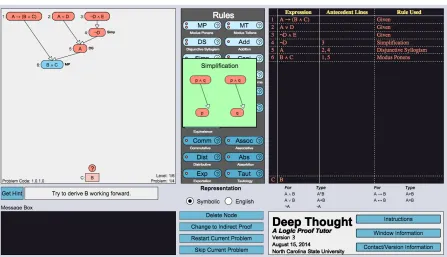
Figure 3.1A screen capture of the Deep Thought tutor, showing given premises at the top, conclusion at the bottom, and rules for application on the right. The inset window is an example of a rule-axiom reference that appears when a student hovers a mouse pointer over a rule button.
tion, and designed the entire set of problems in Deep Thought to allow students to demonstrate
satisfactory knowledge of proof problem solving at an introductory undergraduate level.
User Interaction
Figure 3.1 shows the interface for Deep Thought, where students construct logic proofs by connecting
displayed logical premises (seen at the top of the figure window) using buttons for logical rules (seen at the right of the figure) to derive a conclusion (seen at the bottom of the figure window).
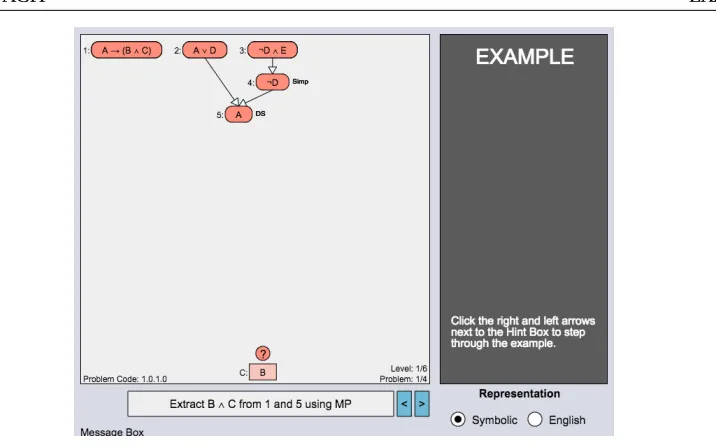
For example, students solving the proof in Figure 3.1 use premisesA→(B∧C);A∨D; and¬D∧E to derive conclusionB. An example solution to this proof is shown in Table 3.1. Each of the logic rule buttons has a rule-reference in graphical representation that could be seen by hovering the
mouse pointer over the selected rule button for two seconds (see inset window in Figure 3.1). As a
student worked through a problem, each step was logged in a data file that recorded the current problem, the rule being applied, any errors made (such as attempting to use a rule that was logically
impossible), completion of the problem, time taken per step, and elapsed time taken to solve the
problem.
Problem selection and window options in DT0 were accomplished through a drop-down window.
Students could select the representation of the logical operators in proof expressions (and; or; not;
(top down), by selecting one or two expression nodes and applying a rule to derive a new expression, or by working backwards (bottom up) by selecting the "?" button above a conclusion block to create
rule-axiom-structured parent blocks, that then must have their unknown variables instantiated [Cro00].
Table 3.1A solution to the proof shown in Figure 3.1.
# Premise Derivation
1 A→(B∧C) Given 2 A∨D Given 3 ¬D∧E Given
4 ¬D 3/Simplification
5 A 2,4/Disjunctive Syllogism 6 B∧C 1,5/Modus Ponens 7 B 6/Simplification
Problem Set
The proofs presented in Deep Thought were divided into three sets of problems. The first set
contained problems requiring basic logical implication rules (e.g.Modus Ponens, Simplification), the second set contained problems expanding the rule requirements to include more advanced
logical implication rules (e.g. Hypothetical Syllogism, Constructive Dilemma), and the third set
contained problems that required logical equivalence rules in addition to implication rules (e.g. DeMorgan’s, Contrapositive). In DT0 students were allowed to solve assigned problems at will, in
any order, though assignments were ordered. There were a total of thirteen available problems in
the tutor for the duration of the studies referenced in this thesis.
Problem-solving Feedback
Feedback in DT0 was limited to alerts upon mistakes made during rule application, either by
attempting an action incorrectly (such as applying a rule before first selecting expression blocks), or
Improvements to Deep Thought
Croy envisioned Deep Thought as a system that could identify at-risk students early in a course curriculum, and give individualized feedback to aid those students[Cro08]. This motivated the
following updates and changes to Deep Thought.
3.2.2 Deep Thought 1 (DT1-NSH) Inception
Barnes & Stamper extended Deep Thought with a data-driven hint-generation system called Hint
Factory to create Deep Thought 1 (also referred to as DT1-NSH, for Next-Step Hints) between
2006 and 2008[BS08]. Hint Factory used a Markov decision process (MDP) to automatically select on-demand hints for students upon request, based on their individual performance on specific
problems. The MDP was data-driven, using actions logs from previous Deep Thought use in the
classroom to assign weight to proof-state actions based on whether or not that action ultimately led to successful completion of the proof.
User Interaction
Aside from the addition of the "Hint" button to the Deep Thought interface, DT1-NSH user
interac-tion was identical to user interacinterac-tion in DT0. The Hint button was only usable if a hint file existed for the current problem. There were a total of eight (out of thirteen total) problems that had available
hints.
Problem Set
The problem set for DT1-NSH was identical to the problem set from DT0.
Problem-solving Feedback
In addition to the same rule-application errors as DT0, when hints were available for a given proof problem, clicking the "Hint" button with the mouse pointer would result in one of four possible
feedback responses for any individual proof-state, displayed on successive "Hint" button presses
for that same step. The student is given a broader hint when they first request one, and given more direct hints the more they ask. The responses for the proof-state in Figure 3.1 are shown below in
Table 3.2A generated on-demand hint sequence for the proof-state in Figure 3.1
Hint # Hint Text Hint Type
1 Try to derive "B" working forward Indicate goal expression 2 Highlight "B & C" to derive it Indicate premises to select 3 Click on the rule Simplification (SIMP) Indicate the rule to use
4 Highlight "B & C" and click on Simplification (SIMP)
to derive "B" Bottom-out hint
Findings
Barnes & Stamper showed that with past performance data, Hint Factory was able to provide a hint
when requested by a student 72% of the time on average using one semester of performance data, 79% when using two semesters, and 82% of the time when using three semesters of performance
data[Bar08]. Eagle, Barnes, and Stamper showed these hints were effective in reducing the time
taken to complete the tutor by 55%, and increasing retention in the tutor by 300%[EB14c; EB14b].
3.2.3 Deep Thought 2 (DT2-MP) Inception
In their research, Stamper et al. observed student dropout in DT0 and DT1-NSH were high[Sta11].
Despite improvements to the student dropout rate from DT0 to DT1-NSH with the addition of hints, there were still significant numbers of students that did not complete the tutor. To address this
issue, I have developed a novel data-driven mastery learning system (DDML) to improve learning in
open-ended problem solving domains such as deductive logic. The DDML system was integrated into DT0 in 2013 as Deep Thought 2 (also referred to as DT2-MP, for Manual Proficiency). It was
hypothesized that the DDML system developed for DT2-MP would result in higher percentage
completion and lower student dropout rates than DT0 and DT1-NSH.
User Interaction
The user interaction of DT2-MP was identical to DT0, except that instead of allowing students to
select a proof problem from a list in the "Options" menu, DT2-MP selected problems based on that
student’s measured proof-solving proficiency. Students were allowed to skip a tutor-selected problem using the drop-down menu; the problems populated in the drop-down menu were dependent on
Problem Set
DT2-MP divided the problem sets of DT0/DT1-NSH into more levels. Each of the three sets of problems in DT0/DT1-NSH was split into two sets in DT2-MP to allow assessment of student rule
application at regular intervals. DT2-MP Level 1 & 2 problems required basic logical implication rules,
Level 3 & 4 problems expanded the rule requirements to include more advanced logical implication rules, and Level 5 & 6 problems required logical equivalence rules in addition to implication rules.
Problem-solving Feedback
Since the DDML system was a hidden process, the feedback for DT2-MP was the same as the feedback
from DT0. No additional hints or problem-solving feedback were provided so that the DDML could accurately assess student proficiency without the proficiency being affected by additional feedback.
Findings
Results show that the DDML system increased mastery of target tutor-actions, improved tutor scores,
and lowered the rate of tutor dropout over DT0 or DT1-NSH. The design, implementation, and
results of using DT2-MP are detailed in Chapter 4.
3.2.4 Deep Thought 3 (DT3) Inception
Deep Thought was created when user-interface development capabilities were limited, and in 2011
Web-Applets were removed from Java web support. For both these reasons, I have re-designed Deep Thought and have led a ground-up re-build between 2013 and 2014. In addition to expanding
the Deep Thought window and removing menus to improve accessibility of options and relevant
information, the re-design includes the ability to develop and manage system features based on course and research requirements, and provides comprehensive step-level logs. Deep Thought 3
(also referred to as DT3) is designed to be a modular instructional and research tool, where features
or modules can be included or excluded for particular classroom or research settings.
User Interaction
DT3’s new features included a traditional text-based list of proof steps that reflected the proof state
in the the graphical window, the ability to work a problem indirectly by negating the conclusion and
Figure 3.2A screen capture of the Deep Thought tutor redesign, mirroring the proof-state in Figure 3.1.
hints while students work backwards, which was facilitated by a complete redesign of the data logs and hint functionality. DT3 was also fully usable with mobile-web devices.
Problem Set
DT3 used the same DDML problem set structure as DT2-MP. DT3 randomly presented some
prob-lems as worked examples based on course options. In these cases, the existing problem set was extended to ensure a balance between problem solving and worked examples.
Problem-solving Feedback
DT3 had an updated DDML system that allowed hints, and a hint policy that selected hint types
based on instructor parameters. The hypothesis after testing and evaluating DT2-MP was that the
Findings
In Fall 2014, DT3 was tested in two configurations: the first is the same no-hint system as DT2-MP (DT3-NoHint) with additional rule-highlighting hints; the second is a policy that chooses between
presenting a problem with no hints, presenting a problem with Hint Factory style next-step hints,
and presenting a worked example of the problem (DT3-Random). Results show that the addition of hint systems and random worked examples to the DDML increased mastery of target
tutor-actions, improved tutor scores, and lowered the rate of tutor dropout over DT2-MP. The design,
implementation, and results of using DT3 are detailed in Chapter 5.
3.2.5 Deep Thought 4 (DT4) Inception
DT4 served mainly as an extension of DT3 for additional data collection, as well as gathering data
on student behavior for new features to be studied in depth at a later time.
In an earlier study, Mostafavi & Barnes used DT1-NSH as a testbed for the automatic generation
of proof problems to determine if parameterized backwards construction of proof problems could
match conceptual and difficulty levels of expert-authored problems[MB11]. LQGen, a logic question generator that automatically generates logic problems based on a set of criteria (number of premises,
number of steps, re-used premises, logic rules, difficulty, and conclusion), was used to create a
set of logic proof problems to use in DT1-NSH. These generated problems were then tested in a philosophy deductive logic course in 2010-2011 at the University of North Carolina at Charlotte. 80
students in the Fall 2010 class solved the original expert authored problems in DT1-NSH, while 80
other students in the Spring 2011 class solved the automatically generated problems. The students who were given the automatically generated problems to solve performed as well as students who
solved the expert-authored problems; the number of attempts and percentage of failed attempts
were comparable between the students solving expert-authored problems and the students solving the automatically generated problems, while students given the automatically generated problems
took less time to solve the problems overall. While the automatic generation of proof problems was
not part of DT4, the exploration of data-driven pedagogical strategies in DT4 could inform problem parameter classification, therefore leading to data-driven automatic problem generation at a later
User Interaction
DT4 user interaction was the same as user interaction in DT3, with the addition of step-decision self-explanation added to certain steps when presented with worked examples.
Problem Set
The problem set for DT4 was identical to the problem set from DT3.
Problem-solving Feedback
In addition to the hint types from DT3, high-level (sub-goal) hints were available for use by the hint
policy.
Findings
In Spring 2015, DT4 was tested in four configurations: the first is the same system as DT3-NoHint
(DT4-NoHint); the second is the same policy that chooses between presenting a problem with no
hints, presenting a problem with next-step hints, and presenting a worked example of the problem (DT4-Random); the third is the same policy as DT4-Random with the addition of step-decision
self-explanation when presented with worked examples (DT4-SE); the fourth is the same policy as
DT4-Random with the use of high-level hints instead of next-step hints (DT4-HLH). The purpose of this study was two-fold; extending the study of worked examples from DT3, and gathering new
data about the behavior of students using high-level hints and self-explanation steps for a future
study. Our results show that students using Deep Thought with worked examples completed more of the assigned problems and were less likely to drop out. Additionally, the students given worked
examples were significantly more likely to finish the tutor. The results from the additional data
collected on worked examples are detailed in Chapter 5.
3.2.6 Deep Thought 5 (DT5) Inception
For the objective of realizing a fully data-driven system, Deep Thought 5 (also referred to as DT5)
was created by extending DT3 and DT4 to replace the expert authored proficiency calculation with a data-driven proficiency profiler (DDPP). This system classifies a student’s proficiency based on
comparisons to all actions taken by exemplars from DT2-MP and DT3-Random, and automatically
User Interaction
DT5 user interaction is the same as user interaction in all versions of Deep Thought since DT3.
Problem Set
The problem set for DT5 is identical to the problem set from DT3 and DT4.
Problem-solving Feedback
The hint types in DT5 are the same as in all versions of Deep Thought since DT3 (next-step hints,
high-level hints, and worked examples). A new feature is available that automatically gives a
next-step or high-level hint after a student works on a problem for longer than the median problem time demonstrated by previous students solving the same problem in Deep Thought.
Findings
In Fall 2015, DT5 was tested in seven configurations:
• Condition 1 (DT5-NSH) is the same system as DT3-NoHint with the addition of next-step hints, and serves as a control.
• Condition 2 (DT5-Random) is the same system as DT3-Random, and serves as a secondary
control.
• Condition 3 (DT5-RL-Base) is the same system as DT5-Random, but using a baseline
rein-forcement learning pedagogical policy to decide whether to provide a worked example or problem-solving opportunity based on data from DT3 and DT4. This condition will be used
for separate unrelated studies.
• Condition 4 (DT5-RL-LPSI) is the same system as DT5-RL-Base, but using a custom
reinforce-ment learning pedagogical policy instead of the baseline policy. This condition will be used for separate unrelated studies.
• Condition 5 (DT5-Random-NSH-tr) is the same system as DT5-Random, but automatically gives a next-step hint (triggered hint) after a student works on a problem for longer than the
median problem time demonstrated by previous students solving the same problem. This
• Condition 6 (DT5-Random-HLH-tr) is the same system as DT5-Random-NSH-tr, but with high-level hints presented instead of next-step hints. This condition will be used for separate
unrelated studies.
• Condition 7 (DT5-DDPP) is the same system as DT5-Random, but with the data-driven profi-ciency profiler (DDPP), which replaces the expert-decided rule priorities and thresholds in
the DDML between levels.
The DDPP was first tested on historical data collected from DT2-MP and DT3-NoHint. The
results were first compared to the original student proficiency calculation in DT3, as well as
stu-dent proficiency calculated based on average and minimum rule scores, showing that the DDPP could potentially predict student proficiency at the same level as the expert-authored DDML with
additional data. It was then implemented and tested in a classroom setting. In terms of the DDPP’s
performance, the results were not statistically significant between the DDPP group and the DDML groups. However, the trends in student dropout and rule application accuracy indicated that the
DDPP performed at least as well as the DDML in guiding students through Deep Thought. The
design, implementation, and results of testing and using the DDPP in DT5-DDPP are detailed in Chapter 6.
3.2.7 Deep Thought 6 (DT6) Inception
DT6 served mainly as an extension of DT5 for additional data collection, as well as gathering data on student behavior for new features to be studied in depth at a later time.
User Interaction
DT6 user interaction is the same as user interaction in all versions of Deep Thought since DT3.
Problem Set
The problem set for DT6 is identical to the problem set from DT5.
Problem-solving Feedback
The hint types in DT6 are the same as in all versions of Deep Thought since DT3 (next-step hints,
Findings
In Spring 2016, DT6 was tested in six configurations:
• Condition 1 (DT6-Random) is the same system as DT3-Random, and serves as a control.
• Condition 2 (DT6-DDPP) is the same system as DT5-DDPP.
• Condition 3 (DT6-RL-Immediate) is the same system as DT6-Random, but using an immediate reward reinforcement learning pedagogical policy to decide whether to provide a worked
example or problem-solving opportunity based on data from DT5. This condition will be used
for separate unrelated studies.
• Condition 4 (DT6-RL-Delay) is the same system as DT6-Random, but using a delayed reward reinforcement learning pedagogical policy to decide whether to provide a worked example or
problem-solving opportunity based on data from DT5. This condition will be used for separate
unrelated studies.
• Condition 5 (DT6-Random-NSH-tr) is the same system as DT5-Random-NSH-tr. This condi-tion will be used for separate unrelated studies.
• Condition 6 (DT6-Random-HLH-tr) is the same system as DT5-Random-HLH-tr. This
condi-tion will be used for separate unrelated studies.
4
STUDY ONE - DATA DRIVEN MASTERY
LEARNING
Towards Data-driven Mastery Learning
4.1
Research Question
Can the tutor completion and dropout rate from DT0 and DT1-NSH be improved using data-driven methods of assessment and problem selection?
4.2
Objective
To create and implement a procedure for the systematic assessment of student performance and assignment of problems that match the student’s preparation and provide practice on still-needed
skills.