ISSN(Online): 2320-9801
ISSN (Print): 2320-9798
I
nternational
J
ournal of
I
nnovative
R
esearch in
C
omputer
and
C
ommunication
E
ngineering
(An ISO 3297: 2007 Certified Organization) Vol. 3, Issue 4, April 2015
Energy Efficient Routing Protocols for Wireless
Sensor Networks
Nischita Waddenkery , S.Visalini
II year M.Tech Scholar (CNE), Dept of ISE, The Oxford College of Engineering, Bangalore, India Asst. Professor, Dept of ISE, The Oxford College of Engineering, Bangalore, India
ABSTRACT: The wireless sensor network is rapidly growing field as many sensor manufacturers are focusing on technological research and improvements in wireless sensing technology. Recent advances in wireless sensor network have led to many new protocols specifically designed for routing to reduce energy consumption, increase life time of sensor network, reduce overhead and so on. Routing protocols are different depending on applications. In this paper routing protocol that are different for symmetric and asymmetric links and discuss about synonyms of different routing protocols. Routing protocols are different depending on applications. There are two routing Protocols for asymmetric sensor network they are LayHet and EgyHet for providing energy efficient routing. LayHet is a layer-based routing protocol that finds the Shortest path and minimize the number of broadcasting. EgyHet is the energy-based routing protocol finds the highest energy among all nodes in network and routing take place. Provide the energy efficient routing and assured delivery rate.
KEYWORDS: wireless sensor Network, routing protocols, Asymmetric links, Symmetric links.
I. INTRODUCTION
Recent advances in wireless communication technologies have enabled the development of large-scale wireless sensor networks that consist of many low-power, low-cost, and small-size sensor nodes. Sensor networks hold the promise of facilitating large-scale and real-time data processing in complex environments. Some of the applications of wireless sensor networks are Target tracking, Intelligent homes, environment monitoring, disaster rescusing, self-touring systems, home health care and so on.
Awireless sensor network (WSN)is a wireless network which sensor nodes are distributed in environment which sense the physical or environmental condition and send to a base station ex temperature, light, pressure and so on.
Routing protocols are specifies how routers communicate with each other, spread the information that enables router to select routes between any two nodes in network. The routing protocols in wireless sensor network are designed in the Network layer of OSI model.
Symmetric Sensor Network is a sensor network which take same path for communications. Example of routing protocol for symmetric sensor networks are distance vector, link state etc.
Asymmetric Sensor Network (ASN) is a sensor network which take different path for communications. Examples of routing protocol for ASN are ProHet, LayHet, EgyHet and so on. Different routing protocols are discussed in next section. Asymmetric sensor network can be result of: Noise sources near a device affecting packet reception at that devices, Nodes powering down to conserve energy, Devices transmitting with different Powers explicitly causing unidirectional links, Environmental conditions affecting signal propagation.
ISSN(Online): 2320-9801
ISSN (Print): 2320-9798
I
nternational
J
ournal of
I
nnovative
R
esearch in
C
omputer
and
C
ommunication
E
ngineering
(An ISO 3297: 2007 Certified Organization) Vol. 3, Issue 4, April 2015
The rest of the Paper is organized as follows: section II references the Related works; Section III ; Section III Proposed; Section IV Conclusion; Section V References.
II. RELATED WORKS
Routing protocols are typically designed for symmetric and asymmetric sensor networks:
DSDV [1] Charles E. Perkins and Pravin B proposed DSDV this was designed for Symmetric Sensor Network. First it find the shortest path. Each node in the network maintains for each destination a preferred neighbor. Each data packet contains a destination node identifier in its header. When a node receives a data packet, it forwards the packet to the preferred neighbor for its destination. The forwarding process continues until the packet reaches its destination. The manner in which routing tables are constructed, maintained and updated differs from one routing method to another. The routing methods can be categorized into two primary classes: Link-state and Distance-Vector.
In Link-State Approach each node maintains a view of the network topology with a cost for each link. Less cost of the link is selected in the link-state. It can be done by broadcasting Flooding message to each node and receives cost from neighbor node and selects the shortest path to the destination. The disadvantage of this is short-lived loops because they disappear in the time. Link cost in a node view can be incorrect because of long-propagation delay.
Distance-Vector algorithm, in this approach every node selects the path to the destination by using shortest distance. Distance vector algorithm is a classical Distributed Bellman-Ford(DBF) algorithm. It is more efficient compared to link-state method. Link link-state cause a looping problem, DBF eliminates looping problem by forcing all nodes to participate in the network form of intermodal coordination protocol. Intermodal coordination mechanism might be effective when network topology changes. Disadvantage of Distance-vector algorithm is in mobile environment enforcing intermodal coordination mechanism will be difficult due to rapid change in topology.
In DSDV routing method allows a collection of mobile computers, which may not be close to any base station and can exchange data while changing paths of interconnection and afford all computers to exchange data with a number of path. This routing protocols overcome the limitations of distance-vector and link-state algorithm. Packets are exchanged between base station, each base station contains routing table. Each route table entry is tagged with sequence number which is originated by destination base station. To maintain the consistency of routing tables in a dynamically varying topology, each station periodically transmits updates immediately when significant new information is available. Advantage of DSDV routing protocol is, the routing information can be easily accessible from the base station and if the destination is same it reduce the rebroadcasting. If the destination is different then the sequence number is increased by one. Disadvantage is when link is broken or fails then the sequence number will be increased because path need to be re-route or changed.
ISSN(Online): 2320-9801
ISSN (Print): 2320-9798
I
nternational
J
ournal of
I
nnovative
R
esearch in
C
omputer
and
C
ommunication
E
ngineering
(An ISO 3297: 2007 Certified Organization) Vol. 3, Issue 4, April 2015
unidirectional links. Hello is another technique in which each Hello packet, a node includes all neighbor nodes from which it can hear Hellos. If a node does not find itself in the Hello packet from another node, it marks the link from that node as unidirectional. The main Advantage is different transmission range is used for saving energy(Reduce energy consumption) and improve the network connectivity. The main drawback is link failure and causes high-overheads. Performance metrics are given by packet delivery, average end-to-end delay of data packets, route search failure.
Lichun Bao and J.J.Garcia-Luna-Aceves[3] discussed about link-state with unidirectional routing. Unidirectional link routing(UDLR) proposed a protocol that invokes link in network by encapsulating and tunneling IP packets. UDLR can detour the unidirectional link in the reverse direction when the link is discovered. Ernst and Dabbous proposed circuit-based link-state approach for unidirectional routing. To find route from source to destination, a circuit including both source and destination is detected then validated by sending validation message. If the message is successfully goes through the circuit, then the communication is established between source and destination, using path on circuit. The L.Bao and J.J.Garcia proposed unidirectional link-state protocol(ULP) in which each node has a unique ID number and set of directed links. A bidirectional link is represented by two unidirectional links. They discussed about inclusive cycle which means that path that carry routing updates from upstream to downstream i.e from neighbor node to source node joined by the unidirectional link. Inclusive cycle find the shortest path from source to destination. ULP contains three parts: Neighbor protocol(NBR), network routing control algorithm(NET) and Retransmission protocol(RET). NBR provides mechanisms for a node to detect upstream neighbors, update cycle sizes of downstream links, and propagate link states. NET calculates the shortest path tree (SPT) based on Dijkstra‟s algorithm and sends changes in SPT to upstream neighbors. RET keeps a list of packets for retransmission upon timeout, until it receives acknowledgments from their destinations or destinations become non-neighbors. The advantages of ULP is less overhead using unidirectional links. The drawback of ULP is searching of inclusive cycle consumes lot of network resources such as more bandwidth usage, energy consumption is more.
Wendi Rabiner Heinzelman, Anantha Chandrakasn and Hari Balakrishnan[4] proposed Microsensor networks can contain hundreds or thousands of sensor nodes and such netwoks rely on large numbers to obtain high quality results. Combining several unreliable data measurements to produce a more accurate signal is known as data fusion. The most energy-efficient protocol to use depends on the network topology and radio parameters of the system. There are four protocols proposed they are: Direct communication protocol, Minimum-transmission-energy routing protocol, Clustering, Low-Energy Adaptive Clustering Hierarchy (LEACH).
ISSN(Online): 2320-9801
ISSN (Print): 2320-9798
I
nternational
J
ournal of
I
nnovative
R
esearch in
C
omputer
and
C
ommunication
E
ngineering
(An ISO 3297: 2007 Certified Organization) Vol. 3, Issue 4, April 2015
node B are in different transmission range then both node communicate indirectly. After identifying the node relationship next part is finding reverse path. In reverse path source node send “Find” message containing source ID, destination ID and expiration length. If intermediate node receives the message it will decrease the length.
The routing part contains three phases/algorithms : Selecting Nodes, Forwarding Messages and Sending Acknowledgement. The Selecting Nodes algorithm chooses the subset of two-hop receivers and the corresponding one-hop receivers; the Forwarding Message algorithm forwards messages to the destination; and the Sending Acknowledgement algorithm sends back an “Acknowledgement” for a successful transmission and updates the delivery probabilities of forwarding nodes. The Advantage of ProHet is assured delivery rate and low overhead. The issue of ProHet is energy consumption and hot-spot.
The Optimized Link State Routing Protocol (OLSR) is proposed by T.Clausen, P.Jacquet, A.Laouiti, P.Muhlethaler, A.Qayyum and L.Viennot[6] is developed for mobile ad hoc networks. It operates as a table driven and proactive protocol, thus exchanges topology information with other nodes of the network regularly. OLSR protocol is an optimization of pure link state protocol for mobile ad-hoc networks. First it reduces the size of control traffic: instead of all links, it declares only a subset of links with neighbors are its multipoint relay selector. Secondly it minimizes flooding of traffic by using only selected nodes called multipoint relays. This algorithm provide reliable transmission of control messages. OLSR protocol performs hop by hop routing i.e. each node uses its most recent information to route a packet. Multipoint relays(MPRs) is used to minimize the flooding of broadcast packets in the network by reducing duplicate retransmission in the same region. Each node select a set of nodes in its neighborhood, which retransmits its packets. This set of selected neibhour nodes is called MPRs of that node. If the neighbor node is not MPRs set then it read and process the packet but not retransmit the broadcast packet received from node. The advantage is, to minimize retransmission of packets, used in dense network. OLSR removes redundancy of the flooding process, which may be a problem in networks with moderate to large packet loss rates.
III. PROPOSED MODEL
ISSN(Online): 2320-9801
ISSN (Print): 2320-9798
I
nternational
J
ournal of
I
nnovative
R
esearch in
C
omputer
and
C
ommunication
E
ngineering
(An ISO 3297: 2007 Certified Organization) Vol. 3, Issue 4, April 2015
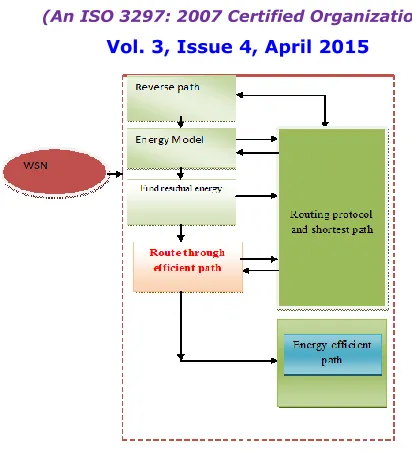
Fig 1.Working of routing protocols
In reverse path we are proposing two routing algorithm. LayHet will find shortest path by using energy of each node and move to EgyHet. In networks all nodes are moving. Each node information is given EgyHet.
Algorithm 1 RP: Finding Reverse Paths for Asymmetric Links:
1. Every node in the network broadcasts a ``Hello'' message.
2. If two nodescan receive ``Hello'' message and the corresponding ``Ack'' of the ``Hello'' message, then each adds the other to its in-out-neighbor list.
3. If node receives`` Hello'' message, but not the ``Ack'' to its own ``Hello'' message, then node knows that the neighbour is
its in-neighbor and adds it to its in- neighbor list. Then, itwill perform the next step to find a reverse routing path.
In reverse path first it find the reverse path from source to destination. Source node send “Find” message containing source ID, destination ID and expiration length. If intermediate node receives the message it will decrease the length. Reverse Path finds the node relationship i.e whether nodes are within the transmission range, or out of transmission. Which will help to route the packets to transmit directly to source to destination. Or it need intermmediate node to transmit. Reverse path sends possible number of reverse path to LayHet protocol.
LayHet will selects shortest path. LayHet is a layer-based routing protocol that embeds the shortest path information and saves energy by minimizing the number of broadcasts and the probability of forwarding. LayHet identifies nodes layer numbers which shortest path information for the sake of lossy links to guide routing in the right direction.In LayHet identifies the node which is going to sleep. The node which has less energy than the threshold that node broadcast the message to its neighbour node that node energy level is less, redirect the path. Then the neighbour node redirect the path in LayHet algorithm.
Algorithm 2 :LayHet [ DILN: Deciding Initial Layer Numbers]
1.Node u broadcasts an exploration packet EP containing a hop-count c=0 and the source ID. 2. if a node v receives EP then
ISSN(Online): 2320-9801
ISSN (Print): 2320-9798
I
nternational
J
ournal of
I
nnovative
R
esearch in
C
omputer
and
C
ommunication
E
ngineering
(An ISO 3297: 2007 Certified Organization) Vol. 3, Issue 4, April 2015
4. it waits for a while for more copies of EP to arrive. Then it picks an EP with the smallest hop count. It increments the hop count by 1 and generates an acknowledgement EP ack containing the value of the current hop count c and the path involving all the forwarding nodes on the path back to the source u. The later arrived copies of EP are dropped.
5. When an intermediate node m on the path receives EP ack, it adjusts its own layer number according to hop count c and its location on the path.
6. if m‟s previous node t is its in-out-neighbor then 7. it sends EP ack directly to t;
8. else if m has a reverse path to t then
9. m sends EP ack to t via the reverse path of the asymmetric link t →m; 10. else
11. m simply drops EP ack 12. end if
13. else
14. it increments the hop count by 1, appends its ID to EP and rebroadcasts EP 15. end if
16. end if
17. After u receives EP ack, it knows its layer number to the sink is c.
In its routing part, to guarantee performance and save more energy. To further reduce energy consumption, we upgrade LayHet to EgyHet.
Algorithm 3: EgyHet
1. Order node u's K lower layer out-neighbors in non- increasing order according to their remaining energy levels. Here we use a node's remaining energy level to represent the node.
2. Is used to select the energy efficent route based on the residual node energy
FAF
N
hops
D
total
E
consumedWhere,
N
hops
Number
of
hops
from
source
node
to
destinatio
n
node
D
total
Total
Dis
tan
ce
Computed
over
the
route
route
the
over
consumed
Energy
Total
E
consumed
EgyHet is its energy-upgraded version that considers nodes remaining energy. It consider the remaining energy of nodes when selecting forwarders. After transmission of packet each node moves into the network. Each node is tracked by the EgyHet, and display the energy consumed by each node. Advantage of these routing protocol is to reduce the energy consumption by knowing the failure node or link failure and redirect the routing path.
III. CONCLUSION
ISSN(Online): 2320-9801
ISSN (Print): 2320-9798
I
nternational
J
ournal of
I
nnovative
R
esearch in
C
omputer
and
C
ommunication
E
ngineering
(An ISO 3297: 2007 Certified Organization) Vol. 3, Issue 4, April 2015
protocol for ad hoc networks routing protocols removes redundancy of the flooding process, which may be a problem in networks with moderate to large packet loss rates. Performance Guaranteed Routing Protocols for Asymmetric Sensor Networks routing protocol reduce the energy-usage, less overhead, assured delivery rate and may be more efficient as compared with all other routing protocols when there is a node failure In LayHet broadcasting message to re-route the path. The routing protocols in asymmetric sensor networks where two end nodes may not use the same path to communicate with each other and provide performance guareented routing protocol. The routing protocol LayHet and EgyHet are used to provide efficient energy. Reduces the energy consumption in the network. Provide assured delivery rate and reduce the overhead in the network in the asymmetric sensor network with high performance. Provide Better routing protocol for wireless sensor network.
IV. FUTURE WORK
The existing work has mainly focused on the development of an energy efficient mechanism of routing protocol, however the performance of the routing protocol is coupled with the infrastructure of the network. The delay during transmission is more as compared. In future work delay can be reduced and also may provide better routing protocols for asymmetric links in wireless sensor network.
REFERENCES
1 C. E. Perkins and P. Bhagwat, „„Highly dynamic destination-sequenced distance-vector routing (DSDV) for mobile computers,‟‟ in Proc. Conf.
Commun. Archit., Protocols Appl., Oct. 1994, pp. 234–244
2 M. K. Marina and S. R. Das, „„Routing performance in the presence of unidirectional links in multihop wireless networks,‟‟ in Proc. IEEE Symp.
Mobile Ad Hoc Netw. Comput., Jun. 2002, pp. 85–97.
3 L. C. Bao and J. J. Garcia-Luna-Aceves, „„Link-state routing in networks with unidirectiona links,‟‟ in Proc. IEEE ICCCN, Oct. 2005, pp. 358–363.
4 W.Heinzelman,A.Chandrakasan,and H.Balakrishnan, „„Energy-efficient communication protocol for wireless microsensor networks,‟‟ in Proc.
HICSS, Jan. 2000.
5 X. Chen, Z. X. Dai, W. Z. Li, Y. F. Hu, J. Wu, H. C. Shi, and S. L. Lu, „„Prohet: A probabilistic routing protocol with assured delivery rate in wireless heterogeneous sensor networks,‟‟IEEE Trans.WirelessCommun., vol. 12, no. 4, pp. 1524–1531, Apr. 2013
6 T.Clausen, P.Jacquet, A.Laouiti, P.Muhlethaler, A.Qayyum and L.Viennot, „„Optimized link state routing protocol for ad hoc networks,‟‟ in Proc.
IEEE INMIC, Mar. 2001, pp. 6682
7 Performance Guaranteed Routing -Protocols for Asymmetric Sensor Networks
8 Notification System [Online]. Available: http://en.wikipedia.org/wiki/ Notification_system
9 I.Alyildiz, Y.Sankarasubramaniam W. Su, and E. Cayicrci, „„A survey on sensornetworks,‟‟IEEECommun.Mag.,vol.40,no.8,pp.10116,Aug. 2002.
BIOGRAPHY
ISSN(Online): 2320-9801
ISSN (Print): 2320-9798
I
nternational
J
ournal of
I
nnovative
R
esearch in
C
omputer
and
C
ommunication
E
ngineering
(An ISO 3297: 2007 Certified Organization) Vol. 3, Issue 4, April 2015