© 2016, IRJET | Impact Factor value: 4.45 | ISO 9001:2008 Certified Journal
| Page 2188
DORSAL PALM VEIN PATTERN BASED RECOGNITION SYSTEM
Tanya Shree
1, Ashwini Raykar
2, Pooja Jadhav
3Dr. D.Y. Patil Institute of Engineering and Technology, Pimpri, Pune-411018
Department of Electronics and Telecommunication Engineering
---***---Abstract -
Biometrics is a technique by which a personcan be identified uniquely by assessing one or more discernible biological traits. Palm vein pattern based recognition system is a novel biometric recognition system which can identify individuals based on their unique dorsal palm vein pattern. The palm vein structure of each individual is unique and cannot be replicated as the veins are present below the surface of the skin and are not visible to the naked eye. These palm veins becomes visible to the naked eye when near infrared light rays falls on the surface of the palm. These infrared lights rays are provided by building an LED matrix. The de-oxidized blood has the property of absorbing these light rays because of which the veins appear as black line when observed through an IR camera. The palm veins are captured by using a low cost low resolution web camera. As the veins are located beneath the surface of the skin, it does not get affected by external injuries. Also the vein pattern does not change with age. In this paper, the matching algorithm that we are using is PCA(Principal Component Analysis) as it reduces the matching time and it has good accuracy.
Key Words: infrared, dorsal palm vein,biometric.
1.INTRODUCTION
Plenty of recognition systems exist that are based on
the dissimilar types of biometrics. The various
discernible biometrics include iris, fingerprint,
retina, voice, face. Each of these biometric systems
have major loopholes which heavily impacts the
system's reliability. This allows criminal and
imposters to surpass these security systems and gain
access using the Dorsal Palm veins are located just
below the surface of the skin and are not visible to
the naked eye. They, unlike the existing biometric
systems are very hard to replicate and do not get
affected by external injury. On exposing our dorsal
palm to an infrared LED matrix of a specified
wavelength range of 750-860nm,they appear as
black lines which can be observed by and infrared
camera. The penetration distance of the infrared LED
rays is 3mm
2. PROBLEM
STATEMENT
There are plenty of issues associated with the current existing biometric techniques. Fingerprint recognition system, one of the most popular biometric techniques used has a major disadvantage, that it can be replicated easily with the help of a cello tape. Also, if the skin of the finger is damaged due to some injury or skin disease this technique is rendered usless.Retina Recognition System can be easily passed with the help of lenses. Iris Recognition System becomes unreliable as iris changes as a person grows older. Criminals and Imposters could essentially copy the digital code for iris scans and reproduce it whenever they want to unlawfully gain access into a certain security system or secured place. Also the parts of the iris can be hidden easily by eyelashes and eyelids. These scans cause discomfort to the end user. Iris scans also pose a risk of damaging the eyes of an individual due to its intrusive nature. Voice Recognition has a major disadvantage that in a crowded place, the noise cannot be filtered out. This results in the mixing of the various voices in the background which makes distinguishing an individual's voice very difficult. Also if two people have similar voice frequencies, then it becomes a major drawback of the system as its accuracy would decrease. Face Recognition has some major drawbacks too. The face can be blocked by hair falling on a person's face, mufflers and spectacles. Also changes in lighting or facial expressions can throw off the device, thereby reducing accuracy. Also in addition, the individual's facial features changes over time. Hence, constant updating of the change in the person's facial features would be required. In case of twins, the distance between the eyes and jaw line could be the same. This distance is another factor which is used as a parameter in facial recognition systems. So in case of twins, face recognition will fail.
3. LITERATURE SURVEY
© 2016, IRJET | Impact Factor value: 4.45 | ISO 9001:2008 Certified Journal
| Page 2189
traced with help of border tracing algorithm. After thisstep, Euler's distance is applied. This step is very crucial for the determination of region of Interest. Region of Interest is very crucial as it helps in increasing the accuracy of the palm vein pattern based recognition system. Infrared techniques are popularly used to capture the vein patterns.. The camera used consisted of an infrared filter which filters out the IR rays. This modification is done by removing the infrared filter so that we can see the illuminated palm vein. This particular system could also be used to capture the palm print of the hands. Palm print is another cost effective biometric system.
(Shah, Shirke, Sawant, & Dandawate, 2015)The techniques proposed for matching in this particular paper are 2D-wavelet based feature, Principal component analysis (PCA) and template has been conceived especially for the for palm vein pattern. These techniques can be applied over the region of interest that was obtained from the captured palm vein images. The accuracy of the system can be improved by leaps and bounds if we use a capture system which captures high quality image in the initial stage.(Shah, Shirke, Sawant, & Dandawate, 2015). A popular technique 2D wavelet transform was also used for feature extraction and matching. After comparing all of the three proposed techniques it was found that template matching has the highest accuracy amongst the three of them. PCA came a close second on accuracy. As template matching has the best imaging, it has the highest accuracy. Accuracy of each of the three proposed techniques was determined experimentally by the author in these papers. Template matching had an astonishing accuracy of 93.54%.The disadvantage, however with this technique is that if the extracted image appears skewed, rotated or scaled on the image, the match would not be an accurate one. The PCA proves to be advantageous in this context since PCA correlates the templates of the palm vein pattern ,also as our project is dealing with palm vein matching. Wavelet transform technique is highly accurate when the variations in the different intensity levels is large.
Also two methods for image capturing namely, reflection and penetration were proposed and discussed in an aim to find out which of the two is best for the designing of an efficient, low cost palm vein scanner. In penetration the hand is between the illumination source and the camera, in reflection it's the other way around. Most of the work on this biometric modality has preferred the technique of reflection. (Shah, Shirke, Sawant, & Dandawate, 2015)also suggests that between penetration and reflection, penetration produces better results when compared with reflection method since reflection technique would require us to perform pre-processing like segmentation, thinning, filtering, Hough transformation. The penetration method uses 750nm to 850nm LED matrix. The reason for this range is that absorption of infrared rays is very high
above 750nm and harmful for the skin above 860nm. Hence we will be using LEDs whose wavelengths fall between 750-860nm. This would result in the development of a low cost system which provides better quality imaging system.
4. BLOCK DIAGRAM OF THE DORSAL
PALM
VEIN
PATTERN
BASED
RECOGNITION SYSTEM
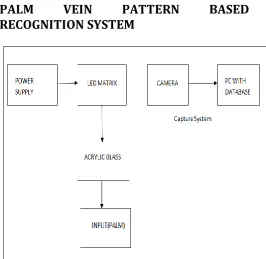
Fig 4.1 Block diagram of Palm Vein Pattern Based recognition System.
The block diagram consists of a power supply, web camera which is connected to a PC with a database or matrix of infrared LED matrix which is connected to a power supply. An acrylic and etched glass is placed right below the LED matrix for transparency. The palm is placed below the glass and is our input. Each part of the block diagram is explained in detail as given below.
PALM
[image:2.595.309.576.220.479.2]© 2016, IRJET | Impact Factor value: 4.45 | ISO 9001:2008 Certified Journal
| Page 2190
Fig 4.2 Palm Vein pattern obtained on infraredillumination
ACRYLIC GLASS
This provides uniform illumination to the LED rays that fall on the palm, so that each and every corner of the palm will be illuminated with the same intensity. A feature of acrylic glass is that it can transmit 92% of the visible light. Which means that 92% of infrared light will be passed.
MATRIX OF INFRARED LEDS
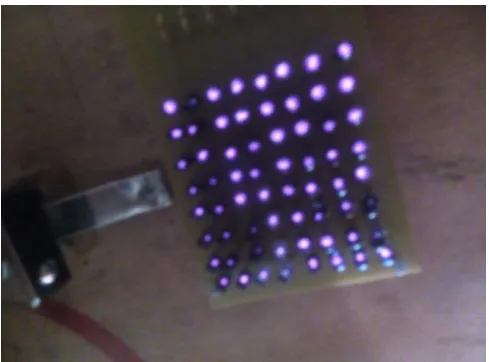
We use a matrix of infrared LEDS since it provides maximum coverage of the palm .We could also use a circular arrangement of LED's however that would not allow us to scan the corners of the palm. The wavelength of the LED's used in our hardware was of 860nm. This particular wavelength was selected as it has the property of highest absorptivity by de-oxidized blood. Dorsal veins will appear as black lines after absorption.
Fig 4.3 Infrared LED matrix as observed through an IR camera.
WEB CAMERA
The web camera consists of an infrared filter. When we remove this infrared filter , the rays in the infrared region will also be visible to the human eye. We will be able to see the palm vein since it has absorbed infrared rays. A USB port is attached to the web camera so that we can
interface the camera to the PC. The images captured by the web camera will then be stored in the PC and be used for matching purposes. The camera used in our hardware setup was a JTAG we camera of 1.3 megapixels. The reason for using such a low cost low resolution camera was to make the cost of the hardware apparatus as low in cost as possible.
POWER SUPPLY
The power supply required for this set up would be a 5V DC output from a DC adapter. The adapter used here is 5V-2A.
[image:3.595.36.285.100.224.2]5. FLOWCHART
Fig 5.1 Flowchart
INPUT
As discussed earlier, the input is nothing but the palm vein pattern captured by the camera.
PRE-PROCESSING
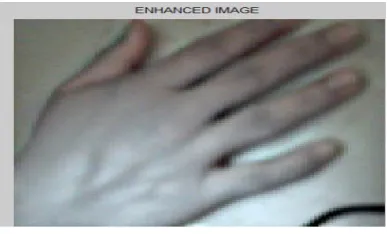
The palm vein image that we have obtained is pre-processed using filters like top hat and bottom hat filters. These filters enhance the contrast of the obtained images.
FEATURE EXTRACTION
[image:3.595.37.282.475.656.2]© 2016, IRJET | Impact Factor value: 4.45 | ISO 9001:2008 Certified Journal
| Page 2191
MATCHING
For matching purposes Euclidean distance classifier is used for matching an obtained palm vein image against one in the database. This method matched and identifies the images by using principle of correlation.
PROVIDE ACCESS
Access to the system is only provided if the palm vein pattern image that we captured matches with any one of the images stored in the database. Else in case of a failure to match the image, access would not be provided and unauthorized would be displayed on the screen.
[image:4.595.38.232.260.377.2]
Fig 5.1 Enhanced Image after pre-processing
7. APPLICATIONS
The dorsal palm vein recognition system could replace all the current existing biometric systems owing to its innumerable advantages as compared to the other biometric systems. It could be used in ATM machines as an alternative to an ATM cum debit card to withdraw money.
Today in hospitals , a patient has to carry his or her file containing the history of their illness and medication that they have been taking. For people have a long history of illness or the people who frequently visit hospitals ,the files would be difficult to carry and also file updating will be tedious. In such cases palm vein authentication system would prove useful.
Passports acts as a person's identity in another country. In airports, the passport verification queues are often long. Also people use stolen passports and easily gain entry into a country with the help of stolen identity. The palm vein pattern being hard to forge it can be used as an authentication system instead of passports. Once the person uses this system, all the relevant information as to where the person is travelling to , flight information, status of the flight and which gate number the person has to proceed to will be displayed once the verification is done.
8. CONCLUSIONS
Thus we can conclude that in the near upcoming future, the dorsal palm vein recognition system would be far
more reliable than the ones that are currently in use. The palm vein hardware setup that we have made has a major advantage being that it is cost effective. The total cost of the hardware amounts to a total of about Rs.1,500. This is one of the cheapest biometric systems that is available in the market. Also the images that are obtained are of good quality. Due to the unique pattern of the palm vein pattern it will also be a very highly accurate system. This method is very safe and does not cause any health hazards to human beings in the long run as it is not intrusive in nature. Also the left and right palm vein pattern are different from each other. This fact could be used as a future scope. Furthermore, the palm vein can be fused with other biometrics like fingerprint, iris scan for even more higher accuracy.
ACKNOWLEDGEMENT
Major part of this work was carried out at C-DAC,Pune. The authors acknowledge the help extended by Shri Suresh V(Joint Director NISG,C-DAC,Pune),Ms.Gita Gosavi and the entire NISG group
REFERENCES
[1]Yogesh.H.Dandawate,&Sajeeda.R.Inamdar.(2015).Fusio n Based Multimodal Biometric Cryptosystem. International Conference on Industrial Instrumentation and Control , 6.
[2].Shah, G., Shirke, S., Sawant, S., & Dandawate, Y. (2015). Palm vein pattern-based biometric recognition. Int. J. Computer Applications in Technology .
[3].Nirmal, T., & Mathew, F. (2014). Palm vein authentication. International Journal of Advanced Research
in Computer Science and Software Engineering , 4.
[4].Fujitsu. (2006). Palm Vein Pattern. Sunnyvale,CA: Fujitsu Computer Products of America, Inc.
[5]Zhang, Y.-B., Li, Q., You, J., & Bhattacharya, P. (2007). Palm Vein Extraction and Matching for Personal Authentication. Researchgate Conference Paper , 12.
BIOGRAPHIES
Tanya Shree, born in 1994 in Maharashtra India. Pursuing BE in E&Tc from Dr.D.Y.Patil Institute of Engineering and
Technology. Her area of
© 2016, IRJET | Impact Factor value: 4.45 | ISO 9001:2008 Certified Journal
| Page 2192
Pooja Jadhav, born in 1994 inMaharashtra India. Pursuing BE in E&Tc from Dr.D.Y.Patil Institute of Engineering and Technology,Pimpri. Her areas of interest include VLSI, Power Electronics and Digital Image Processing.
Pooja Jadhav, born in 1994 in Maharashtra India. Pursuing BE in E&Tc from Dr.D.Y.Patil Institute
of Engineering and