INVESTIGATION
Precise and Heritable Genome Editing in
Evolutionarily Diverse Nematodes Using TALENs
and CRISPR/Cas9 to Engineer Insertions
and Deletions
Te-Wen Lo,*,†,1Catherine S. Pickle,*,†Steven Lin,*,†Edward J. Ralston,*,†Mark Gurling,†
Caitlin M. Schartner,*,†Qian Bian,*,†Jennifer A. Doudna,*,†,‡,§and Barbara J. Meyer*,†,2 *Howard Hughes Medical Institute,†Department of Molecular and Cell Biology and‡Department of Chemistry, University of California, Berkeley, California 94720, and§Physical Biosciences Division, Lawrence Berkeley National Laboratory, Berkeley, California 94720
ABSTRACTExploitation of custom-designed nucleases to induce DNA double-strand breaks (DSBs) at genomic locations of choice has transformed our ability to edit genomes, regardless of their complexity. DSBs can trigger either error-prone repair pathways that induce random mutations at the break sites or precise homology-directed repair pathways that generate specific insertions or deletions guided by exogenously supplied DNA. Prior editing strategies using site-specific nucleases to modify the Caenorhabditis elegansgenome achieved only the heritable disruption of endogenous loci through random mutagenesis by error-prone repair. Here we report highly effective strategies using TALE nucleases and RNA-guided CRISPR/Cas9 nucleases to induce error-prone repair and homology-directed repair to create heritable, precise insertion, deletion, or substitution of specific DNA sequences at targeted endogenous loci. Our robust strategies are effective across nematode species diverged by 300 million years, including necromenic nematodes (Pristionchus pacif-icus), male/female species (Caenorhabditisspecies 9), and hermaphroditic species (C. elegans). Thus, genome-editing tools now exist to transform nonmodel nematode species into genetically tractable model organisms. We demonstrate the utility of our broadly appli-cable genome-editing strategies by creating reagents generally useful to the nematode community and reagents specifically designed to explore the mechanism and evolution of X chromosome dosage compensation. By developing an efficient pipeline involving germline injection of nuclease mRNAs and single-stranded DNA templates, we engineered precise, heritable nucleotide changes both close to and far from DSBs to gain or lose genetic function, to tag proteins made from endogenous genes, and to excise entire loci through targeted FLP-FRT recombination.
S
TRATEGIES to engineer heritable, site-directed mutations at endogenous loci have revolutionized our approach to-ward manipulating and dissecting genome function. Studies of plants and animals alike, whether conducted in whole organ-isms or cell lines, have benefitted greatly from these genome-editing approaches (Bibikovaet al.2002; Beumeret al.2006; Doyonet al.2008; Geurtset al.2009; Hockemeyeret al.2009;Holtet al.2010; Zhanget al.2010; Hockemeyeret al.2011; Tessonet al.2011; Woodet al.2011; Younget al.2011; Bedell
et al. 2012; Bassettet al.2013; Conget al.2013; Jinek et al.
2013; Maliet al.2013; Wanget al.2013; Zuet al.2013). The most modern tools for modifying complex genomes at single-nucleotide resolution are site-specific nucleases that induce DNA double-strand breaks (DSBs) at specifically des-ignated genomic locations. DSBs trigger repair pathways that can elicit targeted genetic reprogramming, primarily through two mechanisms: error-prone nonhomologous end joining (NHEJ) (Lieber 2010) and precise, homology-directed recom-bination or repair (HDR) (Chapman et al.2012). NHEJ re-joins broken ends of chromosomes through an imprecise process that produces nucleotide insertions, deletions, and indels at the DSB site, causing random, heritable null or Copyright © 2013 by the Genetics Society of America
doi: 10.1534/genetics.113.155382
Manuscript received July 15, 2013; accepted for publication August 8, 2013 Supporting information is available online athttp://www.genetics.org/lookup/suppl/ doi:10.1534/genetics.113.155382/-/DC1.
1Ithaca College School of Humanities and Sciences, Department of Biology, 165
Center for Natural Sciences, Ithaca, NY 14850
2Corresponding author: Howard Hughes Medical Institute, Department of Molecular
partial loss-of-function mutations. In contrast, HDR uses homologous DNA as a template to create accurate repairs, guided either by a sister chromosome or by introduced ho-mologous DNA to generate specific deletions or insertions in predictable ways (Chenet al.2011; Bedellet al.2012). DSBs made by any site-specific nucleases should possess the capacity to enter the homology-directed repair pathway and generate precisely specified changes in the genome.
Effective nucleases with engineered specificity include the zinc-finger nucleases (ZFNs), the transcription activator-like effector (TALE) nucleases (TALENs), and the RNA-guided CRISPR-associated (Cas9) endonuclease (Urnov
et al. 2010; Bogdanove and Voytas 2011; Jinek et al.
2012; Wiedenheft et al.2012; Gaj et al.2013; Weiet al.
2013). ZFNs and TALENs contain fusions between the DNA cleavage domain of the FokI endonuclease and a custom-designed DNA-binding domain: either C2H2zinc-finger motifs
for ZFNs or TALE domains for TALENs (Urnov et al.2010; Carroll 2011; Cermaket al.2011; Liet al.2011; Milleret al.
2011; Mussolino et al. 2011). DNA-binding domains of TALEs have a tandem array of repeat units, each 33–35 aa, in which the nucleotide-binding preference of a given repeat is determined by two adjacent amino acids called the repeat variable diresidue (RVD) (Boch et al. 2009; Moscou and Bogdanove 2009). In contrast, the RNA-guided CRISPR-associated Cas9 endonuclease generates DSBs at sites defined by a 20-nt guide sequence contained within an associated CRISPR RNA (crRNA) transcript (Gasiunas et al.
2012; Jineket al.2012). Cas9 requires both the guide crRNA and a trans-activating crRNA (tracrRNA), which partially base pairs with the crRNA, to form active enzyme complexes that achieve site-specific DNA recognition and cleavage (Deltcheva
et al.2011; Jineket al.2012). Cas9 can also be programmed with a single, chimeric fusion of crRNA and tracrRNA for effective DNA cleavage at a selected site (Jineket al. 2012; Bassettet al.2013; Changet al.2013; Friedlandet al.2013; Gratzet al. 2013; Shenet al.2013; Wanget al.2013; Xiao
et al.2013; Yuet al.2013).
The model nematodeCaenorhabditis elegans(Woodet al.
2011; Friedlandet al.2013) and its relativeC. briggsae(Wood
et al.2011), a species diverged by 15–30 MYR (Cutter 2008), have succumbed to genome-editing strategies that yielded site-directed, NHEJ-mediated random mutations, using nucleases with engineered target specificity. However, prior to our current studies, neither species had proved amenable to the site-directed manipulations necessary to introduce precise, HDR-mediated insertions or deletions at endogenous loci with-out traces of dominant genetic markers or other tools of genetic engineering. Furthermore, the genome-editing approaches had not been extended to male/female free-living species or nem-atode species having more unusual lifestyles, such as those with a necromenic association with plants or animals. While whole-genome sequencing has facilitated research beyond traditional model nematode species, lack of broadly effective reverse ge-netic tools has limited cross-species comparisons of gene func-tion needed to explore biological mechanisms.
We report robust strategies, using TALENs and CRISPR/ Cas9 for targeted, heritable genome editing across nema-tode species diverged by 300 MYR (Dieterich et al.2008), the evolutionary time spanning living reptiles and mammals (Hedges and Kumar 2003). Our protocols proved effective in every species tested: necromenic nematodes (Pristionchus pacificus), male/female species (Caenorhabditisspecies 9), and hermaphroditic species (e.g.,C. elegans). These highly efficient strategies produced precise insertion and deletion of specific DNA sequences at designated endogenous loci. These genome-editing tools will enable nonmodel nematode species to become genetically tractable organisms.
We illustrate the utility of our widely applicable genome-editing strategies by creating tools and reagents of general use to the scientific community and ones specifically needed for analyzing the mechanism and evolution of X chromosome dosage compensation across nematode species. Dosage com-pensation ensures that males (1X) and females/hermaphrodites (2X) produce equivalent levels of X chromosome products despite having different doses of X chromosomes. In C. ele-gans, adosagecompensationcomplex (DCC) is recruited to both X chromosomes of hermaphrodites to repress transcription by half (Pferdehirtet al.2011; Kruesiet al.2013) throughrex
(recruitmentelement onX) sites that bind the DCC in a DNA-sequence-dependent manner, using DNAmotifsenriched onX
(MEX) (McDonelet al.2006; Janset al.2009). Pivotal to un-derstanding dosage compensation is the ability to delete com-binations of MEX motifs at endogenousrexsites and to insert MEX motifs into new sites on X or autosomes. We achieved those goals and also created reagents to explore the evolution of dosage compensation by deleting from a diverged nematode species the homolog of the C. elegansgene that triggers sex-specific assembly of the DCC onto X.
Materials and Methods
Construction of TALEN vector
To utilize the commercially available Golden Gate TALEN kit for TALEN construction, we modified our previously published TALEN backbone vector [pTY2551 (Woodet al.2011)] by addingBsmB1 restriction enzyme sites at appropriate posi-tions to insert DNA encoding each TALE. We also modified the vector to include a marker to impose a selection for insert-ing the new TALE DNA.
The QuikChange Lightning site-directed mutagenesis kit (Agilent no. 210518) was used to modify pTY2551. Primers NTAL6F (59ctcaccggggcccccCtgGaGACgaccccagaccaggt 39) and CTAL6R (59cgccaccagatggtcGttGgAGaCGgcagccaacgcggga 39) were used to introduce the necessary BsmBI sites. Nucleotides in uppercase letters represent modified bases and nucleotides in lowercase letters represent unchanged bases.BsmBI sites are shown in boldface type. TheccdB selec-tion cassette was then introduced using theBsmBI sites.
CGA AAC ACA ACA TAT CCA GTC ACT ATG G) and ccdBTALR (CCC TGG AGA CGG AGG ATC CGG CT ACT AAA AGC). This fragment was subcloned into pcr2-1_TOPO vector, using the TOPO TA cloning kit. The TOPO-clonedccdB
cassette was digested withBsmBI, and the 714-bpccdB frag-ment was gel extracted for ligation into a BsmBI-digested modified pTY2551 vector to create thefinal pTY2575 back-bone vector. ccdBis a lethal gene that targets DNA gyrase (Bernard et al. 1994). The pTY2575 plasmid can be main-tained only in anEscherichia colistrain such as DB3.1, which carries a specific suppressor mutation in the gyrase. After trans-formation, only DH5acells carrying plasmids with the desired TALE insert will be viable, because the plasmid will lack the lethal ccdB insert. pTY2575 also includes the T7 promoter necessary forin vitrotranscription, the 59- and 39-UTRs neces-sary for germline expression, and theFokI domain required for DNA cleavage.
TALEN DNA construction
TALEs were designed using the TAL Effector Nucleotide Targeter 2.0 website. We used the following online program preferences: for TALEN architecture preference, Miller et al.
2011; for 59-most nucleotide,“T”. The T is included as part of the TALE design, but is not shown in the construction design, because the T is already encoded in plasmid TY2575 used for TALEN assembly (Supporting Information,Figure S2).
TALENs were constructed using the Golden Gate TALEN kit (Figure S2). We followed the protocol athttp://www. addgene.org/TALefector/goldengate/voytas/with one mod-ification. The plasmids pTAL1, pTAL2, pTAL3, and pTAL4 were replaced with nematode species-specific plasmids having the appropriate 59- and 39-UTRs for germline expression: pTY2575 forCaenorhabditisand pTY2634 forPristionchus. pTY2634 was constructed by replacing the 39-UTR from pTY2575 with the 39-UTR from Ppa-rpl-23. The Ppa-rpl-23
39-UTR sequence is 59ATT GTT ATT GTT GAT TGT TAC
GCG TGA TGC AAT AAA ATG TGT TAT GCG TTT 39. The
Ppa-rpl-2339-UTR and itsflanking sequences were excised from pTY2606 withHindIII andStuI and gel purified. The pTY2575 plasmid was digested withHindIII,StuI, and BglII and gel purified to recover only the largeHindIII-BglII vector fragment. Vector and 39-UTR fragments were ligated and transformed into DB3.1 bacteria. Final TALENs were
se-quenced using primers TALseq2 (59TAA CAG CGG TAG
AGG CAG TG 39) and TALseq3 (59TCT CCT CCA GCT GCT CGC TCT TC 39).
TALENs were made using the code in Figure 1, except for the following pairs that utilized the RVD NK as well as NN to recognize Gs:
smo-1TALEN-L1
HD NI NG HD NN NI NN NK NG HD NG NI HD HD NI NI NN
smo-1TALEN-R1
NN NG NI NN NN NG NI NN NI NK NN NI HD NG NI NN
smo-1TALEN-L2
HD NI NG HD NN NI NN NK NG HD NG NI HD HD NI NI
smo-1TALEN-R2
NI NN NI NN NG NN NG NI NN NN NG NI NN NI NK NN NI HD NG NI
rex-32TALEN-L1
HD NN HD NI NI NK HD NN NK HD NI NI NN HD NI HD
rex-32TALEN-R1
NI NG NG NG NG NG HD HD HD NG NG NK NG NG NN HD NK NN NI NN.
NK increases TALEN DNA-binding specificity, but even a limited number of NKs appear to decrease TALEN activity (see Table 1).
TALEN mRNA synthesis and injection
TALEN mRNA was synthesized using the T7 mMessage mMachine kit (Ambion no. A1344), the Poly-A-Tailing kit (Ambion no. A1350), and the Megaclear kit (Ambion no. AM1908) as described in Woodet al.(2011). TALEN mRNA (1000–1500 ng/ml) was injected alone for knockout experi-ments or with single-stranded DNA nucleotides (ssOligos) (50 ng/ml) for HDR-mediated knock-in experiments.
ssOligo design and synthesis
ssOligos used as repair templates contained the desired insertion sequence flanked on both sides by 20–50 nt of target homology. ssOligos were synthesized by Integrated DNA Technologies (www.idtdna.com).
Mutant screening and isolation
For hermaphroditic species, mutants were screened and isolated according to the protocol (Figure S1) described by Woodet al.(2011), with the exception that the CEL-1 was made using the protocol described in Yang et al. (2000) through the dialysis procedure at the end of step I. For screen-ing, F1 animals laid 8–16 hr postinjection (25°C) were
col-lected and then cloned 2 days postinjection into individual liquid culture wells in a 96-well format. Each liquid well con-tained 50ml of S medium and HB101 bacteria (OD = 0.4). Once F2progeny were present and the wells lacked bacteria,
aliquots of animals from each of 4 wells were pooled into a well for the CEL-1 assay. For example, 5 ml from well A1 of plates 1–4 was pooled into plate A, well A1, resulting in 20
ml. Lysis buffer (20ml) was added to each well, and samples were frozen and then lysed (65°C for 1 hr, followed by 15 min at 95°C). Two microliters from each well was used as a tem-plate for PCR in afinal reaction volume of 50ml. S medium is inhibitory to the reaction when present in a ratio.1:25. The CEL-1 assay, which detects and cleaves mismatched DNA, was performed on the PCR products. The process was repeated with the single wells that comprised the positive pooled wells. Individual animals from positive single wells were picked into single wells and their progeny assayed to identify homozygous mutants.
Digests were visualized on a 2% agarose gel. The DNA se-quence was then obtained from homozygous progeny. For knock-in experiments not introducing a unique restriction site, the DNA sequence of homozygous mutants from CEL-1-positive animals was obtained to determine whether an in-sertion event had occurred.
For male/female species, mutants were screened and isolated in the following manner (Figure S1). Male/female matings were set up 24 hr prior to injection. Mated females were injected with TALEN mRNA. Progeny were isolated from 8 to 16 hr postinjection and allowed to mature. Matings (one L4 female and one sibling male) were set up in 96-well micro-titer plates containing agar rather than liquid medium. Each well had 100 ml of NGM agar and OP50 bacteria. Animals were allowed to mate and produce progeny until the wells lacked bacteria. Animals from starved wells were resuspended in 40ml of S medium, and 5–20ml was removed and pooled for screening.
The homozygous C. sp 9 sdc-2(y516) mutant strain de-rived from this protocol is inviable. The strain is maintained through a cross betweensdc-2(y516)/+ XX females and sdc-2(y516)XO males, with frequent monitoring by PCR.
FLP/FRT experiment
FRT sites flanking rex-32 were inserted sequentially. The 59-FRT was inserted first, using TALENs (pTY2632 and pTY2633) and an ssOligo that contained the FRT sequence and 20 nt ofrex-32homology on either side. The 39-FRT site was next inserted using TALENs pTY2627 and pTY2628 and an ssOligo containing the FRT site and 40 nt of homology on either side. The length of the homology arms was increased to minimize binding to the previously inserted 59-FRT site and to optimize binding to the homologous regions flanking the desired insertion site. RNA synthesis, injection, and screening were performed as described above.rex-32was excised from animals containing both FRT sites, using FLP recombinase, which was introduced into the gonad by injecting FLP-encoding RNA at concentration of 1500 ng/ml. RNA was made by
in vitro transcription from a PCR fragment containing the T7 promoter, the FLP recombinase sequence, derived from pGC92 (Voutev and Hubbard 2008), and 59- and 39-UTRs appropriate for germline translation ofC. elegansmRNAs: 59 -UTR, ATT TAG GTG ACA CTA TAG AAT ACA CGG AAT TCT AGA
TGA TCC CCG CGT ACC GAG CT CAGA AAAA; 39-UTR, GCC
TGA GCT CAC GTC GAC CGG GGC CCT GAG ATC TGC TGC AG. Animals laid 8–16 hr postinjection at 25°C were collected and screened via PCR according to the protocol from Wood
et al. (2011) as described above. In a separate experiment, FLP recombinase was supplied by the DNA plasmid pGC92 injected into the gonad.
P. pacificus Western blot
For the Western blot to demonstrate that UNC-119 carried the HA tag, 10 ml of mixed-stage worms were combined with 43sample buffer [125 mM Tris-HCl (pH 6.8), 20% glycerol, 4% SDS, 10%b-mercaptoethanol, 0.5 mg/ml
bro-mophenol blue] and frozen. Frozen samples were boiled for 5 min, spun at maximum speed in a microcentrifuge for 5 min, and electrophoresed through a 12% acrylamide gel. Standard Western blot protocols were used, and the blot was probed with anti-HA primary antibody (1:1000) (Abcam no. ab1424) and donkey anti-mouse HRP secondary antibody (1:5000) (Jackson ImmunoResearch no. 715.035.151).
Construction of cas9 DNA
TheStreptococcus pyogenes cas9gene, which is codon op-timized for eukaryotic expression and carries a C-terminal HA-2xNLS-mCherry-2xNLS fusion tag, was constructed as follows. Oligonucleotides pTY forward (59-GAC ACG GAA TTC TAG ATA ATC CCC GCG TAC CGA GCT CAG AAA AAA TGG ACA AGA AGT ACA GCA TCG G -39) and pTY reverse
(59-TCG ATC GTC GAC GTG AGC TCA GGC TCT AGA CTA
TTA GTC CAC-39) were used to PCR amplify thecas9fusion gene from pDD921 plasmid (a gift from Diane Dickle at Law-rence Berkeley National Laboratory), using Phusion DNA poly-merase (NEB). The PCR DNA was digested with EcoRI and
SalI (NEB) and ligated into pTY2575 betweenEcoRI andSalI sites. The resulting cas9 construct (pTY2631) is flanked by a 59-UTR (59-GAA TAC ACG GAA TTC TAG ATA ATC CCC GCG TAC CGA GCT CAG AAA AA-39) and a 39-UTR (59 -GCC TGA GCT CAC GTC GAC CGG GGC CCT GAG ATC TGC TGC AG-39) and expressed from the T7 promoter. The plasmid DNA was extracted by the QIAprep Spin Miniprep kit (QIA-GEN, Valencia, CA) and DNA sequencing was performed by Quintara Biosciences. Cas9 mRNA was synthesized using the T7 mMessage mMachine kit (Ambion no. A1344), the Poly-A-Tailing kit (Ambion no. A1350), and the Megaclear kit (Ambion no. AM1908), as described in Woodet al.(2011).
Preparation of S. pyogenes Cas9 tracrRNA and crRNA
The tracrRNA and crRNA were synthesized in vitro by T7 transcription, using oligonucleotide templates carrying the T7 promoter sequence. The tracrRNA template was PCR am-plified fromS. pyogenesM1 GAS genome DNA, using oligonu-cleotides OLEC1521 (59-GAA ATT AAT ACG ACT CAC TAT
AGA AAA CAG CAT AGC AAG TTA AAA TAA-39) and
OLEC1522 (59-AAA AAA AGC ACC GAC TCG GTG CCA
C-39) as described by Jineket al.(2012). TheS. pyrogenes bac-terium and genomic DNA are available from the American Type Culture Collection (Rockville, MD). The crRNA3 tem-plate was annealed from oligonucleotides twGFP T (59-TAA TAC GAC TCA CTA TAG CTC ACA CAA TGT ATA CAT CAG TTT TAG AGC TAT GCT GTT TTG-39) and twGFP B (59-CAA AAC AGC ATA GCT CTA AAA CTG ATG TAT ACA TTG TGT GAG CTA TAG TGA GTC GTA TTA-39) by heating to 70°and cooling to room temperature. Thein vitroT7 transcription reaction consisted of 50 mM tris(hydroxymethyl)amino-methane (pH 8), 5 mM MgCl2, 0.1% Triton X-100, 100mM
formamide containing 10 mM ethylenediaminetetraacetic acid and 0.01% bromophenol blue. The RNA mixture was resolved in a 10% denaturing polyacrylamide gel contain-ing 7 M urea. The RNA band was excised and the RNA was eluted in 10 vol of 0.2 M sodium acetate (pH 5) at 4°C overnight. The RNA was then precipitated with isopropa-nol, washed with 70% ethaisopropa-nol, and dried under vacuum. The tracrRNA and crRNA were dissolved in EB buffer (QIAGEN) and reannealed by heating to 50°C and cooling on ice.
Cas9 injections
The concentrations for the multiple crRNA:tracrRNA dual-guide RNA injection into strain EG4601 (Ppie-1::gfp::his-33) were as follows: Cas9 mRNA, 459 ng/ml; tracrRNA, 1238 ng/ml; crRNA1, 289 ng/ml; crRNA3, 291 ng/ml; crRNA4, 291 ng/ml; and crRNA6, 291 ng/ml. Prior to injection, the crNRA and tracrRNA were mixed in a tube and allowed to anneal by heating to 50°C for 10 min and cooling to room temperature prior to adding the Cas9 mRNA. Concentra-tions for the Cas9 mRNA, crRNA3:tracrRNA dual-guide injection into strain EG6171 (Peft-3::gfp) were as follows: Cas9 mRNA, 500 ng/ml; crRNA3, 1248 ng/ml; and tracrRNA, 1248 ng/ml. The concentrations for the single-guide RNA injections into EG6171 were as follows: Cas9 mRNA, 500 ng/ml or 800 ng/ml; and sgRNA3, 2000 ng/ml. RNA injec-tions and progeny screening were carried out using the pro-tocols described above.
Cas9 in vitro DNA cleavage reactions
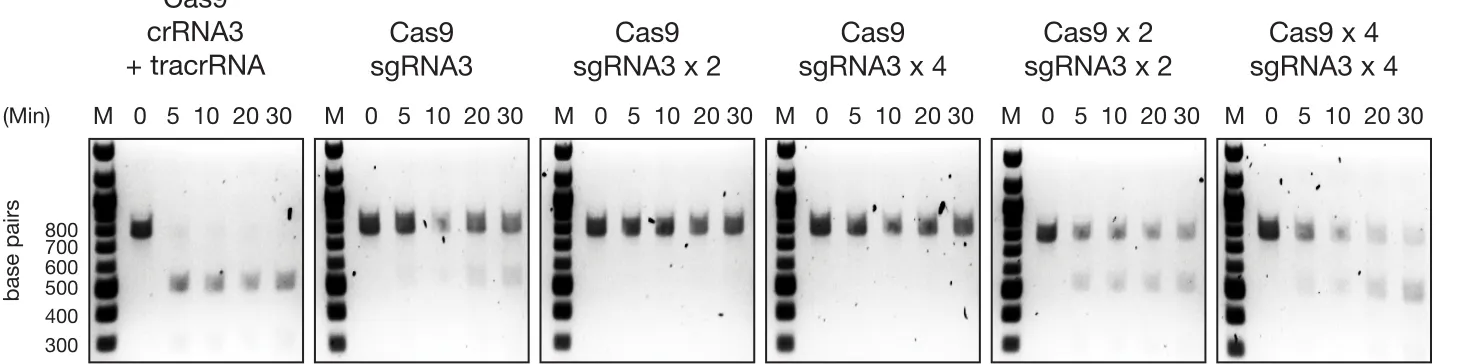
The Cas9 DNA cleavage reactions with either single-guided (sg)RNA or dual crRNA:tracrRNA were performed in a man-ner similar to that in Jineket al.(2012), except the molar ratios for Cas9:guide RNA:target DNA were 0.5:1:0.5 mM (Figure 7D andFigure S4, A and B). The experimental de-sign and concentrations of reagents for the dose-dependent DNA cleavage reactions using sgRNAs are provided in the legend toFigure S5.
Results
Precise, heritable DNA insertions can be achieved in C. elegans by homology-directed repair of TALEN-induced DSBs
To establish a strategy inC. elegansfor the precise insertion of specific DNA sequences at specifically targeted locations
in vivo, wefirst asked whether exogenously supplied single-stranded DNA could be used as a template for HDR of DSBs induced by TALENs, as shown for zebrafish (Bedellet al.
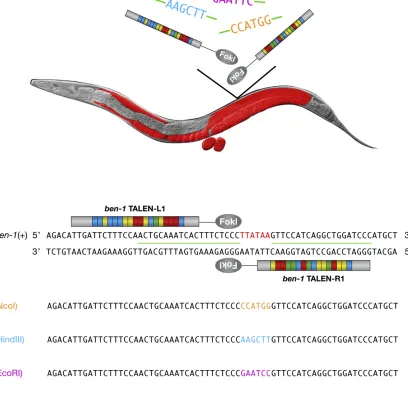
2012). In the initial experiment, we tested the efficacy of a synthetic ssOligo to guide the replacement of aPsiI restric-tion site (TTATAA) in the ben-1 locus with an NcoI site (CCATGG) (Figure 1 and Table 1). The donor ssOligo spanned the TALEN cut site near thePsiI site and carried anNcoI site flanked on both sides by 20 nt of DNA homologous toben-1
sequences. This experimental design allowed us to screen for
all TALEN-induced mutations by molecular genotyping, using the CEL-I DNA mismatch assay, and all HDR-mediated Nco I-insertion mutations, using a restriction enzyme digest. Nucle-ase activity and HDR-mediated insertions were attained in germ cell nuclei by micro-injectingin vitrotranscribed TALEN mRNAs and ssOligos into the gonad syncytium of young adult hermaphrodites. This method simultaneously exposes many germ cell nuclei to the nuclease and ssOligo, enabling multiple independent mutagenic events to occur within a single injected parent. Mutagenesis occurs at such high frequency that mutants are readily identified through the CEL-I assay, without reliance on visual phenotype.
From 15 animals injected with the ssOligo and mRNA encodingben-1TALENs, 548 F1progeny were screened, and
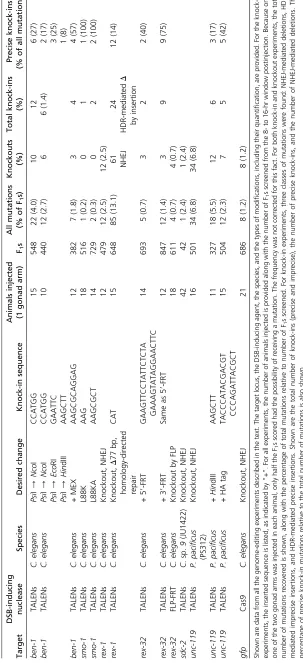
22 independent mutations (4.0% frequency) were identified and verified by DNA sequence. Six (27% of all mutations) had preciseNcoI substitutions with no other changes, 6 had imprecise insertions containing the NcoI site, and 10 had NHEJ-mediated knockouts (Table 1). Thirty percent of injected animals had mutant progeny, and a single injected animal produced both NHEJ-mediated knockouts and pre-cise HDR-mediated knock-ins. For example, one animal produced six NHEJ events and three precise knock-ins. This proof-of-principle experiment established a robust knock-in protocol forC. elegans(Figure S1) and thereby set the stage for all subsequent cross-species genome-editing experiments in this study.
Targeted insertion of different sequences at a single locus in one experiment
To improve the efficiency of inserting different sequences at a single site, as would be useful for creating an allelic series of mutations in a gene, we asked whether simultaneous introduction of several different ssOligos during a single injection experiment would yield precise insertion of different sequences in different progeny. We introduced mRNA for ben-1 TALENs and ssOligos, encoding three different restriction sites (NcoI,EcoRI, andHindIII) into 10 animals. From 440 F1
progeny, 12 mutations were obtained. Six mutations con-tained indels from NHEJ events, and 6 mutations had precise insertions: two of the NcoI site, three of theEcoRI site, and one of theHindII site (Figure 1 and Table 1). This experiment demonstrates the ease and efficiency in obtaining multiple different mutations, both NHEJ-mediated deletions and pre-cise HDR-mediated insertions, within a single gene. The strat-egy permits the recovery of multiple classes of alleles, null, hypomorphic, hypermorphic, and antimorphic, in the same experiment.
Application of the targeted insertion strategy to obtain codon substitutions for the gene encoding SUMO
assembly of the DCC onto X chromosomes (Pferdehirt and Meyer 2013). To analyze in detail the role of SUMO in regu-lating the activities of these proteins, the lysine residues that serve as attachment sites for SUMO modifications must be
identified. The amino acid composition of wild-type SUMO makes it difficult to identify the modified residues by the traditional method of proteolysis followed by mass spec-trometry. However, protocols requiring expression of a SUMO
Figure 1 Precise, targeted DNA insertions mediated by homology-directed repair of TALEN-induced DSBs. In a single experiment, animals were injected
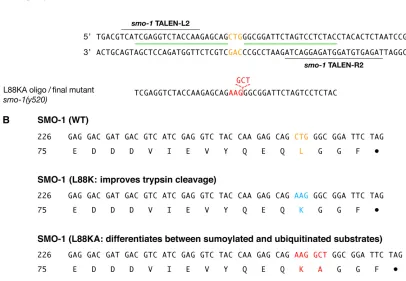
variantin vivohave been devised for efficient identification of SUMO-modified lysines (Wohlschlegelet al.2006). We applied our strategy for obtaining precise sequence changes at endogenous loci to create smo-1gene variants encoding SUMO proteins with either an L88K or an L88KA substitution (Figure 2). L88K improves the efficiency of trypsin cleavage, and L88KA improves cleavage and differentiates between SUMOylated and ubiquitinated substrates. Although the fre-quency of mutagenesis was relatively low for this experiment (0.3%), all of the mutants recovered carried precise knock-ins of the desired codons (Table 1). The SUMO variant is not only useful for the identification of SUMOylated residues on DCC subunits, but also generally useful to the entire C. ele-gans community for identifying SUMOylated targets in any biological processes.
Targeted HDR to create deletions close to and far from the DSB site
Effective genome-editing strategies must permit the pre-cise deletion of specific sequences in the loci of choice. We
developed protocols for this purpose, using the mutagenesis of DCC binding sites as a model. Critical for DCC recruitment to
rexsites on X is the 12-bp MEX motif that occurs preferentially at rexsites and is enriched on X chromosomes relative to autosomes (Janset al.2009; Pferdehirtet al.2011). Many
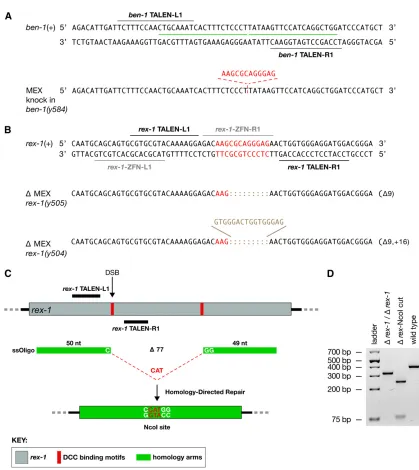
rexsites contain multiple MEX motifs. To understand DCC recruitment torexsites we used our genome-editing strategies to create strains carrying (1) endogenous rex variants with different combinations of MEX deletions and (2) insertions of MEX motifs on autosomes or at new locations on X chro-mosomes. Wefirst created a MEX insertion strain to determine whether a single MEX motif is sufficient to recruit the DCC to an autosome. For this purpose, we inserted the motif into a region on chromosome III that lacks DCC binding, using the appropriate TALENs and an ssOligo that contained the 12-bp MEX motifflanked by 20 nt of homology on either side (Figure 3A). Seven mutants were isolated from the 382 F1
progeny of 12 injected hermaphrodites (Table 1). Of these mutants, four carried precise 12-bp MEX insertions from HDR, and three carried NHEJ-mediated indels (Figure 3A).
Figure 2 Reprogramming thesmo-1gene by precise DNA insertions to encode SUMO variants that facilitate mass spectrometric identification of SUMO
We next targetedrex-1to obtain a deletion of either one MEX motif or two. Thisrexsite was of particular interest to us because our previous efforts with ZFNs did not result in the series of allelic mutations we desired. All of the 32 ZFN-induced NHEJ deletions occurred to one side of the motif, and only one mutation deleted into the motif, removing only the first 2 bp (Wood et al. 2011). Using the scheme pre-sented inFigure S2, we designed and synthesized a pair of TALENs that positioned the DSB in the middle of the first MEX motif. We obtained 12 NHEJ-mediated mutations from 479 F1s (2.5%), 8 of which disrupted the core of the motif
(Figure 3B and Table 1). This result showed that our pre-vious failure to isolate a motif-disrupting mutation was due to limitations of the ZFNs rather than an inherent difficulty in mutagenizing therexsite.
The repetitive nature of therex-1locus made it impossi-ble to design TALENs that would create a DSB within the second motif. We therefore adopted an alternative experi-mental strategy to delete both motifs simultaneously, using the originalrex-1TALEN pair to create a DSB within thefirst MEX motif and an ssOligo to drive precise HDR-mediated deletion of DNA up to 77 bp from the DSB, removing both MEX motifs (Figure 3C). The ssOligo contained longer ho-mology arms (49 nt and 50 nt) than those of oligos used to insert only short sequences. The ssOligo also carried the se-quence CAT between the homology arms to create a unique
NcoI site from the desired HDR-mediated event. The experi-ment was very successful. Of 85 mutations obtained from 648 F1s, 24 had an HDR-mediated deletion, 12 of which were
precise. Our genome-editing experiments show that deletions of different sizes can be engineered either immediately adja-cent to the DSB by NHEJ or distant from the DSB by HDR, thereby providingflexibility in the choice of DNA sequences targeted by TALENs and hence in TALEN design.
Targeted insertion of FRT sites to obtain large precise deletions through FLP recombinase–FLP recognition target (FLP-FRT) recombination in the germline
Effective genome editing requires the ability to delete large stretches of genomic DNA. We therefore devised a general strategy for obtaining large precise deletions, using the FLP recombinase–FLP recognition target (FLP-FRT) recombina-tion system (Golic and Lindquist 1989), and applied itfirst to rex sites containing multiple DCC-binding motifs span-ning#1 kb (Figure 4, A–D). For the purpose of eliminating all DCC-binding activity at such rexsites, removal of each motif individually would be far more labor intensive than simply deleting the entire site. We designed and synthesized two sets of TALENs to insert a 34-bp FRT site at the 59and 39 ends of the rex-32 locus, which contains four strong MEX motifs. Insertion of the 59-FRT was accomplished with an ssOligo that carried the 34-bp FRT sequence and 20-nt ho-mology arms (Figure 3B). Insertion of the 39-FRT in the strain carrying the 59-FRT insertion was then achieved by using an ssOligo with 40-nt homology arms to increase the probability of HDR being driven by homology arm sequences
rather than by FRT sequences (Figure 3B). For both FRT insertions, all of the knock-ins were precise, and they repre-sented 40% and 75%, respectively, of all TALEN-mediated mutations for the 59and 39ends (Table 1).
To catalyze the FLP-FRT recombination event that would
excise rex-32, RNA encoding the FLP recombinase was
injected into the gonads of FRT-containing animals. RNA injections have the advantage over DNA injections in that deletions detected in F1progeny result from a heritable
germ-line recombination event in the injected animal rather than a nonheritable somatic recombination event in the progeny. From 611 F1progeny derived from 18 RNA-injected animals,
four precise deletions were detected by PCR and verified by DNA sequence analysis (Figure 4, C and D). The RNA pro-tocol is simple and efficient. Furthermore, it is faster and less labor intensive than a DNA-based protocol for delivering FLP recombinase, which we also performed successfully. Only two heritable, preciserex-32-deletion strains were recovered from 1007 F1s, despite having eight positive lines that required
tracking for multiple generations. The DNA injections resulted in heritable extrachromosomal arrays that expressed FLP in the progeny, causing somatic, nonheritable recombination events that complicated the analysis. The FLP-FRT system works effectively to delete up to 659 kb inDrosophila(Parks
et al.2004) and should be equally effective in nematodes.
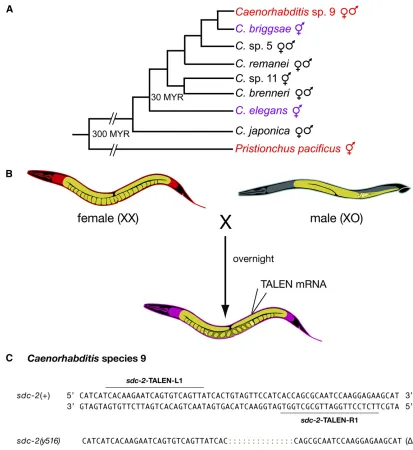
Genome editing in Caenorhabditis species 9, a male/ female species
Entire genome sequences are available for numerous species, but lack of reverse genetic tools has hindered cross-species comparisons of gene function. We previously applied our
C. elegansnuclease delivery and mutant screening procedures, without modification, toC. briggsae, a hermaphroditic species diverged by 15–30 MYR (Cutter 2008), to explore the evolu-tion of dosage compensaevolu-tion (Wood et al. 2011). We were interested in extending our genome-editing protocols to the male/female strainCaenorhabditissp. 9 because it forms fertile hybrids withC. briggsaeand therefore permits direct cross-species comparisons of gene functionin vivo(Figure 5). We changed our general protocol for genome editing to accom-modate male/female species by switching the growth condi-tions to agar-filled microtiter wells, rather than liquid-filled wells, to permit mating (Figure S1). We specifically targeted the dosage compensation gene sdc-2, which triggers sex-specific assembly of the DCC onto X in bothC. elegansand C.briggsae, to discover whether its function is conserved in
Caenorhabditis(C.) sp. 9 and whethersdc-2fromC. briggsae
can function in fertile C. sp. 9/C. briggsae hybrids or vice versa. Although theC. sp. 9 strain JU1422 is not very fertile, we were able to obtain one TALEN-induced, NHEJ-mediated deletion of sdc-2 from 42 F1s that came from 42 injected
females. The 14-bp deletion is predicted to cause a truncation of the 350-kDa protein after only 22 aa. The homozygous
sdc-2(y516) mutant strain is inviable, yet the hemizygous
defects causing inviability of the strain are consistent with a severe disruption in dosage compensation. Successful ge-nome editing inC. sp. 9 opens the way to direct structure– function analysis inC. briggsae/C. sp. 9 hybrids of proteins involved in many biological processes.
Genome editing in the necromenic nematode P. pacificus enabled the production of tagged proteins from endogenous loci
To test the efficacy of our genome-editing strategy across highly diverged species, we applied our protocols to the necromenic
Figure 3 Targeted HDR and NHEJ to obtain insertions and deletions of DCC binding motifs close to and relatively far from the DSB site. (A) Insertion
nematodeP. pacificus, a hermaphroditic species diverged from
C. elegansby 300 MYR (Dieterichet al.2008).P. pacificuslives in close association with scarab beetles and often feeds on the bacteria, fungi, and nematodes growing on dead, rotting
bee-tles. P. pacificuscan be cultured in the laboratory on agar plates containing bacteria used for culturingC. elegans. We modified our protocol solely by replacing the 39-UTR used for translation of TALEN mRNAs in germlines ofCaenorhabditis
Figure 4 FLP-FRT-mediated deletion of therex-32DCC binding site. (A) Diagram ofrex-32(gray) with its four DCC binding motifs (blue) and the
scheme to delete it. FRT sites (red) were inserted at opposite ends ofrex-32via HDR, using the TALENs and ssOligos shown inFigure S3. RNA encoding FLP recombinase was introduced into the germline of the FRT-containing animals, and F2animals were screened by PCR for the deletion events. (B) DNA
species with the 39-UTR from the Pristionchusgene rpl-23, shown previously to permit efficient germline RNA transla-tion (Schlageret al. 2009). We initially targetedunc-119with TALENs to provide the community with a mutant strain enablingunc-119(+) to be used as a co-injection marker for DNA transformation experiments, as inC. elegans. We recov-ered 34 (6.8%) independent NHEJ-mediated deletions in unc-119 from 501 F1progeny of 16 injected animals (Table 1).
The phenotype is strongly Unc.
We next assessed whether ourC. elegansinsertion strategy would be effective inP. pacificus. We mutagenized the unc-119 locus, using TALENs and an ssOligo designed to insert aHindIII site. From 327 F1progeny screened from 11 injected
animals, 18 total independent mutations were obtained (5.5%): 12 had NHEJ-mediated deletions and 6 had the
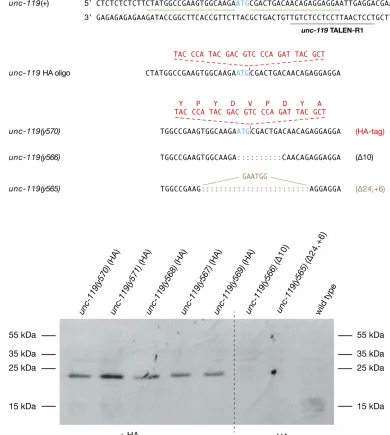
HindIII insertion, 3 of which were precise insertions (Table 1). The ability to tag proteins made from an endogenous locus controlled by normal regulatory mechanisms is invaluable for assessing protein functionin vivo. Having established the ef-ficacy of the insertion strategy in P. pacificus, we used the strategy to modify the endogenousunc-119 gene to encode an UNC-119 protein with an HA tag at its N terminus (Figure 6A). We inserted a 27-bp sequence encoding the 9-aa HA tag immediately after the ATG translation start codon. Of 504 F1
progeny screened from 15 injected animals, we obtained 12 mutants carrying NHEJ-mediated indels and deletions and 5
Figure 5 Genome editing in male/female species. (A) Evolutionary tree for nematode species spanning 300 MYR, from the male/female free-living strain
mutants carrying HDR-mediated insertions, all of which had precise insertions of the tag (Table 1). None of the insertions caused an Unc phenotype. A Western blot of allfive insertion strains using the HA antibody as a probe showed that the UNC-119 protein had indeed been tagged (Figure 6B). None of the controls, neither the wild-type strain (PS312) nor the
unc-119 deletion strains from the experiment, were positive for HA antibody staining. These experiments show that our genome-editing protocols are easily portable to species across a broad span of evolutionary time.
RNA-programmed genome editing using the CRISPR/ Cas9 system
TALENs have proved to be highly effective and efficient tools for targeted genetic reprogramming. They have enabled us to establish robust protocols for the precise insertion and deletion of desired sequences at designated loci. However, their use is somewhat constrained by the need to engineer new proteins for each DNA target site. Knowing that protocols designed to deliver site-specific nucleases to the germline and to manipulate nematode genomes through homology-directed DNA repair should be readily transferable to any site-specific nuclease, we directed our efforts toward harnessing the clusters of regularly interspaced short palindromic repeats (CRISPR) CRISPR/Cas9 system, an RNA-guided DNA surveillance system found in bacteria, for use in nematodes.
CRISPR/Cas loci encode RNA-guided adaptive immune systems that identify and destroy foreign DNA (Bhaya et al.
2011; Terns and Terns 2011; Wiedenheftet al.2012). Unlike the types I and III CRISPR/Cas systems, which are composed of multiprotein surveillance complexes, the type II systems require only a single protein, Cas9, to detect and cleave for-eign DNA (Sapranauskaset al. 2011). Cas9 generates blunt DSBs at sites defined by a 20-nt guide sequence contained within an associated crRNA transcript (Gasiunaset al.2012; Jineket al.2012). Cas9 requires both the guide crRNA and a tracrRNA that is partially complementary to the crRNA for site-specific DNA recognition and cleavage (Deltchevaet al.
2011; Jinek et al.2012). The crRNA:tracrRNA complex can be redesigned as a single chimeric transcript (termed sgRNA) encompassing the features required for both Cas9 binding and DNA target site recognition (Jineket al.2012). Using either the sgRNA or separate crRNAs and tracrRNAs, Cas9 can be programmed to cleave double-stranded DNA at any site defined by the guide RNA sequence and the NGG pro-tospacer-adjacent motif (PAM) (Sapranauskaset al.2011; Jineket al.2012). Recent experiments have demonstrated the utility of Cas9-sgRNA complexes for genome engineering in various eukaryotic cell types and whole organisms (Bassett
et al. 2013; Changet al. 2013; Friedlandet al. 2013; Gratz
et al.2013; Hwanget al.2013; Jineket al.2013; Maliet al.
2013; Shenet al.2013; Wanget al.2013; Xiaoet al.2013; Yu
et al.2013).
Our initial attempts at genome editing using Cas9-sgRNA complexes to target theben-1locus with three dif-ferent sgRNAs in multiple experiments were unsuccessful.
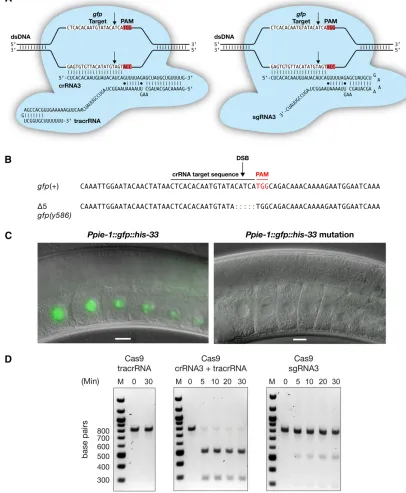
We reasoned that dual crRNA:tracrRNA RNA guides might be more effectivein vivoforC. elegansthan single chimeric sgRNA guides, as observed in some cases for mammalian cells (Conget al.2013). We therefore made use of dual RNA guides to target a single-copy, integrated transgene encoding a bifunctional GFP::histone 2B fusion protein expressed solely in theC. elegansgermline. We simultaneously introduced tracrRNA, mRNA encoding Cas9, and four different crRNAs to target different sites in gfp. We recovered one gfp mutant carrying a 5-bp deletion that eliminated GFP function (Figure 7, A–C). The general small brood size of the transgenic strain made it difficult to recover the three other independent mutants detected by molecular phenotyping ofgfp.
After determining the crRNA that was successful in the dual crRNA:tracrRNA guide experiment from DNA sequence analysis of the mutant, we performed an experiment to compare the efficiency of mutagenesis in vivoof a dual-crRNA:tracrRNA guide vs.a single chimeric sgRNA guide with identical DNA target sequence (Figure 7A). For this experiment, we targeted a different single-copygfp trans-gsene, one expressed universally in both the germline and the soma (Peft-3::gfp). In two separate experiments using the sgRNA, we examined 1034 F1progeny from 30 injected
ani-mals and found no mutations. In contrast, the crRNA:tracrRNA complex was again successful for the mutagenesis. From 686 progeny of 21 injected animals, we recovered eight indepen-dent NHEJ-mediated mutations (1.2% frequency) (Table 1). Curiously, the frequency of mutagenesis was on par with the frequency from TALENs, but the proportion of insertions, dele-tions, and indels differed. Deletions and indels are common for TALEN-mediated mutations, but insertions are very rare (,1%). However, in this small Cas9 experiment, the distri-bution of mutations included a high proportion of inser-tions: three insertions, two deletions, and three indels.
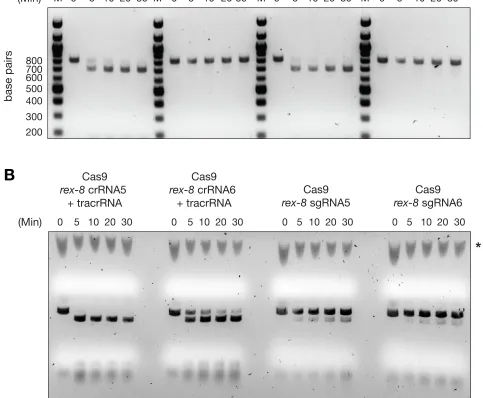
To understand the basis for the difference in efficacy of the two classes of RNAsin vivo, we performed Cas9-mediated DNA cleavage assays in vitroto compare the dual-crRNA: tracrRNA-Cas9 complex with the chimeric sgRNA-Cas9 com-plex, using a molar ratio of complexes to target DNA that would reveal a difference in the efficiency of the cleavage reactions, should one exist. We found the dual-crRNA:tracrRNA:Cas9 cleavage reactions to be more efficient than the sgRNA:Cas9 cleavage reactions (Figure 7D). This result was true for four other guide RNAs, two targeting other gfpregions and two targeting a rexsite (Figure S4, A and B). Thein vitro reac-tions appear to be good predictors for the successin vivoof RNA-delivered Cas9 experiments.
In a further experiment we assessed DNA cleavage
tool for RNA-directed reprogramming of genetic information at designated loci.
Discussion
The genetic tools used to manipulate the model organismC. eleganswere not previously capable of generating specifically designated nucleotide changes in genomic locations of choice. Not possible, for example, was the ability to modify
endoge-nous loci for the purposes of tagging proteins, perturbing gene function in specific ways, marking chromosomal locations, or changing the position and number of cis-acting regulatory sites. Our genome-editing strategies using CRISPR/Cas9 and TALENs make such custom-designed changes possible not only forC. elegans, but also for nematode species span-ning at least 300 MYR of evolutionary divergence, includ-ing necromenic nematodes and free-livinclud-ing male/female species. We show that efficient and facile tools now exist
Figure 6 Genome editing inP. pacificusresults in an HA-tagged protein made from the endogenousunc-119locus. (A) Segment ofunc-119spanning
for reprogramming genetic information in the germline by the insertion or deletion of specific sequences at any designated locus. Nonmodel nematode species can now be as genetically tractable as model species, thus
expand-ing the repertoire of biological questions to be addressed and the means by which hypotheses can be tested. Pre-cise genome editing provides the opportunity to conduct functional evolutionary studies of diverse biological
Figure 7 Heritable, RNA-targeted gene disruption in theC. elegansgermline using CRISPR/Cas9. (A) Schematic of Cas9 interacting with its dsDNA
processes, including one of particular interest to us, dosage compensation.
Two key elements were necessary for advancing the genome-editing technology: (1) the rapid construction and efficient germline delivery of DNA nucleases with engineered target specificity and (2) the ability to exploit DNA damage responses to repair DSBs, using exogenous DNA templates carrying desired sequences. In previous work, we developed an effective mRNA injection strategy to deliver and express ZFNs and TALENs in the germline as well as an efficient strategy to assay putative progeny for NHEJ-mediated muta-tions. Our current work extended these strategies to achieve RNA-programmed genome editing, using CRISPR-associated Cas9 nuclease. We also expanded the technology to achieve the targeted insertion and deletion of specific DNA sequences, using ssOligos as templates for homology-directed DSB repair. This technology can now be used to achieve homology-directed repair of DSBs made by any engineered nucleases. Our targeted insertion strategy offers many advantages. It is highly effective. In 7 of 10 experiments, precise insertions represented 100% of all insertions, and in the remaining 3 experiments, they represented 50%. Furthermore, precise insertions comprised a large fraction of all mutations, ranging from 14% to 100%, with a median of 46%. This high frequency makes practical, as demonstrated, the use of several different ssOligos simultaneously to insert different sequences into one locus in a single experiment. This approach permits an allelic series of mutations to be made with ease in one gene in the same experiment.
The insertion strategy is rapid. Four days after injection, molecular genotyping via the CEL-1 mismatch assay revealed the success of the mutagenesis. This speed of analysis is attributable to two factors. First, the frequency of mutagenesis is sufficiently high that identification of mutations requires only a molecular signature, without need for a visual pheno-type or genetic selection. Thus, F1progeny can be scored just
after they have reproduced sufficiently to sustain the strain. Second, germline-injected mRNAs used to deliver nucleases and recombinases (TALEN, Cas9, and FLP) are very short lived compared to germline-injected DNAs. Thus, discovery of mutant F1progeny by the CEL-1 assay indicates the
muta-tions are heritable rather than the consequence of DSBs aris-ing in the somatic tissues of F1s due to enzymes made from
inherited DNA arrays. Moreover, the RNA delivery method obviates the need to engineer expression vectors for each dif-ferent species. Only the 39-UTR needs to be changed to ensure germline translation in non-Caenorhabditisspecies.
Another group recently reported the application of CRISPR/Cas9 to induce NHEJ-mediated random mutations at DSB sites inC. elegans, using DNA extrachromosomal arrays to express Cas9 and sgRNAs (Friedlandet al.2013). Success with sgRNAs is likely due to the higher concentration of Cas9 achieved by their expression from DNA arrays. Thus, both Cas9 delivery approaches are successful, as are both chimeric sgRNA guides and dual crRNA:tracrRNA guides, but the Cas9 RNA delivery scheme we used is more successful with dual
RNA guides than with sgRNA guides. RNA delivery of Cas9 also has the advantages listed above. Greater efficacyin vivo
of dual RNA guides compared to sgRNA guides has been observed previously (Cong et al.2013) and is likely due to better RNA folding of the dual guides.
Our genome-editing strategy yields precise, clean muta-tions, without other molecular traces near the endogenous locus. In contrast, a homologous repair event guided by a co-injected DNA plasmid occurs at a lower frequency than repair from an ssOligo template, requiring that both a selection and a counterselection be utilized. That approach leaves a genetic marker near the endogenous locus and is significantly slower than the approach we used, requiring weeks rather than days to recover the insertion (Frokjaer-Jensenet al.2012).
Because the insertion strategy permits endogenous changes to occur at some distance from the DSB, it providesflexibility in target selection to avoid complications arising from DNA features needed for nuclease target recognition. Both TALENs and CRISPR/Cas9 have specific, although remarkably minimal, constraints for site recognition. TALENs require a 59 T
and CRISPR/Cas9 a 39 NGG PAM (Miller et al. 2011;
Sapranauskaset al.2011; Jineket al.2012). The ability to in-troduce a specific nucleotide change at a location distant from the DSB permits targets to be chosen that optimize DSB frequency.
For our experiments, the design and construction of TALENs have been rapid and straightforward, and all TALENs yielded the insertions or deletions we sought. However, the CRISPR/Cas9 approach has the ease and simplicity of re-quiring the synthesis of only a new guide RNA for each new target rather than an entire pair of nucleases. Moreover, experiments in mice indicate that the frequency of mutagen-esis using CRISPR/Cas9 is higher than the frequency using TALENs. The frequency is sufficiently high that injection of sgRNAs for two different gene targets into mouse embryos resulted in pups having knockouts of both alleles in both genes. Future experiments will reveal whether the frequency of Cas9 mutagenesis inC. eleganswill be comparably high to that in mice (Wanget al.2013).
Our insertion experiments enabled the first successful utilization of the FLP-FRT system in theC. elegansgermline for the purpose of permanently excising an entire single locus from the genome in a precise way, a convenient way to remove multiplecis-acting regulatory motifs in one step. Of course, the insertion of FRT sites in endogenous loci, combined with the temporal or tissue-specific control of FLP expression, will facil-itate the more common use of FLP-FRT, to conditionally elim-inate gene activity from a desired tissue at a desired time. Engineered FRT sites will also enable the production of inser-tions, inversions, and larger deletions in the genome.
Acknowledgments
We thank members of the Meyer and Doudna laboratories for thoughtful discussions and technical support, particu-larly E. Anderson for construction ofrex-1TALEN plasmids, D. Lapidus for assistance with TALEN experiments, S. Uzawa for microscopy, M. Jinek for initial Cas9 experiments, and D. Stalford forfigure graphics. We also thank T. Cline for crit-ical discussions, R. Hong and R. Sommer for advice about
P. pacificus, E. J. A. Hubbard for FLP-FRT plasmids, M.-A. Félix forC. sp. 9 strain JU1422, C. Frøkjær-Jensen and E. Jorgensen forgfpstrains EG4601 and EG6171, and the Caenorhabditis Genetics Center for other nematode strains. We are grateful to Sangamo BioSciences for providing ZFNs to conduct initial genome-editing experiments inP. pacificus. This research was supported in part by National Institutes of Health grant R0130702 to B.J.M. J.A.D. and B.J.M. are investi-gators of the Howard Hughes Medical Institute.
Literature Cited
Bassett, A. R., C. Tibbit, C. P. Ponting, and J. L. Liu, 2013 Highly efficient targeted mutagenesis ofDrosophilawith the CRISPR/ Cas9 system. Cell Rep. 4: 220–228.
Bedell, V. M., Y. Wang, J. M. Campbell, T. L. Poshusta, C. G. Starker
et al., 2012 In vivo genome editing using a high-efficiency TALEN system. Nature 491: 114–118.
Bernard, P., P. Gabant, E. M. Bahassi, and M. Couturier, 1994 Positive-selection vectors using the F plasmid ccdB
killer gene. Gene 148: 71–74.
Beumer, K., G. Bhattacharyya, M. Bibikova, J. K. Trautman, and D. Carroll, 2006 Efficient gene targeting inDrosophilawith
zinc-finger nucleases. Genetics 172: 2391–2403.
Bhaya, D., M. Davison, and R. Barrangou, 2011 CRISPR-Cas sys-tems in bacteria and archaea: versatile small RNAs for adaptive defense and regulation. Annu. Rev. Genet. 45: 273–297. Bibikova, M., M. Golic, K. G. Golic, and D. Carroll, 2002 Targeted
chromosomal cleavage and mutagenesis in Drosophila using zinc-finger nucleases. Genetics 161: 1169–1175.
Boch, J., H. Scholze, S. Schornack, A. Landgraf, S. Hahn et al., 2009 Breaking the code of DNA binding specificity of TAL-type III effectors. Science 326: 1509–1512.
Bogdanove, A. J., and D. F. Voytas, 2011 TAL effectors: custom-izable proteins for DNA targeting. Science 333: 1843–1846. Carroll, D., 2011 Genome engineering with zinc-finger nucleases.
Genetics 188: 773–782.
Cermak, T., E. L. Doyle, M. Christian, L. Wang, Y. Zhang et al., 2011 Efficient design and assembly of custom TALEN and other TAL effector-based constructs for DNA targeting. Nucleic Acids Res. 39: e82.
Chang, N., C. Sun, L. Gao, D. Zhu, X. Xu et al., 2013 Genome editing with RNA-guided Cas9 nuclease in zebrafish embryos. Cell Res. 23: 465–472.
Chapman, J. R., M. R. Taylor, and S. J. Boulton, 2012 Playing the end game: DNA double-strand break repair pathway choice. Mol. Cell 47: 497–510.
Chen, F., S. M. Pruett-Miller, Y. Huang, M. Gjoka, K. Dudaet al., 2011 High-frequency genome editing using ssDNA oligonu-cleotides with zinc-finger nucleases. Nat. Methods 8: 753– 755.
Cong, L., F. A. Ran, D. Cox, S. Lin, R. Barrettoet al., 2013 Multiplex genome engineering using CRISPR/Cas systems. Science 339: 819–823.
Cutter, A. D., 2008 Divergence times inCaenorhabditisand Dro-sophila inferred from direct estimates of the neutral mutation rate. Mol. Biol. Evol. 25: 778–786.
Deltcheva, E., K. Chylinski, C. M. Sharma, K. Gonzales, Y. Chao
et al., 2011 CRISPR RNA maturation by trans-encoded small RNA and host factor RNase III. Nature 471: 602–607.
Dieterich, C., S. W. Clifton, L. N. Schuster, A. Chinwalla, K. Delehaunty
et al., 2008 ThePristionchus pacificusgenome provides a unique perspective on nematode lifestyle and parasitism. Nat. Genet. 40: 1193–1198.
Doyon, Y., J. M. McCammon, J. C. Miller, F. Faraji, C. Ngoet al., 2008 Heritable targeted gene disruption in zebrafish using de-signed zinc-finger nucleases. Nat. Biotechnol. 26: 702–708. Friedland, A. E., Y. B. Tzur, K. M. Esvelt, M. P. Colaiacovo, G. M.
Churchet al., 2013 Heritable genome editing inC. elegansvia a CRISPR-Cas9 system. Nat. Methods 10: 741–743.
Frokjaer-Jensen, C., M. W. Davis, M. Ailion, and E. M. Jorgensen, 2012 Improved Mos1-mediated transgenesis inC. elegans. Nat. Methods 9: 117–118.
Gaj, T., C. A. Gersbach, and C. F. Barbas, 3rd, 2013 ZFN, TALEN, and CRISPR/Cas-based methods for genome engineering. Trends Biotechnol. 31: 397–405.
Gasiunas, G., R. Barrangou, P. Horvath, and V. Siksnys, 2012 Cas9-crRNA ribonucleoprotein complex mediates spe-cific DNA cleavage for adaptive immunity in bacteria. Proc. Natl. Acad. Sci. USA 109: E2579–E2586.
Geiss-Friedlander, R., and F. Melchior, 2007 Concepts in sumoy-lation: a decade on. Nat. Rev. Mol. Cell Biol. 8: 947–956. Geurts, A. M., G. J. Cost, Y. Freyvert, B. Zeitler, J. C. Milleret al.,
2009 Knockout rats via embryo microinjection of zinc-finger nucleases. Science 325: 433.
Golic, K. G., and S. Lindquist, 1989 The FLP recombinase of yeast catalyzes site-specific recombination in theDrosophilagenome. Cell 59: 499–509.
Gratz, S. J., A. M. Cummings, J. N. Nguyen, D. C. Hamm, L. K. Do-nohue et al., 2013 Genome engineering ofDrosophilawith the CRISPR RNA-guided Cas9 nuclease. Genetics 194: 1029–1035. Hedges, S. B., and S. Kumar, 2003 Genomic clocks and
evolution-ary timescales. Trends Genet. 19: 200–206.
Hockemeyer, D., F. Soldner, C. Beard, Q. Gao, M. Mitalipovaet al., 2009 Efficient targeting of expressed and silent genes in hu-man ESCs and iPSCs using zinc-finger nucleases. Nat. Biotech-nol. 27: 851–857.
Hockemeyer, D., H. Wang, S. Kiani, C. S. Lai, Q. Gao et al., 2011 Genetic engineering of human pluripotent cells using TALE nucleases. Nat. Biotechnol. 29: 731–734.
Holt, N., J. Wang, K. Kim, G. Friedman, X. Wanget al., 2010 Human hematopoietic stem/progenitor cells modified by zinc-finger nucleases targeted to CCR5 control HIV-1 in vivo. Nat. Biotechnol. 28: 839–847. Hwang, W. Y., Y. Fu, D. Reyon, M. L. Maeder, S. Q. Tsai et al., 2013 Efficient genome editing in zebrafish using a CRISPR-Cas system. Nat. Biotechnol. 31: 227–229.
Jans, J., J. M. Gladden, E. J. Ralston, C. S. Pickle, A. H. Michelet al., 2009 A condensin-like dosage compensation complex acts at a distance to control expression throughout the genome. Genes Dev. 23: 602–618.
Jinek, M., K. Chylinski, I. Fonfara, M. Hauer, J. A. Doudna et al., 2012 A programmable dual-RNA-guided DNA endonuclease in adaptive bacterial immunity. Science 337: 816–821.
Jinek, M., A. East, A. Cheng, S. Lin, E. Ma et al., 2013 RNA-programmed genome editing in human cells. Elife 2: e00471. Kruesi, W. S., L. J. Core, C. T. Waters, J. T. Lis, and B. J. Meyer,
2013 Condensin controls recruitment of RNA polymerase II to achieve nematode X-chromosome dosage compensation. Elife 2: e00808.
for targeted gene knockout and gene replacement in eukaryotes. Nucleic Acids Res. 39: 6315–6325.
Lieber, M. R., 2010 The mechanism of double-strand DNA break repair by the nonhomologous DNA end-joining pathway. Annu. Rev. Biochem. 79: 181–211.
Mali, P., L. Yang, K. M. Esvelt, J. Aach, M. Guellet al., 2013 RNA-guided human genome engineering via Cas9. Science 339: 823–826. McDonel, P., J. Jans, B. K. Peterson, and B. J. Meyer, 2006 Clustered DNA motifs mark X chromosomes for repression by a dosage com-pensation complex. Nature 444: 614–618.
Miller, J. C., S. Tan, G. Qiao, K. A. Barlow, J. Wanget al., 2011 A TALE nuclease architecture for efficient genome editing. Nat. Biotechnol. 29: 143–148.
Moscou, M. J., and A. J. Bogdanove, 2009 A simple cipher gov-erns DNA recognition by TAL effectors. Science 326: 1501. Mussolino, C., R. Morbitzer, F. Lutge, N. Dannemann, T. Lahaye
et al., 2011 A novel TALE nuclease scaffold enables high ge-nome editing activity in combination with low toxicity. Nucleic Acids Res. 39: 9283–9293.
Parks, A. L., K. R. Cook, M. Belvin, N. A. Dompe, R. Fawcettet al., 2004 Systematic generation of high-resolution deletion coverage of theDrosophila melanogastergenome. Nat. Genet. 36: 288–292. Pferdehirt, R. R., and B. J. Meyer, 2013 SUMOylation is essential for sex-specific assembly and function of theC. elegansdosage compensation complex onto the X chromosomes. Proc. Natl. Acad. Sci. USA (in press).
Pferdehirt, R. R., W. S. Kruesi, and B. J. Meyer, 2011 An MLL/ COMPASS subunit functions in theC. elegansdosage compen-sation complex to target X chromosomes for transcriptional reg-ulation of gene expression. Genes Dev. 25: 499–515.
Sapranauskas, R., G. Gasiunas, C. Fremaux, R. Barrangou, P. Horvath
et al., 2011 TheStreptococcus thermophilusCRISPR/Cas sys-tem provides immunity inEscherichia coli. Nucleic Acids Res. 39: 9275–9282.
Schlager, B., X. Wang, G. Braach, and R. J. Sommer, 2009 Molecular cloning of a dominant roller mutant and establishment of DNA-mediated transformation in the nematode Pristionchus pacificus. Genesis 47: 300–304.
Shen, B., J. Zhang, H. Wu, J. Wang, K. Maet al., 2013 Generation of gene-modified mice via Cas9/RNA-mediated gene targeting. Cell Res. 23: 720–723.
Terns, M. P., and R. M. Terns, 2011 CRISPR-based adaptive im-mune systems. Curr. Opin. Microbiol. 14: 321–327.
Tesson, L., C. Usal, S. Menoret, E. Leung, B. J. Niles et al., 2011 Knockout rats generated by embryo microinjection of TALENs. Nat. Biotechnol. 29: 695–696.
Urnov, F. D., E. J. Rebar, M. C. Holmes, H. S. Zhang, and P. D. Gregory, 2010 Genome editing with engineered zinc finger nucleases. Nat. Rev. Genet. 11: 636–646.
Voutev, R., and E. J. Hubbard, 2008 A“FLP-Out”system for con-trolled gene expression in Caenorhabditis elegans. Genetics 180: 103–119.
Wang, H., H. Yang, C. S. Shivalila, M. M. Dawlaty, A. W. Cheng
et al., 2013 One-step generation of mice carrying mutations in multiple genes by CRISPR/Cas-mediated genome engineering. Cell 153: 910–918.
Wei, C., J. Liu, Z. Yu, B. Zhang, G. Gao et al., 2013 TALEN or Cas9—rapid, efficient and specific choices for genome modifi ca-tions. J. Genet. Genomics 40: 281–289.
Wiedenheft, B., S. H. Sternberg, and J. A. Doudna, 2012 RNA-guided genetic silencing systems in bacteria and archaea. Na-ture 482: 331–338.
Wohlschlegel, J. A., E. S. Johnson, S. I. Reed, and J. R. Yates, 3rd, 2006 Improved identification of SUMO attachment sites using C-terminal SUMO mutants and tailored protease digestion strat-egies. J. Proteome Res. 5: 761–770.
Wood, A. J., T. W. Lo, B. Zeitler, C. S. Pickle, E. J. Ralstonet al., 2011 Targeted genome editing across species using ZFNs and TALENs. Science 333: 307.
Xiao, A., Z. Wang, Y. Hu, Y. Wu, Z. Luoet al., 2013 Chromosomal deletions and inversions mediated by TALENs and CRISPR/Cas in zebrafish. Nucleic Acids Res. 41: e141.
Yang, B., X. Wen, N. S. Kodali, C. A. Oleykowski, C. G. Milleret al., 2000 Purification, cloning, and characterization of the CEL I nuclease. Biochemistry 39: 3533–3541.
Young, J. J., J. M. Cherone, Y. Doyon, I. Ankoudinova, F. M. Faraji
et al., 2011 Efficient targeted gene disruption in the soma and germ line of the frogXenopus tropicalisusing engineered zinc-finger nucleases. Proc. Natl. Acad. Sci. USA 108: 7052– 7057.
Yu, Z., M. Ren, Z. Wang, B. Zhang, Y. S. Ronget al., 2013 Highly efficient genome modifications mediated by CRISPR/Cas9 in
Drosophila. Genetics 113: 287–289.
Zhang, F., M. L. Maeder, E. Unger-Wallace, J. P. Hoshaw, D. Reyon
et al., 2010 High frequency targeted mutagenesis in Arabidop-sis thaliana using zincfinger nucleases. Proc. Natl. Acad. Sci. USA 107: 12028–12033.
Zu, Y., X. Tong, Z. Wang, D. Liu, R. Pan et al., 2013 TALEN-mediated precise genome modification by homologous recom-bination in zebrafish. Nat. Methods 10: 329–331.
GENETICS
Supporting Information http://www.genetics.org/lookup/suppl/doi:10.1534/genetics.113.155382/-/DC1
Precise and Heritable Genome Editing in
Evolutionarily Diverse Nematodes Using TALENs
and CRISPR/Cas9 to Engineer Insertions
and Deletions
Te-Wen Lo, Catherine S. Pickle, Steven Lin, Edward J. Ralston, Mark Gurling, Caitlin M. Schartner, Qian Bian, Jennifer A. Doudna, and Barbara J. Meyer
days 1-6
Design, synthesize, validate TALENs.
days 7-8
Synthesize TALEN
RNAs.
Inject either TALEN RNAs or Cas9 and guide RNAs
with or without ssOligos. Collect progeny in the 8-16 hour window post-injection.
day 9
day 13
Pool aliquots from each of 4 single wells to perform CEL-I assay and identify putative mutants from young F2 progeny.
day 11
Pick individual L3-L4 F1s to single wells for growth.
day 14
Screen single wells of pooled CEL-1-positive wells. Transfer animals from positive single wells
onto plates with food for overnight recovery.
day 15
Pick individual animals to individual wells for growth.
day 17
PCR region and sequence to identify molecular lesions
and recover homozygous mutant worms.
Inject hermaphrodites. Inject mated females.
X
female (XX) male (XO)
Pick into liquid wells. Pick into agar wells
and set up sib matings.
Pick into liquid wells. Pick into agar wells
and set up sib matings. Resuspend worms in 40 μl S medium; pool 5 μl
from each of 4 wells for CEL-I assay.
Screen 5 μl from single wells in pooled positive CEL-1 wells.
Put positive single agar well onto plate.
General Strategy for Genome Editing Across Nematode Species
Hermaphrodite Species
Male/Female Species
days 6-8
*
Synthesize RNAs for Cas9
and guides.
st
ep 1
st
ep 2
GGTCTCCCATG
CCAGAGGGTAC CCTGGGACCGAGACCGCTCTGG
BsaI
BsaI
HD pHD2
GGTCTCGCCAG
CCAGAGCGGTC TGTTGGAGACCACAACCTCTGG
BsaI BsaI NI pNI4 pFUS_B4 CTATCGAGACC
GATAGCTCTGG GGTCTCCCCAGAGGACAATGTT
BsaI
BsaI LacZ
NI HD HD NI
BsmBI BsmBI
pFUS_B4 with RVD modules 11-14 pFUS_B Reaction
Cleave with BsaI
Ligate
GGTCTCAGGAC
CCAGAGTCCTG CCAGGGAGACCGGTCCCTCTGG
BsaI
BsaI
HD pHD3
GGTCTCGCTAT
CCAGAGCGATA CATGGGAGACCGTACCCTCTGG
BsaI BsaI NI pNI1 GGAC GGTC HD CTAT GTAC
NI CATG HD CCTG CCAG NI ACAA
pFUS_B4
GATA TGTT
BsmBI BsmBI
GGTCTCGCTAT
CCAGAGCGATA CATGGGAGACCGTACCCTCTGG
BsaI
BsaI
HD
pHD1
GGTCTCCCATG
CCAGAGGGTAC HD GGACCGAGACCCCTGGCTCTGG
pHD2
GGTCTCAGGAC
CCAGAGTCCTG NI CCAGGGAGACCGGTCCCTCTGG
pNI3
GGTCTCGCCAG
CCAGAGCGGTC NG TGTTGGAGACCACAACCTCTGG
pNG4
GGTCTCCTGTT
CCAGAGGACAA HD TGCAGGAGACCACGTCCTCTGG
pHD5
GGTCTCGTGCA
CCAGAGCACGT CGGTGGAGACCGCCACCTCTGG
BsaI
BsaI
HD
pHD6
GGTCTCACGGT
CCAGAGTGCCA NG GAAACGAGACCCTTTGCTCTGG
pNG7
GGTCTCCGAAA
CCAGAGGCTTT HD TCGAAGAGACCAGCTTCTCTGG
pHD8
GGTCTCCTCGA
CCAGAGGAGCT HD GCTCGGAGACCCGAGCCTCTGG
pHD9
GGTCTCCGCTC
CCAGAGGCGAG HD GGCGGGAGACCCCGCCCTCTGG
pHD10
CTATCGAGACC
GATAGCTCTGG GGTCTCTCCAGAGACCGCGGCG
BsaI BsaI LacZ pFUS_A BsmBI BsmBI HD
HD NI NG HD HD NG HD HD HD
pFUS_A with RVD modules 1-10
BsmBI BsmBI pFUS_A Reaction BsaI BsaI BsaI BsaI BsaI BsaI BsaI BsaI BsaI BsaI BsaI BsaI BsaI BsaI BsaI BsaI HD
HD NI NG HD HD NG HD HD HD
CGTCTCCCCCT
GCAGAGGGGGA TGGCCGAGACGACCGGCTCTGC
pFUS_A with RVD modules 1-10 BsmBI BsmBI
NI HD HD NI
CGTCTCATGGC
GCAGAGTACCG CTATCGAGACGGATAGCTCTGC
pFUS_B4 with RVD modules 11-14 BsmBI BsmBI
NN
pLR-NN
CGTCTCGCTAT
GCAGAGCGATA AACGAGAGACGTTGCTCTCTGC
BsmBI BsmBI
complete TALEN monomer pTY2575
T7 promoter CCCTGGAGACGGGGACCTCTGC 3‘ UTR
BsmBI
ccdB ORF CGTCTCCGCAGAGGTTGCAACG
BsmBI
NG FOK I
5‘ UTR
T7 promoter5‘ UTR NG HD HD NI NG HD HD NG HD HD HD NI HD HD NI NN FOK I 3‘ UTR
Cleave with BsaI and ligate
Figure S2 Diagram for the construction of a TALEN. TALENs were constructed using the Golden Gate TALEN Kit. See http://www.addgene.org/TALefector/goldengate/ voytas/. This kit includes numerous RVD-encoding plasmids that permit the efficient assembly of RVD domains in the desired order for DNA recognition. The assembly principle is based on the ability of Type IIS restriction enzymes to cleave outside of their recognition sequence, specifically to one side. The nucleotides between the recognition site and the cleavage site of each RVD has a unique end once cleaved from its plasmid so that the cleaved RVD can only ligate with an RVD having a complementary sequence. Thus, RVDs can assemble in only one order. The kit is organized to permit 10 RVDs to be assembled in one reaction (A reaction) and the next 10 RVDs to be assembled in a second reaction (B reaction) (see step 1). The products of the two reactions are then assembled into the final TALEN (step 2). A more extended explanation for the RVD assembly in the first reaction is the following: For each RVD position in the final assembly, plasmids are provided for all possible RVDs so that after BsaI digestion, any RVD for that position will have the same overhanging sequences. Using the first position as an example, the desired RVD can be retrieved from any one of the plasmids pHD-1, pNN-1, pNG-1 pNI-1, and either pNK-1 or pNH-1. After digestion with BsaI each RVD will have overhangs of 5' CTAT 3' at one end and 3' GTAC 5' at the other end (red bases). Similarly, for the second position, plasmids are provided for all possible RVDs such that after BsaI digestion, all RVDs have a 3' GTAC 5' overhang that uniquely complements the 5' CATG 3' overhang of the first-position RVD.
Step 1. The plasmids for the first 10 RVDs (Reaction A) are mixed with the plasmid pFUS_A, T4DNA ligase, and the Type IIS restriction enzyme BsaI. The mixture is treated to 10 cycles of 37°C for BsaI digestion and 16°C for ligation. The plasmids for RVDs 11 - 14 and pFUS_B4 are treated in the same manner. Ligated DNAs from the two reactions are transformed independently into DH5α chemically competent cells and plated on LB agar with spectinomycin, IPTG, and X-gal. For each transformation, white colonies are selected and checked by colony PCR or by restriction digestion of isolated plasmid DNA with ApaI and BamHI. Plasmids can be sequenced to insure that they have the correct RVDs.
5’ GACCATCGCAAGCGGCAAGCACTACTCACTGCGCTATCTCCGCAACAAGGGAAAAATAAGTGA 3’
3’ CTGGTAGCGTTCGCCGTTCGTGATGAGTGACGCGATAGAGGCGTTGTTCCCTTTTTATTCACT 5’
rex-32 TALEN-L1
rex-32 TALEN-R1
rex-32 5’ FRT
5’ AATTGTAAATAAACGAATAGAAATACTAATCTCAGATCACTGTCAGAAAATGGCTTGCACATCATGCAAGTTTAGTTTCATAAAATGTCGA 3’
3’ TTAACATTTATTTGCTTATCTTTATGATTAGAGTCTAGTGACAGTCTTTTACCGAACGTGTAGTACGTTCAAATCAAAGTATTTTACAGCT 5’
rex-32 TALEN-L2
rex-32 TALEN-R2
rex-32 3’ FRT
GCGGCAAGCACTACTCACTG CGCTATCTCCGCAACAAGGG GAAGTTCCTATTCTCTAGAAAGTATAGGAACTTC
5’ FRT oligo/final mutant
3’ FRT oligo/final mutant
TAAATAAACGAATAGAAATACTAATCTCAGATCACTGTCA GAAAATGGCTTGCACATCATGCAAGTTTAGTTTCATAAAA
GAAGTTCCTATTCTCTAGAAAGTATAGGAACTTC
M 0 5 10 20 30 M 0 5 10 20 30 M 0 5 10 20 30 M 0 5 10 20 30
Cas9
gfp crRNA7
+ tracrRNA
gfp sgRNA7
Cas9
Cas9
gfp crRNA9
+ tracrRNA
gfp sgRNA9
Cas9
A
(Min)
0 5 10 20 30 0 5 10 20 30 0 5 10 20 30 0 5 10 20 30
Cas9
rex-8 crRNA5
+ tracrRNA
rex-8 sgRNA5
Cas9
Cas9
rex-8 crRNA6
+ tracrRNA
rex-8 sgRNA6
Cas9
*
B
(Min)
800 700 600 500 400 300base pairs
200
Figure S4 in vitro DNA cleavage assays comparing the effectiveness of Cas9-crRNA: tracrRNA and Cas9-sgRNA complexes. Double-stranded DNA cleavage was tested in time course reactions using the molar ratio of Cas9 : guide RNA : target DNA as 0.5 µM : 1 µM : 0.5 µM. Reactions were conducted at 37°C. The in vitro assays show that the dual RNA guides are more effective at promoting DNA cleavage than the sgRNAs.
(A) DNA cleavage assays for gfp. The target binding sequences in the gfp RNA guides are the following: crRNA7, 5' AAAGGGCAGAUUGUGUGGAC 3' and crRNA9, 5' GUGGACAGGUAAUGGUUGUC 3'. M, 100-bp markers.