ISSN(Online): 2320-9801
ISSN (Print): 2320-9798
International Journal of Innovative Research in Computer
and Communication Engineering
(An ISO 3297: 2007 Certified Organization)
Vol. 4, Issue 10, October 2016
Implementation of Security through hiding the
Data within an Image using bytes of padding
Tanima Banerjee1, Prof. Dr Pranam Paul2
MCA Final Year Student, Narula Institute of Technology, Agarpara, West Bengal, India1 HOD, Dept. of Computer Application, Narula Institute of Technology, Agarpara, West Bengal, India2
ABSTRACT: Nowadays “Steganography” becomes familiar in our day-to-day life. The term “Steganography” means hiding data within image, video, audio etc. In any communication, security is the most important issue in today’s world. Data hiding is the art of hiding data for various purposes such as maintain private data, secure confidential data and so on. As increasingly more material becomes available electronically, the influence of steganography on our lives will continue to grow. With the growth of internet and network, the need for secure data transmission become more and more essential and important, as security is a major concern in internet world. Here, we introduce an algorithm of steganography which is based on hiding data by using bytes in padding. In our algorithm, we convert the secret message to binary sequence and hide the bits of embedded message into padding of cover image. In this, n byte(s) of padding of cover image are replaced by n byte(s) secret message [1, 7].
KEYWORDS: Steganography, encryption, padding, BMP Image file, steganalysis, data hiding, embedding data, information security.
I.INTRODUCTION
This paper presents a Steganography method based on the spatial domain for encoding extra information in an image by making small modifications to its padding. An image in a computer is an array of numbers that represent light intensities at various points (pixels). These pixels make up the image’s raster data. Digital images are stored in either 24-bit or 8-bit per pixel files. A common image size is 640 × 480 pixels and 256 colors (or 8 bits per pixel). Such an image could contain about 300 Kb of data. Such large size images should be avoided since the attention when sending over a network or the Internet. Hence 8-bit color images, like GIF files, BMP files can be used to hide information. Here, each pixel is represented as a single byte, and the pixel's value is between 0 and 255. Grey-scale images are preferred because the shades are changed very gradually between palette entries. This increases the image's ability to hide information [9]. The most well known techniques to data hiding in images are least significant bit (LSB) substitution, and masking & filtering techniques [4]. But image manipulation can destroy the hidden information in this image. Padding bytes can be encoded with the message bits from which no change will appear in the cover image. Bitmap pixels are packed in rows. The size of each row is rounded up to a multiple of 4 byte by padding; each pixel is represented by three bytes. These bytes are for the Blue, Green, Red and the fourth byte is padding and always zero.
II.RELATED WORK
ISSN(Online): 2320-9801
ISSN (Print): 2320-9798
International Journal of Innovative Research in Computer
and Communication Engineering
(An ISO 3297: 2007 Certified Organization)
Vol. 4, Issue 10, October 2016
information is called the cover media, and the cover along with the secret is called the stego media [3]. There are many ways (methods) to hide information in images. Any text, image, or anything that can be embedded in a bit stream can be hidden in an image. Image steganography has come quite far in recent years with the development of fast, powerful graphical computers. Applying LSB technique to each byte of a 24-bit image, three bits can be encoded into each pixel, as each pixel is represented by three bytes. Applying LSB technique to each byte of an 8-bit image, only one bit can be encoded into each pixel, as each pixel is represented by one byte [4,9].
III.OBJECTIVE OF THE PROJECT
In a BMP file, the size of each row of pixel data is rounded up to a multiple of 4 byte by padding. In this algorithm, we use these padding bytes which are always zero. We converts the secret message to a binary sequence and hides the bits of embedded message into padding of cover image which occurs no change to the original image and store the message file size in 4 bytes of reserved bytes of BMP file header.
IV. ALGORITHMS
A. ALGORITHM FOR HIDING THE SECRETE DATA IN A COVER IMAGE USING THE BYTES OF PADDING
This is the simplest of the steganography methods based in the use of padding bytes. The embedding process consists of the sequential substitution of each bit of the padding of the cover image for the bit message. For its simplicity, this method can camouflage a great volume of information. The following steps illustrate how this method is used to hide the secret data in cover image which is a Bitmap Image file.
Algorithm
STEP 1: Convert the message text (which will be hidden as secret data) into its binary form and print it into a text file (i.e. “b.txt”).
STEP 2: Segment the binary file into binary streams of n number of bits.
STEP 3: Take a Bitmap Image file (i.e. cover image) in which the secrete message will be hidden.
STEP 4: Read the image file (i.e. o_img). If the file is empty then print “the file cannot open “. Otherwise go to STEP 6.
STEP 5: Now, we have to copy the whole image file (i.e. o_img) into another Bitmap image file (i.e. h_img). So, i) First, copy the whole 14 bytes bmp header file part of the file “o_img” into bmp image file “h_img”.
This 14 bytes includes 2bytes for ASCII characters of bmp, 4bytes for size of bmp file, 4bytes for reserve bits (for future use) and 4bytes for Off bits(i.e. specifies the number of file to the starting of pixel data type).
Convert the first 10 bytes of these 14bytes into binary streams and store it.
Print the message file size which containing the secret message in the 4bytes of reserve bits. ii) Then copy the 40 bytes of Bitmap header information of file “o_img” into file “h_img”. iii) Copy the pixel data part of the image.
STEP 6: Calculate the padding portion each row pixel and store them into an integer variable (i.e pd).
STEP 7: Calculate the new width of the image after padding of each pixel row. Store the new width into another integer variable (i.e. new_w).
STEP 8: Print the header, width, height, padding and new width of image after padding.
STEP 9: Copy the pixel data as it is in the cover image. Then convert and segment the padding of each row into 8bit binary bit streams.
STEP 10: Now read the converted binary stream of secret message from text file (i.e. b.txt).
STEP 11: Replace the Bits of each segment of each padding in the row of the original image with binary message bits one by one b.txt. Store them in padding data part of another bmp image file (i.e. “h_img”). The bits of binary message will be taken one by one from MSB of binary streams.
Repeat STEP 12 until all message bits are processed.
STEP 12: After hiding all message bits image file “h_img” is containing the image with hidden data.
STEP 13: Close both files (i.e. “o_img” and “h_img”).
ISSN(Online): 2320-9801
ISSN (Print): 2320-9798
International Journal of Innovative Research in Computer
and Communication Engineering
(An ISO 3297: 2007 Certified Organization)
Vol. 4, Issue 10, October 2016
STEP 15: After hiding the secret message into image file again convert the binary format of the bmp image file into an image file into an image format and store it into file.
B. ALGORITHM FOR RETRIEVING THE HIDDEN MESSAGE FROM IMAGE
In this method we have to extract the secrete message (which is hidden in the image) from image.
Algorithm :
STEP 1: Take the image file in which hidden data bits are included.
STEP 2: Check whether the image file is empty or not. If empty, then print “file cannot open”. Otherwise go to STEP 3.
STEP 3: Read 14bytes bmp file header of the image file containing secrete message.
STEP 4: Segment the file header into binary bit stream of 8bit and print them into a text file (i.e. “temp.txt”).
STEP 5: Close the text file (temp.txt).
STEP 6: Again open the text file (i.e. temp.txt) in read mode.
STEP 7: Calculate the bmp image file size and print the file size.
STEP 8: Read the 40 byte header information of the bmp image file (in which file the data is hidden).
STEP 9: Read the pixel part of the image file.
STEP 10: Calculate the padding of each row of pixels after replacing the message bits.
STEP 11: Calculate the new width of the image after hiding data.
STEP 12: Print the new width of image after hiding data.
STEP 13: Create a text file (i.e. c.txt).
STEP 14: Compare the new image file size (i.e. the file included hidden data) with size of original image file. If the file size is same then go to STEP 15.
STEP 15: Copy the pixel data and then convert and segment each byte of padding of the image into binary stream of 8bits and store them into an single dimension array (i.e. pda[ ] ).
STEP 16: Pick bits of each segment and store them into a text file (c.txt). Repeat this step till the difference of pixel data of the image (i.e. consisting hidden message) with the pixel data of original image is caught.
STEP 17: After retrieving all hidden message bits from the image, now the text file (i.e.c.txt) is containing the secret message in form of binary bit stream of 8bits.
STEP 18: Convert the binary stream of text file (c.txt) character stream and store them into another text file (txt_fl). Now the new text file is containing the original secrete message. Message is extracted from image.
V. EXAMPLE
We have elaborated our project work through an illustrative example. We hide the secret message “ABC” in a cover image name “duck.bmp” using padding byte.
A. HIDING SECRET DATA IN COVER IMAGE USING BYTE OF PADDING
STEP 1: First each character of the text message (which will be hidden in cover image) is converted into its corresponding ASCII value.
A 65 B 66 C 67
STEP 2: Each ASCII value its converted into its binary form of 8 bits. And we get a binary stream for the text as below,
65 01000001 66 01000010 67 01000011 --- Segment the binary bit streams.
01000001 01000010 01000011
ISSN(Online): 2320-9801
ISSN (Print): 2320-9798
International Journal of Innovative Research in Computer
and Communication Engineering
(An ISO 3297: 2007 Certified Organization)
Vol. 4, Issue 10, October 2016
Figure V. 1(a): duck.bmp
Table V. 1(a): Equivalent ASCII of the Figure V. 1(a)
156 141 59 132 … … 0 0 111 125 99 76 … … 0 0 88 131 95 85 … … 0 0 84 96 126 135 … … 0 0 59 80 102 114 … … 0 0
… … … …
… … … …
155 115 105 94 … … … …
STEP 4: Convert the Cover Image from decimal to binary.
Table V. 1(b): Equivalent ASCII of the Figure V.1(a)
10011100 10001101 00111011 10000100 … … 00000000 00000000 01101111 01111101 01100011 01001100 … … 00000000 00000000 01011000 10000011 01011111 01010101 … … 00000000 00000000 01010100 01100000 01111110 10000111 … … 00000000 00000000 00111011 01010000 01100110 01110010 … … 00000000 00000000
… … … …
… … … …
10011011 01110011 01101001 01011110 … … … … *** Underline bytes are padding bytes.
STEP 5: Break the secret message bytes to be hidden into bits.
01000001 01000010 01000011
STEP 6: Take first row of pixels from binary table form of cover image
10011100 10001101 00111011 10000100 … … 00000000 00000000 In this row last two bytes are used as padding.
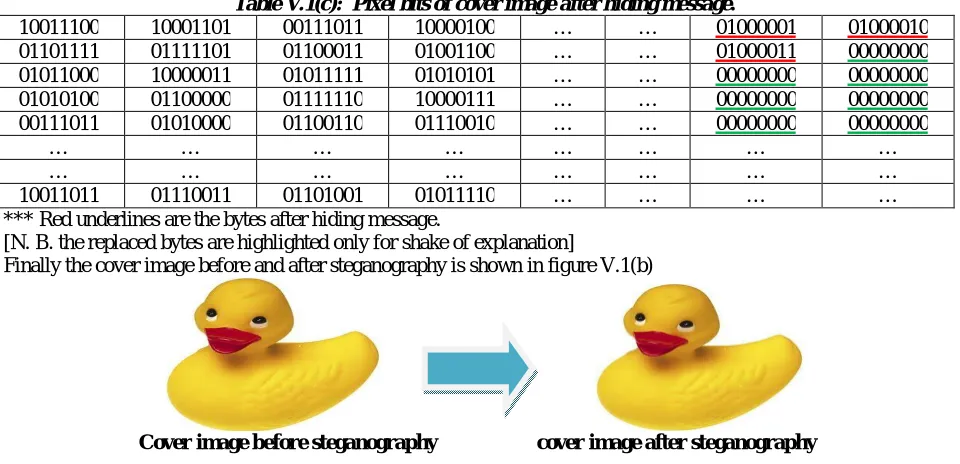
STEP 7: So wetake the first padding byte and we take the first message byte. First message byte is 01000001 First padding byte is 00000000 Now we simply replace the padding byte with the message byte.
ISSN(Online): 2320-9801
ISSN (Print): 2320-9798
International Journal of Innovative Research in Computer
and Communication Engineering
(An ISO 3297: 2007 Certified Organization)
Vol. 4, Issue 10, October 2016
After this, second byte of padding from this row replace by the second message byte.
Then take the third padding byte from the second row and replace it with the third byte of message. We do this until all our message bytes are completed.
Table V.1(c): Pixel bits of cover image after hiding message.
10011100 10001101 00111011 10000100 … … 01000001 01000010 01101111 01111101 01100011 01001100 … … 01000011 00000000 01011000 10000011 01011111 01010101 … … 00000000 00000000 01010100 01100000 01111110 10000111 … … 00000000 00000000 00111011 01010000 01100110 01110010 … … 00000000 00000000
… … … …
… … … …
10011011 01110011 01101001 01011110 … … … … *** Red underlines are the bytes after hiding message.
[N. B. the replaced bytes are highlighted only for shake of explanation]
Finally the cover image before and after steganography is shown in figure V.1(b)
Cover image before steganography cover image after steganography Figure V. 1(b): Cover image before and after steganography
STEP 8: Number of message bit to be hidden is stored in the reserved section (4bytes) of image file header starting from 6th byte to 9th byte.
B. RETRIEVING THE HIDDEN MESSAGE FROM COVER IMAGE STEP 1: Read the new cover image in which the message is hidden.
Figure V. 2(a) Stego image of duck.bmp
Table V. 2(a): Pixel values after steganography
156 141 59 132 … … 65 66 111 125 99 76 … … 67 0
88 131 95 85 … … 0 0 84 96 126 135 … … 0 0 59 80 102 114 … … 0 0
… … … …
… … … …
ISSN(Online): 2320-9801
ISSN (Print): 2320-9798
International Journal of Innovative Research in Computer
and Communication Engineering
(An ISO 3297: 2007 Certified Organization)
Vol. 4, Issue 10, October 2016
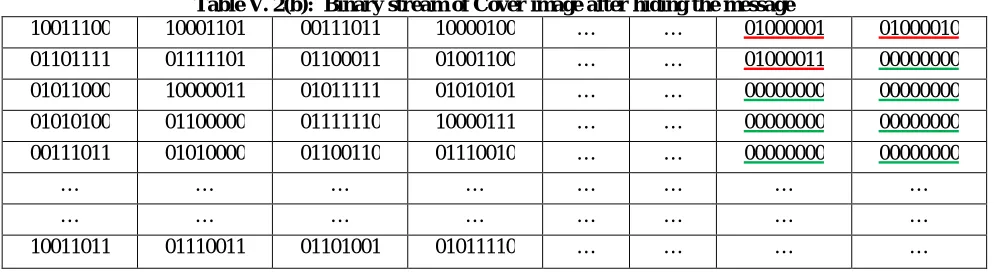
STEP 2: Convert the pixel values into 8 bits of binary stream.
Table V. 2(b): Binary stream of Cover image after hiding the message
10011100 10001101 00111011 10000100 … … 01000001 01000010 01101111 01111101 01100011 01001100 … … 01000011 00000000 01011000 10000011 01011111 01010101 … … 00000000 00000000 01010100 01100000 01111110 10000111 … … 00000000 00000000 00111011 01010000 01100110 01110010 … … 00000000 00000000
… … … …
… … … …
10011011 01110011 01101001 01011110 … … … …
STEP 3: After reading pixel value of each row, we extract only the padding portion and retrieve the message bits from there. Retrieving from the first padding byte of the first row.
0 1 0 0 0 0 0 1
---Repeat this step for each pixel until all message bits are retrieved.
STEP 4: After repeating Step 3all the message bits are retrieved.
0 1 0 0 0 0 0 1 0 1 0 0 0 0 1 0 0 1 0 0 0 0 1 1 STEP 5: Segment the message bits into 8 bits of binary stream. 01000001 01000010 01000011
STEP 6: Convert each segment into their integer value respectively. 01000001 65 01000010 66 01000011 67 STEP 7: Convert the integers into their corresponding character value. 65 A 66 B 67 C
---The original message “ABC” is retrieved.
VI.RESULT AND ANALYSIS
In our algorithm, we applied the Steganography technique for BMP image file. In order to investigate the performance of our algorithm, the algorithm is used in a number of experiments to hide text files of different sizes into various BMP image files. The minimum image pixel for width is at least 150 while the minimum image pixel for height is at least 112. Both cover and stego images are alike with the images with the images those are shown in our previous example with near-zero distortion noticeable by naked eyes. Therefore, this algorithm ia a strong yet robust algorithm to produce
Cover image name
Cover image File size
Text file name
Text file size
Stego image name
Stego image size
Hide message
Retrieve message Name.bmp 60KB text.txt 1KB Namen.bmp 60KB Succeed Succeed Smile.bmp 138KB sml.txt 1KB Smileb.bmp 138KB Succeed Succeed Bird.bmp 153KB bi.txt 1KB Birdf.bmp 153KB Succeed Succeed Fish.bmp 102KB fi.txt 1KB Fishw.bmp 102KB Succeed Succeed Om.bmp 60KB god.txt 1KB Om1.bmp 60KB Succeed Succeed Durga.bmp 1542KB tr.txt 1KB dur.bmp 1.5MB Failed Failed
Sea.bmp 81KB s.txt 1KB Seag.bmp 81KB Succeed Succeed
ISSN(Online): 2320-9801
ISSN (Print): 2320-9798
International Journal of Innovative Research in Computer
and Communication Engineering
(An ISO 3297: 2007 Certified Organization)
Vol. 4, Issue 10, October 2016
1MB then the data hiding process fails. This failure occurs because we are using an array in our coding portion which supports up to array size 32667.
The image file format used in proposed algorithm is focused on bitmap (BMP) format. The BMP file format handles graphics files within the Microsoft Windows OS. Typically, BMP files are uncompressed, hence they are large. The advantage of using BMP files is the simplicity and wide acceptance of BMP files in Windows programs. Thus, this type of image is chosen to be used in our proposed algorithm. Since BMP image has a relatively larger size, the pixels in image are relatively larger as well. Thus, it provides more space for binary codes to be encoded within it. To increase as much as characters that can be hidden, zip technique can be used to reduce to total size of file and to enhance the security of the file. Above Table shows the comparison of different sizes in BMP image by using the proposed steganography algorithm.
VII. CONCLUSION AND FUTURE SCOPE OF PROJECT:
Our conclusion towards this project work is that we have tested the implementation of our proposed algorithm and this algorithm worked correctly for the above set of image files. From this we can assume that algorithm can correctly be implemented for various type and size of file. It will be secured. We have fulfilled our expectation only for BMP image file and it is working correctly. In further research, we are going to use more advance schemes like steganography with some hybrid cryptographic algorithm for enhancing the data security and also we try this algorithm with pixel values.
REFERENCES
[1] Vijay Kumar sharma ,Vishal Shrivastava ; “A Steganography Algorithm For Hiding Image In Image By Improved LSB Substitution By Minimize Detection ” , Journal of Theoretical and Applied Information Technology 15th February 2012. Vol. 36 No.1.. ISSN: 1992-8645; E-ISSN: 1817-3195. [2] Rosziati Ibrahim and Teoh Suk Kuan ; “ Steganography Algorithm To Hide Secret Message Inside An Image ”, Published: February 25, 2011. [3] Hussein Al-Bahadili ; “A Secure Block Permutation Image Steganography Algorithm” ; International Journal on Cryptography and Information Security (IJCIS), Vol.3, No. 3, September 2013.
[4] A. E. Mustafa , A.M.F.ElGamal , M.E.ElAlmi , Ahmed.BD; “A Proposed Algorithm For Steganography In Digital Image Based on Least Significant Bit”; Research Journal Specific Education ; April. 2011.
[5] Andreas Westfeld; Steganographic Algorithm High Capacity Despite Better Steganalysis; I. S. Moskowitz (Ed.): IH 2001, LNCS 2137, pp. 289– 302, 2001.
[6] Nagham Hamid, Abid Yahya, R. Badlishah Ahmad, Dheiaa Najim, Lubna Kanaan; “Steganography in image files: A survey”, Australian Journal of Basic and Applied Sciences, 7(1): 35-55, 2013 ISSN 1991-8178.
[7] Dwayne Phillips; first edition of “Image Processing in C" (Copyright 1994, ISBN 0-13-104548-2) ; was published by R & D Publications. [8] Jasleen Kour, Deepankar Verma; “ Steganography Techniques –A Review Paper”; May 2014 ; ISSN: 2278-9359 (Volume-3, Issue-5).
[9] Aritra Dutta, Souvik Neogi, Prof. Dr Pranam Paul; “Implementation of security through hiding the data within an image with the help of least significant bit replacement”; 2016.
[10] Ramadhan Mstafa, Christian Bach ; “Information Hiding in Images Using Steganography Techniques”; March 14-16, 2013.
[11] Wikipedia, the free encyclopedia.
BIOGRAPHY
Tanima Banerjee, pursuing MCA from Narula Institute of Technology, Agarpara, West Bengal, India. She completed her B.Sc. degree from Jogesh Chandra Chaudhuri College (Kolkata) under the Calcutta University. She completed her 10th and 12th examination from K.V. Fort William and K.V. Asansol respectively.
ISSN(Online): 2320-9801
ISSN (Print): 2320-9798
International Journal of Innovative Research in Computer
and Communication Engineering
(An ISO 3297: 2007 Certified Organization)
Vol. 4, Issue 10, October 2016
Months. After completing the Ph.D., he had joined Narula Institute of Technology in Computer Application Department. He has 39 International Journal Publications among 54 accepted papers in different areas. He is also a reviewer of International Journal of Network Security (IJNS), Taiwan and International Journal of Computer Science Issue (IJCSI); Republic of Mauritius.
Achievements: