NETWORKS
SAQIB ALI
A thesis submitted in fulfilment of the requirements for the award of the degree of
Doctor of Philosophy (Computer Science)
Faculty of Computing Universiti Teknologi Malaysia
ACKNOWLEDGEMENT
Thanks to Almighty ALLAH for providing me the knowledge, guidance and patience to achieve this goal.
My deepest gratitude is to my supervisor, Associate Professor Dr. Md Asri bin Ngadi. I had been amazingly fortunate to have an advisor who gave me the freedom to explore on my own, and at the same time, provide me the guidance, when my steps faltered. His patience and support helped me to complete this thesis.
Next, I would like to thank Assistant Professor Dr. Michele Garetto from Dipartimento di Informatica, Universit`a degli Studi di Torino, Italy for providing me the background knowledge of interference in wireless networks. Special thanks to Assistant Professor Dr. Anjum Naveed from School of Electrical Engineering and Computer Science, National University of Science and Technology, Islamabad, Pakistan and Dr. Zaitul Marlizawati Zainuddin from Faculty of Science, Universiti Teknologi Malaysia, Malaysia who expressed their interest in my work and shared with me their knowledge of optimization, analytical modeling, and evaluation.
My thanks also go to Professor Dr. Norsheila binti Fisal from Center of Excellence UTM-MIMOS, Universiti Teknologi Malaysia and Senior Staff Researcher Dr. Hafizal bin Mohamad from MIMOS BERHAD for providing me facility of using QualNet Simulator. Further, I would like to thank NSF Crest Post-Doctoral Researcher Dr. Mohammad Asadul Hoque from Center for Research on Complex Network, Texas Southern University, USA for providing the technical support on different parts of joint channel assignment algorithms using QualNet.
Last but not least, I would like to express my sincerest and heartiest thanks to my parents and family, for their encouraging attitude unfailing patience and excellent co-operation throughout my research.
ABSTRACT
ABSTRAK
TABLE OF CONTENTS
CHAPTER TITLE PAGE
DECLARATION ii
DEDICATION iii
ACKNOWLEDGEMENT iv
ABSTRACT v
ABSTRAK vi
TABLE OF CONTENTS vii
LIST OF TABLES xii
LIST OF FIGURES xiii
LIST OF ABBREVIATIONS xv
LIST OF SYMBOLS xviii
LIST OF ALGORITHMS xx
LIST OF APPENDICES xxi
1 INTRODUCTION 1
1.1 Overview 1
1.2 Problem Background 1
1.2.1 Components of Wireless Mesh Networks 2 1.2.2 Signal Propagation in Wireless Networks 4
1.2.3 Research Gap 8
1.2.4 Problem Statement 10
1.2.5 Hypothesis 11
1.2.6 Research Questions 11
1.3 Aim 11
1.4 Objectives 12
1.5 Scope 12
1.6 Significance of the Study 13
1.7 Thesis Organization 13
2.1 Overview 14 2.2 Architecture of IEEE 802.11s Standard 15 2.2.1 Components of IEEE 802.11s Standard 15
2.2.2 IEEE 802.11s MAC Protocol 18
2.2.3 Limitations of IEEE 802.11s Standard 19
2.3 Interference Models 19
2.3.1 Physical Model of Interference 20 2.3.2 Protocol Model of Interference 22 2.3.3 Extended Protocol Model of Interference 22 2.3.4 Garetto’s Model of Interfering Links 23 2.3.5 Naveed’s Model of Interfering Links 27 2.3.6 Razak’s Model of Interfering Links 29 2.4 Interference Aware Channel Assignment Schemes 32
2.4.1 Hyacinth 32
2.4.2 Breadth First Search Channel Assignment 33 2.4.3 Probabilistic Channel Usage Based
Chan-nel Assignment 34
2.4.4 Cluster-based Multipath Topology
Con-trol and Channel Assignment 35
2.4.5 Centralized Tabu-based Algorithm 36 2.4.6 Cluster Based Channel Assignment
Scheme 36
2.5 Joint Channel Assignment 40
2.5.1 Advantages of using Joint Channels 42 2.5.2 Joint Channel Assignment Schemes 43
2.5.2.1 Interference Factor 44
2.5.2.2 Interference Matrix 46
2.5.2.3 Channel Overlapping Matrix 48
2.5.2.4 Conflict Graph Model 49
2.6 Network Simulators 50
2.7 Findings of Literature Review 51
2.8 Summary 54
3 RESEARCH METHODOLOGY 55
3.1 Overview 55
3.2 Operational Framework 55
3.2.1 Background, Analysis and Formulation of
3.2.2 Design & Development of Interference Aware Cluster-Based Joint Channel
As-signment Scheme 59
3.2.3 Testing and Performance Evaluation 62
3.3 Assumptions and Limitations 65
3.4 Summary 66
4 INTERFERENCE AWARE NON-OVERLAPPING
CHANNEL ASSIGNMENT MODEL 67
4.1 Overview 67
4.2 Interference Aware Non-Overlapping Channel
As-signment Model 67
4.2.1 Basics of I-NOC model 68
4.2.2 Assumptions 68
4.2.3 Network Model 70
4.2.4 Interference Model 72
4.2.5 Channel Assignment Model 72
4.2.6 I-NOC Model Formulation 74
4.2.7 I-NOC Model 78
4.3 Simulation Setup 81
4.4 AMPL Implementation 83
4.5 Numerical Results 85
4.6 Summary 87
5 INTERFERENCE AWARE JOINT CHANNEL
ASSIGN-MENT MODEL 88
5.1 Overview 88
5.2 Interference Aware Joint Channel Assignment
Model 88
5.2.1 Network Model 90
5.2.2 Interference Model 91
5.2.3 Channel and Interface Assignment Model 91 5.2.4 Channel Overlapping Utilization Model 94
5.2.5 Link Capacity Model 95
5.2.6 I-JCA Model Formulation 96
5.2.7 I-JCA Model 101
5.3 Performance Evaluation 103
5.4.1 Interference Behavior 106
5.4.2 Throughput Behavior 108
5.4.3 Fairness Behavior 109
5.5 Summary 111
6 INTERFERENCE AWARE CLUSTER-BASED JOINT
CHANNEL ASSIGNMENT SCHEME 112
6.1 Overview 112
6.2 Analysis of Garetto’s Model of Interfering Links 113 6.2.1 Impact of Interference on Goodput 114 6.2.2 Impact of Interference on Fairness 118 6.3 Interference Aware Cluster-Based Joint Channel
Assignment Scheme 121
6.3.1 Phase-1 Clustering of Network 122 6.3.2 Phase-2 Intra-Cluster Channel
Assign-ment 126
6.3.3 Phase-3 Inter-Cluster Channel
Assign-ment 129
6.3.4 Phase-4 Intra-Cluster Non-Default
Inter-face Channel Assignment 132
6.4 Evaluation 133
6.4.1 Goodput Improvement of Single-Hop
Flows 134
6.4.2 Goodput Improvement of Multi-Hop
Flows 135
6.4.3 Impact of Traffic Load on Single-Hop
Flows 136
6.4.4 Capacity Fairness of Single-Hop Flows 137
6.5 Summary 139
7 CONCLUSIONS 140
7.1 Overview 140
7.2 Contributions 140
7.2.1 Interference Aware Non-overlapping
Channel Assignment Model 141
7.2.2 Interference Aware Joint Channel
7.2.3 Interference Aware Cluster-Based Joint
Channel Assignment Scheme 142
7.3 Directions for Future Work 143
7.3.1 Dynamic Interference Aware
Cluster-Based Joint Channel Assignment Scheme 143
7.3.2 Topology Control 144
7.3.3 External Interference 144
REFERENCES 145
LIST OF TABLES
TABLE NO. TITLE PAGE
2.1 Comparison of interference aware channel assignment
schemes in wireless mesh networks 39
2.2 Frequencies and channel overlap of IEEE 802.11b standard 41
2.3 I-Factor for IEEE 802.11b standard 44
2.4 Interference range 46
2.5 Interference vector 46
2.6 Interference matrix 47
2.7 Interference matrix modified 48
3.1 AMPL input parameters 63
3.2 Simulation parameters 64
4.1 Notations used in I-NOC model formulation 69
4.2 Input parameters of I-NOC model 79
4.3 Variables of I-NOC model 79
4.4 Simulation parameters for I-NOC model 81
4.5 Output of I-NOC model variables 84
5.1 Notations used in I-JCA model formulation 89
5.2 Input parameters of I-JCA model 102
5.3 Variables of I-JCA model 102
5.4 Simulation parameters of I-JCA model 104
5.5 Classes of SC, AIS, SIS and FH interfering links 105
6.1 Simulation parameters 113
6.2 Communication range of a node 123
6.3 Interfering clusters of a cluster headCH1 124
6.4 Simulation parameters for Hyacinth, BFS-CA, CCAS and
LIST OF FIGURES
FIGURE NO. TITLE PAGE
1.1 Components of wireless mesh network 2
1.2 Channels available in IEEE 802.11b standard 3
1.3 Protocol stack of IEEE 802.11s standard 3
1.4 Propagation behavior of a wireless signal 5
1.5 Garetto’s model of interfering links 8
2.1 Service sets in wireless communication 16
2.2 Hybrid nature of wireless mesh network 17
2.3 Architecture, components and protocol stacks of IEEE
802.11s standard 17
2.4 Channel access techniques of CSMA/CA MAC protocol 18
2.5 Physical model of interference 21
2.6 Protocol model of interference 22
2.7 Extended protocol model of interference 23
2.8 Sender connected interfering links 24
2.9 Asymmetric incomplete state interfering links 25 2.10 Symmetric incomplete state interfering links 26
2.11 Far hidden interfering links 27
2.12 Coordinated interference links 28
2.13 Non-coordinated interfering links 28
2.14 Interfering destinations incomplete state 30
2.15 Senders connected asymmetric interference 31
2.16 Interference models: Time-line and potential influence 31
2.17 Channels in IEEE 802.11b standard 40
2.18 Network connectivity and throughput improvement 43 3.1 Flowchart of the operational framework of research 56 4.1 Mesh routers forming the backbone of a network 70 4.2 Directed topology graph of wireless mesh network 71
4.3 Topology graph of wireless mesh network 76
4.4 Network topology for I-NOC model 81
4.6 Network capacity of CCAS and I-NOC models 85 5.1 Network topology graph of wireless mesh network 90 5.2 Interference range for channel separation|k−k′ | 94
5.3 Network topology of wireless mesh networks 98
5.4 Network topology of WMNs with geometric coordinates 104 5.5 Non-overlapping channel and interface assignment 106
5.6 Joint channel and interface assignment 107
5.7 Throughput improvement by using I-JCA model 108
5.8 Link capacity fairness by using I-JCA and I-NOC models 110 5.9 Channel utilization fairness by using I-JCA and I-NOC
models 110
6.1 Impact of increasing SC interfering links on goodput 114 6.2 Impact of increasing SC, AIS, SIS, and FH interfering links
on aggregate goodput 116
6.3 Impact of increasing SC, AIS, SIS, and FH interfering links
on average goodput 117
6.4 Impact of SC and AIS interfering links on the fairness of
goodput 118
6.5 Impact of SC and SIS interfering links on the fairness of
goodput 119
6.6 Impact of SC and FH interfering links on the fairness of
goodput 120
6.7 Clustering of wireless mesh network 122
6.8 Interfering clusters regarding the target cluster 123 6.9 Channel assignment in far interfering clusters 126 6.10 Channel assignment in near interfering clusters 127
6.11 Inter-cluster links in a topology 129
6.12 Inter-cluster channel assignment 131
6.13 Goodput improvement of single hop flows 134
6.14 Goodput improvement of multi-hop flow 136
6.15 Aggregate goodput of single-hop flows with increasing traffic
load 137
LIST OF ABBREVIATIONS
ACK – Acknowledgment
AIS – Asymmetric Incomplete State
AOMDV – Ad-hoc On demand Multi-path Distance Vector BFS-CA – Breadth First Search Channel Assignment
BSS – Basic Service Set
CA – Channel Assignment
CAEPO – Channel Assignment Exploiting Partially Overlapping Channels
CAEPO-G – Load-Aware Channel Assignment Exploiting Partially Overlapping Channels
CAS – Channel Assignment Server
CBR – Constant Bit Rate
CCAS – Cluster based Channel Assignment Scheme
CG – Conflict Graph
CG-Model – Conflict Graph Model
CLICA – Connected Low Interference Channel Assignment
COASTS – Coalition Operating Area Surveillance and Targeting System CO-Matrix – Channel Overlapping Matrix
CoMTaC – Cluster-based Multipath Topology control and Channel assignment
CSMA/CA – Carrier Sense Multiple Access with Collision Avoidance CTA – Centralized Tabu-based Algorithm
CTS – Clear To Send
DCF – Distributed Coordination Function DIFS – DCF Inter-Frame Space
ESS – Extended Service Set
ETT – Expected Transmission Time
FH – Far Hidden
IBSS – Independent Basic Service Set
I-CJCAS – Interference aware Cluster-Based Joint Channel Assignment Scheme
IDIS – Interfering Destinations Incomplete State IEEE – Institute of Electrical and Electronics Engineers I-Factor – Interference Factor
I-JCA – Interference aware Joint Channel Assignment I-Matrix – Interference Matrix
I-NOC – Interference aware Non-Overlapping Channel assignment INSTC – Minimum Interference Survivable Topology Control ISM – Industrial, Scientific and Medical
LP – Linear Programming
MAC – Medium Access Control
MANETs – Mobile Ad hoc Networks Mbps – Megabits per second
MC – Multiple Channels
MCG – Multi Conflict Graph MC-MR – Multi-channel Multi-radio
MICA – Minimum Interference for Channel Allocation MILP – Mixed Integer Linear Programming
MIMO – Multiple Input, Multiple Output
MR – Multiple Radios
NAV – Network Allocation Vector NOCs – Non-Overlapping Channels
NS – Network Simulator
OFDM – Orthogonal Frequency Division Multiplexing OLPC – One Laptop per Child
PCF – Point Coordination Function
PCU-CA – Probabilistic Channel Usage based Channel Assignment POCs – Partially Overlapping Channels
QoS – Quality of Service
RSSI – Received Signal Strength Intensity
RTS – Request To Send
SC – Sender Connected
SCSI – Senders Connected Symmetric Interference SC-SR – Single-Channel Single-Radio
SDP – Semi Definite Program
SINR – Signal to Interference and Noise Ratio SIS – Symmetric Incomplete State
UDP – User Datagram Protocol VANETs – Vehicular Ad-hoc Networks
VoIP – Voice over IP
Wi-Fi – Wireless Fidelity
WiMAX – Worldwide Interoperability for Microwave Access WLAN – Wireless Local Area Network
LIST OF SYMBOLS
G – Directed network topology graph
N – Set of nodes
L – Set of edges or links
T – Time interval
dist(i, j) – Euclidean distance between nodeiandj tx – Transmission power of a nodei
l(i,j) – Link or edge between nodeiandj Rt – Transmission range of a node Rcs – Carrier sensing range of a node K – Set of available channels
k – Channel number used by the linkl(i,j)
|k−k′| – Extent of channel overlap between the frequency channelsk
andk′
Γn – Total number of radio interface installed on a noden τi – Set of links incident on a nodei
Ck
max – Maximum capacity of channelk Ck
l(i,j) – Actual capacity of linkl(i,j) while operating on channelk
during a given time durationT Uk
l(i,j) – Total data traffic load that needs to be transmitted by the
transmitter of a linkl(i,j)when it operates on a channelkduring a given time durationT
γl(i,j) – Portion of the total traffic load actually transmitted by the link l(i,j)during time intervalT
Zk
l(i,j) – Actual data traffic load transmitted by the linkl(i,j) when it
operates on a channelkduring time intervalT Πk
SC(l(i,j)) – Set of Sender Connected Interfering Links of a target linkl(i,j)
while operating on channelk Πk
AIS(l(i,j)) – Set of Asymmetric Incomplete State Interfering Links of a
Πk
SIS(l(i,j)) – Set of Symmetric Incomplete State Interfering Links of a target
linkl(i,j)while operating on channelk Πk
F H(l(i,j)) – Set of Far Hidden Interfering Links of a target linkl(i,j)while
operating on channelk Π(k,AIS(l|k−k′|)
(i,j)) – Asymmetric Incomplete State interfering links of a target link
l(i,j)operating on channelkin interference range of|k−k′| Π(k,SIS(l|k−(k′|)
i,j)) – Symmetric Incomplete State interfering links of a target link
l(i,j)operating on channelkin interference range of|k−k′|
Π(k,F H(l|k−k′|)
(i,j)) – Far Hidden interfering links of a target linkl(i,j) operating on
LIST OF ALGORITHMS
ALGO. NO. TITLE PAGE
1 Algorithm for Garetto’s model of interfering links 82 2 Interference aware cluster-based joint channel assignment
scheme 121
3 Phase-1 Clustering of network 125
4 Phase-2 Intra-cluster channel assignment 128
5 Phase-3 Inter-cluster channel assignment 130
6 Phase-4 Intra-cluster Non-default interface channel
LIST OF APPENDICES
APPENDIX TITLE PAGE
A Matlab code for Garetto’s Model of interfering links 155 B QualNet configuration files to analyze Garetto’s model of
interfering links. 161
C QualNet configuration files for channel assignment schemes 173
INTRODUCTION
1.1 Overview
Over the recent years, wireless nodes are popping up everywhere and are becoming more popular. Wireless mesh network is a cost effective, multi hop solution to provide the Internet connectivity to this large number of wireless nodes. Practical and extensive deployments of wireless mesh network are the target of several research studies. The motivation behind this research is to address this goal by developing a practical wireless solution to improve the performance of the network. The main focus of this research is to address the problems of interference and channel assignment which have a critical effect on the performance of the network. This research helps in the enhancement of network capacity by developing an interference aware cluster-based joint channel assignment scheme for wireless mesh networks.
1.2 Problem Background
1.2.1 Components of Wireless Mesh Networks
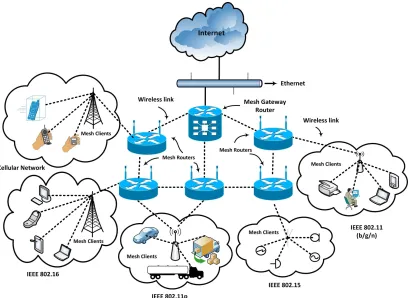
The components of WMNs consist of Mesh Gateway Routers, Mesh Routers and Mesh Clients (Carrano et al., 2011). The components of wireless mesh networks are shown in Figure 1.1. Mesh gateway routers are outfitted with bridging and routing functionality. Thus, provide the Internet connectivity to the network and carry traffic in and out of the mesh network. Mesh routers are interconnected through multi-hop wireless links, and form the backbone of the network. Mesh routers are almost static in nature with no power constraints. Mesh routers are equipped with multiple radios. Each radio has its own MAC and Physical layer, which increases the throughput potentially by a factor equal to the number of radios on each node (Benyamina et al., 2012). Non-Overlapping Channels (NOCs) present in a single radio are further used to increase the throughput of the network. For example, IEEE 802.11b standard splits the frequency into 11 channels, out of which 3 are NOCs as shown by the solid lines in Figure 1.2. Thus, multiple radios (MR) with multiple channels (MC) are available between the source and destination pairs, to increase throughput of the network (Avallone and Akyildiz, 2008; Li et al., 2009).
Figure 1.2: Channels available in IEEE 802.11b standard
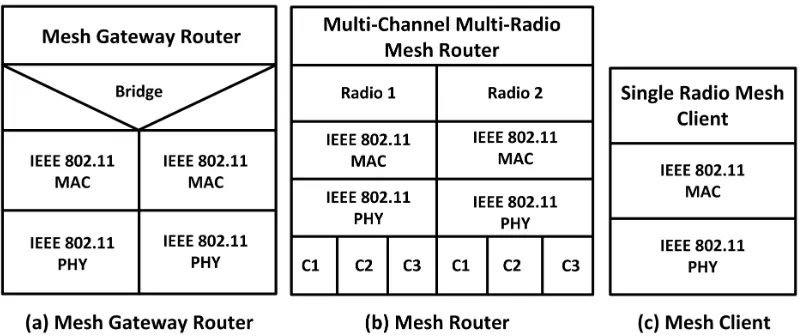
The multi-channel multi-radio (MC-MR) architecture of wireless mesh network is defined by IEEE 802.11s standard (Wang and Lim, 2008). Figure 1.3 (a) indicates the protocol stack of mesh gateway router with bridging and router functionality which allow them to incorporate with different wired and wireless networks like Ethernet, Mobile Ad hoc Networks (MANETS), Wireless Sensor Networks (WSNs), Wireless-Fidelity (Wi-Fi), Vehicular Ad hoc Networks (VANETs), and Worldwide Interoperability for Microwave Access (WiMAX) (Hiertz et al., 2010). The protocol stack of MC-MR mesh router is shown in Figure 1.3 (b). Each mesh router is equipped with two radios: Radio-1 and Radio-2. Each radio has its own MAC and Physical layer. The transmission is carried out by three NOCs (C1, C2 and C3) available in free spectrum. Consequently, MC-MR architecture of mesh router increases the overall performance of the network as compared to channel single-radio (SC-SR) architecture. Multi single-radios available in a mesh router also assist in the interoperability of WMNs with other networks like WSNs, VANETs, WiMAX, and cellular network as shown in Figure 1.1. Mesh clients are end user devices in the network i.e., laptops, tablet computers, IP and smart phones (Li et al., 2010). The protocol stack of a single radio mesh client is shown in Figure 1.3 (c).
The famous deployments of WMNs include One Laptop Per Child (OLPC) association (OLPC, 2012), National ICT Australia (NICTA) (NICTA, 2012), and Coalition Operating Area Surveillance and Targeting System (COASTS) by MESH Dynamics (MeshDynamics, 2012). Moreover, the search giant Google is deploying wireless mesh network in central cities of US with the help of a privately owned company Meraki (Meraki, 2013).
The foremost challenge encountered in deploying wireless mesh network is the interference present between the links which are in close proximity of each other’s communication range. Such links are known as co-located interfering links, which limit the throughput performance of the network. As a result, scalability, capacity and QoS parameters are highly degraded in single frequency WMNs (Ashraf et al., 2012). This is because wireless network used a shared medium for communication while communication in wired network took place through a dedicated medium. The shared nature of communication medium made the lower abstraction layers of wireless network extremely multifarious as compared to a wired network (Bouckaert et al., 2010). The MC-MR communication architecture of WMNs has further increased the complexity of MAC and Physical layers. Moreover, the bandwidth and number of channels are limited in a wireless network; hence interference is unavoidable, resulting in the degradation of the throughput of the network (Ding et al., 2012a, 2013).
1.2.2 Signal Propagation in Wireless Networks
In a wireless network, the signal propagation is Omni-directional. The rate of successful transmission of signals in wireless communication is highly dependent on the distance between the source node and the destination node of a link. The Received Signal Strength Intensity (RSSI) is directly proportional to 1/d2 whereas d is the distance between the source node and the destination node of a link in a given network topology (Schiller, 2003). On the basis of RSSI, the propagation behavior of the signal in wireless communication is classified as follows:
i. Transmission Range
the transmission range of wireless node A is encircled by the innermost solid circle. Any node located within this circle is considered within the transmission range of wireless node A. Hence, the packet sent by the source node A can be easily received at the destination node B with an error rate low enough to be able to communicate with each other (Lee et al., 2009). Normally, the transmission range of a node is indicated byRt.
ii. Carrier Sensing Range
The carrier sensing range of a wireless node A is the distance from the node such that another wireless node C within this distance can sense the radio activity (not necessarily correctly received the data) of node A. Thus, node C backs-off itself randomly, when the sender node A has a transmission of packets of its own (Garetto et al., 2008). The carrier sensing range of a wireless node A is shown by the middle dash circle in Figure 1.4. The carrier sensing range of a node is denoted byRcs.
iii. Interference Range
The nodes A and D are outside the carrier sensing range of one another can transmit packets simultaneously. Suppose node A is transmitting packets to node B. The interference range is defined by all possible locations of node D that discard some of packets transmitted by node A towards the node B. This is because the signal strength of a node A at node B, does not go beyond node D’s signal strength at node B by some capture able threshold level. Therefore, node A’s packets are lost at the node B (Alawieh et al., 2009). The interference range Ri is shown by the dash dot circle in Figure 1.4.
Overall throughput of WMNs depends on the bandwidth or capacity of the links between the source and the destination pair, channel assignment techniques, and level of interference present between the channels. The interference is a critical restraining factor and is extraordinarily complicated to handle in WMNs. Therefore, the effect of interference on link throughput should be well thought-out for realistic routing models, channel assignment schemes, topology control, and network diagnosis in wireless mesh network (Naveed and Kanhere, 2009).
Interference affects both the sender and receiver node of a wireless link. On the sender or source side, the data sending rate decreases by Carrier Sense Multiple Access with Collision Avoidance (CSMA/CA) based Medium-Access Control (MAC) layer interaction. On the receiver or destination side, interference causes collisions which result in the degradation of overall throughput of the link (Alotaibi et al., 2010). For example, consider a channel with capacity equal to X Mbps. If there are N interfering links present in the network then the capacity of the channel is distributed amongst the interfering links and each link can only achieve the bandwidth of≈ X
N (assuming equal sharing of throughput among links). Moreover, when random access CSMA/CA MAC protocol is employed, the senders of more than one interfering links can start its transmission simultaneously. This will result in the collision of transmitted data, and the transmission opportunity is lost for the active links. Consequently, the achievable throughput of each link is further decreased.
The overall capacity of WMNs can be improved significantly by deploying MC-MR architecture as compared to SC-SR architecture. The use of multiple channels can decrease the effect of interference present between the communication links (Kyasanur and Vaidya, 2005). However, the channel assignment on the basis of interference present between multiple co-located channels becomes critical due to the following constraints:
i. Limited Radio Interfaces per Node
ii. Limited Frequency Channels
Only limited numbers of channels are available in free ISM spectrum. This is because of technical facts or government regulations regarding the radio spectrum. For example in US, IEEE 802.11b radio spectrum is divided into 11 channels with 25 MHz frequency spacing (IEEE 802.11b standard, 1999). Only three channels 1, 6, and 11 are NOCs, which are used to overcome the interference present between the links. Thus, it is not possible to operate all interfering links on distinct NOCs. Consequently, the interference cannot be entirely eliminated from the wireless mesh network (Duarte et al., 2012). iii. Network Connectivity
The channel assignment schemes sometimes partitioned the network into disconnected Wi-Fi islands. A link is only possible between two nodes if nodes are physically placed within the transmission range of each other and are operating on a common channel. Otherwise, the logical topology of WMNs may differ from the physical topology. Therefore, the design of the channel assignment scheme is such that it ensures that there exist multiple paths between the nodes in the logical topology of the network. Further, the number of channels assigned to a node should be less than or equal to the number of radio interfaces installed on that node (Awwad et al., 2012).
iv. Fairness
The fair distribution of the network capacity is the key feature of the channel assignment schemes in wireless mesh network. Otherwise, the channel assignment schemes cause bottleneck links in the network which degrade the overall performance of the network (Abouaissa et al., 2013).
v. Interference Model
1.2.3 Research Gap
Interference is mitigated by assigning distinct channels to the co-located interfering links in the network. Such channel assignment strategies are known as interference aware channel assignment schemes. As surveyed by Skalli et al. (2007), most of the interference aware channel assignment schemes available in the literature, are based on the Physical model of interference (Gupta, 2000), Protocol model of interference (Gupta, 2000), and Extended protocol model of interference (Tang et al., 2005). However, Iyer et al. (2009) indicated that these models do not capture the effect of interference between the links precisely. This is because the behavior of CSMA/CA MAC protocol of IEEE 802.11 standard is not analyzed properly as mentioned by Bianchi (2000). Therefore, Garetto et al. (2005, 2008) based on the findings of Bianchi (2000), modeled the media access in embedded two-flow topologies of multi-hop wireless networks. Garetto’s model of interfering links concluded that the impact of interference on the throughput of a link varies with the relative geometric location (relative physical position) of the sender and receiver of interfering links. Therefore, two links l1(i1,j1) and l2(i2,j2) act as an interfering links if any of the Euclidean distancesdist(i1, i2),dist(i1, j2),dist(i2, j1), anddist(j1, j2)≤RCS. The model classifies the interfering links into four different classes as shown in Figure 1.5. These classes are explained as follows:
i. Sender Connected (SC) Interfering Links
Two linksl1(i1,j1) andl2(i2,j2) are said to be SC interfering links if the Euclidean distance dist(i1, i2) ≤ Rcs as shown in Figure 1.5 (a). This means that the senders of the two links are within the carrier sensing range of each other, and can sense the transmission activity of each other. Hence, there is no problem of short term unfairness or long term unfairness in SC scenarios.
ii. Asymmetric Incomplete State (AIS) Interfering Links
Two links l3(i3,j3) and l4(i4,j4) are said to be AIS interfering links if the Euclidean distancedist(i3, i4)> Rcsanddist(j3, i4)≤Rcs (the receiver ofl3 is within the carrier sensing range of the sender of l4) and dist(j4, i3) > Rcs (the receiver ofl4is outside the carrier sensing range of the sender ofl3) as shown in Figure 1.5 (b). This means that only one of the senderi3ori4 interferes with the other destination and only one of the flows experiences collisions.
iii. Symmetric Incomplete State (SIS) Interfering Links
Two links l5(i5, j5) and l6(i6,j6) are said to be SIS interfering links if the Euclidean distance dist(i5, i6) > Rcs anddist(j5, i6) ≤Rcs anddist(j6, i5) ≤ Rcs (the receivers ofl5 andl6 are within the carrier sensing range of the sender ofl6andl5, respectively) as shown in Figure 1.5 (c). This means that the senders of the two target links are not connected, and either one or both of the senders can interfere with the other receivers. Therefore, SIS interfering scenarios are long term fair, but short term unfair.
iv. Far Hidden (FH) Interfering Links
Two links l7(i7, j7) and l8(i8, j8) are said to be Far Hidden Interfering Links (FH) if the Euclidean distancedist(i7, i8)> Rcs (the senders of the two links are outside the carrier sensing range of each other),dist(j7, i8)> Rcs,dist(j8, i7)> Rcs, (the receivers ofl7 andl8 are outside the carrier sensing range of senders of l8 and l7, respectively), and dist(j7, j8)≤Rcs (the two receivers are within the carrier sensing range of each other) as shown in Figure 1.5 (d).
and mitigates the effect of interference by utilizing NOCs. The results conclude that the scheme gives a better picture of link quality in sparse topology. However, in dense topology, co-located links classified into two classes and operating on common NOCs again cause interference in the network. As a result, overall throughput of the network is degraded. Similarly, Alotaibi et al. (2010) classified the interfering links in two classes, based on the geometric position of the sender and receiver of a link. However, it experiences same limitations as mentioned in CCAS scheme.
The aim of this research is to overcome the limitations of existing channel assignment schemes based on the geometric location of the sender and receiver. Therefore, this work is based on the findings of Garetto et al. (2005, 2008) by classifying the co-located links exactly into SC, AIS, SIS and FH interfering links. Further, the clustering is used to identify the SC, AIS, SIS and FH interfering links in a given network topology (Naveed and Kanhere, 2009). This will escalate the correctness in capturing the interference present between the links. The effect of interference is mitigated by operating the interfering links on distinct channels. Unfortunately, NOCs are limited in nature. Therefore, the scarcity of NOCs is overcome by assigning joint channels (non-overlapping and partially overlapping channels) to co-located interfering links. However, joint channel assignment needs a systematic optimized approach for utilizing the spectral re-usability of all channels. Otherwise, it degrades the overall capacity of the network as indicated by the testbed results of Mishra et al. (2005a). Therefore, this research targets to design and develop an optimized structured approach for utilizing the joint channels available in a free spectrum, in mitigating the interference present between the co-located links of a wireless mesh network. It reduces the level of interference between the links, which in turn increases the spectral re-usability and parallel communication between the links. As a result, overall performance of the network increased.
1.2.4 Problem Statement
1.2.5 Hypothesis
The above problem statement leads to the following hypothesis:
The throughput of the mesh network can be increased significantly if the interfering links are classified on the basis of geometric location of the sender and receiver of links. Afterwards, joint channel assignment is used to mitigate the interference between the links while satisfying the capacity and connectivity constraints of the network.
1.2.6 Research Questions
The above research hypothesis leads to the following research questions:
i. How to design and develop an optimized interference aware non-overlapping channel assignment model in a wireless mesh network?
ii. How to design and develop an optimized interference aware joint channel assignment model in a wireless mesh network?
iii. How to design and develop an interference aware cluster-based joint channel assignment scheme in a wireless mesh network?
iv. How to test and validate the proposed models and joint channel assignment scheme with most widely used approaches in terms of throughput, fairness, channel utilization, and impact of traffic load?
1.3 Aim
1.4 Objectives
The following objectives are in place to design and develop interference aware cluster-based joint channel assignment scheme in wireless mesh network.
i. To design and develop an optimized interference aware non-overlapping channel assignment model in a wireless mesh network.
ii. To design and develop an optimized interference aware joint channel assignment model in a wireless mesh network.
iii. To design and develop an interference aware cluster-based joint channel assignment scheme in a wireless mesh network.
iv. To test and evaluate the performance of proposed models and interference aware cluster-based joint channel assignment scheme with most widely used methods in terms of standard performance indicators such as throughput, fairness, channel utilization, and impact of traffic load.
1.5 Scope
The scope of this research covers the following points:
i. The proposed models and scheme are validated with the assumption that mesh routers are static in nature. Each mesh router is equipped with multiple radio interfaces. TheRtandRcs of the radios are fixed, andRcs is twice that ofRtof the radio interface.
ii. The external interference experienced by the links from co-located wireless network deployments is not under consideration.
iii. The position of cluster heads is known to the channel assignment server running parallel to mesh gateway router. The location of remaining nodes in the mesh network does not matter. Further, the positioning of the mesh gateway router is not under consideration.
1.6 Significance of the Study
Interference is a key factor which degrades the overall capacity of wireless mesh network. The Physical and Protocol model of interference respond contradictory to CSMA/CA MAC protocol. Consequently, in the proposed scheme, interference is quantified on the basis of geometric location of the sender and receiver of a link. The existing channel assignment schemes used NOCs, to overcome the interference present between the links. Unfortunately, NOCs are limited in number, therefore, cannot handle the interference significantly. Therefore, spectral re-usability of joint channels is used to overcome the interference between the co-located links. It has increased the parallel communication between the interfering links. Thus, it increases the overall throughput of the network while satisfying the connectivity and fairness constraints of the network. The proposed scheme can serve as a benchmark in relay node placement, channel assignment, and topology control schemes in the wireless mesh network.
1.7 Thesis Organization
Abouaissa, A., Brahmia, M.-e.-A. and Lorenz, P. (2013). Increasing end-to-end fairness over IEEE 802.11e-based wireless mesh networks. International Journal of Communication Systems. 26(1), 1–12.
Akyildiz, I. and Wang, X. (2008). Cross-Layer Design in Wireless Mesh Networks. IEEE Transactions on Vehicular Technology. 57(2), 1061–1076.
Alawieh, B., Zhang, Y., Assi, C. and Mouftah, H. (2009). Improving Spatial Reuse in Multihop Wireless Networks - A Survey. IEEE Communications Surveys & Tutorials. 11(3), 71–91.
Alicherry, M., Bhatia, R. and Li, L. E. (2005). Joint channel assignment and routing for throughput optimization in multi-radio wireless mesh networks. In Proceedings of the 11th annual international conference on Mobile computing and networking. MobiCom 2005. Cologne, Germany, 58–72.
Alocci, I., Murphy, S., Nafaa, A. and Murphy, J. (2008). Development of an IEEE 802.11 s Simulation Model for QualNet. NAEC2008/ATSMA.
Alotaibi, E., Ramamurthi, V., Batayneh, M. and Mukherjee, B. (2010). Interference-aware routing for multi-hop Wireless Mesh Networks. Computer Communications. 33(16), 1961–1971.
Amaldi, E., Capone, A., Cesana, M., Filippini, I. and Malucelli, F. (2008). Optimization models and methods for planning wireless mesh networks. Computer Networks. 52(11), 2159–2171.
Annese, S., Casetti, C., Chiasserini, C.-F., Di Maio, N., Ghittino, A. and Reineri, M. (2011). Seamless Connectivity and Routing in Vehicular Networks with Infrastructure. IEEE Journal on Selected Areas in Communications. 29(3), 501– 514.
Ashraf, U., Abdellatif, S. and Juanole, G. (2012). Interference-Aware Bandwidth Reservation in multi-radio multi-channel mesh networks. Computer Communications. 35(17), 2138–2149.
Awwad, O., Al-Fuqaha, A., Khan, B. and Ben Brahim, G. (2012). Topology Control Schema for Better QoS in Hybrid RF/FSO Mesh Networks. IEEE Transactions on Communications. 60(5), 1398–1406.
Bahl, P., Adya, A., Padhye, J. and Walman, A. (2004). Reconsidering wireless systems with multiple radios. ACM SIGCOMM Computer Communication Review. 34(5), 39–46.
Benyamina, D., Hafid, A. and Gendreau, M. (2012). Wireless Mesh Networks Design-A Survey. IEEE Communications Surveys & Tutorials. 14(2), 299–310.
Bianchi, G. (2000). Performance analysis of the IEEE 802.11 distributed coordination function. IEEE Journal on Selected Areas in Communications. 18(3), 535–547. Bokhari, F. and Z´aruba, G. (2012). Wireless Mesh Networks - Efficient Link
Scheduling, Channel Assignment and Network Planning Strategies. InTech 2012. Bouckaert, S., De Poorter, E., Latr, B., Hoebeke, J., Moerman, I. and Demeester, P.
(2010). Strategies and Challenges for Interconnecting Wireless Mesh and Wireless Sensor Networks. Wireless Personal Communications. 53, 443–463.
Bukkapatanam, V., Franklin, A. and Murthy, C. (2009). Using Partially Overlapped Channels for End-to-End Flow Allocation and Channel Assignment in Wireless Mesh Networks. In IEEE International Conference on Communications. ICC 2009. Dresden, Germany, 1–6.
Cardieri, P. (2010). Modeling Interference in Wireless Ad Hoc Networks. IEEE Communications Surveys & Tutorials. 12(4), 551–572.
Carrano, R., Magalha andes, L., Saade, D. and Albuquerque, C. (2011). IEEE 802.11s Multihop MAC: A Tutorial. IEEE Communications Surveys & Tutorials. 13(1), 52– 67.
Cavalcanti, D., Agrawal, D., Cordeiro, C., Xie, B. and Kumar, A. (2005). Issues in integrating cellular networks, WLANs, and MANETs: A futuristic heterogeneous wireless network. IEEE Wireless Communications. 12(3), 30–41.
Cui, Y., Li, W. and Cheng, X. (2011). Partially overlapping channel assignment based on node orthogonality for 802.11 wireless networks. In IEEE Proceedings. INFOCOM 2011. Shanghai, China, 361–365.
Ding, Y., Huang, Y., Zeng, G. and Xiao, L. (2012a). Using Partially Overlapping Channels to Improve Throughput in Wireless Mesh Networks. IEEE Transactions on Mobile Computing. 11(11), 1720–1733.
Computing. 12(2), 206–218.
Ding, Y., Yang, Y. and Xiao, L. (2012b). Multisource Video On-Demand Streaming in Wireless Mesh Networks. IEEE-ACM Transactions on Networking. 20(6), 1800– 1813.
Draves, R., Padhye, J. and Zill, B. (2004). Routing in multi-radio, multi-hop wireless mesh networks. In Proceedings of the 10th annual international conference on Mobile computing and networking. MobiCom 2004. Philadelphia, USA, 114–128.
Drieberg, M. (2010). Channel assignment strategies for throughput enhancement in high density wireless local area networks. Ph.D. Thesis. Centre for Telecommunications and Micro-Electronics, Faculty of Health, Engineering and Science, Victoria University, Melbourne, Australia.
Duarte, P., Fadlullah, Z., Hashimoto, K. and Kato, N. (2010). Partially Overlapped Channel Assignment on Wireless Mesh Network Backbone. In IEEE Global Telecommunications Conference. IEEE GLOBECOM 2010. Miami, FL, USA, 1–5.
Duarte, P., Fadlullah, Z., Vasilakos, A. and Kato, N. (2012). On the Partially Overlapped Channel Assignment on Wireless Mesh Network Backbone: A Game Theoretic Approach. IEEE Journal on Selected Areas in Communications. 30, 119– 127.
Feng, Z. and Yang, Y. (2008a). Characterizing the impact of partially overlapped channel on the performance of wireless networks. In Global Telecommunications Conference. IEEE GLOBECOM 2008. New Orleans, LA, USA, 1–6.
Feng, Z. and Yang, Y. (2008b). How Much Improvement Can We Get From Partially Overlapped Channels? In IEEE Wireless Communications and Networking Conference. WCNC 2008. Las Vegas, Nevada, USA, 2957–2962.
Fourer, R., Gay, D. M. and Kernighan, B. W. (2002). AMPL: A Modeling Language for Mathematical Programming. Duxbury Press.
Garetto, M., Salonidis, T. and Knightly, E. (2008). Modeling per-flow throughput and capturing starvation in CSMA multi-hop wireless networks. IEEE/ACM Transactions on Networking. 16(4), 864–877.
Garetto, M., Shi, J. and Knightly, E. W. (2005). Modeling media access in embedded two-flow topologies of multi-hop wireless networks. In Proceedings of the 11th annual international conference on Mobile computing and networking. MOBICOM 2005. Cologne, Germany, 200–214.
of the ACM (JACM). 42(6), 1115–1145.
Gonzalez, T. F. (1985). Clustering to minimize the maximum intercluster distance. Theoretical Computer Science. 38, 293–306.
Gupta, K. P., P. (2000). The capacity of wireless networks. IEEE Transactions on Information Theory. 46(2), 388–404.
Hertz, A. and Werra, D. d. (1987). Using tabu search techniques for graph coloring. Computing. 39(4), 345–351.
Hiertz, G., Denteneer, D., Max, S., Taori, R., Cardona, J., Berlemann, L. and Walke, B. (2010). IEEE 802.11s: The WLAN Mesh Standard. IEEE Wireless Communications. 17(1), 104–111.
Hoque, M. A. and Hong, X. (2009). Interference minimizing channel assignment using partially overlapped channels in multi-radio multi-channel wireless mesh networks (non-refereed). In Proceedings of IEEE Southeastcon 2009. Atlanta, GA, USA, 445.
IEEE 802.11a standard (1999). IEEE Standard for Information Technology-Telecommunications and Information Exchange Between Systems - Local and Metropolitan Area Networks - Specific Requirements. Part 11: Wireless LAN Medium Access Control (MAC) and Physical Layer (PHY) Specifications: High-Speed Physical Layer in the 5 GHz Band.
IEEE 802.11b standard (1999). IEEE Standard for Information Technology-Telecommunications and Information Exchange Between Systems- Local and Metropolitan Area Networks- Specific Requirements- Part 11: Wireless LAN Medium Access Control (MAC) and Physical Layer (PHY) Specifications: Higher-Speed Physical Layer Extension in the 2.4 GHz Band.
IEEE 802.11s standard (2011). IEEE Standard for Information Technology– Telecommunications and information exchange between systems–Local and metropolitan area networks–Specific requirements Part 11: Wireless LAN Medium Access Control (MAC) and Physical Layer (PHY) specifications Amendment 10: Mesh Networking.
ILOG-IBM (2013). ILOG CPLEX 11.0 Users Manual.<http://www.ilog.com/
products/cplex/>.
Jain, K., Padhye, J., Padmanabhan, V. N. and Qiu, L. (2005). Impact of Interference on Multi-Hop Wireless Network Performance. Wireless Networks. 11, 471–487. Jurdak, R., Nafaa, A. and Barbirato, A. (2008). Large Scale Environmental Monitoring
through Integration of Sensor and Mesh Networks. SENSORS. 8(11), 7493–7517. Kas, M., Yargicoglu, B., Korpeoglu, I. and Karasan, E. (2010). A Survey
on Scheduling in IEEE 802.16 Mesh Mode. IEEE Communications Surveys & Tutorials. 12(2), 205–221.
Khattak, R., Chaltseva, A., Riliskis, L., Bodin, U. and Osipov, E. (2011). Comparison of Wireless Network Simulators with Multihop Wireless Network Testbed in Corridor Environment. In Wired/Wireless Internet Communications. (pp. 80–91). vol. 6649. Springer Berlin Heidelberg.
Kolar, V., Bharath, K., Abu-Ghazaleh, N. B. and Riihijarvi, J. (2009). Contention in multi-hop wireless networks: model and fairness analysis. In Proceedings of the 12th ACM international conference on Modeling, analysis and simulation of wireless and mobile systems. MSWiM 2009. 21–29.
Ku, C.-Y., Lin, Y.-D., Tsao, S.-L. and Lai, Y.-C. (2011). Utilizing Multiple Channels With Fewer Radios in Wireless Mesh Networks. IEEE Transactions on Vehicular Technology. 60(1), 263–275.
Kumar, N., Kumar, M. and Patel, R. (2011). Capacity and interference aware link scheduling with channel assignment in wireless mesh networks. Journal of Network and Computer Applications. 34(1), 30 – 38.
Kurkowski, S., Camp, T. and Colagrosso, M. (2005). MANET simulation studies: the incredibles. SIGMOBILE Mobile Computing and Communications Review. 9(4), 50–61.
Kyasanur, P. and Vaidya, N. H. (2005). Capacity of multi-channel wireless networks: impact of number of channels and interfaces. In Proceedings of the 11th annual international conference on Mobile computing and networking. MOBICOM 2005. Cologne, Germany, 43–57.
Kyasanur, P. and Vaidya, N. H. (2006). Routing and link-layer protocols for multi-channel multi-interface ad hoc wireless networks. ACM SIGMOBILE Mobile Computing and Communications Review. 10(1), 31–43.
Lee, J., Lee, S.-J., Kim, W., Jo, D., Kwon, T. and Choi, Y. (2009). Understanding interference and carrier sensing in wireless mesh networks. IEEE Communications Magazine. 47(7), 102–109.
O. (2010). Broadband Internet Access via Multi-Hop Wireless Mesh Networks: Design, Protocol and Experiments. Wireless Personal Communications, 1–23. Li, P., Scalabrino, N., Fang, Y., Gregori, E. and Chlamtac, I. (2009). How to Effectively
Use Multiple Channels in Wireless Mesh Networks. IEEE Transactions on Parallel and Distributed Systems. 20(11), 1641–1652.
Liu, Y., Venkatesan, R. and Li, C. (2009). Channel assignment exploiting partially overlapping channels for wireless mesh networks. In IEEE Global Telecommunications Conference. IEEE GLOBECOM 2009. Hawaii, USA, 1–5.
Liu, Y., Venkatesan, R. and Li, C. (2010). Load-Aware Channel Assignment Exploiting Partially Overlapping Channels for Wireless Mesh Networks. In IEEE Global Telecommunications Conference. IEEE GLOBECOM 2010. Miami, FL, USA.
Mak, T. K., Laberteaux, K. P., Sengupta, R. and Ergen, M. (2009). Multichannel Medium Access Control for Dedicated Short-Range Communications. IEEE Transactions on Vehicular Technology. 58(1), 349–366.
Malone, D., Duffy, K. and Leith, D. (2007). Modeling the 802.11 Distributed Coordination Function in Nonsaturated Heterogeneous Conditions. IEEE/ACM Transactions on Networking. 15(1), 159–172.
Marina, M. and Das, S. (2005). A Topology Control Approach for Utilizing Multiple Channels in Multi-Radio Wireless Mesh Networks. In Proceedings of the Second IEEE International Conference on Broadband Networks (BroadNets) Broadband Wireless Networking Symposium. Boston, MA, USA.
MATLAB (2012). version 8.0 (R2012b). Natick, Massachusetts, USA: The MathWorks Inc. Retrievable athttp://www.mathworks.com/.
Meraki (2013). Meraki. Retrievable athttp://www.meraki.com/.
MeshDynamics (2012). MeshDynamics. Retrievable at http://www.
meshdynamics.com/.
Mishra, A., Rozner, E., Banerjee, S. and Arbaugh, W. (2005a). Exploiting partially overlapping channels in wireless networks: Turning a peril into an advantage. In Proceedings of the 5th ACM SIGCOMM conference on Internet Measurement. ICM 2005. Berkeley, CA, USA, 29–29.
Mishra, A., Rozner, E., Banerjee, S. and Arbaugh, W. (2005b). Using partially overlapped channels in wireless meshes. Wimesh, Santa Clara. 26.
Mohsenian Rad, A. and Wong, V. (2007). Partially Overlapped Channel Assignment for Multi-Channel Wireless Mesh Networks. In IEEE International Conference on Communications, 2007. ICC ’07. Glasgow, Scotland, 3770–3775.
Naveed, A. (2008). Channel Assignment in Multi-Radio Multi-Channel Wireless Mesh Networks. Ph.D. Thesis. School of Computer Science and Engineering, University of New South Wales, Sydney, Australia.
Naveed, A. and Kanhere, S. (2009). Cluster-based channel assignment in multi-radio multi-channel wireless mesh networks. In IEEE 34th Conference on Local Computer Networks. LCN 2009. Zurich, Switzerland, 53–60.
Naveed, A., Kanhere, S. and Jha, S. (2007). Topology Control and Channel Assignment in Multi-Radio Multi-Channel Wireless Mesh Networks. In The Fourth IEEE International Conference on Mobile Ad-hoc and Sensor Systems. MASS 2007. Pisa, Italy, 1–9.
Nguyen, L., Beuran, R. and Shinoda, Y. (2007). Performance analysis of IEEE 802.11 in multi-hop wireless networks. Mobile Ad-Hoc and Sensor Networks, 326–337. NICTA, N. I. A. L. (2012). National ICT Australia Ltd. Retrievable athttp://www.
nicta.com.au/.
NS-2 (2013). The Network Simulator NS-2. Retrievable at http://www.isi.
edu/nsnam/ns/.
NS-3 (2013). The Network Simulator NS-3. Retrievable at http://www.nsnam.
org/.
OLPC, O. L. P. C. (2012). One Laptop Per Child OLPC. Retrievable at http:
//one.laptop.org/.
OMNeT++ (2013). OMNeT++ Network Simulation Framework. Retrievable at
http://www.omnetpp.org/.
OPNET (2013). OPNET Tchnologies. Retrievable athttp://www.opnet.com/. Pathak, P. and Dutta, R. (2011). A Survey of Network Design Problems and Joint Design Approaches in Wireless Mesh Networks. IEEE Communications Surveys & Tutorials. 13(3), 396–428.
Perahia, E. (2008). IEEE 802.11n Development: History, Process, and Technology. IEEE Communications Magazine. 46(7), 48–55.
Proakis, J. G. (2003). Spread Spectrum Signals for Digital Communications. John Wiley & Sons, Inc.
of wireless interference. In Proceedings of the 13th annual ACM international conference on Mobile computing and networking. MOBICOM 2007. Montreal, Quebec, Canada, 171–182.
QualNet (2013). Qualnet Network Simulator SCALABLE Network Technolo-gies. Retrievable at http://web.scalable-networks.com/content/
qualnet.
Rachedi, A., Lohier, S. p., Cherrier, S. and Salhi, I. (2012). Wireless network simulators relevance compared to a real testbed in outdoor and indoor environments. International Journal of Autonomous and Adaptive Communications Systems. 5(1), 88–101.
Ramachandran, K. N., Belding, E. M., Almeroth, K. C. and Buddhikot, M. M. (2006). Interference-Aware Channel Assignment in Multi-Radio Wireless Mesh Networks. In 25th IEEE International Conference on Computer Communications. INFOCOM 2006. Barcelona, Catalunya, Spain, 1–12.
Raniwala, A. and Cker Chiueh, T. (2005). Architecture and algorithms for an IEEE 802.11-based multi-channel wireless mesh network. In Proceedings of 24th Annual Joint Conference of the IEEE Computer and Communications Societies, INFOCOM 2005, vol. 3. Miami, FL, USA, 2223–2234.
Razak, S., Abu-Ghazaleh, N. and Kolar, V. (2008). Modeling of two-flow interactions under SINR model in Multi-hop Wireless Networks. In 33rd IEEE Conference on Local Computer Networks. LCN 2008. 297–304.
Razak, S., Kolar, V. and Abu-Ghazaleh, N. B. (2010). Modeling and analysis of two-flow interactions in wireless networks. Ad Hoc Networks. 8(6), 564–581.
Schiller, J. H. (2003). Mobile Communications. Pearson Education.
Shah, S. (2011). Partially Overlapping Channel Assignment in Radio Multi-Channel Wireless Mesh Networks. Master’s Thesis. School of Electrical Engineering and Computer Science, National University of Sciences and Technology, Islamabad, Pakistan.
Shi, J., Gurewitz, O., Mancuso, V., Camp, J. and Knightly, E. (2008). Measurement and Modeling of the Origins of Starvation in Congestion Controlled Mesh Networks. In 27th IEEE Conference on Computer Communications. INFOCOM 2008. Phoenix, AZ, USA, 1633–1641.
Si, W., Selvakennedy, S. and Zomaya, A. Y. (2010). An overview of Channel Assignment methods for multi-radio multi-channel wireless mesh networks. Journal of Parallel and Distributed Computing. 70(5), 505–524.
Sikdar, B. (2007). An analytic model for the delay in IEEE 802.11 PCF MAC-based wireless networks. IEEE Transactions on Wireless Communications. 6(4), 1542– 1550.
Skalli, H., Ghosh, S., Das, S., Lenzini, L. and Conti, M. (2007). Channel assignment strategies for multiradio wireless mesh networks: issues and solutions. IEEE Communications Magazine. 45(11), 86–95.
Sollacher, R., Greiner, M. and Glauche, I. (2006). Impact of interference on the wireless ad-hoc networks capacity and topology. Wireless Networks. 12, 53–61. Subramanian, A., Gupta, H., Das, S. and Cao, J. (2008). Minimum Interference
Channel Assignment in Multiradio Wireless Mesh Networks. IEEE Transactions on Mobile Computing. 7(12), 1459–1473.
Taha, H. A. (1997). Operations research: an introduction. vol. 8. Prentice hall Englewood Cliffs.
Tan, K., Wu, D., Chan, A. J. and Mohapatra, P. (2011). Comparing simulation tools and experimental testbeds for wireless mesh networks. Pervasive and Mobile Computing. 7(4), 434–448.
Tang, J., Xue, G. and Zhang, W. (2005). Interference-aware topology control and QoS routing in multi-channel wireless mesh networks. In Proceedings of the 6th ACM international symposium on Mobile ad hoc networking and computing. MobiHoc 2005. Urbana-Champaign, IL, USA, 68–77.
Vural, S., Wei, D. and Moessner, K. (2013). Survey of Experimental Evaluation Studies for Wireless Mesh Network Deployments in Urban Areas Towards Ubiquitous Internet. IEEE Communications Surveys & Tutorials. 15(1), 223–239. Wang, X. and Lim, A. O. (2008). IEEE 802.11s wireless mesh networks: Framework
and challenges. Ad Hoc Networks. 6(6), 970–984.
Weber, S., Andrews, J. G. and Jindal, N. (2010). An overview of the transmission capacity of wireless networks. IEEE Transactions on Communications. 58(12), 3593–3604.