Face Identification and Recognition Using
Facial Skin Marks
Sudha Magdum1, Dr Prashant P. Patavardhan2
P.G. Student, Department of Electronics and Communication Engineering, Gogte Institute of Technology, Khanapur
Road, Karnataka, India 1
Head, Department of Electronics and Communication Engineering, Gogte Institute of Technology, Khanapur Road,
Karnataka, India2
Abstract Biometrics is one of the very abruptly developing trends now-a-days. The applications of biometrics lies in various fields like crime control, forensics, authentication control, secured access to the crucial data etc. The face is one of the prime important biometrics used in various fields for security application. Hence we propose here a strong technique of face identification using facial marks such as moles, face lines, wrinkles, pimples, scars etc. There are few limitations of the traditional face recognition algorithms as they use primary features such as eyes, nose and mouth for the face recognition. The dependence of the algorithm prominently of face primary feature could not work if the person faces an accident and the primary features are completely damaged. In the proposed technique we mask all the primary features such as eyes, nose and mouth which are detected using computer vision toolbox and we consider only the skin portion of the face for person identification. The face marks are strongly highlighted using canny edge detection algorithm and the feature descript are located using speeded up robust feature (SURF). The other algorithm scale invariant feature transform (SIFT) is also implemented for face identification using facial marks. The results of both algorithms are examined and the comparison of the 2 algorithms is performed, where we can observe that the SURF technique is faster than SIFT by detecting fewer feature points. The time of execution taken for the SIFT algorithm is much more than SURF for feature matching.
KEYWORDS: canny edge detection, facial marks, face identification, scale invariant feature transform (SIFT),
speeded up robust feature (SURF).
I. INTRODUCTION
In this modern world, the reliable individual identification capability of a system in real time is of immense use in various applications such as forensics, international border crossing, financial transactions and access allocation to the computer systems etc. The very biggest factors which led to emergence of skin biometrics techniques are forensics, financial frauds, and security applications.
Facial marks detection is one of the most prominent techniques in the field of face recognition. There are few drawbacks of face recognition algorithm where these techniques need the complete visibility of the primary face features such as eyes, nose, mouth etc. In many accidental cases these primary features are completely damaged and hence becomes much difficult to recognize the face using those primary features. In such situations, facial marks detection technique can be used where the skin marks are used to identify the person instead of primary features. A wide range of research has been carried to improve the performance of face recognition algorithms by improving the feature presentation scheme. The facial features include the wide range of facial marks such as moles, freckles, scars, wrinkles and lines etc. These skin marks are detected using various algorithms such as Fast Radial Symmetry Transform (FRST), Canny edge detection algorithm, Scale Invariant Symmetry transform (SIFT), Principle component analysis and Speeded Up Robust Feature (SURF) etc.
The frontal face image is considered as an input image where the facial portion can be easily viewed. The face portion from the image is cropped an all the primary features such are eyes, nose and mouth are masked. Hence, the only portion considered for the person identification would be skin and marks on the skin.
The facial marks detection technique can be effectively used to identify the person identity in the applications of authentication and the access allocation systems. The authenticated person can be easily identified using the facial marks; if the person is found to be exact match with the intended user then the permission for accessing the services can be granted.
II. LITERATUREREVIEW
III. METHODOLOGY The Figure 1 shows the system flow diagram.
Figure1
Initially the test images are considered. There are two RGB images with the frontal face captured which are read as test images. The face portion from the image is cropped using computer vision toolbox. The rest portion except the face part is discarded. Later the primary facial features are extracted using computer vision toolbox. The primary facial features such as eyes, nose, mouth etc are considered. These features are masked. Hence only the skin portion from the face will be visible and the rest features will be masked. The marks on the skin portion will be identified and located using the two algorithms which are canny edge detection algorithm which is used to locate the skin marks and speeded up robust feature which is used to locate the features and the second algorithm used is scale invariant feature transform. We will discuss these algorithms in some more detail in the later sections. Later the detected facial features will be matched with the other image and will decide whether the two test image faces are similar or not.
3.1 Canny Edge Detection
Canny edge detection technique is a process of identifying the sharp irregularities in the image and locating those discontinuities. The irregularities are abrupt changes in the intensity gradients near the boundary regions. The various steps in canny edge detection are as discussed in section 3.1.1
3.1.1 Steps in canny edge detection
1. Noise Filtering: The unwanted noise from the image is filtered using Gaussian filter with the mask shown in figure 2.
Figure 2: Discrete approximation to Gaussian function sigma=1.4
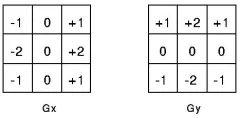
2. Calculating the edge strength: The edge strength is calculated by taking the gradient of an image. The sobel operator can be used to calculate the gradient of the image which is as shown in figure 3.
Figure 3: sobel operators Input test
images
Image cropping
Primary feature extraction
Mask the features Skin mark
identification and location Image
The gradient magnitude, or edge strength, of the gradient can be calculated using the formula given in eqn 1:
|G| = |Gx| + |Gy|……(1)
3. Computing the direction of the edge: The directions of the edge can be calculated by approximating the gradients. It can be represented by the formula given in eqn 2,
θ= invtan (Gy / Gx) ………..eqn 2
4. Once the edge direction is known, it is time to relate the edge direction to a direction that can be traced in an image and decide a single direction which can be 0, 45, 90 or 135 degrees.
5. No maximum suppression: It traces along the edge in the edge direction and suppress any pixel value that is not considered to be an edge. This will give a thin line in the output image.
6. Hysteresis: uses 2 thresholds, a high and a low. Any pixel in the image that has a value greater than T1 is presumed to be an edge pixel, and is marked as such immediately. Then, any pixels that are connected to this edge pixel and that have a value greater than T2 are also selected as edge pixels. If you think of following an edge, you need a gradient of T2 to start but you don't stop till you hit a gradient below T1.
3.2 Speeded Up Robust Feature (SURF)
Surf can be used to determine and locate the prominent facial marks in the test image. SURF uses hessian based blob detector which provides better and faster results. The Hessian matrix H(x, σ) in x at scale σ can be given by formula given in eqn 2,
( , ) = ( , ) ( , )
( , ) ( , )…….. (2)
Where Lxx (x, σ) is the convolution of the Gaussian second order derivative ∂2/∂x2 g(σ) with the image I in point x, and similarly for Lxy (x, σ) and Lyy (x, σ).
3.3 Scale invariant feature transform (SIFT)
Scale invariant feature transform is a technique used to detect the required prominent features effectively. The SIFT feature is scale and rotation invariant hence it can effectively detect the features even if image is varied in scale as well as rotation.
3.3.1 Steps in the SIFT technique are as described in the section 3.3.1
1. Scale Space Extrema Detection: The scale space extrema detection in SIFT algorithm resembles finding and locating the key points of interests in an image. These key feature points are found in the scale space which represents the maxima and the minima in the images which is obtained by the difference of the Gaussian function which is indicated by D (x,y,σ).
The scale space variable is defined by the function L(x, y, σ) which can be obtained by taking the convolution of a variable-scale Gaussian G(x, y, σ), with the input image, I(x,y). the space variable function can be interpreted as shown in the eqn 3. While eqn 4 gives the equation for variable scale Gaussian function.
( , , ) = ( , , )∗ ( , )……….. (3)
Where σ denotes the standard deviation of the Gaussian G(x, y, σ)
2. Removal of unreliable key points: The final key feature points are chosen based on its stability condition. In this removal of unreliable keypoints the least contrast points and the points which are localized at the end edges are suppressed and ignored to remove the unwanted noise and the instability occurring due to the noise. In order to find the unreliable keypoints, at each of the detected and located keypoints the value of |D (x, y, σ)| is computed. Later these values are compared with thresholds. If the value of keypoint is indicated below the threshold then that keypoint is ignored as it is a low contrast point.
3. Orientation assignment: Each keypoint is assigned with the orientation by constructing the HOG i.e histogram of gradients orientation (x,y) which is weighted by the m (x, y) which are the magnitude of the gradients from the keypoint neighbourhood.
4. Key point Descriptor Calculation: This indicates the various keypoint descriptors which have various different directions of orientation. The 4x4 histogram is created for the significant shift in the gradient positions. The directions of the orientations are as indicated in the figure. The length of each arrow denotes the magnitude of the histogram entry
IV. RESULTS
The facial feature matching and using those matched features the two test image match detection is carried. If the two test images are matched then the message “face match found is displayed”. If the two faces are not matched then the message “face match not found is displayed”.
These experimentations are carried out using two algorithms 1. Scale invariant feature transform
2. Canny edge detection and speeded up robust feature 5.1 Scale invariant feature transform (SIFT):
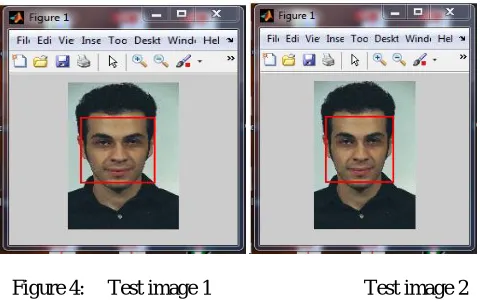
Figure 4: Test image 1 Test image 2
Figure 5: Primary features masked for test images 1 and 2
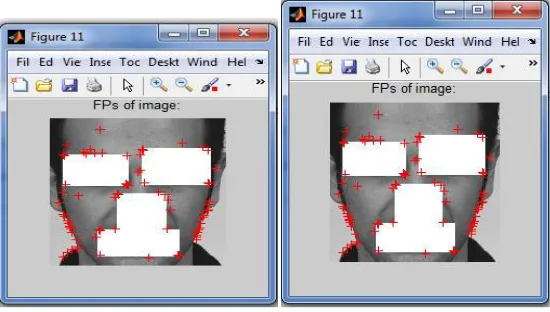
Once all the primary features are masked, now it is time to locate all the SIFT features on the test image. Figure 5 shows all the SIFT feature points located on the two test images. As the two test images are same, the number of feature points located will be same and at same location which is as indicated in figure 5.
The features points marked on the test images needs to be compared and matched for the correct recognition of the face image. Figure 6 shows the matching of the feature points in the two test images. The more the numbers of feature are matched, the greater will the chances of recognizing the face with correct match
Figure 5: SIFT feature points detected in test images 1 and 2
5.2 The results for 2 different test images
Figure 7: Test image 1 Test image 2
Figure 7 shows the test image set for SURF algorithm. Here the two test images considered are the different images of different person. The face portion of the image is used for further processing. We identify the face part from the image using computer vision toolbox in MATLAB.
Figure 9: Canny edges detected in test images 1 and 2
Canny edge detection technique is applied to the images with the masked primary features. This technique highlights all the facial marks, lines and scars on the face image. Figure 9 shows the canny edge detected image highlighting the facial marks. These highlighted marks are used by SURF algorithm for feature matching and face recognition.
Figure 10 shows all the SURF feature points located on the two test images. As the two test images are different, the number of feature points located will be different and at different location which is as indicated in figure 10.
Figure 10: Features detected using SURF
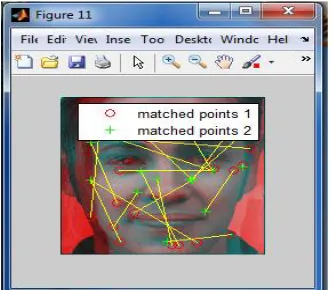
feature are matched, the greater will the chances of recognizing the face with correct match. There are least matching features as the two test images are different as shown in figure 11.
Figure 11: Matched feature points using SURF
V.CONCLUSION
The technique for face identification using facial marks was proposed which is capable of identifying the face correctly using the face marks. This proposal can be effectively used in security applications where there is a strict requirement of authentication security. It can also be used in various applications such as forensics, criminal identification using the sketch images.
The face identification using facial marks technique was proposed using two algorithms which are scale invariant feature transform and canny edge detection along with speeded up robust feature for detecting and comparing the feature points.
REFERENCES
[1] Jain, Anil K., and Unsang Park, "Facial marks: Soft biometric for face recognition," In Image Processing (ICIP), 2009 16th IEEE International Conference on, pp. 37-40. IEEE, 2009.
[2] Dey, Biman Chandra, B. Nirmal, and Ramesh R. Galigekere, "Automatic detection of acne scars: Preliminary results," In Point-of-Care Healthcare Technologies (PHT), 2013 IEEE, pp. 224-227. IEEE, 2013.
[3] Choudhury, Ziaul Haque, and K. M. Mehata, "Robust facial Marks detection method Using AAM and SURF," International Journal Engineering Research and Applications 2, no. 6 (2012): 708-715.
[4] Srinivas, Nisha, Gaurav Aggarwal, Patrick J. Flynn, and Richard W. Vorder Bruegge, "Analysis of facial marks to distinguish between identical twins," IEEE Transactions on Information Forensics and Security 7, no. 5 (2012): 1536-1550.
[5] Tang, Chaoying, Adams Wai-Kin Kong, and Noah Craft, "Using a knowledge-based approach to remove blocking artifacts in skin images for forensic analysis," IEEE Transactions on Information Forensics and Security 6, no. 3 (2011): 1038-1049.
[6] Li, Dong, Huiling Zhou, and Kin-Man Lam, "High-resolution face verification using pore-scale facial features," IEEE transactions on image processing 24, no. 8 (2015): 2317-2327.
[7] Nurhudatiana, Arfika, Adams Wai‐Kin Kong, Noah Craft, and Hong Liang Tey, "Relatively permanent pigmented or vascular skin marks for identification: A pilot reliability study," Journal of forensic sciences 61, no. 1 (2016): 52-58.
[8] Pedersen, Jacob Toft, "Study group SURF: Feature detection and description," Department of Computer Science, Aarhus University (2011). [9] Bay, Herbert, Andreas Ess, Tinne Tuytelaars, and Luc Van Gool. "Speeded-up robust features (SURF)." Computer vision and image understanding 110, no. 3 (2008): 346-359.
[10] Zhu, Juan, Shuai Wang, and Fanying Meng. "SIFT method for paper detection system." In Multimedia Technology (ICMT), 2011 International Conference on, pp. 711-714. IEEE, 2011.
[11] Liu, Ruian, Junsheng Zhang, Lei Wang, and Baoju Zhang. "Application of the extraction of the image feature points by improved SIFT algorithm." In Communications Workshops (ICC), 2013 IEEE International Conference on, pp. 946-949. IEEE, 2013.