MURTHY, PRASHANT. GTKgREP - Design and Implementation of a Gnutella-based Reputation Management System. (Under the direction of Dr. Douglas Reeves).
by
Prashant Murthy
A thesis submitted to the Graduate Faculty of North Carolina State University
in partial satisfaction of the requirements for the Degree of
Master of Science
Department of Computer Science
Raleigh 2003
Approved By:
Dr. Peng Ning Dr. Munindar Singh
To my parents,
K S Keshava Murthy, Lakshmi Murthy and my sister and brother-in-law,
Biography
Acknowledgements
I acknowledge the efforts of Dr. Douglas Reeves, my thesis advisor, in providing me direction and guidance when required. He helped me remain focused and persistent. Working with him has been a pleasure and honor.
I thank Dr. Singh and Dr. Ning for serving on my thesis advisory committee and providing me with invaluable advice.
I thank my family for encouraging me to take up graduate studies, especially my sister. In this endeavor, they have put in just as much effort as me.
Contents
List of Figures viii
List of Tables ix
1 Introduction 1
1.1 Reputation Systems . . . 4
2 Related Work 7 2.1 Architectures in P2P Networks . . . 7
2.1.1 Centralized Networks . . . 8
2.1.2 Decentralized (Pure P2P) Networks . . . 8
2.1.3 Hybrid Networks . . . 8
2.2 Reputation Management . . . 10
2.2.1 Centralized Approaches . . . 11
2.2.2 Decentralized Approaches . . . 11
3 Review of Gnutella Design and Implementation 15 3.1 Operation . . . 16
3.2 Protocol Description . . . 16
3.3 Protocol Messages . . . 17
3.3.1 Message Header . . . 18
3.3.2 Message Types . . . 19
3.4 GGEP Extensions . . . 21
3.5 Gtk-Gnutella . . . 22
3.5.1 Features . . . 22
3.5.2 Design . . . 24
4 Review and Analysis of RCert Reputation Management Protocol 25 4.1 Introduction . . . 25
4.2 Overview . . . 26
4.2.1 Rating Certificates (RCert) . . . 27
4.3 Protocol description . . . 28
4.3.1 Discussion . . . 32
4.4 Protocol enhancements . . . 34
4.4.1 Message Extensions . . . 34
4.4.2 Security Extensions . . . 36
4.5 Security analysis . . . 39
4.5.1 Integrity and Non-repudiation . . . 40
4.5.2 Authentication of messages . . . 40
4.5.3 Validity of RCerts . . . 40
4.5.4 Misbehaving entities . . . 40
4.5.5 Collusions . . . 42
4.6 Extended RCert vs P2PRep/XRep . . . 43
4.6.1 Security Analysis of P2PRep/XRep . . . 43
4.6.2 Comparison of the two approaches . . . 44
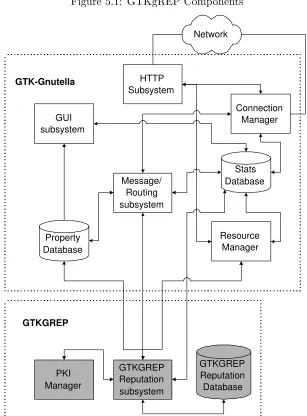
5 Design and Implementation of a Gnutella-based Reputation Management System 47 5.1 GTKgREP Subsystems . . . 48
5.1.1 Message/Routing Subsystem . . . 48
5.1.2 Connection Manager . . . 48
5.1.3 Resource Manager . . . 49
5.1.4 GUI Subsystem . . . 50
5.1.5 HTTP Subsystem . . . 50
5.1.6 Property and Stats Database . . . 50
5.1.7 PKI Manager . . . 50
5.1.8 GTKgREP Reputation Subsystem . . . 51
5.1.9 GTKgREP Reputation Database . . . 51
5.2 Design Issues . . . 51
5.2.1 Stateless Protocol . . . 51
5.2.2 Gui-Core Dependency . . . 52
5.2.3 Non-persistent GUID . . . 52
5.2.4 Broadcast searches . . . 52
5.2.5 Size of search messages . . . 52
5.3 Message Formats . . . 53
5.4 State Machine . . . 55
5.5 Flow of events . . . 55
5.6 Test Scenarios . . . 58
5.7 Assessment of overheads . . . 61
5.7.1 Bandwidth Usage . . . 61
5.7.2 Round Trip Delays . . . 62
5.7.3 Cryptographic Statistics . . . 63
Bibliography 67
List of Figures
2.1 Architectures in P2P Networks . . . 9
3.1 Client-Server handshake in Gnutella . . . 17
4.1 RCert Protocol Message Flow . . . 29
4.2 Protocol behavior with offline recommenders . . . 31
4.3 Protocol behavior when most-recent recommender is offline . . . 33
4.4 RCert Protocol Message Flow (Modified) . . . 35
4.5 Message Authentication in Extended RCert . . . 37
4.6 Selective Certificate Deletions . . . 39
4.7 Onion Signatures in RCert . . . 39
5.1 GTKgREP Components . . . 49
5.2 GTKgREP State Machine . . . 56
5.3 GTKgREP Sequence Diagram . . . 57
5.4 P2P Test Bed . . . 59
5.5 Certificate Bandwidth vs Number of providers and recommenders . . . 61
List of Tables
3.1 Gnutella Message Header . . . 18
3.2 Gnutella Message Types . . . 19
3.3 Query Message Format . . . 20
3.4 Query Hit Message Format . . . 20
3.5 Result Set Structure . . . 20
3.6 Push Message Format . . . 21
3.7 GGEP Extension Format . . . 21
4.1 Rating Certificates . . . 27
4.2 RCert Header Format . . . 27
4.3 RCert Unit . . . 28
4.4 Recommendations . . . 28
5.1 GTKgREP Request Message Format . . . 53
5.2 GTKgREP Message Formats . . . 54
5.3 Number of Signatures Computed/Verified . . . 63
Chapter 1
Introduction
Peer-to-peer networks (P2P) have become a very popular medium of content dis-tribution in the past few years. In such networks, computer resources and services are exchanged directly between systems. Beginning with the popular Napster [9] phenomenon in the late 1990s, the popularity of P2P has dramatically increased the volume of data transferred between Internet users. Recent studies concluded that the file sharing activity on P2P networks accounts for up to 60% of the Internet traffic on any given service provider network [26].
P2P Networks provide an alternate mechanism to client/server paradigms for shar-ing resources. Existshar-ing P2P systems ([4], [2], [8], [9]) have been drivshar-ing a major paradigm shift in the era of distributed computing. Many factors have fostered the recent explosive growth of such networks: low cost attributed to the fact that P2P networks may not require any high-performance centralized servers, high availability of large numbers of computing and storage resources and increased network connectivity.
Many characteristics of P2P networks have made it popular for resource sharing applications[38]:
• Performance and Scalability: P2P paradigm shows its full potential only on large-scale deployments where the limits of the traditional client/server paradigm become obvious. Moreover, scalability is important as P2P applications exhibit the network effect [28]: the value of a network to an individual user increases with the total number of users participating in the network. Ideally, when increasing the number of nodes, aggregate storage space and file availability should grow linearly, response time should remain constant, while search throughput should remain high or grow.
• Availability of resources: The same resource may be available at many different nodes simultaneously, thus providing high availability of these resources.
• No single point of failure: Since P2P networks do not depend on any centralized infrastructure, there cannot be a common point of failure.
The nodes in P2P networks are termed as servents (or peers) since they act both as a client and as a server to the network. Content retrieval in P2P networks usually involves a content search phase and a content download phase. First, the initiator searches for the desired content in the network. Then, after having discovered a servent sharing the above content, it establishes a direct connection and transfers the resource from the provider.
Peer-to-peer networks can be broadly classified into two categories: 1. Centralized networks such as Napster, 2. Decentralized networks such as Gnutella. In the former approach, content search is facilitated by a central server that maintains file indexes to resources shared on the network. In the decentralized approach, the entities directly discover each other by exchanging broadcast messages or by other mechanisms without involving any central server. More recently, a third class of networks that adopt both approaches have become prevalent. Networks such as Kazaa [6] distinguish their peers into leaf nodes and supernodes based on the computation power and bandwidth limitations of the servent. Leaf nodes (low computation power, low bandwidth) are usually connected only to supernodes and are not involved in routing P2P traffic. Supernodes are servents that are endowed with additional responsibilities such as routing, handling requests, etc.
• Secure Routing: Since P2P networks form a virtual network of peers at the applica-tion layer, a P2P message (or packet) sent by the source node may need to traverse many peers before reaching the destination. This implies that intermediate peers are involved in routing packets to the destination peer. Hence, there needs to be a mech-anism to maintain the authenticity, confidentiality and integrity of messages. There has been some work on avoiding attacks that prevent correct message delivery in P2P networks [14].
• Peer Authentication: Since there is no central authority to validate the credentials of the peers in the network, authentication is a non-trivial issue. Further, the nodes involved in exchanging resources may never have interacted with each other, thus making it difficult for them to authenticate each other. This could lead to lack of accountability of shared content. Thus, the network can be extremely susceptible to attacks by malicious users who could spread harmful viruses and trojans, or waste network resources. The Mandragore virus [5] that brought down the Gnutella network in February 2001 is an example of such an attack.
• Anonymity: Anonymity is a property that allows a user to conceal its identity, while allowing access to the resources in the network. There have been many proposals addressing the issue of anonymity in P2P networks [13] [16] [39].
• Accountability: In most P2P networks, peers obtain a unique identity (pseudonym) to log into the network. However, these pseudonyms may not be persistent, thus making it difficult to address the problem of accountability of transactions. Most P2P networks suffer from free-riding [12] – a phenomenon where peers do not share any resources. It has been shown that almost 70% of Gnutella users share no files, and 50% of all responses are returned by the top 1% of sharing hosts. Further, nodes may come online and go offline in very short intervals of time; only a small percentage of the peers are online for a considerable period of time. All nodes are involved in routing request packets to the destination nodes, thus demanding cooperation from all peers.
above, there is no central authority to monitor and coordinate activities of all nodes in the network. The peers are autonomous and may be unreliable and non-cooperating. There must be a mechanism by which the network is able to distinguish trusted peers from the malicious peers. Hence, it is very essential to have a system by which peers are able to trust each other and ensure the authenticity of the shared content. There have been many different approaches that have been adopted to establish trust in a network [32] [40]. Reputation-based trust is one specific form of trust management, which is described in detail in Section 1.1
Thus, peer-to-peer networks are very useful for deployment in large-scale networks. However, for successful deployment of these networks, the above security issues must be addressed. Since trust is a fundamental security issue in these networks, it is very essential to address it and identify solutions to provide the same.
1.1
Reputation Systems
In general, reputation can be defined as the general estimation in which a person is held by the public. It is the memory and summary of behavior from past transactions. It describes the popularity of an individual as seen by the other nodes in the network [35]. In the physical world, when we talk about how much we trust someone, we often consider that person’s reputation. We usually are willing to put great trust in someone whom we have personally observed to be highly capable and who has a high level of integrity. In the absence of personal observation, the recommendation of a trusted friend can lead to trust in someone. Hence, in real life, trust is often increased by establishing positive reputations and networks for conveying these reputations.
participant has a running total of the points attached to its identity on the portal. This information is stored and retrieved for future transactions as necessary. Thus, reputation systems seek to restore information about the history of transactions with the expectation that other people will use this as a reference in the future.
The most essential properties that are required for a reputation system at the minimum are persistence of participating entities, a mechanism for capture and distribu-tion feedback and storage of cumulative ratings to be made available in the future. Such reputation systems can be well adapted into peer-to-peer networks where trust amongst participating nodes is very critical. However, the decentralized property and certain other characteristics of P2P networks make it challenging to adapt reputation systems directly in such networks.
In the recent past, there has been some work in establishing trust using reputations in P2P networks [25] [41] [11] [43] [27] [31] [17] [34], as discussed in Chapter 2. At the time of this work, there was no reputation-based implementation to realize the practical deployment of these systems in P2P networks. In this work, we analyze some approaches that have been proposed to address the problem of reputation based trust management. Bearing the goals of establishing trust among peers in a secure manner and the perfor-mance constraints in P2P networks, we identify two protocols more specific and relevant to P2P networks – RCert and P2PRep. We compare the two approaches in terms of security and performance (overheads). Based on an analysis of the two approaches, we conclude that both approaches are very similar in providing the required security functionalities. However, since the RCert protocol performs better in terms of overheads, we choose to enhance RCert. We identify the drawbacks and vulnerabilities of this protocol and propose an extension to RCert. We provide the design of the modified system (GTKgREP) over an existing decentralized P2P network - Gnutella. We provide the details of the imple-mentation of GTKgREP that has been built as an extension to Gtk-Gnutella, an existing GTK-based Gnutella servent. We also demonstrate the impact on the performance in terms of bandwidth, round-trip time and processing delays due to cryptography.
Chapter 2
Related Work
In this chapter, we provide a brief review of peer-to-peer networks. We describe the architectures in P2P networks and highlight some of the reputation-based approaches that have been proposed.
Peer-to-peer networking is the utilization of the relatively powerful computers (personal computers) that exist at the edge of the Internet for more than just client-based computing tasks. Such networks provide an alternate mechanism of computing as against client/server architectures. In addition to the ability to pool together and harness large amounts of resources, the strengths of existing P2P systems ([4], [2], [8], [9]) include self-organization, load-balancing, cost-effective infrastructure, adaptation and fault tolerance. Because of these desirable qualities, many research projects have been focused on under-standing the issues surrounding these systems and improving their performance [37], [30], [20].
2.1
Architectures in P2P Networks
2.1.1 Centralized Networks
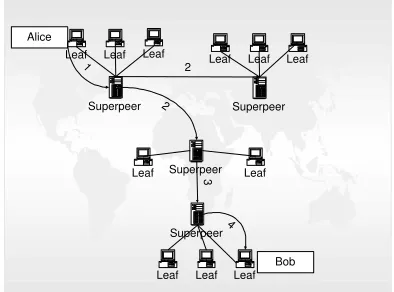
Such networks make use of a centralized indexing service. Figure 2.1(a) depicts the design of such networks and the steps involved in resource sharing. A central server stores information about the files that exist on each peer in the network. Each peer sends its location information on connecting to the network (Step 1). If Alice intends to download a resource, she sends a search request to this server (Step 2), which returns information about the peer (Bob) sharing the resource (Step 3). Alice then connects directly with Bob and downloads the file (Step 4). This architecture offers very good performance in terms of the response time to search requests. However, such architectures may not scale well since the central server becomes a potential bottleneck. Further, due to the existence of a central server, these schemes are not robust to attacks – an attack on the server can bring down the entire network. Napster is a very popular P2P network that uses centralized indexing. Napster collapsed due to litigations over potential copyright infringements.
2.1.2 Decentralized (Pure P2P) Networks
Decentralized networks adopt a distributed architecture for searching content shared by peers. Each peer discovers and establishes connections with a variable number of servents to exchange content as shown in Figure 2.1(b). A peer discovers new peers in the network using broadcast messages. A search request (Step 1) is broadcast from the source to the nodes directly connected to the source. Each of these nodes in turn broadcasts the request to its neighbors (Steps 2, 3), until the message reaches a peer who possesses the content or has traversed a maximum number of hops . Here, every peer is involved in handling and forwarding request messages, thus behaving both as a client and as a server. Gnutella is an example of a pure P2P network.
2.1.3 Hybrid Networks
Server Data Data Data Data Bob Alice 1 1 1 4 1 2 3
(a) Centralized Network Architecture
2 3 2 2 2 2 1 1 3 1 1 Alice Bob
(b) Decentralized Network Architecture
Superpeer
Superpeer Superpeer
Superpeer
Leaf Leaf Leaf Leaf Leaf Leaf Leaf Leaf Leaf
Leaf Leaf Alice Bob 1 2 3 4 2
(c) Hybrid Network Architecture
the superpeers from any signaling messages, thus establishing a two-tier hierarchy among the servents. As shown in the figure, a request originating at a leaf node (or superpeer) is processed only by intermediate superpeers. The software developed by Sharman Networks – Kazaa is an instance of such networks. However, many of the Gnutella servents have adopted the hybrid model because it provides benefits from both centralized and decentral-ized models.
2.2
Reputation Management
There has been a lot of work in the past on reputation-based trust management for client/server based networks. An important instance of successful reputation management is the centralized online auction system eBay [22]. In this reputation system, buyers and sellers rate each other at the end of the transaction. A cumulative rating is computed for each buyer and seller based on the above individual ratings. This rating is stored on a central server managed by eBay. Hence, the above system uses a centralized approach to manage and store reputation information.
The model proposed by Yu and Singh [43] builds a social network among agents that supports participants’ reputation both for expertise (providing service) and helpfulness (providing referrals). Every agent keeps a list of its neighbors (which can be changed over time) and computes the trustworthiness of other agents by updating the current values based on testimonies obtained from reliable referral chains. A bad experience with an agent results in the decrease of its rating and this information is propagated throughout the network.
The proposal for computing and using reputation for Internet ratings by Chen et al [15] differentiates the ratings by computing a reputation for each rater based on the quality and quantity of the ratings it gives. However, the method is based on the assumption that the ratings are of good quality if they are consistent with a majority of the opinions. Adversaries who submit fake or misleading feedbacks can still gain a good reputation as a rater in their method simply by submitting a large number of feedbacks and becoming the majority opinion.
2.2.1 Centralized Approaches
TrustMe [41] is motivated by the importance of anonymity in trust based systems. A secure and anonymous underlying protocol has been proposed for trust management, which provides mutual anonymity for both the trusted host and the querying peer. A peer gives a reputation rating to another peer based on all its experiences with that peer. The trust rating of the peer is an aggregation of all ratings obtained from the rest of the peers. TrustMe provides a system similar to the secret ballot for voters. The trust rating of each peer is stored on a random peer X which replies to all queries for the trust values it possesses. A peer can anonymously issue a query and get the true value without requiring to know the identity of peer X. However, this approach depends on the availability of the peers storing the reputation information.
In the work by Minaxi Gupta et al [25], reputations are computed using either one of two schemes - debit-credit reputation computation and credit-only reputation computa-tion. This approach computes reputation as a function of two variables - peer’s behavior and its capabilities (processing power, memory, bandwidth and storage capacity). Hence, parameters such as size of shared files, bandwidth and time are used in computing the reputation. Using a centralized reputation computation agent (RCA), a public-key based mechanism has been proposed to address the problem of reliable reputations. The RCA is contacted periodically by peers to get credits for their contribution in the system based on the above schemes. Thus, the RCA maintains state information about all transactions made by all the peers in the network.
Centralized approaches are useful in consolidating reputation data at one central location. However, they may not scale well and may be susceptible to security attacks such as denial of service attacks. Thus, as part of this work, we were inclined to choose reputation systems that were decentralized in their approach.
2.2.2 Decentralized Approaches
There have been many approaches proposed to distribute and store reputation information without the use of central servers. In the following paragraphs, some of the important approaches pertinent to peer-to-peer networks have been described.
P2P distributed database which stores complaints about individuals if transactions with them were not satisfactory. When an agent p wants to evaluate trust for another agent q, it sends a query for complaint data which involves q, and decides q’s trustworthiness based on the returned data, using a proposed formula. Hence, complaints are the only behavioral data being used in this work. This system does not incorporate both good and bad transactions which is essential in estimating the reputation of a peer. Further, such systems may be vulnerable to DoS attacks, since a malicious node could insert any number of complaints into the system, without being detected.
The work by Yu et al. [43] is primarily about social mechanisms for regulating users in electronic communities. This work provides a distributed agent architecture to represent and propagate the ratings that participants give to each other. When evaluating the trustworthiness of any party, a peer combines its local evidence (obtained from direct transactions) with the recommendations received from others regarding the same peer. They also propose an algorithm to compute the trust index for an agent in the range [-1, 1] that was an outcome of local evidence and testimonies. This approach focussed primarily on reputations, but did not address the issues of providing integrity and authentication of messages.
EigenRep [27] uses a distributed and secure method to assign a unique global reputation value to each peer based on the history of uploads using power iteration. This work attempts to decrease the number of downloads of inauthentic files in a peer-to-peer file sharing network. In this approach, each peer locally stores its own view of the reputation of the peers it has interacted with. The global reputation of the peer is then computed using local reputation values assigned by other peers, weighted by the global reputation of the assigning peers. This work also does not focus on describing how integrity and authentication of messages are achieved.
PeerTrust [42] is also a feedback based trust management system for peers to quantify and compare the reputation of other peers in P2P networks. In this work, three basic trust parameters are used for evaluating the trustworthiness of peers – feedback in terms of amount of satisfaction, feedback context such as the total number of transactions and the credibility of the feedback sources. The trust for a peer in this system is also a non-decreasing scalar and is subjective. Each peer is mapped to maintain a small database that stores a portion of the global trust data. Maliciousness is countered by having multiple peers responsible for storing the same database. Voting can be used if these databases differ. Trust is computed by querying multiple databases over the network. This work uses a broadcast approach to obtain ratings for a peer, thus consuming significant bandwidth.
P2PRep [17] uses a distributed broadcast polling mechanism to search and dis-tribute reputation information in the P2P network. Public key encryption has been used to achieve confidentiality, integrity and non-repudiation of messages. In this approach, each peer is associated with an opaque identifier. Each peer maintains a history of the trans-actions and its experiences with other peers in its local reputation database. The protocol comprises of five different phases. In the first phase, the initiator broadcasts its request to the network, like in a standard Gnutella interchange and receives responses from the peers, which include the identifier of the providers and a digest of the resource. In the resource sharing and vote polling phase, the initiator enquires the network (broadcast) about the provider from which it intends to download the resource. Upon receiving this poll message, each peer checks its experience repositories and responds with votes if it has had a prior transaction with that entity. In the third phase, the initiator performs a vote evaluation on the set of votes that it has received about each provider. It then chooses the providers with the highest reputation value as suggested by the voters. The fourth phase attempts to handle some load balancing and prevent some security attacks on the protocol. In this phase, the most reliable provider is contacted to verify the fact that it exports the resource. In the final phase, the initiator downloads the resource and based on the quality of the transaction, it updates the local repository with an entry for the set of providers from which it downloaded the resource.
RCert [34] is another reputation-based approach that uses public key encryption to provide security properties such as authentication, integrity and non-repudiation. This protocol aims to provide efficient retrieval of reputation information by storing the content locally at the owner (server-side) in the form of certificates. The protocol also ensures that these certificates are secure from being modified by the owner. This approach provides an efficient mechanism for the retrieval of reputation content. Further, all messages in RCert are unicast messages.
Chapter 3
Review of Gnutella Design and
Implementation
In this chapter, we describe the reason for choosing Gnutella for our implementa-tion and review the design of the Gnutella protocol. We also briefly describe the security issues in Gnutella. We have left out the details of the specification and described only sections that are relevant for this thesis. A detailed description of the protocol can be obtained in the Gnutella specification [29]. In the final section, we describe Gtk-Gnutella, a unix-based Gnutella servent.
3.1
Operation
There are no central servers in the Gnutella network. In order to join the system a peer initially connects to one of several known hosts (e.g., gnutellahosts.com) that are almost always available (generally, these hosts do not provide shared files). Such entities are known ashost caches. The host cache then forwards the IP addresses and port numbers of numerous other peers that are currently online. This connection is performed over a TCP session.
Once attached to the network (having one or more open connections with nodes already in the network), nodes send messages to interact with each other. Messages can be either a request message or a response to some previously received request message. Messages can be broadcast (i.e., sent to all nodes with which the sender has open TCP connections) or simply back-propagated (i.e., sent on a specific connection in the reverse direction on the path taken by an initial, broadcast, message). Several features of the protocol facilitate this broadcast/back-propagation mechanism. First, each message has a randomly generated unique identifier. Second, each node keeps a short memory of the recently routed messages, used to prevent re-broadcasting and implement back-propagation. Third, messages are flagged withtime-to-live (TTL) andhops passed fields. These messages are described in detail in Section 3.3.
3.2
Protocol Description
A Gnutella servent connects itself to the network by establishing a connection with another servent connected to a peer-group. Nodes forward all incoming messages to all members of their peer-group.
Each Gnutella message contains a globally unique identifier (GUID) in its header. When a node receives a message, it stores this message ID in a table before sending it on to its peer-group. If the message ID is already in the table, it discards the message since it has already been processed. After receiving the responses, the peer selects the resources it desires to download. Resources are downloaded using the standard HTTP protocol.
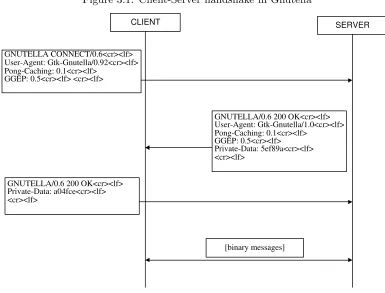
A sample interaction of the initial handshake between a client and a server servent has been shown in Figure 3.1:
Figure 3.1: Client-Server handshake in Gnutella
GNUTELLA CONNECT/0.6<cr><lf> User-Agent: Gtk-Gnutella/0.92<cr><lf> Pong-Caching: 0.1<cr><lf>
GGEP: 0.5<cr><lf> <cr><lf>
CLIENT SERVER
GNUTELLA/0.6 200 OK<cr><lf> User-Agent: Gtk-Gnutella/1.0<cr><lf> Pong-Caching: 0.1<cr><lf>
GGEP: 0.5<cr><lf> Private-Data: 5ef89a<cr><lf> <cr><lf>
GNUTELLA/0.6 200 OK<cr><lf> Private-Data: a04fce<cr><lf> <cr><lf>
[binary messages]
header is made up of a field name, followed by a colon, and then the value. Each line ends with the sequence (< cr >< lf >), and the end of the headers is marked by a single line. Each line normally starts a new header, unless it begins with a space or a horizontal tab, in which case it continues the preceding header line.
3.3
Protocol Messages
3.3.1 Message Header
The message header is 23 bytes and comprises of the fields as shown in Table 3.1
Table 3.1: Gnutella Message Header
Message ID (GUID) Payload Type TTL (Time to live) Hops Payload Length
0-15 16 17 18 19-22
A brief description of the elements in the header is provided below:
Message ID: A 16-byte string (GUID) uniquely identifying the message on the
network.
Payload Type: This field indicates the type of message. The following codes are
currently recognized: 0x00 = Ping, 0x01 = Pong, 0x02 = Bye, 0x40 = Push, 0x80 = Query, 0x81 = Query Hit
TTL: Time To Live. This field is similar to the TTL value in the IP header. The value represents the number of times the message will be forwarded by Gnutella servents before it is removed from the network. Each servent will decrement the TTL before passing it on to another servent. When the TTL reaches 0, the message will no longer be forwarded and is dropped.
Hops: This field indicates the number of times the message has been forwarded. As a message is passed from servent to servent, the TTL and Hops fields of the header must satisfy the following condition: TTL(0) = TTL(i) + Hops(i) where TTL(i) and Hops(i) are the values of the TTL and Hops fields of the message, and TTL(0) is maximum number of hops a message will travel (usually 7).
Payload Length: The length of the message (in bytes) immediately following
3.3.2 Message Types
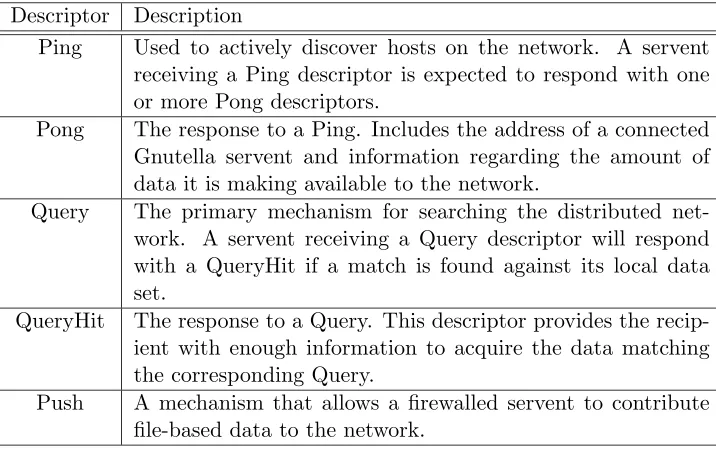
Immediately following the message header is the payload consisting of one of the messages shown in Table 3.2.
Table 3.2: Gnutella Message Types
Descriptor Description
Ping Used to actively discover hosts on the network. A servent receiving a Ping descriptor is expected to respond with one or more Pong descriptors.
Pong The response to a Ping. Includes the address of a connected Gnutella servent and information regarding the amount of data it is making available to the network.
Query The primary mechanism for searching the distributed net-work. A servent receiving a Query descriptor will respond with a QueryHit if a match is found against its local data set.
QueryHit The response to a Query. This descriptor provides the recip-ient with enough information to acquire the data matching the corresponding Query.
Push A mechanism that allows a firewalled servent to contribute file-based data to the network.
Ping and Pong Messages
Ping messages are broadcast into the network to discover new peers and statistics about the resources that they possess. A peer receiving a ping message responds with a pong message that is routed back to the originator along the path traversed by the ping message. To conserve bandwidth, the protocol uses pong caching. When a peer receives a ping message, it responds with a pong message with all the entries in its pong cache.
Query Message
A query message contains the search criteria specified by the user. As shown in Table 3.3, the query message comprises of the search string provided by the user. It also comprises of an optional extensions block, which will be described in section 3.4. A servent decrements the TTL value by 1 before forwarding the query message to its neighbors. If, after decrementing the header’s TTL field, the TTL field is found to be zero, the message is dropped.
one it has received before, discards the message since it has already processed the message.
Table 3.3: Query Message Format
Field Min Speed Search Criteria NUL(0x00) Extensions block (optional)
Byte offset 0...1 2...N N+1 N+1...L-1
Query-Hit Message
The QueryHit message is sent only in response to an incoming Query message. A servent should reply to a Query with a QueryHit message if it contains data that strictly meets the query search criteria. A QueryHit message should be initially generated with hops=0 and the TTL field equal to the number of hops traversed by the corresponding Query message. The Descriptor Id field in the descriptor header of the QueryHit should contain the same value as that of the associated Query message. This allows a servent to identify the QueryHit message associated with Query messages it generated.
The format has been shown in Table 3.4. The result set is a list of results with each entry having the elements showed in Table 3.5.
Table 3.4: Query Hit Message Format
Field No of Hits Port IP Addr Speed Result Set Optional QHD Data Servent ID
Byte offset 0 1...2 3...6 7...10 11...10+N 11+N...L-17 L-16...L-1
Table 3.5: Result Set Structure
Field File Index File Size File Name NUL(0x0) Optional Result Data NUL(0x0)
Byte offset 0...3 4...7 8...7+K 8+K 9+K...R-2 R-1
A servent may send a Push descriptor if it receives a QueryHit descriptor from a servent that does not support incoming connections. This might occur when the servent sending the QueryHit descriptor is behind a firewall. When a servent receives a Push descriptor, it may act upon the push request if and only if the Servent Identifier field contains the value of its servent identifier. The Descriptor Id field in the Descriptor Header of the Push descriptor should not contain the same value as that of the associated QueryHit descriptor, but should contain a new value.
Table 3.6: Push Message Format
Field Servent Identifier File Index IP Address Port Optional Push Data
Byte offset 0...15 16...19 20...23 24...25 26...L-1
3.4
GGEP Extensions
The Gnutella Generic Extension Protocol (GGEP) allows arbitrary extensions in Gnutella messages. A GGEP block is a framework for other extensions. These extensions are embedded in the trailer of Gnutella query and query-hit messages. The two peers negotiate the version of GGEP being used during the initial handshake shown in Figure 3.1.
A GGEP block always starts with a magic byte used to help distinguish GGEP extensions from legacy data which may exist. It must be set to the value0xC3. The magic byte is followed by any number of extensions. They are processed in the order in which they appear. Table 3.7 shows the elements of the GGEP extension.
Table 3.7: GGEP Extension Format
Field Flags ID Data Length Extension Data
Length 1 1...15 1...3 x
can be obtained from [29]. In our implementation, all protocol messages are embedded as GGEP extensions in the query and query-hit messages, and will be discussed in detail in Chapter 4.
3.5
Gtk-Gnutella
In this section, we mention the existence of different implementations of Gnutella and describe why we have used Gtk-Gnutella for our implementation. We highlight the salient features supported by Gtk-Gnutella and briefly describe the design.
There are many different implementations of Gnutella that are currently available. They are collectively called Gnutelliums. Limewire [7] is the most popular open-source java-based Gnutella servent. Bearshare [1] and Gnucleus [3] are the predominant servents on Windows. Some other implementations are Morpheus, Mutella, Phex, etc.
Gtk-Gnutella (Gtk-G) [24] is an open-source GUI based Gnutella servent. It is a fully featured Gnutella servent designed to share any type of file the user wishes to share. It has been developed and tested under Linux using C. Gtk-gnutella is open-source and is released under the GNU Public License (GPL). In this work, we understand the design of Gtk-Gnutella and extend the code to incorporate the reputation protocol that is described in Chapter 4.
3.5.1 Features
This section summarizes the salient features that have been implemented in Gtk-Gnutella. We provide only a brief description of the features here. Detailed information about the features are described in the Gnutella specification [29].
about each other, and that all caches have relatively fresh hosts and URLs. The concept is independent of Gnutella clients joining and leaving the nework.
• GNet compression: Gtk-G implements compressed gnutella net connections to con-serve bandwidth in the network. Compression is meant to be done on a per-connection basis. The deflate scheme is handled by the www.zlib.org library (the deflate/inflate routines). This implies that there will be a compression dictionary and history per connection on both ends, thus achieving a good compression as compared to compress-ing each message individually. The peers exchange this information in the Accept-Encoding and Content-Encoding headers in the initial handshake described in Fig-ure 3.1
• Ultrapeers: Gtk-G provides a hierarchical Gnutella network by categorizing nodes on the network as leaf nodes and supernodes or ultrapeers, based on the bandwidth capacity and computational power of the peer. A leaf node keeps only one open con-nection to its neighboring supernode. A supernode acts as a proxy to the Gnutella network for the leaf nodes connected to it. This makes the network scalable by reduc-ing the number of nodes on the network involved in routreduc-ing and message handlreduc-ing, as well as reducing the actual traffic between them.
• PARQ: Passive/Active Remote Queueing (PARQ) allows a provider of a resource to enqueue requests from initiators, when the server has no upload slots available. The queueing technique has been built considering fairness and other such factors.
• QRP: QRP (Query Routing Protocol) has been implemented in Gtk-G for routing messages efficiently by avoiding broadcast queries on the network. In this protocol, hosts create query route tables by hashing file keywords and regularly exchange them with their neighbors. Thus, a request is forwarded only if the route table received on a connection matched the keywords in the request string.
• PFTP: Partial File Transfer Protocol is a protocol for sharing partial files on the Gnutella network. A partial file is a file that a host has only downloaded parts of. Partial file sharing allows files to spread faster over the Gnutella network.
The graphical user interface for Gtk-gnutella has been developed using GTK+ - The GIMP ToolKit, a multi-platform toolbar for creating GUIs.
3.5.2 Design
Gtk-Gnutella has been implemented utilizing the functionality of events and call-backs provided by GTK. Every action, such as receipt of a network message, a timeout or a button click by a user is associated with an event. Each event has callback APIs associated with them, which are invoked when the event gets triggered. We provide further details about the design of Gtk-Gnutella in Section 5.1.
Chapter 4
Review and Analysis of RCert
Reputation Management Protocol
The RCert protocol has been designed to provide a mechanism to determine and establish trust between nodes in a P2P network. This chapter discusses the goals of the protocol and describes the approach in detail. We extend this protocol by adding messages to address a few shortcomings of RCert. We then perform a security analysis on this protocol and present the details. Finally, we compare RCert with P2PRep, another reputation-based protocol in P2P networks and describe the rationale for extending the RCert protocol as the foundation for building our reputation management system.
4.1
Introduction
The RCert protocol was designed with the following properties in mind:
• Distributed storage of reputation information: This protocol does not require any centralized infrastructure. It uses a decentralized approach to retrieve and store rep-utation information.
adopts a different approach in which each peer stores its own reputation content lo-cally. Thus, this approach ensures that the time for retrieval of the reputation content is a constant factor.
• Integrity and non-repudiation: RCert uses public/private keys and digital signatures to ensure the integrity and non-repudiation of messages sent on the network. Further, it does not require any PKI infrastructure for generating these keys.
• Efficient use of network bandwidth: Since this protocol stores the reputation infor-mation locally, the number of messages exchanged between the peers is significantly reduced. Further, all RCert messages are unicast, thus ensuring efficient utilization of network bandwidth.
• Global rating for each entity: The RCert protocol uses a simple technique to compute the global rating information for each peer by considering the average of all the ratings in its history.
Each peer is identified by an opaque identifier called GUID (Globally Unique Identifier). The GUID is sent in all the messages to identify the originator of the message, as described in Section 3.2. Just as in the case of most reputation-based P2P systems, the reputation information about a peer is associated with its GUID. Each new peer starts with a default rating and accumulates new rating values as it participates in the network. If a peer wishes to build its reputation over a period of time, it needs to maintain a persistent identifier in the network. When a peer assumes a new GUID, it loses all information about the past reputation and is treated as a new member in the network.
4.2
Overview
This protocol uses two important entities for storing reputation information -rating certificates and recommendations.
4.2.1 Rating Certificates (RCert)
Rating certificates store the ratings received from other peers at the end of a transaction. RCerts consist of a header, a list of RCertUnits and the digital signature as shown in Table 4.1. Each RCert unit essentially contains the rating provided by the previous recommenders and the identity information about the recommender who provided this rating. These certificates are stored locally at the provider and are sent by the provider along with the query-hit message. The provider signs the RCerts and stores the signature in theSignature field before sending them into the network.
Table 4.1: Rating Certificates
Header RCert U nit1 RCertU nit2 ... RCert U nitn Signature
The RCert header contains information about the provider and its local certificates, and is shown in Table 4.2. It contains information about the identity of the owner – the GUID and the public key. This information is used during the authentication of the RCert message. TheRCert Num andPrevious RCert Numfields in the header are used to provide information about the history of certificates stored. In due course of time, the provider may accumulate many certificates and it may not be efficient to send all the certificates, when requested. Hence, using these fields, the provider may send only the most recent certificates, thus conserving bandwidth. It does this by setting theRCert Num to the most recent certificate list and by setting the Previous RCert Num to the value referring to the past certificates. If the provider is able to send all the certificates in the message, it sets thePrevious RCert Num field to 0.
Table 4.2: RCert Header Format
Owner ID Public Key RCert Num Previous RCert Num
provider of the rating, as shown in Table 4.3. A new RCert is appended to the list of RCerts at the end of each transaction with this peer. The rater ID, IP address and port number fields provide information about the identity of the recommender. Therating contains information about the recommenders’ transaction experience with the provider. The counter is the sequence number for this certificate. Every new RCert has the counter value incremented by one. Thetimestampfield contains the value of the timestamp issued by the provider. Each RCert unit is individually signed by the recommender of that certificate.
Table 4.3: RCert Unit
Rater ID IP Address Port Number Rating Counter Timestamp Signature
4.2.2 Recommendations
Each peer stores a list of recommendations that contains information about the rating that it had provided to the servents from which it downloaded resources in the past (Table 4.4). It provides information about the identity of the peer for whom the recommendation was provided (GUID), the timestamp that was provided by that servent and status information to identify the validity of the certificate (valid or revoked). It provides information about the identity of the revoked peer (IP address and port number) if the entry was revoked. We describe the use of this information when we describe the protocol in detail in Section 4.3.
Table 4.4: Recommendations
GUID Timestamp IP Address Port Number Status
4.3
Protocol description
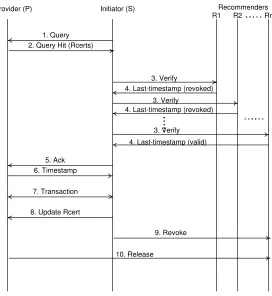
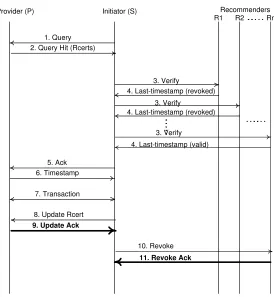
entity searching for content in the P2P network. Any peer who currently shares the resource that was requested by the initiator is defined as a provider of that content. A peer who has had a transaction with some such provider in the past and currently possesses a rating for that provider is termed as a recommender. The exchange of messages between these entities has been described below. For the sake of simplicity of this discussion, Figure 4.1 shows only one provider (P) and n recommenders.
Figure 4.1: RCert Protocol Message Flow
Provider (P) Initiator (S) Recommenders
1. Query 2. Query Hit (Rcerts)
3. Verify
4. Last-timestamp (revoked)
3. Verify
4. Last-timestamp (revoked)
3. Verify
4. Last-timestamp (valid)
5. Ack 6. Timestamp
7. Transaction
8. Update Rcert
9. Revoke
10. Release
R1 R2 Rn
The initiator (S) who wishes to search for a resource broadcasts a Query message into the network(1). Any providers (P) who are currently sharing the resource respond to this request message by sending the QueryHit message(2). The above steps are the same as the initial steps in the Gnutella protocol. However, in addition, the providers send their RCerts, that are locally available at the provider, in the trailer of the QueryHit message. The initiator verifies the signature in the response message and drops the packet if there is a mismatch.
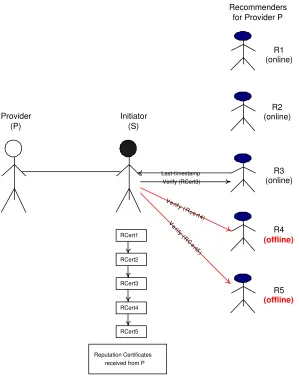
entities. S computes the global rating for each provider from the RCerts that it received and selects the providers who have a rating higher than a predefined threshold value. The initiator needs to verify the validity of the RCerts of each of these providers. This is done by checking the last RCert unit in the received certificate list by sending averifymessage to the recommender R1(3). Theverify message contains the certificate that is being verified. R1 verifies the certificate and responds with alast-timestamp message(4). The last-timestamp message contains information about the timestamp that was provided by the provider, the status of the timestamp(valid orrevoked) and the identity of the peer who authorized the revoke. If the recommender R1 was offline, then, the initiator repeats steps 3 and 4 by contacting the previous raters until there is one available as depicted in Figure 4.2. In this figure, we see that the most recent recommender R5 is offline and hence, the initiator S is not able to receive a last-timestamp response from it. Hence, it contacts R4, which is also offline. It then contacts R3 and receives a last-timestamp message. S verifies that the status in this message is revoked and the IP address and port number of the revoked peer matches that of the succeeding recommender in the certificate list that it originally received from the provider (i.e with the IP address and port number of R4). If verified, S computes the global rating for P using the certificate ratings upto R3’s certificate (since it was not able to verify certificates RCert4 and RCert5. The receipt of the last-timestamp message
terminates the process of verifying the providers’ certificates.
After this step, the initiator sends a message to those providers for which it was able to successfully verify the rating certificates. Thisack message indicates the initiator’s interest in proceeding with the transaction (5). Theack is used as an evidence of transaction request by P. P then responds with thetimestamp message (6). This message provides the time value on the provider’s machine and the transaction counter. The initiator uses this time information in the future steps of the protocol. The transaction counter indicates the number of transactions the provider has experienced in the past. Thus, the counter reflects the latest information about the transactions of the provider.
Figure 4.2: Protocol behavior with offline recommenders R1 (online) R5 (offline) R4 (offline) R3 (online) R2 (online) Provider (P) Initiator (S) RCert3 RCert4 RCert1 RCert2 RCert5 Reputation Certificates received from P
Recommenders for Provider P
Verify (RCert3) Last-timestamp
V erify (R ce rt4)
V e rify
(RC e
rt5)
message. On receiving this message, P verifies the value of the timestamp information in the new certificate. If the value is successfully verified, it appends the new rating to its list of certificates. At the same time, the initiator stores the last-timestamp (recommendation information) and makes it available to others, when needed. If it was not the first rater, it contacts the previous recommender to revoke the last-timestamp information on that peer (9).
The recommender Rn verifies the revoke message received from S and if valid,
4.3.1 Discussion
The RCert protocol provides for secure local storage of rating certificates at the provider. We also call this server-side storage, since the provider acts as the server in a transaction. Hence, reputation information about a provider is always available, as long as the provider is online. The protocol allows the initiator to verify these rating certifi-cates by contacting the recommenders in temporal order, starting from the most recent recommender. Based on the ratings available in these certificates, the initiator is able to choose the best set of providers from whom he/she wants to download the resource. The initiator would require to contact past recommenders only in instances where the most re-cent recommender is unavailable. Further, in these situations, the past recommenders are able to verify the rating certificates for the initiator. The last-timestamp message serves to verify rating certificates. After verifying the validity of the certificates of all chosen providers, the initiator sends Acks to these providers indicating an interest in proceeding with the transaction. TheAck message serves as evidence of a transaction for the provider for future references. If the initiator refuses to give a rating, then the provider can use the Ack message as evidence of the transaction. This message can be provided to the previous recommender to request arbitration, as required.
The protocol also provides a mechanism to rate the provider at the end of the transaction. The servent is allowed to rate the transaction with a binary rating (0 or 1) based on different factors such as quality of transaction, authenticity of shared content, etc. The protocol does not define what factors are required to be considered by the servents. Further, the global rating for a servent is computed as the average of its past ratings. While this protocol allows for such a simple mechanism to provide ratings, any other approach may be used in place of the above method. For example, the approach described in [44] uses a weighted average approach for computing the global rating. [43] applies Dempster-Shafer calculus to calculate the ratings for agents.
The protocol also provides a mechanism by which the initiator is able to revoke the timestamp from the most-recent recommender. Thus, at the end of a transaction, the initiator has a new valid recommendation in its recommendation list, the provider has a new certificate appended to its list of rating certificates and the most recent recommender has the corresponding recommendation revoked in its recommendation list.
Initiator S Recommender R Provider P
OFFLINE
Revoke
(a) Recommender R offline
Initiator T Recommender R Provider P
ONLINE
Verify
Initiator S
OFFLINE
Verify Last-Timestamp (Status = Valid)
(b) Initiator S is offline and Recom-mender R is online
Figure 4.3: Protocol behavior when most-recent recommender is offline
behavior of the protocol when the most-recent recommender is offline when the revoke message is sent. We observe that this property does not affect the normal behavior of the protocol because the provider stores the most recent certificates and the last certificate in its certificate chain points to the appropriate recommender. We consider the following case where there is a peer S (initiator), peer P (provider) and peer R1 (most-recent recommender) who is offline, as depicted in Figure 4.3(a).
S completes a transaction with P and sends a new rating to P. Now, when it sends the revoke message to R1, R1 does not acknowledge it since it is offline. At some later instance, S goes offline and R1 logs back into the network as shown in Figure 4.3(b). A new initiator T requests certificates from P. P sends its list of certificates. T contacts S (most-recent recommender), but does not receive any response since S is offline. Hence, T contacts the previous recommender R1 who responds with thelast-timestamp message with a valid timestamp. At this point, since T has verified the signature on the list of RCerts that it received from P, it is aware that it possesses the most recent recommendations and that R1 has provided an incorrect timestamp. Hence, it can send a message asking R1 to update its information by sending the information about S (the peer who was supposed to have revoked the certificate).
specify the behavior of the protocol in the presence of interleaved transactions. In this para-graph, we suggest changes in the protocol that are able to handle multiple sessions started simultaneously with the same provider. In any distributed protocol that involves multiple writers, the resource being written must be locked such that we can ensure consistency in the interpretation of the resource. In the context of the RCert protocol, the shared resource being written is the rating certificate chain at the provider. In the RCert protocol, let us assume multiple initiators desire to begin simultaneous sessions with provider P and rate the provider at the end of their respective transactions. As a constraint, the protocol can allow all transactions to proceed serially - the provider can serve only one initiator at a time. However, in P2P networks such a constraint is undesirable since it could lead to denial of service attacks. We suggest a simple extension to RCert that allows simultaneous sessions with the provider. At the end of the transaction, the initiator can signal the provider (write request) that it is interested in providing a new rating, before sending the update rcert message to the provider. At this point, the provider grabs a lock for this session, if avail-able, and sends its latest certificate chain. Following this step, the provider queues write requests received from other initiators, since it is still in the process of appending a new rating certificate to its certificate chain. After receiving the new rating from the initiator, P will release the resource and respond to any other initiators waiting in the queue to send a new rating certificate.
4.4
Protocol enhancements
In this section, we describe the shortcomings of the RCert protocol and propose a few improvements to address these problems. We highlight the two new messages that have been added into the protocol. We also describe the security extensions that have been incorporated into RCert to address certain vulnerabilities.
4.4.1 Message Extensions
the new rating to its certificate list. However, if the provider was offline when the initiator sent this message, the protocol may enter an unstable state, where the most recent recom-mender has a different notion about the status of certificates compared with the notion at the provider.
To prevent such a situation, we introduce two additional messages into the protocol as shown in bold in Figure 4.4. TheUpdate RCert and Revoke messages are acknowledged using the Update Ack and Revoke Ack messages. In the current protocol, the initiator does not expect an acknowledgement to the Update message that it sends to the provider. Thus, there is no mechanism by which the initiator can be ensured that the provider has received the message. Hence, in Figure 4.4, after sending an Update RCert message(8), the initiator waits for an Update Ack message(9). Only after receiving this message, S sends theRevoke message(10). Again, it waits to receive an acknowledgement to the revoke message (11). The initiator re-sends these messages, if it does not receive an ack from the servents. Further, we have also removed the Release message, since this message was no longer required as part of the protocol.
Figure 4.4: RCert Protocol Message Flow (Modified)
Provider (P) Initiator (S) Recommenders
1. Query 2. Query Hit (Rcerts)
3. Verify
4. Last-timestamp (revoked)
3. Verify
4. Last-timestamp (revoked)
3. Verify
4. Last-timestamp (valid)
5. Ack 6. Timestamp
7. Transaction
8. Update Rcert
9. Update Ack
10. Revoke
R1 R2 Rn
4.4.2 Security Extensions
The RCert protocol lacks a mechanism of providing message authentication. The receiver of a message will not be able to verify the initiator of that message, since there is no information being provided in the messages. Lack of message authentication could lead to ID spoofing or ID stealth attacks. We propose a mechanism to authenticate RCert protocol messages. Further, since each of the RCert units are signed individually, the provider would be able to remove certificates selectively from its history. The onion signature scheme proposed in this section provides a solution against this problem.
Authentication
We propose a mechanism by which the peers are able to verify the authentication of the sender’s messages. The approach we have used is to include essential information about the sender’s identity within each protocol message. We then ensure that there is a mechanism by which we can detect tampering of these messages in the network using public key encryption.
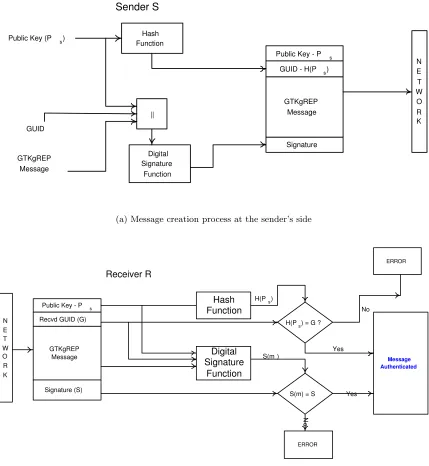
The opaque identifier of each peer (GUID) is computed as the secure hash (md5 digest) of the public key of that peer. Each protocol message includes the GUID and public key of the peer (collectively termed as identity of the peer) who sent the message. This information along with the message payload is signed digitally using the private key of the peer before being sent into the network. On the receipt of a message, the receiver first verifies the digital signature on the message. If verified, it implies that this message was received from the network untampered.Now the recipient verifies the GUID present in the message. This ensures that the message is verified for authenticity before being processed at the receivers end. The process of message authentication is depicted in Figure 4.5. In Figure 4.5(a), we show the process by which the sender (S) prepares and dispatches a protocol message and Figure 4.5(b) depicts how this message is authenticated at the receiver (R).
Onion Signatures
Public Key - P s
GTKgREP Message GUID - H(P s)
Signature Sender S
Public Key (P s)
GTKgREP Message Hash Function GUID || Digital Signature Function N E T W O R K
(a) Message creation process at the sender’s side
Public Key - P s
GTKgREP Message Recvd GUID (G)
Signature (S)
Receiver R
Hash Function
H(Ps)
Digital Signature
Function
H(Ps) = G ?
S(m) = S S(m ) Yes Message Authenticated Yes N E T W O R K N o ERROR No ERROR
(b) Message authentication at the receiver’s side
certificates and thus increase its cumulative rating. We then describe the concept of onion signatures that provides a solution against this vulnerability.
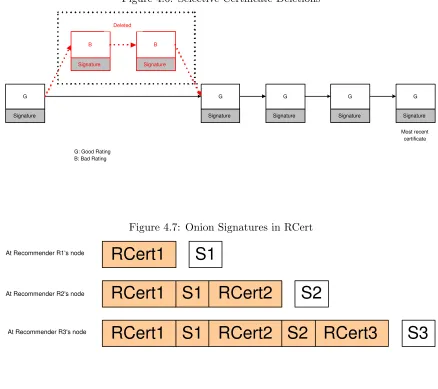
A malicious provider may be able to selectively remove certificates which have received negative ratings from its history as depicted in Figure 4.6. The figure shows a provider with seven transactions in its history, which includes two bad transactions that it made in the past. We observe from this figure that the provider is able to remove certificates 2 and 3 from its history and create a new chain of certificates excluding these bad transactions. The same argument holds for the fact that the provider will also be able to add spurious certificates into its history thus increasing its global rating. This is possible because all certificates are not verified by the peer receiving these certificates (only the most recent certificates would be verified). More importantly, this drawback is due to the fact that each recommender computes a signature only on its own certificate while sending a new rating certificate using theUpdate RCert message.
Thus, in order to protect the integrity of the local certificate database, an onion layered signature scheme can be used by the recommenders while sending theUpdate RCert Message. In this method, the recommender incorporates its signature over all the previous certificates that it received from the provider, in addition to its new rating certificate. This can be visualized as having layered signatures, where each layer contains the certificate and signature provided by the previous recommenders – the innermost layer comprises of the information from the first recommender and the outermost layer comprises of the information from the most recent recommender.
Figure 4.6: Selective Certificate Deletions
G G G G G
B B
Signature Signature Signature Signature
Signature Signature
Signature
Most recent certificate
Deleted
G: Good Rating B: Bad Rating
Figure 4.7: Onion Signatures in RCert
RCert1
RCert1
S1
S1 RCert2
S2
RCert1
S1 RCert2 S2 RCert3
S3
At Recommender R1's node
At Recommender R2's node
At Recommender R3's node
4.5
Security analysis
4.5.1 Integrity and Non-repudiation
Public key encryption is being used to maintain the integrity and non-repudiation of all RCert messages. The content of all the messages is being digitally signed using the private key of the peer. The public key and GUID are being sent in messages to verify the integrity of these messages. This approach prevents any outsider from tampering with the messages in the network.
4.5.2 Authentication of messages
The extension that was proposed in section 4.4.2 provides for the authentication of messages exchanged by the protocol. The GUID is computed using a one-way hash function as the secure hash of the public key of the peer. We know that one of the properties of one-way hash functions is weak collision resistence – i.e. given the hash value H(m) and the message m, it is computationally infeasible to find another message m’ such that Hm’) = Hm). Thus, given the public key and its hash value, it is computationally infeasible to find another public key with the same hash value. This property in conjunction with digital signatures (message integrity) safeguards the protocol against ID stealth or ID spoofing attacks.
4.5.3 Validity of RCerts
The last-timestamp message used in this protocol provides information about the validity of the certificates. The initiator contacts the previous recommender to verify the validity of the certificate. If the previous recommender responds with a last-timestamp message that has not been revoked, then, the certificate is up-to-date. Otherwise, the certificate received from the provider is not the latest information and hence, this provider can be avoided.
4.5.4 Misbehaving entities
• Misbehaving Providers: The provider may not wish to divulge previous recommen-dations, if it has received bad ratings in the past. The essential motivation for such an act could be the fact that the provider has accumulated a rating lower than the threshold initial value it started with. Hence, to avoid such circumstances, the mini-mum rating that a peer can receive has been ensured to be greater than or equal to the threshold initial value.
Two collaborative peers may conduct multiple transactions with each other and rate themselves at the end of each transaction, thus increasing their global rating value. To prevent this, only the latest rating (determined by the received timestamp) is used for calculating the cumulative rating from each peer. If a rating already exists for the peer, it is overwritten with the new rating. This ensures that the global rating is calculated as a factor of many independent transactions undergone with different entities, thus decreasing the effect of such collusion.
Providers may spurious add rating certificates or delete certain certificates in its his-tory (for which it has received bad ratings). The property of onion signatures that was suggested as an extension to RCert detects such misbehavior. Such misbehavior is detected because the digital signature on the last certificate will not match the computed signature.
• Misbehaving Initiators: At the end of the transaction, the initiator is expected to provide a rating of the provider about the quality of the transaction. If the initiator refuses to give a rating, then the provider can use theack message in the protocol as a proof of the transaction. This message can be provided to the previous recommender to request arbitration. Although there is no mechanism defined in the protocol, it can be extended to provide the above functionality.
the identity of the rater (i.e. identity of the initiator) and is digitally signed by the provider. When the most-recent recommender receives therevoke message, it verifies the signature on the rating-timestamp to ensure that the initiator has sent a new rating to the provider before sending therevoke message.
• Malicious Recommenders: A malicious node may send a revoke message attempting to revoke a legitimate certificate stored on a recommender. The RCert protocol pre-vents such misbehavior. The recommender receiving this message first verifies if the timestamp is more recent than the one that it currently possesses for the provider. It also verifies whether the timestamp was indeed signed by the provider and revokes the timestamp only if the two conditions are satisfied. Otherwise, the recommender simply discards the message.
The most recent recommender for a provider may falsely respond with alast-timestamp message by setting the status as revoked. This act is easily detected by the initiator receiving this timestamp message. The fact that this recommender was the most recent recommender on the provider’s list of recommendation certificates implies that a valid last-timestamp message was expected from this peer. Thus a recommender will not be able to falsely respond with the status of the certificate as revoked.
4.5.5 Collusions