ISSN(Online): 2320-9801
ISSN (Print) : 2320-9798
I
nternational
J
ournal of
I
nnovative
R
esearch in
C
omputer
and
C
ommunication
E
ngineering
(An ISO 3297: 2007 Certified Organization)
Vol. 4, Issue 3, March 2016
An Image Based Approach of Iris Recognition
for Person Identification using Segmentation
Algorithm
Prajakta Patil1, Chetan Shelke2
M. E, II nd yr Student P.R.Patil College of Engineering, Amravati, India1
HOD, Dept. of IT P.R.Patil College of Engineering, Amravati, India2
ABSTRACT: In today’s diplomatic environment, for personal authentication, iris recognition is the most attentive technique among the various biometric techniques. In iris recognition systems, when capturing an iris image under unconstrained conditions and without user cooperation, the image condition can be highly degraded by poor focus, off-angle view, motion blur, secular reflection, and other artifacts. The noisy iris images increase the intra-individual variations, thus, markedly shorten recognition accuracy. In this paper first we present an overview of face recognition and discuss the methodology and its functioning. after that, we represent the most recent face recognition techniques listing their advantages and drawbacks. Some techniques specified here also improve the efficiency of face recognition under various illumination and expression condition of face images.
KEYWORDS: Keywords: Iris Recognition, Iris Segmentation, Specular Reflection, Iris Obstructions
I. INTRODUCTION
Face Recognition technique becomes one of the most biometrics authentication techniques from the past few years. Face recognition is an interesting as well as successful application of Pattern recognition and Image analysis. Face recognition system has two main phases: verification and identification.
Face verification means a 1:1 match that compares a face images against a template face images whose identity being claimed. Face identification means a 1: N problem that compares a query face image against all image templates in a face database. Machine recognition of faces is gradually becoming very important due to its wide range of commercial and law enforcement applications, which include forensic identification, access control, border surveillance and human interactions and availability of low-cost recording devices. Various biometric features can be used for the purpose of human recognition like the fingerprint, palm print, hand geometry, iris, face, speech, gaits, signature etc. The problem with a fingerprint, iris palm print, speech, gaits are they need active co-operation of the person while face recognition is a the process does not require active co-operation of a person so without instructing the person can recognize the person. So face recognition is much more advantageous compared to the other biometrics. Face recognition has a high identification or the recognition rate of greater than 90% for huge face databases with well-controlled pose and illumination conditions.
II. BASIC OF FACE RECOGNITION
The first step in face recognition system is to detect the face in an image. The main objective of face detection is to find whether there are any faces in the image or not. If the face is present, then it returns the location of the image and extent of the each face. Pre-processing is done to remove the noise and reliance on the precise registration. In the Face recognition process the input image is compared with the database. Then it gives a match report and then the classification is done to identify the sub-population to which new observations belong [2]. There are basically three approaches for face recognition [1].
ISSN(Online): 2320-9801
ISSN (Print) : 2320-9798
I
nternational
J
ournal of
I
nnovative
R
esearch in
C
omputer
and
C
ommunication
E
ngineering
(An ISO 3297: 2007 Certified Organization)
Vol. 4, Issue 3, March 2016
B. Holistic approach
In holistic approach the whole face taken as the input in the face detection system to perform face recognition. C. Hybrid approach
Hybrid approach is combination of feature based and holistic approach. In this approach both local and whole face is used as the input to face detection system.
III. RELATED WORK
I. TECHNIQUESFORFACERECOGNITION
A. Eigenface
The Eigenface method is one of the generally used algorithm for face recognition. Karhunen-Loeve is based on the eigenfaces technique in which the Principal Component Analysis (PCA) is used. This method is successfully used to perform dimensionality reduction. Principal Component Analysis is used by face recognition and detection.[3]
implementation of an eigenface recognition system becomes easy. It is efficient in processing time and storage. PCA reduces the dimension size of an image in a short period of time. There is a high An advantage of this algorithm is that the eigenfaces were invented exactly for those purpose what makes the system very efficient [4]. A drawback is that it is sensitive for lightening conditions and the position of the head.
B. Neural Networks
The neural networks are used in many applications like pattern recognition problems, character recognition, object recognition, and autonomous robot driving. The main objective of the neural network in the face recognition is the feasibility of training a system to capture the complex class of face patterns. The
disadvantage of the neural network approach is that when the number of classes increases. [5],[6]
Multi-Layer Perceptron (MLP) with a feed forward learning algorithms was chosen for the proposed system for its simplicity and its capability in supervised pattern matching.[7] A new approach to face detection with Gabor wavelets & feed forward neural network was presented. The method used Gabor wavelet transform and feed forward neural network for both finding feature points and extracting feature vectors.
C. Fisherfaces
Fisherfaces is one the most successfully widely used method for face recognition. It is based on appearance method. In 1930 R.A Fisher developed linear/fisher discriminant analysis for face recognition.[12] It shows successful result in the face recognition process. LDA method demonstrated in (Belhumeur et al., 1997; Zhao et al., 1999; Chen et al., 2000;Yu and Yang, 2001; Liu and Wechsler., 2002; Lu et al.,2003a, b; Ye and Li., 2004).[13] All used LDA to find set of basis images which maximizes the ratio of between-class scatter to within-class scatter. The disadvantage of LDA is that within the class the scatter matrix is always single, since the number of pixels in images is larger than the number of images so it can increase detection of error rate if there is a variation in pose and lighting condition within same images.
The fisherface method for face recognition described by Belhumeur et al [14] uses both principal component analysis and linear discriminant analysis which produce a subspace projection matrix, similar as used in the eigenface method. The disadvantages of Fisherface are that it is more complex than Eigenface to finding the projection of face space.
D. Elastic bunchGraph matching
ISSN(Online): 2320-9801
ISSN (Print) : 2320-9798
I
nternational
J
ournal of
I
nnovative
R
esearch in
C
omputer
and
C
ommunication
E
ngineering
(An ISO 3297: 2007 Certified Organization)
Vol. 4, Issue 3, March 2016
E. Template matching
In template matching, we can exploit other face templates from different prospects to characterize single face. Primarily,grey levels that match the face image can also be processed in proper format (Bichsel, 1991). In Bruneli and Poggio (1993)
the Pop and Bruneli is available for all aspects of developing automatic four template features i.e., eyes, nose, mouth, face and selecting the entire set. The system is evaluated by comparing results from geometrical based algorithms on 188 images of 47 subjects. The pattern matching algorithm is a very practical approach, very simple to use and approximately achieves 100% recognition rate. The Principal Component Analysis using Eigenface provides the linear arrangement of templates. The main advantage of this approach is that it is easy to implement and is less expensive than any other feature classifier. Comparatively, template based algorithms are more expensive and cannot be easily processed. However, the recognition process is easily handled between the given template and input image. The complexity arises only during the extraction of template. Generally template based techniques outperform as compared to feature based methods. In Karungaruet al. (2004) uses template based genetic algorithm and exposes different results on target image by adjusting the size of the template as preprocessing. The edge detection and YIQ color templates are exploited. The results are taken around the distance measure face recognition approach and comparison is performed with existing methods. In Anlonget al. (2005) the author works on the grid to construct reliable and proper infrastructure. This method is highly effective for larger databases that solve the problem of face recognition under reasonable computational cost. In Sao and Yegnanarayana (2007) an algorithm is proposed for person verification using template based face recognition method. Primarily, the edginess based face representation is calculated to process one dimensional images. The system is somehow associated with Neural Networks to test the images under varying pose and illumination conditions. Similarly in Wang and Yang (2008) a face detection algorithm is proposed rather than face recognition algorithm as preprocessing steps. Now the advantage is taken from template based algorithm for face detection by constructing a general frame work for hierarchical face detection. The features are extracted using PCA from 2D images. At the end, it concludes that it is good to use template algorithms for face detection because it gives highest recognition rate. Similarly in Leva daet al. (2008) Dynamic Time Warping (DTW) and Long Short Term Memory (LSTM) are investigated under the Neural Network classification in which a single feature template is large enough for feature extraction. It actually implements the gradient based learning algorithm by handling associated gradient problems. The experimental result reveals that both methods perform well for face recognition while the learning strategy gives robust recognition rate. The working of this approach is summed up by saying that further improvements are still required in order to solve the recognition problem that seems to be very common in real world. [16] [17][18].
F. Geometrical feature matching
Geometrical feature matching techniques are based on the computation of a set of geometrical features from the picture of a face. The overall configuration can be described by a vector which representing the position and size of the main facial features like eyes and eyebrows, nose, mouth, and an outline of face. The primary works on automated face recognition by using geometrical features was done in 1973. Their system achieved 75% recognition rate on a database of 20 people using two images per person, one as the model and
the other as the test image. In 1993 R. Bruneli and T. Poggio, automatically extracted a set of geometrical features from the picture of a face, such as nose width and length, mouth position and chin shape. There were 35 features extracted form a 35 dimensional vector. The recognition was then
ISSN(Online): 2320-9801
ISSN (Print) : 2320-9798
I
nternational
J
ournal of
I
nnovative
R
esearch in
C
omputer
and
C
ommunication
E
ngineering
(An ISO 3297: 2007 Certified Organization)
Vol. 4, Issue 3, March 2016
proposed by the ability to identify is divided into four steps. The starting step is pre-processing. The main aim of this step is to reduce the noise and the input image is converted into a binary one. The second step contains labeling of facial features and then finding the origin of these labeled features. Finally, it calculates the estimated distance used for matching purpose. [19]
IV. PROPOSED ALGORITHM
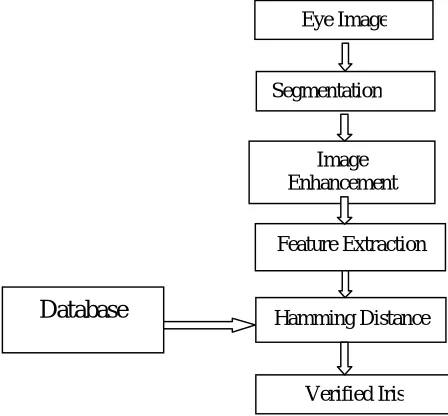
The process of iris recognition made up of iris image capturing, pre-processing, and recognition of iris region in eye image In preprocessing stage, many methods were useded for feature extraction and noise avoidance to extract the iris from the image. under the segmentation process , it may be needed to use certain algorithms whose task is to further image preparation for processing by using feature extraction algorithms. After segmentation has done to avoid occlusion certain portions of the circular iris is discarded. This step is necessary, When we get the non concentric outer and inner circular shapes of the iris, the iris image having the circular shape can now be converted into a image having rectangular shape. after normalizing the iris image the extracted iris image is compared with the image which is stored in the database figure 3.1 shows the Flow chart of the proposed
System, Image input-
First step of proposed system is an Image input in this step eye image is captured for recognition. 1. Iris segmentation
: The step after image input is Segmentation. The process called Segmentation is to isolate the actual iris region from the captured eye. The iris region can be divided into two circles, one for the sclera boundary and another for of the pupil boundary. Specular light reections can occur in the iris region distracting the iris pattern and therefore technique is required to seperate and exclude the artifacts and locating the circular iris region. Region growing segmentation is the direct construction of regions. In the region based segmentation image is divided into similar parts made up pixels through the application of similarity criteria among candidates sets of pixels.the simple region based image segmentation method is Region growing . It is also called as pixel based image segmentation method because it involves the initial seed points selection. This method to segmentation observes the pixels of initial seed points and determines whether the pixel neighbors should be added to the region. firstly, an initial
figure 3.1: Flow Chart of Iris Recognition System Eye Image
Segmentation
Image Enhancement
Feature Extraction
Hamming Distance
Verified Iris
ISSN(Online): 2320-9801
ISSN (Print) : 2320-9798
I
nternational
J
ournal of
I
nnovative
R
esearch in
C
omputer
and
C
ommunication
E
ngineering
(An ISO 3297: 2007 Certified Organization)
Vol. 4, Issue 3, March 2016
set of small areas are iteratively combined according to similarity rules. it chooses an arbitrary seed pixel and then compare that pixels with neighboring pixels. After that, the region is extend from the seed pixel by adding neighboring pixels which are similar, then the size of the region is increases. Whenever the growth of one region stops, then simply chooses another seed pixel which does not yet belong to any region and again start the process. The main advantages of this method is that, It can accurately separate the regions that have the same properties. Also, This method can provide the images which have clear edges with good results of segmentation.
2. Iris Normalization :
The step after sengmentation is called as normalization . The normalization is done to enable the generation of iris code and comparisons of Iris code,there is the need to normalize the segmented iris region because variations in the eye, like position of the pupil in the iris, iris optical size, and the orientation of iris change person to person. It normalises the iris of various sizes to the same size. This is done by unwrapping the iris and by converting it into its polar. The normalization reduces iris distortion which is caused by the pupil and simpliffes processing.
3. Feature Extraction :
This explains the feature extraction that applied to the preprocessed training set images. Features extraction is done for getting a most compact images. this can be done at two levels as, low level and high level feature extraction. The process of iris recognition consists of capturing the iris image, pre-processing it, and recognition of iris region in eye image, many methods were used for feature extraction and noise avoidence to extract the iris from the captured image. In the process of segmentation, it may be needed to use some algorithms whose task is to further prepare the image for processing by the feature extraction algorithms. We use canny edge detection after segmentation for getting inner and outer circle of eye i.e scera and pupil so that we will get accurete distance. For matching, the Hamming distance was chosen for recognition, since bit-wise comparisons is needed. The Hamming distance algorithm is used which incorporates noise masking, so that signiffcant bits are used only in calculating the Hamming distance between two iris pattern. This step involves an algorithm to perform a comparison between the obtained biometric pattern and the stored pattern in the system to determine a match of iris. The output of the comparison is then provide to some application device which Compares the extracted iris image and the image that is stored in the database, we can identify the people after comparison has been done .
REFERENCES
[1] Jigar M. Pandya, Devang Rathod, Jigna J. Jadav,” A Survey of Face Recognition approach”, International Journal of Engineering Research and Applications (IJERA) ISSN: 2248-9622 www.ijera.com Vol. 3, Issue 1, January -February 2013, pp.632-635
[2] Jyoti S. Bedre ,Shubhangi Sapkal, ”Comparative Study of Face Recognition Techniques: A Review”, Emerging Trends in
Computer Science and Information Technology–2012(ETCSIT2012) Proceedings published in International Journal of Computer Applications® (IJCA) 12
[3] A. S. Tolba, A.H. El-Baz, and A.A. El-Harby, ” Face Recognition: A Literature Review”, International Journal of Signal Processing 2:2 2006 [4] Sushma Jaiswal, Dr. (Smt.) Sarita Singh Bhadauria, Dr. Rakesh Singh Jadon,” COMPARISON BETWEEN FACE RECOGNITION ALGORITHM EIGENFACES, FISHERFACES AND ELASTIC BUNCH GRAPH MATCHING”, Volume 2, No.7, July 2011 Journal of Global Research in Computer Science
[5] Ming-Hsuan Yang, David J. Kriegman and NarendraAhuja, “Detecting Faces in Images: A Survey,” IEEE TRANSACTIONS ON PATTERN ANALYSIS AND MACHINE INTELLIGENCE, VOL. 24, NO. 1, JANUARY 2002
[6] KIRBY, M. AND SIROVICH, L. 1990. “Application of the Karhunen-Loeve procedure for the characterization of human faces”. IEEE Trans. Patt. Anal. Mach. Intell. 12
[7] Li X. and Areibi S.,―”A Hardware/Software codesign approach for Face Recognition”, The 16th,International Conference on Microelectronics,Tunisia,2004
[8] Lin-Lin Huang, Akinobu Shimizu, Yoshihiro Hagihara, Hidefumi Kobatake ,”Face detection from cluttered images using a polynomial neural network”, Elsevier Science 2002
[9] U. KreQel, J. SchRurmann, “Pattern classification techniques based on function approximation, in: H.Bunke, P.S.P. Wang (Eds.), Handbook of Character Recognition and Document Image Analysis”, World Scienti5c, Singapore, 1997, pp. 49–78.
[10] Yue Ming, Qiuqi Ruan, Xiaoli Li, Meiru Mu, ” Efficient Kernel Discriminate Spectral Regression for 3D Face Recognition”, Proceedings Of ICSP 2010
[11] Mohammed Javed, Bhaskar Gupta, ”Performance Comparison of Various Face Detection Techniques” ,International Journal of Scientific Research Engineering & Technology (IJSRET) Volume 2 Issue1 pp 019-0027 April 2013 www.ijsret.org ISSN 2278 –0882 IJSRET @ 2013 [12] R. A. Fisher, “The Use of Multiple Measurements in Taxonomic Problems”, 1936.
[13] Belhumeur, V., Hespanda, J., Kiregeman, D., 1997,” Eigenfaces vs. fisherfaces: recognition using class specific linear pojection”, IEEE Trans. on PAMI, V. 19, pp. 711-720
ISSN(Online): 2320-9801
ISSN (Print) : 2320-9798
I
nternational
J
ournal of
I
nnovative
R
esearch in
C
omputer
and
C
ommunication
E
ngineering
(An ISO 3297: 2007 Certified Organization)
Vol. 4, Issue 3, March 2016
[16] K.; Subban, R.; Krishnaveni, K.; Fred, L.; Selvakumar, R.K Nallaperumal, “Human face detection in color images using skin color and template matching models for multimedia on the Web”, Wireless and Optical Communications Networks, 2006 IFIP International Conference on 11-13 April 2006, pp. 5-10
[17] R. Bruneli and T. Poggio, “Face recognition: features versus templates,” IEEE Trans. Pattern Analysis and Machine Intelligence, vol. 15, pp. 1042-1052, 1993.
[18] R.J. Baron, “Mechanism of human facial recognition,” Int'l J. Man Machine Studies, vol. 15, pp. 137-178, 1981.
[19] Muhammad Sharif, Research Journal of Applied Sciences,Engineering and Technology 4(23): 4979-4990, 2012,ISSN: 2040-7467