OPTIMIZATION OF NON-UNIFORM RELATIONAL B-SPLINE SURFACE RECONSTRUCTION USING
GROWING GRID- DIFFERENTIAL EVOLUTION
PRIZA PANDUNATA
OPTIMIZATION OF NON-UNIFORM RELATIONAL B-SPLINE SURFACE RECONSTRUCTION USING
GROWING GRID-DIFFERENTIAL EVOLUTION
PRIZA PANDUNATA
A thesis submitted in fulfillment of the Requirements for the award of the degree of
Master of Science (Computer Science)
Faculty of Computer Science and Information Systems Universiti Teknologi Malaysia
iii
iv
ACKNOWLEDGEMENTS
In preparing this thesis, I was in contact with many people, researchers, and academicians. They have contributed towards my understanding and thoughts. In particular, I wish to express my sincere appreciation to my main thesis supervisor, Prof. Dr. Siti Mariyam bt Shamsuddin, for encouragement, guidance, and critics. I am also indebted to Universiti Teknologi Malaysia (UTM) for funding my study.
v
ABSTRACT
vi
ABSTRAK
vii
TABLE OF CONTENTS
CHAPTER TITLE PAGE
ACKNOWLEDGEMENTS iv
ABSTRACT v
ABSTRAK vi
TABLE OF CONTENTS vii
LIST OF TABLES x
LIST OF FIGURES xii
LIST OF ABBREVIATIONS xv
LIST OF SYMBOLS xvi
LIST OF APPENDICES xvii
1 INTRODUCTION 1
1.1 Introduction 1
1.2 Background of the Study 2
1.3 Problem Statement 6
1.4 Research Aim 7
1.5 Objectives 7
1.6 Research Scope 7
1.7 Thesis Organization 8
2 LITERATURE REVIEW 10
2.1 Overview of Surface Reconstruction 10 2.1.1 Surface Reconstruction Process 11
2.2 Surface Representation 11
2.2.1 Bezier Curve and Surface 12
viii
2.2.2 B-Spline 14
2.2.2.1 B-Spline Equations 14
2.2.3 Non-Uniform Rational B-Spline (NURBS) 16
2.2.3.1 NURBS Equations 17
2.3 Artificial Neural Network for Surface Reconstruction 18 2.3.1 Overview of Kohonen Network 19 2.3.1.1 Kohonen Network Architecture 19 2.3.1.2 Kohonen Network Algorithm 22 2.4 Evolutionary Computation for Surface Reconstruction 25 2.4.1 Overview of Differential Evolution 25 2.4.1.1 Properties of Differential Evolution 28 2.4.1.2 Proper Algorithm of Differential
Evolution 28 2.4.1.3 The Basic Operation of Differential
Evolution 30
2.5 Related Studies 31
2.6 Summary 33
3 METHODOLOGY AND THE PROPOSED METHOD 34
3.1 The Framework of the Study 34
3.1.1 Data Collection 35
3.1.2 Growing Grid Network (GGN) Generation 36 3.1.2.1 Update the Parameter of Growing Grid
Network (GGN) 44
3.1.3 Parameterization and Knot Vector Generation of
Initial Sketch 45
3.1.3.1 Parameterization 46
3.1.3.2 Knot Vector Generation 47 3.1.4 Differential Evolution Algorithm 48
3.1.4.1 Population and Chromosome initialization 50 3.1.4.2 Calculation of fitness value 50 3.1.4.3 Mutation and Selection 51 3.1.5 Performance Analysis and Comparison 53
3.2 Summary 54
4 EXPERIMENTAL RESULTS AND ANALYSIS 55
ix
4.1.1 Data Specifications 56
4.1.2 Parameter Setting of Growing Grid Network
(GGN) 58
4.1.3 Development of the Growing Grid Data Network 58 4.1.4 Implementation of Parameterization and Knot
Vector Generation 59
4.1.5 Parameter Setting of Differential Evolution
Algorithm (DEA) 60
4.1.6 Parameter Setting of PSO 62
4.1.7 Parameter Setting of GA 63
4.2 Performance Assessments 64
4.2.1 Results and Analysis of Curve and Surface using
GGN – DEA 65
4.2.2 Results and Analysis of Curve and Surface using
PSO 68
4.2.3 Results and Analysis of Curve and Surface using
(GA) 69
4.3 Results Comparison 71
4.4 Experimental Results of Mathematical Function using
Evolutionary Computing 73
4.4.1 Experimental Results for Mathematical
Functions 77
4.5 Summary 79
5 CONCLUSIONS AND FUTURE WORK 80
5.1 Research Achievements 80
5.2 Research Contributions 81
5.3 Future Works 82
REFERENCES 83
x
LIST OF TABLES
TABLE NO. TITLE PAGE
1.1 Previous Related Study on Surface Reconstruction 5 2.1 Comparation of PSO, GA, and DE (Wdaa 2008) 26
3.1 Sample Data for Semi-sphere 36
4.1 Data Specifications 56
4.2 Parameter settings of Growing Grid Network (GGN) 58
4.3 Parameter Value of Mask Data Points 60
4.3 Parameter Settings of DEA 61
4.4 Parameter settings of PSO 62
4.5 Parameter settings of GA 64
4.6 Average error of GGN-DEA for 2D data (curve) 65 4.7 Average error of GGN-DEA for 3D data (surface) 66 4.8 Average error of GGN-PSO for 2D data (curve) 68 4.9 Average error of GGN-PSO for 3D data (surface) 69 4.10 Average error of GGN-GA for 2D data (curve) 70 4.11 Average error of GGN-GA for 3D data (surface) 70 4.12 Average Error between DEA, PSO, and GA for Curve Data 71 4.13 Average Error between DEA, PSO, and GA for Surface Data 72
4.14 Results for Mathematical Functions 77
A.1 Sine Data 89
A.2 Trochoid Data 90
A.3 Spiral Data 91
A.4 Free form curve data 92
A.5 Sample of Mask data 95
xi
A.7 Sample of Saddle data 97
A.8 Sample of Sphere Data 98
A.9 Sample of Buddha statue data 99
A.10 Sample of Free-form surface data 100
B.1 Average error of GGN-DEA for 2D data (curve) 104 B.2 Average error of GGN-DEA for 3D data (surface) 104 B.3 Average error of GGN-PSO for 2D data (curve) 110 B.4 Average error of GGN-PSO for 3D data (surface) 110 B.5 Average error of GGN-GA for 2D data (curve) 116 B.6 Average error of GGN-GA for 3D data (surface) 116 B.7 Comparison of Average Error between DEA, PSO, and GA for
Curve Data 125
B.8 Comparison of Average Error between DEA, PSO, and GA for
xii
LIST OF FIGURES
FIGURE NO TITLE PAGE
2.1 Kohonen SOM Architecture 20
2.2 Mapping Structure of Kohonen SOM 21
2.3 Mapping Dimension of Kohonen SOM 21
2.4 Lattice Structure of Kohonen SOM 22
2.5 Gaussian Graph Function 24
2.6 Basic pseudo-code for the DE algorithm. 28
2.7 Flowchart of DE algorithm 29
3.1 Framework of the study 35
3.2 Construction of initial sketch using GGN 37
3.3 Neurons Initialization 38
3.4 Initialization Position of Neurons 38
3.5 Initialization Weights for each sample point 39
3.6 Win counter value for each neuron 39
3.7 Sample Points Ps 39
3.8 Winning Neuron 40
3.9 Boundary Neuron 40
3.10 Boundary Neuron Detected 41
3.11 Boundary Neuron Not Detected 41
3.12 Update Position If Boundary Neuron Not Detected 41 3.13 Update Position If Boundary Neuron Detected 42
3.14 Maximum winning counter detected 42
3.15 Node Addition to Column 43
3.16 Node Addition to Row 43
xiii
3.18 The architecture of population of DE 50 3.19 The Mutation, Recombination, and Selection process of DE 53
4.1 Spiral data 57
4.2 Unstructured Mask 57
4.3 Structured Mask 59
4.4 Generated Spiral Curve using DEA 67
4.5 Generated Semi Sphere Surface using DEA 67
A.1 Sine data 93
A.2 Trochoid data 93
A.3 Spiral data 94
A.4 Free form curve data 94
A.5 Mask data 101
A.6 Ship Hull data 101
A.7 Saddle data 102
A.8 Sphere data 102
A.9 Buddha Statue data 103
A.10 Free Form Surface data 103
B.1 Sine curve, generated by DEA 105
B.2 Trochoid curve, generated by DEA 105
B.3 Spiral curve, generated by DEA 106
B.4 Free form curve, generated by DEA 106
B.5 Sphere in wireframe view, generated by DEA 107 B.6 Ship in wireframe view, generated by DEA 107 B.7 Mask in wireframe view, generated by DEA 108 B.8 Saddle in wireframe view, generated by DEA 108 B.9 Free Form in wireframe view, generated by DEA 109 B.10 Buddha statue in wireframe view, generated by DEA 109
B.11 Sine curve, generated by PSO 111
B.12 Trochoid curve, generated by PSO 111
B.13 Spiral curve, generated by PSO 112
B.14 Free form curve, generated by PSO 112
xiv
B.18 Saddle in wireframe view, generated by PSO 114 B.19 Free Form in wireframe view, generated by PSO 115 B.20 Buddha statue in wireframe view, generated by PSO 115
B.21 Sine curve, generated by GA 117
B.22 Trochoid curve, generated by GA 117
B.23 Spiral curve, generated by GA 118
B.24 Free form curve, generated by GA 118
B.25 Sphere in wireframe view, generated by GA 119 B.26 Ship in wireframe view, generated by GA 119 B.27 Mask in wireframe view, generated by GA 120 B.28 Saddle in wireframe view, generated by GA 120 B.29 Free Form in wireframe view, generated by GA 121
xv
LIST OF ABBREVIATIONS
ABBREVATION DESCRIPTION
2D (x, y)-Two dimensional plane
3D (x, y, z)-Three dimensional plane
CAD Computer Aided Design
CAM Computer Aided Manufacturing CAGD Computer Aided Geometric Design
DE Differential Evolution
GA Genetic Algorithm
GGN Growing Grid Network
NFL No Free Lunch
xvi
LIST OF SYMBOLS
SYMBOLS DESCRIPTION
Bk,n(t) - basis function for Bezier curve at parameter t. Ni,k(t) - B-Spline basis function at parameter t and kth
xvii
LIST OF APPENDICES
APPENDIX TITLE PAGE
A ORIGINAL DATA 89
B RESULTS OF THE OPTIMIZATION 104
C PUBLICATIONS 127
CHAPTER 1
INTRODUCTION
1.1 Introduction
Computer graphics is fast growing field due to its significant contributions to the advancement of modern technology for human and nation wealth creation. One of the major areas in computer graphics is surface reconstruction since it is widely used in industries to design the products. Computer-Aided Design (CAD), Computer-Aided Manufacturing (CAM) and Computer-Aided Geometric Design (CAGD) are commonly used in reconstructing the surfaces to obtain a set of geometric sample values (in most cases, points) which is normally limited and unorganized. Conventionally, mathematical description represents a shape of physical surface accurately and concisely. Surface reconstruction and surface representation has also an important part in the design problems such as construction of scanned 3D objects, modeling of car bodies, medical imaging and other free-form objects.
2
the parametric surface in which to obtain suitable parameterizations of data points are crucial.
Some scientists to overcome the problems of surface reconstruction from unstructured data have used variety of methods. Some of these methods used multi-quadratic functions (Franke, Hagen et al. 1994), range images (Curless 1997), discrete fairing and variation subdivision (Kobbelt 2000), dynamic base surfaces (Azariadis 2004), approximations of the unsigned distance function (Flöry and Hofer 2010), and Artificial Intelligence (AI).
Recent literatures have shown that the usage of AI in surface reconstruction can produce good results (Hoppe, DeRose et al. 1992; Ivrissimtzis, Jeong et al. 2003; Junior, Neto et al. 2004; Gálvez, Cobo et al. 2008; Tsai, Huang et al. 2009; Mendona Ernesto Rego, Araujo et al. 2010).The common AI methods in surface reconstruction include Artificial Neural Network (ANN), Kohonen Self Organizing Map (SOM), and Genetic Algorithm (GA).
1.2 Background of the Study
Surface reconstruction is view from two perspectives: mathematical aspects and Artificial Intelligence (AI). Some recent studies have shown that some AI application shave achieved remarkable results (Ivrissimtzis, Jeong et al. 2003; Junior, Neto et al. 2004; Gálvez, Cobo et al. 2008). The input data obtained from the object can be represented into two types: image mesh, and the 3D point from the scanned image with have noise and scattered. These types of data, however, yield an enormous amount of irregular and scattered digitized point that requires intensive reconstruction processing.
3
mapping from the surface to a suitable domain. In other words, surface approximation is a procedure of determining a control polygon that generates a curve or surface from a set of known data points using a set of parameter obtained from the parameterization procedure.
Previous related studies used data points, which are noisy and scattered. However, the issue arises on how to re-arrange the scattered point data to be organized, and to deal with the algorithm’s complexity as well as processing time.
(Barhak and Fischer 2001) use Self Organizing Map (SOM) for creating a 3D parametric grid. The main advantage of SOM relies on both the orientation of the grid and the position of the sub-boundaries. The neural network grid converges to the sampled shape through an adaptive learning process. However, some enhancements need to be done to create a complete envelope of a volumetric object and accuracy.
(Jalba and Roerdink 2007) have done some studies on deploying a fast convection algorithm to attract the evolving surface towards the data points. However, this method has limitation, that is, surface features are smaller than the size of the smallest grid cells; hence the reconstruction is not accurate enough.
(Gálvez, Iglesias et al. 2007)used GA to reconstruct the surface, and functional networks for the functional constraints problems. These methods are integrated with the least-squares approximation to yield suitable methods for surface fitting. However, this approach still faces the difficulty to attain global optimum due to the variation of distance error function for fitting data for different models.
4
(Kazhdan, Bolitho et al. 2006) has presented surface reconstruction problem as Poisson problem that allows a hierarchy of locally supported basis functions. The solution has reduced to well-conditioned sparse linear system. However, there are some limitations on this approach due to the weaknesses in handling huge data sets.
(Shamsuddin and Ahmed 2006) proposed hybrid parameterization to solve parameterization of data points on the surfaces. The method takes into consideration the maximum rational B-spline basis functions as the initial values. The centripetal method generates the parameter values of hybrid parameterization. However, some improvements are required to refine the reconstructed object to be fairer and smoother.
(Forkan and Shamsuddin 2008) proposed a method for surface reconstruction based on the hybridization of Kohonen Network and Particle Swarm Optimization (PSO). In this study, PSO probes the best control points for the data with B-Spline as surface representation. However, B-Spline surface representation is still incapable to represent accurately most of the analytically defined shape and conic sections such as Circle, Ellipse, and Hyperbola.
(Gálvez and Iglesias) in 2010 has presented recovery of a surface using PSO from scattered noisy data points. The process consists of two main phases: parameterization and surface fitting. The result is good in terms of accuracy. However, the computational time and complexity need to be reduced.
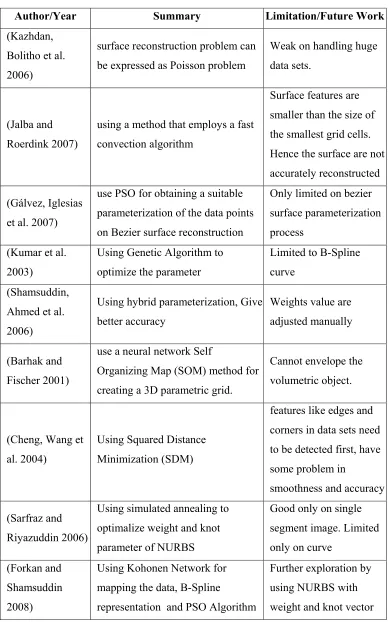
Table 1.1 shows the summary of recent study in the field of surface reconstruction
5
Table 1.1: Previous Related Study on Surface Reconstruction
Author/Year Summary Limitation/Future Work
(Kazhdan, Bolitho et al. 2006)
surface reconstruction problem can be expressed as Poisson problem
Weak on handling huge data sets.
(Jalba and Roerdink 2007)
using a method that employs a fast convection algorithm
Surface features are smaller than the size of the smallest grid cells. Hence the surface are not accurately reconstructed (Gálvez, Iglesias
et al. 2007)
use PSO for obtaining a suitable parameterization of the data points on Bezier surface reconstruction
Only limited on bezier surface parameterization process
(Kumar et al. 2003)
Using Genetic Algorithm to optimize the parameter
Limited to B-Spline curve
(Shamsuddin, Ahmed et al. 2006)
Using hybrid parameterization, Give better accuracy
Weights value are adjusted manually
(Barhak and Fischer 2001)
use a neural network Self
Organizing Map (SOM) method for creating a 3D parametric grid.
Cannot envelope the volumetric object.
(Cheng, Wang et al. 2004)
Using Squared Distance Minimization (SDM)
features like edges and corners in data sets need to be detected first, have some problem in
smoothness and accuracy (Sarfraz and
Riyazuddin 2006)
Using simulated annealing to optimalize weight and knot parameter of NURBS
Good only on single segment image. Limited only on curve
(Forkan and Shamsuddin 2008)
Using Kohonen Network for mapping the data, B-Spline
representation and PSO Algorithm
6
for surface fitting optimization
(Delint Ira Setyo 2010)
Solve NURBS curve approximation problem by using Particle Swarm Optimization (PSO).
Limited only on 2D data
(Gálvez and Iglesias 2010)
Using PSO for parameterization and surface fitting
The results show the algorithm can reconstruct the surface accurately, but the complexity and computation time is still need to be reduced
Based on the above issues, a comprehensive study needs to be conducted to produce an algorithm that can utilize the application of AI for surface reconstruction process. This hybridization could benefit the manufacturing and industry sectors.
1.3 Problem Statement
As mentioned previously, to solve the issues on surface reconstruction from unstructured data points, these data need to be organized. The procedure involves by obtaining suitable parameterization of data points and control point that can approximate the original surfaces. Hence, the research questions for this study include:
1. What is Growing Grid Network (GGN), and how to deal with NURBS surface reconstruction?
2. How GGN organize the unstructured data in NURBS surface reconstruction? 3. How Differential Evolution Algorithm (DEA) being implemented in
optimizing the NURBS surface?
7
1.4 Research Aim
The aim of the study is to optimize NURBS surface reconstruction from unstructured 3D data points with feasible control points while preserving the shape of the objects using Evolutionary Algorithms.
1.5 Objectives
The main objectives of this research are as follows:
1. To develop NURBS surface reconstruction from unstructured data points using growing grid network (GGN).
2. To propose and develop Differential Evolution Algorithm (DEA) to optimize NURBS surface reconstruction
3. To validate and compare the proposed algorithm with the existing related methods
1.6 Research Scope
The scope of this study includes:
1. Technique to be used:
a. The growing grid technique adopted from (Forkan and Shamsuddin 2008)are used to obtain the initial surface
8
c. Time consumption is not considered, more focus on the aspects of accuracy. And we also we focus on parametric approach, not on the typical graphic methods, i.e., non-parametric approach. Which is the common issue in non-parametric, such as triangulation, is difficulties in dealing with sharp corner (T-Junction).
2. Datasets
a. Datasets in this study are open surface which noise level is minimal and unorganized. Examples of 2D and 3D data are sine, spiral, semi-sphere, ships and free-form shapes.
3. Tools and environment to be used include: a. Java Programming Language
b. Graphics API and library, OpenGL and GLUT
c. For rendering purpose, OpenGL API GLUT library will be used. 4. Experiment will be run on PC with specifications:
a. Operating System: Windows 7 Professional b. Processor: 2GHz CPU
c. Memory: 2048MB RAM
1.7 Thesis Organization
Thesis structure is given as follows:
9
Chapter 2: Literature review - This chapter states some existing methods of surface reconstruction. It also contains the review of the related previous works for solving surface reconstruction and approximation methods.
Chapter 3: Methodology and The Proposed Method- This chapter describes the system overview and the framework of proposed methods. It explains the details of every steps of growing grid, include the process of generating initial surface using growing grid map and differential evolution in optimizing and approximating NURBS surface reconstruction.
Chapter 4: Experimental Results and Analysis - This chapter presents the findings of the study, analysis of the results and the comparisons with other works.
83
REFERENCES
Azariadis, P. N. (2004). "Parameterization of clouds of unorganized points using dynamic base surfaces." Computer-Aided Design 36(7): 607-623.
Barhak, J. and A. Fischer (2001). "Parameterization and reconstruction from 3D scattered points based on neural network and PDE techniques." Visualization and Computer Graphics, IEEE Transactions on 7(1): 1-16.
Boudjemai, F., P. B. Enberg, et al. (2003). Surface modeling by using self organizing maps of Kohonen. Systems, Man and Cybernetics, 2003. IEEE International Conference on.
Brunnstrom, K. and A. J. Stoddart (1996). Genetic algorithms for free-form surface matching. Pattern Recognition, 1996., Proceedings of the 13th International Conference on.
Chakraborti, N. (2008) "Differential Evolution: The Real parameter Genetic Algorithm applied to Materials and Metallurgy."
Cheng, K.-S. D., W. Wang, et al. (2004). Fitting Subdivision Surfaces to Unorganized Point Data Using SDM. Proceedings of the Computer Graphics and Applications, 12th Pacific Conference, IEEE Computer Society: 16-24.
Curless, B. L. (1997). New Methods for Surface Reconstruction from Range Images, Stanford University.
Das, S. and P. N. Suganthan (2011). "Differential Evolution: A Survey of the State-of-the-Art." Evolutionary Computation, IEEE Transactions on 15(1): 4-31.
Davoud Sedighizadeh, E. M. (2009). "Particle Swarm Optimization Methods, Taxonomy and Applications." International Journal of Computer Theory and Engineering 1(5): 486-502.
84
Echevarra, G., A. Iglesias, et al. (2002). Extending Neural Networks for B-Spline Surface Reconstruction. Proceedings of the International Conference on Computational Science-Part II, Springer-Verlag.
Flöry, S. and M. Hofer (2010). "Surface fitting and registration of point clouds using approximations of the unsigned distance function." Computer Aided Geometric Design 27(1): 60-77.
Fnaiech, F., S. Abid, et al. (2002). A comparative study of fast neural network learning algorithms. Systems, Man and Cybernetics, 2002 IEEE International Conference on.
Forkan, F. B. and S. M. H. Shamsuddin (2008). Kohonen-Swarm Algorithm for Unstructured Data in Surface Reconstruction. Proceedings of the 2008 Fifth International Conference on Computer Graphics, Imaging and Visualisation - Volume 00, IEEE Computer Society.
Franke, R., H. Hagen, et al. (1994). "Least squares surface approximation to scattered data using multiquadratic functions." Advances in Computational Mathematics 2(1): 81-99.
Fritzke, B. (1995). "Growing Grid — a self-organizing network with constant neighborhood range and adaptation strength." Neural Processing Letters 2(5): 9-13.
Gálvez, A., A. Cobo, et al. (2008). Particle Swarm Optimization for Bézier Surface Reconstruction. Computational Science – ICCS 2008: 116-125.
Gálvez, A. and A. Iglesias (2010). "Particle swarm optimization for non-uniform rational B-spline surface reconstruction from clouds of 3D data points." Information Sciences.
Gálvez, A., A. Iglesias, et al. (2007). Bézier Curve and Surface Fitting of 3D Point Clouds Through Genetic Algorithms, Functional Networks and Least-Squares Approximation. Computational Science and Its Applications – ICCSA 2007: 680-693.
Gu, P. and X. Yan (1995). "Neural network approach to the reconstruction of freeform surfaces for reverse engineering." Computer-Aided Design 27(1): 59-64.
85
Ilonen, J., J.-K. Kamarainen, et al. (2003). "Differential Evolution Training Algorithm for Feed-Forward Neural Networks." Neural Process. Lett. 17: 93-105.
Ismail Wdaa, A. S. (2008). Differential evolution for neural networks learning enhancement. Faculty of Computer Science and Information System, Universiti Teknologi Malaysia: 114.
Ivrissimtzis, I. P., W.-K. Jeong, et al. (2003). Using Growing Cell Structures for Surface Reconstruction. Proceedings of the Shape Modeling International 2003, IEEE Computer Society.
Jalba, A. C. and J. B. T. Roerdink (2007). "Efficient Surface Reconstruction using Generalized Coulomb Potentials." Visualization and Computer Graphics, IEEE Transactions on 13(6): 1512-1519.
Junior, A. M. B., A. D. D. Neto, et al. (2004). Surface reconstruction using neural networks and adaptive geometry meshes. Neural Networks, 2004. Proceedings. 2004 IEEE International Joint Conference on.
Kazhdan, M., M. Bolitho, et al. (2006). Poisson surface reconstruction. Proceedings of the fourth Eurographics symposium on Geometry processing. Cagliari, Sardinia, Italy, Eurographics Association: 61-70.
Kennedy, J. and R. Eberhart (2002). Particle swarm optimization. Neural Networks, 1995. Proceedings., IEEE International Conference on, Perth, WA, Australia.
Kobbelt, L. P. (2000). "Discrete fairing and variational subdivision for freeform surface design." The Visual Computer 16(3): 142-158.
Kohonen, T. (1998). "The self-organizing map." Neurocomputing 21(1-3): 1-6.
Kumar, G. S., P. K. Kalra, et al. (2003). Parameter optimization for B-spline curve fitting using genetic algorithms. Evolutionary Computation, 2003. CEC '03. The 2003 Congress on.
Mallipeddi, R. and P. N. Suganthan (2008). Empirical study on the effect of population size on Differential evolution Algorithm. Evolutionary Computation, 2008. CEC 2008. (IEEE World Congress on Computational Intelligence). IEEE Congress on. Manoj Kumar, M. H., Naveen Upreti, Deepti Gupta (2010). "GENETIC ALGORITHM:
REVIEW AND APPLICATION." International Journal of Information Technology and Knowledge Management 2(2): 451-454.
86
Mendona Ernesto Rego, R. L., A. F. R. Araujo, et al. (2010). "Growing Self-Reconstruction Maps." Neural Networks, IEEE Transactions on 21(2): 211-223. Middleton, L. and J. Sivaswamy (2005). Hexagonal Image Processing : A Practical
Approach, Springer-Verlag UK.
Müller, H. (1999). Surface Reconstruction - An Introduction. Dagstuhl '97, Scientific Visualization, IEEE Computer Society: 239-242.
Onur Boyabatli, I. S. (2007). "Parameter Selection in Genetic Algorithms." System, Cybernatics & Informatics 2(4): 78-83.
Piegl, L. and W. Tiller (1997). The Nurbs Book, Springer.
Price, K. V., R. M. Storn, et al. (2005). The Differential Evolution Algorithm. Differential Evolution, Springer Berlin Heidelberg: 37-134.
Riesenfeld, R. F. (1975). Aspects of modelling in computer aided geometric design. Proceedings of the May 19-22, 1975, national computer conference and exposition, ACM.
Rogers, D. F. (2001). An introduction to NURBS: with historical perspective, Morgan Kaufmann Publishers Inc.
Sarfraz, M. and M. Riyazuddin (2006). Curve Fitting with NURBS using Simulated Annealing. Applied Soft Computing Technologies: The Challenge of Complexity. A. Abraham, B. de Baets, M. Köppen and B. Nickolay, Springer Berlin / Heidelberg. 34: 99-112.
Shamsuddin, S., M. Ahmed, et al. (2006). "NURBS skinning surface for ship hull design based on new parameterization method." The International Journal of Advanced Manufacturing Technology 28(9): 936-941.
Shi, Y. and R. C. Eberhart (1998). Parameter Selection in Particle Swarm Optimization. Proceedings of the 7th International Conference on Evolutionary Programming VII, Springer-Verlag: 591-600.
Söderkvist, I. (1999). "Introductory Overview of Surface Reconstruction Methods,” Lulea." University of Technology, Dept.
Storn, R. and K. Price (1997). "Differential Evolution – A Simple and Efficient Heuristic for global Optimization over Continuous Spaces." Journal of Global Optimization 11(4): 341-359-359.
87
Tsai, Y.-C., C.-Y. Huang, et al. (2009). "Development of automatic surface reconstruction technique in reverse engineering." The International Journal of Advanced Manufacturing Technology 42(1): 152-167.